A careful reading of the Roman, Jewish and earliest Christian witnesses to Jesus of Nazareth, what they establish, and what they leave you to decide.
Abstract
Did Jesus of Nazareth really live, and what can a historian know about Him without first assuming the Bible is true? This paper reads the ancient witnesses for themselves, in their own words and with their standard references. The Roman writers Tacitus, Pliny the Younger, Suetonius and Lucian; the Jewish historian Josephus and the later rabbinic tradition; the Syriac letter of Mara bar Serapion; and the earliest Christian sources, above all the creed Paul quotes in 1 Corinthians 15 and his own meetings with Peter and James. It sets these beside the archaeology of Pilate, Caiaphas and Roman crucifixion, weighs the "Jesus never existed" theory against them, and reports honestly what scholars of every persuasion grant, including the agnostic Bart Ehrman. The conclusion is that Jesus' life and crucifixion under Pontius Pilate are as secure as anything in ancient history, and that the real question the sources press on us is the one His first followers staked their lives on. It is written for honest skeptics and for believers who want to answer them.
What’s inside
·Introduction
Part 1Part 1: How Historians Weigh Ancient Evidence
Part 2Part 2: The Roman Witnesses
Part 3Part 3: The Jewish Witnesses
Part 4Part 4: The Earliest Christian Witnesses
Part 5Part 5: The Ground Under Their Feet: Archaeology
Part 6Part 6: Why the "Jesus Never Existed" Theory Fails
Part 7Part 7: What History Can Establish, and What It Asks of You
·Conclusion
Research paper · 9 chapters · 45 notes · October 2026
About 45 minutes · 9 parts · the PDF has the same text
Introduction
2 min read
Somewhere on the internet today, someone is being told that Jesus never existed. The claim usually comes with confidence and a meme: no Roman records, no eyewitnesses, a story copied from older gods. If you have heard it and wondered whether it is true, this paper is for you.
The question deserves a straight answer, because everything else hangs on it. Christianity is not a set of timeless ideas that would survive if their founder turned out to be fictional. It is a claim about events: that a particular Jewish man was born under Augustus, taught in Galilee, was crucified in Jerusalem when Pontius Pilate governed Judaea, and rose from the dead. The apostle Paul put it bluntly: "And if Christ be not raised, your faith is vain; ye are yet in your sins" (1 Corinthians 15:17). A faith that stakes itself on history invites historical questions. So let us ask them.
What this paper does
This is a study, not a sermon. It reads the ancient sources that mention Jesus, quoting them in standard English translations and giving the reference so you can check every line for yourself. It begins with the witnesses who had no reason to help the Christians: Roman officials and historians who despised the movement, and a Jewish historian who did not believe Jesus was the Messiah. It then turns to the earliest Christian sources, judged not as Scripture (that is a separate question) but as ancient documents, the way a historian would read them. It looks at what archaeology has added. It weighs the theory that Jesus never lived. And it ends by asking what all this evidence can and cannot do.
Two cautions run through the whole paper. First, no overclaiming. Some popular defences of Christianity quote sources that do not say what they are made to say, or treat a disputed passage as settled. That does the truth no favours. Where a source is uncertain, this paper says so. Second, no underclaiming either. The evidence for Jesus is better than many people assume, and an honest skeptic should hear it at full strength.
A word about me
I was raised Roman Catholic but never really connected — I went through the motions, fell asleep in the pews, and faked being sick to skip Mass. Eventually I gave up and called myself an atheist. I decided to read the Bible for one reason: to disprove it, so I'd have an excuse to stop going to church for good. It did the opposite. I came to faith in 2022, and my wife came to faith a month later. The rest of my story is at kylelauriano.com/about. I mention it so you know where I stand.
A note on Scripture: every Bible verse in this paper is quoted from the King James Bible. You can read it free, in the 1611 edition, in the 1611 Reader at kylelauriano.com/library. Where the King James and modern editions of the Greek text part ways, the 1611 stands in this paper, and you can see every such place for yourself at kylelauriano.com/library/changes.
Before we read a single source, it helps to know what we should expect to find. Many people approach Jesus with a standard of evidence they would never apply to anyone else from the ancient world, and then conclude that the evidence fails. This part matters because the right question is not "Is there a birth certificate?" but "What kind of evidence survives for anyone from first-century Galilee, and how does Jesus compare?"
What survives from the ancient world
Almost everything written in antiquity is lost. Libraries burned, papyrus rotted, and books that no one copied disappeared. What we have is what later generations thought worth preserving, often in copies made centuries after the originals. This is true of every ancient author. Tacitus' Annals, our best Roman source for the reign of Tiberius, survives in a small number of medieval manuscripts, and whole books of it are missing.
Nor did ancient historians write about the people we would most like to know about. They wrote about emperors, generals, senators and wars. A Jewish preacher from a village in Galilee, executed as a troublemaker on the edge of the empire, was exactly the kind of person Roman historians ignored. Pontius Pilate himself, the governor who sentenced Jesus, is mentioned by only a handful of ancient writers, and until 1961 there was not a single inscription bearing his name (we will come to that stone in Part 5).
So the fair expectation is not that Roman archives will be full of reports about Jesus. It is that He will appear, if at all, in passing, in sources written by people who were interested in something else, and above all in the writings of the movement He started.
The tools historians use
Historians of the ancient world weigh sources by a set of common-sense questions. The ones that matter most for this paper are these:
How early is the source? The closer a source is to the events, the less time for legend to grow. A report written within living memory of the events, when eyewitnesses or their friends could still be asked, carries more weight than one written centuries later.
Is it independent? Two sources that copy each other count as one. Several sources that arrive at the same fact by different routes count for more.
Is the source friendly or hostile? A witness who has every reason to deny a fact, and admits it anyway, is especially valuable. When an enemy concedes a point, historians listen.
Does it include embarrassing details? A movement does not usually invent facts that make its own leader look bad. If a story survives that its tellers would rather not have told, it was probably too well known to drop.
Does it fit what we know of the time and place? Details that match the geography, customs, officials and politics of the period, as known from other sources, count in a source's favour.
These are not Christian rules invented to protect the Bible. They are the ordinary tools of the trade, and scholars who reject Christianity use them as readily as those who accept it.
"Christian sources don't count"
One objection needs to be met at the start. Some say that the New Testament cannot be used as evidence for Jesus because it was written by believers. But no historian works this way. Biased sources are the normal condition of ancient history. Our accounts of Alexander the Great were written by admirers; our accounts of the emperors by senators who hated them. The historian's job is not to throw such sources away but to read them critically.
The agnostic New Testament scholar Bart Ehrman, who does not believe in the resurrection, made exactly this point in defending the historicity of Jesus in 2012. The question, he wrote, is not whether a source is biased "but whether biased sources can be used to yield historically reliable information, once their biased chaff is separated from the historical kernel." And historians, he added, "have devised ways of doing just that."1
So this paper will read the Christian sources too. But it begins with the others, because they are the ones the skeptic is most likely to ask about, and because they have no motive at all to help the Christian case.
Roman writers did not care about Jesus. They cared about order, and Christians were a problem for order. That is precisely what makes their testimony valuable: it comes from men who looked down on the movement and had no interest in flattering its founder. This part reads the four most important Roman and Greek witnesses, and two others that are often quoted but need more care.
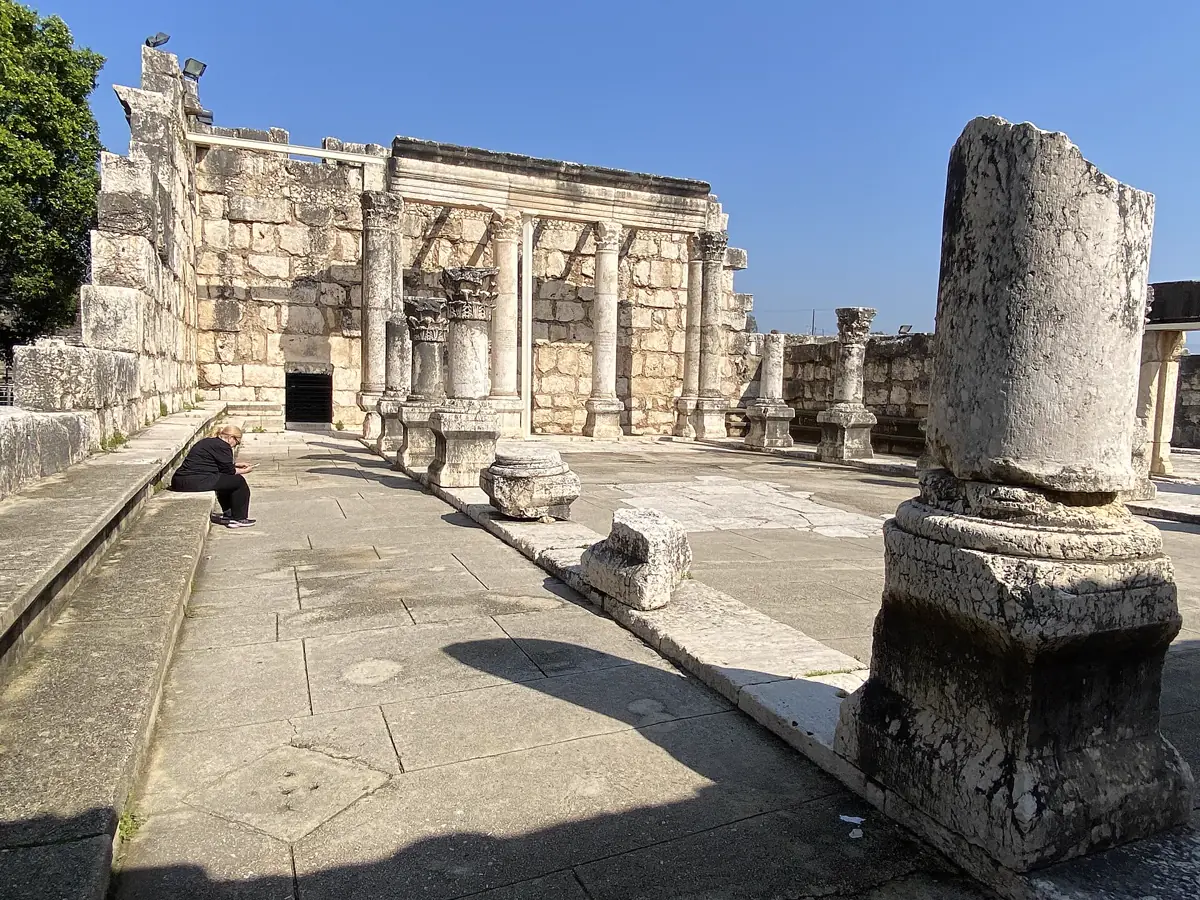
The synagogue at Capernaum, standing on the black-basalt foundations of the 1st-century hall where Jesus taught.שלמה רודד · CC BY 2.5
Tacitus: "Christus ... suffered the extreme penalty"
Cornelius Tacitus (c. AD 56 – c. 120) was a Roman senator, consul in AD 97, and later governor of the province of Asia. He is generally reckoned the greatest of the Roman historians. His last work, the Annals, covered the emperors from Tiberius to Nero and was written around AD 116.
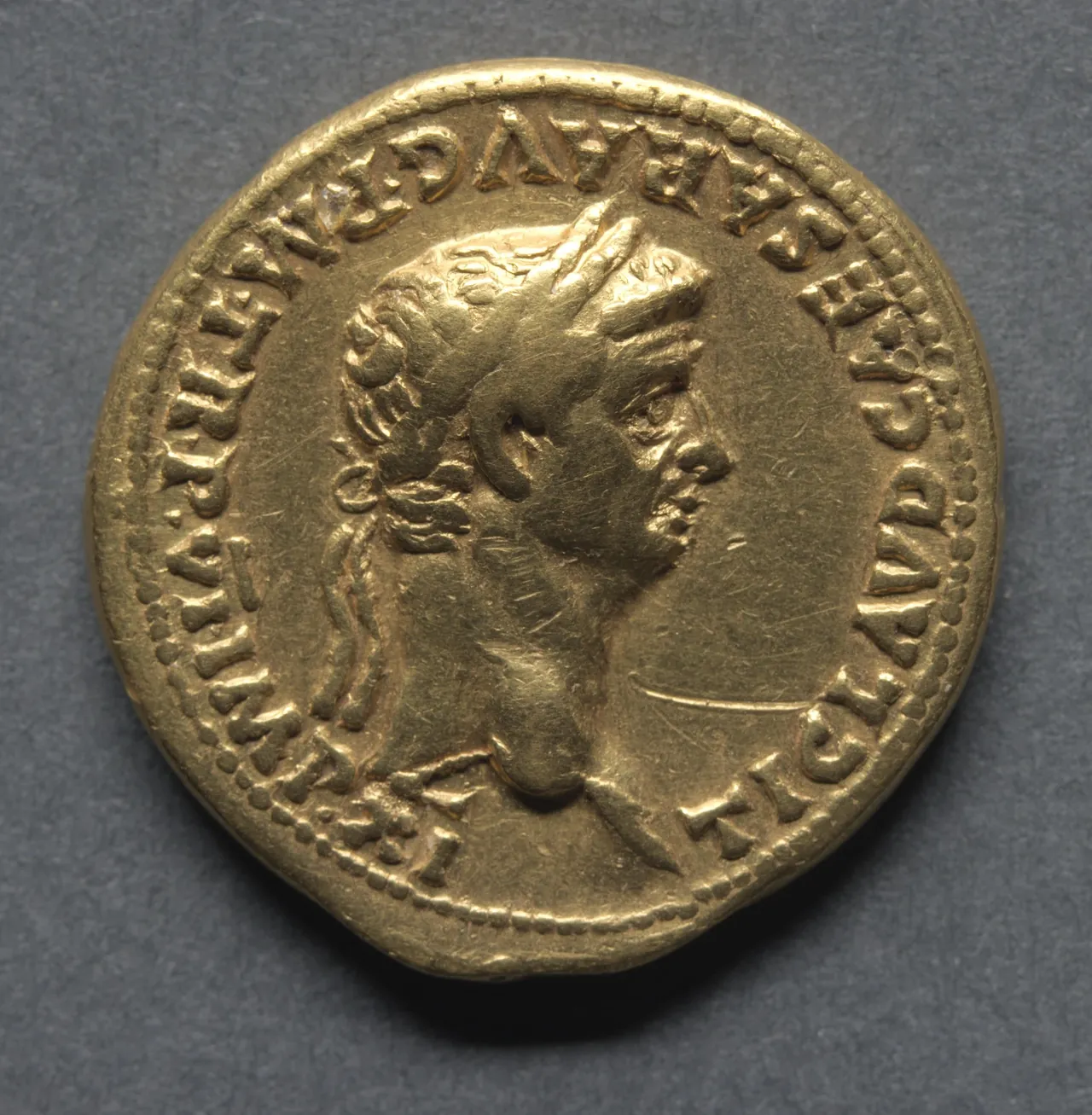
A gold aureus struck in 47 or 48 CE with the bust of the emperor Claudius I, whose reign Suetonius records in his Life of Claudius.Aureus: Bust of Claudius I (obverse) · 47–48 CE · Cleveland Museum of Art · CC0 · museum record · Galeria Regni
In Book 15 he describes the great fire of Rome in AD 64 and the rumour that Nero himself had ordered it. To kill the rumour, Tacitus says, Nero found scapegoats:
"Consequently, to get rid of the report, Nero fastened the guilt and inflicted the most exquisite tortures on a class hated for their abominations, called Christians by the populace. Christus, from whom the name had its origin, suffered the extreme penalty during the reign of Tiberius at the hands of one of our procurators, Pontius Pilatus, and a most mischievous superstition, thus checked for the moment, again broke out not only in Judaea, the first source of the evil, but even in Rome, where all things hideous and shameful from every part of the world find their centre and become popular."2
He goes on to describe what happened to them: some were "covered with the skins of beasts" and "torn by dogs", some "nailed to crosses", some burned "to serve as a nightly illumination, when daylight had expired". Even Romans, he says, began to feel pity, because it seemed the Christians were being destroyed not "for the public good, but to glut one man's cruelty."3
Notice what this hostile witness confirms. There was a man called Christus. The movement was named after Him. He was executed, and the "extreme penalty" for a non-citizen provincial meant crucifixion. It happened under Tiberius (emperor AD 14–37), at the hands of Pontius Pilate. The movement began in Judaea, was "checked for the moment" by His death, then broke out again and reached Rome itself, where by AD 64 there was a sizeable community, large enough to be blamed for a disaster. Every one of these points matches the Gospels and Acts. Compare Luke's own dating of the start of the ministry: "Now in the fifteenth year of the reign of Tiberius Caesar, Pontius Pilate being governor of Judaea" (Luke 3:1).
Is the passage genuine, and where did Tacitus get it?
The passage is found in all manuscripts of this part of the Annals, and its tone is unmistakably that of Tacitus: no Christian would have called his own faith "a most mischievous superstition" or a source of "evil". Scholars of every stripe accept it as authentic.
Where did Tacitus get his information? He does not say. Some suggest he simply repeated what Christians in Rome said about themselves. But Tacitus was a careful senator who had held high office, and the librarian and historian Lawrence Mykytiuk, surveying the question for Biblical Archaeology Review, judges that through his offices, including a Roman priesthood that supervised foreign cults, he likely had access to some official records, and he calls the claim that Tacitus relied only on Christians an assumption based on opinion, not evidence.4 Either way, the most important fact remains: a leading Roman historian, writing for Romans, treated the execution of Christus under Pilate as a plain matter of record.
One small puzzle is worth mentioning because skeptics sometimes raise it. Tacitus calls Pilate a "procurator", while the inscription found at Caesarea (Part 5) calls him "prefect". The title of Judaea's governors changed from prefect to procurator after AD 41, and Tacitus seems to have used the title current in his own day. It is the kind of small anachronism historians find in every ancient writer, and it does nothing to weaken the core report.
Pliny the Younger: "a form of prayer to Christ, as to a divinity"
Pliny the Younger (c. AD 61 – c. 113) was a Roman lawyer and senator and a friend of Tacitus. Around AD 110–112 the emperor Trajan sent him to govern Bithynia and Pontus, on the southern coast of the Black Sea in what is now northern Turkey. From there he wrote a stream of letters to the emperor asking for advice, and Trajan's replies survive with them. The tenth book of his letters is one of the most vivid windows we have into how a Roman province was run.
In letter 96 he asks what to do about the Christians. He has never been present at their trials, he says, and does not know whether to punish the name itself or only crimes attached to it. His method so far has been simple: he asks the accused three times whether they are Christians, and if they persist, he has them executed. Then he reports what former Christians told him under questioning:
"They affirmed the whole of their guilt, or their error, was, that they met on a stated day before it was light, and addressed a form of prayer to Christ, as to a divinity, binding themselves by a solemn oath, not for the purposes of any wicked design, but never to commit any fraud, theft, or adultery, never to falsify their word, nor deny a trust when they should be called upon to deliver it up; after which it was their custom to separate, and then reassemble, to eat in common a harmless meal."5
Pliny adds that he tortured "two female slaves" who were "said to officiate" in the Christians' rites, and found nothing but "an absurd and extravagant superstition". He is alarmed by how far it has spread: the trials involve "persons of all ranks and ages, and even of both sexes", and "this contagious superstition is not confined to the cities only, but has spread its infection among the neighbouring villages and country." The pagan temples, he notes with relief, are beginning to be frequented again.6
What does Pliny tell us about Jesus? Honestly, not much about His life. Mykytiuk is right that the letter "reveals nothing new about Jesus himself".7 Its value lies elsewhere. Within about eighty years of the crucifixion, in a province far from Judaea, ordinary men and women were dying rather than curse Christ, gathering before dawn to sing to Him "as to a divinity", and binding themselves to the moral teaching we know from the Gospels. The worship of Jesus as divine was not a slow development of later centuries. A Roman governor found it already established, in the countryside as well as the towns, and some of those he questioned said they had left the faith "above twenty years ago".
Suetonius: "at the instigation of Chrestus"
Gaius Suetonius Tranquillus (c. AD 69 – after 122) was a scholar who served for a time as a secretary to the emperor Hadrian, with access to the imperial archives. His Lives of the Caesars, published around AD 121, is a set of biographies of Julius Caesar and the first eleven emperors. Two passages concern us.
In the Life of Nero, among a list of that emperor's measures, he writes: "Punishment was inflicted on the Christians, a class of men given to a new and mischievous superstition."8 This confirms, independently of Tacitus, that Christians were punished in Rome under Nero, though Suetonius does not connect it with the fire.
The second passage is in the Life of Claudius, who reigned AD 41–54:
"Since the Jews constantly made disturbances at the instigation of Chrestus, he expelled them from Rome."9
"Chrestus" was a common Greek name, and also a common misspelling of Christus, since the two words sounded almost alike. Many scholars think Suetonius had garbled a report of disputes in Rome's synagogues over whether Jesus was the Messiah, and took "Chrestus" for a troublemaker who was present in person. The New Testament mentions the same expulsion. When Paul reached Corinth he "found a certain Jew named Aquila, born in Pontus, lately come from Italy, with his wife Priscilla; (because that Claudius had commanded all Jews to depart from Rome:)" (Acts 18:2).
Honesty requires a caution here. The identification of Chrestus with Christ is probable, not certain. Mykytiuk says plainly that it "is not completely certain."10 This paper does not lean any weight on it. If it does refer to Jesus, it shows that disputes about Him had reached the Jewish community of Rome within about twenty years of the crucifixion. If it does not, the case for Jesus is untouched, because it never rested here.
Lucian of Samosata: "the crucified sage"
Lucian (c. AD 125 – after 180) was a Greek-speaking satirist from Syria, the sharpest comic writer of his age, who mocked philosophers, prophets and religions alike. Around AD 165 he wrote The Passing of Peregrinus, a scornful account of a wandering Cynic who for a time attached himself to the Christians in Palestine and fleeced them. Lucian describes the Christians this way:
"The Christians, you know, worship a man to this day,—the distinguished personage who introduced their novel rites, and was crucified on that account."11
And a little later:
"...it was impressed on them by their original lawgiver that they are all brothers, from the moment that they are converted, and deny the gods of Greece, and worship the crucified sage, and live after his laws."12
Lucian is no friend. He calls the Christians "misguided creatures" and "simple souls" whom any clever rogue can exploit. But he confirms what the others say: the Christians worshipped a man who had been crucified, who had founded their way of life and given them laws, and they taught that believers were "all brothers". He also notes, with grudging surprise, how they cared for their imprisoned members, and their "contempt of death". He does not name Jesus, and he wrote later than the others, but scholars commonly value him as independent evidence, since his garbled details suggest he had not been reading Christian books.13
Two witnesses that need more care
Two other sources often appear in popular lists. They are real and interesting, but they carry less weight, and it is better to say so than to overstate them.
Mara bar Serapion and "their Wise King"
Sometime after AD 73, a Syrian named Mara, son of Serapion, wrote a letter in Syriac to his son from captivity. Reflecting on how the wise are persecuted, he writes:
"For what benefit did the Athenians obtain by putting Socrates to death, seeing that they received as retribution for it famine and pestilence? Or the people of Samos by the burning of Pythagoras, seeing that in one hour the whole of their country was covered with sand? Or the Jews by the murder of their Wise King, seeing that from that very time their kingdom was driven away from them?"14
The "Wise King" of the Jews, killed by His own people, who "did not die" because of "the new laws which he enacted", sounds very much like Jesus as an outsider might describe Him. Mara does not seem to be a Christian: he puts Jesus beside Socrates and Pythagoras and says nothing of a resurrection. But he does not name Jesus, and the date of the letter is uncertain. Mykytiuk calls the identification, "though reasonable, still somewhat uncertain", and Robert Van Voorst discusses the debate at length.15 It is best treated as a possible early witness, not a proof.
Thallus and the darkness
The Christian chronographer Julius Africanus, writing in the early third century, discusses the darkness at the crucifixion and says: "This darkness Thallus, in the third book of his History, calls, as appears to me without reason, an eclipse of the sun." Africanus objects that an eclipse is impossible at Passover, at full moon.16
If Thallus wrote around AD 50, as many have argued, this would mean that a pagan historian within about twenty years of the crucifixion already knew the story of the darkness and tried to explain it away. But the work of Thallus is lost, we do not know for certain when he wrote, and we do not have his words, only Africanus' summary. It is an intriguing fragment, and no more. A sound case does not need it.
What the Roman witnesses establish
Set the reliable Roman testimony side by side and a consistent picture emerges, from writers who were hostile, independent of the Gospels, and writing for readers who had no interest in Christian claims:
| Source | Date written | What it confirms | |---|---|---| | Tacitus, Annals 15.44 | c. AD 116 | Christus executed under Tiberius by Pontius Pilate; movement began in Judaea, spread to Rome; Christians persecuted by Nero in AD 64 | | Pliny, Letters 10.96 | c. AD 110–112 | Christians worship Christ "as to a divinity"; strict moral oath; spread to town and countryside; willing to die | | Suetonius, Nero 16.2 | c. AD 121 | Christians punished under Nero | | Suetonius, Claudius 25.4 | c. AD 121 | Probable reference to disputes over Christ among Rome's Jews, late 40s | | Lucian, Peregrinus 11–13 | c. AD 165 | Christians worship a crucified man who gave them their laws |
None of these men believed in Jesus. Several despised His followers. Yet not one of them suggests He never existed. The idea that Jesus was a myth does not appear in any ancient source, pagan or Jewish. His enemies attacked what He did and what His followers believed. They never doubted that He had lived and been executed.
If the Romans had little reason to mention Jesus, the Jewish leaders of the first centuries had every reason to deny Him, if they could. He was the founder of a movement that claimed the Jewish Scriptures for itself and called its own people to repent. This part reads the one Jewish historian of the first century whose work survives, and then the later rabbinic tradition. Neither is friendly. Both treat Jesus as a real man.
Flavius Josephus
Josephus (AD 37 – c. 100) was born Yosef ben Matityahu into a priestly family in Jerusalem. He commanded Jewish forces in Galilee in the revolt against Rome in AD 66, surrendered, and became an adviser to the Roman general Vespasian, who soon became emperor. In Rome he wrote two great works: the Jewish War, an account of the revolt, and the Antiquities of the Jews, a history of his people from creation to his own day, finished around AD 93–94. He knew Galilee and Jerusalem personally, he had no sympathy for the Christian movement, and he wrote for a Roman audience. Two passages in the Antiquities mention Jesus.
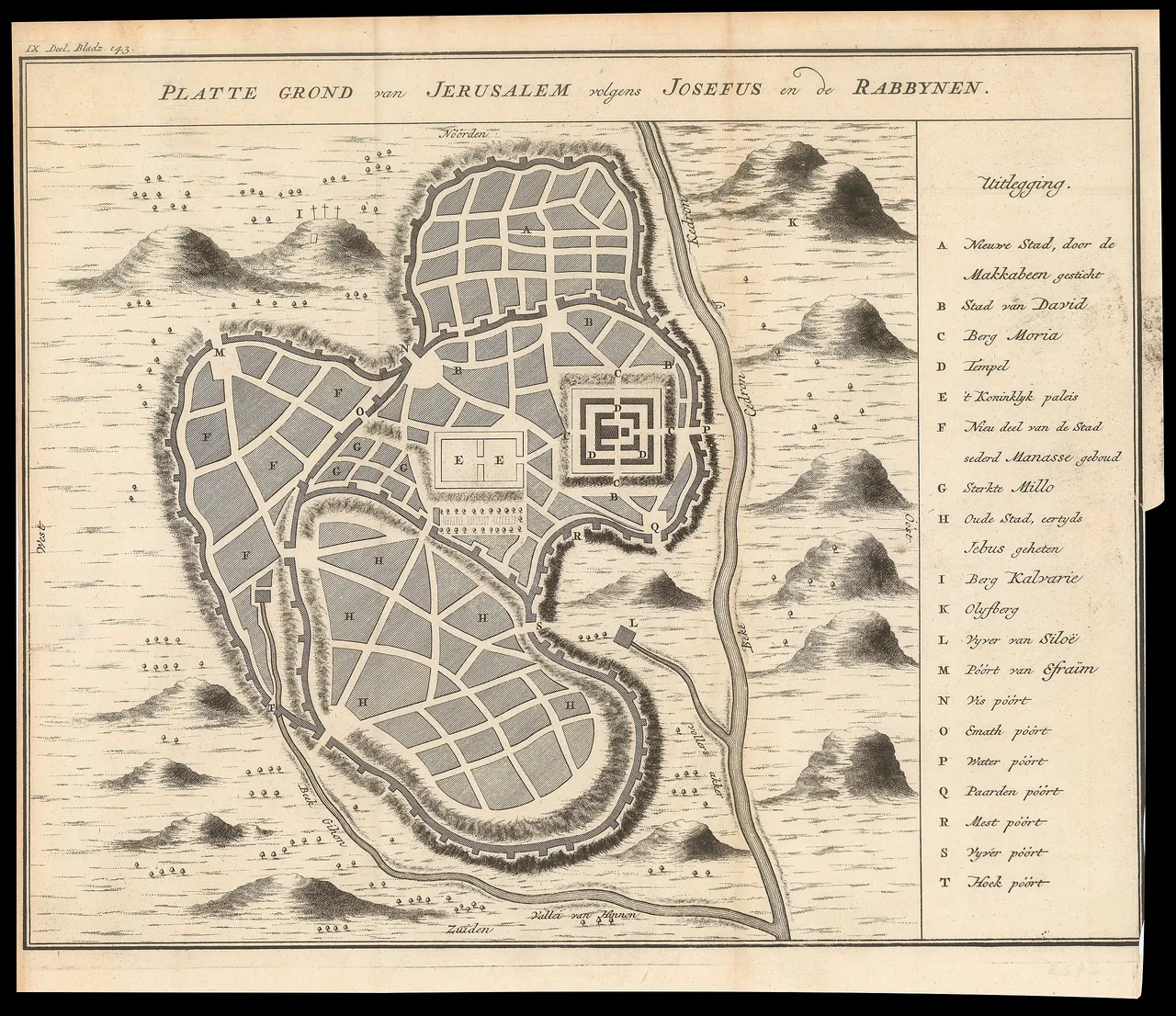
An undated Dutch plan of Jerusalem drawn according to Josephus and the rabbis, the city as the Jewish witnesses described it.Platte grond van Jerusalem.volgens Josefus en de Rabbynen (FL36558882 3901677) · Wikimedia Commons · Public domain · museum record · Galeria Regni
The brother of Jesus "who was called Christ"
The shorter passage is the easier one, so we begin there. In Book 20, Josephus describes events in Jerusalem in AD 62. The Roman governor Festus had died, and his successor Albinus had not yet arrived. The high priest Ananus, a Sadducee, seized the moment:
"...so he assembled the sanhedrim of judges, and brought before them the brother of Jesus, who was called Christ, whose name was James, and some others, [or, some of his companions]; and when he had formed an accusation against them as breakers of the law, he delivered them to be stoned..."17
Josephus goes on to say that the most fair-minded citizens of Jerusalem were angry at what had been done, complained to King Agrippa and to Albinus, and that Ananus was removed from the high priesthood after only three months.
This passage is accepted as genuine by the great majority of scholars. Mykytiuk notes that "the huge majority accepts it as genuine".18 The reasons are strong. It sits naturally in its context, which is about the misdeeds of a high priest, not about Christianity. It uses a phrase, "the brother of Jesus, who was called Christ", that no Christian would have chosen: Christians called James "the Lord's brother" (Galatians 1:19), not the brother of someone "called" Christ. And the third-century Christian scholar Origen read it in his copy of Josephus and was struck by how odd it was. He wrote that Josephus spoke of "James the brother of Jesus who is called Christ", and added: "the wonderful thing is, that, though he did not accept Jesus as Christ, he yet gave testimony that the righteousness of James was so great".19
Think about what this one sentence establishes. Jesus had a brother named James, who was a known figure in Jerusalem in the early 60s and was put to death for breaking the law as the high priest saw it. Jesus was known as the one "called Christ", the Messiah. And Josephus can mention Him in passing, as a way of identifying James, because his readers would know who was meant. One does not identify a man by reference to a brother who never existed.
This fits the New Testament exactly. The Gospels name James first among the brothers of Jesus: "Is not this the carpenter, the son of Mary, the brother of James, and Joses, and of Juda, and Simon?" (Mark 6:3). Paul met him personally: "But other of the apostles saw I none, save James the Lord's brother" (Galatians 1:19). And Acts and Paul's letters show James as a leader of the Jerusalem church (Galatians 2:9).
The Testimonium Flavianum
The longer passage, in Book 18, is more complicated. As it stands in all surviving Greek manuscripts, it reads:
"Now there was about this time Jesus, a wise man, if it be lawful to call him a man; for he was a doer of wonderful works, a teacher of such men as receive the truth with pleasure. He drew over to him both many of the Jews and many of the Gentiles. He was [the] Christ. And when Pilate, at the suggestion of the principal men amongst us, had condemned him to the cross, those that loved him at the first did not forsake him; for he appeared to them alive again the third day; as the divine prophets had foretold these and ten thousand other wonderful things concerning him. And the tribe of Christians, so named from him, are not extinct at this day."20
Few scholars, Christian or otherwise, believe Josephus wrote every word of this. A Jew who did not accept Jesus as Messiah, as Origen tells us, would hardly have written "He was the Christ", or "if it be lawful to call him a man", or that He appeared alive on the third day as the prophets foretold. Those phrases read like the additions of a later Christian copyist.
But very few scholars think the whole passage was invented, either. The judgement of the clear majority is that Josephus wrote a shorter, neutral notice about Jesus, which a Christian hand later embellished. Mykytiuk sums up this middle view: once the probable additions are removed, "the remaining text appears to be pure Josephus", and the view has "the support of the overwhelming majority of scholars".21 Several things support it. The core of the passage uses Josephus' own vocabulary and style. A brief introduction of Jesus in Book 18 would explain why Book 20 can refer to Him as "Jesus, who was called Christ" without further comment. And in 1971 the Israeli scholar Shlomo Pines published a tenth-century Arabic version of the passage, preserved by the Christian historian Agapius, which lacks the most obviously Christian phrases and says instead that Jesus' followers reported that He had appeared to them and that He was "perhaps" the Messiah.22 Whether that version reflects an independent line of transmission is still debated, but it shows that more cautious forms of the passage circulated.
What does the core of the passage, stripped of the disputed phrases, tell us? That at the time of Pilate there was a man named Jesus, regarded as wise; that He did remarkable deeds and was a teacher; that He won followers among Jews and Gentiles; that Pilate, prompted by leading men among the Jews, condemned Him to the cross; that His followers did not abandon Him after His death; and that the Christians named after Him still existed when Josephus wrote. That is a sober summary of a real life, written by a Jewish historian of the same century.
It is worth being clear about how this paper uses the passage. It does not use the disputed phrases as Josephus' testimony to the resurrection. The resurrection does not need them. It uses only what most scholars, believers and unbelievers alike, think Josephus actually wrote.
The rabbinic tradition
The Jewish teachers whose discussions were later gathered into the Talmud said little about Jesus, and what they said is hostile. The clearest passage is in the Babylonian Talmud, tractate Sanhedrin 43a. It quotes a baraita, a teaching from the early rabbinic period (before about AD 200) that was not included in the Mishnah:
"On Passover Eve they hung the corpse of Jesus the Nazarene after they killed him by way of stoning. And a crier went out before him for forty days, publicly proclaiming: Jesus the Nazarene is going out to be stoned because he practiced sorcery, incited people to idol worship, and led the Jewish people astray. Anyone who knows of a reason to acquit him should come forward and teach it on his behalf. And the court did not find a reason to acquit him, and so they stoned him and hung his corpse on Passover eve."23
This passage must be handled carefully. It was written down centuries after Jesus. It differs from the Gospels in important ways (stoning before hanging, a forty-day search for defenders), and some of its details look like a reply to Christian claims rather than independent memory. Scholars disagree about how much of the rabbinic material refers to Jesus at all. Peter Schäfer of Princeton, in a full study, argued that these passages are deliberate counter-stories to the Gospels, shaped in the third and fourth centuries.24 Mykytiuk calls Sanhedrin 43a "a fairly clear example" of a rabbinic reference to Jesus, but agrees with Van Voorst that most claimed references "do not in fact do so, or are so late as to have no value".25
So the Talmud is not a strong independent source for the details of Jesus' life. But it is valuable for one thing. The rabbis who preserved this tradition had every reason to deny that Jesus had ever lived, if denial had been possible. They did not. They accepted that He was real, that He did things that needed explaining (they explained them as "sorcery"), that He led many in Israel to follow Him, and that He was executed at Passover. Their charge echoes the charge the Gospels say His enemies made in His lifetime: "Then gathered the chief priests and the Pharisees a council, and said, What do we? for this man doeth many miracles" (John 11:47). Even His opponents did not deny the deeds. They argued about their source.
We come now to the sources that tell us most about Jesus: the writings of His own followers. A skeptic may be tempted to skip this part. Please do not. The question here is not whether the New Testament is inspired (a question this paper sets aside; this ministry holds that it is) but whether, read simply as ancient documents, these sources give us early and credible information. On that question, scholars who reject Christianity are often more generous than the internet is.
Paul: the earliest writer
The earliest Christian writings that survive are not the Gospels but the letters of Paul. Paul was a Pharisee from Tarsus who, by his own account, had tried to destroy the church: "For ye have heard of my conversation in time past in the Jews' religion, how that beyond measure I persecuted the church of God, and wasted it" (Galatians 1:13). Something turned him around (we will come to that), and from the late 40s to the early 60s he travelled the eastern Mediterranean planting churches and writing letters to them.
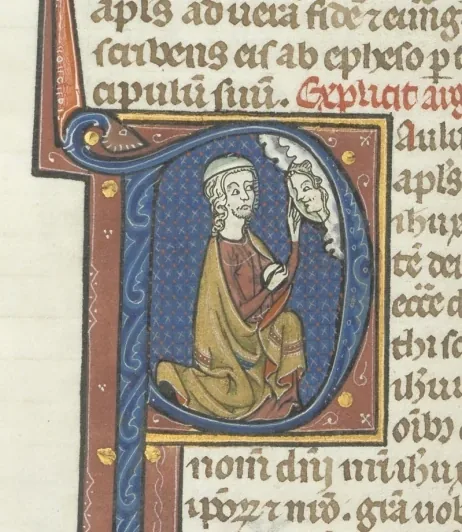
A manuscript page from southern France, about 1275 to 1300, opening First Corinthians with an initial of Paul kneeling, the letter that preserves the early creed of chapter fifteen.Fol. 440v, Corinthians I, historiated initial P, Paul kneeling talking to the bust of God above · c. 1275–1300 · Cleveland Museum of Art · CC0 · full page · museum record · Galeria Regni
Scholars of all persuasions agree that Paul wrote at least seven of the letters that bear his name, among them Romans, 1 and 2 Corinthians and Galatians, and that they date from roughly AD 48 to 60. These letters are not biographies, and Paul does not retell Jesus' life in order. But they assume a great deal. In passing, Paul tells us that Jesus was born a Jew, "made of a woman, made under the law" (Galatians 4:4), and was descended from David (Romans 1:3); that He had brothers, one of them named James (Galatians 1:19; 1 Corinthians 9:5); that He had twelve close disciples (1 Corinthians 15:5); that on the night He was betrayed He shared a last meal with them and spoke of the bread and cup (1 Corinthians 11:23–25); that He was killed, and that some Judaean leaders shared the guilt (1 Thessalonians 2:14–15); that He was crucified (1 Corinthians 1:23; Galatians 3:13); that He was buried; and that He was raised and seen alive.
This is the evidence that convinces scholars like Bart Ehrman that Jesus certainly lived. Paul, Ehrman writes, "acquired his information within a couple of years of Jesus' life", and he "actually knew, first hand, Jesus' closest disciple Peter and his own brother James. If Jesus did not exist, you would think his brother would know it."26
Fifteen days with Peter
Ehrman's point rests on a passage in Galatians that is worth reading slowly. Describing his life after his conversion, Paul writes:
"Then after three years I went up to Jerusalem to see Peter, and abode with him fifteen days. But other of the apostles saw I none, save James the Lord's brother." (Galatians 1:18-19)
Paul was converted, by most reckonings, within a few years of the crucifixion. Three years after that, he spent two weeks with Peter, the leading disciple, and also met James, the brother of Jesus. Fourteen years later he went up again and met with "James, Cephas, and John, who seemed to be pillars" (Galatians 2:9), to make sure the gospel he preached was the same as theirs. Whatever one thinks of Paul's theology, he was in a position to know whether the man he preached had lived. He had sat at the table of that man's brother and of His closest friend.
The creed of 1 Corinthians 15
The most important single passage for the historian is in 1 Corinthians, written from Ephesus in the mid-50s. Paul reminds the Corinthians of the message he had brought them a few years earlier:
"For I delivered unto you first of all that which I also received, how that Christ died for our sins according to the scriptures; And that he was buried, and that he rose again the third day according to the scriptures: And that he was seen of Cephas, then of the twelve: After that, he was seen of above five hundred brethren at once; of whom the greater part remain unto this present, but some are fallen asleep. After that, he was seen of James; then of all the apostles. And last of all he was seen of me also, as of one born out of due time." (1 Corinthians 15:3-8)
Almost all scholars agree that verses 3 to 5, at least, are not Paul's own composition but a formula he had been taught. The reasons are in the text. Paul uses the technical words of Jewish teachers for handing on tradition: he "delivered" what he had "received". The lines are short and balanced, built to be memorised. They use expressions Paul does not normally use, and they call Peter by his Aramaic name, Cephas. This is a summary of the faith that Christians were reciting before Paul wrote it down.
How early is it? Paul probably "received" it when he became a believer, or at the latest on that fifteen-day visit to Peter in Jerusalem, which puts it within a few years of the crucifixion. Even critical scholars who doubt the resurrection date the formula very early. The German New Testament scholar Gerd Lüdemann, who argued that the resurrection appearances were visions and that Jesus' body decayed, dated the tradition to within about two years of the crucifixion.27 Ehrman's 2012 article speaks of sources lying behind Paul and the Gospels that "originated in Jesus' native tongue Aramaic and that can be dated to within just a year or two of his life."28
This matters enormously. Legends need time. A story about a man that grows up over generations, after everyone who knew him is gone, can drift into myth. But the creed of 1 Corinthians 15 was being recited while Peter and James were alive and leading the church, and Paul adds a remarkable detail of his own: of the more than five hundred who saw the risen Jesus at once, "the greater part remain unto this present". In other words: they are still alive; you can ask them. That is not how myths talk.
It is important to say what this does and does not prove. It does not, by itself, prove that Jesus rose from the dead. It proves that from the very beginning, within a few years of His death, His followers were claiming that He had died, been buried, been raised, and been seen by named individuals and groups. The claim of the resurrection is not a late development. It is the oldest thing in Christianity.
James and the brothers who did not believe
One name in the creed deserves special notice: "After that, he was seen of James" (1 Corinthians 15:7). The Gospels are frank that during Jesus' ministry His own brothers did not believe in Him: "For neither did his brethren believe in him" (John 7:5). Mark records that those close to Him once went out "to lay hold on him: for they said, He is beside himself" (Mark 3:21). This is the kind of embarrassing detail the early church would hardly have invented about its own leaders.
Yet after the crucifixion James is a believer, and soon one of the leaders of the church in Jerusalem (Galatians 2:9; Acts 15:13). And Josephus, as we have seen, tells us he was stoned around AD 62. Something changed a skeptical brother into a leader of the movement, willing to die. The creed gives the reason the first Christians gave: he saw his brother alive. Gary Habermas and Michael Licona list James's conversion among the small set of facts that a wide range of scholars, including skeptical ones, accept.29
The Gospels as ancient biographies
The four Gospels were written later than Paul's letters. Most scholars date them between about AD 65 and 95, though some argue for earlier dates. That is within the lifetime of people who had known Jesus, and much closer to the events than many ancient biographies are to their subjects. The best surviving accounts of Alexander the Great, by Arrian and Plutarch, were written more than four centuries after he died, and historians still use them.
The Gospels claim to rest on eyewitness testimony. Luke opens his Gospel like a Greek historian:
"Forasmuch as many have taken in hand to set forth in order a declaration of those things which are most surely believed among us, Even as they delivered them unto us, which from the beginning were eyewitnesses, and ministers of the word; It seemed good to me also, having had perfect understanding of all things from the very first, to write unto thee in order, most excellent Theophilus, That thou mightest know the certainty of those things, wherein thou hast been instructed." (Luke 1:1-4)
A reader is entitled to test such a claim, and the next part of this paper looks at some of the tests archaeology provides. But it is worth noting that a broad consensus of modern scholars now holds that the Gospels belong to the genre of ancient biography, the bios or "life", and not to myth or fable. They are set in real places, under named rulers and high priests, with a texture of local detail that matches what we know from other sources. Luke dates the opening of John the Baptist's ministry by six different officials (Luke 3:1–2). That is not how one begins a fairy tale.
What the Christian sources tell the historian
Read as historical documents, the earliest Christian sources give us much more than the bare existence of Jesus. They show a Jewish teacher from Nazareth, baptised by John, who gathered disciples, was known for healings and exorcisms, taught about the kingdom of God, came into conflict with the Temple authorities, was handed over to Pilate and crucified at Passover, and was proclaimed risen by His followers almost at once. The scholar James D. G. Dunn wrote that two facts in particular, Jesus' baptism and His crucifixion, "command almost universal assent".30 John Dominic Crossan, a sceptical scholar who does not believe the Gospels' accounts of the resurrection, wrote: "That he was crucified is as sure as anything historical can ever be, since both Josephus and Tacitus ... agree with the Christian accounts on at least that basic fact."31
Archaeology cannot dig up a resurrection. What it can do is test whether a writer knew the world he described. When the people, places and practices in a text turn up in the ground, the text earns trust; when they are contradicted, it loses it. This part looks at a handful of discoveries that bear directly on the story of Jesus' trial and death.
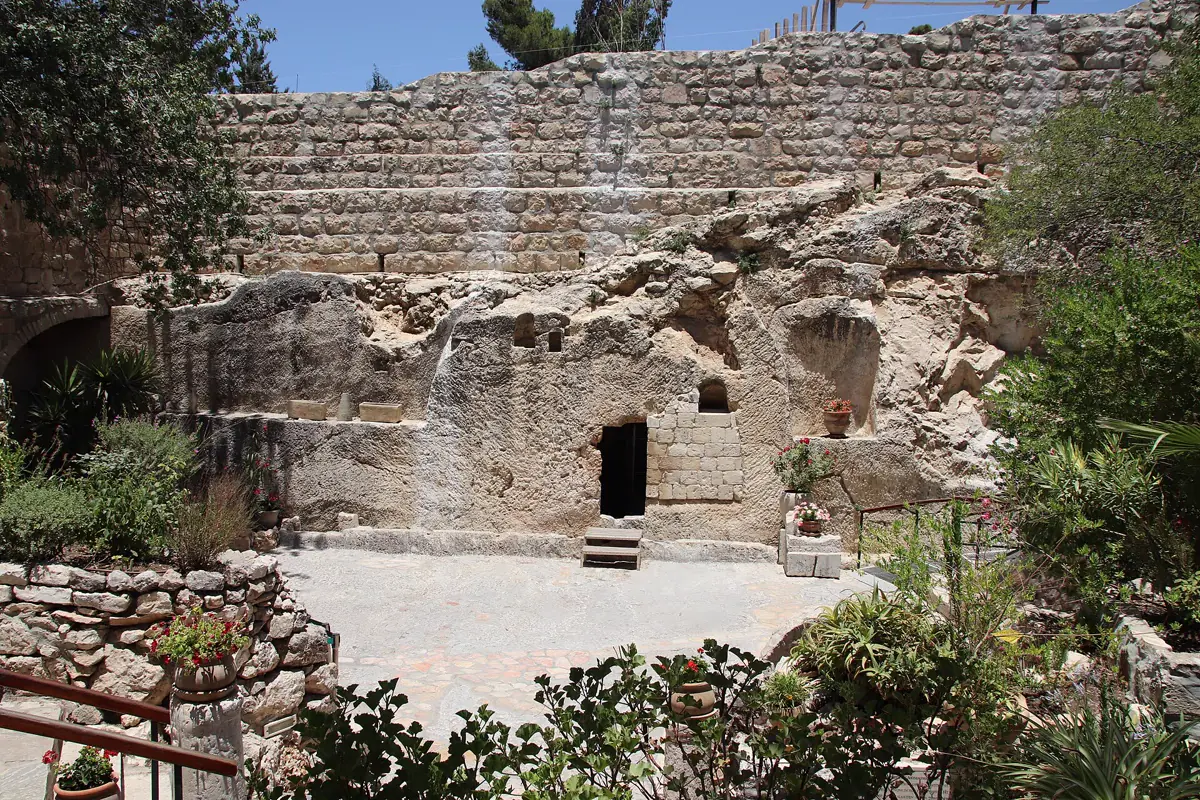
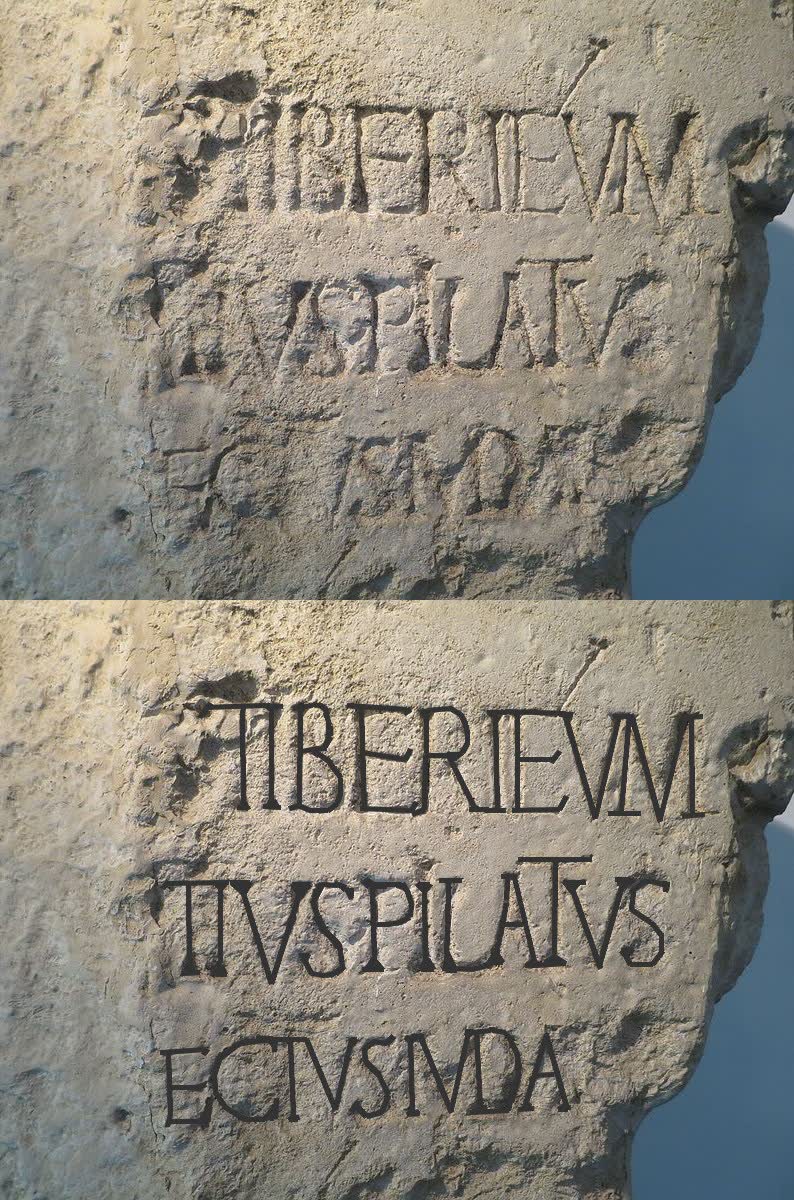
The Garden Tomb in Jerusalem — a rock-cut burial place of the very kind the Gospels describe, its stone bench still empty.Gary Todd · CC0The Pilate Stone (shown in replica; the original, 1st century AD, was found at Caesarea Maritima) — the inscription naming Pontius Pilate, prefect of Judea, the governor of the Gospels.Reinhard Dietrich · CC BY-SA 4.0
The Pilate stone
For centuries Pontius Pilate was known only from texts: the Gospels, Josephus, the Jewish philosopher Philo, and Tacitus. Some critics wondered whether the Gospels had his title and role right. Then, in 1961, an Italian archaeological mission excavating the Roman theatre at Caesarea Maritima on the coast of Israel found a limestone block that had been reused in a later staircase. It bore part of a Latin dedication. The surviving letters, with the usual reconstruction, read:
That is: "...Tiberieum ... Pontius Pilate ... prefect of Judaea ...", recording a building Pilate dedicated in honour of the emperor Tiberius.32 The stone is now in the Israel Museum in Jerusalem. It is the only inscription from Pilate's own lifetime that names him, and it confirms that a man of that name governed Judaea under Tiberius, with the title of prefect, from Caesarea, which was the Roman capital of the province. The Gospels call him simply "the governor" (for example Matthew 27:2), which fits.
The Caiaphas ossuary
The Gospels name the high priest who presided over Jesus' hearing: "And they that had laid hold on Jesus led him away to Caiaphas the high priest, where the scribes and the elders were assembled" (Matthew 26:57). Josephus gives his full name, Joseph called Caiaphas, and says he held office for an unusually long time, from about AD 18 to 36.
In November 1990, workers building a recreation park in the Peace Forest south of Jerusalem's Old City broke into a first-century family tomb. In all, twelve ossuaries came to light, limestone boxes in which Jews of the period gathered the bones of the dead a year after burial. One finely decorated ossuary bore the family name on one side and, on another, "Joseph son of Caiaphas" (Yehosef bar Qafa), and contained the bones of six people, including a man of about sixty. The excavator, Zvi Greenhut of the Israel Antiquities Authority, and many scholars since have identified it as the family tomb of the high priest.33 Not every scholar is persuaded that this is the same Caiaphas, and that uncertainty should be noted. But if it is, we have the bones of the man before whom Jesus stood.
A crucified man from Jerusalem
Crucifixion was so common in the Roman world, and the bodies of the crucified so often left to the birds or thrown into common pits, that almost no physical remains survive. Some scholars had even argued that crucified men were never given a family burial, which would make the Gospels' account of Joseph of Arimathea burying Jesus in a tomb (Mark 15:43–46) improbable.
In 1968, at Giv'at ha-Mivtar in north-east Jerusalem, the archaeologist Vassilios Tzaferis excavated a group of first-century Jewish tombs. In one ossuary, inscribed with the name Yehohanan, were the bones of a young man whose right heel bone was still pierced by an iron nail, its point bent, with a fragment of wood still attached. Because the nail could not be pulled free, it was buried with him.34 Later study by Joe Zias and Eliezer Sekeles revised some of the first conclusions about how he was fixed to the cross, but the central finding stands.35
The discovery shows two things. Romans in Judaea did nail victims to crosses, as the Gospels describe (John 20:25). And at least one crucified Jew of the period was taken down and given a proper family burial in a rock-cut tomb, just as the Gospels say Jesus was.
The Pool of Siloam and the world of the Gospels
John's Gospel is full of Jerusalem place names: the pool of Bethesda "having five porches" (John 5:2), the place called "the Pavement, but in the Hebrew, Gabbatha" (John 19:13), the pool of Siloam where Jesus sent a blind man to wash (John 9:7). Critics once treated some of these as symbolic inventions. Excavations in the nineteenth and twentieth centuries uncovered a large pool complex with porticoes near the Sheep Gate, at the site of Bethesda. And in 2004, during work on a large water pipe in the City of David, stone steps came to light; the archaeologists Eli Shukron and Ronny Reich identified them as part of the Second Temple period Pool of Siloam, and the identification was announced in December 2004.36
None of this proves that Jesus healed a blind man. But it shows that the writer of John knew Jerusalem as it was before the Romans destroyed it in AD 70. Fiction written far away, generations later, does not usually get the plumbing right.
The Gallio inscription
One more find helps fix the timeline of the earliest church. Acts says that during Paul's stay in Corinth, "when Gallio was the deputy of Achaia, the Jews made insurrection with one accord against Paul, and brought him to the judgment seat" (Acts 18:12). At Delphi in Greece, French excavators recovered fragments of a letter from the emperor Claudius, first joined and published by Émile Bourguet in 1905, which speaks of "my friend and proconsul L. Iunius Gallio". The letter can be dated to AD 52 by the titles of Claudius it records.37 That places Gallio in Corinth around AD 51–52 and gives scholars one of the firmest dates in Paul's career, a date that fits with Acts' mention of Aquila and Priscilla, "lately come from Italy" after Claudius' expulsion of the Jews.
What archaeology shows
| Find | Discovered | What it confirms | |---|---|---| | Pilate stone, Caesarea | 1961 | Pontius Pilate, prefect of Judaea under Tiberius | | Caiaphas family ossuary, Jerusalem | 1990 | Probable tomb of the high priest Joseph Caiaphas | | Yehohanan's heel bone, Giv'at ha-Mivtar | 1968 | Roman crucifixion with nails in Judaea; burial of a crucified man in a family tomb | | Second Temple Pool of Siloam | 2004 | The pool of John 9:7 as it was in Jesus' day | | Gallio inscription, Delphi | early 20th century | Gallio proconsul of Achaia c. AD 51–52 (Acts 18:12) |
Archaeology does not prove the faith. But again and again it has shown that the New Testament writers knew the people, places and practices of their world. As Paul told King Agrippa, "this thing was not done in a corner" (Acts 26:26).
Part 6 — Why the "Jesus Never Existed" Theory Fails
5 min read
The view that Jesus never existed at all, sometimes called the "Christ myth" theory or "mythicism", has been around since the late eighteenth century. It has a following online and a handful of defenders in print. This part matters because many people meet it before they meet the evidence. We will look at what it claims and why scholars, including those who are not Christians, have rejected it.
What the scholars say
It is no exaggeration to say that the mythicist view is rejected by almost every professional historian of the period, whatever their beliefs. In 1977 the classical historian Michael Grant, who wrote widely on Rome and was not writing as a Christian apologist, concluded: "To sum up, modern critical methods fail to support the Christ-myth theory. It has 'again and again been answered and annihilated by first-rank scholars'. In recent years, 'no serious scholar has ventured to postulate the non-historicity of Jesus', or at any rate very few, and they have not succeeded in disposing of the much stronger, indeed very abundant, evidence to the contrary."38
The most thorough recent answer to mythicism came from Bart Ehrman, an agnostic who left the evangelical faith of his youth and has spent his career criticising traditional Christian beliefs. In Did Jesus Exist? (2012) he set out the historical case for Jesus' existence, and in an online article that year he put his conclusion bluntly. Denying Jesus' existence, he wrote, is to deny "what virtually every sane historian on the planet -- Christian, Jewish, Muslim, pagan, agnostic, atheist, what have you -- has come to conclude based on a range of compelling historical evidence." And: "Whether we like it or not, Jesus certainly existed."39
A Christian should not overstate this. Ehrman does not believe Jesus was the Son of God, or that He rose from the dead. His testimony is valuable precisely because he has no stake in the Christian conclusion. On the question of whether Jesus lived, the believing and unbelieving scholar stand on the same ground.
The argument from silence
The mythicist's main argument is silence: if Jesus was a famous miracle-worker, why did not more writers of His day mention Him? We have already seen part of the answer in Part 1. Most of what was written is lost; Roman historians wrote about the powerful; and a Galilean preacher executed on the edge of the empire was not news in Rome until His followers became a problem there, which is exactly when the Roman sources begin to mention Him.
The silence is also smaller than it sounds. We have more than a dozen sources, Christian and non-Christian, within about a century of Jesus' death, and the Christian sources begin within a couple of decades, with an oral tradition behind them that goes back almost to the events. For comparison, many figures of first-century Galilee and Judaea whose existence no one doubts are known from one or two writers only. If silence disproved existence, half of ancient history would vanish.
"Copied from pagan gods"
A second argument is that the story of Jesus was borrowed from older myths of dying-and-rising gods: Osiris, Mithras, Horus, Dionysus and others. Internet lists of "parallels" claim that these gods were born of virgins on December 25, had twelve disciples, were crucified and rose on the third day.
When these claims are checked against the ancient sources, they mostly fall apart. Many of the "parallels" come not from ancient texts but from nineteenth-century writers, or are drawn from sources written after Christianity began. Osiris, in the Egyptian myth, is torn apart and reassembled to rule the dead in the underworld; he does not walk out of a tomb and eat breakfast with his friends. Mithras was not crucified. The cults of the mystery gods celebrated the cycle of the seasons, not a man executed under a named Roman governor at a known date. Ehrman, again no friend of orthodoxy, deals with these claims at length in Did Jesus Exist? and dismisses the idea that Jesus was invented on their model; in his 2012 article he said simply that the claim that Jesus was made up "falters on every ground".40
More basically, the earliest followers of Jesus were Jews in Judaea, devoted to the one God of Israel and horrified by pagan idolatry. They were the last people in the ancient world to borrow from Egyptian or Persian mystery religions. Their categories came from their own Scriptures.
A crucified Messiah is the last thing anyone would invent
This leads to the strongest point of all. If someone in the first century had set out to invent a Messiah for the Jewish people, the last thing he would have done was have that Messiah crucified. The Jewish Scriptures said: "for he that is hanged is accursed of God" (Deuteronomy 21:23), and Paul himself quotes it: "Cursed is every one that hangeth on a tree" (Galatians 3:13). Crucifixion was the most shameful death Rome could inflict, reserved for slaves, rebels and the lowest criminals. Paul admits that the message of a crucified Christ was, "unto the Jews a stumblingblock, and unto the Greeks foolishness" (1 Corinthians 1:23).
No one invents a stumblingblock for his own cause. The early Christians preached a crucified Messiah not because it was a good story, but because it was what had happened, and they had to explain it. The criterion of embarrassment, which historians use everywhere, points strongly here: the crucifixion is so awkward for the movement that it must have been true.
A brother, a friend and a Roman prefect
Finally, mythicism has to explain away too many particular people. It has to say that Paul, who knew Peter and James, did not realise that the Jesus he preached had never lived, or that Peter and James were in on the fiction. It has to say that Josephus, a Jerusalem priest of the same century, was deceived about a James who was stoned in his own city and identified by his brother. It has to say that Tacitus, a Roman senator, accepted a story of execution under Pilate without question. Every one of these explanations is harder to believe than the simple one. As Ehrman put it, if Jesus did not exist, "you would think his brother would know it."
The early opponents of Christianity, who were in a far better position than we are to check, never took this line. The Jewish leaders said the disciples stole the body (Matthew 28:13). The rabbis said Jesus was a sorcerer. The pagan critic Celsus, in the second century, said Jesus had learned magic in Egypt.41 Not one of them said He never lived. When those closest to the evidence, and most eager to discredit it, all agree that He was real, we should take notice.
Part 7 — What History Can Establish, and What It Asks of You
4 min read
We have read the witnesses. It is time to gather what they say, and then to ask honestly what this kind of evidence can do and where it hands the question back to us.
Facts that are granted across the field
Drawing the sources together, and staying with what scholars of very different beliefs accept, we can say with confidence:
1. Jesus of Nazareth lived in Galilee and Judaea in the first decades of the first century. (Paul; the Gospels; Josephus; Tacitus; the rabbinic tradition.) 2. He was a Jewish teacher with a following, known to friend and foe for remarkable deeds. (The Gospels; Josephus' core text; the rabbis' charge of "sorcery".) 3. He had brothers, one of them named James, who later led the Jerusalem church and was put to death around AD 62. (Paul; Mark; Josephus.) 4. He was crucified in Judaea under Pontius Pilate, during the reign of Tiberius. (Paul; the Gospels; Josephus; Tacitus; Lucian; archaeology of Pilate and of crucifixion.) 5. Very soon after His death, His followers proclaimed that He had been raised and had appeared to them, to named individuals and to groups. (The creed of 1 Corinthians 15, dated by critics to within a few years.) 6. A persecutor and a skeptic became believers: Paul, who had tried to destroy the church, and James, who had not believed in his brother. (Paul's letters; the Gospels; Acts; Josephus on James.) 7. The movement spread fast and its members were willing to die, within a generation reaching Rome and, within eighty years, the villages of Asia Minor, where its members worshipped Christ "as to a divinity". (Tacitus; Suetonius; Pliny; Lucian.)
Gary Habermas, who has spent decades cataloguing scholarly opinion on these questions, built his well-known "minimal facts" approach on exactly this kind of list. To count as a minimal fact, he explains, an event "had to be established by more than adequate scholarly evidence, and usually by several critically-ascertained, independent lines of argumentation. Additionally, the vast majority of contemporary scholars in relevant fields had to acknowledge the historicity of the occurrence."42 In their book The Case for the Resurrection of Jesus, Habermas and Michael Licona argue that four such facts (Jesus' death by crucifixion, the disciples' sincere belief that He rose and appeared to them, the conversion of the persecutor Paul, and the conversion of the skeptic James), together with the empty tomb, are best explained by the resurrection itself.43
How far history can go
Here we must be careful, because this is where many apologetic arguments overreach. History works by probability. It can tell us, with a confidence equal to anything in ancient history, that Jesus lived and was crucified. It can tell us that His followers claimed, from the very beginning, that He had risen, and that they were sincere enough to suffer for the claim. It can show that the alternative explanations offered (that the disciples stole the body, that Jesus did not really die, that the appearances were hallucinations) each run into serious difficulties.
The British scholar N. T. Wright, after a long study of how ancient Jews and pagans thought about death and life after death, argued that the historian is driven to two conclusions that are hard to avoid: "Historical investigation, I propose, brings us to the point where we must say that the tomb previously housing a thoroughly dead Jesus was empty, and that his followers saw and met someone they were convinced was this same Jesus, bodily alive though in a new, transformed fashion."44 Wright is careful to add that history alone cannot force anyone to the further step of faith.
That is the honest place to stand. Even Bart Ehrman, who does not believe in the resurrection, accepts as historical that some of Jesus' followers came to believe very soon after His death that He had been raised.45 The question is not whether they believed it. Nearly everyone agrees they did. The question is why.
The question the sources press on you
This is where the historical Jesus hands you over to the risen Jesus, or leaves you to decide that He is not. The evidence of this paper does not ask you to accept the resurrection because a Roman historian said so. Tacitus said nothing of the kind. It asks you to face the fact that a real man, executed under a real governor, was proclaimed alive by people who knew Him, within a few years and in the city where it happened, and that those people, including His own skeptical brother and the man who had hunted them, staked their lives on it.
The first Christians understood that this claim stood or fell on what had happened. Peter told a crowd in Jerusalem, only weeks after the crucifixion: "Ye men of Israel, hear these words; Jesus of Nazareth, a man approved of God among you by miracles and wonders and signs, which God did by him in the midst of you, as ye yourselves also know" (Acts 2:22). He was speaking to people who could have contradicted him. Paul staked everything on the same ground: "And if Christ be not risen, then is our preaching vain, and your faith is also vain" (1 Corinthians 15:14). And Peter, near the end of his life, wrote: "For we have not followed cunningly devised fables, when we made known unto you the power and coming of our Lord Jesus Christ, but were eyewitnesses of his majesty" (2 Peter 1:16).
The case for the resurrection itself, and for the wider truth of the Christian faith, is set out in this paper's companion, The Evidence for Christianity. Here we close with the question Jesus Himself put to His disciples, which every reader of the evidence must answer in the end: "But whom say ye that I am?" (Matthew 16:15).
Jesus of Nazareth is not a legend. He is one of the best-attested figures of the ancient world outside the ranks of emperors and generals. A Roman senator recorded His execution under Pontius Pilate. A Roman governor reported that people across his province sang to Him as to a god, and would die rather than curse Him. A Jewish historian of Jerusalem named His brother James and called Him the one "called Christ". The rabbis who opposed His followers never denied that He lived. And within a few years of His death His own followers were reciting a creed that named the witnesses who had seen Him alive, many of whom were still living when Paul wrote it down. Archaeology has found the governor's name, probably the high priest's bones, and the nail in a crucified man's heel.
That much is history. What you do with it is not a question history can settle for you.
A next step
If you have come this far, do not stop at reading about Jesus. Read Him.
Read one Gospel through. Mark is the shortest; you can read it in an evening. As you read, ask the question Jesus asked: "But whom say ye that I am?" You can read it free in the 1611 Reader at kylelauriano.com/library.
Check the sources yourself. Every quotation in this paper has a reference. Look them up. Read Tacitus' chapter in full, and Pliny's letter, and the chapter of Josephus. You will find they say what this paper says they say.
Read the companion paper.The Evidence for Christianity takes up the resurrection, the reliability of the Scriptures and the wider case.
Talk to someone. If you have questions this paper did not answer, write to contact@kylelauriano.com.
You will not be the first skeptic to take the evidence seriously and find more than you expected. Michael Ray Lewis told his story on The King Is Coming Show (TKIC #48): in his own telling, an atheist who mocked Christians until one question undid him. Watch it in his own words: youtube.com/watch?v=Rd-RdSqeQDk Michael's account of what happened to him, shared as his testimony — weigh it for yourself.
An invitation
I decided to read the Bible for one reason: to disprove it, so I'd have an excuse to stop going to church for good. In Matthew I read Jesus' own words and felt the weight of my own sin for the first time. Then one day I got on my knees and prayed: "Jesus, if you are real, show me — and I'll serve you." That is my story; yours will be your own.
The Jesus of history is not only a figure to be studied. If He rose, as His first witnesses said, He is alive, and He still calls. The message the apostles preached was repentance toward God and faith toward our Lord Jesus Christ (Acts 20:21), and the promise that came with it has not changed: "That if thou shalt confess with thy mouth the Lord Jesus, and shalt believe in thine heart that God hath raised him from the dead, thou shalt be saved" (Romans 10:9).
"All that the Father giveth me shall come to me; and him that cometh to me I will in no wise cast out." (John 6:37)
8Suetonius, Life of Nero 16.2, in The Lives of the Twelve Caesars, trans. J. C. Rolfe, Loeb Classical Library (1914), https://penelope.uchicago.edu/Thayer/E/Roman/Texts/Suetonius/12Caesars/Nero*.html.↩
9Suetonius, Life of Claudius 25.4, trans. Rolfe, https://penelope.uchicago.edu/Thayer/E/Roman/Texts/Suetonius/12Caesars/Claudius*.html.↩
11Lucian, The Passing of Peregrinus 11, in The Works of Lucian of Samosata, trans. H. W. Fowler and F. G. Fowler, vol. 4 (Oxford: Clarendon Press, 1905), https://www.sacred-texts.com/cla/luc/wl4/wl420.htm.↩
12Lucian, Peregrinus 13, trans. Fowler and Fowler.↩
14"A Letter of Mara, Son of Serapion," trans. B. P. Pratten, in Ante-Nicene Fathers, vol. 8, ed. Alexander Roberts, James Donaldson and A. Cleveland Coxe (Buffalo, NY: Christian Literature Publishing, 1886), https://www.newadvent.org/fathers/0863.htm.↩
15Mykytiuk, "Did Jesus Exist?"; Robert E. Van Voorst, Jesus Outside the New Testament: An Introduction to the Ancient Evidence (Grand Rapids: Eerdmans, 2000), 53–56.↩
16Julius Africanus, Chronography, fragment 18, in Ante-Nicene Fathers, vol. 6, ed. Roberts, Donaldson and Coxe (Buffalo, NY: Christian Literature Publishing, 1886), https://www.newadvent.org/fathers/0614.htm.↩
17Josephus, Antiquities of the Jews 20.9.1 (20.200 in modern numbering), trans. William Whiston (1737), https://www.gutenberg.org/ebooks/2848.↩
19Origen, Commentary on Matthew 10.17, in Ante-Nicene Fathers, vol. 9, ed. Allan Menzies (New York: Christian Literature Publishing, 1896), https://www.newadvent.org/fathers/101610.htm.↩
22Shlomo Pines, An Arabic Version of the Testimonium Flavianum and Its Implications (Jerusalem: Israel Academy of Sciences and Humanities, 1971).↩
23Babylonian Talmud, Sanhedrin 43a, William Davidson edition, trans. Adin Even-Israel Steinsaltz, https://www.sefaria.org/Sanhedrin.43a. (Many older printed editions, censored from the sixteenth century on, omit the passage; the name appears in manuscripts and in modern editions such as this one.)↩
24Peter Schäfer, Jesus in the Talmud (Princeton: Princeton University Press, 2007).↩
27Gerd Lüdemann, The Resurrection of Jesus: History, Experience, Theology, trans. John Bowden (Minneapolis: Fortress, 1994), 38; as discussed in William Lane Craig, "Visions of Jesus: A Critical Assessment of Gerd Lüdemann's Hallucination Hypothesis," https://www.reasonablefaith.org/writings/scholarly-writings/historical-jesus/visions-of-jesus-a-critical-assessment-of-gerd-ludemanns-hallucination-hypo/.↩
29Gary R. Habermas and Michael R. Licona, The Case for the Resurrection of Jesus (Grand Rapids: Kregel, 2004); see also Michael R. Licona, The Resurrection of Jesus: A New Historiographical Approach (Downers Grove, IL: IVP Academic, 2010), as summarised in Gary R. Habermas, "The Minimal Facts Approach to the Resurrection of Jesus: The Role of Methodology as a Crucial Component in Establishing Historicity," Southeastern Theological Review 3, no. 1 (2012): 15–26, online at https://www.garyhabermas.com/articles/southeastern_theological_review/minimal-facts-methodology_08-02-2012.htm.↩
30James D. G. Dunn, Jesus Remembered, Christianity in the Making 1 (Grand Rapids: Eerdmans, 2003), 339.↩
31John Dominic Crossan, Jesus: A Revolutionary Biography (San Francisco: HarperSanFrancisco, 1994), 145.↩
32"caes0043," Inscriptions of Israel/Palestine, ed. Michael Satlow et al. (Brown University), https://search.inscriptionsisraelpalestine.org/inscriptions/caes0043; Center for Online Judaic Studies, "Pontius Pilate's Tiberium Inscription, 26-36 CE," https://cojs.org/pontius_pilate-s_tiberium_inscription-_26-36_ce/.↩
33Center for Online Judaic Studies, "Ossuary of the High Priest Caiaphas, 18-36 CE," https://cojs.org/ossuary_of_the_high_priest_caiaphas-_18-36_ce/; see also Helen K. Bond, Caiaphas: Friend of Rome and Judge of Jesus? (Louisville: Westminster John Knox, 2004). The ossuary is in the Israel Museum, Jerusalem.↩
34Vassilios Tzaferis, "Jewish Tombs at and near Giv'at ha-Mivtar, Jerusalem," Israel Exploration Journal 20, nos. 1–2 (1970): 18–32.↩
35Joe Zias and Eliezer Sekeles, "The Crucified Man from Giv'at ha-Mivtar: A Reappraisal," Israel Exploration Journal 35, no. 1 (1985): 22–27.↩
36"Archaeologists Identify Traces of 'Miracle' Pool," NBC News, December 23, 2004, https://www.nbcnews.com/id/wbna6750670; Biblical Archaeology Society Staff, "The Siloam Pool: Where Jesus Healed the Blind Man," Bible History Daily, https://www.biblicalarchaeology.org/daily/biblical-sites-places/biblical-archaeology-sites/the-siloam-pool-where-jesus-healed-the-blind-man/.↩
37Fouilles de Delphes III.4.286; text at https://epigraphy.packhum.org/text/240470. For its use in Pauline chronology, see Jerome Murphy-O'Connor, St. Paul's Corinth: Texts and Archaeology, 3rd ed. (Collegeville, MN: Liturgical Press, 2002), 141, section "The Proconsul Gallio".↩
38Michael Grant, Jesus: An Historian's Review of the Gospels (New York: Scribner's, 1977), 200. The phrases Grant quotes are from Roderic Dunkerley and Otto Betz.↩
39Ehrman, "Did Jesus Exist?," HuffPost. See also Bart D. Ehrman, Did Jesus Exist? The Historical Argument for Jesus of Nazareth (New York: HarperOne, 2012).↩
40Ehrman, "Did Jesus Exist?," HuffPost; Ehrman, Did Jesus Exist?↩
41Origen, Against Celsus 1.28, in Ante-Nicene Fathers, vol. 4, ed. Roberts, Donaldson and Coxe (Buffalo, NY: Christian Literature Publishing, 1885), https://www.newadvent.org/fathers/04161.htm.↩
42Habermas, "The Minimal Facts Approach to the Resurrection of Jesus."↩
43Habermas and Licona, The Case for the Resurrection of Jesus.↩
44N. T. Wright, "Jesus' Resurrection and Christian Origins," Gregorianum 83, no. 4 (2002): 615–35, online at https://ntwrightpage.com/2016/07/12/jesus-resurrection-and-christian-origins/. Wright develops the argument fully in The Resurrection of the Son of God, Christian Origins and the Question of God 3 (London: SPCK; Minneapolis: Fortress, 2003).↩
45Bart D. Ehrman, How Jesus Became God: The Exaltation of a Jewish Preacher from Galilee (New York: HarperOne, 2014).↩
The Bible makes one promise on page three. I believe its name is Jesus. Eight pages, to the empty tomb.
Eight passages in the 1611 King James, one a morning, that I believe are one story about Jesus — from the serpent’s head, through the giants, to the empty tomb. The page, a work of art, a clip, and a real person who says they met him. Free.
Some of the answers in this resource are strong — well-attested, widely accepted, and historically grounded. Others are an honest step of faith — positions I hold because of Scripture and personal experience, not because I can prove them in a lab. I've tried to be clear about which is which. Where I'm less certain, I say so.