The Residue · Genesis · chapter 6 · verse 17
Genesis 6:17
And behold, I, euen I doe bring a flood of waters vpon the earth, to destroy all flesh, wherein is the breath of life from vnder heauen, and euery thing that is in the earth shall die.
The 1611, as printed, with the residue painted on the words: a gold rule under the words reported, the remembered reading above them, a dotted rule where people do not recall the words at all. Open it in the 1611 Reader with the Residue switch on.
What the record shows
Three things, in order: the 1611 page; today’s printing where it parts from the 1611; and an older printed witness to the remembered wording where one has been found.
What others recall
- Reported
Some recall “every thing that is on the earth”, where the King James reads “every thing that is in the earth”.
- Reported
What the 1611 shows
- The 1611, as printed
And behold, I, euen I doe bring a flood of waters vpon the earth, to destroy all flesh, wherein is the breath of life from vnder heauen, and euery thing that is in the earth shall die.
- Today’s printing
And, behold, I, even I, do bring a flood of waters upon the earth, to destroy all flesh, wherein is the breath of life, from under heaven; and every thing that is in the earth shall die.
In the words, the 1611 and today’s printing agree here (spelling aside). The residue for this verse is in what people recall and in the wider record below, not on the 1611 page itself.
- The 1611, as printed
An older printed witness
1 verified · in print by 1739
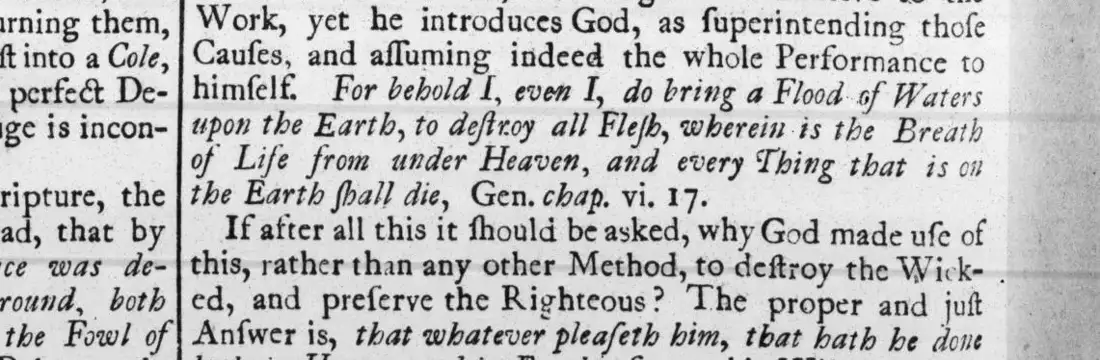
1739“superintending those causes, and assuming indeed the whole performance to himself. for behold j, even i, do bring a flood of waters upon the earth, to destroy all flesh, wherein is the breath of life from under heaven, and every thing that is on the earth shall die, gen. chap. vi. 17. | if after all this it should be asked, why god made use of this, rather than any other method, to destroy the wick- ed, and preserve the righteous? the proper and just answer is, that whatever pleas”The family companion: or, annotations upon the Holy Bible. Together with the lives, ... of our blessed Saviour and his twelve apostles. ... By S. Smith, D.D. 1739 — Smith, Samuel, D.D. (1739). leaf 74. Open the page at Internet Archive. The family companion: or, annotations upon the Holy Bible. Together with the lives, ... of our blessed Saviour and his twelve apostles. ... By S. Smith, D.D. 1739, 1739, Internet Archive, via archive.org. Public domain (published before 1929). 
1755“these causes, and afsuming in- deed the whole performance to himself: for, behold j, even i, do bring a flood of waters upon the earth, to destroy. all flesh, wherein is the breath of life, from under heaven, and every thing that is on the | earth shall die. tu us, with the help and concurmnce of god, we have found a sufficient quan- tity of water for the destruction of the old world : let us now consider the make and capacity of the vessel, wherein t”A new history of the Holy Bible, from the beginning of the world, to the establishment of Christianity. ... To which are added, notes, ... The whole illustrated with one hundred and four useful and ornamental maps and sculptures, ... By the Reverend Thomas Stackhouse, ... 1755: Vol 1 — Stackhouse, Thomas (1755). leaf 218. Open the page at Internet Archive. A new history of the Holy Bible, from the beginning of the world, to the establishment of Christianity. ... To which are added, notes, ... The whole illustrated with one hundred and four useful and ornamental maps and sculptures, ... By the Reverend Thomas Stackhouse, ... 1755: Vol 1, 1755, Internet Archive, via archive.org. Public domain (published before 1929). Candidate — not yet verified 
1818“en. yi. causes, and assuming indeed the whole performance to himself: for, “behold i, even !2:'?'% 20 i, do bring a flood of waters upon the earth, to destroy all flesh, wherein is the breath of life, from under heaven, and every thing that is on the earth shall die.” thus, with the help and concurrence of god, we have found a sufficient quantity of water for the destruction of the old world: but it is not on the difficulty in finding wa-’ ter, but on other circumstances, which see”A History of The Holy Bible from the Beginning of the World to the Establishment of Christianity — Various (1818). leaf 221. Open the page at Internet Archive. A History of The Holy Bible from the Beginning of the World to the Establishment of Christianity, 1818, Internet Archive, via archive.org. Public domain (published before 1929). Candidate — not yet verified A page of an older printing that carries the remembered wording shows the wording was in print at that date; a text edition quotes that printing and links the source. Each plate says what the printing is; none is a 1611 page, and none is called a King James Bible unless it is one.
Have a printed source? Send a photo of the page and we will check it twice before anything is shown.
Submit your proofOn the page around it
Genesis 6, the 1611 as printed. Verses with their own residue are linked.
- 15And this is the fashion, which thou shalt make it of: the length of the arke shalbe three hundred cubits, the breadth of it fifty cubits, and the height of it thirtie cubits.
- 16A window shalt thou make to the arke, and in a cubite shalt thou finish it aboue; and the doore of the arke shalt thou set in the side thereof: With lower, second, and third stories shalt thou make it.
- 17And behold, I, euen I doe bring a flood of waters vpon the earth, to destroy all flesh, wherein is the breath of life from vnder heauen, and euery thing that is in the earth shall die.
- 18But with thee wil I establish my Couenant: and thou shalt come into the Arke, thou, and thy sonnes, and thy wife, and thy sonnes wiues with thee.
- 19And of euery liuing thing of all flesh, two of euery sort shalt thou bring into the Arke, to keepe them aliue with thee: they shall be male and female.
Share this page
https://www.kylelauriano.com/residue/genesis/6/17