The Residue · Iob · chapter 39 · verse 9
Job 39:9
Will the Unicorne be willing to serue thee? or abide by thy cribbe?
The 1611, as printed, with the residue painted on the words: a gold rule under the words reported, the remembered reading above them, a dotted rule where people do not recall the words at all. Open it in the 1611 Reader with the Residue switch on.
What the record shows
Three things, in order: the 1611 page; today’s printing where it parts from the 1611; and an older printed witness to the remembered wording where one has been found.
What others recall
- Reported
Some recall “the wild ox”, where the King James reads “Will the unicorn”.
- Reported
What the 1611 shows
- The 1611, as printed
Will the Unicorne be willing to serue thee? or abide by thy cribbe?
- Today’s printing
Will the unicorn be willing to serve thee, or abide by thy crib?
In the words, the 1611 and today’s printing agree here (spelling aside). The residue for this verse is in what people recall and in the wider record below, not on the 1611 page itself.
- The 1611, as printed
An older printed witness
A candidate witness has been found for this verse: an older printing carries the remembered wording, but it does not name the verse exactly, or it differs only in spelling, or it follows another translation. It is marked as such below. The residue here rests on the remembrance of others.
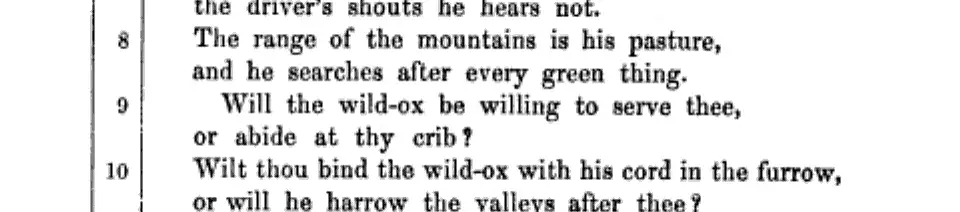
The Book of Job — Thomas Jefferson Conant (1856). PA78. Open the page at Google Books. The Book of Job, 1856, Harvard University, via Google Books. Public domain (published before 1929; Google-digitized). Candidate — not yet verified 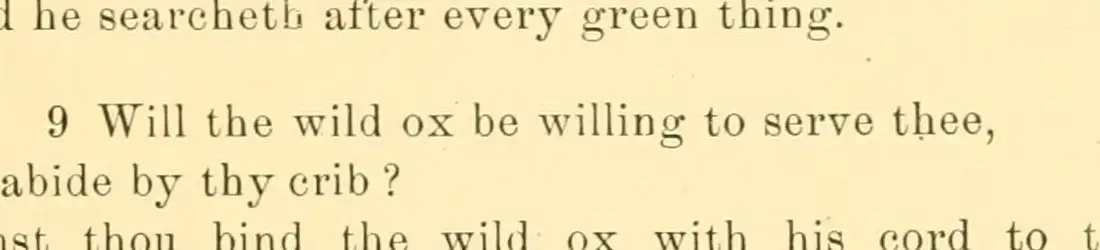
Old Testament revision : first revision (1885). leaf 223. Open the page at Internet Archive. Old Testament revision : first revision, 1885, Princeton Theological Seminary Library, via archive.org. Public domain (published before 1929). Candidate — not yet verified 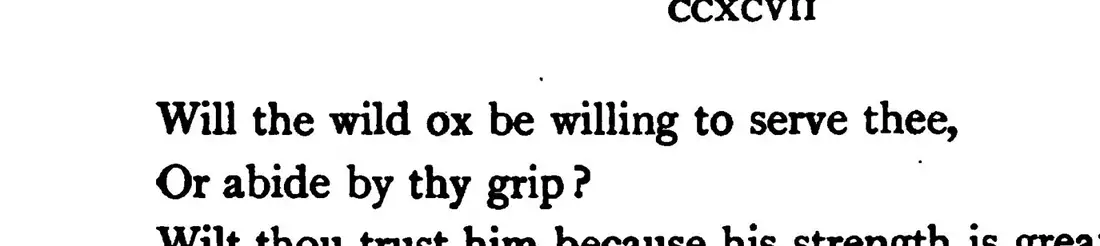
The sceptics of the Old Testament, Job, Koheleth, Agur; — Dillon, Emile Joseph, 1855-1933 (1895). leaf 255. Open the page at Internet Archive. The sceptics of the Old Testament, Job, Koheleth, Agur;, 1895, University of California, via archive.org. Public domain (published before 1929). Candidate — not yet verified Text edition
Will the wild-ox be willing to serve thee, or abide at thy crib?
1856 · The Book of Job (translated by T. J. Conant)The Book of Job (translated by T. J. Conant) — Thomas Jefferson Conant (1856). Conant's translation of Job reads 'Will the wild-ox be willing to serve thee, or abide at thy crib?'; a named translation, snippet only.. Open the source text. The Book of Job (Conant), 1856, via Google Books. public domain (printed before 1929). Candidate — not yet verified
Have a printed source? Send a photo of the page and we will check it twice before anything is shown.
Submit your proofOn the page around it
Iob 39, the 1611 as printed. Verses with their own residue are linked.
- 7He scorneth the multitude of the citie, neither regardeth he the crying of the driuer. residue →
- 8The range of the mountaines is his pasture, and hee searcheth after euery greene thing.
- 9Will the Unicorne be willing to serue thee? or abide by thy cribbe?
- 10Canst thou binde the Unicorne with his band in the furrow? or will he harrow the valleyes after thee? residue →
- 11Wilt thou trust him because his strength is great? or wilt thou leaue thy labour to him?
Share this page
https://www.kylelauriano.com/residue/job/39/9