The Residue · S. Iohn · chapter 1 · verse 21
John 1:21
And they asked him, What then? Art thou Elias? And he saith, I am not. Art thou that Prophet? And hee answered, No.
The 1611, as printed, with the residue painted on the words: a gold rule under the words reported, the remembered reading above them, a dotted rule where people do not recall the words at all. Open it in the 1611 Reader with the Residue switch on.
What the record shows
Three things, in order: the 1611 page; today’s printing where it parts from the 1611; and an older printed witness to the remembered wording where one has been found.
What others recall
- Reported
Some recall “Elijah”, where the King James reads “Art thou Elias”.
- Reported
What the 1611 shows
- The 1611, as printed
And they asked him, What then? Art thou Elias? And he saith, I am not. Art thou that Prophet? And hee answered, No.
- Today’s printing
And they asked him, What then? Art thou Elias? And he saith, I am not. Art thou that prophet? And he answered, No.
In the words, the 1611 and today’s printing agree here (spelling aside). The residue for this verse is in what people recall and in the wider record below, not on the 1611 page itself.
- The 1611, as printed
An older printed witness
A candidate witness has been found for this verse: an older printing carries the remembered wording, but it does not name the verse exactly, or it differs only in spelling, or it follows another translation. It is marked as such below. The residue here rests on the remembrance of others.
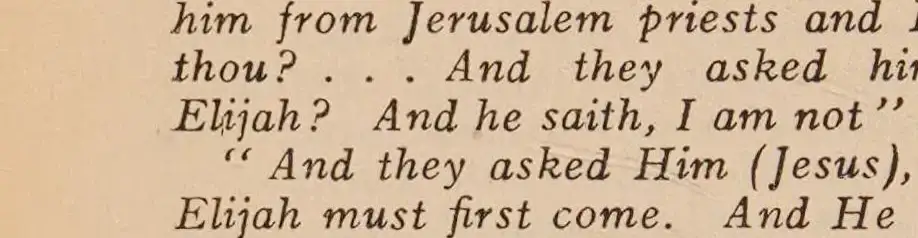
Unfulfilled prophecy — C.A. Shipman (1915). leaf 68. Open the page at Internet Archive. Unfulfilled prophecy, 1915, Internet Archive, via archive.org. Public domain (published before 1929). Candidate — not yet verified Text edition
… asked him, What then? Art thou Elijah? and he saith, I am not. …
1833 · The Holy Bible, with Amendments of the LanguageThe Holy Bible, with Amendments of the Language — Noah Webster (1833). John 1:21. Webster's Bible prints John 1:21 with 'Elijah' where the King James has 'Art thou Elias'; held at candidate (another translation's reading).. public domain. Candidate — not yet verified Text edition
… asked him: What then? Are you Elijah? And he said: I am not. …
1864 · The New Testament, Translated from the Original GreekThe New Testament, Translated from the Original Greek — H. T. Anderson (1864). John 1:21. Anderson's New Testament prints John 1:21 with 'Elijah' where the King James has 'Art thou Elias'; held at candidate (another translation's reading).. public domain. Candidate — not yet verified
Have a printed source? Send a photo of the page and we will check it twice before anything is shown.
Submit your proofOn the page around it
S. Iohn 1, the 1611 as printed. Verses with their own residue are linked.
- 19¶ And this is the record of Iohn, when the Iewes sent Priests and Leuites from Hierusalem, to aske him, Who art thou?
- 20And he confessed, and denied not: but confessed, I am not the Christ.
- 21And they asked him, What then? Art thou Elias? And he saith, I am not. Art thou that Prophet? And hee answered, No.
- 22Then said they vnto him, Who art thou, that we may giue an answere to them that sent vs? What sayest thou of thy selfe?
- 23He said, I am the voice of one crying in the wildernesse: Make straight the way of the Lord, as said the Prophet Esaias. residue →
Share this page
https://www.kylelauriano.com/residue/john/1/21