The Residue · S. Iohn · chapter 11 · verse 40
John 11:40
Iesus saith vnto her, Said I not vnto thee, that if thou wouldst beleeue, thou shouldest see the glory of God?
The 1611, as printed, with the residue painted on the words: a gold rule under the words reported, the remembered reading above them, a dotted rule where people do not recall the words at all. Open it in the 1611 Reader with the Residue switch on.
What the record shows
Three things, in order: the 1611 page; today’s printing where it parts from the 1611; and an older printed witness to the remembered wording where one has been found.
What others recall
- Reported
Some recall “wouldst” and “shouldst” where the King James reads “wouldest” and “shouldest”.
- Reported
What the 1611 shows
- The 1611, as printed
Iesus saith vnto her, Said I not vnto thee, that if thou wouldst beleeue, thou shouldest see the glory of God?
- Today’s printing
Jesus saith unto her, Said I not unto thee, that, if thou wouldest believe, thou shouldest see the glory of God?
In the words, the 1611 and today’s printing agree here (spelling aside). The residue for this verse is in what people recall and in the wider record below, not on the 1611 page itself.
- The 1611, as printed
An older printed witness
A candidate witness has been found for this verse: an older printing carries the remembered wording, but it does not name the verse exactly, or it differs only in spelling, or it follows another translation. It is marked as such below. The residue here rests on the remembrance of others.
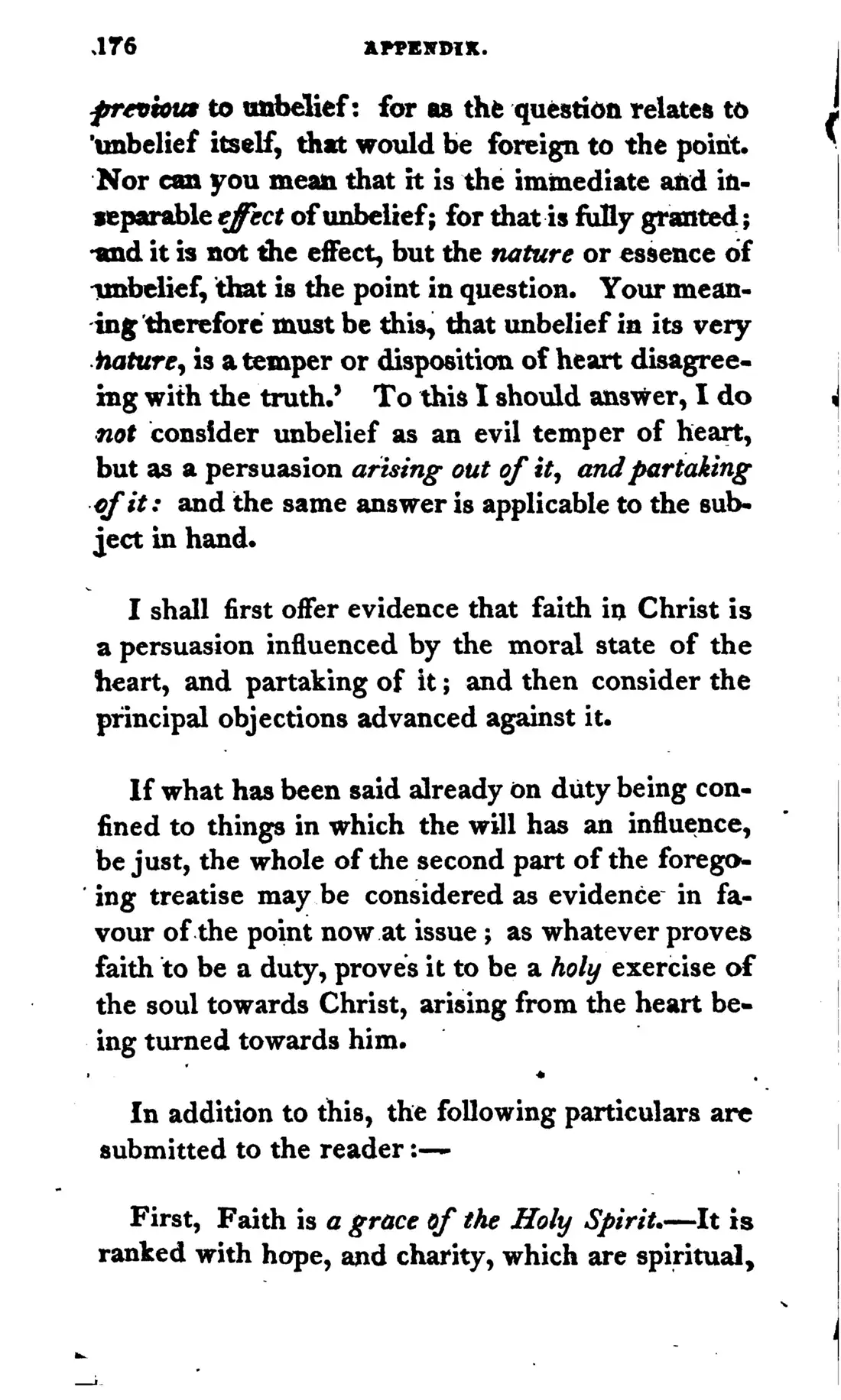
The Gospel Worthy of All Acceptation, Or, The Duty of Sinners to Believe in ... — Andrew Fuller (1805). leaf 201. Open the page at Internet Archive. The Gospel Worthy of All Acceptation, Or, The Duty of Sinners to Believe in ..., 1805, Harvard University, via archive.org. Public domain (published before 1929). Candidate — not yet verified 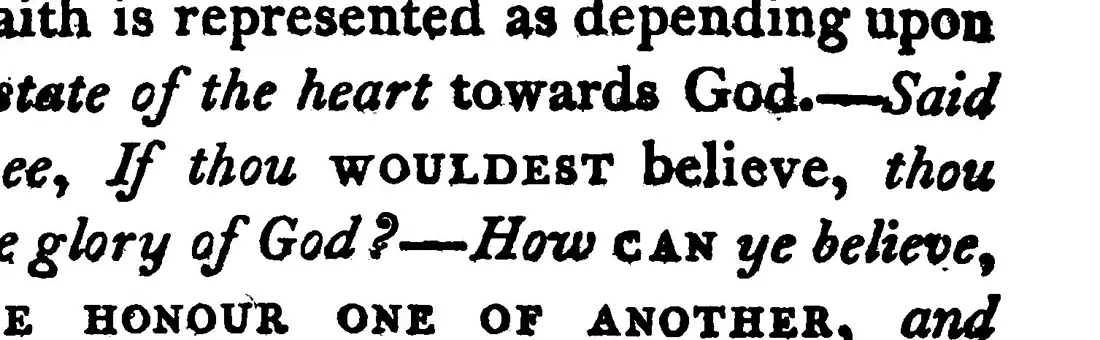
The Gospel Worthy of All Acceptation, Or, The Duty of Sinners to Believe in ... — Andrew Fuller (1805). leaf 203. Open the page at Internet Archive. The Gospel Worthy of All Acceptation, Or, The Duty of Sinners to Believe in ..., 1805, Harvard University, via archive.org. Public domain (published before 1929). Candidate — not yet verified Text edition
shall be filled with the glory of the Lord. John 11. 40. Said I not unto thee, that if thou wouldst believe thou shouldst see the glory of God? For that he heareth your…
1643 · A help for the understanding of the Holy Scripture intend…A help for the understanding of the Holy Scripture intended chiefly for the assistance and information of those that use constantly every day to reade some part — Jackson, Arthur, 1593?-1666. (1643). p. 165 (image 88). Spelling / name-form only; quoted with the verse named. Open the source text. A help for the understanding of the Holy Scripture intended chiefly for the assistance and, Jackson, Arthur, 1593?-1666., 1643, EEBO-TCP A46823 (Text Creation Partnership). public domain (EEBO-TCP, CC0 transcription). Candidate — not yet verified Text edition
… not tell thee, that if thou wouldst believe, thou shouldst see the glory …
1869 · A New TranslationA New Translation — George R. Noyes (1869). John 11:40. Noyes's translation prints John 11:40 with 'wouldst' where the King James has 'wouldest'; held at candidate (another translation's reading).. public domain. Candidate — not yet verified Text edition
… not unto thee, that, if thou wouldst believe, thou shouldst see the glory …
1902 · The Emphasised BibleThe Emphasised Bible — J. B. Rotherham (1902). John 11:40. Rotherham's Emphasised Bible prints John 11:40 with 'wouldst' where the King James has 'wouldest'; held at candidate (another translation's reading).. public domain. Candidate — not yet verified
Have a printed source? Send a photo of the page and we will check it twice before anything is shown.
Submit your proofOn the page around it
S. Iohn 11, the 1611 as printed. Verses with their own residue are linked.
- 38Iesus therefore againe groning in himselfe, commeth to the graue. It was a caue, and a stone lay vpon it.
- 39Iesus said, Take yee away the stone. Martha, the sister of him that was dead, sayth vnto him, Lord, by this time he stinketh: for he hath beene dead foure dayes.
- 40Iesus saith vnto her, Said I not vnto thee, that if thou wouldst beleeue, thou shouldest see the glory of God?
- 41Then they tooke away the stone from the place where the dead was laid. And Iesus lift vp his eyes, and said, Father, I thanke thee, that thou hast heard me.
- 42And I knewe that thou hearest me alwayes: but because of the people which stand by, I said it, that they may beleeue that thou hast sent me.
Share this page
https://www.kylelauriano.com/residue/john/11/40