The Residue · S. Marke · chapter 2 · verse 7
Mark 2:7
Why doeth this man thus speake blasphemies? Who can forgiue sinnes but God onely?
The 1611, as printed, with the residue painted on the words: a gold rule under the words reported, the remembered reading above them, a dotted rule where people do not recall the words at all. Open it in the 1611 Reader with the Residue switch on.
What the record shows
Three things, in order: the 1611 page; today’s printing where it parts from the 1611; and an older printed witness to the remembered wording where one has been found.
What others recall
- Reported
Some recall “Why does this man” where the King James reads “Why doth this man”.
- Reported
What the 1611 shows
- The 1611, as printed
Why doeth this man thus speake blasphemies? Who can forgiue sinnes but God onely?
- Today’s printing
Why doth this man thus speak blasphemies? who can forgive sins but God only?
In the words, the 1611 and today’s printing agree here (spelling aside). The residue for this verse is in what people recall and in the wider record below, not on the 1611 page itself.
- The 1611, as printed
An older printed witness
A candidate witness has been found for this verse: an older printing carries the remembered wording, but it does not name the verse exactly, or it differs only in spelling, or it follows another translation. It is marked as such below. The residue here rests on the remembrance of others.
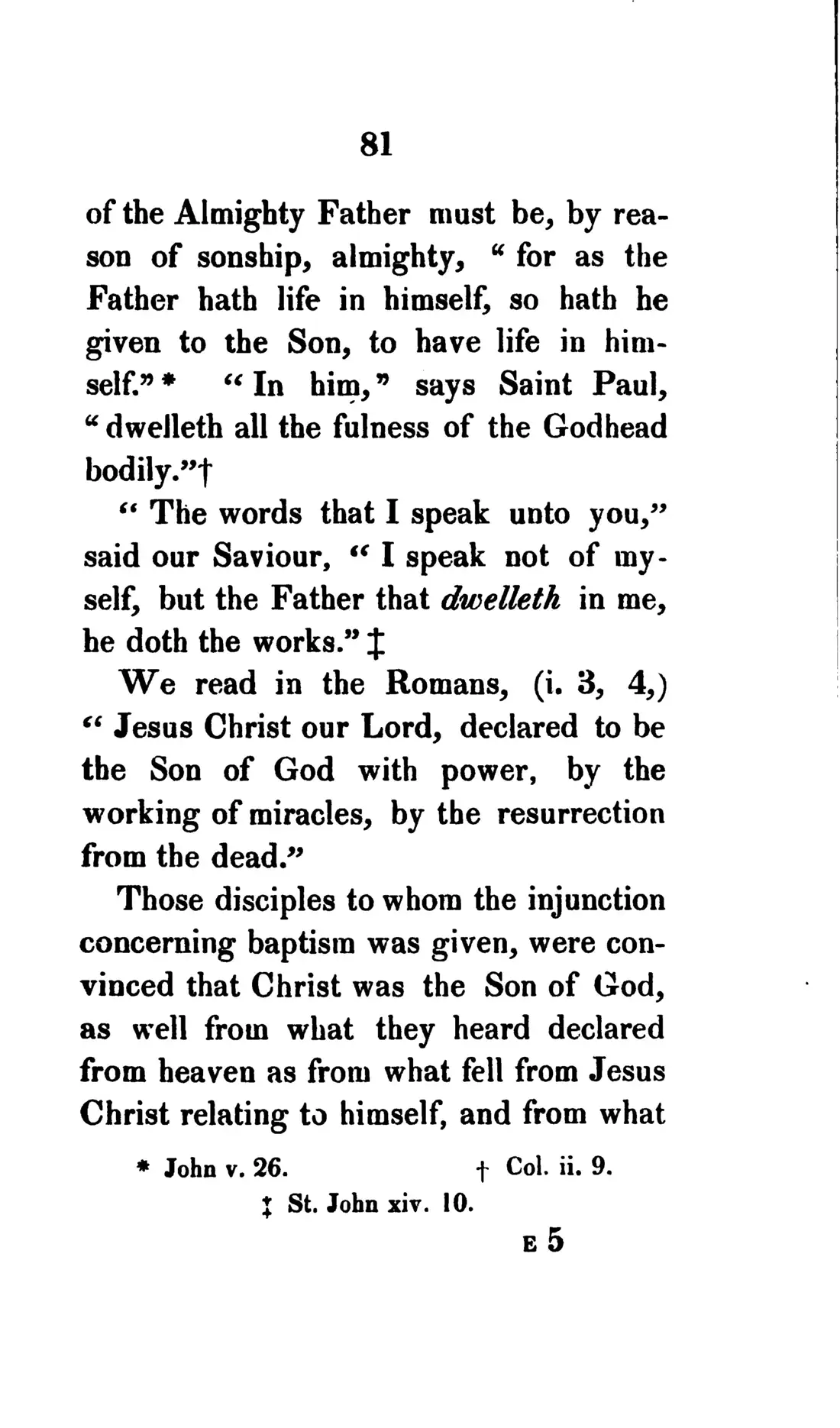
A short exposition of the Creed — John Woodward (1834). leaf 90. Open the page at Internet Archive. A short exposition of the Creed, 1834, Oxford University, via archive.org. Public domain (published before 1929). Candidate — not yet verified Commentator’s renderingText edition
... Why does this man thus speak blasphemies ? Who can forgive sins but God alone ? 8. And immediately ...
1845 · Commentary on a Harmony of the Evangelists, Matthew, Mark…Commentary on a Harmony of the Evangelists, Matthew, Mark, and Luke — John Calvin (1845). The 1845 English Calvin harmony prints verse 7 as 'Why does this man thus speak blasphemies?', its own translation of the text.. Open the source text. Commentary on a Harmony of the Evangelists, Matthew, Mark, and Luke, 1845, via Google Books. public domain (printed before 1929). Candidate — not yet verified Text edition
Why does this man thus speak impiously? Who …
1864 · The New Testament, Translated from the Original GreekThe New Testament, Translated from the Original Greek — H. T. Anderson (1864). Mark 2:7. Anderson's New Testament prints Mark 2:7 with 'does' where the King James has 'doth'; held at candidate (another translation's reading).. public domain. Candidate — not yet verified Text edition
Why does this [man] thus speak? he blasphemes. …
1890 · The Holy Scriptures, a New Translation from the Original …The Holy Scriptures, a New Translation from the Original Languages — J. N. Darby (1890). Mark 2:7. Darby's translation prints Mark 2:7 with 'does' where the King James has 'doth'; held at candidate (another translation's reading).. public domain. Candidate — not yet verified
Have a printed source? Send a photo of the page and we will check it twice before anything is shown.
Submit your proofOn the page around it
S. Marke 2, the 1611 as printed. Verses with their own residue are linked.
- 5When Iesus saw their faith, hee said vnto the sicke of the palsie, Sonne, thy sinnes be forgiuen thee.
- 6But there were certaine of the Scribes sitting there, and reasoning in their hearts, residue →
- 7Why doeth this man thus speake blasphemies? Who can forgiue sinnes but God onely?
- 8And immediatly, when Iesus perceiued in his Spirit, that they so reasoned within themselues, he said vnto them, Why reason ye these things in your hearts?
- 9Whether is it easier to say to the sicke of the palsie, Thy sinnes be forgiuen thee: or to say, Arise, and take vp thy bed and walke?
Share this page
https://www.kylelauriano.com/residue/mark/2/7