The Residue · S. Marke · chapter 6 · verse 5
Mark 6:5
And he could there doe no mightie worke, saue that he laid his hands vpon a few sicke folke, and healed them.
The 1611, as printed, with the residue painted on the words: a gold rule under the words reported, the remembered reading above them, a dotted rule where people do not recall the words at all. Open it in the 1611 Reader with the Residue switch on.
What the record shows
Three things, in order: the 1611 page; today’s printing where it parts from the 1611; and an older printed witness to the remembered wording where one has been found.
What others recall
- Reported
Some recall “a few sick” without the word “folk”.
- Reported
What the 1611 shows
- The 1611, as printed
And he could there doe no mightie worke, saue that he laid his hands vpon a few sicke folke, and healed them.
- Today’s printing
And he could there do no mighty work, save that he laid his hands upon a few sick folk, and healed them.
In the words, the 1611 and today’s printing agree here (spelling aside). The residue for this verse is in what people recall and in the wider record below, not on the 1611 page itself.
- The 1611, as printed
An older printed witness
A candidate witness has been found for this verse: an older printing carries the remembered wording, but it does not name the verse exactly, or it differs only in spelling, or it follows another translation. It is marked as such below. The residue here rests on the remembrance of others.
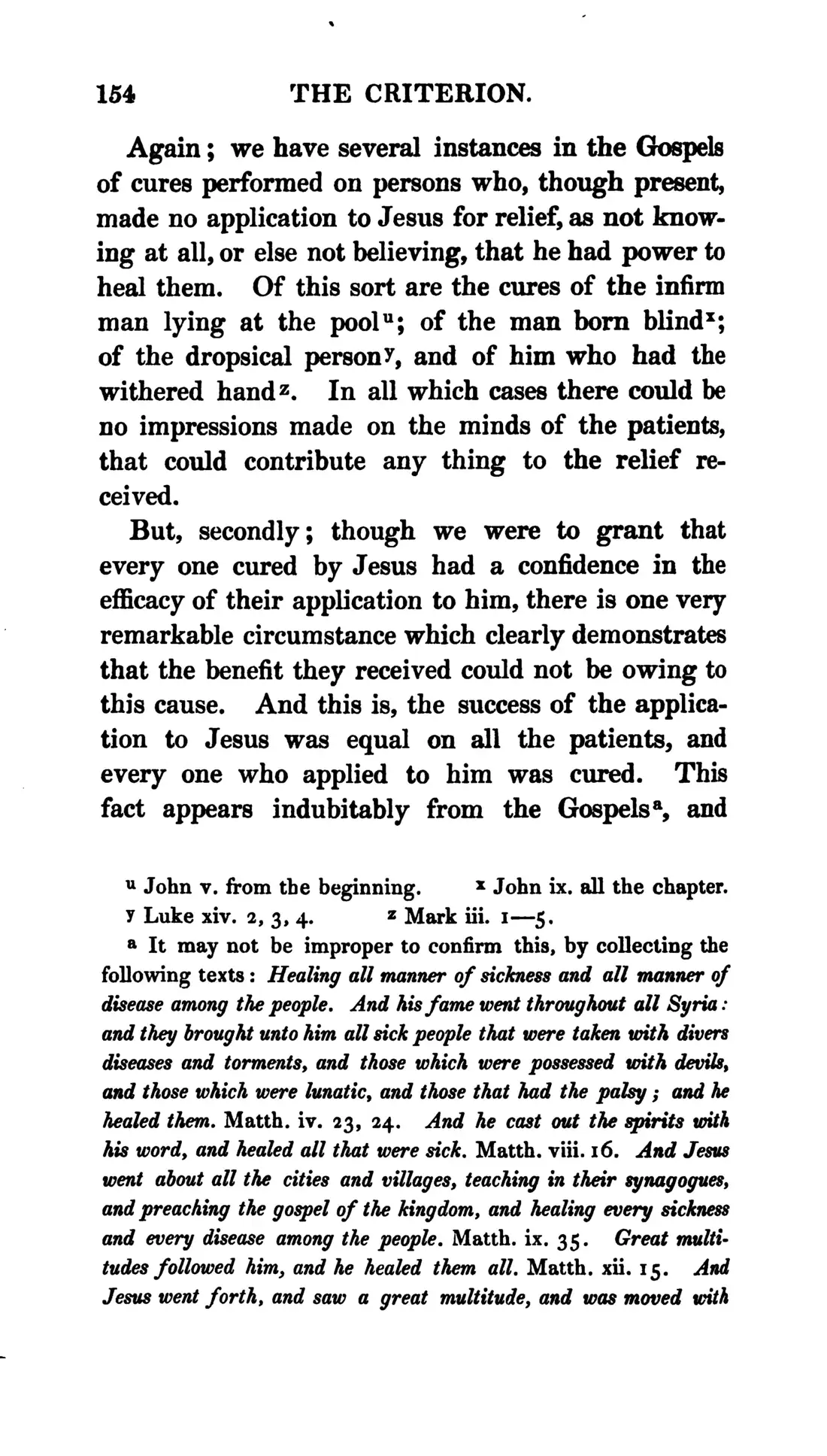
The criterion; or Rules by which the true miracles recorded in the New Testament are distinguished from the spurious miracles of pagans and papists. — Douglas, John, 1721-1807 (1832). leaf 169. Open the page at Internet Archive. The criterion; or Rules by which the true miracles recorded in the New Testament are distinguished from the spurious miracles of pagans and papists., 1832, New York Public Library, via archive.org. Public domain (published before 1929). Candidate — not yet verified 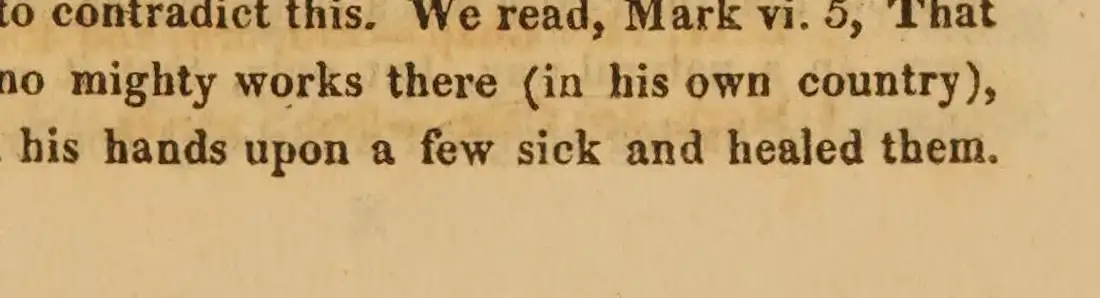
Criterion ; or, Rules by which the true miracles recorded in the New Testament are distinquished from the spurious miracles of pagans and papists. — Douglas, John, 1721-1807, author (1824). leaf 147. Open the page at Internet Archive. Criterion ; or, Rules by which the true miracles recorded in the New Testament are distinquished from the spurious miracles of pagans and papists., 1824, Princeton Theological Seminary Library, via archive.org. Public domain (published before 1929). Candidate — not yet verified English Bible before the King JamesText edition
And he coude not shew one miracle there, but layed his handes vpon a few sicke, and healed them.
1535 · The Coverdale Bible (English Bible before the King James)The Coverdale Bible (English Bible before the King James) (1535). Mark 6:5. Coverdale prints Mark 6:5 'a few sicke' without 'folk' [Kyle 2026-11-02: a pre-KJV Bible reading differently is a translation difference, partial match only]. public domain. Candidate — not yet verified Text edition
... laid his hands upon a few sick and healed them . But what St. Mark tells us Jesus could not do , St. Matthew relates simply ...
1816 · The Evidences of the Christian Religion; Being a Collecti…The Evidences of the Christian Religion; Being a Collection of All the Arguments (1816). An 1816 evidences collection quotes Mark's statement without 'folk'; the snippet shows only the end of the verse.. Open the source text. The Evidences of the Christian Religion; Being a Collection of All the Arguments, 1816, via Google Books. public domain (printed before 1929). Candidate — not yet verified
Have a printed source? Send a photo of the page and we will check it twice before anything is shown.
Submit your proofOn the page around it
S. Marke 6, the 1611 as printed. Verses with their own residue are linked.
- 3Is not this the carpenter, the sonne of Mary, the brother of Iames and Ioses, and of Iuda, and Simon? And are not his sisters heere with vs? And they were offended at him. residue →
- 4But Iesus sayde vnto them, A Prophet is not without honour, but in his owne countrey, and among his owne kinne, and in his owne house.
- 5And he could there doe no mightie worke, saue that he laid his hands vpon a few sicke folke, and healed them.
- 6And he marueiled because of their vnbeliefe. And he went round about the villages, teaching. residue →
- 7¶ And he calleth vnto him the twelue, and began to send them foorth, by two and two, and gaue them power ouer vncleane spirits,
Share this page
https://www.kylelauriano.com/residue/mark/6/5