The Residue · S. Marke · chapter 7 · verse 22
Mark 7:22
Thefts, couetousnesse, wickednesse, deceit, lasciuiousnesse, an euill eye, blasphemie, pride, foolishnesse:
The 1611, as printed, with the residue painted on the words: a gold rule under the words reported, the remembered reading above them, a dotted rule where people do not recall the words at all. Open it in the 1611 Reader with the Residue switch on.
What the record shows
Three things, in order: the 1611 page; today’s printing where it parts from the 1611; and an older printed witness to the remembered wording where one has been found.
What others recall
- Reported
Some recall “envy” where the King James reads “an evil eye”.
- Reported
What the 1611 shows
- The 1611, as printed
Thefts, couetousnesse, wickednesse, deceit, lasciuiousnesse, an euill eye, blasphemie, pride, foolishnesse:
- Today’s printing
Thefts, covetousness, wickedness, deceit, lasciviousness, an evil eye, blasphemy, pride, foolishness:
In the words, the 1611 and today’s printing agree here (spelling aside). The residue for this verse is in what people recall and in the wider record below, not on the 1611 page itself.
- The 1611, as printed
An older printed witness
1 verified · in print by 1926
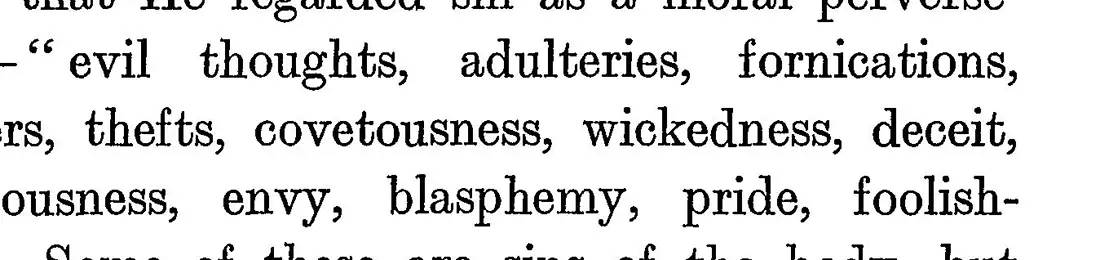
1926“t of him, those are they which defile him " (mark vii. 15). and the list of sins which he gives (mark vii. 21,22) shows that he regarded sin as a moral perverse- ness —" evil thoughts, adulteries, fornications, murders, thefts, covetousness, wickedness, deceit, lasciviousness, envy, blasphemy, pride, foolishness." some of these are sins of the body, but others entirely sins of the spirit, and all of them might be described as due to a 'wilful perverseness. the pauline teaching on the nature of sin, as”Christian fundamentals [microform] ; a modern apology for the Apostles' creed — Baird, Andrew Cumming, 1883- (1926). leaf 275. Open the page at Internet Archive. Christian fundamentals [microform] ; a modern apology for the Apostles' creed, 1926, Internet Archive, via archive.org. Public domain (published before 1929). 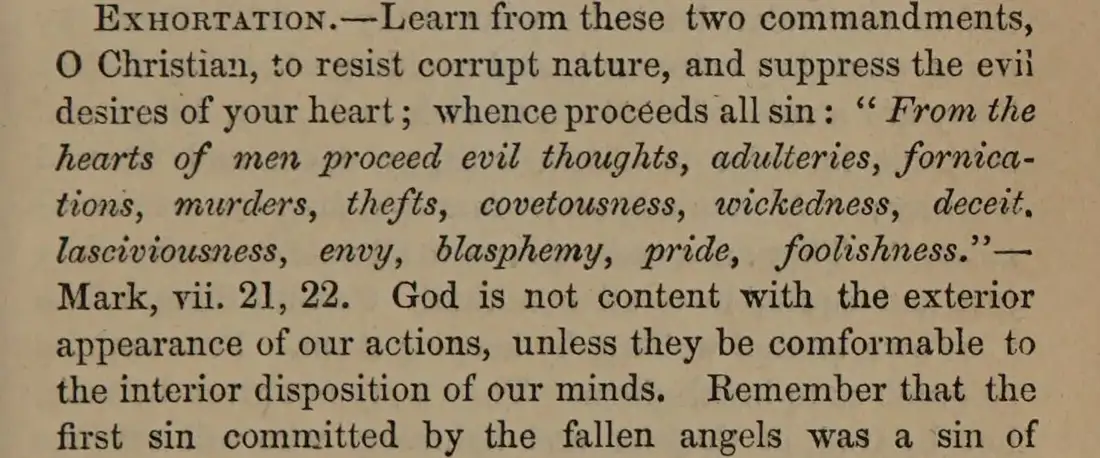
1840“m these two commandments, o christian, to resist corrupt nature, and suppress the evil desires of your heart; whence proceeds allsin: ‘‘ from the hearts of men proceed evil thoughts, adulteries, fornica- tions, murders, thefts, covetousness, wickedness, deceit, lasciviousness, envy, blasphemy, pride, foolishness.” — mark, vii. 21, 22. god is not content with the exterior appearance of our actions, unless they be comformable to the interior disposition of our minds. remember that the first sin committed by the fallen angels was”The poor man's catechism, or, the Christian doctrine explained : with suitable admonitions — Mannock, John, 1677-1764 (1840). leaf 167. Open the page at Internet Archive. The poor man's catechism, or, the Christian doctrine explained : with suitable admonitions, 1840, Saint Meinrad Archabbey Library, via archive.org. Public domain (published before 1929). Candidate — not yet verified A page of an older printing that carries the remembered wording shows the wording was in print at that date; a text edition quotes that printing and links the source. Each plate says what the printing is; none is a 1611 page, and none is called a King James Bible unless it is one.
Have a printed source? Send a photo of the page and we will check it twice before anything is shown.
Submit your proofOn the page around it
S. Marke 7, the 1611 as printed. Verses with their own residue are linked.
- 20And he said, That which commeth out of the man, that defileth the man.
- 21For from within, out of the heart of men, proceed euill thoughts, adulteries, fornications, murders,
- 22Thefts, couetousnesse, wickednesse, deceit, lasciuiousnesse, an euill eye, blasphemie, pride, foolishnesse:
- 23All these euill things come from within, and defile the man.
- 24¶ And from thence he arose, and went into the borders of Tyre and Sidon, and entred into an house, and would haue no man know it, but hee could not be hid.
Share this page
https://www.kylelauriano.com/residue/mark/7/22