A study of what evangelism is, how the apostles and the great evangelists of history did it, and how an ordinary believer can share the gospel honestly, clearly and without pressure.
Abstract
What is evangelism, who is meant to do it, and how should it be done? This paper answers from the King James Bible first — the commissions of the risen Christ, the preaching of the apostles in Acts, and Paul's own account of how he persuaded men — and second from the history of the church: Pliny's letter to Trajan, the field preaching of George Whitefield and John Wesley, the conversion of C. H. Spurgeon under a lay preacher, and D. L. Moody, won by a Sunday-school teacher's "very weak plea" in a Boston shoe store. It sets out the content of the gospel, the patterns of witness in Acts, the ethics of persuasion (why Scripture forbids manipulation and also forbids silence), a practical method for real conversations, how to meet common objections, and how to follow up. The conclusion is that evangelism is the plain telling of good news by ordinary believers, depending on the Holy Ghost, with no tricks and no pressure. It is written for any believer who wants to share the faith and is not sure how.
What’s inside
·Introduction
Part 1Part 1: What Evangelism Is
Part 2Part 2: How the Apostles Did It: Patterns from Acts
Part 3Part 3: What Church History Shows
Part 4Part 4: Free Truth, No Pressure: The Ethics of Persuasion
Part 5Part 5: Conversations: A Practical Method
Part 6Part 6: Answering Objections with Meekness
Part 7Part 7: After the Conversation: Follow-Up and Discipleship
·Conclusion
Research paper · 9 chapters · 28 notes · October 2026
"He that goeth forth and weepeth, bearing precious seed, shall doubtless come again with rejoicing, bringing his sheaves with him." — Psalm 126:6 (KJV)Read in the 1611 →
About 47 minutes · 9 parts · the PDF has the same text
Introduction
2 min read
Most Christians want to share their faith. Most Christians also feel they are bad at it. Somewhere between those two feelings a great deal of silence lives.
This paper is written for that gap. It does not offer a technique that guarantees results, because there is none. It offers something better: what the Bible actually says evangelism is, how the first Christians did it, what the church has learned in two thousand years of doing it, and a plain method any believer can use this week.
What this paper is
This is a study, not a sales manual. It argues from the King James Bible first. Where history helps, the history is given with its source: Roman letters, the journals of the field preachers, the autobiographies of evangelists, the records of the men who heard them. Where a modern survey sheds light, it is named with its year.
Seven parts follow. Part 1 asks what evangelism is and what the gospel is. Part 2 studies how the apostles did it in Acts. Part 3 looks at what the church has learned since, from the second century to the nineteenth. Part 4 deals with the ethics of persuasion: what is forbidden, and why pressure and silence are both failures. Part 5 gives a practical method for real conversations. Part 6 deals with objections. Part 7 deals with what happens after the conversation.
A word about me
I was raised Roman Catholic but never really connected. Eventually I gave up and called myself an atheist. I decided to read the Bible for one reason: to disprove it, so I'd have an excuse to stop going to church for good.
It did the opposite. Genesis gripped me. In Matthew I read Jesus' own words and felt the weight of my own sin for the first time. I wept at worship music I'd never have been caught listening to. Then one day I got on my knees and prayed: "Jesus, if you are real, show me — and I'll serve you." A warmth ran from the top of my head to the soles of my feet. Peace I'd never known, and it didn't leave.
I came to faith in 2022, and my wife came to faith a month later. Today we're raising three kids in a home that was transformed — and I haven't stopped telling people since.
That is my story; the full version is at kylelauriano.com/about. I tell it here because evangelism, at its simplest, is what that last sentence says: telling people. Everything in this paper serves that.
A note on Scripture: every verse here is quoted from the King James Bible. You can read it free in the 1611 Reader at kylelauriano.com/library. A KJV with Strong's Concordance is the best study tool most believers will ever need.
This part matters because a wrong idea of evangelism produces either a wrong practice or no practice at all. If you think evangelism means winning arguments, you will either argue too much or give up because you cannot. If you think it means getting decisions, you will be tempted to pressure people. If you think it is only for pastors, you will leave it to them. Scripture gives a better picture.
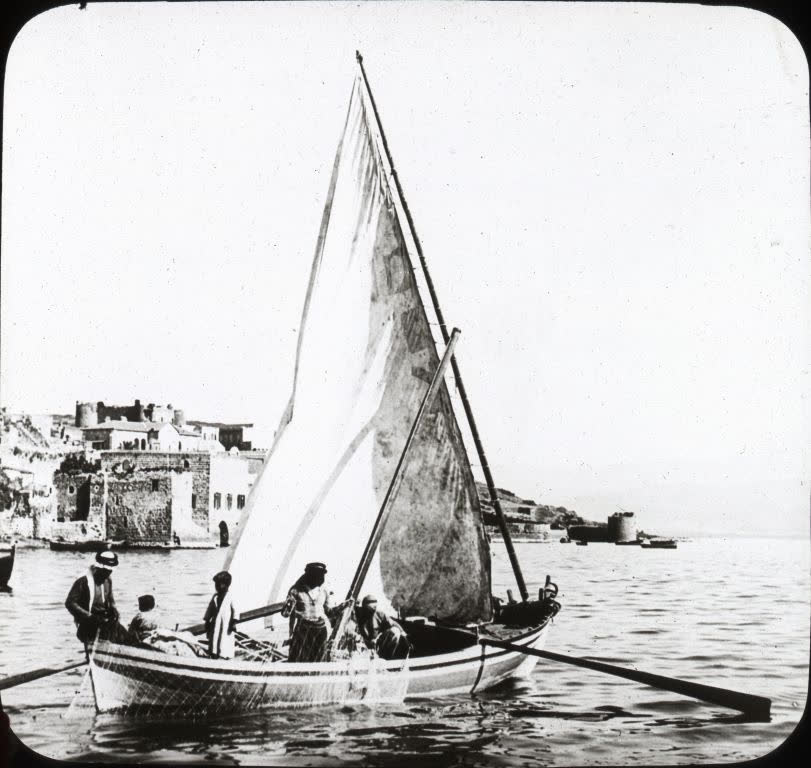
Fishing boats on the Sea of Galilee — the working world of the first disciples, called off these waters into a movement.OSU Special Collections & Archives · Public domain
The word
The English word evangelism comes from the Greek euangelion, "good news" — the word the King James renders "gospel". An evangelist is a bringer of good news. The verb appears in Romans 10, where Paul quotes Isaiah: "How beautiful are the feet of them that preach the gospel of peace, and bring glad tidings of good things!" (Romans 10:15).
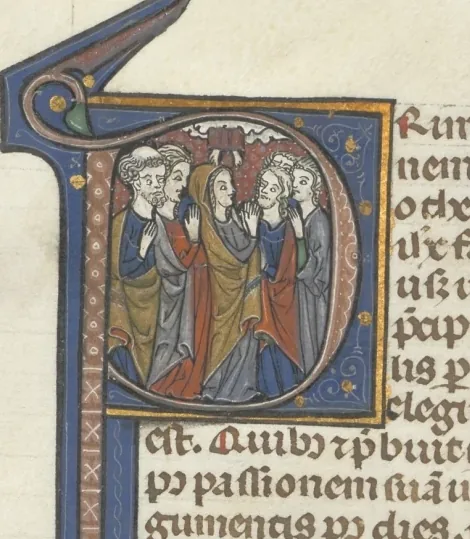
The opening of Acts in a thirteenth-century Bible from southern France, its initial showing the Ascension, when the risen Lord sent His disciples out as witnesses.Fol. 463r, Acts, historiated initial P, the Ascension · c. 1275–1300 · Cleveland Museum of Art · CC0 · full page · museum record · Galeria Regni
So evangelism is, first of all, announcement. It is not advice, and it is not primarily a programme for self-improvement. It is news: something has happened in history that changes everything, and the hearer needs to know it.
The commission
The risen Lord left His disciples with a commission, recorded in several forms. In Matthew: "And Jesus came and spake unto them, saying, All power is given unto me in heaven and in earth. Go ye therefore, and teach all nations, baptizing them in the name of the Father, and of the Son, and of the Holy Ghost: Teaching them to observe all things whatsoever I have commanded you: and, lo, I am with you alway, even unto the end of the world. Amen." (Matthew 28:18-20).
In Mark: "Go ye into all the world, and preach the gospel to every creature. He that believeth and is baptized shall be saved; but he that believeth not shall be damned." (Mark 16:15-16). Mark 16:9-20 stands in the 1611 and the Received Text; where modern versions bracket or question it, you can see the difference set out at kylelauriano.com/library/changes.
In Luke: "Thus it is written, and thus it behoved Christ to suffer, and to rise from the dead the third day: And that repentance and remission of sins should be preached in his name among all nations, beginning at Jerusalem. And ye are witnesses of these things." (Luke 24:46-48).
And in Acts, just before the ascension: "But ye shall receive power, after that the Holy Ghost is come upon you: and ye shall be witnesses unto me both in Jerusalem, and in all Judaea, and in Samaria, and unto the uttermost part of the earth." (Acts 1:8).
Four things stand out across these texts:
The authority is His. The commission begins with "All power is given unto me". We do not go on our own authority or in our own strength.
The scope is everyone. "All nations", "every creature", "the uttermost part of the earth."
The content is fixed. Christ's suffering and resurrection, repentance and remission of sins, preached "in his name".
The presence is promised. "Lo, I am with you alway." The one who sends goes with.
Evangelists and witnesses
Scripture names a particular gift: "And he gave some, apostles; and some, prophets; and some, evangelists; and some, pastors and teachers; For the perfecting of the saints, for the work of the ministry, for the edifying of the body of Christ" (Ephesians 4:11-12). Philip is called "Philip the evangelist" (Acts 21:8), and Paul told Timothy, a pastor, to "do the work of an evangelist" (2 Timothy 4:5).
But the gift of the evangelist does not cancel the calling of every believer to be a witness. When persecution scattered the Jerusalem church, it was not the apostles who went — Acts 8:1 says they stayed — but ordinary believers: "Therefore they that were scattered abroad went every where preaching the word." (Acts 8:4). Some of those unnamed believers crossed a line no one had crossed before: "And some of them were men of Cyprus and Cyrene, which, when they were come to Antioch, spake unto the Grecians, preaching the LORD Jesus. And the hand of the Lord was with them: and a great number believed, and turned unto the Lord." (Acts 11:20-21). The church at Antioch, which later sent out Paul, was planted by people whose names we do not know.
So there are evangelists, gifted to preach and to equip; and there are witnesses, which is every Christian. You may not be the first. You are certainly the second.
Evangelism and discipleship
The commission in Matthew does not end with "go". It ends with "teaching them to observe all things whatsoever I have commanded you". Evangelism is the announcement and the call; discipleship is the long work that follows, in which a new believer is baptised, taught and built into a church. They are distinct, but they belong together. An evangelism that does not lead anywhere is not what Christ commanded. Part 7 of this paper returns to this.
Who does the work
Here is the most freeing truth in this whole subject. The Lord Jesus said of the Holy Ghost: "And when he is come, he will reprove the world of sin, and of righteousness, and of judgment" (John 16:8). Conviction is His work. Paul said the same about his own preaching: "I have planted, Apollos watered; but God gave the increase. So then neither is he that planteth any thing, neither he that watereth; but God that giveth the increase." (1 Corinthians 3:6-7).
When Lydia believed at Philippi, Luke is careful about who did what: Lydia "heard us: whose heart the Lord opened, that she attended unto the things which were spoken of Paul" (Acts 16:14). Paul spoke. The Lord opened. Lydia attended.
Christians have long discussed how God's sovereignty in salvation fits with our responsibility to preach. J. I. Packer's short book Evangelism and the Sovereignty of God (1961) is a classic treatment, and its argument is that the two are not rivals: God's sovereignty is the reason evangelism is not hopeless, and it never excuses us from doing it.1 This paper does not need to settle the wider debate. It needs only the plain point every Christian can agree on: we are responsible to speak faithfully, and we are not responsible to produce the result.
The content: what the gospel is
Before we ask how to share the gospel, we have to know what it is. Paul gives the core: "Moreover, brethren, I declare unto you the gospel which I preached unto you, which also ye have received, and wherein ye stand; By which also ye are saved, if ye keep in memory what I preached unto you, unless ye have believed in vain. For I delivered unto you first of all that which I also received, how that Christ died for our sins according to the scriptures; And that he was buried, and that he rose again the third day according to the scriptures" (1 Corinthians 15:1-4).
From that centre, the apostolic message can be laid out in four movements:
Each part matters, and none may be dropped to make the message easier.
Sin and judgment. Paul did not soften this: "For all have sinned, and come short of the glory of God" (Romans 3:23). He added, "For the wages of sin is death; but the gift of God is eternal life through Jesus Christ our Lord." (Romans 6:23). And "as it is appointed unto men once to die, but after this the judgment" (Hebrews 9:27). The Lord Jesus Himself said, "except ye repent, ye shall all likewise perish" (Luke 13:3). A gospel without sin and judgment is not good news; it is a pleasant thought with nothing to rescue anyone from.
Christ crucified and risen. "But God commendeth his love toward us, in that, while we were yet sinners, Christ died for us." (Romans 5:8). Peter wrote that Christ was the one "Who his own self bare our sins in his own body on the tree, that we, being dead to sins, should live unto righteousness: by whose stripes ye were healed." (1 Peter 2:24). And the resurrection is not an optional extra: "And if Christ be not raised, your faith is vain; ye are yet in your sins." (1 Corinthians 15:17).
Grace. Salvation is a gift: "For by grace are ye saved through faith; and that not of yourselves: it is the gift of God: Not of works, lest any man should boast." (Ephesians 2:8-9). Paul told Titus the same: "Not by works of righteousness which we have done, but according to his mercy he saved us, by the washing of regeneration, and renewing of the Holy Ghost" (Titus 3:5).
Repentance and faith. Paul summed up his whole ministry in Ephesus as "Testifying both to the Jews, and also to the Greeks, repentance toward God, and faith toward our Lord Jesus Christ." (Acts 20:21). Repentance is a turning — from sin and self to God. Faith is trust — resting on Christ and His work, not our own. They are two sides of one turning.
Baptism. When the crowd at Pentecost asked what to do, Peter answered: "Repent, and be baptized every one of you in the name of Jesus Christ for the remission of sins, and ye shall receive the gift of the Holy Ghost." (Acts 2:38). In Acts, people who believed were baptised, usually at once. Baptism is the obedience that follows faith and marks a believer publicly as Christ's.
One way. Peter told the Sanhedrin, "Neither is there salvation in any other: for there is none other name under heaven given among men, whereby we must be saved." (Acts 4:12). The Lord said it of Himself: "I am the way, the truth, and the life: no man cometh unto the Father, but by me." (John 14:6).
Paul's warning about this content is the sternest in the New Testament: "But though we, or an angel from heaven, preach any other gospel unto you than that which we have preached unto you, let him be accursed." (Galatians 1:8). The method can adapt to the hearer. The message cannot.
Part 2 — How the Apostles Did It: Patterns from Acts
8 min read
The Book of Acts is the church's first evangelism manual, though it is written as history rather than as instruction. It matters because it shows the gospel moving through real places — a festival crowd, a desert road, a synagogue, a marketplace, a lecture hall, a prison, a governor's court, a rented house — and it shows how the same message met different people. What follows are the patterns that repeat.
The synagogue at Capernaum, standing on the black-basalt foundations of the 1st-century hall where Jesus taught.שלמה רודד · CC BY 2.5
Pattern 1: Speaking to a crowd that was already asking
Pentecost began with a question. When the Spirit came and the disciples spoke in other tongues, the crowd "were all amazed, and were in doubt, saying one to another, What meaneth this?" (Acts 2:12). Peter stood and answered the question they were asking, and moved from it to Christ. "But Peter, standing up with the eleven, lifted up his voice, and said unto them, Ye men of Judaea, and all ye that dwell at Jerusalem, be this known unto you, and hearken to my words" (Acts 2:14).
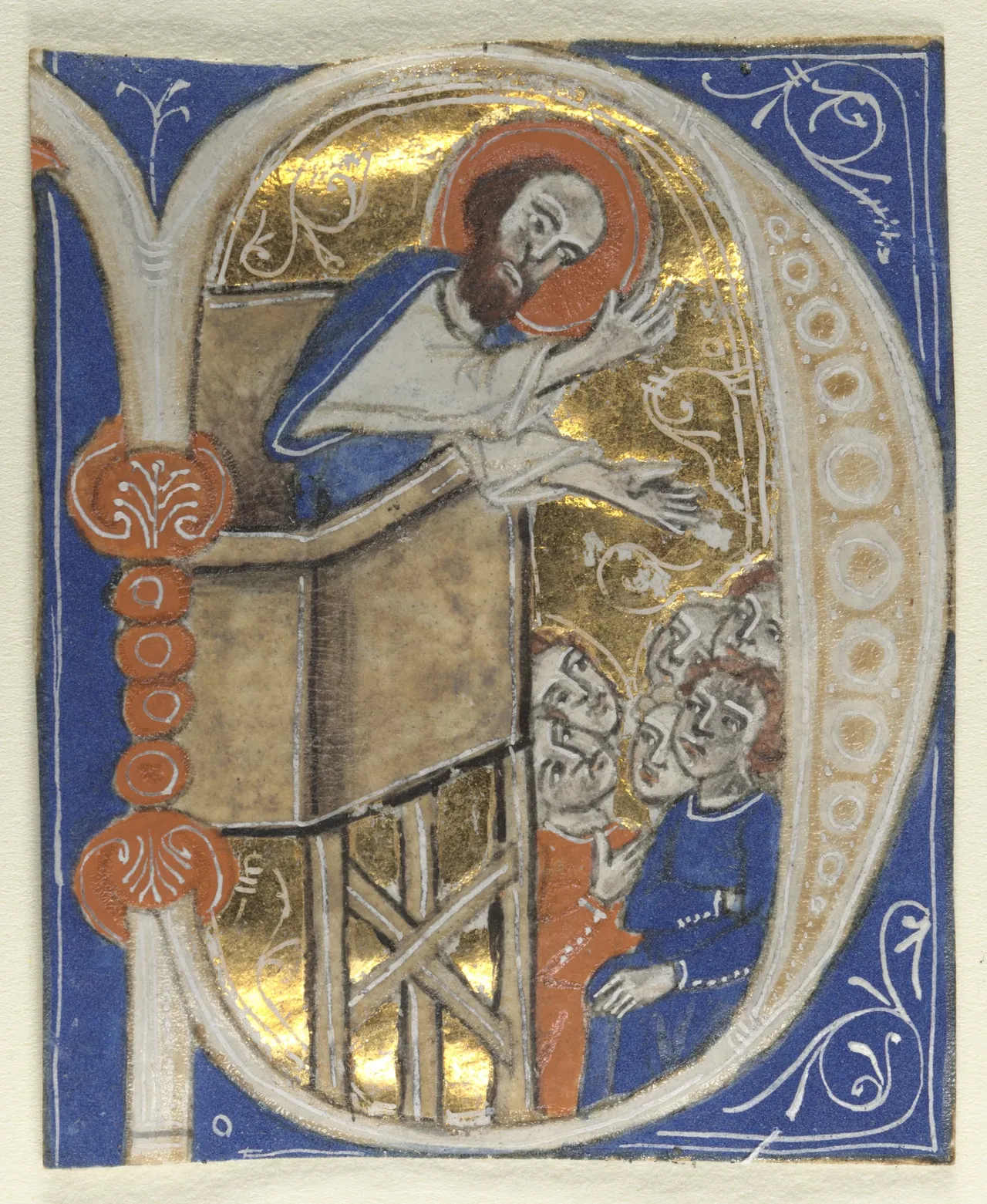
A thirteenth-century Italian initial excised from a Bible showing Saint Paul preaching to a gathered crowd, as he reasoned from the Scriptures in city after city in Acts.Historiated Initial Excised from a Bible: St. Paul Preaching · 1200s · Cleveland Museum of Art · CC0 · museum record · Galeria Regni
His sermon is mostly Scripture — Joel and two psalms — and it ends on the person of Christ: "Therefore let all the house of Israel know assuredly, that God hath made that same Jesus, whom ye have crucified, both Lord and Christ." (Acts 2:36). The response came from the hearers: "Now when they heard this, they were pricked in their heart, and said unto Peter and to the rest of the apostles, Men and brethren, what shall we do?" (Acts 2:37).
Notice the order. Peter did not manufacture the conviction. The word did that, and the people asked. Then Peter told them plainly what to do (Acts 2:38), and "with many other words did he testify and exhort" (Acts 2:40). About three thousand were added that day (Acts 2:41).
Pattern 2: Ordinary people, plainly bold
When the Sanhedrin questioned Peter and John, the rulers noticed something: "Now when they saw the boldness of Peter and John, and perceived that they were unlearned and ignorant men, they marvelled; and they took knowledge of them, that they had been with Jesus." (Acts 4:13). "Unlearned and ignorant" here means without formal training, not foolish. Their boldness came from having been with Jesus, not from a school.
When they were ordered to stop, their answer is the heart of all witness: "Whether it be right in the sight of God to hearken unto you more than unto God, judge ye. For we cannot but speak the things which we have seen and heard." (Acts 4:19-20). Then they went back to the church and prayed — not for safety, but for boldness: "And now, Lord, behold their threatenings: and grant unto thy servants, that with all boldness they may speak thy word" (Acts 4:29). Luke records the answer: "And when they had prayed, the place was shaken where they were assembled together; and they were all filled with the Holy Ghost, and they spake the word of God with boldness." (Acts 4:31).
Boldness in Acts is something prayed for and given. That is good news for the timid.
Pattern 3: One person, one question, one Scripture
The account of Philip and the Ethiopian is the most detailed one-to-one conversation in Acts. The Spirit sent Philip to a desert road (Acts 8:26-29). He found a man reading Isaiah aloud, and he began with a question: "And Philip ran thither to him, and heard him read the prophet Esaias, and said, Understandest thou what thou readest? And he said, How can I, except some man should guide me? And he desired Philip that he would come up and sit with him." (Acts 8:30-31).
Then: "Philip opened his mouth, and began at the same scripture, and preached unto him Jesus." (Acts 8:35). He started where the man was — in Isaiah 53 — and went to Christ. The man asked to be baptised, and Philip answered: "If thou believest with all thine heart, thou mayest. And he answered and said, I believe that Jesus Christ is the Son of God." (Acts 8:37). That verse stands in the 1611 and the Received Text; where modern versions omit it, the difference is set out at kylelauriano.com/library/changes.
Three lessons are in this short account: go where you are sent, ask a real question, and begin where the other person already is.
Pattern 4: Reasoning from the Scriptures
With Jews and God-fearers, Paul's method was to reason from the Old Testament: "And Paul, as his manner was, went in unto them, and three sabbath days reasoned with them out of the scriptures, Opening and alleging, that Christ must needs have suffered, and risen again from the dead; and that this Jesus, whom I preach unto you, is Christ." (Acts 17:2-3). At Corinth "he reasoned in the synagogue every sabbath, and persuaded the Jews and the Greeks." (Acts 18:4).
"Reasoned", "opening", "alleging", "persuaded" — these are words of argument and explanation. Evangelism in Acts is not only testimony; it includes giving reasons. That is why Peter could later write that believers should "be ready always to give an answer to every man that asketh you a reason of the hope that is in you with meekness and fear" (1 Peter 3:15).
Pattern 5: The marketplace and the unknown god
In Athens, Paul went to two places: "Therefore disputed he in the synagogue with the Jews, and with the devout persons, and in the market daily with them that met with him." (Acts 17:17). The market — the agora — was the public square. Paul talked with whoever was there, daily.
When the philosophers brought him to the Areopagus, he began with something he had seen in their own city: "For as I passed by, and beheld your devotions, I found an altar with this inscription, TO THE UNKNOWN GOD. Whom therefore ye ignorantly worship, him declare I unto you." (Acts 17:23). From there he spoke of God as Creator, of the folly of idols, and then he came to the point: God "now commandeth all men every where to repent: Because he hath appointed a day, in the which he will judge the world in righteousness by that man whom he hath ordained; whereof he hath given assurance unto all men, in that he hath raised him from the dead." (Acts 17:30-31).
Paul built a bridge from what the Athenians knew, but he did not stay on the bridge. He arrived at repentance, judgment and the resurrection. And the results were mixed, as they always are: "And when they heard of the resurrection of the dead, some mocked: and others said, We will hear thee again of this matter." (Acts 17:32). Luke adds, "Howbeit certain men clave unto him, and believed: among the which was Dionysius the Areopagite, and a woman named Damaris, and others with them." (Acts 17:34).
Mockery, curiosity and faith, all from one talk. That is normal.
Pattern 6: A settled place and patient teaching
In Ephesus, when opposition closed the synagogue, Paul rented a lecture hall: "he departed from them, and separated the disciples, disputing daily in the school of one Tyrannus. And this continued by the space of two years; so that all they which dwelt in Asia heard the word of the Lord Jesus, both Jews and Greeks." (Acts 19:9-10). Two years of daily teaching in one place reached a whole province, because the people who heard it carried it home.
Paul later described his Ephesian ministry to the elders: "And how I kept back nothing that was profitable unto you, but have shewed you, and have taught you publickly, and from house to house, Testifying both to the Jews, and also to the Greeks, repentance toward God, and faith toward our Lord Jesus Christ." (Acts 20:20-21). Public and private, hall and home — both.
Pattern 7: Before rulers, and in a rented house
Paul's defence before King Agrippa ended with one of the most personal exchanges in the New Testament: "Then Agrippa said unto Paul, Almost thou persuadest me to be a Christian. And Paul said, I would to God, that not only thou, but also all that hear me this day, were both almost, and altogether such as I am, except these bonds." (Acts 26:28-29). Paul wanted Agrippa saved. He said so. He did not pretend indifference, and he did not force anything.
Acts closes with Paul under house arrest in Rome, and still the pattern holds. "And when they had appointed him a day, there came many to him into his lodging; to whom he expounded and testified the kingdom of God, persuading them concerning Jesus, both out of the law of Moses, and out of the prophets, from morning till evening. And some believed the things which were spoken, and some believed not." (Acts 28:23-24). The book ends: "Preaching the kingdom of God, and teaching those things which concern the Lord Jesus Christ, with all confidence, no man forbidding him." (Acts 28:31).
What the patterns add up to
| Setting in Acts | What happened | What it teaches | |---|---|---| | Festival crowd (Acts 2) | Answered the question they were asking | Start from real questions | | Before the council (Acts 4) | "We cannot but speak" | Witness is what we have seen and heard | | Desert road (Acts 8) | "Understandest thou?" — began at their Scripture | Ask; begin where they are | | Synagogue (Acts 17:2-3) | Reasoned from the Scriptures | Give reasons, not only feelings | | Marketplace (Acts 17:17) | Daily conversations with whoever came | Public conversation is normal | | Areopagus (Acts 17:22-34) | Bridge from their altar to the risen Christ | Build a bridge, then cross it | | Lecture hall (Acts 19) | Two years of daily teaching | Patience and a settled place | | House to house (Acts 20) | Public and private teaching | Both, not either | | Before a king (Acts 26) | "I would to God…" | Say honestly what you want for them | | Rented house (Acts 28) | Persuading from morning till evening; some believed, some not | Faithfulness, not guaranteed results |
Across all of them, three constants: the message is Christ crucified and risen; the messengers depend on the Holy Ghost; and the responses are mixed. No one in Acts converted everyone. No one in Acts stopped.
This part matters because the church did not stop evangelising when Acts ended, and the people who did it best left records that are still useful — both for what they did right and for the mistakes they confessed. What follows is limited to things their own writings or eyewitnesses record.
The second century: villages and farms
Around AD 112, Pliny the Younger, the Roman governor of Bithynia in what is now northern Turkey, wrote to the emperor Trajan for advice on what to do with Christians. His letter is one of the earliest non-Christian descriptions of the church. He complained that this "contagious superstition is not confined to the cities only, but has spread its infection among the neighbouring villages and country", and that it had reached "persons of all ranks and ages, and even of both sexes."2
Pliny also recorded what he learned about these people under interrogation: that they met before dawn and sang to Christ "as to a divinity", and bound themselves "never to commit any fraud, theft, or adultery, never to falsify their word".3 There were no church buildings, no media and no budget. The gospel spread village by village, through people whose lives matched what they said.
George Whitefield and the colliers
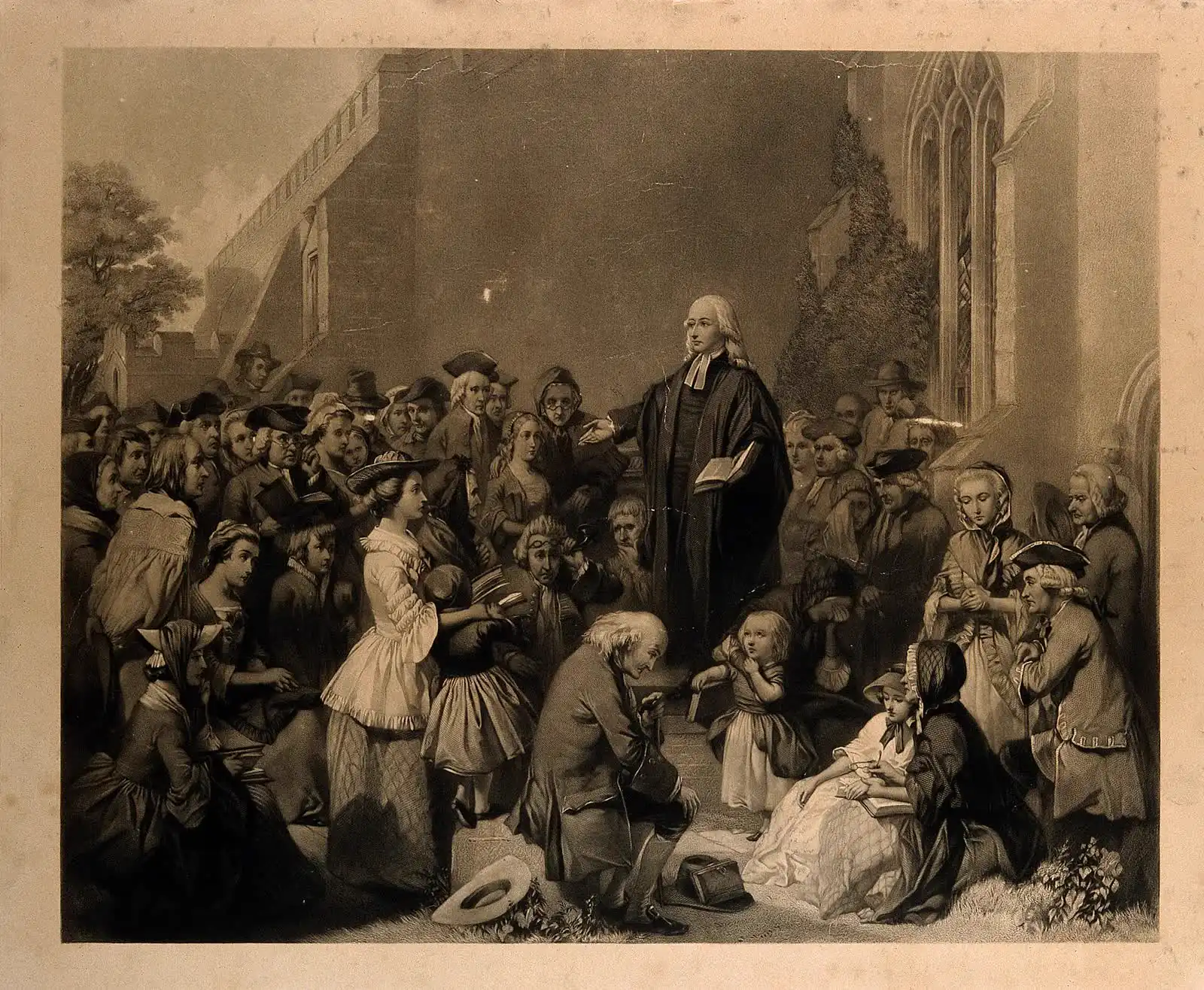
In early 1739, George Whitefield, a young Church of England clergyman, found the pulpits of Bristol closing to him. Outside the city lay Kingswood, a coal-mining district whose colliers had, according to his first biographer John Gillies, no place of worship and a reputation so rough that, as Gillies put it, "nobody cared to go among them". After prayer and, in Gillies's words, "many struggles with himself", Whitefield went to Hannam Mount, stood on a hill, "began to preach to about a hundred colliers, upon Matt. v. 1, 2, 3." Within a few visits the crowds were counted in the thousands.4
Whitefield's own account, which Gillies quotes, is one of the most famous lines in the history of evangelism: "The first discovery of their being affected, was to see the white gutters made by their tears, which plentifully fell down their black cheeks, as they came out of their coal-pits." He explained why he had gone outdoors at all: he thought it might be doing the service of his Creator, "who had a mountain for his pulpit, and the heavens for his sounding board".5
Benjamin Franklin, who was not a believer, heard Whitefield preach in Philadelphia later that year and left an eyewitness record. He observed "the extraordinary influence of his oratory on his hearers", and the change that followed in the town: "From being thoughtless or indifferent about religion, it seem'd as if all the world were growing religious, so that one could not walk thro' the town in an evening without hearing psalms sung in different families of every street."6
Franklin also bore witness to something that matters for every evangelist. Whitefield took up collections for an orphan house, and his enemies hinted that he kept the money. Franklin, who printed Whitefield's sermons and journals and knew his affairs, wrote that he "never had the least suspicion of his integrity" and judged him "in all his conduct a perfectly honest man" — adding that his testimony ought to carry weight "as we had no religious connection."7 The preacher's honesty was visible even to an unbeliever who never accepted his message.
John Wesley: "I submitted to be more vile"
John Wesley's conversion is recorded in his journal for 24 May 1738, at a meeting in Aldersgate Street, London, where someone was reading Luther's preface to Romans: "About a quarter before nine, while he was describing the change which God works in the heart through faith in Christ, I felt my heart strangely warmed. I felt I did trust in Christ, Christ alone, for salvation".8
The next year Whitefield invited him to Bristol. Wesley admitted he could scarcely reconcile himself "to this strange way of preaching in the fields". He had been, he wrote, "so tenacious of every point relating to decency and order that I should have thought the saving of souls almost a sin if it had not been done in a church." Then, on 2 April 1739: "At four in the afternoon, I submitted to be more vile and proclaimed in the highways the glad tidings of salvation, speaking from a little eminence in a ground adjoining to the city, to about three thousand people."9
"Submitted to be more vile" is an echo of David's words in 2 Samuel 6:22. Wesley felt that preaching outdoors was beneath his dignity, and he did it anyway. Most believers know that feeling. The answer to it is not to wait until it goes away.
When critics objected that he was preaching in other men's parishes, Wesley answered with a line that became a motto: "I look upon all the world as my parish; thus far I mean, that, in whatever part of it I am, I judge it meet, right, and my bounden duty to declare unto all that are willing to hear, the glad tidings of salvation."10 Note the qualifier: "unto all that are willing to hear". Wesley preached to crowds who came and stayed; he did not force his message on the unwilling.
In 1742, refused the pulpit of his late father's church at Epworth, he stood in the churchyard on his father's tombstone and preached to a congregation that, he wrote, "I believe Epworth never saw before."11 A closed door is not always the end of the matter.
Spurgeon and the lay preacher
Charles Haddon Spurgeon became the most widely read preacher of the nineteenth century. He was converted, at fifteen, through a man whose name he never learned. On a snowy Sunday morning — 6 January 1850, as the editors of his Autobiography establish from his own later sermon — he turned into a small Primitive Methodist chapel in Colchester. The minister did not arrive. A layman, "a shoemaker, or tailor, or something of that sort," as Spurgeon remembered him, went up to preach on Isaiah 45:22: "Look unto me, and be ye saved, all the ends of the earth: for I am God, and there is none else." (Isaiah 45:22).12
Spurgeon was frank that the man was no great preacher — "He was obliged to stick to his text, for the simple reason that he had little else to say." But the text was enough. "Look unto Me; I am sweatin' great drops of blood. Look unto Me; I am hangin' on the cross. Look unto Me; I am dead and buried. Look unto Me; I rise again." Then, fixing his eyes on the stranger under the gallery: "Young man, look to Jesus Christ. Look! Look! Look! You have nothin' to do but to look and live." Spurgeon wrote: "I saw at once the way of salvation."13
The greatest preacher of the age was brought to Christ by a man with "little else to say" than one verse, said plainly to one person. Remember that the next time you think you are not equipped.
D. L. Moody and the "very weak plea"
Dwight L. Moody, the best-known American evangelist of the late nineteenth century, was a young clerk in his uncle's shoe store in Boston when his Sunday-school teacher, Edward Kimball, decided to speak to him. Kimball's own account survives in the biography written by Moody's son. He walked past the shop once, unsure whether he should go in during business hours, then "determined to make a dash for it and have it over at once." He found Moody in the back, wrapping shoes. "I went up to him at once, and putting my hand on his shoulder, I made what I afterwards felt was a very weak plea for Christ. I don't know just what words I used, nor could Mr. Moody tell. I simply told him of Christ's love for him and the love Christ wanted in return. That was all there was."14 In May 1855 Moody applied for membership of the Mount Vernon Church in Boston; the church minute recorded that he "Saw himself a sinner" and was "not ashamed to be known as a Christian."15
Kimball was nervous, nearly walked away, and thought he had done it badly. That "very weak plea" reached a young man who would later preach to great crowds on two continents. Faithfulness, not polish, is what God used.
Moody himself later said: "For a good many years I have made it a rule not to let any day pass without speaking to some one about eternal things."16 That was his own rule, not a law for every Christian, but it shows how evangelism becomes a habit rather than an event.
A mistake Moody confessed
Moody also recorded a mistake that haunted him. In October 1871 he preached in Farwell Hall, Chicago, on the question "What shall I do with Jesus?" He closed by telling the audience to take the question home "and next Sunday I want you to come back and tell me what you are going to do with Him." That night the Great Chicago Fire broke out. "About one o'clock Farwell hall was burned; soon the church in which I had preached went down, and everything was scattered. I never saw that audience again." He concluded: "Since then I never have dared give an audience a week to think of their salvation."17
That is a real lesson about urgency, and Scripture backs it: "behold, now is the accepted time; behold, now is the day of salvation." (2 Corinthians 6:2). But it has to be held together with the next part of this paper. Urgency is true. Pressure is not the answer to it.
What history teaches
Ordinary people are God's usual instruments. A Sunday-school teacher, a lay preacher with one verse, unnamed believers in villages.
Plain gospel works. "Look unto me." "Christ's love for him." Nothing clever.
Going outside the usual walls is often necessary. Whitefield and Wesley went to the fields because the people were there and the doors were closed.
Integrity is part of the witness. Pliny's Christians kept their word; Franklin trusted Whitefield's honesty.
The evangelists themselves were honest about their failures. We should be too.
Part 4 — Free Truth, No Pressure: The Ethics of Persuasion
5 min read
This part matters because the two great failures in evangelism are opposites. One is pressure: tricks, guilt, emotional manipulation, decisions pushed out of people. The other is silence: never saying anything, in the name of respect. Scripture forbids both.
What Paul refused to do
Paul described his own method in terms that rule out every manipulative technique: "But have renounced the hidden things of dishonesty, not walking in craftiness, nor handling the word of God deceitfully; but by manifestation of the truth commending ourselves to every man's conscience in the sight of God." (2 Corinthians 4:2).
Heinrich Hofmann's 1889 painting Christ and the Rich Young Ruler, the man Jesus loved, told the truth, and then let walk away.Christ and the Rich Young Ruler, Heinrich Hofmann · 1889 · Wikimedia Commons · Public domain · museum record · Galeria Regni
To the Thessalonians he wrote: "For our exhortation was not of deceit, nor of uncleanness, nor in guile: But as we were allowed of God to be put in trust with the gospel, even so we speak; not as pleasing men, but God, which trieth our hearts. For neither at any time used we flattering words, as ye know, nor a cloke of covetousness; God is witness" (1 Thessalonians 2:3-5).
And to the Corinthians: "And my speech and my preaching was not with enticing words of man's wisdom, but in demonstration of the Spirit and of power: That your faith should not stand in the wisdom of men, but in the power of God." (1 Corinthians 2:4-5).
Put those texts together and the list of what is forbidden is clear:
Deceit — hiding what following Christ costs, or promising what God has not promised (health, wealth, an easy life).
Craftiness — scripted traps, bait-and-switch conversations, pretending to be doing a "survey" when you are not.
Flattery — telling people what they want to hear to win them.
A cloke of covetousness — any hint that the conversation is really about money, numbers or your reputation.
Enticing words — emotional manipulation designed to produce a response the person has not actually reached.
What Paul did do
Yet the same Paul wrote, "Knowing therefore the terror of the Lord, we persuade men" (2 Corinthians 5:11). And: "Now then we are ambassadors for Christ, as though God did beseech you by us: we pray you in Christ's stead, be ye reconciled to God." (2 Corinthians 5:20).
Persuading and beseeching are not manipulation. Persuasion appeals to a person's mind and conscience with the truth, openly. Manipulation goes around the mind and conscience to get a result. The difference is whether you would be comfortable with the person seeing exactly what you are doing and why. Paul was: "by manifestation of the truth commending ourselves to every man's conscience".
The Lord who let a man walk away
The clearest picture of this in the Gospels is the rich young ruler. "Then Jesus beholding him loved him, and said unto him, One thing thou lackest: go thy way, sell whatsoever thou hast, and give to the poor, and thou shalt have treasure in heaven: and come, take up the cross, and follow me. And he was sad at that saying, and went away grieved: for he had great possessions." (Mark 10:21-22).
Jesus loved him. Jesus told him the truth, including the cost. And Jesus let him walk away. He did not chase him down the road with a softer offer. That is our pattern: love, truth, and freedom.
Spurgeon on "undue pressure"
Spurgeon, who wanted souls won as much as anyone who ever lived, wrote some of the sharpest warnings against pressure. In The Soul-Winner he described young men who were pressed by a well-meaning pastor until they made a profession of faith: "to secure them, he made them hypocrites." Some of the most glaring sinners he knew, he wrote, had once been church members, "led to make a profession by undue pressure, well-meant but ill-judged."18
He was just as hard on manufactured emotion: "Do not aim at sensation and 'effect.' Flowing tears and streaming eyes, sobs and outcries, crowded after-meetings and all kinds of confusion may occur, and may be borne with as concomitants of genuine feeling; but pray do not plan their production." And: "It very often happens that the converts that are born in excitement die when the excitement is over."19
And on tricks of every kind: "to endeavour to save men by mere claptrap, or excitement, or oratorical display, is as foolish as to hope to hold an angel with bird-lime, or lure a star with music. The best attraction is the gospel in its purity."20
He also mocked inflated reporting: "I am weary of this public bragging, this counting of unhatched chickens, this exhibition of doubtful spoils."21 A real conversion is something that "will need the testing of a lifetime", not something to be certified in half a minute.
Urgency without pressure
How do Moody's lesson from the Chicago fire and Spurgeon's warnings fit together? Like this: the truth is urgent, and you may say so honestly. "Now is the day of salvation" is Scripture. What you may not do is manufacture a decision. You can tell someone, plainly and kindly, "I don't know if either of us will be here next week, and I don't want you to put this off." You cannot trap them, shame them, or keep them until they say the words you want.
Here is a simple test for any technique you are taught:
| Ask yourself | If the answer is yes | |---|---| | Would I be embarrassed if they knew exactly why I said this? | Drop it | | Am I hiding the cost of following Christ? | Tell them the cost | | Am I trying to get words out of them rather than faith into them? | Stop and listen | | Would I keep going if they said "no" clearly? | Respect the no | | Is this about my numbers, my church's numbers, or my reputation? | Repent of it |
The opposite failure: silence
Pressure is one failure. Silence is the other, and in our time it may be the more common one. In 2019 the Barna Group published research, commissioned by Alpha USA, which found that 47 percent of practising Christian Millennials in the United States agreed at least somewhat that "it is wrong to share one's personal beliefs with someone of a different faith in hopes that they will one day share the same faith." The figures for older generations were lower: 27 percent of Gen X, 19 percent of Boomers.22
That instinct often comes from a good place — a hatred of pushiness. But it confuses respect with silence. If the gospel is true, then keeping it to yourself is not respect. Paul's heart was the opposite: "Brethren, my heart's desire and prayer to God for Israel is, that they might be saved." (Romans 10:1). And the logic of Romans 10 is unanswerable: "How then shall they call on him in whom they have not believed? and how shall they believe in him of whom they have not heard? and how shall they hear without a preacher?" (Romans 10:14). His conclusion follows: "So then faith cometh by hearing, and hearing by the word of God." (Romans 10:17).
Spurgeon put it in one line: "it must not be tolerated that Christ should be unknown through our silence, and sinners unwarned through our negligence."23
The answer to pushiness is not silence. It is honest, gentle, clear speech, followed by real freedom for the hearer.
This part matters because most evangelism does not happen from a platform. It happens in kitchens, cars, break rooms, hospital corridors and text threads, between people who know each other a little or a lot. What follows is a method, not a script. Use it the way a carpenter uses a square: to keep things true, not to replace judgment.
Wheat at harvest — the image Jesus reached for when He said the harvest is plentiful but the workers are few (Matthew 9).Chparveshtaak · CC BY-SA 4.0
Step 1: Pray for doors and for words
Paul asked the churches to pray for two things: opportunities and clarity. "Withal praying also for us, that God would open unto us a door of utterance, to speak the mystery of Christ, for which I am also in bonds: That I may make it manifest, as I ought to speak." (Colossians 4:3-4). And for courage: "that utterance may be given unto me, that I may open my mouth boldly, to make known the mystery of the gospel" (Ephesians 6:19).
The Lord told His disciples to pray for workers: "The harvest truly is plenteous, but the labourers are few; Pray ye therefore the Lord of the harvest, that he will send forth labourers into his harvest." (Matthew 9:37-38). It is a dangerous prayer. The people who pray it usually become the answer.
A practical habit: keep a short list of people you know who do not know Christ, and pray for them by name. Ask God for a door with each one.
Step 2: Walk wisely and notice
"Walk in wisdom toward them that are without, redeeming the time. Let your speech be alway with grace, seasoned with salt, that ye may know how ye ought to answer every man." (Colossians 4:5-6). Three things are in those verses: wisdom in how you live, attention to opportunities ("redeeming the time"), and speech that is gracious and has flavour.
Most doors open through something the other person says: a worry, a loss, a question about death, a comment about a news story, a remark about how you seem different. Notice those moments. "A word fitly spoken is like apples of gold in pictures of silver." (Proverbs 25:11).
Step 3: Listen first
"Wherefore, my beloved brethren, let every man be swift to hear, slow to speak, slow to wrath" (James 1:19). Listening is not a technique to soften someone up. It is how you learn who they are and what they actually believe, so that what you say is for them and not for a generic unbeliever.
Ask, and then actually listen to the answer. You will often find that the person's real question is not the one you prepared for.
Step 4: Ask good questions
The Lord Jesus asked questions constantly. He asked His disciples, "Whom do men say that I the Son of man am?" (Matthew 16:13); He asked a blind man, "What wilt thou that I should do unto thee?" (Mark 10:51); and He asked Martha, "Believest thou this?" (John 11:26). Philip opened with one: "Understandest thou what thou readest?" (Acts 8:30).
Gregory Koukl, in his book Tactics and in his teaching at Stand to Reason, recommends what he calls the "Columbo" approach, after the television detective, built on two mild questions: "What do you mean by that?" and "How did you come to that conclusion?"24 The first clarifies; the second invites the person to give their reasons. Neither attacks, and both take the other person seriously.
Other questions that open honest conversations:
"Do you have any spiritual beliefs? How did you come to them?"
"Who do you think Jesus was?"
"What do you think happens when we die?"
"If God were real, would you want to know Him?"
"Can I tell you what changed my mind?"
Michael Ray Lewis told his story on The King Is Coming Show (TKIC #48): an atheist who mocked Christians — until, in his telling, one question undid him. Watch it in his own words: youtube.com/watch?v=Rd-RdSqeQDk Michael's account of what happened to him, shared as his testimony — weigh it for yourself.
Step 5: Tell what happened to you
When the Lord delivered the man from Gadara, the man wanted to go with Him. Jesus sent him home instead: "Go home to thy friends, and tell them how great things the Lord hath done for thee, and hath had compassion on thee." (Mark 5:19). The man born blind, questioned by the Pharisees, could not answer their theology, but he could answer this: "one thing I know, that, whereas I was blind, now I see." (John 9:25).
Your story is not the gospel. It is a witness to the gospel. A good testimony does three things briefly: what you were like, how you came to Christ, and what has changed. It points to Him, not to you. And it is true — not polished into something more dramatic than it was.
Mine is short: "I came to disprove God. He met me instead — and I couldn't unsee what time it is." You can hear the full version in my own words at kylelauriano.com/about. If you want to shape your own story, the site's Level 2 paper, Share Your Story, walks through it.
Step 6: Bring them to Jesus, not just to an argument
The first disciples did something very simple. "One of the two which heard John speak, and followed him, was Andrew, Simon Peter's brother. He first findeth his own brother Simon, and saith unto him, We have found the Messias, which is, being interpreted, the Christ. And he brought him to Jesus." (John 1:40-42). When Nathanael objected — "Can there any good thing come out of Nazareth?" — Philip did not argue. "Philip saith unto him, Come and see." (John 1:46).
"Come and see" is still the best invitation. Invite people to read a Gospel with you. John wrote his for exactly this purpose: "But these are written, that ye might believe that Jesus is the Christ, the Son of God; and that believing ye might have life through his name." (John 20:31). The Samaritan woman did the same for her town: "Come, see a man, which told me all things that ever I did: is not this the Christ?" (John 4:29). And the end of that story is the goal of every witness: "Now we believe, not because of thy saying: for we have heard him ourselves, and know that this is indeed the Christ, the Saviour of the world." (John 4:42).
Step 7: Explain the gospel clearly
At some point, the person needs to hear the message itself, not only your story. It can be said in two minutes, and it can be said in two hours. Here is a short form that keeps every essential part, with a verse for each:
1. God made us and we answer to Him. He "hath appointed a day, in the which he will judge the world in righteousness" (Acts 17:31). 2. We have all sinned. "For all have sinned, and come short of the glory of God" (Romans 3:23). Sin earns death (Romans 6:23). 3. God sent His Son. "For God so loved the world, that he gave his only begotten Son, that whosoever believeth in him should not perish, but have everlasting life." (John 3:16). 4. Christ died for our sins and rose again. "How that Christ died for our sins according to the scriptures; And that he was buried, and that he rose again the third day according to the scriptures" (1 Corinthians 15:3-4). 5. Salvation is a gift received by faith. "For by grace are ye saved through faith" (Ephesians 2:8). 6. God calls us to repent and believe. "Repent ye, and believe the gospel." (Mark 1:15). Believers are baptised in obedience (Acts 2:38) and follow Christ in His church.
Use your own words between the verses. Avoid church jargon where you can, and explain it where you cannot. Do not leave out repentance, sin or judgment to make it easier. Do not leave out grace to make it sterner.
Step 8: Invite a response, and leave them free
The gospel calls for a response, and it is right to ask for one. "That if thou shalt confess with thy mouth the Lord Jesus, and shalt believe in thine heart that God hath raised him from the dead, thou shalt be saved." (Romans 10:9). You might simply ask, "Is there anything stopping you from trusting Christ today?" or "Would you like to talk to God about this now?"
If they want to pray, help them — but remember that no form of words saves anyone. A sinner who turns to Christ and calls on Him is heard: "For whosoever shall call upon the name of the Lord shall be saved." (Romans 10:13). The thief on the cross had no script: "Lord, remember me when thou comest into thy kingdom." (Luke 23:42). What matters is the heart's turning, not the precise sentence.
If they are not ready, say so honestly and leave the door open. Felix told Paul, "Go thy way for this time; when I have a convenient season, I will call for thee." (Acts 24:25). Paul did not force him. You can say, kindly, that you hope they will not wait too long, and that you will keep praying.
Some hypothetical conversations
The following are illustrations, not real people. They show the method in ordinary settings.
Suppose a coworker mentions she cannot sleep because of worry about her son. You listen. You ask how long it has been like this. Later you might say, "Can I tell you what I do with that kind of worry?" — and share honestly that you pray, and why you believe Someone hears. If she wants to go further, you can explain who Jesus is and why you trust Him. If not, you offer to pray for her son, and you do.
Suppose a friend says, "I just think all religions are basically the same." Instead of a speech, you ask, "What do you mean by that?" Perhaps he means they all teach being good. You might say that is exactly where Christianity is different: it says none of us is good enough, and that God Himself came to rescue us. Then ask what he makes of Jesus' claim in John 14:6.
Suppose your father, who has watched your life change, asks, "What's got into you?" Family is the hardest audience; the Lord Himself said, "A prophet is not without honour, but in his own country, and among his own kin, and in his own house." (Mark 6:4). Answer simply and humbly. Admit your failures. Tell him what Christ has done. Do not preach at every family dinner. Live it for years if you have to.
Witness at work and in the neighbourhood
Two cautions for the places where you spend most of your week.
At work, do your job well and honestly. "And whatsoever ye do, do it heartily, as to the Lord, and not unto men" (Colossians 3:23). Respect your employer's rules about time and conduct, and do not use your position over someone to press your faith on them. The conversations that matter usually happen at lunch, after hours, or when a colleague comes to you.
In the neighbourhood, hospitality opens more doors than leaflets. A meal, a lent tool, help in a crisis — these are not tricks to earn a hearing. They are what love does. But love also speaks. Spurgeon praised the believers who preached "with your feet", by holy living, and then added that the living word is better still than any paper: "A tract is a useful thing, but a living word is better."25
This part matters because honest people have honest questions, and running from them suggests you have no answers. At the same time, evangelism is not a debate tournament. Peter's instruction holds both together: "But sanctify the Lord God in your hearts: and be ready always to give an answer to every man that asketh you a reason of the hope that is in you with meekness and fear: Having a good conscience; that, whereas they speak evil of you, as of evildoers, they may be ashamed that falsely accuse your good conversation in Christ." (1 Peter 3:15-16).
Ready, reasoned, meek, and with a clean conscience. Paul added the tone: "And the servant of the Lord must not strive; but be gentle unto all men, apt to teach, patient, In meekness instructing those that oppose themselves; if God peradventure will give them repentance to the acknowledging of the truth" (2 Timothy 2:24-25).
Three kinds of objection
It helps to recognise what kind of objection you are hearing:
Questions. The person genuinely wants to know. Answer as well as you can, and say so when you do not know.
Smoke screens. The objection is a way of avoiding something else. Answer briefly, then gently ask about the real issue.
Hurts. The objection is pain — a death, a betrayal by a church, an unanswered prayer. Listen first. Grief is not an argument to be won.
Common objections and where to begin
The answers below are starting points. Each subject has whole books behind it, and the site has papers on most of them (The Evidence, Is the Bible Reliable?, The Problem of Evil, Common Objections).
"Jesus probably never existed, or never rose." Paul wrote that the risen Christ "was seen of above five hundred brethren at once; of whom the greater part remain unto this present" (1 Corinthians 15:6) — an invitation to check with living witnesses. Gary Habermas and Michael Licona, in The Case for the Resurrection of Jesus, set out a "minimal facts" approach, building only on facts that most scholars who study the subject grant, and argue that the resurrection is the best explanation of them.26 Lee Strobel's The Case for Christ and J. Warner Wallace's Cold-Case Christianity came from two men who began as sceptics and examined the evidence as a journalist and a homicide detective.27 And Paul himself admitted what is at stake: "And if Christ be not risen, then is our preaching vain, and your faith is also vain." (1 Corinthians 15:14). Christianity invites the question.
"How can you trust the Bible?" Start with the person of Christ rather than defending every verse at once; if Jesus rose, His view of Scripture matters. Invite them to read a Gospel and judge for themselves, like the Bereans who "searched the scriptures daily, whether those things were so" (Acts 17:11). For those who ask about translations and manuscripts, this ministry holds to the King James Bible and the Received Text, and the places where modern versions differ from the 1611 are set out openly at kylelauriano.com/library/changes.
"If God is good, why is there so much suffering?" Listen before you answer; ask whether the question is personal. Then remember that Christianity does not deny suffering. Its centre is a suffering God-man, who "was wounded for our transgressions, he was bruised for our iniquities" (Isaiah 53:5), and who promises an end to it. Do not offer slogans to someone grieving.
"All religions lead to God." Respectfully point out that the religions themselves do not say so, and that Jesus did not: "I am the way, the truth, and the life: no man cometh unto the Father, but by me." (John 14:6). Then ask what they make of Him. The question is not "Which religion is nicest?" but "Is Jesus who He said He was?"
"I'm a good person." Ask by whose standard. Most people, honestly asked, admit they have lied, envied and hurt others. Scripture's measure is God's glory: "all have sinned, and come short of the glory of God" (Romans 3:23). The good news is that salvation is not for good people; "the Son of man is come to seek and to save that which was lost." (Luke 19:10).
"Christians are hypocrites." Agree that many are, and that you have been one. Then point to Christ, who is not. The failures of His followers are a reason to look at Him more closely, not less.
"I'm not ready." Respect it, and ask what would need to change. Be honest that none of us is promised tomorrow (Hebrews 9:27), and leave the door open.
When you do not know
You will be asked things you cannot answer. Say so. "That's a good question; I don't know, but I'd like to find out" is honest and disarming. Then actually find out and come back. A follow-up conversation is often better than the first.
And remember Spurgeon's counsel to open-air preachers, which applies at any kitchen table: "your business is not to argue but to proclaim the gospel."28 Answer the question; then come back to Christ.
Part 7 — After the Conversation: Follow-Up and Discipleship
3 min read
This part matters because the commission does not end at a decision. "Teaching them to observe all things whatsoever I have commanded you" (Matthew 28:20) is part of the same sentence as "go". The Parable of the Sower shows why: some seed springs up quickly and withers, because "hath he not root in himself, but dureth for a while" (Matthew 13:21). Follow-up is how we help roots grow.
The first church's follow-up
After Pentecost, the new believers did four things: "And they continued stedfastly in the apostles' doctrine and fellowship, and in breaking of bread, and in prayers." (Acts 2:42). Teaching, fellowship, the Lord's Supper, prayer. And "the Lord added to the church daily such as should be saved." (Acts 2:47). Converts were added to a church, not left on their own.
Practical steps when someone believes
Make sure they understand what happened. Go back over the gospel. Show them a promise of assurance from the text: "These things have I written unto you that believe on the name of the Son of God; that ye may know that ye have eternal life" (1 John 5:13). Show them also that real faith continues and bears fruit (Luke 8:15). The site's paper Assurance of Salvation treats both sides of this carefully.
Baptism. Explain it from Acts 2:38 and Acts 8:36-38, and connect them with a church that will baptise them.
The word. Give them a King James Bible or point them to the free 1611 Reader at kylelauriano.com/library. Suggest starting with the Gospel of John or Mark. Read it with them if you can.
Prayer. Teach them to talk to God simply, in their own words.
A church. Help them find a sound local church, and go with them the first time if possible. The site's paper Finding a Church can help.
A friend. Stay in touch. Answer questions. Be honest about your own struggles.
When someone does not believe yet
Most conversations do not end in a conversion, and that is not failure. Paul planted, Apollos watered, God gave the increase (1 Corinthians 3:6). The Lord said it Himself: "And herein is that saying true, One soweth, and another reapeth." (John 4:37). Keep praying for them. Keep being their friend. Do not make your friendship conditional on their response — people can tell. Look for the next natural opening, and do not force it.
Making it a way of life
Moody's daily rule is one man's habit, not a commandment. But some rhythm helps most of us:
Daily: pray for the people on your list, and ask God for one open door.
Weekly: take one step with one person — a question, an invitation, a Gospel to read together.
With others: tell a mature believer how your conversations are going, and pray together. Witness is not meant to be solitary; even the seventy were sent "two and two" (Luke 10:1).
Passing it on
Paul told Timothy: "And the things that thou hast heard of me among many witnesses, the same commit thou to faithful men, who shall be able to teach others also." (2 Timothy 2:2). The best way to learn evangelism is to watch someone do it, do it alongside them, and then do it while someone watches you. If you have learned something from this paper, take a younger believer with you next time. The site's Level 4 paper, Disciple Someone, gives a twelve-week path for walking with one person.
Evangelism is not a technique. It is ordinary believers telling good news, honestly and clearly, in the power of the Holy Ghost.
Look back over the people in this paper. Unnamed believers scattered from Jerusalem, who planted the church at Antioch. Christians in Bithynian villages whose oath was never to falsify their word. A young clergyman preaching to colliers on a hill. A careful Oxford don who "submitted to be more vile". A lay preacher with one verse and little else to say. A Sunday-school teacher who nearly walked past the shop and thought his plea was weak. None of them was sufficient for the task. All of them were faithful to it, and God used them.
The same is true of you. You do not need to be eloquent. You need to know the gospel, love the person in front of you, tell the truth, and leave the result to God.
A next step
Choose one this week:
Write down the names of three people who do not know Christ, and start praying for them daily.
Write out your story in a few short paragraphs: what you were, how you came to Christ, what has changed.
Learn the six-point gospel outline in Part 5 with its verses, until you can say it in your own words.
Ask one person one honest question about what they believe — and listen to the answer.
Invite one person to read the Gospel of John with you.
An invitation
If you are reading this and you are not yet a Christian, everything above was written about people like you — and for you. The good news is not that you must become good enough for God. It is that God has come for you. Christ died for sinners and rose again. He calls you to turn from your sin and trust Him. "Repent ye, and believe the gospel." (Mark 1:15).
My own prayer was this: "Jesus, if you are real, show me — and I'll serve you." You can pray as honestly as that. His promise stands: "him that cometh to me I will in no wise cast out" (John 6:37).
"Come unto me, all ye that labour and are heavy laden, and I will give you rest." (Matthew 11:28)
1J. I. Packer, Evangelism and the Sovereignty of God (London: Inter-Varsity Fellowship, 1961).↩
2Pliny the Younger, Letters 10.96, to Trajan, trans. William Melmoth, Letters of Pliny (Project Gutenberg #2811), letter XCVII in Melmoth's numbering. Online: https://www.gutenberg.org/ebooks/2811.↩
4John Gillies, Memoirs of the Life of the Reverend George Whitefield (New-London, CT: S. Green for Cornelius Davis, 1798), 28–29. Online: https://archive.org/details/memoirsoflifeofr00gill_2.↩
6Benjamin Franklin, Autobiography of Benjamin Franklin, ed. Frank Woodworth Pine (New York: Henry Holt, 1916), ch. XI. Online: https://www.gutenberg.org/ebooks/20203.↩
12C. H. Spurgeon, C. H. Spurgeon's Autobiography, compiled by his wife and his private secretary, vol. 1 (London: Passmore and Alabaster, 1897), 104–106 and note on the date. Online: https://archive.org/details/spurgeonsautobio01spuruoft.↩
13Spurgeon, Autobiography, 1:105–106 (dialect as printed).↩
14William R. Moody, The Life of Dwight L. Moody (New York: Fleming H. Revell, 1900), 41. Online: https://archive.org/details/cihm_13583.↩
16D. L. Moody, To The Work! To The Work! Exhortations to Christians (Chicago: Fleming H. Revell, 1884). Online: https://www.gutenberg.org/ebooks/33014.↩
17D. L. Moody, Moody's Stories: Being a Second Volume of Anecdotes, Incidents, and Illustrations (Chicago: The Moody Press; copyright 1884 F. H. Revell), "Should Not Be Postponed." Online: https://www.gutenberg.org/ebooks/33024.↩
18C. H. Spurgeon, The Soul-Winner; or, How to Lead Sinners to the Saviour (New York: Fleming H. Revell, 1895), 12–13. Online: https://archive.org/details/soulwinnerorhowt00spur.↩
22Barna Group, "Almost Half of Practicing Christian Millennials Say Evangelism Is Wrong," February 5, 2019, from the report Reviving Evangelism (online panels of 992 practising Christians and 1,001 other U.S. adults, May 2018). https://www.barna.com/research/millennials-oppose-evangelism/.↩
24Gregory Koukl, Tactics: A Game Plan for Discussing Your Christian Convictions (Grand Rapids: Zondervan, 2009); and "The Columbo Tactic," Stand to Reason, https://www.str.org/w/the-columbo-tactic.↩
26Gary R. Habermas and Michael R. Licona, The Case for the Resurrection of Jesus (Grand Rapids: Kregel, 2004).↩
27Lee Strobel, The Case for Christ (Grand Rapids: Zondervan, 1998); J. Warner Wallace, Cold-Case Christianity (Colorado Springs: David C. Cook, 2013).↩
28C. H. Spurgeon, Lectures to My Students, Second Series (London: Passmore and Alabaster, 1885), 94. Online: https://archive.org/details/secondseriesofle00spuriala.↩
Seven people who say they met Jesus. What happened, in their own words.
Seven testimonies from The King Is Coming Show, one a morning — the story as they tell it, the verse the story lands on in the 1611 King James, and the page itself. Then the teaching that explains it. Free.
This is practical teaching, not proof. It's drawn from Scripture and from walking this road myself. If you're still weighing the basics — whether God is real, whether the Bible can be trusted — I'd encourage you to start with the Skeptic resources in the Research Hub before diving in here.