A study for mature believers of the ordinary, demanding disciplines Scripture gives for the long fight, and the guardrails that keep them from becoming magic.
Abstract
What does "advanced" spiritual warfare look like in the New Testament? Not secret techniques, but maturity: senses "exercised to discern both good and evil" (Hebrews 5:14). This paper studies four disciplines from the King James Bible: prayer, fasting, discernment, and the repentance and renunciation by which believers walk free and stay free. It sets the texts beside the early church (the Didache, Cyril of Jerusalem's baptismal renunciation), the classic Christian writers on prayer and revival (Andrew Murray, Jonathan Edwards), and the 2000 Lausanne consultation on spiritual conflict, including its counsel on mental illness and deliverance. It weighs popular teachings on generational curses, "legal rights", house cleansing and holidays against the text. It concludes that the mature believer fights with the old weapons, used humbly and in the church, that deliverance is for today and must be guarded, and that no prayer, fast or declaration works as a formula. It is written for believers who help others in spiritual trouble.
What’s inside
·Introduction
Part 1Part 1: Prayer: Where the Battle Is Fought
Part 2Part 2: Fasting: Humbling Ourselves Before God
Part 3Part 3: Discernment: Trying the Spirits
Part 4Part 4: Walking Free: Repentance and Renunciation
Part 5Part 5: Deliverance in the Church, Guarded
Part 6Part 6: A Rule of Life for the Long War
·Conclusion
Research paper · 8 chapters · 21 notes · October 2026
About 44 minutes · 8 parts · the PDF has the same text
Introduction
3 min read
The word "advanced" can mislead. It suggests that beyond the ordinary Christian life there is a hidden level of spiritual warfare, with its own techniques, vocabulary and initiates. Many books and conferences sell exactly that: the secret prayers, the names of the spirits, the steps that guarantee breakthrough.
Scripture knows nothing of it. The New Testament does speak of an advanced Christian, but it uses a different word. It speaks of the mature:
“But strong meat belongeth to them that are of full age, even those who by reason of use have their senses exercised to discern both good and evil.” (Hebrews 5:14)
Notice what marks the mature believer here. Not access to special knowledge, but senses "exercised" by "use". Maturity is practice. It is the same few disciplines, prayer, the word, fasting, repentance, fellowship, worked at for years until they become the shape of a life. Paul's goal for the church is that "we henceforth be no more children, tossed to and fro, and carried about with every wind of doctrine, by the sleight of men, and cunning craftiness, whereby they lie in wait to deceive" (Ephesians 4:14). The advanced believer is the one who is no longer easily fooled.
What this paper covers
This paper is about four disciplines.
Prayer, the place where the believer actually fights.
Fasting, the discipline Jesus expected His disciples to practise and joined to prayer against stubborn evil.
Discernment, the ability to tell the Spirit of God from the spirit of error, and spiritual trouble from medical trouble.
Walking free: the repentance, renunciation and filling by which a person is set free and stays free.
A final part considers deliverance ministry in the church: what it is, who does it, and how it is guarded.
It is a companion to the paper on this site called The Believer's Authority, which studies the authority Jesus gives His people (Luke 10:19; Ephesians 1–2; Ephesians 6). That paper answers "what authority do I have?" This one answers "how then do I live and fight?"
What this paper does not teach
Because this subject is easily abused, it is fair to say at the start what you will not find here, and why. The gifts of the Spirit and deliverance from evil spirits are for today, and guests on my show testify to both. Every gift is tested by the word of God and kept within the limits the word sets. This paper does not teach:
conversing with demons, interviewing them or seeking information from them;
curses that "return" on anyone ("Bless them that curse you", Luke 6:28);
commanding, summoning or praying to angels;
that a born-again believer can be possessed (oppressed and attacked, yes; owned, no);
guaranteed outcomes, or fasts and prayers that work by number of days;
formulas, declarations or phrases treated as magic, including "pleading the blood" as an incantation;
"legal ground" procedures taught as doctrine;
mapping territorial spirits as a method;
prosperity declarations;
claims about the pagan origins of holidays that come without sources.
Each of these is addressed from Scripture where it arises.
A word about me
When real life hit — a lost job, a pregnant wife, constant fights — I went looking for peace anywhere I could find it. New Age, crystals, astral projection, tarot, angel numbers. None of it held. So I swung back hard to religion, said the rosary every night, and still felt nothing.
Eventually I gave up and called myself an atheist. I decided to read the Bible for one reason: to disprove it, so I'd have an excuse to stop going to church for good. It did the opposite. I came to faith in 2022, and my wife came to faith a month later. The full story is at kylelauriano.com/about.
I tell it because discernment is not a technique. What a seeker needs is the truth, and the One who is the truth.
A note on Scripture: every verse in this paper is quoted from the King James Bible. You can read it free in the 1611 Reader at kylelauriano.com/library. A KJV with Strong's Concordance is the best study tool most believers will ever need.
This part matters because prayer is not one weapon among many. It is the atmosphere in which every other weapon is used. Paul ends his description of the armour of God not with another piece of armour but with prayer, and the New Testament's examples of warfare are, again and again, examples of people praying.
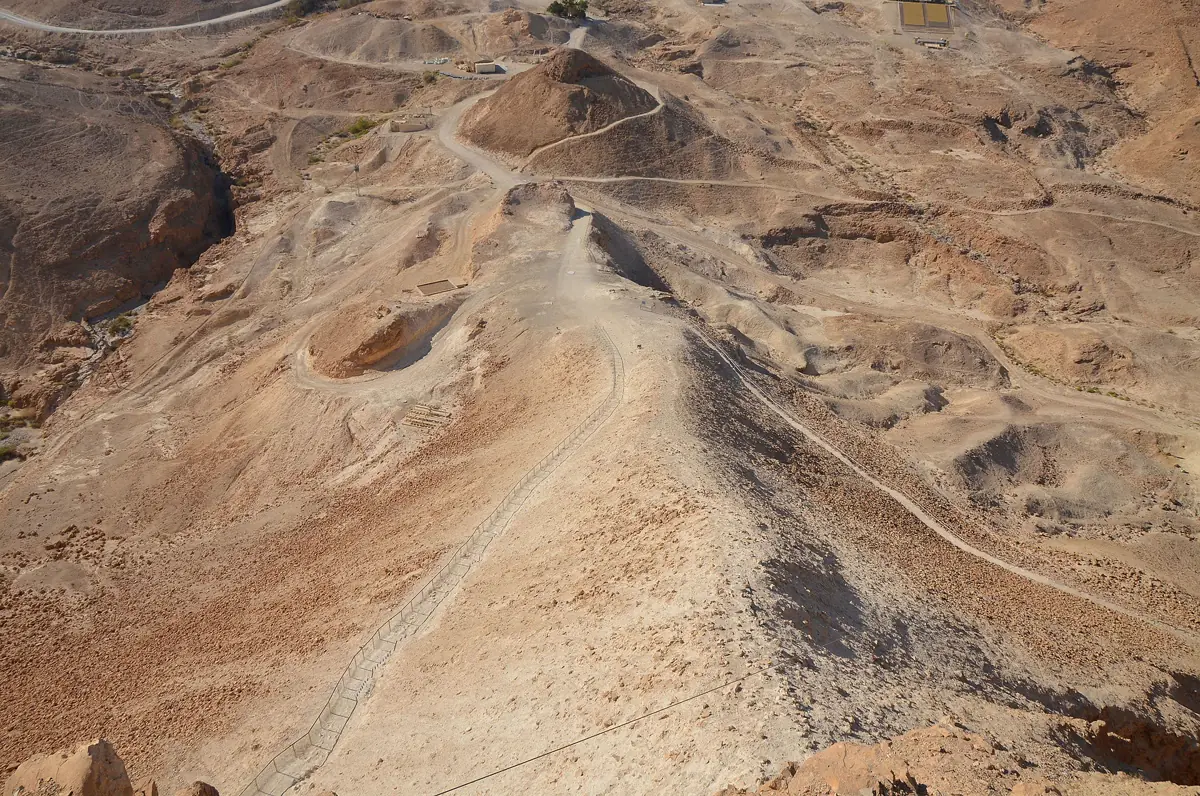
The Roman siege ramp at Masada (73 AD), still standing against the western cliff — a legion’s entire engineering effort aimed at one fortress.Carole Raddato · CC BY-SA 2.0
"Deliver us from evil"
The Lord's Prayer is a warfare prayer. Jesus taught it to every disciple, not to specialists:
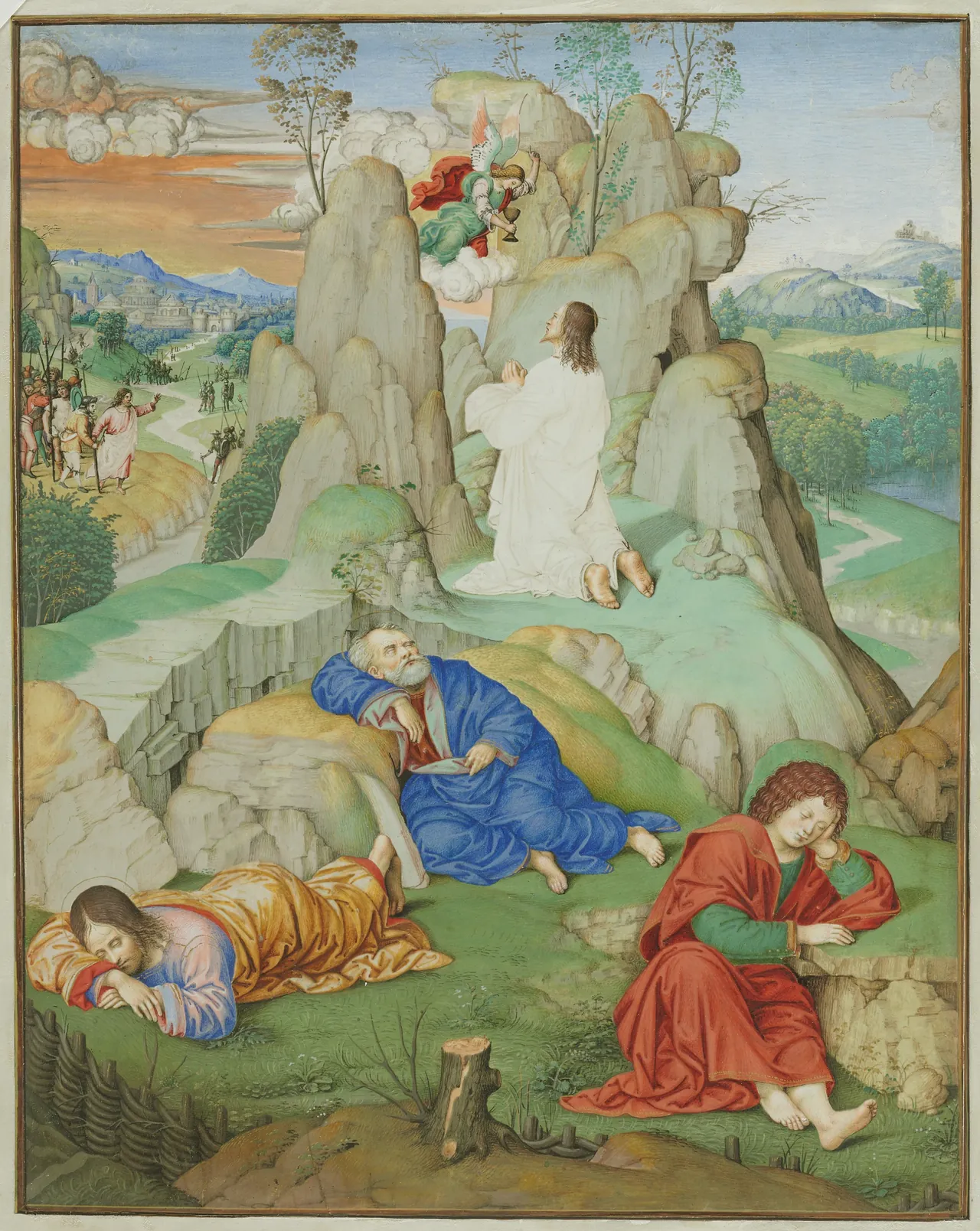
A full-page miniature of the Agony in the Garden by Timoteo Viti, 1490 to 1500, with Christ praying while the disciples sleep, beside the call to watch and pray.Full Page Miniature: The Agony in the Garden · 1490–1500 · Cleveland Museum of Art · CC0 · museum record · Galeria Regni
“After this manner therefore pray ye: Our Father which art in heaven, Hallowed be thy name. Thy kingdom come. Thy will be done in earth, as it is in heaven. Give us this day our daily bread. And forgive us our debts, as we forgive our debtors. And lead us not into temptation, but deliver us from evil: For thine is the kingdom, and the power, and the glory, for ever. Amen.” (Matthew 6:9-13)
Look at its shape. It begins with God's name, God's kingdom and God's will. Only then does it turn to our needs: bread, forgiveness, protection. And the request for deliverance is addressed to the Father. The disciple does not say "I rebuke evil". He says "deliver us". The prayer ends where it began, with God: "thine is the kingdom, and the power, and the glory". The whole prayer places the believer's fight inside God's reign.
The early Christians took this seriously. The Didache, an early Christian manual of church practice, gives the Lord's Prayer in full and then says simply: "Thrice in the day thus pray."1 That echoes Daniel, who "kneeled upon his knees three times a day, and prayed, and gave thanks before his God, as he did aforetime" (Daniel 6:10), and David: "Evening, and morning, and at noon, will I pray, and cry aloud: and he shall hear my voice" (Psalm 55:17).
There is no magic in the number three. The point is rhythm. A believer who prays at fixed times does not wait for a crisis to start fighting.
Jesus prays for His people
The most important prayer in spiritual warfare is not ours. It is Christ's. On the night He was betrayed, Jesus told Peter:
“And the Lord said, Simon, Simon, behold, Satan hath desired to have you, that he may sift you as wheat: But I have prayed for thee, that thy faith fail not: and when thou art converted, strengthen thy brethren.” (Luke 22:31-32)
Satan asked. Jesus prayed. Peter fell, but his faith did not fail, and he was restored and strengthened his brethren. Later that night Jesus prayed for all His disciples: "I pray not that thou shouldest take them out of the world, but that thou shouldest keep them from the evil" (John 17:15). And He still prays: "Wherefore he is able also to save them to the uttermost that come unto God by him, seeing he ever liveth to make intercession for them" (Hebrews 7:25).
The believer under attack is never praying alone. Before he opens his mouth, his High Priest is already praying for him. That is why we "come boldly unto the throne of grace, that we may obtain mercy, and find grace to help in time of need" (Hebrews 4:16).
The church at prayer
The New Testament's pictures of spiritual conflict are, very often, pictures of a praying church.
When Herod killed James and arrested Peter, the church had no political power and no army. It had prayer: "Peter therefore was kept in prison: but prayer was made without ceasing of the church unto God for him" (Acts 12:5). The account that follows, of the angel, the chains falling off and the iron gate opening "of his own accord" (Acts 12:10), is a story about answered prayer. No one in the house commanded the angel. They prayed to God, and God sent him.
When the Sanhedrin threatened the apostles, the church prayed:
“And now, Lord, behold their threatenings: and grant unto thy servants, that with all boldness they may speak thy word, By stretching forth thine hand to heal; and that signs and wonders may be done by the name of thy holy child Jesus. And when they had prayed, the place was shaken where they were assembled together; and they were all filled with the Holy Ghost, and they spake the word of God with boldness.” (Acts 4:29-31)
Notice what they asked for. Not that their enemies be cursed. Not even that the threats be removed. They asked for boldness to keep preaching, and for God to stretch out His hand. Their warfare prayer was a mission prayer.
Paul describes his friend Epaphras as "always labouring fervently for you in prayers, that ye may stand perfect and complete in all the will of God" (Colossians 4:12). The word "labouring" is the language of a wrestler. Intercession is real work, and it is the work of ordinary believers for one another.
Praying when you do not know what to pray
There are times in the fight when words fail. Paul anticipates them: "Likewise the Spirit also helpeth our infirmities: for we know not what we should pray for as we ought: but the Spirit itself maketh intercession for us with groanings which cannot be uttered" (Romans 8:26). The believer does not need the right formula. He needs to come, weak as he is, and let the Spirit carry what he cannot say.
And there is a promise for the anxious: "Be careful for nothing; but in every thing by prayer and supplication with thanksgiving let your requests be made known unto God. And the peace of God, which passeth all understanding, shall keep your hearts and minds through Christ Jesus" (Philippians 4:6-7). The word "keep" is a military word: the peace of God stands guard.
Watch and pray
In Gethsemane Jesus gave His sleepy disciples a two-word command for the hour of trial: "Watch and pray, that ye enter not into temptation: the spirit indeed is willing, but the flesh is weak" (Matthew 26:41). Watching is alertness, the opposite of spiritual drowsiness. Peter, who slept that night, later wrote, "Be sober, be vigilant; because your adversary the devil, as a roaring lion, walketh about, seeking whom he may devour" (1 Peter 5:8). He had learned it the hard way.
How to pray under attack
What does this look like in practice? There is no script, and a script would miss the point. But Scripture gives the shape.
Pray to the Father, in the name of Jesus. "Whatsoever ye shall ask the Father in my name, he will give it you" (John 16:23). Not to angels, not to saints, not to the devil.
Begin with God. Praise Him for who He is before you describe what you face. "The LORD is my rock, and my fortress, and my deliverer; my God, my strength, in whom I will trust; my buckler, and the horn of my salvation, and my high tower" (Psalm 18:2).
Confess what needs confessing. Unconfessed sin gives the enemy "place" (Ephesians 4:27). The promise is sure: "If we confess our sins, he is faithful and just to forgive us our sins, and to cleanse us from all unrighteousness" (1 John 1:9).
Ask plainly for deliverance. "Deliver us from evil" is enough. Name what you need.
Stand on Scripture. Pray God's promises back to Him, as the psalmists did.
Resist briefly, in faith. Where it is right to address the enemy at all, James's order holds: "Submit yourselves therefore to God. Resist the devil, and he will flee from you" (James 4:7). One sentence in Jesus' name is enough. Then turn back to God.
Ask others to pray. Paul, who knew more about spiritual conflict than any of us, constantly asked for the prayers of the churches.
Leave the outcome with God. "Thy will be done."
If you want words to begin with, something like this is faithful to the text, though it is not a formula and has no power in its wording:
Father, I come to You in the name of Jesus Christ, Your Son, who died for my sins and rose again. You are my rock and my deliverer. I confess my sin, and I thank You that the blood of Jesus cleanses me. I am Yours. Keep me from the evil one, as Jesus prayed. Give me strength to stand and wisdom to see. I resist the devil in the name of Jesus, and I submit myself to You. Thy will be done. Amen.
This part matters because fasting is the most neglected discipline in the modern Western church, and at the same time the most abused in warfare teaching. Some ignore it. Others treat it as a lever: fast long enough and God must act. Scripture takes it seriously and refuses the lever.
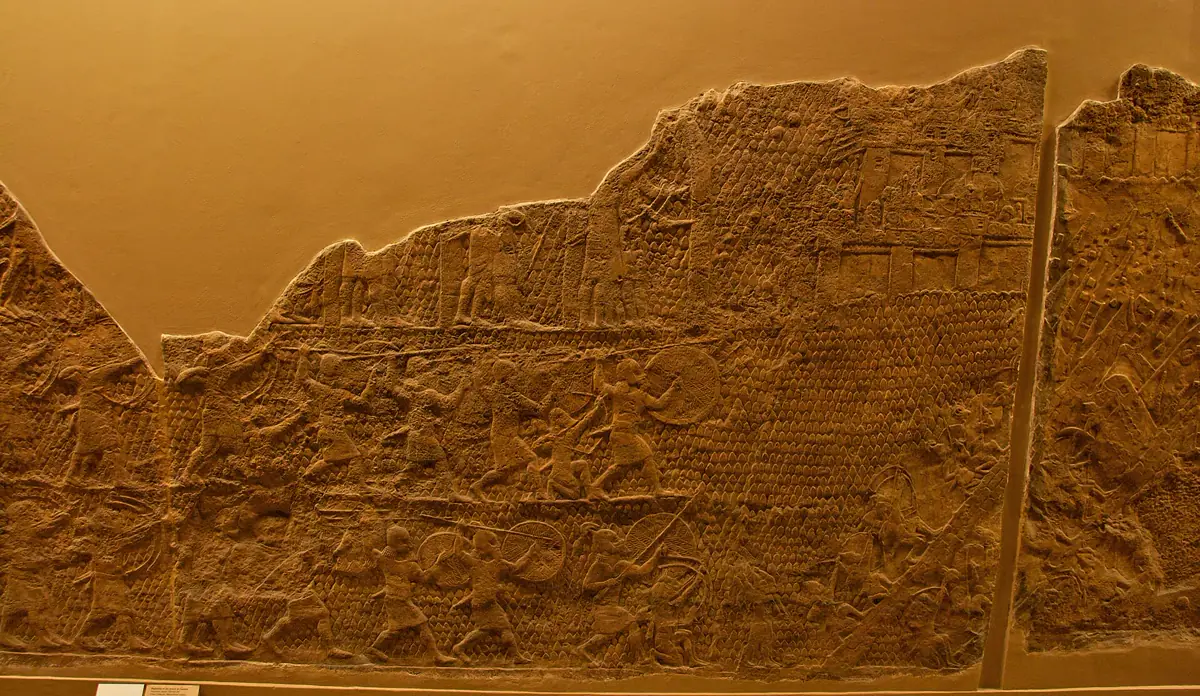
Assyrian palace relief from Nineveh (c. 700 BC) depicting the siege of Lachish — a battle the Bible records in 2 Kings 18, carved by the other side.Mike Peel · CC BY-SA 4.0
"When ye fast"
Jesus assumed His disciples would fast. In the Sermon on the Mount He spoke of fasting in the same breath as giving and prayer, and He said "when", not "if":
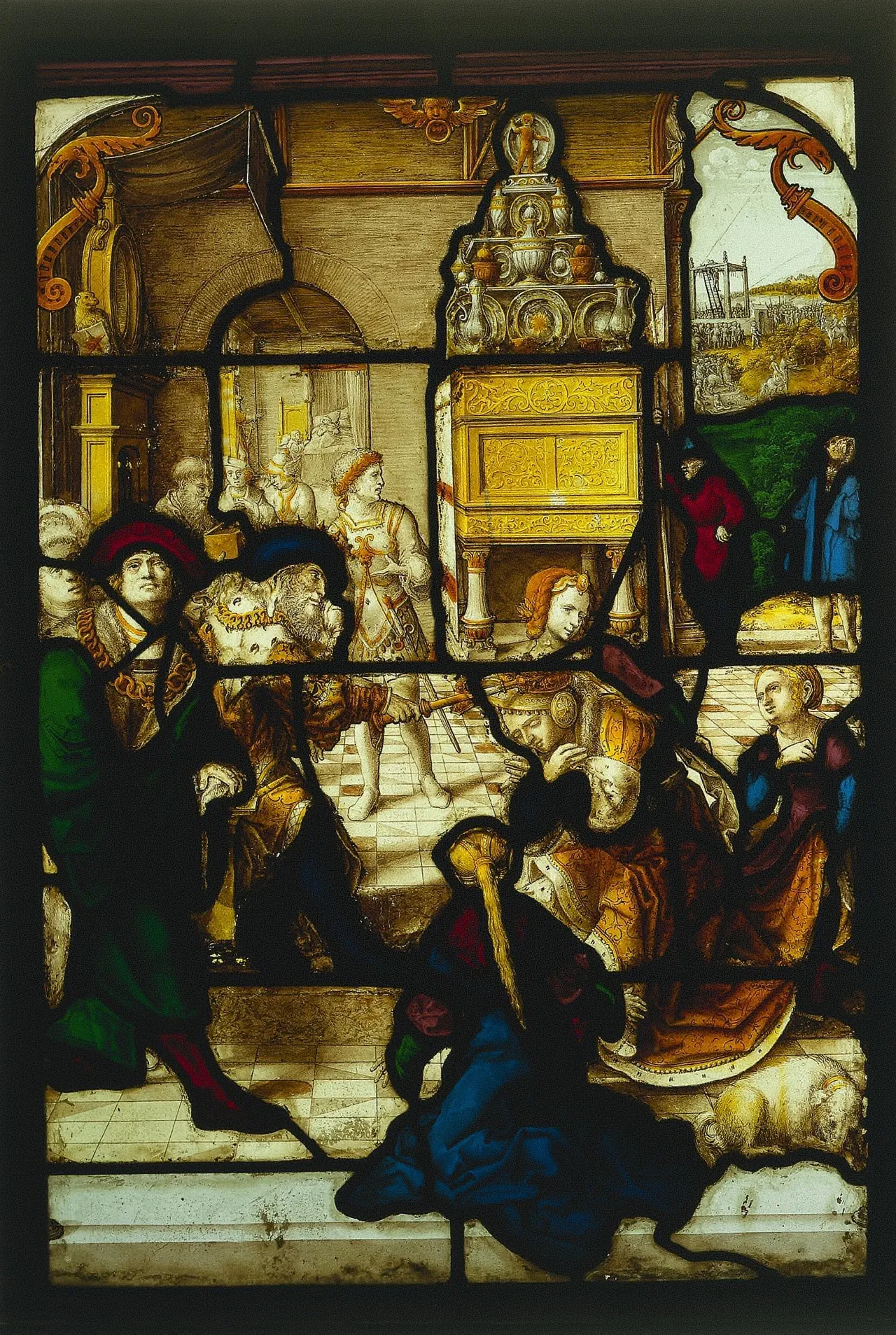
A stained-glass panel of Esther before Ahasuerus by Dirk Vellert, about 1530, recalling the queen who asked her people to fast before she went in to the king.Esther before Ahasuerus · c. 1530 · Cleveland Museum of Art · CC0 · museum record · Galeria Regni
“Moreover when ye fast, be not, as the hypocrites, of a sad countenance: for they disfigure their faces, that they may appear unto men to fast. Verily I say unto you, They have their reward. But thou, when thou fastest, anoint thine head, and wash thy face; That thou appear not unto men to fast, but unto thy Father which is in secret: and thy Father, which seeth in secret, shall reward thee openly.” (Matthew 6:16-18)
And when He was asked why His disciples did not fast while John's did, He answered, "Can the children of the bridechamber mourn, as long as the bridegroom is with them? but the days will come, when the bridegroom shall be taken from them, and then shall they fast" (Matthew 9:15). The days of the absent Bridegroom are our days. Fasting belongs to the church age.
The word for fasting, nesteia (Strong's G3521), means "abstinence (from lack of food, or voluntary and religious)".2 Biblical fasting is going without food, usually for a set time, for the sake of seeking God.
Fasting in Scripture
The Bible records fasts of many kinds, and they share a single theme: people humbling themselves before God in a time of need.
| Who | Occasion | Text | |---|---|---| | Jehoshaphat and Judah | A vast army approaching | 2 Chronicles 20:3-4 | | Ezra and the returning exiles | A dangerous journey without soldiers | Ezra 8:21-23 | | Nehemiah | News of Jerusalem's ruin | Nehemiah 1:4 | | Esther and the Jews of Shushan | A decree of death | Esther 4:16 | | Daniel | Seeking to understand God's purpose | Daniel 9:3; 10:2-3 | | Nineveh | Jonah's warning of judgment | Jonah 3:5-10 | | Anna | Long waiting for the Messiah | Luke 2:37 | | Jesus | Before His temptation and ministry | Matthew 4:1-2 | | The church at Antioch | Seeking God's will; sending missionaries | Acts 13:2-3 | | Paul and Barnabas | Appointing elders | Acts 14:23 |
Ezra's fast is a good example of what fasting means. He was leading families and treasure across dangerous country, and he had told the king that God would protect them. "For I was ashamed to require of the king a band of soldiers and horsemen to help us against the enemy in the way" (Ezra 8:22). So "I proclaimed a fast there, at the river of Ahava, that we might afflict ourselves before our God, to seek of him a right way for us" (Ezra 8:21). And the result is stated simply: "So we fasted and besought our God for this: and he was intreated of us" (Ezra 8:23).
Notice the verbs: "afflict ourselves before our God", "seek of him", "besought". Fasting is not a way of forcing God's hand. It is a way of putting ourselves low before Him and asking.
"This kind goeth not out but by prayer and fasting"
The text most often cited on fasting and spiritual warfare is Jesus' answer to His disciples after they failed to deliver a boy:
“Then came the disciples to Jesus apart, and said, Why could not we cast him out? And Jesus said unto them, Because of your unbelief: for verily I say unto you, If ye have faith as a grain of mustard seed, ye shall say unto this mountain, Remove hence to yonder place; and it shall remove; and nothing shall be impossible unto you. Howbeit this kind goeth not out but by prayer and fasting.” (Matthew 17:19-21)
Mark records the same answer: "This kind can come forth by nothing, but by prayer and fasting" (Mark 9:29). Both verses stand in the 1611 and the Received Text. Many modern versions omit Matthew 17:21 entirely and drop "and fasting" from Mark 9:29. You can see both differences, and every other, at kylelauriano.com/library/changes.
What does Jesus mean? Notice that He first names the root problem: "Because of your unbelief." The disciples' faith had grown thin. Then He names the remedy: a life of prayer and fasting, out of which such faith grows. Jesus Himself did not fast on the spot before casting out the spirit. He had no need to. His whole life was lived in communion with the Father.
Andrew Murray, the South African pastor whose With Christ in the School of Prayer has been read by generations of Christians, gave a whole lesson to this verse. His reading is careful and worth quoting:
The faith that can overcome such stubborn resistance as you have just seen in this evil spirit, Jesus tells them, is not possible except to men living in very close fellowship with God, and in very special separation from the world—in prayer and fasting.3
And he gave the best short definition of fasting I know:
Prayer is the one hand with which we grasp the invisible; fasting, the other, with which we let loose and cast away the visible.4
That is the point. Fasting is not a technique that adds power to prayer the way fuel adds power to an engine. It is a letting go. By refusing for a time what our bodies want most, we say to God with our whole selves that we want Him more. Murray put it this way: "fasting helps to express, to deepen, and to confirm the resolution that we are ready to sacrifice anything, to sacrifice ourselves, to attain what we seek for the kingdom of God."5
Murray closes the lesson with a note on the pastor Blumhardt, who, in the middle of what Murray calls "his terrible conflict with the evil spirits in those who were possessed", was directed to Jesus' words about fasting and "resolved to give himself to fasting, sometimes for more than thirty hours".6 Murray reports it as an encouragement, not as a method. Blumhardt fasted because he took Jesus' words seriously.
The fast God has chosen
The prophets give fasting its sharpest warning. In Isaiah's day the people complained that God ignored their fasts. God answered:
“Wherefore have we fasted, say they, and thou seest not? wherefore have we afflicted our soul, and thou takest no knowledge? Behold, in the day of your fast ye find pleasure, and exact all your labours. Behold, ye fast for strife and debate, and to smite with the fist of wickedness: ye shall not fast as ye do this day, to make your voice to be heard on high.” (Isaiah 58:3-4)
They were fasting while oppressing their workers and quarrelling. Their fast was a religious performance laid over an unrepentant life. Then God described the fast He wanted:
“Is not this the fast that I have chosen? to loose the bands of wickedness, to undo the heavy burdens, and to let the oppressed go free, and that ye break every yoke?” (Isaiah 58:6)
This verse is sometimes quoted as though fasting itself looses bands and breaks yokes by spiritual force. But read it in its setting. The bands and yokes are the ones the fasters themselves had put on others. God's chosen fast is one joined to justice and mercy: the next verse speaks of feeding the hungry and housing the poor (Isaiah 58:7). A fast that does not change how we treat people is not the fast God has chosen.
Joel adds the inward side: "Therefore also now, saith the LORD, turn ye even to me with all your heart, and with fasting, and with weeping, and with mourning: And rend your heart, and not your garments" (Joel 2:12-13). And Jesus gives us the Pharisee who "stood and prayed thus with himself", boasting "I fast twice in the week" (Luke 18:11-12), and went home unjustified. Fasting can be done in pride. It is only worth anything when it is done in humility.
The early church's practice
The first Christians fasted regularly. The Didache tells believers not to fast on the same days as the hypocrites, "for they fast on the second and fifth day of the week; but fast on the fourth day and the Preparation (Friday)."7 That is, Wednesdays and Fridays. It also instructs that before a baptism "let the baptizer fast, and the baptized, and whatever others can", and that the one to be baptized should fast "one or two days before".8
Notice what this shows. Fasting in the early church was not reserved for spiritual emergencies or for an elite of "warriors". It was a weekly habit for ordinary believers, and it was joined to the great moment of conversion and baptism, the moment when a person turned from the devil to Christ.
No numbers, no levers
Two errors need naming plainly.
The first is number mysticism. It is common to hear that a twenty-one-day fast is especially powerful because the angel told Daniel that "the prince of the kingdom of Persia withstood me one and twenty days" (Daniel 10:13). But Daniel did not choose twenty-one days as a technique. He was "mourning three full weeks" (Daniel 10:2), and the angel explained afterwards why the answer had taken that long. Daniel's prayer was heard "from the first day" (Daniel 10:12). Scripture never teaches that twenty-one, forty or any other number has power in itself. Jesus' forty days and Esther's three were the length God led them to, not a code.
The second is the lever. Fasting does not oblige God. No fast guarantees a breakthrough. Nineveh fasted, and the king said honestly, "Who can tell if God will turn and repent" (Jonah 3:9). David fasted and wept seven days for his dying son, and the child died (2 Samuel 12:16-23). We fast to humble ourselves and seek God. The outcome is His.
Fasting wisely
Fasting is good for the soul, and for most healthy adults a short fast is safe. But the body God gave you matters, and wisdom is part of obedience. If you are pregnant or nursing, diabetic, taking medication that must be taken with food, recovering from illness, underweight, or have any history of an eating disorder, talk with your doctor before you fast, and consider other forms of fasting: from a meal rather than a day, from certain foods (as Daniel did, Daniel 10:3), from media, or from entertainment. Drink water unless you have a clear reason and medical advice not to. Break a long fast gently.
Elijah's story is worth remembering here. When he collapsed under the juniper tree, God's first answer was not a sermon. It was food and sleep: "Arise and eat; because the journey is too great for thee" (1 Kings 19:7). God cares for our bodies. Fasting is a gift, not a test of endurance.
How to begin
Start small. Skip one meal and spend that time in prayer and the word.
Then try a day, from evening to evening or from breakfast to dinner.
Decide beforehand what you are seeking God for, and write it down.
Fill the time you would have spent eating with Scripture and prayer. A fast without prayer is just a diet.
Keep it between you and your Father, as Jesus said (Matthew 6:17-18), unless your church is fasting together.
If you are seeking freedom from a particular bondage, fast with others who will pray with you.
Brittany Sivels told her story on The King Is Coming Show (TKIC #52): two decades in homosexuality and lust, and then, in her telling, a three-day fast that changed everything. Watch it in her own words: youtube.com/watch?v=JJ0SsSLQgEg Brittany's account of what happened to her, shared as her testimony — weigh it for yourself.
This part matters because the enemy's main weapon is deception, and deception does not announce itself. "And no marvel; for Satan himself is transformed into an angel of light" (2 Corinthians 11:14). A believer who cannot discern will be led about by every voice that sounds spiritual.
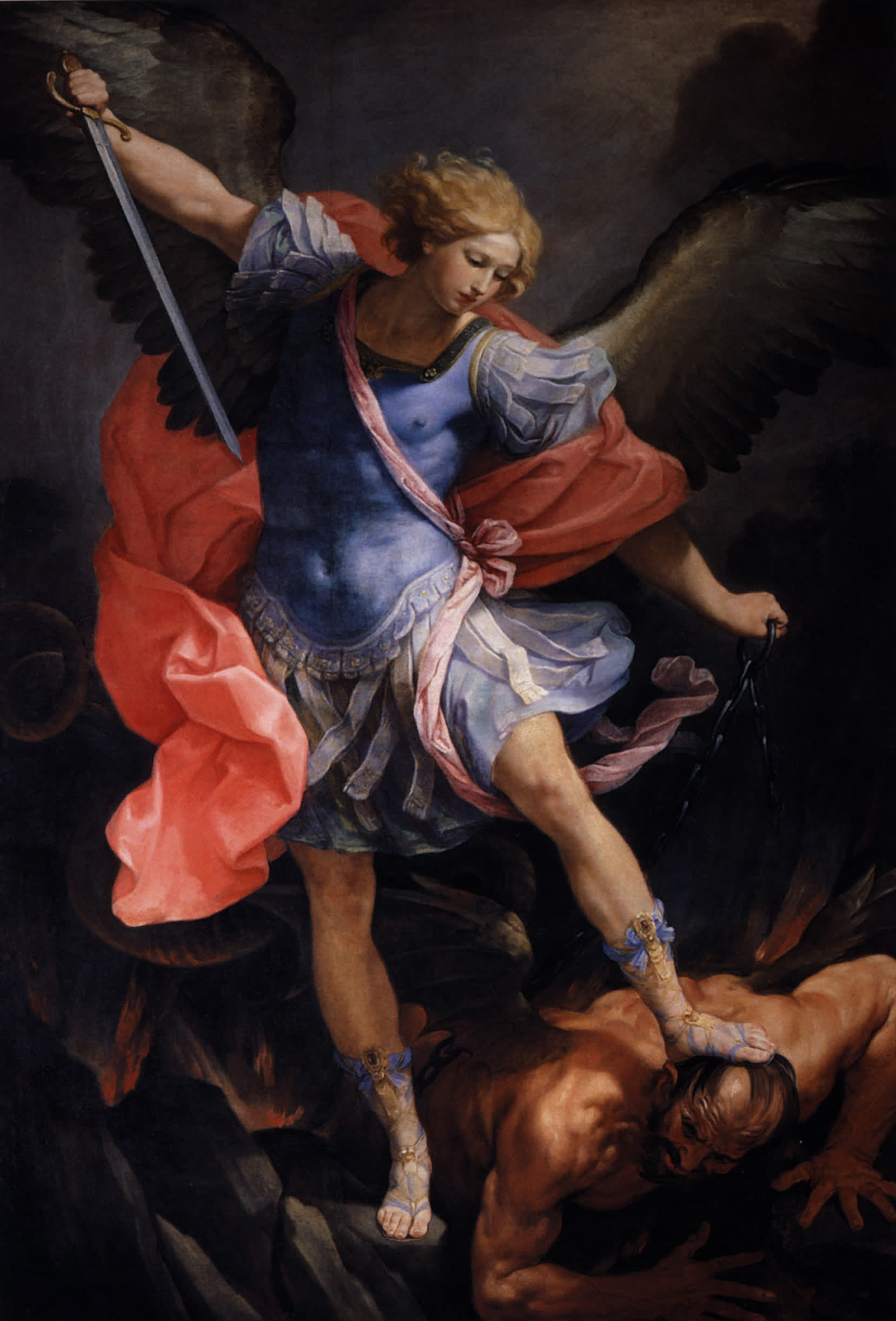
Guido Reni’s Michael Defeats Satan (1635) — the archangel with his foot on the enemy, the war of Revelation 12 on canvas.Guido Reni, 1635 · Public domain
The command to test
John gives the command plainly:
“Beloved, believe not every spirit, but try the spirits whether they are of God: because many false prophets are gone out into the world. Hereby know ye the Spirit of God: Every spirit that confesseth that Jesus Christ is come in the flesh is of God: And every spirit that confesseth not that Jesus Christ is come in the flesh is not of God: and this is that spirit of antichrist, whereof ye have heard that it should come; and even now already is it in the world.” (1 John 4:1-3)
Paul says the same in a sentence: "Prove all things; hold fast that which is good" (1 Thessalonians 5:21). Testing is not unbelief. It is obedience. A believer who accepts every spiritual experience, every prophecy and every voice without examination is disobeying Scripture, however spiritual he feels.
The gift and the discipline
Paul lists "discerning of spirits" among the gifts of the Spirit (1 Corinthians 12:10). The word is diakrisis (Strong's G1253), "judicial estimation", rendered "discern", "discerning" and "disputation".9 It is the judgment of a court: weighing evidence and reaching a verdict. The Spirit gives some believers a special sensitivity in this, and the church needs them.
But discernment is also a discipline every believer must grow in. Hebrews 5:14 describes the mature as those who "have their senses exercised to discern both good and evil". That comes "by reason of use". The Bereans are the model: they "received the word with all readiness of mind, and searched the scriptures daily, whether those things were so" (Acts 17:11). They tested even Paul by the Scriptures, and Luke calls them "more noble" for it.
Signs that come to pass
One of the most important texts on discernment is in Deuteronomy:
“If there arise among you a prophet, or a dreamer of dreams, and giveth thee a sign or a wonder, And the sign or the wonder come to pass, whereof he spake unto thee, saying, Let us go after other gods, which thou hast not known, and let us serve them; Thou shalt not hearken unto the words of that prophet, or that dreamer of dreams: for the LORD your God proveth you, to know whether ye love the LORD your God with all your heart and with all your soul.” (Deuteronomy 13:1-3)
Notice: the sign comes to pass. The supernatural event is real. And it is still to be rejected, because it leads away from the true God. Power is not proof. Accuracy is not proof. The test is where it leads.
Paul says the same about the gospel itself: "But though we, or an angel from heaven, preach any other gospel unto you than that which we have preached unto you, let him be accursed" (Galatians 1:8). Even an angelic visitation does not outrank the gospel already delivered.
And in Philippi, as the authority paper on this site describes, a girl with "a spirit of divination" followed Paul crying out, "These men are the servants of the most high God, which shew unto us the way of salvation" (Acts 16:17). Every word was true. The source was a demon. Paul discerned it and cast the spirit out. The enemy will tell the truth when the truth serves his purpose.
Edwards' five marks
The most careful work on discernment in the English-speaking church was written during a revival. In 1741, in the middle of the Great Awakening, Jonathan Edwards preached at New Haven on 1 John 4, and the sermon, expanded, was published as The Distinguishing Marks of a Work of the Spirit of God. The revival was accompanied by strong outward effects, and people were asking how to tell whether it was God at work. Edwards argued that such outward signs prove nothing either way, and drew from 1 John 4 five marks that are "sure" signs of the Spirit's work. They are as useful for testing a ministry, a prophecy or an experience today as they were then.10
First, it exalts the real Jesus. "When the operation is such as to raise their esteem of that Jesus who was born of the Virgin, and was crucified without the gates of Jerusalem; and seems more to confirm and establish their minds in the truth of what the gospel declares to us of his being the Son of God, and the Saviour of men; is a sure sign that it is from the Spirit of God." Notice how specific Edwards is: not a vague "Christ", but the Jesus of history, born of the virgin and crucified outside Jerusalem.
Second, it works against sin and worldliness. "When the spirit that is at work operates against the interests of Satan's kingdom, which lies in encouraging and establishing sin, and cherishing men's worldly lusts; this is a sure sign that it is a true, and not a false spirit." A spirituality that leaves people proud, greedy or sexually loose is not from God, whatever its power.
Third, it raises regard for Scripture. "The spirit that operates in such a manner, as to cause in men a greater regard to the Holy Scriptures, and establishes them more in their truth and divinity, is certainly the Spirit of God." Edwards asks a sharp question: "Would the prince of darkness, in order to promote his kingdom of darkness, lead men to the sun?" The devil, he says, "has ever shown a mortal spite and hatred towards that holy book the Bible".
Fourth, it leads to truth. "If by observing the manner of the operation of a spirit that is at work among a people, we see that it operates as a spirit of truth, leading persons to truth, convincing them of those things that are true, we may safely determine that it is a right and true spirit." Edwards names the truths: that there is a God, great and sin-hating; that life is short; that there is another world; that we are sinful and helpless in ourselves.
Fifth, it produces love. "If the spirit that is at work among a people operates as a spirit of love to God and man, it is a sure sign that it is the Spirit of God."
These five marks make a simple checklist. Faced with a teacher, a movement, a prophetic word or an experience of your own, ask: Does it make much of the real Jesus? Does it lead away from sin? Does it send me to the Bible? Does it tell the truth about God, sin and eternity? Does it produce love? Where the answers are no, it does not matter how powerful the experience felt.
Spiritual experience is not the Holy Ghost
This is where my own story and those of some of my guests meet. When real life hit — a lost job, a pregnant wife, constant fights — I went looking for peace anywhere I could find it. New Age, crystals, astral projection, tarot, angel numbers. None of it held. Those things did not lead to Jesus, or to Scripture, or to repentance. By Edwards' marks, they failed every test.
Steve Kang told his story on The King Is Coming Show (TKIC #49): chanting eight hours a day to reach nirvana, and then, in his telling, waking up in hell instead. Watch it in his own words: youtube.com/watch?v=46SP1FgXfbY Steve's account of what happened to him, shared as his testimony — weigh it for yourself.
Scripture's verdict on such practices is not a matter of opinion. "There shall not be found among you any one that maketh his son or his daughter to pass through the fire, or that useth divination, or an observer of times, or an enchanter, or a witch. Or a charmer, or a consulter with familiar spirits, or a wizard, or a necromancer. For all that do these things are an abomination unto the LORD" (Deuteronomy 18:10-12). And Isaiah asks the question every seeker must face: "And when they shall say unto you, Seek unto them that have familiar spirits, and unto wizards that peep, and that mutter: should not a people seek unto their God? for the living to the dead? To the law and to the testimony: if they speak not according to this word, it is because there is no light in them" (Isaiah 8:19-20).
"To the law and to the testimony." The word of God is the final test.
Not every struggle is a demon
Discernment cuts both ways. It warns against accepting every spirit, and it warns against seeing a spirit behind every trouble.
Look at how Matthew describes the crowds that came to Jesus: "they brought unto him all sick people that were taken with divers diseases and torments, and those which were possessed with devils, and those which were lunatick, and those that had the palsy; and he healed them" (Matthew 4:24). Matthew lists demon possession as one category among several. Not every sickness was a demon. Jesus healed some by touch and cast out spirits from others, and the Gospel writers distinguish the two. Sometimes a spirit did cause sickness, as with the woman "which had a spirit of infirmity eighteen years" (Luke 13:11), whom Jesus described as one "whom Satan hath bound" (Luke 13:16). But that was named, not assumed.
James traces most temptation to our own desires (James 1:14). Many of our troubles are the fruit of our own choices, of a fallen world, or of tired and broken bodies. The Lausanne consultation on spiritual conflict, meeting in Nairobi in 2000, warned against "an overemphasis on spirits that blames demons for the actions of people", adding: "Demons can only work through people—and people can actively choose to cooperate. Spirits are not the only source of resistance to the gospel."11
When the trouble is medical
This matters most of all where mental illness is concerned. The Lausanne consultation asked a Christian psychologist, Jerry Mungadze, to address it, and the report of his paper gives sober counsel. It warns that "often Christians and others suffering from psychological illness have been treated as if they were demonised", and states a first principle: "One of the fundamentals in dealing with people is that no harm should be done to people in the name of deliverance or help."12
It continues: "The safest approach is to first rule out mental illness or psychological problems before assuming that it is a spiritual problem." It recommends asking about any history of mental illness, past treatment, medications and hospitalisation, and it describes how trauma-related conditions in particular are often mistaken for demonisation, with real harm done when they are treated by exorcism alone. It also allows that illness and spiritual conflict can exist together, and that "deliverance is not effective if the existence of the illness is ignored."13
This is not unbelief in the spiritual. It is love for the person in front of you. A believer who discerns well will pray, and will also say, "Have you seen a doctor?" Both are acts of faith.
So when you face a struggle, in yourself or in someone you are helping, ask the questions in order:
1. Is there sin to confess and forsake? Begin with repentance (Psalm 139:23-24). 2. Is there a medical or psychological cause? See a doctor. Take the medicine if it is needed. 3. Is this the ordinary weight of a fallen world, to be borne with patience and prayer? 4. Is there a clear sign of spiritual involvement: past occult practice, a pact or dedication, manifestations that do not fit illness? If so, seek mature, sound help in your church.
Part 4 — Walking Free: Repentance and Renunciation
9 min read
This part matters because freedom in Christ is both an event and a walk. A person is "delivered … from the power of darkness" at conversion (Colossians 1:13), and then told to "Stand fast therefore in the liberty wherewith Christ hath made us free, and be not entangled again with the yoke of bondage" (Galatians 5:1). Scripture shows how freedom is entered and how it is kept.
Ephesus: confession before the bonfire
The fullest account of a whole community walking free from the occult is in Acts 19. After the sons of Sceva were humiliated, "fear fell on them all, and the name of the Lord Jesus was magnified" (Acts 19:17). Then:
“And many that believed came, and confessed, and shewed their deeds. Many of them also which used curious arts brought their books together, and burned them before all men: and they counted the price of them, and found it fifty thousand pieces of silver. So mightily grew the word of God and prevailed.” (Acts 19:18-20)
Three things happened, in order. First, believers "confessed, and shewed their deeds". They brought hidden practices into the light. Second, they destroyed the tools of those practices, at great cost, "before all men". Third, "the word of God" grew. There is no record here of a deliverance session for each person, no list of spirits named and bound. There is confession, renunciation and the word.
Renouncing the devil
The early church built this into baptism. By the fourth century, candidates in Jerusalem faced west, the direction of darkness, and spoke a renunciation aloud before they turned east and confessed Christ. Cyril of Jerusalem explained the rite to the newly baptised:
I renounce you, Satan,— you wicked and most cruel tyrant! Meaning, I fear your might no longer; for that Christ has overthrown, having partaken with me of flesh and blood, that through these He might by death destroy death, that I might not be made subject to bondage forever. (Cyril cites Hebrews 2:14–15 at this point.)14
Notice the reason Cyril gives for the renunciation. Not a formula that drives the devil away, but a declaration of fact: "I fear your might no longer; for that Christ has overthrown". The renunciation is a statement of allegiance. The candidate is changing sides, and saying so out loud.
This is one place where it is right for a believer to speak, in words, a refusal of the devil and his works. Not to converse with him, but to renounce him, as Joshua did when he told Israel to choose: "choose you this day whom ye will serve … but as for me and my house, we will serve the LORD" (Joshua 24:15). A person coming out of the occult, a cult or a life of deliberate sin may find it a real help to say plainly, before God and a trusted believer: I renounce this practice. I renounce every allegiance to the devil. I belong to Jesus Christ.
The Lausanne report gives the same counsel for people caught in occult bondage: "They should renounce whatever pacts or covenants were made. They need to fully recognise what happened, how it happened, and repent of it. As believers they have the authority to remove their loyalty from Satan and to trust God."15
Getting rid of the objects
The Ephesian bonfire raises a practical question: what should a believer do with objects tied to the occult or to idolatry? The Old Testament is direct:
“The graven images of their gods shall ye burn with fire: thou shalt not desire the silver or gold that is on them, nor take it unto thee, lest thou be snared therein: for it is an abomination to the LORD thy God. Neither shalt thou bring an abomination into thine house, lest thou be a cursed thing like it: but thou shalt utterly detest it, and thou shalt utterly abhor it; for it is a cursed thing.” (Deuteronomy 7:25-26)
Notice the reason: "lest thou be snared therein". The danger is that the object draws the heart back. So a new believer coming out of the occult should do what the Ephesians did: get rid of the tarot cards, the crystals used for spiritual power, the occult books, the charms and amulets, the Ouija board. Not because the objects are magic, but because they were tools of a false worship and a snare to the heart.
What Scripture does not teach is that a believer's house becomes haunted by every object with an unknown history, or that a home must be cleansed room by room with a set ritual. Paul told the Corinthians, about meat that might have been offered to idols: "Whatsoever is sold in the shambles, that eat, asking no question for conscience sake: For the earth is the Lord's, and the fulness thereof" (1 Corinthians 10:25-26). Things are not demons. A believer may certainly pray over his home and dedicate it to God; that is good and right. But the house is not cleansed by a formula. It is kept by the life lived in it.
Giving no place
Freedom is kept in the ordinary places. Paul's command "Neither give place to the devil" (Ephesians 4:27) sits in the middle of a list of everyday sins:
“Let all bitterness, and wrath, and anger, and clamour, and evil speaking, be put away from you, with all malice: And be ye kind one to another, tenderhearted, forgiving one another, even as God for Christ’s sake hath forgiven you.” (Ephesians 4:31-32)
Unforgiveness in particular is named as a way the enemy gains advantage. Paul urged the Corinthians to forgive a repentant brother, "Lest Satan should get an advantage of us: for we are not ignorant of his devices" (2 Corinthians 2:11). Many who seek "deliverance" need instead, or first, to forgive someone.
The empty house
Jesus told a short parable that every person who has been set free should know:
“When the unclean spirit is gone out of a man, he walketh through dry places, seeking rest, and findeth none. Then he saith, I will return into my house from whence I came out; and when he is come, he findeth it empty, swept, and garnished. Then goeth he, and taketh with himself seven other spirits more wicked than himself, and they enter in and dwell there: and the last state of that man is worse than the first.” (Matthew 12:43-45)
The house was "swept, and garnished", cleaned and tidied. But it was "empty". Freedom from something is not enough. A life emptied of evil must be filled with good, or the last state will be worse than the first. Jesus told the parable about "this wicked generation", which had seen His works and remained unchanged; but it applies to every individual too.
What fills the house? Scripture answers: Christ Himself, by His Spirit and His word. "Be filled with the Spirit" (Ephesians 5:18). Paul again: "Let the word of Christ dwell in you richly in all wisdom" (Colossians 3:16). The psalmist: "Thy word have I hid in mine heart, that I might not sin against thee" (Psalm 119:11). And the fellowship of the church: "Not forsaking the assembling of ourselves together, as the manner of some is" (Hebrews 10:25). A person set free who then stays home alone, without Scripture, prayer or fellowship, is an empty house.
Generational curses
Much modern deliverance teaching speaks of "generational curses": patterns of sin, sickness or misfortune passed down family lines that must be identified and broken by special prayers. The idea rests mainly on one verse:
“Thou shalt not bow down thyself to them, nor serve them: for I the LORD thy God am a jealous God, visiting the iniquity of the fathers upon the children unto the third and fourth generation of them that hate me; And shewing mercy unto thousands of them that love me, and keep my commandments.” (Exodus 20:5-6)
What does this verse say? It says that the consequences of idolatry spread through families, "of them that hate me". Children raised in a home given to idols learn its ways and suffer its results. Anyone who has watched addiction, violence or unbelief pass from parent to child knows this is true. But the same verse sets that against "mercy unto thousands of them that love me". The emphasis is on God's mercy, which far outruns His judgment.
And the prophets explicitly reject the idea that children are condemned for their parents' sins. In Ezekiel's day the people had a proverb: "The fathers have eaten sour grapes, and the children's teeth are set on edge" (Ezekiel 18:2). God answered:
“The soul that sinneth, it shall die. The son shall not bear the iniquity of the father, neither shall the father bear the iniquity of the son: the righteousness of the righteous shall be upon him, and the wickedness of the wicked shall be upon him.” (Ezekiel 18:20)
Jeremiah says the same: "every one shall die for his own iniquity" (Jeremiah 31:30). And for the believer, the New Testament settles it: "Christ hath redeemed us from the curse of the law, being made a curse for us: for it is written, Cursed is every one that hangeth on a tree" (Galatians 3:13). And again: "Therefore if any man be in Christ, he is a new creature: old things are passed away; behold, all things are become new" (2 Corinthians 5:17).
So this paper teaches what the text teaches. Family patterns are real, and they are worth facing honestly: the sins we learned at home, the wounds we carry, the habits that run in families. A believer should repent of his own part in them, forgive his parents where needed, and by God's grace refuse to pass them on. But he does not live under an ancestral curse that needs a special ritual to break. Christ became the curse. A believer is in Christ.
"Legal ground"
Closely related is the teaching that demons have "legal rights" or "legal ground" in a person's life, created by sins, vows, traumas or ancestral dedications, and that these rights must be identified and cancelled one by one before a spirit can be made to leave. The Lausanne report gives a fair summary of one experienced practitioner's approach. Charles Kraft described looking for the "garbage" in a person's life (curses, vows, dedications, unforgiveness and the like) and wrote that for demons "to be there, they must have legal rights given them by those who created the garbage."16
There is a true insight here, and it is the insight of Ephesians 4:27: sin gives the devil "place". Unconfessed sin, unforgiveness, occult involvement and deliberate rebellion are open doors, and they should be closed by repentance.
But the "legal" framework goes beyond the text when it is taught as doctrine. The New Testament never describes demons as holding legal rights over a believer, and it never gives a procedure for cancelling them. What it describes is the cross: "Blotting out the handwriting of ordinances that was against us, which was contrary to us, and took it out of the way, nailing it to his cross; And having spoiled principalities and powers, he made a shew of them openly, triumphing over them in it" (Colossians 2:14-15). Whatever "legal" case the enemy had against us was nailed to the cross. The believer's response to sin is not a legal procedure but confession: "If we confess our sins, he is faithful and just to forgive us our sins, and to cleanse us from all unrighteousness" (1 John 1:9).
So this paper does not teach "legal ground" formulas. It teaches repentance, which is better, because it is what God actually asked for.
Holidays and days
Some warfare teaching warns that celebrating certain holidays opens a family to demonic influence because of the holidays' supposed pagan origins. Many of those claims are made without sources, and this paper does not repeat them.
What Scripture does give is a principle of conscience. "One man esteemeth one day above another: another esteemeth every day alike. Let every man be fully persuaded in his own mind. He that regardeth the day, regardeth it unto the Lord" (Romans 14:5-6). And to the Colossians: "Let no man therefore judge you in meat, or in drink, or in respect of an holyday, or of the new moon, or of the sabbath days" (Colossians 2:16). And there is a clear line: "the things which the Gentiles sacrifice, they sacrifice to devils, and not to God: and I would not that ye should have fellowship with devils" (1 Corinthians 10:20). A believer should not take part in any celebration that honours other gods or the occult. Beyond that, he should follow his conscience before God, and not judge his brother who follows his.
This part matters because deliverance from evil spirits is part of the ministry Jesus gave His church, and because it is the part most easily turned into a show, a business or a cause of harm.
Deliverance is for today
Jesus cast out devils as a sign that the kingdom had come (Matthew 12:28). He sent His disciples to do the same (Luke 9:1). And the risen Lord said, "And these signs shall follow them that believe; In my name shall they cast out devils" (Mark 16:17). (Mark 16:9–20 stands in the 1611 and the Received Text; see kylelauriano.com/library/changes.) The early church practised it, as Justin Martyr and Origen record, and Christians on every continent testify to it today. Many of the guests on my show describe being set free.
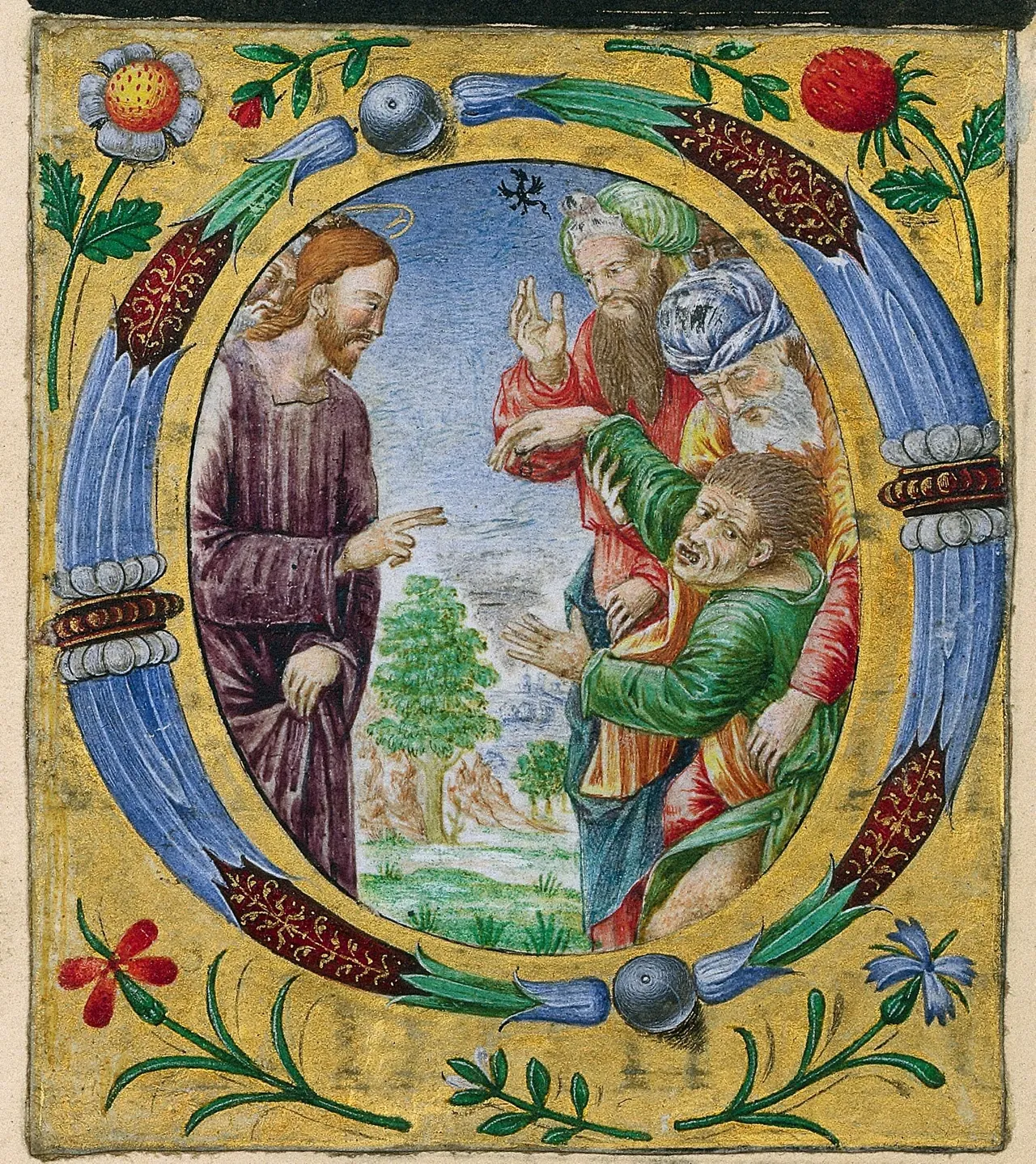
A missal cutting by Matteo da Milano, about 1520, with Christ performing an exorcism in the initial O, beside the study of how Jesus delivered the oppressed.Cutting from a Missal: Initial O with Christ Performing an Exorcism · c. 1520 · Cleveland Museum of Art · CC0 · museum record · Galeria Regni
Jackie VanTine shared a testimony of faith, deliverance, and marriage under Christ on The King Is Coming Show (TKIC #16). Watch it in Jackie's own words: youtube.com/watch?v=wjU6N7arAbA Jackie's account of what happened, shared as testimony — weigh it for yourself.
This ministry teaches deliverance as Scripture does. It also teaches the guardrails Scripture gives.
Who it is for
The New Testament's accounts of casting out spirits all concern unbelievers or people not yet in the church: the man in the synagogue, the Gadarene, the Syrophenician woman's daughter, the girl in Philippi. As the Lausanne statement put it, "there is no direct evidence that demons need to be cast out of believers."17 A born-again believer is "the temple of the Holy Ghost" (1 Corinthians 6:19), and "that wicked one toucheth him not" (1 John 5:18).
That does not mean believers are never attacked. They are oppressed, harassed, tempted and buffeted, and they need prayer, counsel and the ministry of the church. But the remedy for a believer under attack is not the casting out of a spirit that owns him. It is repentance where there is sin, resistance in faith, the prayers of the church, and the steady filling of the empty house. Many people who come to deliverance ministry are not yet believers, or are believers who have dabbled again in the occult and need to repent and renounce it. Discernment matters.
How Jesus did it
The pattern in the Gospels is brief, direct and in command:
“And there was in their synagogue a man with an unclean spirit; and he cried out, Saying, Let us alone; what have we to do with thee, thou Jesus of Nazareth? art thou come to destroy us? I know thee who thou art, the Holy One of God. And Jesus rebuked him, saying, Hold thy peace, and come out of him. And when the unclean spirit had torn him, and cried with a loud voice, he came out of him.” (Mark 1:23-26)
Jesus did not converse. He did not ask for information. He silenced the spirit and commanded it out. When the apostles did the same, they did it "in the name of Jesus Christ" (Acts 16:18), with one command.
Guardrails for deliverance ministry
From the text and from the church's long experience, these guardrails follow.
It belongs in the church. James tells the sick to "call for the elders of the church; and let them pray over him" (James 5:14). Serious spiritual trouble belongs with mature, sound, accountable leaders, not with a stranger on the internet or a travelling showman.
It is done in meekness. "Brethren, if a man be overtaken in a fault, ye which are spiritual, restore such an one in the spirit of meekness; considering thyself, lest thou also be tempted" (Galatians 6:1).
The gospel comes first. A person who does not know Christ needs, above all, to repent and believe. Deliverance without the gospel leaves the house empty.
The person takes part. The Lausanne report notes that "people need to be empowered to fight their own battles instead of relying on an outsider doing it for them."18 The one seeking freedom confesses, renounces, forgives and chooses Christ.
No conversation with spirits. Command briefly in Jesus' name. Do not ask names, ranks or reasons. The devil is "a liar, and the father of it" (John 8:44).
No show. Deliverance is not entertainment. It is not filmed for a channel. It protects the dignity of the person.
No harm. Never restrain, strike or exhaust a person. Never keep someone for hours. Never tell someone to stop medication. "No harm should be done to people in the name of deliverance or help."19
Rule out illness. Ask about medical and psychiatric history. Work with doctors, not against them.
No guarantees. "Any suggestion that a particular technique or method in spiritual conflict ministry ensures success is a magical, sub-Christian understanding of God's workings."20
Aftercare. Help the person fill the house: Scripture, prayer, fellowship, discipleship, baptism if they are not baptised.
Relationships, not techniques
The Lausanne statement put the heart of it in one sentence: "The ministry of spiritual conflict is grounded in the transformative power of relationships, not techniques or methods."21 That is the difference between the ministry of Jesus and the work of the sons of Sceva. They had a technique. The apostles had a Lord, and a church.
This part matters because spiritual warfare is not mainly a series of crises. It is a long obedience. Paul told Timothy, "Thou therefore endure hardness, as a good soldier of Jesus Christ" (2 Timothy 2:3). Soldiers win by training, discipline and endurance, not by heroics.
Many guides give a list of daily, weekly, monthly and yearly duties. A rule of life can help, but it must never become a new law, as if God's protection depended on ticking boxes. What follows is offered as a pattern of grace, not a checklist for merit.
Daily
The word. Read Scripture every day, and hide some of it in your heart (Psalm 119:11). The sword of the Spirit must be in your hand when the attack comes, not on a shelf.
Prayer. Pray at set times, morning and evening at least (Psalm 55:17). Pray the Lord's Prayer and mean it.
Examination. Ask God to search you: "Search me, O God, and know my heart: try me, and know my thoughts: And see if there be any wicked way in me, and lead me in the way everlasting" (Psalm 139:23-24). Confess quickly.
The mind. Guard what you take in. "Keep thy heart with all diligence; for out of it are the issues of life" (Proverbs 4:23). Fill it with what is "true … honest … just … pure … lovely" (Philippians 4:8).
Forgiveness. "Let not the sun go down upon your wrath" (Ephesians 4:26).
Weekly
The Lord's day. Gather with the church to worship, hear the word and pray (Hebrews 10:24-25). An isolated believer is an easy target.
The Lord's Supper, where your church observes it weekly or often: "For as often as ye eat this bread, and drink this cup, ye do shew the Lord's death till he come" (1 Corinthians 11:26). Every time, you proclaim the victory of the cross.
A fast, if your health allows: a meal, or a day. The early Christians fasted twice a week.
Fellowship. Have at least one believer who knows the truth about your life and prays for you (James 5:16).
Hold on to the promises: "There hath no temptation taken you but such as is common to man: but God is faithful, who will not suffer you to be tempted above that ye are able; but will with the temptation also make a way to escape, that ye may be able to bear it" (1 Corinthians 10:13).
Over the years
Grow in discernment by use (Hebrews 5:14). Read the Bible through, again and again.
Disciple someone younger in the faith. You learn to fight by teaching others to fight.
Remember how the war ends: "And the God of peace shall bruise Satan under your feet shortly" (Romans 16:20).
Advanced spiritual warfare, in the New Testament, is not exotic. It is prayer that begins with God and asks Him for deliverance. It is fasting done in humility, not as a lever. It is discernment that tests every spirit by the real Jesus and the written word, and that knows the difference between a demon and a disease. It is repentance and renunciation that close the doors, and a life filled with the Spirit and the word so that the house is never left empty. And it is deliverance ministered in the church, briefly, in Jesus' name, with love and without show.
None of it works as a formula. All of it depends on God. That is not a weakness in the Christian's armour. It is the whole point. "Be strong in the Lord, and in the power of his might" (Ephesians 6:10).
A summary
| Discipline | What Scripture gives | What it is not | |---|---|---| | Prayer | To the Father, in Jesus' name, for deliverance and boldness (Matthew 6:13; Acts 4:29) | Commanding angels, long speeches to Satan | | Fasting | Humbling ourselves to seek God (Ezra 8:21; Matthew 6:16-18) | A lever, a number code, a guarantee | | Discernment | Try the spirits by Christ and the word (1 John 4:1-3; Isaiah 8:20) | Accepting every experience; blaming every trouble on demons | | Walking free | Confess, renounce, destroy the tools, fill the house (Acts 19:18-19; Matthew 12:43-45) | Legal procedures, ancestral-curse rituals | | Deliverance | Brief command in Jesus' name, in the church (Mark 1:25; James 5:14) | Conversation with spirits, a show, harm |
An invitation
If you have gone looking for peace anywhere you could find it, and none of it held, there is a better way, and it is not a technique. It is a Person. Jesus said, "Come unto me, all ye that labour and are heavy laden, and I will give you rest" (Matthew 11:28). Repentance toward God and faith toward our Lord Jesus Christ (Acts 20:21) is the door. My own turning came like this: Then one day I got on my knees and prayed: "Jesus, if you are real, show me — and I'll serve you." That is my account; weigh it for yourself. But His promise does not depend on my story: "him that cometh to me I will in no wise cast out" (John 6:37).
And if you know Him and you are tired of the fight, remember that you are not the one holding the line alone. He is praying for you.
“If the Son therefore shall make you free, ye shall be free indeed.” (John 8:36)
1The Didache 8.3, trans. M. B. Riddle, in Ante-Nicene Fathers, vol. 7; online at https://www.newadvent.org/fathers/0714.htm.↩
2James Strong, The Exhaustive Concordance of the Bible (New York: Hunt & Eaton, 1890), Greek dictionary, no. 3521; online at https://www.blueletterbible.org/lexicon/g3521/kjv/tr/0-1/.↩
3Andrew Murray, With Christ in the School of Prayer, Lesson 13, "Prayer and Fasting; or, The Cure of Unbelief"; online at https://fbbc.com/messages/school_of_prayer/murray_school_of_prayer_13.htm.↩
4Murray, With Christ in the School of Prayer, Lesson 13.↩
5Murray, With Christ in the School of Prayer, Lesson 13.↩
6Murray, With Christ in the School of Prayer, Lesson 13, note on Blumhardt.↩
7The Didache 8.1, trans. M. B. Riddle, in Ante-Nicene Fathers, vol. 7; online at https://www.newadvent.org/fathers/0714.htm.↩
9Strong, Exhaustive Concordance, Greek dictionary, no. 1253; online at https://www.blueletterbible.org/lexicon/g1253/kjv/tr/0-1/.↩
10Jonathan Edwards, The Distinguishing Marks of a Work of the Spirit of God (Boston, 1741), section 2, in The Works of Jonathan Edwards, vol. 2; online at https://ccel.org/ccel/edwards/works2.vii.ii.ii.html. The quotations below are from this section.↩
11Lausanne Movement, "Deliver Us From Evil Consultation Statement" (Nairobi, 16–22 August 2000), "Warnings", https://lausanne.org/content/statement/deliver-us-from-evil-consultation-statement.↩
12Tormod Engelsviken, ed. A. Scott Moreau, Spiritual Conflict in Today's Mission, Lausanne Occasional Paper 29 (Lausanne Committee for World Evangelization), section 10, "Spiritual Conflict in Light of Psychology and Medicine", https://lausanne.org/occasional-paper/spiritual-conflict-todays-mission-lop-29.↩
13Engelsviken, Spiritual Conflict in Today's Mission, LOP 29, section 10.↩
14Cyril of Jerusalem, Catechetical Lectures 19 (Mystagogical Catechesis 1), sections 2, 4 and 9, trans. Edwin Hamilton Gifford, in Nicene and Post-Nicene Fathers, Second Series, vol. 7; online at https://www.newadvent.org/fathers/310119.htm.↩
15Engelsviken, Spiritual Conflict in Today's Mission, LOP 29, section 10.↩
16Engelsviken, Spiritual Conflict in Today's Mission, LOP 29, section 5, "Spiritual Conflict Today: Case Histories", reporting the paper of Charles Kraft.↩
17Lausanne Movement, "Deliver Us From Evil Consultation Statement" (2000), "Areas of Tension", https://lausanne.org/content/statement/deliver-us-from-evil-consultation-statement.↩
18Engelsviken, Spiritual Conflict in Today's Mission, LOP 29, section 10.↩
19Engelsviken, Spiritual Conflict in Today's Mission, LOP 29, section 10.↩
20Lausanne Movement, "Deliver Us From Evil Consultation Statement" (2000), "Warnings", https://lausanne.org/content/statement/deliver-us-from-evil-consultation-statement.↩
21Lausanne Movement, "Deliver Us From Evil Consultation Statement" (2000), "Spiritual Conflict in Practice", https://lausanne.org/content/statement/deliver-us-from-evil-consultation-statement.↩
The Bible says something is fighting you. It names it.
Seven passages in the 1611 King James, one a day — the armour, the princes over the nations, the war in heaven — with the page, a work of art, a clip, and a real person who says they were delivered. Free.
This material is drawn from testimony and Scripture — not "proof" in the academic sense. It's written for believers who are already grounded in the faith. If you're still exploring the basics, I'd encourage you to start with the Skeptic resources first. This content is about protection and authority in Christ — it ends on protection, never fear. "For God hath not given us the spirit of fear; but of power, and of love, and of a sound mind" (2 Timothy 1:7, KJV).