Thirty days through the Gospel of John, the Epistle of James and the First Epistle of John in the King James Bible, one chapter a day, with a short note, a question and a prayer for each.
Abstract
Where should a new believer begin reading the Bible, and how does a first habit of reading take hold? This plan answers with thirty readings from the King James Bible: the Gospel of John in twenty-one days, the Epistle of James in five, and the First Epistle of John in four. John was written "that ye might believe" (John 20:31); James shows what faith does; 1 John was written so that believers "may know" they have eternal life (1 John 5:13). Each day gives the chapter, one verse to carry, a short note grounded in Scripture and in checkable history (the church fathers, Josephus, Edersheim, and the archaeology of Jerusalem and Caesarea), one question and a prayer. Practical guidance draws on R. A. Torrey and George Müller, who wrote down how they read. It is written for new believers, for anyone returning to the Bible after years away, and for those who want to walk a friend through their first month.
What’s inside
·Introduction
Part 1Part 1: How to Use This Plan
Part 2Part 2: Week 1: Who Is Jesus? (Days 1–7)
Part 3Part 3: Week 2: The Light, the Shepherd and the Resurrection (Days 8–14)
Part 4Part 4: Week 3: The Upper Room, the Cross and the Empty Tomb (Days 15–21)
Part 5Part 5: Week 4: Faith That Works (James, Days 22–26)
Part 6Part 6: Last Days: That Ye May Know (1 John, Days 27–30)
·Conclusion — After Thirty Days
Research paper · 8 chapters · 16 notes · October 2026
About 37 minutes · 8 parts · the PDF has the same text
Introduction
2 min read
Thirty days is not long. It is long enough, though, to read one whole Gospel, one practical letter and one letter of assurance, and to find out that the Bible can be read, understood and loved by an ordinary person with an ordinary day.
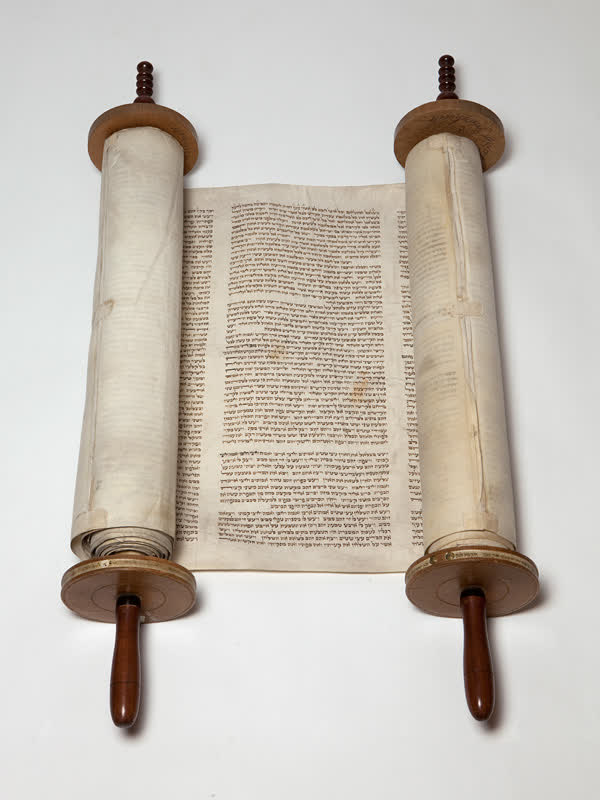
A handwritten Torah scroll (1821) — Scripture copied letter by letter under scribal rules strict enough to count every character.LGLou · CC BY-SA 4.0
That is the aim of this plan. It is not a course and it is not a test. It is a path through three books of the King James Bible, one chapter a day (two on the last day), with just enough help beside each chapter to keep you moving.
Why these three books
The Gospel of John (Days 1–21). John tells us plainly why he wrote: "But these are written, that ye might believe that Jesus is the Christ, the Son of God; and that believing ye might have life through his name" (John 20:31). A book written so that its reader will believe is the right place for a new believer to begin. John shows who Jesus is, in His own words and in His works, and walks slowly through His last night with the disciples, His death and His rising.
The Epistle of James (Days 22–26). Once we have seen who Jesus is, James asks what difference it makes on a Tuesday. "But be ye doers of the word, and not hearers only, deceiving your own selves" (James 1:22). James is short, blunt and practical: trials, the tongue, money, pride, patience and prayer.
The First Epistle of John (Days 27–30). The plan ends where many new believers need to stand: on assurance. "These things have I written unto you that believe on the name of the Son of God; that ye may know that ye have eternal life" (1 John 5:13). The same apostle who wrote the Gospel so that we might believe wrote this letter so that believers might know.
Why the King James
Every verse in this plan is quoted from the King James Bible. You can read it free in the 1611 Reader at kylelauriano.com/library, in the 1611 spelling or in modern spelling, with Strong's Concordance, Webster's 1828 dictionary and Matthew Henry's Concise Commentary a tap away. Where a verse in your reading is left out or changed in modern versions (John 5:4, John 7:53 to 8:11 and 1 John 5:7 all fall inside this plan), the note says so, and the full list of such places is at kylelauriano.com/library/changes. A companion paper, Bible Reading Basics, explains the King James language, its italics and its old words.
A word about me
I was raised Roman Catholic but never really connected — I went through the motions, fell asleep in the pews, and faked being sick to skip Mass. Eventually I gave up and called myself an atheist. I decided to read the Bible for one reason: to disprove it, so I'd have an excuse to stop going to church for good. It did the opposite. Genesis gripped me. In Matthew I read Jesus' own words and felt the weight of my own sin for the first time. I came to faith in 2022, and my wife came to faith a month later.
I tell you that for one reason: the same book is open to you. The full story is at kylelauriano.com/about.
This part matters because a plan that is not used is only paper. Here is the whole of it on one page, and then a few things that will help it last.
The reading table
| Day | Reading | Verses | Theme | A verse to carry | | --- | --- | --- | --- | --- | | 1 | John 1 | 51 | The Word made flesh | John 1:14 | | 2 | John 2 | 25 | The first sign at Cana | John 2:11 | | 3 | John 3 | 36 | Born again | John 3:16 | | 4 | John 4 | 54 | The woman at the well | John 4:14 | | 5 | John 5 | 47 | The pool of Bethesda | John 5:24 | | 6 | John 6 | 71 | The bread of life | John 6:35 | | 7 | John 7 | 53 | Rivers of living water | John 7:37–38 | | 8 | John 8 | 59 | The light of the world | John 8:12 | | 9 | John 9 | 41 | The man born blind | John 9:25 | | 10 | John 10 | 42 | The good shepherd | John 10:27–28 | | 11 | John 11 | 57 | Lazarus raised | John 11:25 | | 12 | John 12 | 50 | The corn of wheat | John 12:24 | | 13 | John 13 | 38 | The towel and the basin | John 13:34 | | 14 | John 14 | 31 | The way, the truth, the life | John 14:6 | | 15 | John 15 | 27 | The vine and the branches | John 15:5 | | 16 | John 16 | 33 | The Comforter | John 16:33 | | 17 | John 17 | 26 | The Lord's prayer for His own | John 17:17 | | 18 | John 18 | 40 | Arrest and trial | John 18:37 | | 19 | John 19 | 42 | The cross | John 19:30 | | 20 | John 20 | 31 | The empty tomb | John 20:31 | | 21 | John 21 | 25 | Peter restored | John 21:17 | | 22 | James 1 | 27 | Trials and wisdom | James 1:22 | | 23 | James 2 | 26 | Faith that works | James 2:17 | | 24 | James 3 | 18 | The tongue | James 3:17 | | 25 | James 4 | 17 | Submit, resist, draw nigh | James 4:7–8 | | 26 | James 5 | 20 | Patience and prayer | James 5:16 | | 27 | 1 John 1 | 10 | Fellowship and the light | 1 John 1:9 | | 28 | 1 John 2 | 29 | Our advocate | 1 John 2:1 | | 29 | 1 John 3 | 24 | Sons of God | 1 John 3:1 | | 30 | 1 John 4–5 | 42 | God is love; ye may know | 1 John 5:13 |
That is all of John (21 chapters), all of James (5) and all of 1 John (5): thirty-one chapters in thirty days. The verse counts are those of the King James text in the 1611 Reader. The longest day is Day 6 (71 verses); the shortest is Day 27 (10). Most days take ten to fifteen minutes to read at an unhurried pace.
What to do each day
Each day below gives you five things: the reading, a verse to carry, a short note, one question and a prayer. A simple order works well:
1. Pray a sentence first. "Open thou mine eyes, that I may behold wondrous things out of thy law" (Psalm 119:18). 2. Read the whole chapter. Do not stop for every question. Read it as you would a letter from someone you love. 3. Read the note. It gives background or explains a word. It is help, not Scripture. 4. Write one line. Answer the question, or write down the verse that stopped you. 5. Turn it into prayer. Use the prayer given, or your own words.
That last step is older than any modern method. George Müller, who cared for thousands of orphans in Bristol in the nineteenth century, wrote that in the spring of 1841 he changed his mornings. He had been praying first; now, he said, "the most important thing I had to do was, to give myself to the reading of the word of God and to meditation on it." He found that "after a very few minutes my soul has been led to confession, or to thanksgiving, or to intercession, or to supplication." He read first, and the reading turned into prayer.1
When you miss a day
You will miss a day. Do not read three chapters to catch up and do not start over. Read the next chapter the next day. The plan is numbered so you can see where you are, not so you can judge yourself.
R. A. Torrey, who trained Bible students in Chicago in the 1890s, wrote that "Regularity counts for more in Bible study than most people fancy," and advised his readers to fix a time, "even if it is no more than fifteen minutes to start with, and hold to it."2 Fifteen minutes, at the same time, in the same place, will carry you through this plan.
Reading the King James for the first time
Three things will save you frustration.
Thee and ye. "Thou" and "thee" are singular; "ye" and "you" are plural. When Jesus says to Nicodemus, "Marvel not that I said unto thee, Ye must be born again" (John 3:7), "thee" is Nicodemus and "ye" is everyone. Webster's dictionary of 1828 still taught this: "ye" is "the nominative plural of the second person, of which thou is the singular."3
Old words. A few words have changed their meaning. "Prevent" once meant to go before; "let" could mean to hinder; "conversation" meant your whole manner of life. The Webster's 1828 button in the 1611 Reader will give you the old sense.
Italics. In most printed King James Bibles some words are in italics. They are not for emphasis. They mark words the translators supplied to make the English read, where no single Hebrew or Greek word stands behind them.
Reading with someone
If you can, read this plan with one other person: a friend, your husband or wife, someone from church. Send each other the verse you carried that day. "Iron sharpeneth iron; so a man sharpeneth the countenance of his friend" (Proverbs 27:17). And if a chapter raises a question you cannot answer, write it down and ask a pastor or a mature believer. The Ethiopian in Acts 8 was reading Isaiah in his chariot when Philip asked whether he understood it. "And he said, How can I, except some man should guide me?" (Acts 8:31). There is no shame in asking.
This week matters because everything else in the Christian life rests on the answer to one question: who is Jesus? John opens with that answer before he tells a single story, and then spends seven chapters showing it.
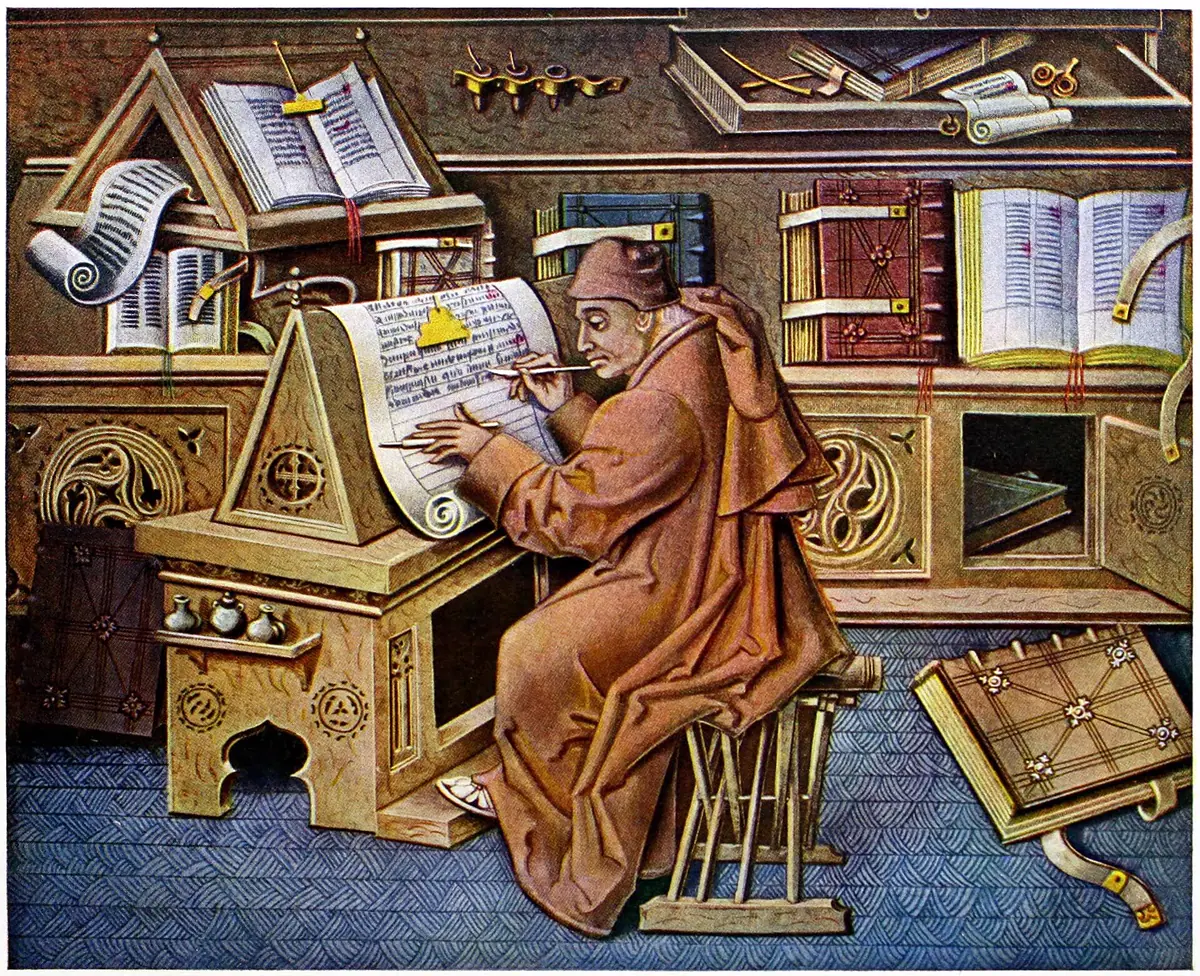
The scribe Jean Miélot at his desk, painted in the 15th century — Scripture copied by hand, line by disciplined line, for a thousand years before print.Jean Le Tavernier, 15th century · Public domain
John was written last of the four Gospels. Irenaeus of Lyons, writing around AD 180, said that John, "the disciple of the Lord, who also had leaned upon His breast," published his Gospel "during his residence at Ephesus in Asia."4 Clement of Alexandria, as quoted by the church historian Eusebius, said that John, seeing that the outward facts had been set down in the other Gospels, "composed a spiritual Gospel."5 That is why John reads differently from Matthew, Mark and Luke: fewer stories, longer conversations, and again and again the words "I am."
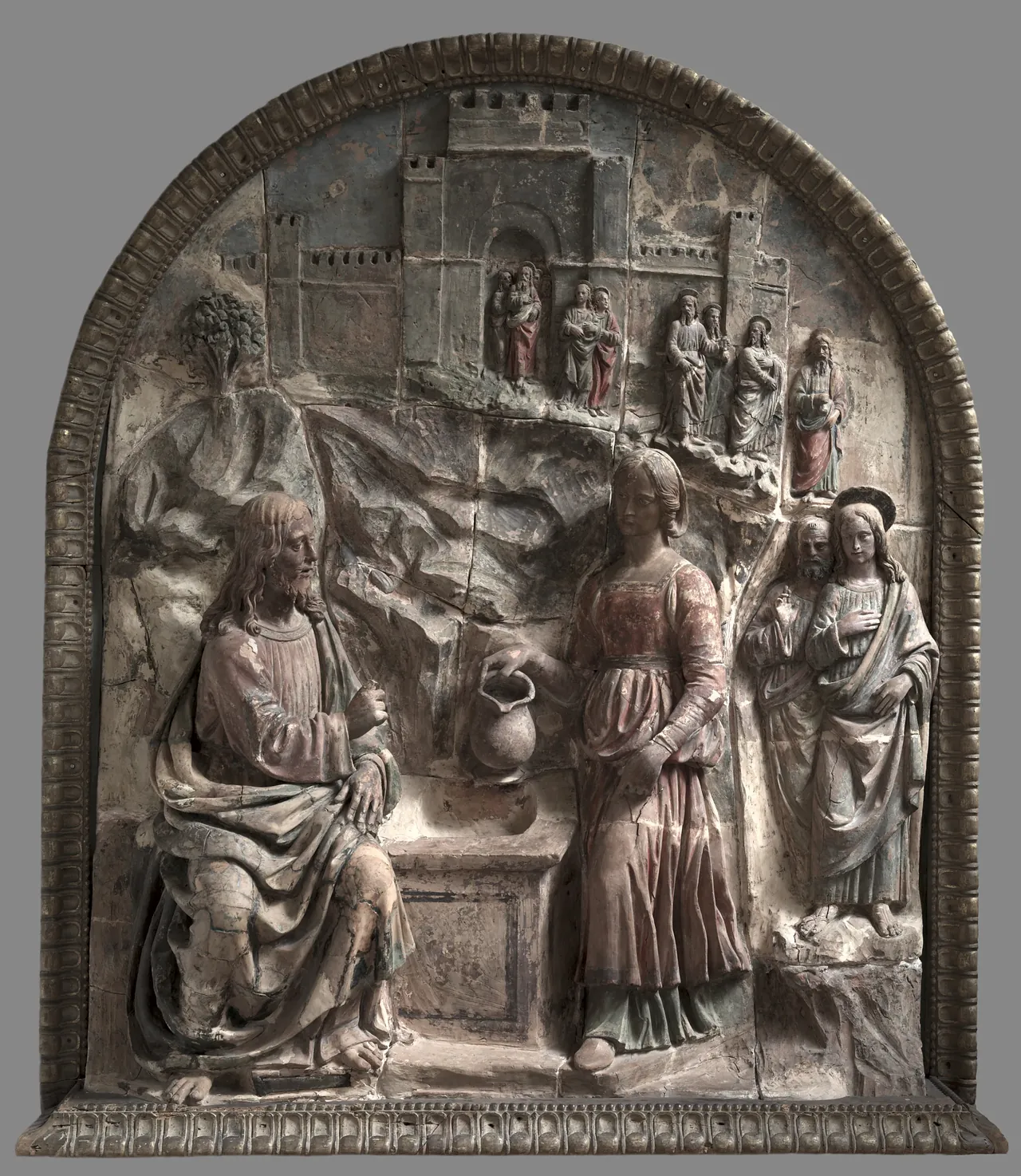
A polychromed terracotta relief of Christ and the Samaritan Woman at the Well, Italian, about 1500 to 1530, the meeting read on Day 4 from John 4.Christ and the Samaritan Woman at the Well · c. 1500–1530 · Cleveland Museum of Art · CC0 · museum record · Galeria Regni
Day 1 — John 1: The Word Made Flesh
Read: John 1 (51 verses).
Carry: "And the Word was made flesh, and dwelt among us, (and we beheld his glory, the glory as of the only begotten of the Father,) full of grace and truth" (John 1:14).
Note. John begins where Genesis begins: "In the beginning was the Word, and the Word was with God, and the Word was God" (John 1:1). The Word is not a thing God said; He is a Person who was with God and was God, and who then became a man. The rest of the chapter introduces Him through witnesses. John the Baptist points: "Behold the Lamb of God, which taketh away the sin of the world" (John 1:29). Andrew finds his brother Simon. Philip finds Nathanael. Notice the pattern: one person meets Jesus and brings another.
Question. Verse 12 says, "But as many as received him, to them gave he power to become the sons of God" (John 1:12). What does it mean to receive Him?
Prayer. Lord Jesus, You were in the beginning and You came near. As I read this month, let me behold Your glory.
Day 2 — John 2: The First Sign at Cana
Read: John 2 (25 verses).
Carry: "This beginning of miracles did Jesus in Cana of Galilee, and manifested forth his glory; and his disciples believed on him" (John 2:11).
Note. John calls Jesus' miracles signs: each points beyond itself. At a wedding the wine runs out. The jars Jesus uses were "six waterpots of stone, after the manner of the purifying of the Jews" (John 2:6), vessels for ritual washing. He fills them with something better. Then in Jerusalem He drives the traders out of the temple and says, "Destroy this temple, and in three days I will raise it up" (John 2:19). John explains: "But he spake of the temple of his body" (John 2:21). The disciples only understood after the resurrection (John 2:22). Some things in Scripture open later; keep reading.
Question. Mary told the servants, "Whatsoever he saith unto you, do it" (John 2:5). What is one thing you already know He has said to you?
Prayer. Lord, You keep the best wine until now. Teach me to do whatever You say.
Day 3 — John 3: You Must Be Born Again
Read: John 3 (36 verses).
Carry: "For God so loved the world, that he gave his only begotten Son, that whosoever believeth in him should not perish, but have everlasting life" (John 3:16).
Note. Nicodemus was "a man of the Pharisees" and "a ruler of the Jews" (John 3:1), a teacher of Israel. He came by night. Jesus did not flatter him: "Except a man be born again, he cannot see the kingdom of God" (John 3:3). Religion, learning and good standing were not enough; he needed new life from God. Then Jesus put it plainly: "Except a man be born of water and of the Spirit, he cannot enter into the kingdom of God. That which is born of the flesh is flesh; and that which is born of the Spirit is spirit" (John 3:5-6). The new birth is God's work, not man's. Then come the most loved words in the Bible, and, at the end of the chapter, words just as plain: "He that believeth on the Son hath everlasting life: and he that believeth not the Son shall not see life; but the wrath of God abideth on him" (John 3:36).
Question. John the Baptist said, "He must increase, but I must decrease" (John 3:30). Where does that need to be true in your life?
Prayer. Father, thank You for giving Your Son. Give me the new birth, and let me never take it lightly.
Day 4 — John 4: The Woman at the Well
Read: John 4 (54 verses).
Carry: "But whosoever drinketh of the water that I shall give him shall never thirst; but the water that I shall give him shall be in him a well of water springing up into everlasting life" (John 4:14).
Note. Jews and Samaritans had a long hostility; John explains, "for the Jews have no dealings with the Samaritans" (John 4:9). Jesus sat at Jacob's well at noon and asked a Samaritan woman for a drink. He knew her life, her five husbands and the man who was not her husband, and He did not leave her in it. He told her that "God is a Spirit: and they that worship him must worship him in spirit and in truth" (John 4:24), and then told her plainly that He was the Christ (John 4:26). She left her waterpot and went to tell the town. By the end of the chapter the Samaritans say, "we have heard him ourselves, and know that this is indeed the Christ, the Saviour of the world" (John 4:42).
Question. What have you been drinking from that leaves you thirsty again?
Prayer. Lord, You know everything I ever did. Give me the living water, and make me unashamed to tell others.
Day 5 — John 5: The Pool of Bethesda
Read: John 5 (47 verses).
Carry: "Verily, verily, I say unto you, He that heareth my word, and believeth on him that sent me, hath everlasting life, and shall not come into condemnation; but is passed from death unto life" (John 5:24).
Note. "Now there is at Jerusalem by the sheep market a pool, which is called in the Hebrew tongue Bethesda, having five porches" (John 5:2). Excavation in Jerusalem at the site long identified as Bethesda has uncovered two large pools; scholars still debate when and why they were built.6 Verse 4, which tells of the angel troubling the water, stands in the 1611; many modern versions remove it (see kylelauriano.com/library/changes). The man had waited thirty-eight years. Jesus asked, "Wilt thou be made whole?" (John 5:6). When the leaders objected that He healed on the sabbath, Jesus said God was His Father, "making himself equal with God" (John 5:18), and He told them, "Search the scriptures; for in them ye think ye have eternal life: and they are they which testify of me" (John 5:39).
Question. Jesus says the Scriptures testify of Him. As you read, are you looking for Him or only for advice?
Prayer. Lord, I have heard Your word. Thank You that I have passed from death unto life.
Day 6 — John 6: The Bread of Life
Read: John 6 (71 verses, the longest day; take your time).
Carry: "And Jesus said unto them, I am the bread of life: he that cometh to me shall never hunger; and he that believeth on me shall never thirst" (John 6:35).
Note. This is the first of seven "I am" sayings with a picture attached: bread, light, door, shepherd, resurrection, way, vine. Jesus feeds five thousand men with five barley loaves and two small fishes, walks on the sea, and then teaches that He Himself is the bread come down from heaven. Many could not bear it, and "From that time many of his disciples went back, and walked no more with him" (John 6:66). Jesus asked the twelve whether they too would go. Peter's answer is one to keep: "Lord, to whom shall we go? thou hast the words of eternal life" (John 6:68). And there is a promise for anyone afraid of being turned away: "him that cometh to me I will in no wise cast out" (John 6:37).
Question. What are you hungry for today, and have you brought that hunger to Him?
Prayer. Lord, to whom else would I go? You have the words of eternal life.
Day 7 — John 7: Rivers of Living Water
Read: John 7 (53 verses).
Carry: "In the last day, that great day of the feast, Jesus stood and cried, saying, If any man thirst, let him come unto me, and drink. He that believeth on me, as the scripture hath said, out of his belly shall flow rivers of living water" (John 7:37–38).
Note. "Now the Jews' feast of tabernacles was at hand" (John 7:2). The background makes Jesus' cry vivid. Alfred Edersheim, the nineteenth-century scholar who was born Jewish and came to faith in Christ, described from the Mishnah how, on each morning of the feast, a priest went down to the Pool of Siloam and drew water "into a golden pitcher," which was carried up and poured out at the altar amid singing and trumpets.7 On the last day of that feast, with the ceremony of water fresh in every mind, Jesus stood up and offered Himself. John explains that He spoke "of the Spirit, which they that believe on him should receive" (John 7:39). The officers sent to arrest Him came back empty-handed: "Never man spake like this man" (John 7:46).
Question. The people were divided about Him (John 7:43). Where do you hear the same division today?
Prayer. Lord, I am thirsty. I come to You to drink. Fill me with Your Spirit.
Part 3 — Week 2: The Light, the Shepherd and the Resurrection (Days 8–14)
6 min read
This week matters because it shows the growing conflict around Jesus and His astonishing claims, and then turns, in chapter 13, to the quiet upper room. Read these chapters as a drama: opposition rises, and the Lord walks steadily toward the cross.
Day 8 — John 8: The Light of the World
Read: John 8 (59 verses). Begin with John 7:53, which belongs with this account.
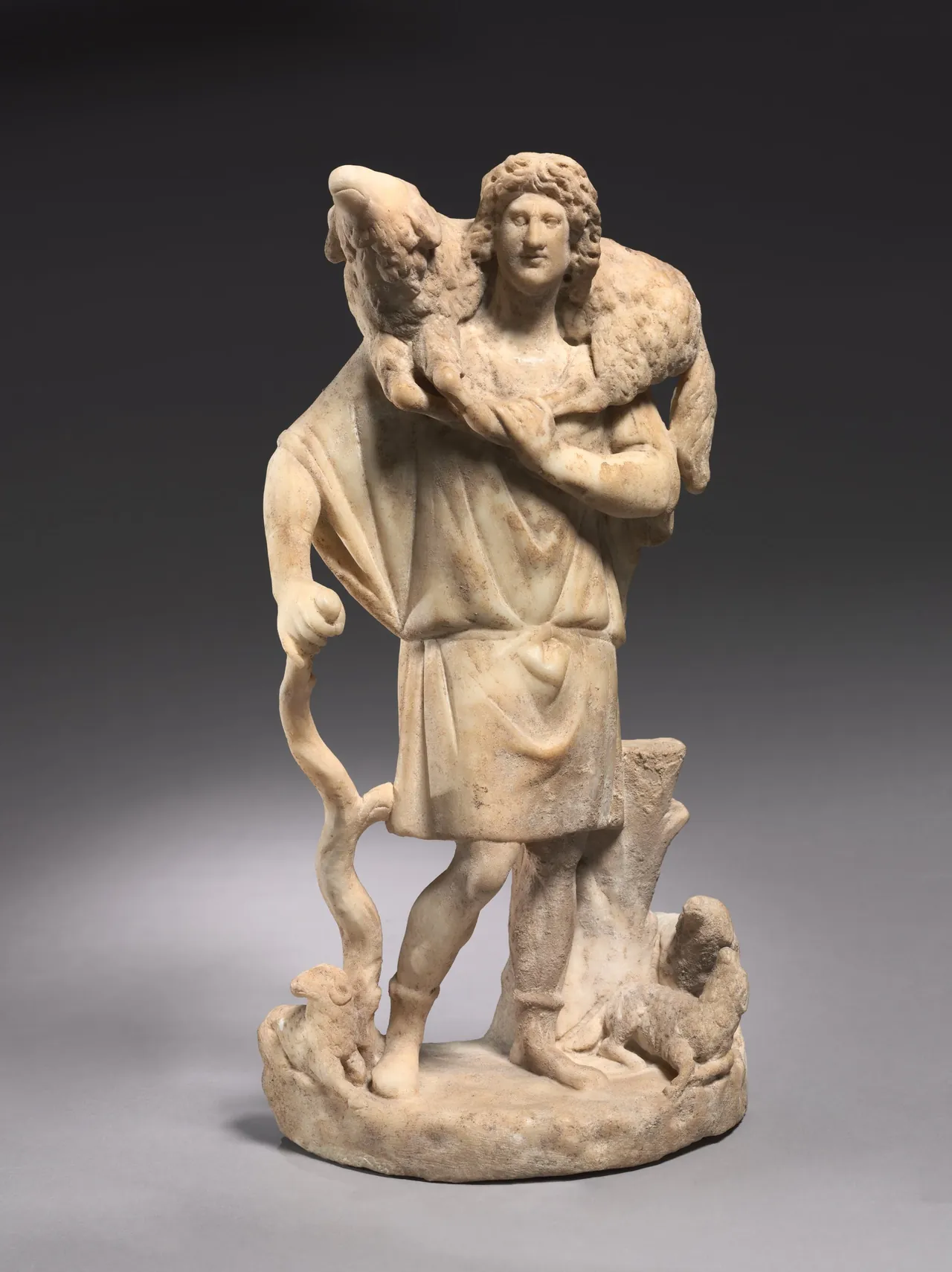
A marble Good Shepherd from Anatolia, carved around 280 to 290 CE, an early Christian image of the shepherd of John 10 read on Day 10.The Good Shepherd · 280–90 CE · Cleveland Museum of Art · CC0 · museum record · Galeria Regni
Carry: "Then spake Jesus again unto them, saying, I am the light of the world: he that followeth me shall not walk in darkness, but shall have the light of life" (John 8:12).
Note. The account of the woman taken in adultery (John 7:53 to 8:11) stands in the 1611 and in the Received Text; modern versions bracket it or move it (see kylelauriano.com/library/changes). Her accusers wanted to trap Jesus. He said, "He that is without sin among you, let him first cast a stone at her" (John 8:7), and they left one by one. To her He said, "Neither do I condemn thee: go, and sin no more" (John 8:11): mercy and a new life in one sentence. Edersheim notes that at the same feast great golden lamps were lit in the Court of the Women, so bright that, in the Mishnah's words as he renders them, "There was not a court in Jerusalem that was not lit up."8 Jesus spoke there, "in the treasury, as he taught in the temple" (John 8:20). The chapter ends with His boldest claim: "Before Abraham was, I am" (John 8:58). They took up stones, because they understood Him.
Question. "And ye shall know the truth, and the truth shall make you free" (John 8:32). What does Jesus say, in verse 36, makes a man free indeed?
Prayer. Lord, You did not condemn me, and You told me to sin no more. Light my way.
Day 9 — John 9: The Man Born Blind
Read: John 9 (41 verses).
Carry: "He answered and said, Whether he be a sinner or no, I know not: one thing I know, that, whereas I was blind, now I see" (John 9:25).
Note. Jesus anointed the eyes of a man born blind and said, "Go, wash in the pool of Siloam, (which is by interpretation, Sent.)" (John 9:7). In 2004, workers repairing a sewer pipe in Jerusalem's City of David uncovered steps that archaeologists Eli Shukron and Ronny Reich identified as part of the Pool of Siloam of the Second Temple period, the pool of this chapter.9 The healed man is questioned, his parents are questioned, and he is thrown out of the synagogue. He did not have every answer. He had one thing he knew. Later Jesus found him and he worshipped (John 9:38). Testimony does not wait for a theology degree.
Question. What is the "one thing I know" in your own story?
Prayer. Lord, I was blind and now I see. Give me courage to say so.
Day 10 — John 10: The Good Shepherd
Read: John 10 (42 verses).
Carry: "My sheep hear my voice, and I know them, and they follow me: And I give unto them eternal life; and they shall never perish, neither shall any man pluck them out of my hand" (John 10:27–28).
Note. "I am the good shepherd: the good shepherd giveth his life for the sheep" (John 10:11). A hired man runs from the wolf; the shepherd lays down his life. The second half of the chapter is set at "the feast of the dedication, and it was winter" (John 10:22). That feast remembered the cleansing and rededication of the temple by Judas Maccabeus after its defilement under Antiochus; the account is in 1 Maccabees 4:52–59, among the Apocrypha printed between the Testaments in the 1611 as history, not as Scripture. In the temple at that feast Jesus said, "I and my Father are one" (John 10:30), and again they took up stones.
Question. How do you hear the Shepherd's voice? (Think of where you are right now.)
Prayer. Good Shepherd, You laid down Your life for me. Keep me in Your hand.
Day 11 — John 11: Lazarus Raised
Read: John 11 (57 verses).
Carry: "Jesus said unto her, I am the resurrection, and the life: he that believeth in me, though he were dead, yet shall he live" (John 11:25).
Note. Jesus loved Martha, Mary and Lazarus (John 11:5), and yet He waited two days before going to them. Lazarus had been in the grave four days when He came. Martha met Him with grief and faith together. Jesus asked her, "Believest thou this?" (John 11:26). At the tomb, knowing what He was about to do, "Jesus wept" (John 11:35). Then He called, and the dead man came out. The miracle that gave life to Lazarus moved the council to plan Jesus' death (John 11:53). Read Caiaphas's words in verses 49–52: he said more than he knew.
Question. Where has God's timing seemed late to you? What does this chapter say about His love in the waiting?
Prayer. Lord, You are the resurrection and the life. I believe; help me in the waiting.
Day 12 — John 12: The Corn of Wheat
Read: John 12 (50 verses).
Carry: "Verily, verily, I say unto you, Except a corn of wheat fall into the ground and die, it abideth alone: but if it die, it bringeth forth much fruit" (John 12:24).
Note. "Corn" in the King James is grain, the wheat and barley of the Bible lands; Webster's 1828 defines it first as "A single seed of certain plants, as wheat, rye, barley and maiz; a grain."10 Mary anoints Jesus with costly ointment; the crowd waves palm branches as He rides into Jerusalem; Greeks come asking to see Him. Then Jesus speaks of His death as a seed falling into the ground, and of the cross as the place where He draws men: "And I, if I be lifted up from the earth, will draw all men unto me" (John 12:32). The chapter closes John's account of His public ministry.
Question. What might it mean for you to "fall into the ground and die" in some part of your life?
Prayer. Lord, You gave Yourself to bear much fruit. Draw me, and draw others through me.
Day 13 — John 13: The Towel and the Basin
Read: John 13 (38 verses).
Carry: "A new commandment I give unto you, That ye love one another; as I have loved you, that ye also love one another" (John 13:34).
Note. Chapters 13–17 are one evening, the last before the cross. Jesus, knowing "that the Father had given all things into his hands" (John 13:3), took a towel and washed His disciples' feet, the work of a servant. Peter objected and then asked for more. Jesus said, "If I then, your Lord and Master, have washed your feet; ye also ought to wash one another's feet" (John 13:14). Judas went out, "and it was night" (John 13:30). Then the new commandment, and the mark of a disciple: "By this shall all men know that ye are my disciples, if ye have love one to another" (John 13:35).
Question. Whose feet are you being asked to wash this week?
Prayer. Lord and Master, You served me. Make me a servant.
Day 14 — John 14: The Way, the Truth and the Life
Read: John 14 (31 verses).
Carry: "Jesus saith unto him, I am the way, the truth, and the life: no man cometh unto the Father, but by me" (John 14:6).
Note. "Let not your heart be troubled" (John 14:1). Jesus speaks these words on the night He will be betrayed. He promises a place in His Father's house, and He answers Thomas, who did not know the way, with Himself. He is not one way among many. Then He promises "another Comforter, that he may abide with you for ever" (John 14:16): the Holy Ghost. Note the plain link between love and obedience: "If ye love me, keep my commandments" (John 14:15).
Question. What is troubling your heart tonight? Read verse 27 again with that in mind.
Prayer. Lord Jesus, You are the way. Give me Your peace, "not as the world giveth" (John 14:27).
Part 4 — Week 3: The Upper Room, the Cross and the Empty Tomb (Days 15–21)
6 min read
This week matters because it brings you to the centre of the faith. The gospel is not first a set of ideas; it is what happened in these chapters. Christ died for our sins and rose again. Read slowly.
Day 15 — John 15: The Vine and the Branches
Read: John 15 (27 verses).
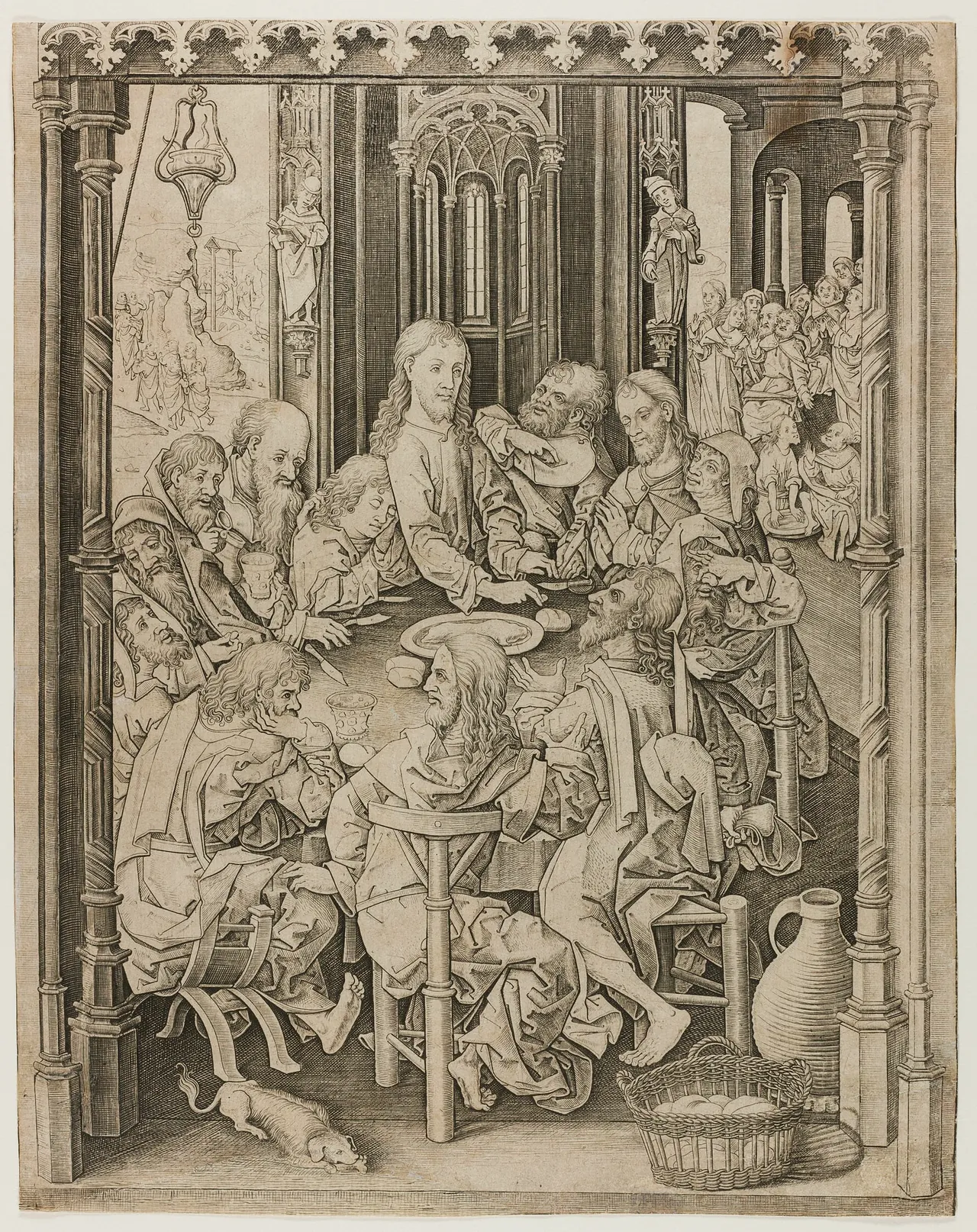
A Netherlandish engraving of the Last Supper from about 1485, the evening in the upper room that John 13 to 17 records before the cross.The Last Supper · c. 1485 · Art Institute of Chicago · CC0 · museum record · Galeria Regni
Carry: "I am the vine, ye are the branches: He that abideth in me, and I in him, the same bringeth forth much fruit: for without me ye can do nothing" (John 15:5).
Note. The key word is "abide," to remain, to stay. A branch does not strain to produce grapes; it stays joined to the vine. The chapter holds a comfort and a warning together, and both should be read as written. The comfort: "Ye have not chosen me, but I have chosen you" (John 15:16). The warning: "If a man abide not in me, he is cast forth as a branch, and is withered; and men gather them, and cast them into the fire, and they are burned" (John 15:6). Take both to heart. And see what the Lord calls His disciples: "Greater love hath no man than this, that a man lay down his life for his friends" (John 15:13).
Question. What helps you abide? What pulls you away?
Prayer. Lord, I am a branch. Keep me in You, and make me fruitful.
Day 16 — John 16: The Comforter
Read: John 16 (33 verses).
Carry: "These things I have spoken unto you, that in me ye might have peace. In the world ye shall have tribulation: but be of good cheer; I have overcome the world" (John 16:33).
Note. Jesus tells the disciples it is good for them that He goes away, because then the Comforter will come. The Holy Ghost will "reprove the world of sin, and of righteousness, and of judgment" (John 16:8), and will "guide you into all truth" (John 16:13). Jesus does not promise His people an easy road. He promises tribulation in the world and peace in Him, and He tells them that their sorrow will be turned into joy (John 16:20).
Question. Which do you notice more this week: the tribulation, or His peace?
Prayer. Holy Ghost, guide me into all truth. Lord, You have overcome the world.
Day 17 — John 17: The Lord's Prayer for His Own
Read: John 17 (26 verses).
Carry: "Sanctify them through thy truth: thy word is truth" (John 17:17).
Note. Here we listen as the Son prays to the Father. He prays for Himself (verses 1–5), for His disciples (6–19), and then for us: "Neither pray I for these alone, but for them also which shall believe on me through their word" (John 17:20). If you believe, you are in that prayer. He defines eternal life as a relationship: "And this is life eternal, that they might know thee the only true God, and Jesus Christ, whom thou hast sent" (John 17:3). And He asks that His people be kept, made holy by the word, and one, "that the world may believe that thou hast sent me" (John 17:21).
Question. Jesus prayed for you by name, in effect, in verse 20. How does that change how you see today?
Prayer. Father, sanctify me through Your truth. Your word is truth.
Day 18 — John 18: Arrest and Trial
Read: John 18 (40 verses).
Carry: "To this end was I born, and for this cause came I into the world, that I should bear witness unto the truth. Every one that is of the truth heareth my voice" (John 18:37).
Note. Jesus is arrested in a garden, taken "to Annas first; for he was father in law to Caiaphas, which was the high priest that same year" (John 18:13). In December 1990, park development work in the Peace Forest in south Jerusalem broke into a first-century family tomb; one ornate bone box in it was inscribed "Joseph son of Caiaphas," and many scholars identify it with this high priest, whom Josephus also names as Joseph Caiaphas.11 Meanwhile Peter, warming himself by a fire, says three times that he does not know Jesus: "I am not" (John 18:17). Before Pilate, Jesus speaks of truth, and Pilate answers, "What is truth?" (John 18:38), then finds "no fault at all" in Him.
Question. Peter failed by a fire. Where are you most tempted to say, "I am not"?
Prayer. Lord, You bore witness to the truth. Keep me from denying You.
Day 19 — John 19: The Cross
Read: John 19 (42 verses).
Carry: "When Jesus therefore had received the vinegar, he said, It is finished: and he bowed his head, and gave up the ghost" (John 19:30).
Note. Pilate was a real Roman official. In June 1961, Italian archaeologists working at the theatre of Caesarea Maritima, Rome's capital in Judaea, found a limestone block with a Latin dedication naming Pontius Pilate as prefect of Judaea; it is now in the Israel Museum in Jerusalem.12 Pilate "sat down in the judgment seat in a place that is called the Pavement, but in the Hebrew, Gabbatha" (John 19:13), and gave Jesus up to be crucified. Over the cross he wrote, "JESUS OF NAZARETH THE KING OF THE JEWS" (John 19:19). John, who stood there with Jesus' mother, gives us the last words: "It is finished." The debt is paid in full. Read verse 35: John wants you to know he saw it.
Question. What does "It is finished" mean for the sins you still carry?
Prayer. Lord Jesus, You finished the work. I trust what You have done, not what I can do.
Day 20 — John 20: The Empty Tomb
Read: John 20 (31 verses).
Carry: "But these are written, that ye might believe that Jesus is the Christ, the Son of God; and that believing ye might have life through his name" (John 20:31).
Note. Mary Magdalene comes while it is still dark and finds the stone taken away. Peter and John run; John sees the grave clothes lying and believes. Jesus speaks Mary's name, and she knows Him. That evening He stands among the disciples behind shut doors. Thomas was not there and would not believe without seeing the wounds. A week later Jesus said, "Reach hither thy finger, and behold my hands" (John 20:27), and Thomas answered, "My LORD and my God" (John 20:28). Then Jesus blessed us: "blessed are they that have not seen, and yet have believed" (John 20:29). John closes with the reason for his whole book.
Question. You have now read the whole account. Do you believe that Jesus is the Christ, the Son of God?
Prayer. My Lord and my God, I have not seen, and yet I believe. Give me life through Your name.
Day 21 — John 21: Peter Restored
Read: John 21 (25 verses).
Carry: "He saith unto him the third time, Simon, son of Jonas, lovest thou me? Peter was grieved because he said unto him the third time, Lovest thou me? And he said unto him, Lord, thou knowest all things; thou knowest that I love thee. Jesus saith unto him, Feed my sheep" (John 21:17).
Note. Peter went back to fishing. Jesus met him on the shore with a fire of coals, a breakfast and three questions, one for each denial. If you look the words up in Strong's Concordance in the 1611 Reader, you will see that Jesus' first two questions use the Greek verb Strong numbers G25 and Peter's answers use G5368; the third time Jesus uses Peter's word. Strong describes the first as wider and the second as "personal attachment."13 Christians differ on how much weight to put on the change; the plain point is that the Lord restored a man who had failed Him and gave him work to do. The Gospel ends modestly: "there are also many other things which Jesus did" (John 21:25).
Question. Is there a failure you think disqualifies you? What did Jesus do with Peter's?
Prayer. Lord, You know all things; You know that I love You. Give me Your work to do.
Part 5 — Week 4: Faith That Works (James, Days 22–26)
5 min read
This week matters because a new believer must learn early that faith is not only something you hold but something you live. James presses that home in five short chapters.
The writer calls himself "James, a servant of God and of the Lord Jesus Christ" (James 1:1). The early church identified him as the James whom Paul calls "the Lord's brother" (Galatians 1:19), the leader of the church in Jerusalem in Acts 15. The Jewish historian Josephus records that in the interval between two Roman governors, after Festus died and while Albinus "was but upon the road," the high priest Ananus brought before the Sanhedrin "the brother of Jesus, who was called Christ, whose name was James," and had him stoned.14
Day 22 — James 1: Trials and Wisdom
Read: James 1 (27 verses).
Carry: "But be ye doers of the word, and not hearers only, deceiving your own selves" (James 1:22).
Note. James opens with a hard word: "My brethren, count it all joy when ye fall into divers temptations; Knowing this, that the trying of your faith worketh patience" (James 1:2–3). "Divers" means various, of different kinds. Trials are not pointless; God uses them. When you do not know what to do, ask: "If any of you lack wisdom, let him ask of God, that giveth to all men liberally, and upbraideth not" (James 1:5). To "upbraid" is to reproach; God does not scold you for asking. Then the mirror: hearing without doing is self-deception. James defines pure religion in practical terms: caring for "the fatherless and widows in their affliction," and keeping "unspotted from the world" (James 1:27).
Question. What did you read in John that you have heard but not yet done?
Prayer. Father, I lack wisdom. Give it liberally, and make me a doer of Your word.
Day 23 — James 2: Faith That Works
Read: James 2 (26 verses).
Carry: "Even so faith, if it hath not works, is dead, being alone" (James 2:17).
Note. James first condemns favouritism in church: honouring the rich man in fine clothes and shaming the poor man (James 2:1–4). Then he asks what good a faith is that says "be ye warmed and filled" (James 2:16) and gives nothing. Does James contradict Paul? Read them side by side. Paul: "For by grace are ye saved through faith; and that not of yourselves: it is the gift of God: Not of works, lest any man should boast" (Ephesians 2:8–9), and then at once, "For we are his workmanship, created in Christ Jesus unto good works" (Ephesians 2:10). James quotes the same verse Paul uses: "Abraham believed God, and it was imputed unto him for righteousness" (James 2:23). Paul says works cannot save; James says a faith that never works is not saving faith. Both say the same Christ makes a living faith.
Question. If someone watched your week, what would they say your faith does?
Prayer. Lord, I am saved by grace. Let my faith be alive and visible.
Day 24 — James 3: The Tongue
Read: James 3 (18 verses).
Carry: "But the wisdom that is from above is first pure, then peaceable, gentle, and easy to be intreated, full of mercy and good fruits, without partiality, and without hypocrisy" (James 3:17).
Note. "For in many things we offend all" (James 3:2). James is honest: everyone stumbles, and the tongue most of all. "Even so the tongue is a little member, and boasteth great things. Behold, how great a matter a little fire kindleth!" (James 3:5). He names the strangeness of it: "Therewith bless we God, even the Father; and therewith curse we men, which are made after the similitude of God" (James 3:9). In verse 17, the old phrase easy to be intreated means open to persuasion, willing to yield. Notice that James turns from the tongue to wisdom: the cure for the mouth is a heart changed from above.
Question. Where did your words do damage this week, and to whom do you need to speak again?
Prayer. Lord, set a watch on my mouth. Give me the wisdom that is from above.
Day 25 — James 4: Submit, Resist, Draw Nigh
Read: James 4 (17 verses).
Carry: "Submit yourselves therefore to God. Resist the devil, and he will flee from you. Draw nigh to God, and he will draw nigh to you" (James 4:7–8).
Note. James traces quarrels back to desires at war within us (James 4:1). He warns that friendship with the world is enmity with God, and then gives grace: "God resisteth the proud, but giveth grace unto the humble" (James 4:6). The order in verse 7 matters. First submit to God; then resist the devil. The devil is real and he does flee, but no one resists him in his own strength while running his own life. James then humbles our plans: "For what is your life? It is even a vapour, that appeareth for a little time, and then vanisheth away" (James 4:14). The chapter ends with a sentence to keep you honest: "Therefore to him that knoweth to do good, and doeth it not, to him it is sin" (James 4:17).
Question. In what area do you need to submit before you can resist?
Prayer. Father, I submit to You. I resist the devil in Jesus' name. Draw near to me as I draw near to You.
Day 26 — James 5: Patience and Prayer
Read: James 5 (20 verses).
Carry: "Confess your faults one to another, and pray one for another, that ye may be healed. The effectual fervent prayer of a righteous man availeth much" (James 5:16).
Note. James warns rich men who cheat their workers (James 5:1–6), and then calls believers to patience: "Be ye also patient; stablish your hearts: for the coming of the Lord draweth nigh" (James 5:8). Then he speaks plainly about sickness: "Is any sick among you? let him call for the elders of the church; and let them pray over him, anointing him with oil in the name of the Lord: And the prayer of faith shall save the sick, and the Lord shall raise him up" (James 5:14–15). Take the instruction as written: call the elders, and pray. The healing belongs to "the Lord"; we ask in faith and leave the outcome in His hands. James's example is Elijah, "a man subject to like passions as we are" (James 5:17). Prayer is not for spiritual heroes only.
Question. Is there someone you should call to pray with you, or for whom you should pray today?
Prayer. Lord, teach me to pray earnestly, to confess honestly, and to wait patiently for Your coming.
Part 6 — Last Days: That Ye May Know (1 John, Days 27–30)
4 min read
This last stretch matters because many new believers wonder whether their faith is real. First John answers, and it answers in two ways at once: with promises to rest on and with tests to examine ourselves by. The letter does not name its author, but from the early church onward it has been received as the work of the apostle John; its opening words echo the first verses of his Gospel.
Day 27 — 1 John 1: Fellowship and the Light
Read: 1 John 1 (10 verses, the shortest day; read it twice).
Carry: "If we confess our sins, he is faithful and just to forgive us our sins, and to cleanse us from all unrighteousness" (1 John 1:9).
Note. John writes as an eyewitness: "That which was from the beginning, which we have heard, which we have seen with our eyes, which we have looked upon, and our hands have handled, of the Word of life" (1 John 1:1). He writes so that we may share fellowship "with the Father, and with his Son Jesus Christ" (1 John 1:3). God is light. Walking in the light does not mean never sinning; it means living in the open before God: "the blood of Jesus Christ his Son cleanseth us from all sin" (1 John 1:7). Those who claim to have no sin deceive themselves; those who confess are forgiven.
Question. Is there a sin you have been hiding rather than confessing?
Prayer. Father, I confess my sins. Thank You that You are faithful and just to forgive.
Day 28 — 1 John 2: Our Advocate
Read: 1 John 2 (29 verses).
Carry: "My little children, these things write I unto you, that ye sin not. And if any man sin, we have an advocate with the Father, Jesus Christ the righteous" (1 John 2:1).
Note. An advocate pleads another's case. Christ is also "the propitiation for our sins" (1 John 2:2), the sacrifice that turns away God's wrath; Webster's 1828 defines the word in its theological sense as "the atonement or atoning sacrifice offered to God."15 John gives a test: "And hereby we do know that we know him, if we keep his commandments" (1 John 2:3). And a warning that sounds as if it were written yesterday: "Love not the world, neither the things that are in the world" (1 John 2:15). John names what the world offers as "the lust of the flesh, and the lust of the eyes, and the pride of life" (1 John 2:16), and then he shows where it ends: "And the world passeth away, and the lust thereof: but he that doeth the will of God abideth for ever" (1 John 2:17).
Question. Which of the three in verse 16 pulls hardest at you?
Prayer. Lord Jesus, You are my advocate. Loosen the world's grip on my heart.
Day 29 — 1 John 3: Sons of God
Read: 1 John 3 (24 verses).
Carry: "Behold, what manner of love the Father hath bestowed upon us, that we should be called the sons of God: therefore the world knoweth us not, because it knew him not" (1 John 3:1).
Note. "Beloved, now are we the sons of God, and it doth not yet appear what we shall be: but we know that, when he shall appear, we shall be like him; for we shall see him as he is" (1 John 3:2). The hope of His appearing makes us pure (1 John 3:3). Verse 9 is strong: "Whosoever is born of God doth not commit sin; for his seed remaineth in him: and he cannot sin, because he is born of God" (1 John 3:9). Read it beside 1 John 1:8–9, where John says believers do sin and must confess. Many readers take chapter 3 to describe the settled direction of a life rather than the absence of every failure; let John's two statements stand together. Love, he says, is shown in action: "let us not love in word, neither in tongue; but in deed and in truth" (1 John 3:18).
Question. What is one act of love, in deed and not in word, you can do tomorrow?
Prayer. Father, thank You for calling me Your child. Make me like Your Son.
Day 30 — 1 John 4–5: God Is Love; That Ye May Know
Read: 1 John 4 and 5 (21 + 21 verses).
Carry: "These things have I written unto you that believe on the name of the Son of God; that ye may know that ye have eternal life, and that ye may believe on the name of the Son of God" (1 John 5:13).
Note. "He that loveth not knoweth not God; for God is love" (1 John 4:8). And our love is a reply: "We love him, because he first loved us" (1 John 4:19). In chapter 5, verse 7 reads, "For there are three that bear record in heaven, the Father, the Word, and the Holy Ghost: and these three are one" (1 John 5:7). It stands in the 1611 and the Received Text; modern versions remove it (see kylelauriano.com/library/changes). Then comes the assurance John has been building toward: "He that hath the Son hath life; and he that hath not the Son of God hath not life" (1 John 5:12). Take that promise to heart, and take with it the call of Scripture to keep going: "give diligence to make your calling and election sure" (2 Peter 1:10). Assurance and diligence are not enemies. The letter ends with a sentence that fits a new believer's whole life: "Little children, keep yourselves from idols" (1 John 5:21).
Question. Do you have the Son? On what do you rest your answer?
Prayer. Father, thank You for the record that You have given me eternal life in Your Son. Keep me from idols, and keep me to the end.
You have read thirty-one chapters of the word of God. That is not a small thing. But it is a beginning, not a finish line.
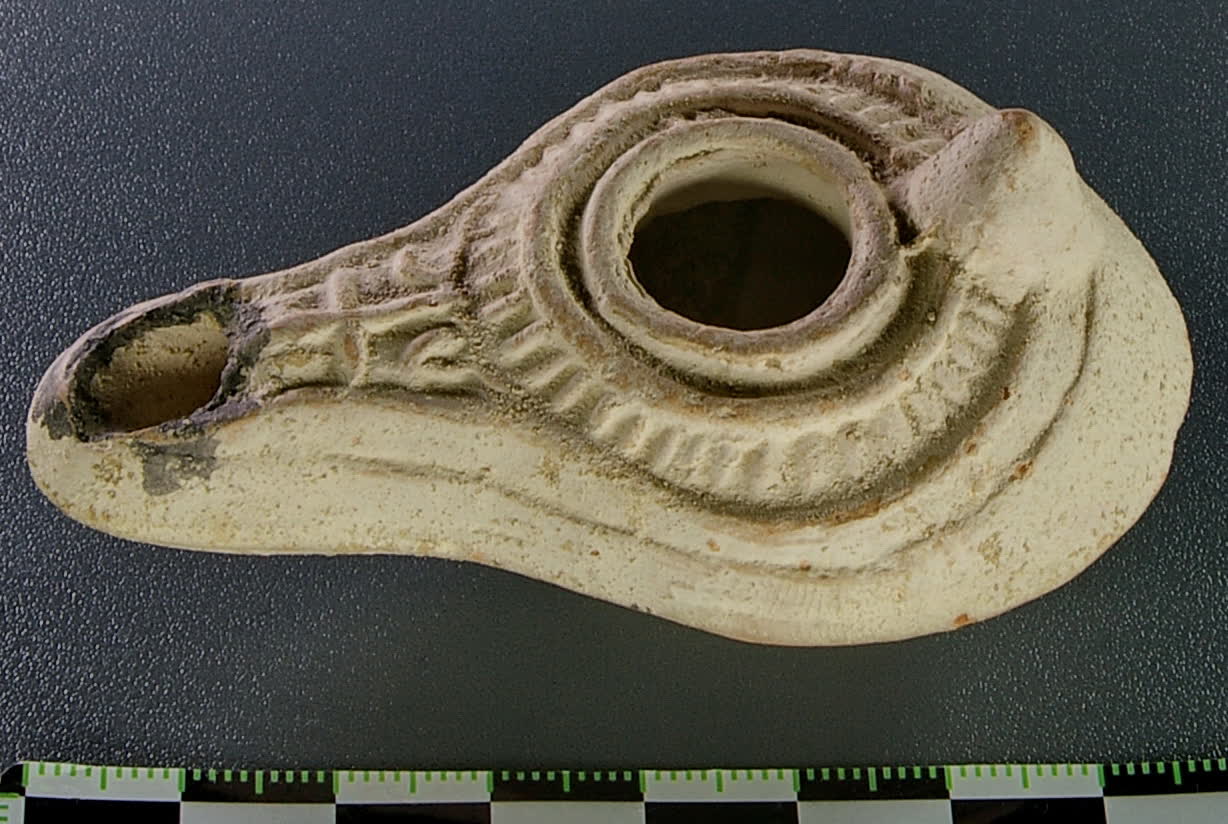
A simple clay oil lamp of the Roman era — trimmed wick and ready oil, the small daily disciplines behind Jesus’ parable of the ten virgins.Johann H. Addicks · CC BY-SA 3.0
Where to go next
Torrey advised beginners to study a short book richly, and he named the First Epistle of Paul to the Thessalonians as a good first choice, "quite short" and "exceedingly rich in its teaching."16 A sensible next month looks like this:
| Next | Reading | Chapters | Why | | --- | --- | --- | --- | | Month 2 | Mark | 16 | The shortest Gospel, fast and vivid | | | Acts | 28 | What happened after John 21 | | Month 3 | Romans | 16 | The gospel explained | | | 1 and 2 Thessalonians | 5 + 3 | Short, rich, full of the Lord's return | | Month 4 | Genesis | 50 | The beginning of everything | | Daily | Psalms and Proverbs | 150 + 31 | One psalm and one proverb chapter a day alongside |
Proverbs has thirty-one chapters, one for each day of the longest months, which makes it an easy companion to any plan. The companion paper Bible Reading Basics sets out longer plans, including the whole Bible in a year.
Keep the habit simple
The Bereans were called noble because they "searched the scriptures daily" (Acts 17:11). Daily is the key word. Keep the same time and the same place. Keep a notebook. Keep reading with a friend. When you miss, pick up the next day.
If you have read this far and you are not sure you belong to Christ, John wrote his Gospel for you. Repentance toward God and faith in our Lord Jesus Christ (Acts 20:21) is the door, and the promise of John 6 still stands: "him that cometh to me I will in no wise cast out" (John 6:37). You do not need to understand everything. You need to come.
And if you do belong to Him, keep reading. The Lord who spoke in these thirty days is still speaking.
"Thy word is a lamp unto my feet, and a light unto my path." (Psalm 119:105)
1George Müller, A Narrative of Some of the Lord's Dealings with George Müller, Part 3 (London: J. Nisbet & Co.), entry written of his stay at Nailsworth in the spring of 1841. Project Gutenberg ebook 22148, https://www.gutenberg.org/ebooks/22148.↩
2R. A. Torrey, How to Study the Bible for Greatest Profit (New York: Fleming H. Revell, 1896), 116–18. Online: https://archive.org/details/howtostudybiblef00torr.↩
3Noah Webster, An American Dictionary of the English Language (New York: S. Converse, 1828), s.v. "Ye"; text in the Study shelf of the 1611 Reader, kylelauriano.com/library/study.↩
4Irenaeus, Against Heresies 3.1.1, trans. Alexander Roberts and William Rambaut, in Ante-Nicene Fathers, vol. 1 (Buffalo: Christian Literature Publishing, 1885). Online: https://www.newadvent.org/fathers/0103301.htm.↩
5Eusebius, Church History 6.14.7, quoting Clement of Alexandria's Hypotyposes, trans. Arthur Cushman McGiffert, in Nicene and Post-Nicene Fathers, 2nd series, vol. 1 (Buffalo: Christian Literature Publishing, 1890). Online: https://www.newadvent.org/fathers/250106.htm.↩
6Urban C. von Wahlde, review of Le Projet Béthesda (1994–2010), ed. Claudine Dauphin and Shimon Gibson, Bible History Daily (Biblical Archaeology Society), February 13, 2013, https://www.biblicalarchaeology.org/reviews/le-projet-bethesda-1994-2010/.↩
7Alfred Edersheim, The Temple: Its Ministry and Services (London, 1874; repr. London: Hodder and Stoughton, 1904), ch. 14, "The Feast of Tabernacles." Online: https://ccel.org/ccel/edersheim/temple.↩
8Edersheim, The Temple, ch. 14, citing Mishnah Sukkah 5.2–4.↩
9Ronny Reich, Eli Shukron and Omri Lernau, "Recent Discoveries in the City of David, Jerusalem," Israel Exploration Journal 57 (2007): 153–69.↩
10Webster, American Dictionary (1828), s.v. "Corn."↩
11Zvi Greenhut, "Discovery of the Caiaphas Family Tomb," Jerusalem Perspective 33/34 (1991): 6–11, https://www.jerusalemperspective.com/2592/; Ronny Reich, "Ossuary Inscriptions from the Caiaphas Tomb," Jerusalem Perspective 33/34 (1991), https://www.jerusalemperspective.com/2598/; Josephus, Antiquities of the Jews 18.2.2, trans. William Whiston, https://www.gutenberg.org/ebooks/2848.↩
12Antonio Frova, "L'iscrizione di Ponzio Pilato a Cesarea," Rendiconti dell'Istituto Lombardo 95 (1961): 419–34.↩
13James Strong, "A Concise Dictionary of the Words in the Greek Testament," in The Exhaustive Concordance of the Bible (New York: Hunt & Eaton, 1890), nos. 25 and 5368; text in the Study shelf of the 1611 Reader.↩
14Josephus, Antiquities of the Jews 20.9.1, trans. William Whiston. Online: https://www.gutenberg.org/ebooks/2848.↩
15Webster, American Dictionary (1828), s.v. "Propitiation."↩
16Torrey, How to Study the Bible for Greatest Profit, 15–16.↩
The Bible says something is fighting you. It names it.
Seven passages in the 1611 King James, one a day — the armour, the princes over the nations, the war in heaven — with the page, a work of art, a clip, and a real person who says they were delivered. Free.
This is practical teaching, not proof. It's drawn from Scripture and from walking this road myself. If you're still weighing the basics — whether God is real, whether the Bible can be trusted — I'd encourage you to start with the Skeptic resources in the Research Hub before diving in here.