A study of what the Bible says God does when a sinner trusts Christ, the new birth, justification, adoption and the gift of the Holy Ghost, and of the first steps a new believer takes in the weeks that follow.
Abstract
What actually happens when a person turns from sin and trusts Jesus Christ? Many new believers know that something has changed but cannot say what. This paper answers from the King James Bible, beginning with Jesus' conversation with Nicodemus in John 3 and moving through the great words of the New Testament for what God does in salvation: new birth, justification, adoption, redemption, reconciliation and the sealing of the Holy Ghost. It sets beside the Scriptures the recorded conversions of Augustine, John Bunyan's pilgrim, John Wesley and Charles Spurgeon, and uses J. C. Ryle's classic distinction between justification and sanctification to explain what changes at once and what changes slowly. It teaches assurance from the texts that give it and the texts that warn, without choosing a theological system. It ends with the first steps the apostles set before new converts: repentance that shows itself, telling others, the word, prayer, the church and baptism. It is written for anyone in the first weeks of faith, and for those who help them.
What’s inside
·Introduction
Part 1Part 1: Born Again: Jesus and Nicodemus
Part 2Part 2: What God Did for You
Part 3Part 3: How Conversion Feels, and Why It Varies
Part 4Part 4: What Changed at Once, and What Changes Slowly
Part 5Part 5: Can I Know That I Belong to Christ?
Part 6Part 6: Your First Steps
Part 7Part 7: A Thirty-Day Plan
·Conclusion
Research paper · 9 chapters · 13 notes · October 2026
About 40 minutes · 9 parts · the PDF has the same text
Introduction
3 min read
If you have recently turned to Jesus Christ, something has happened to you that you may not have words for yet. You may feel lighter. You may feel confused. You may feel nothing in particular and wonder whether that is a bad sign. You may have prayed alone in a car or a bedroom, or at the front of a church, or quietly in the middle of reading the Bible.
Whichever it was, the first question most new believers ask is simple: what just happened?
This paper is an answer to that question from the Bible. It is not about a technique or a programme. It is about what God says He does when a sinner trusts His Son, and about the first steps the apostles set before people in exactly your position.
What this paper is
This is a study, written for new believers but not watered down for them. It argues from the King James Bible first. Where the history behind a passage helps, the history is given with its source. Where Christians of earlier centuries described their own conversions, their words are quoted from their own books, so you can see that what happened to you is not strange; it has happened to millions before you, in many different ways.
Seven parts follow. Part 1 looks at the new birth through Jesus' conversation with Nicodemus. Part 2 sets out what God did for you, in the great words of the New Testament. Part 3 looks at how different conversions feel, and why feelings vary. Part 4 explains what changed at once and what changes slowly. Part 5 asks how you can know you belong to Christ. Part 6 is practical: your first steps. Part 7 is a thirty-day plan. A companion paper, Survival Kit, takes up the hard things that usually come later in the first year: doubt, relationships, temptation and church. The Baptism Guide covers baptism in depth.
A word about me
This is how it happened to me, in my own words.
I was raised Roman Catholic but never really connected — I went through the motions, fell asleep in the pews, and faked being sick to skip Mass. College was rebellion: parties, drugs, freedom I loved and abused.
When real life hit — a lost job, a pregnant wife, constant fights — I went looking for peace anywhere I could find it. New Age, crystals, astral projection, tarot, angel numbers. None of it held. So I swung back hard to religion, said the rosary every night, and still felt nothing.
Eventually I gave up and called myself an atheist. I decided to read the Bible for one reason: to disprove it, so I'd have an excuse to stop going to church for good.
It did the opposite. Genesis gripped me. In Matthew I read Jesus' own words and felt the weight of my own sin for the first time. I wept at worship music I'd never have been caught listening to. Then one day I got on my knees and prayed: "Jesus, if you are real, show me — and I'll serve you." A warmth ran from the top of my head to the soles of my feet. Peace I'd never known, and it didn't leave.
I came to faith in 2022, and my wife came to faith a month later. Today we're raising three kids in a home that was transformed — and I haven't stopped telling people since.
My testimony is on video at youtube.com/watch?v=FR7cNUiaAqU, and the full story is at kylelauriano.com/about. I tell it here not because yours must look like mine. It probably will not. I tell it because I know what it is to come to Christ from a long way off.
A note on Scripture: every verse in this paper is quoted from the King James Bible. You can read it free in the 1611 Reader at kylelauriano.com/library. If you are going to buy one Bible, buy a King James with Strong's Concordance, so that you can look up the Hebrew and Greek word behind any English word for yourself.
This part matters because the phrase "born again" has been worn smooth by use. People say it as a label, as in "a born-again Christian". Jesus said it as a necessity: "Ye must be born again." If we want to know what happened to us, the best place to start is the conversation where He first explained it.
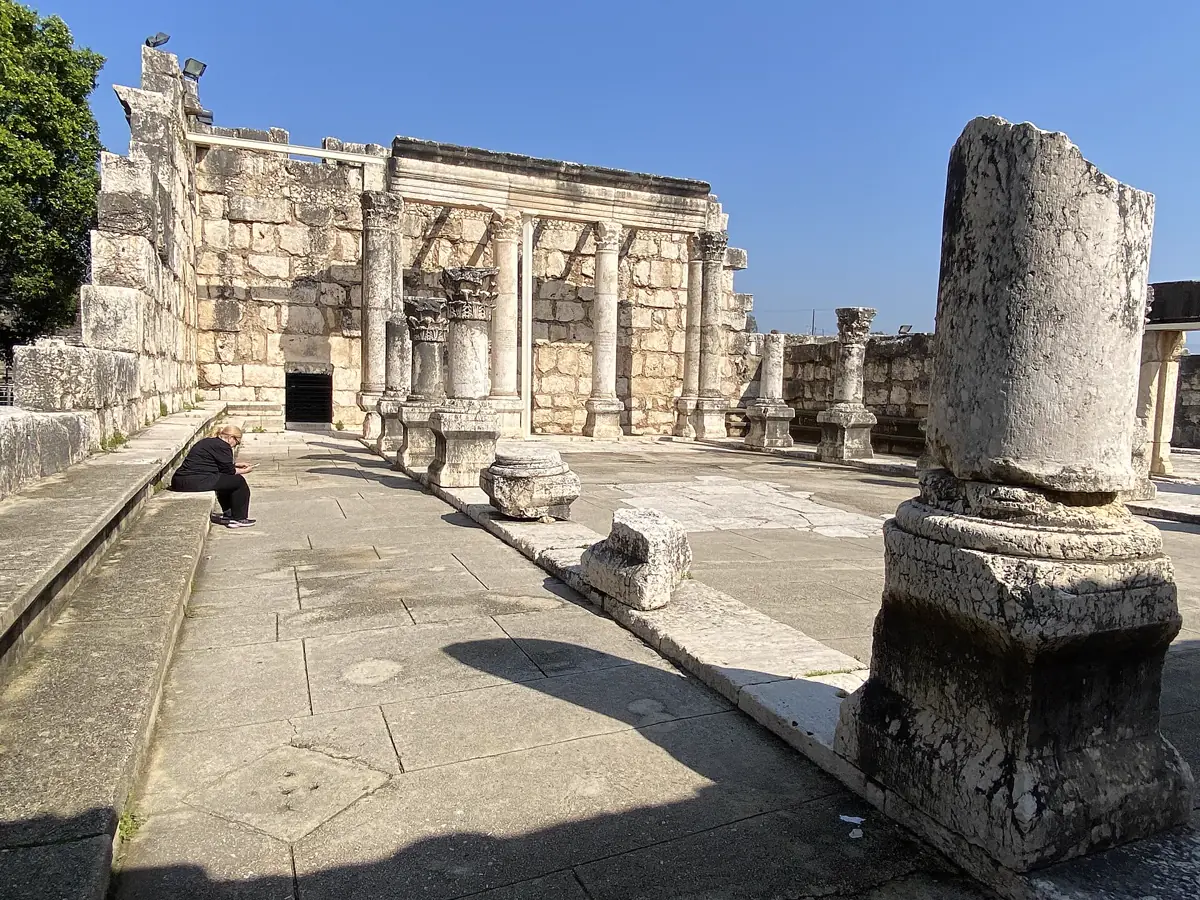
The synagogue at Capernaum, standing on the black-basalt foundations of the 1st-century hall where Jesus taught.שלמה רודד · CC BY 2.5
The man who came by night
"There was a man of the Pharisees, named Nicodemus, a ruler of the Jews: The same came to Jesus by night, and said unto him, Rabbi, we know that thou art a teacher come from God: for no man can do these miracles that thou doest, except God be with him" (John 3:1-2).
John tells us three things about Nicodemus at once. He was a Pharisee, a member of the most serious and devout religious movement of his day. He was "a ruler of the Jews", which in John's Gospel means a member of the Jewish ruling council in Jerusalem; later John shows him speaking up in that council for a fair hearing of Jesus (John 7:50-51). And he came "by night". John mentions that detail every time Nicodemus appears, even in the last scene, where he helps bury Jesus: "And there came also Nicodemus, which at the first came to Jesus by night, and brought a mixture of myrrh and aloes, about an hundred pound weight" (John 19:39).
Nicodemus was not a wicked man by any ordinary standard. He was learned, respected, moral and religious. He was the kind of person most of us would think did not need converting. Jesus told him that he needed to be born.
"Ye must be born again"
"Jesus answered and said unto him, Verily, verily, I say unto thee, Except a man be born again, he cannot see the kingdom of God" (John 3:3).
The word translated "again" is the Greek anōthen. Strong's concordance gives its meanings as "from above; by analogy, from the first; by implication, anew".1 Both senses fit. The birth Jesus speaks of is a new birth, a starting over; and it is a birth from above, from God. Nicodemus heard only the first sense, and it baffled him: "How can a man be born when he is old? can he enter the second time into his mother's womb, and be born?" (John 3:4).
Jesus answered by explaining where this birth comes from. "Verily, verily, I say unto thee, Except a man be born of water and of the Spirit, he cannot enter into the kingdom of God. That which is born of the flesh is flesh; and that which is born of the Spirit is spirit. Marvel not that I said unto thee, Ye must be born again" (John 3:5-7).
Christians have read "water" in verse 5 in more than one way. Some hear baptism in it; some hear natural birth; many hear the cleansing God promised through the prophets. The Baptism Guide sets out those readings. But the main point is not in dispute. "That which is born of the flesh is flesh." Human nature can only produce more human nature. Religion, education and effort can improve a man's behaviour; they cannot give him a new life. Only the Spirit of God can do that.
The wind
Then Jesus gave Nicodemus a picture. "The wind bloweth where it listeth, and thou hearest the sound thereof, but canst not tell whence it cometh, and whither it goeth: so is every one that is born of the Spirit" (John 3:8).
In both Hebrew and Greek, the same word can mean "wind", "breath" or "spirit". Jesus is using that double meaning. You cannot see the wind, control it or schedule it. But you can hear it, and you can see what it does to the trees. So it is with the new birth. You may not be able to say exactly when or how it happened to you. But its effects are visible: a new hunger for God, a new hatred of sin, a new love for Christ and His people.
That is a great comfort to new believers who did not have a dramatic experience. The question is not, "Can I describe the wind?" It is, "Are the leaves moving?"
"Art thou a master of Israel?"
Nicodemus asked, "How can these things be?" Jesus answered, "Art thou a master of Israel, and knowest not these things?" (John 3:9-10).
Why should a teacher of Israel have known? Because the prophets had promised it. Six centuries earlier, God had said through Ezekiel: "Then will I sprinkle clean water upon you, and ye shall be clean: from all your filthiness, and from all your idols, will I cleanse you. A new heart also will I give you, and a new spirit will I put within you: and I will take away the stony heart out of your flesh, and I will give you an heart of flesh. And I will put my spirit within you, and cause you to walk in my statutes, and ye shall keep my judgments, and do them" (Ezekiel 36:25-27).
Clean water, a new heart, a new spirit, God's own Spirit within. That is the new birth, promised long before. Nicodemus had read it, and probably taught it, without realizing it was meant for him.
How the new birth comes: looking to the lifted Son
Jesus did not leave Nicodemus with a mystery and no way in. He went on to say how the new birth reaches a person.
“And as Moses lifted up the serpent in the wilderness, even so must the Son of man be lifted up: That whosoever believeth in him should not perish, but have eternal life. For God so loved the world, that he gave his only begotten Son, that whosoever believeth in him should not perish, but have everlasting life.” (John 3:14-16)
Nicodemus knew the story Jesus referred to. In Numbers 21, Israel was dying from the bites of fiery serpents. God told Moses to make a serpent of brass and set it on a pole, and "if a serpent had bitten any man, when he beheld the serpent of brass, he lived" (Numbers 21:9). The cure was not a medicine or a ritual. It was a look.
So with the new birth. You cannot cause it, any more than you caused your first birth. But God gives it to everyone who looks in faith to His Son lifted up on the cross. John says the same thing in his opening chapter: "But as many as received him, to them gave he power to become the sons of God, even to them that believe on his name: Which were born, not of blood, nor of the will of the flesh, nor of the will of man, but of God" (John 1:12-13).
The new birth elsewhere in Scripture
The apostles used the same language. Peter: "Being born again, not of corruptible seed, but of incorruptible, by the word of God, which liveth and abideth for ever" (1 Peter 1:23). James: "Of his own will begat he us with the word of truth, that we should be a kind of firstfruits of his creatures" (James 1:18). Paul: "Not by works of righteousness which we have done, but according to his mercy he saved us, by the washing of regeneration, and renewing of the Holy Ghost" (Titus 3:5).
Notice the role of "the word" in Peter and James. God usually brings people to new birth through the hearing or reading of Scripture. "So then faith cometh by hearing, and hearing by the word of God" (Romans 10:17). That was certainly true for me. I decided to read the Bible for one reason: to disprove it, so I'd have an excuse to stop going to church for good. It did the opposite.
Paul describes the same event from another angle in Ephesians. Before, "you hath he quickened, who were dead in trespasses and sins" (Ephesians 2:1); "quickened" is old English for "made alive". "But God, who is rich in mercy, for his great love wherewith he loved us, Even when we were dead in sins, hath quickened us together with Christ, (by grace ye are saved;)" (Ephesians 2:4-5). A dead man does not help with his own resurrection. The new birth is God's work from first to last.
Notice, too, that it is you who are made alive. Not a different person, not another life, but you, the same person, made alive to God.
This part matters because the New Testament uses many words for salvation, and each one shows a different side of it. Like light through a prism, the one work of Christ breaks into many colours. Knowing these words will steady you on days when you feel nothing, because they describe what God has done, not how you feel about it.
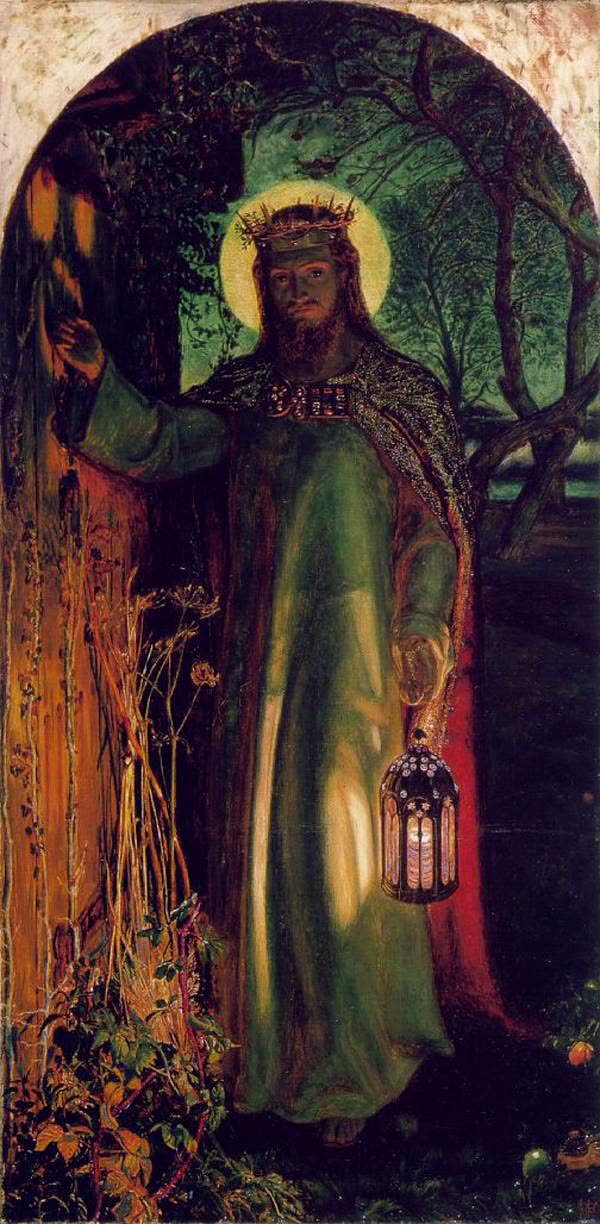
William Holman Hunt’s The Light of the World (1853) — Christ knocking at a door with no outside handle; it only opens from within.William Holman Hunt, 1853 · Public domain
Justified: declared righteous
The first word is a courtroom word. "Therefore being justified by faith, we have peace with God through our Lord Jesus Christ" (Romans 5:1).
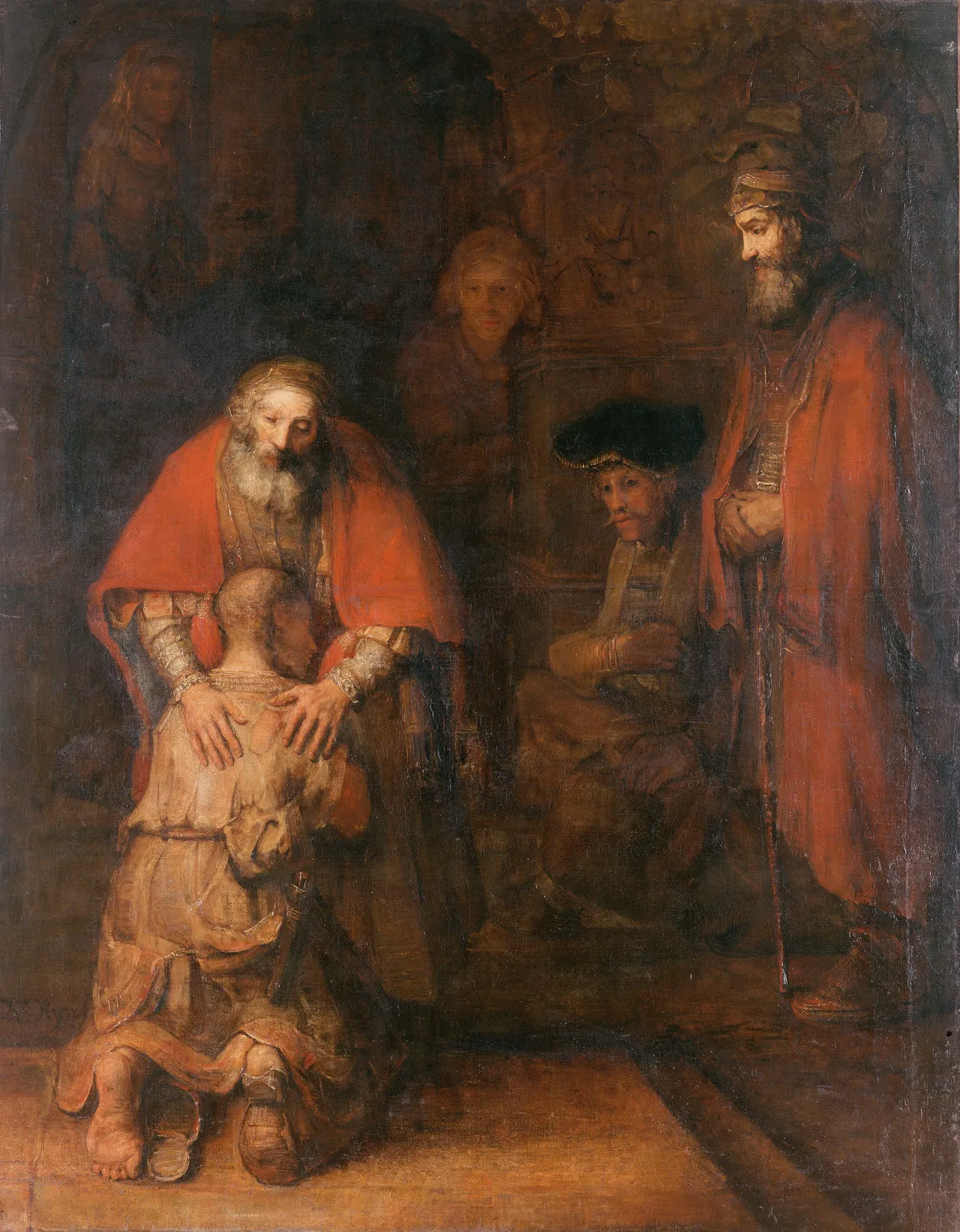
Rembrandt's Return of the Prodigal Son, painted about 1668, the father receiving his son home as a son and not as a hired servant.The Return of the Prodigal Son, Rembrandt van Rijn · c. 1668 · Wikimedia Commons · Public domain · museum record · Galeria Regni
To be justified is to be declared righteous by the judge. It does not mean you have become a good person; it means God has declared you in the right with Him. On what ground? Not your record. "For all have sinned, and come short of the glory of God; Being justified freely by his grace through the redemption that is in Christ Jesus: Whom God hath set forth to be a propitiation through faith in his blood" (Romans 3:23-25). A propitiation is a sacrifice that turns away just anger. Christ bore the judgment your sins deserved, so that God could be, in Paul's words, "just, and the justifier of him which believeth in Jesus" (Romans 3:26).
Paul is very bold about who receives this: "But to him that worketh not, but believeth on him that justifieth the ungodly, his faith is counted for righteousness" (Romans 4:5). God justifies the ungodly. Not the people who have cleaned themselves up first; the ungodly, who believe.
And he explains the exchange that makes it possible: "For he hath made him to be sin for us, who knew no sin; that we might be made the righteousness of God in him" (2 Corinthians 5:21). Christ took your sin. You receive His righteousness. Christians have long called this the great exchange, and it is the heart of the gospel.
The nineteenth-century Anglican bishop J. C. Ryle put the difference between justification and the slower work of change that follows in plain words. "Justification is the reckoning and counting a man to be righteous for the sake of another, even Jesus Christ the Lord," he wrote. "Justification is a finished and complete work, and a man is perfectly justified the moment he believes."2 That is why a believer of one day is as fully justified as a believer of fifty years.
Forgiven
Bound up with justification is forgiveness. "Who hath delivered us from the power of darkness, and hath translated us into the kingdom of his dear Son: In whom we have redemption through his blood, even the forgiveness of sins" (Colossians 1:13-14). The psalmist had sung of it long before: "As far as the east is from the west, so far hath he removed our transgressions from us" (Psalm 103:12).
If you are carrying shame for what you did before you came to Christ, read those verses slowly. You will still remember your sins. God has chosen not to hold them against you.
Adopted: a son, not a servant
The second great word is a family word. Paul says God sent His Son "To redeem them that were under the law, that we might receive the adoption of sons. And because ye are sons, God hath sent forth the Spirit of his Son into your hearts, crying, Abba, Father. Wherefore thou art no more a servant, but a son; and if a son, then an heir of God through Christ" (Galatians 4:5-7).
"Abba" is the Aramaic word for "father", the word a child in a Jewish home would use. It appears only three times in the New Testament: twice in Paul, and once on the lips of Jesus in Gethsemane, "Abba, Father, all things are possible unto thee; take away this cup from me: nevertheless not what I will, but what thou wilt" (Mark 14:36). Paul says the Holy Ghost puts that same word into the believer's heart. You may speak to God the way Jesus spoke to Him.
J. I. Packer, in his classic Knowing God, argued that adoption is the highest privilege the gospel offers, higher even than justification, because it is one thing to be acquitted by a judge and another to be taken home by him as his child; and he suggested that the best test of how well someone understands Christianity is how much he makes of being God's child.3 Whether or not you rank them that way, do not miss this. You are not a servant on probation in God's house. You are a son or a daughter.
John could hardly get over it: "Behold, what manner of love the Father hath bestowed upon us, that we should be called the sons of God: therefore the world knoweth us not, because it knew him not. Beloved, now are we the sons of God, and it doth not yet appear what we shall be: but we know that, when he shall appear, we shall be like him; for we shall see him as he is" (1 John 3:1-2).
Redeemed: bought back
The third word comes from the slave market. To redeem is to buy someone out of bondage by paying a price. Peter tells believers, "Forasmuch as ye know that ye were not redeemed with corruptible things, as silver and gold, from your vain conversation received by tradition from your fathers; But with the precious blood of Christ, as of a lamb without blemish and without spot" (1 Peter 1:18-19).
"Vain conversation" in the King James means an empty way of life, and Peter says it was "received by tradition from your fathers". Many of us inherited our emptiness. Some inherited religion without life; some inherited unbelief; some inherited a family pattern of drink or rage. Christ bought you out of all of it.
Redemption has a second side. If you were bought, you belong to the one who bought you. "What? know ye not that your body is the temple of the Holy Ghost which is in you, which ye have of God, and ye are not your own? For ye are bought with a price: therefore glorify God in your body, and in your spirit, which are God's" (1 Corinthians 6:19-20).
Reconciled: enemies made friends
The fourth word is a word for broken relationships. "For if, when we were enemies, we were reconciled to God by the death of his Son, much more, being reconciled, we shall be saved by his life" (Romans 5:10). Paul says plainly that we were God's enemies. Not misunderstood friends; enemies, in rebellion against Him. And it was God who moved first: "And all things are of God, who hath reconciled us to himself by Jesus Christ, and hath given to us the ministry of reconciliation" (2 Corinthians 5:18).
That last phrase matters for Part 6. The person who has been reconciled is handed a message to carry to others.
Sealed with the Holy Ghost
The fifth word is a mark of ownership. "In whom ye also trusted, after that ye heard the word of truth, the gospel of your salvation: in whom also after that ye believed, ye were sealed with that holy Spirit of promise, Which is the earnest of our inheritance until the redemption of the purchased possession, unto the praise of his glory" (Ephesians 1:13-14).
In the ancient world a seal on a document or a jar showed who owned it and guaranteed its contents. An "earnest" was a deposit, a first payment that bound the buyer to pay the rest. The Holy Ghost living in you is both: God's mark that you are His, and the first instalment of everything He has promised.
The Holy Ghost is not an influence or a force. He is God, the third person of the Trinity, and He lives in every believer. "The Spirit itself beareth witness with our spirit, that we are the children of God" (Romans 8:16).
A new creature
Paul gathers it all up in one sentence: "Therefore if any man be in Christ, he is a new creature: old things are passed away; behold, all things are become new" (2 Corinthians 5:17).
The key words are "in Christ". Every one of the gifts above comes to you because you are joined to Him by faith. His death counts as yours. His righteousness is credited to you. His Father is your Father. His Spirit lives in you. That union is the root; everything else is fruit.
Eternal life, now
Finally, Jesus speaks of eternal life not only as something future but as something a believer has now. "Verily, verily, I say unto you, He that heareth my word, and believeth on him that sent me, hath everlasting life, and shall not come into condemnation; but is passed from death unto life" (John 5:24). Note the tenses: "hath", "is passed". And He defines that life: "And this is life eternal, that they might know thee the only true God, and Jesus Christ, whom thou hast sent" (John 17:3).
Eternal life is not just endless existence. It is knowing God. It has begun.
This part matters because new believers often measure themselves against someone else's story. If yours was quiet, you may wonder whether it was real. If yours was dramatic, you may wonder why the feeling faded. Scripture and history both show that God brings people to Himself in many ways, and that the reality does not depend on the drama.
Three encounters in one chapter of Acts
Acts 16 records three very different encounters with Christ in a single city, Philippi: two conversions and a deliverance.
The first is Lydia, a businesswoman from Thyatira who already worshipped the God of Israel. Paul spoke at a riverside place of prayer, and Luke says simply that she "heard us: whose heart the Lord opened, that she attended unto the things which were spoken of Paul" (Acts 16:14). No earthquake, no vision. A heart quietly opened.
The second is a slave girl possessed by a spirit of divination, whose owners made money from her fortune-telling. Paul commanded the spirit in the name of Jesus Christ to come out of her, "And he came out the same hour" (Acts 16:18). Luke records her deliverance; he does not record whether she went on to believe, so hers is not told as a conversion.
The third is the city jailer. After an earthquake opened the prison doors, he drew his sword to kill himself, and then fell trembling before Paul and Silas asking, "Sirs, what must I do to be saved?" (Acts 16:30). He was baptized that same night.
A gentle opening, a deliverance, a crisis at midnight. One Lord, one gospel, three very different encounters, and two very different conversions. Luke seems to have set them side by side on purpose.
Elsewhere in Acts, Saul of Tarsus was knocked to the ground by a light from heaven and heard the voice of the risen Christ (Acts 9:3-6). Few conversions since have looked like his. It would be a mistake to make his the pattern for everyone, and an equal mistake to make Lydia's the pattern for everyone.
Augustine in the garden
Augustine of Hippo, who became the most influential theologian of the Western church, described his own conversion in his Confessions, written about AD 400. For years he had been convinced in his mind that Christianity was true but could not bring himself to give up his sins, especially his sexual life. One day in a garden in Milan, in an agony of tears, he heard a child's voice from a neighbouring house chanting, "Take up and read; take up and read." He picked up the letters of Paul and read the first passage his eyes fell on: "Let us walk honestly, as in the day; not in rioting and drunkenness, not in chambering and wantonness, not in strife and envying. But put ye on the Lord Jesus Christ, and make not provision for the flesh, to fulfil the lusts thereof" (Romans 13:13-14).
"No further would I read, nor did I need," he wrote; "for instantly, as the sentence ended — by a light, as it were, of security infused into my heart — all the gloom of doubt vanished away."4
Notice two things. Augustine's conversion came through a verse of Scripture. And it came after years of struggle in which he already knew a great deal about Christianity. Knowing about Christ and trusting Christ are not the same.
Bunyan's pilgrim at the cross
John Bunyan's The Pilgrim's Progress, first published in 1678, is an allegory, not a biography, but it has helped countless believers understand their own experience. Its hero, Christian, carries a great burden on his back, the weight of his sin. He struggles through the Slough of Despond and is nearly led astray by Mr. Worldly Wiseman, who tells him to go to the village of Morality to have it removed. At last he comes to a place where there is a cross, and "just as Christian came up with the cross, his burden loosed from off his shoulders" and tumbled into the mouth of a sepulchre, where it fell in and was seen no more. "Then was Christian glad and lightsome, and said, with a merry heart, He hath given me rest by his sorrow, and life by his death."5
Bunyan saw clearly what Nicodemus had not: that moral effort cannot lift the burden. Only the cross can.
Wesley's heart "strangely warmed"
John Wesley had been an ordained minister for years, had crossed the Atlantic as a missionary to Georgia, and had lived a life of strict religious discipline, all without peace. On the evening of 24 May 1738 he went, in his own words, "very unwillingly" to a small meeting in Aldersgate Street, London, where someone was reading Luther's preface to the letter to the Romans. "About a quarter before nine, while he was describing the change which God works in the heart through faith in Christ, I felt my heart strangely warmed. I felt I did trust in Christ, Christ alone, for salvation; and an assurance was given me that He had taken away my sins, even mine, and saved me from the law of sin and death."6
Wesley's story is a warning to religious people. He had done everything religion asked of him. What he lacked was trust in "Christ, Christ alone".
Spurgeon in the snow
Charles Spurgeon, later the most widely read preacher of his century, was a miserable fifteen-year-old when a snowstorm on 6 January 1850 drove him into a small Primitive Methodist chapel in Colchester. The minister had not come; a layman went up into the pulpit and preached on Isaiah 45:22, "Look unto me, and be ye saved, all the ends of the earth: for I am God, and there is none else." Spurgeon remembered the man looking at him where he sat under the gallery and saying, "Young man, you look very miserable," and urging him to look to Christ. He looked, and afterward said he "could have risen that moment and sung with the most enthusiastic of them".7
Spurgeon's story shows how simple saving faith is. A look. The same look the dying Israelites gave the serpent of brass.
The reluctant convert
Not every conversion comes with warmth or joy. C. S. Lewis, the Oxford scholar who had been an atheist since his teens, described in Surprised by Joy how, in 1929, he finally gave in and admitted that God was God, and knelt and prayed; he called himself perhaps the most dejected and reluctant convert in all England. Even then he did not yet believe in Christ; that came later, as he tells in the book's final chapter.8 Lewis's turning was slow, intellectual and, at first, joyless. The joy came later.
Two guests on our show
Two guests on The King Is Coming Show have told stories that sit beside these.
Michael Ray Lewis told his story on The King Is Coming Show (TKIC #48): an atheist who mocked Christians, until, in his telling, one question undid him. Watch it in his own words: youtube.com/watch?v=Rd-RdSqeQDk Michael's account of what happened to him, shared as his testimony — weigh it for yourself.
Mike Shreve told his story on The King Is Coming Show (TKIC #46): a Kundalini guru who, in his own telling, was born again on a Tampa roadside. Watch it in his own words: youtube.com/watch?v=oqAq58bDC4k Mike's account of what happened to him, shared as his testimony — weigh it for yourself.
What all these stories share
Lydia, the jailer, Augustine, Bunyan's pilgrim, Wesley, Spurgeon, Lewis and you: the outward shapes differ enormously. What they share is this.
They all came to see their sin. Augustine could not break his; Wesley could not rest from his; I "felt the weight of my own sin for the first time".
They all gave up on saving themselves. Bunyan's pilgrim could not get the burden off at the village of Morality; Wesley could not get peace from discipline.
They all turned to Christ. "Christ, Christ alone." "Look unto me."
The feelings varied. Augustine felt a light of security; Wesley a strange warmth; Lewis, at first, mostly dejection.
So do not judge your conversion by the strength of the feeling. Judge it by its object. Did you turn from your sin and trust Jesus Christ, crucified and risen? Then you have done what every one of these people did. Feelings come and go. As Part 4 will show, what God has done does not.
Part 4 — What Changed at Once, and What Changes Slowly
4 min read
This part matters because many new believers are thrown by the discovery that they still sin. They expected everything to change overnight. Some things did. Others are meant to change over a lifetime. Knowing which is which will save you a great deal of needless despair.
Ryle's distinction
J. C. Ryle's book Holiness, first published in 1877, has helped generations of Christians with this. He distinguished carefully between justification, God's declaration that you are righteous, and sanctification, God's work of actually making you holy. Both come together; neither comes without the other. "Those who are justified are always sanctified, and those who are sanctified are always justified," he wrote. "God has joined them together, and they cannot be put asunder."9 But they are not the same:
"Justification is the reckoning and counting a man to be righteous for the sake of another, even Jesus Christ the Lord. Sanctification is the actual making a man inwardly righteous, though it may be in a very feeble degree."10
And again:
"Justification is a finished and complete work, and a man is perfectly justified the moment he believes. Sanctification is an imperfect work, comparatively, and will never be perfected until we reach heaven."11
He also noted that sanctification, unlike justification, can be seen by others: "Justification is the act of God about us, and is not easily discerned by others. Sanctification is the work of God within us, and cannot be hid in its outward manifestation from the eyes of men."12
What changed at once
These things were true of you from the moment you believed, and they do not grow or shrink with your feelings:
| What changed | The text | |---|---| | You were declared righteous | "Therefore being justified by faith, we have peace with God" (Romans 5:1) | | Your sins were forgiven | "In whom we have redemption through his blood, even the forgiveness of sins" (Colossians 1:14) | | You passed from death to life | "hath everlasting life … is passed from death unto life" (John 5:24) | | You became God's child | "Beloved, now are we the sons of God" (1 John 3:2) | | The Holy Ghost came to live in you | "after that ye believed, ye were sealed with that holy Spirit of promise" (Ephesians 1:13) | | You were moved into a new kingdom | "translated us into the kingdom of his dear Son" (Colossians 1:13) | | Sin lost its right to rule you | "For sin shall not have dominion over you: for ye are not under the law, but under grace" (Romans 6:14) |
What did not change at once
And these things did not change overnight, because they are not meant to.
You still have a sinful nature to fight. Paul, writing to believers, says, "For the flesh lusteth against the Spirit, and the Spirit against the flesh: and these are contrary the one to the other: so that ye cannot do the things that ye would" (Galatians 5:17). The very fact that you now feel this conflict is a sign of new life. Before, there was no fight; you simply did what you wanted.
You still sin. John is blunt: "If we say that we have no sin, we deceive ourselves, and the truth is not in us. If we confess our sins, he is faithful and just to forgive us our sins, and to cleanse us from all unrighteousness" (1 John 1:8-9). Notice that John says "we", including himself. The remedy for sin after conversion is not despair but confession.
Your habits and appetites take time to change. Some people are freed from an addiction or a habit instantly at conversion. Many are not; they are given the power to fight it, and the fight is long. Neither experience is more spiritual than the other. The Survival Kit takes this up in detail.
Your circumstances did not all change. The debts, the broken relationship, the illness, the job you hate may all still be there. What has changed is that you face them as a child of God, with the Holy Ghost within you and the promises of God beneath you.
Your personality is still yours. God does not erase who you are; He redeems it. Peter was still Peter after Pentecost: bold, quick, sometimes wrong. But his boldness was now aimed at preaching Christ.
The direction of the Christian life
Paul gives the shape of what comes next in his letter to Titus: "For the grace of God that bringeth salvation hath appeared to all men, Teaching us that, denying ungodliness and worldly lusts, we should live soberly, righteously, and godly, in this present world; Looking for that blessed hope, and the glorious appearing of the great God and our Saviour Jesus Christ" (Titus 2:11-13).
Grace saves you, and then grace teaches you. You are not saved by your growth in holiness. But you are saved for it. And God, who started the work, is committed to it: "Being confident of this very thing, that he which hath begun a good work in you will perform it until the day of Jesus Christ" (Philippians 1:6).
This part matters because doubt about whether you are really saved is one of the commonest troubles of the first year, and because the Bible speaks to it with both comfort and warning. A paper that gives you only the comfort, or only the warning, would not be giving you the whole Bible.
God wants you to know
John wrote one of his letters with this purpose stated outright: "These things have I written unto you that believe on the name of the Son of God; that ye may know that ye have eternal life, and that ye may believe on the name of the Son of God" (1 John 5:13). Not "hope", not "guess": "know".
Jesus spoke of His sheep with great confidence: "My sheep hear my voice, and I know them, and they follow me: And I give unto them eternal life; and they shall never perish, neither shall any man pluck them out of my hand. My Father, which gave them me, is greater than all; and no man is able to pluck them out of my Father's hand" (John 10:27-29).
And Paul ended the eighth chapter of Romans with a list of everything he could think of that might come between a believer and God, and dismissed it all: "For I am persuaded, that neither death, nor life, nor angels, nor principalities, nor powers, nor things present, nor things to come, Nor height, nor depth, nor any other creature, shall be able to separate us from the love of God, which is in Christ Jesus our Lord" (Romans 8:38-39).
And Jesus said of everyone who comes to Him: "him that cometh to me I will in no wise cast out" (John 6:37).
These are real promises. Lean your whole weight on them.
The warnings are real too
The same New Testament also warns believers, earnestly and often.
“Take heed, brethren, lest there be in any of you an evil heart of unbelief, in departing from the living God. But exhort one another daily, while it is called To day; lest any of you be hardened through the deceitfulness of sin. For we are made partakers of Christ, if we hold the beginning of our confidence stedfast unto the end;” (Hebrews 3:12-14)
“If ye continue in the faith grounded and settled, and be not moved away from the hope of the gospel, which ye have heard” (Colossians 1:23)
“Wherefore the rather, brethren, give diligence to make your calling and election sure: for if ye do these things, ye shall never fall:” (2 Peter 1:10)
“Examine yourselves, whether ye be in the faith; prove your own selves.” (2 Corinthians 13:5)
Hebrews contains the sternest warnings of all, in chapters 6 and 10, about those who "were once enlightened" and "fall away" (Hebrews 6:4-6), and about sinning "wilfully after that we have received the knowledge of the truth" (Hebrews 10:26). Even the Book of Life is spoken of with a promise and a warning together: "He that overcometh, the same shall be clothed in white raiment; and I will not blot out his name out of the book of life" (Revelation 3:5).
Holding both
Christians have built large theological systems to explain how the promises and the warnings fit together. This paper does not ask you to adopt one. It asks you to do what the New Testament does: hold both, and let each do its work.
The promises are for the trembling. If you have come to Christ and you are afraid you are not good enough, John 10, Romans 8 and John 6:37 are written for you. Christ does not cast out those who come to Him.
The warnings are for the careless. If you are tempted to think that a prayer you once said lets you live however you like, Hebrews 3 and 2 Peter 1 are written for you. The faith that saves is a faith that continues.
The three witnesses
How, then, does a believer come to know? The New Testament points to three witnesses that stand together.
The witness of God's word. God has promised eternal life to all who believe on His Son (John 3:16; 5:24). If you believe, the promise is yours. This is the foundation. It does not move.
The witness of the Spirit. "The Spirit itself beareth witness with our spirit, that we are the children of God" (Romans 8:16). For many believers this is a quiet, settled conviction, a sense of belonging, a cry of "Abba, Father" that was not there before. It may be stronger or weaker on different days.
The witness of a changed life. John gives tests: "And hereby we do know that we know him, if we keep his commandments" (1 John 2:3). And again: "We know that we have passed from death unto life, because we love the brethren" (1 John 3:14). These are not tests of perfection. They are tests of direction. Do you want to obey God now, and grieve when you do not? Do you find yourself loving other believers? Those are the leaves moving in the wind.
When one witness is faint, lean on the others. On a day when you feel nothing and have stumbled, go back to the promise. God's word is not weaker because your feelings are.
This part matters because the apostles did not leave new converts to work out the Christian life on their own. In Acts, the response to the gospel was immediate and concrete. Here are the first steps, in roughly the order they usually come.
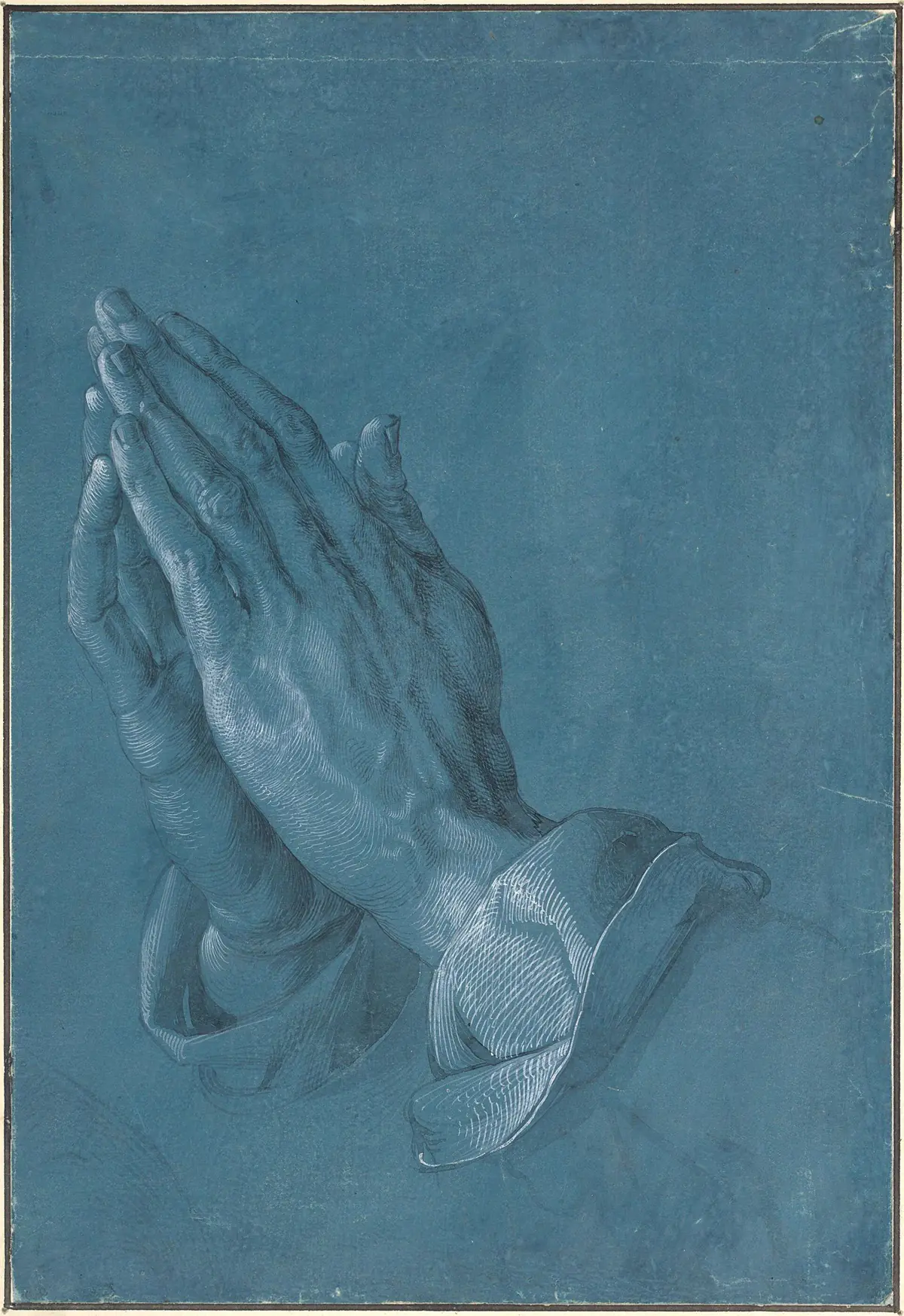
Albrecht Dürer’s Praying Hands (1508) — a working study of hands folded in petition, five centuries old and still legible at a glance.Albrecht Dürer, 1508 · Public domain
Step 1: Let your repentance show
Repentance is not only a feeling of sorrow; it is a turning. Paul summed up his preaching as "repentance toward God, and faith toward our Lord Jesus Christ" (Acts 20:21), and the risen Jesus told His disciples "that repentance and remission of sins should be preached in his name among all nations" (Luke 24:47).
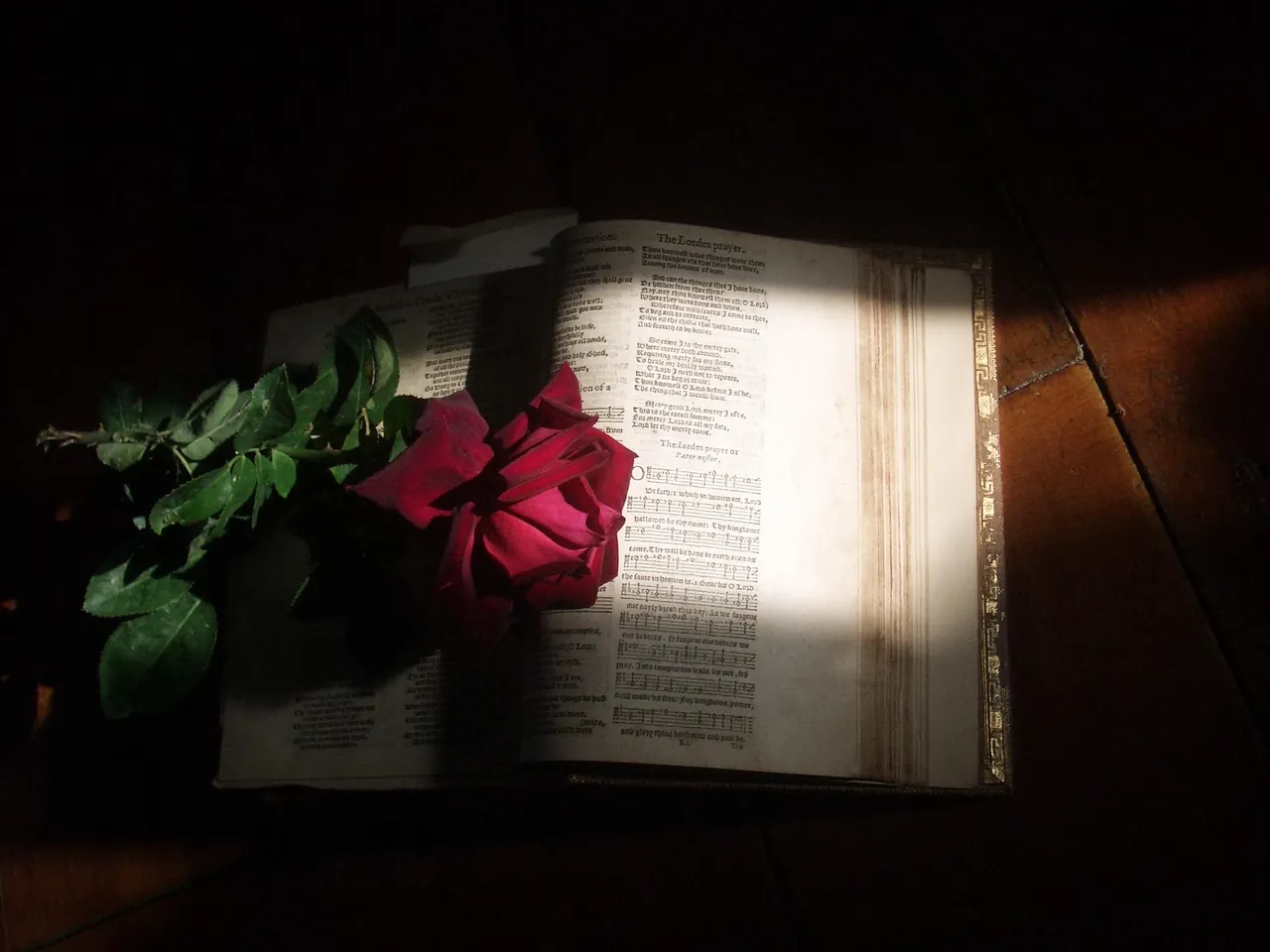
A photograph of about 2003 showing a 1581 Bible and psalter lying open in sunlight at the Lord's Prayer set to music, for the first steps of reading and prayer.A psalter with a rose · photographed c. 2003 · Wikimedia Commons · Public domain · museum record · Galeria Regni
In the New Testament, repentance showed itself quickly in practical ways.
When Zacchaeus, a dishonest tax collector, met Jesus, he stood up and said, "Behold, Lord, the half of my goods I give to the poor; and if I have taken any thing from any man by false accusation, I restore him fourfold." Jesus answered, "This day is salvation come to this house" (Luke 19:8-9). If you have wronged people in ways that can be put right, a debt, a theft, a lie, begin to put them right, wisely and with counsel.
At Ephesus, a city famous in the ancient world for magic, "many that believed came, and confessed, and shewed their deeds. Many of them also which used curious arts brought their books together, and burned them before all men: and they counted the price of them, and found it fifty thousand pieces of silver" (Acts 19:18-19). "Curious arts" means magic and the occult. If you have come out of New Age practice, crystals, astral projection, tarot, angel numbers or the like, as I did, get rid of the materials. Do not sell them on to someone else. The Thessalonians, Paul says, "turned to God from idols to serve the living and true God" (1 Thessalonians 1:9). A clean break is a mercy to yourself.
Step 2: Tell someone
When Jesus delivered a man from a legion of demons, the man wanted to go with Him. Jesus told him instead: "Go home to thy friends, and tell them how great things the Lord hath done for thee, and hath had compassion on thee" (Mark 5:19).
Tell someone soon: a Christian friend, the person who shared the gospel with you, a pastor, your spouse. Keep it simple: "I've trusted Jesus Christ. I'm a Christian now." Saying it out loud helps you, and it begins the confession that Romans 10:9-10 describes: "with the mouth confession is made unto salvation."
You do not have to tell everyone at once, and with family who may be hostile you should be wise and gentle. But do not hide it. The Survival Kit has more on difficult family situations.
Step 3: Start reading the Bible
"As newborn babes, desire the sincere milk of the word, that ye may grow thereby" (1 Peter 2:2). A newborn does not need to be told to be hungry. If you find yourself wanting to read the Bible, that is the new life at work. Feed it.
Where to start. Start with the Gospel of John. It was written for exactly this: "But these are written, that ye might believe that Jesus is the Christ, the Son of God; and that believing ye might have life through his name" (John 20:31). It has twenty-one chapters; one a day takes three weeks. Then read Mark, then Acts, then Romans.
How to read. Read slowly. Read a whole chapter, not a single verse. Ask simple questions: What does this show me about God? About Jesus? About myself? Is there a command to obey, a promise to trust, a sin to avoid? Write down one verse each day. Pray it back to God.
Which Bible. Use the King James Bible. You can read it free in the 1611 Reader at kylelauriano.com/library. A KJV with Strong's Concordance lets you look up the original words. Do not be put off by the older English; within a few weeks it becomes familiar, and its rhythm makes it easy to memorise. Where modern versions differ from the 1611, you can see every place at kylelauriano.com/library/changes.
Meditate on it. The Bible's own word for this is meditation, and it means thinking hard about God's word, turning it over, saying it to yourself, until it sinks in. God told Joshua, "This book of the law shall not depart out of thy mouth; but thou shalt meditate therein day and night, that thou mayest observe to do according to all that is written therein" (Joshua 1:8). That is not emptying your mind. It is filling it with Scripture.
Step 4: Start praying
Prayer is talking to your Father. You do not need special words. When the disciples asked Jesus to teach them to pray, He gave them a pattern:
“After this manner therefore pray ye: Our Father which art in heaven, Hallowed be thy name. Thy kingdom come. Thy will be done in earth, as it is in heaven. Give us this day our daily bread. And forgive us our debts, as we forgive our debtors. And lead us not into temptation, but deliver us from evil: For thine is the kingdom, and the power, and the glory, for ever. Amen.” (Matthew 6:9-13)
You can pray those words as they stand. You can also use them as a framework, one line at a time:
"Our Father which art in heaven, Hallowed be thy name." Begin by worshipping God for who He is.
"Thy kingdom come. Thy will be done." Ask for His purposes before your own: for His gospel to spread, for His will in your life.
"Give us this day our daily bread." Bring Him your real needs, small and large.
"Forgive us our debts, as we forgive our debtors." Confess your sins by name, and let go of grudges against others.
"Lead us not into temptation, but deliver us from evil." Ask for protection and strength for the day.
"For thine is the kingdom." End with praise.
Some people find a simple four-word memory aid helpful: adoration, confession, thanksgiving, supplication. That is a modern summary, not a Bible formula, but it follows the same movement from God to our needs that the Lord's Prayer and many of the psalms follow. Start with five minutes in the morning and five in the evening. It will grow.
Step 5: Find a church
"And they continued stedfastly in the apostles' doctrine and fellowship, and in breaking of bread, and in prayers" (Acts 2:42). That was the life of the first converts, and it has never been improved on. Hebrews adds: "Not forsaking the assembling of ourselves together, as the manner of some is; but exhorting one another: and so much the more, as ye see the day approaching" (Hebrews 10:25).
You were not born again to live alone. Look for a church where the Bible is preached plainly, where the gospel of salvation by grace through faith in the crucified and risen Christ is clear, where sin and repentance are not softened, and where people will know your name. The Survival Kit goes into much more detail on finding and staying in a church, and on the warning signs of an unhealthy one.
Step 6: Be baptized
When the crowd at Pentecost asked what to do, Peter said: "Repent, and be baptized every one of you in the name of Jesus Christ for the remission of sins, and ye shall receive the gift of the Holy Ghost" (Acts 2:38). Baptism is Christ's command to every believer, and in the New Testament it came quickly after faith, often the same day. Talk to the pastor of the church you are joining. The Baptism Guide sets out what the Scriptures and the early church teach about it, and where churches differ.
Step 7: Begin to tell your story
You now have what Paul calls "the ministry of reconciliation" (2 Corinthians 5:18). You do not need to be a preacher to use it. A simple story told honestly is often more powerful than an argument. In three parts:
1. Before: what your life was like without Christ. 2. How: how you heard the gospel and came to trust Him. 3. Since: what has changed.
Keep it short, true and centred on Christ rather than on your sins or your feelings. Never exaggerate. If all you can say is, "I was lost, and I found that Jesus is real, and He forgave me," that is enough. John Newton, a former slave-ship captain who became a pastor, put his own story into a hymn that the world still sings: "I once was lost, but now am found, was blind, but now I see."13
This part matters because good intentions fade without a plan. The following is not a law, and you will not fail God if you miss a day. It is a simple path through your first month, built from the steps above.
Week 1: Foundations
| Day | Read | Do | |---|---|---| | 1 | John 1 | Tell one person you have trusted Christ | | 2 | John 2 | Pray the Lord's Prayer slowly, line by line | | 3 | John 3 | Read John 3:1-21 twice; write down verse 16 | | 4 | John 4 | Get a King James Bible, or bookmark the 1611 Reader | | 5 | John 5 | Memorise John 5:24 | | 6 | John 6 | Remove anything from your home tied to the occult or to a sin you are leaving | | 7 | John 7 | Visit a Bible-preaching church |
Week 2: Habits
| Day | Read | Do | |---|---|---| | 8 | John 8 | Choose a set time and place for reading and prayer | | 9 | John 9 | Write a short list of people to pray for | | 10 | John 10 | Read John 10:27-29 aloud; thank God for His hand | | 11 | John 11 | Ask a mature Christian of your own sex to meet with you | | 12 | John 12 | Confess any known sin by name to God (1 John 1:9) | | 13 | John 13 | Do one quiet act of service for someone | | 14 | John 14 | Return to the church you visited, or visit another |
Week 3: Roots
| Day | Read | Do | |---|---|---| | 15 | John 15 | Memorise John 15:5 | | 16 | John 16 | Pray for the Holy Ghost's help in a specific struggle | | 17 | John 17 | Read Jesus' prayer for His people slowly; notice what He asks | | 18 | John 18 | Begin to put right one wrong you did to someone, with counsel | | 19 | John 19 | Read about the crucifixion and thank Christ specifically | | 20 | John 20 | Read about the resurrection; write down why it matters | | 21 | John 21 | Ask the pastor about baptism and church membership |
Weeks 4 and beyond: Growing
| Day | Read | Do | |---|---|---| | 22 | Romans 5 | Write down every word in the chapter for what God has done | | 23 | Romans 6 | Read about baptism and newness of life | | 24 | Romans 8 | Read the whole chapter aloud | | 25 | Ephesians 1 | List what you have "in Christ" | | 26 | Ephesians 2 | Memorise Ephesians 2:8-9 | | 27 | 1 John 1 | Practise confession and receive forgiveness | | 28 | 1 John 3 | Notice the tests of new life; thank God for any you see | | 29 | 1 John 5 | Memorise 1 John 5:13 | | 30 | Psalm 103 | Write out your story in three parts; share it with one person |
After thirty days, carry on: read Mark, then Acts, then the rest of Romans. Keep praying. Keep going to church. Be baptized. You will not be a finished Christian at the end of a month. No one is. But you will have laid foundations.
Something happened to you when you trusted Christ, and now you have words for it.
You were born again, from above, by the Spirit of God, through His word, as Jesus told Nicodemus you must be. You were justified, declared righteous for Christ's sake, completely and at once. You were forgiven. You were adopted into God's family and given His Spirit, who cries "Abba, Father" in your heart. You were redeemed, bought with the precious blood of Christ. You were reconciled, an enemy made a friend. You were sealed, marked as God's own. You have eternal life now, which is to know God.
And something has begun that will take the rest of your life: the slow, real work of being made holy. You will stumble. You will confess and be forgiven. You will grow, sometimes so slowly that only others notice. God, who began the work, will finish it.
A next step
If you have not yet been baptized, read the Baptism Guide and talk to a pastor. If you are entering the harder months of the first year, read the Survival Kit. And open the Gospel of John today, at chapter one.
An invitation
If you have read this far and you are not sure you have ever truly turned to Christ, the door is open. Jesus said, "him that cometh to me I will in no wise cast out" (John 6:37). You do not have to clean yourself up first. Turn from your sin, and trust Him, crucified for sinners and risen from the dead. Tell Him so, in your own words. "For God so loved the world, that he gave his only begotten Son, that whosoever believeth in him should not perish, but have everlasting life" (John 3:16).
And Jesus said there is joy in heaven when you do: "I say unto you, that likewise joy shall be in heaven over one sinner that repenteth, more than over ninety and nine just persons, which need no repentance" (Luke 15:7).
1James Strong, The Exhaustive Concordance of the Bible (New York: Hunt & Eaton, 1890), Greek Dictionary, no. 509. Online: https://www.blueletterbible.org/lexicon/g509/kjv/tr/0-1/.↩
2J. C. Ryle, Holiness: Its Nature, Hindrances, Difficulties, and Roots (1877), ch. 2, "Sanctification." Online: https://www.ccel.org/ccel/ryle/holiness.iii.ii.html.↩
3J. I. Packer, Knowing God (London: Hodder & Stoughton, 1973), ch. 19, "Sons of God."↩
4Augustine, Confessions 8.12.29, trans. J. G. Pilkington, in Nicene and Post-Nicene Fathers, First Series, vol. 1 (Buffalo: Christian Literature Publishing, 1887). Online: https://www.newadvent.org/fathers/110108.htm.↩
5John Bunyan, The Pilgrim's Progress from This World to That Which Is to Come (1678). Online: https://www.gutenberg.org/ebooks/131.↩
6John Wesley, The Journal of John Wesley, entry for 24 May 1738. Online: https://www.ccel.org/ccel/wesley/journal.vi.ii.xvi.html.↩
7C. H. Spurgeon, C. H. Spurgeon's Autobiography, vol. 1 (London: Passmore & Alabaster, 1897); as quoted in Justin Taylor, "Charles Spurgeon's Conversion in a Primitive Methodist Chapel," The Gospel Coalition, January 6, 2014, https://www.thegospelcoalition.org/blogs/justin-taylor/charles-spurgeons-conversion-in-a-primitive-methodist-chapel/.↩
8C. S. Lewis, Surprised by Joy: The Shape of My Early Life (London: Geoffrey Bles, 1955), ch. 14–15.↩
Seven mornings for the person who just prayed: what happened, the first night, the Bible, prayer, church, the pushback, and who to tell — the page in the 1611, one person who says they walked it, and a room on the site each morning. Free.
This is practical teaching, not proof. It's drawn from Scripture and from walking this road myself. If you're still weighing the basics — whether God is real, whether the Bible can be trusted — I'd encourage you to start with the Skeptic resources in the Research Hub before diving in here.