A study of what Scripture means when it tells us to meditate (from Joshua 1:8, Psalm 1, Psalm 119 and Philippians 4:8) and of how the Puritans taught ordinary believers to do it.
Abstract
Scripture commands meditation: "thou shalt meditate therein day and night." But the word now means something very different in most of the world. This paper asks what the Bible itself means by it. It works from the King James text and the Hebrew and Greek words behind it, through four central passages: Joshua 1:8, Psalm 1, Psalm 119 and Philippians 4:8. It then turns to the believers who taught the practice most fully, the English Puritans, quoting Thomas Watson's A Christian on the Mount (1657) and Richard Baxter's The Saints' Everlasting Rest (1650) from their own pages, along with George Müller's account of how meditation on the Word changed his prayer. The conclusion is that biblical meditation is not emptying the mind but filling it with what God has said, and thinking it through until it warms the heart and moves the hands. The paper ends with a plain method, worked examples and a list of subjects. It is written for believers who read the Bible but find that it runs through them, and who want it to stay.
What’s inside
·Introduction
Part 1Part 1: The Words Scripture Uses
Part 2Part 2: Four Texts
Part 3Part 3: The Puritans' School
Part 4Part 4: How to Meditate
Part 5Part 5: Subjects for Meditation
Part 6Part 6: Hindrances and Helps
·Conclusion
Research paper · 8 chapters · 46 notes · October 2026
About 42 minutes · 8 parts · the PDF has the same text
Introduction
2 min read
Most Christians read the word "meditate" in their Bibles without stopping on it. It is there in the first chapter of Joshua, in the first psalm, again and again in Psalm 119, and in Paul's letters. God commands it. He promises blessing to those who do it. And yet if you ask an ordinary believer what it means, you will often get a blank look, or an answer borrowed from somewhere other than the Bible.
This paper is about what the Bible means. It matters because meditation is the difference between a Bible that passes through us and a Bible that stays. George Müller, whose story appears in Part 3, put it in a picture: reading the Word "so that it only passes through our minds, just as water runs through a pipe."1 Meditation is how the water soaks in.
What this paper is
This is a study, not a technique. It argues from the King James Bible first, with the Hebrew and Greek words behind it checked against Strong's Concordance. It then listens to the teachers who wrote most fully about biblical meditation, the English Puritans of the seventeenth century, and quotes them from their own books so that you can check every line. It ends with a plain method you can use tomorrow morning.
Six parts follow. Part 1 looks at the words Scripture uses. Part 2 works through four central passages: Joshua 1:8, Psalm 1, Psalm 119 and Philippians 4:8. Part 3 sits in the Puritans' school, with Thomas Watson and Richard Baxter, and with Müller, who learned the same lesson two centuries later. Part 4 gives a method, with worked examples. Part 5 lists the great subjects for meditation. Part 6 deals with hindrances: no time, a wandering mind, dryness, and a few misread verses.
A word about me
When real life hit — a lost job, a pregnant wife, constant fights — I went looking for peace anywhere I could find it. New Age, crystals, astral projection, tarot, angel numbers. None of it held. Eventually I gave up and called myself an atheist. I decided to read the Bible for one reason: to disprove it, so I'd have an excuse to stop going to church for good. It did the opposite. I came to faith in 2022, and my wife came to faith a month later. The rest of that story is at kylelauriano.com/about.
I mention it because the peace Scripture promises does not come from within. It comes from Someone outside us, who has spoken. "Thou wilt keep him in perfect peace, whose mind is stayed on thee: because he trusteth in thee" (Isaiah 26:3). Biblical meditation is a mind stayed on Him, through what He has said.
A note on Scripture: every verse in this paper is quoted from the King James Bible. You can read it free in the 1611 Reader at kylelauriano.com/library. A KJV with Strong's Concordance is the best study tool most believers will ever need, and it is the tool this paper uses.
This part matters because the meaning of a word in the Bible is set by the Bible, not by the culture around us. If we let the modern world define "meditation", we will either reject a command of God or obey something God never commanded.
Hagah: to murmur over
The word behind "meditate" in Joshua 1:8 and Psalm 1:2 is the Hebrew verb hagah. Strong's Concordance (H1897) defines it as "to murmur (in pleasure or anger); by implication, to ponder," and lists the ways the King James renders it: "imagine, meditate, mourn, mutter, roar, × sore, speak, study, talk, utter."2 It occurs twenty-five times; "meditate" accounts for six of them.
The range is striking. The same verb describes a dove mourning, a man speaking, and, once, a lion over its kill: "Like as the lion and the young lion roaring on his prey, when a multitude of shepherds is called forth against him, he will not be afraid of their voice" (Isaiah 31:4). The word there is hagah. The picture is not of a lion roaring to frighten, but of a lion growling low over what it has caught, refusing to let go however many shepherds shout.
That is meditation in its root sense. It is not silent emptiness. It is a low, steady murmuring over something you have and will not give up. It is often done aloud, under the breath. That is why God tells Joshua that the book of the law "shall not depart out of thy mouth" (Joshua 1:8). The Hebrew way of meditating involved the lips.
The same verb has a dark use, too, which helps define the light one. Isaiah warns against those who "seek unto them that have familiar spirits, and unto wizards that peep, and that mutter" (Isaiah 8:19), and the word for "mutter" is hagah. The difference between the godly man and the wizard is not that one moves his lips and the other does not. It is the object. The wizard murmurs to the dead; the believer murmurs God's law. Isaiah's answer follows at once: "To the law and to the testimony: if they speak not according to this word, it is because there is no light in them" (Isaiah 8:20). Meditation is defined by its content, and its content is God's word.
Siach: to ponder and talk it over
The second Hebrew word dominates Psalm 119: "I will meditate in thy precepts, and have respect unto thy ways" (Psalm 119:15). This is siach. Strong's (H7878) defines it as "to ponder, i.e. (by implication) converse (with oneself, and hence, aloud) or (transitively) utter," and the King James renders it "commune, complain, declare, meditate, muse, pray, speak, talk (with)."3
The connection between meditating and talking runs all through this word. The psalmist says in one breath, "I will meditate also of all thy work, and talk of thy doings" (Psalm 77:12). In Psalm 119 the same word is translated "talk": "Make me to understand the way of thy precepts: so shall I talk of thy wondrous works" (Psalm 119:27). Biblical meditation is a conversation: with yourself about God's word, and then with God about it, and then with others. It is the opposite of a blank mind.
Meletaō: to give careful thought to
In the New Testament Paul tells Timothy, "Meditate upon these things; give thyself wholly to them; that thy profiting may appear to all" (1 Timothy 4:15). The Greek is meletaō. Strong's (G3191) defines it as "to take care of, i.e. (by implication) revolve in the mind," and the word appears only three times.4 "These things", in context, are the things Paul has just listed: "Till I come, give attendance to reading, to exhortation, to doctrine" (1 Timothy 4:13). Timothy is to turn over in his mind the Scriptures he reads and the doctrine he teaches, and give himself wholly to them, so that his growth shows.
Logizomai: to reckon up
Paul's great command to the Philippians, "think on these things" (Philippians 4:8), uses yet another word, logizomai. Strong's (G3049) defines it as "to take an inventory, i.e. estimate (literally or figuratively)," and the King James renders it with words such as "count", "impute", "reckon" and "think (on)".5 It is the word Paul uses when he says Abraham's faith was "counted" for righteousness. To think on something in this sense is to weigh it, reckon with it, take stock of it, and let it count.
Pondering in the heart
One more picture completes the set. After the shepherds came to the manger, Luke tells us, "But Mary kept all these things, and pondered them in her heart" (Luke 2:19). Twelve years later, after the boy Jesus was found in the temple, "his mother kept all these sayings in her heart" (Luke 2:51). Mary heard words about her Son, and she kept them and turned them over. That is meditation: keeping God's words and pondering them.
Why this is not the meditation of the world
Put the words together and the meaning is clear: to murmur over God's word, to talk it through, to give it careful thought, to reckon with it, to keep it and ponder it. Every one of these has an object outside the self, and the object is what God has said. That is why the meditation Scripture commands is a different thing altogether from the practices that now share its name: the repeated syllable meant to quiet thought, the effort to empty the mind, the search for an inner centre or for "oneness" with the universe, the guided picture-making of the imagination, and the Eastern disciplines from which most of these come. Those methods aim to get beneath or beyond words; Scripture's meditation aims to get into God's words, because "faith cometh by hearing, and hearing by the word of God" (Romans 10:17). Jesus warned against prayer made of "vain repetitions, as the heathen do: for they think that they shall be heard for their much speaking" (Matthew 6:7). And Paul warns, "Beware lest any man spoil you through philosophy and vain deceit, after the tradition of men, after the rudiments of the world, and not after Christ" (Colossians 2:8). A Christian does not need to borrow a method from another religion to obey a command of his own God. He needs his Bible open, and his mind awake.
Steve Kang told his story on The King Is Coming Show (TKIC #49, "I Chanted 8 Hours a Day to Reach Nirvana — I Woke Up in Hell Instead"). In his telling, he chanted eight hours a day to reach nirvana, and woke up in hell instead. Watch it in his own words: youtube.com/watch?v=46SP1FgXfbY Steve's account of what happened to him, shared as his testimony — weigh it for yourself.
The rest of this paper is about the meditation God commands.
This part matters because the command to meditate does not stand alone. It comes in four great passages, each adding something to the others: Joshua 1:8 gives the command and its purpose, Psalm 1 gives the picture, Psalm 119 gives the practice, and Philippians 4:8 gives the range.
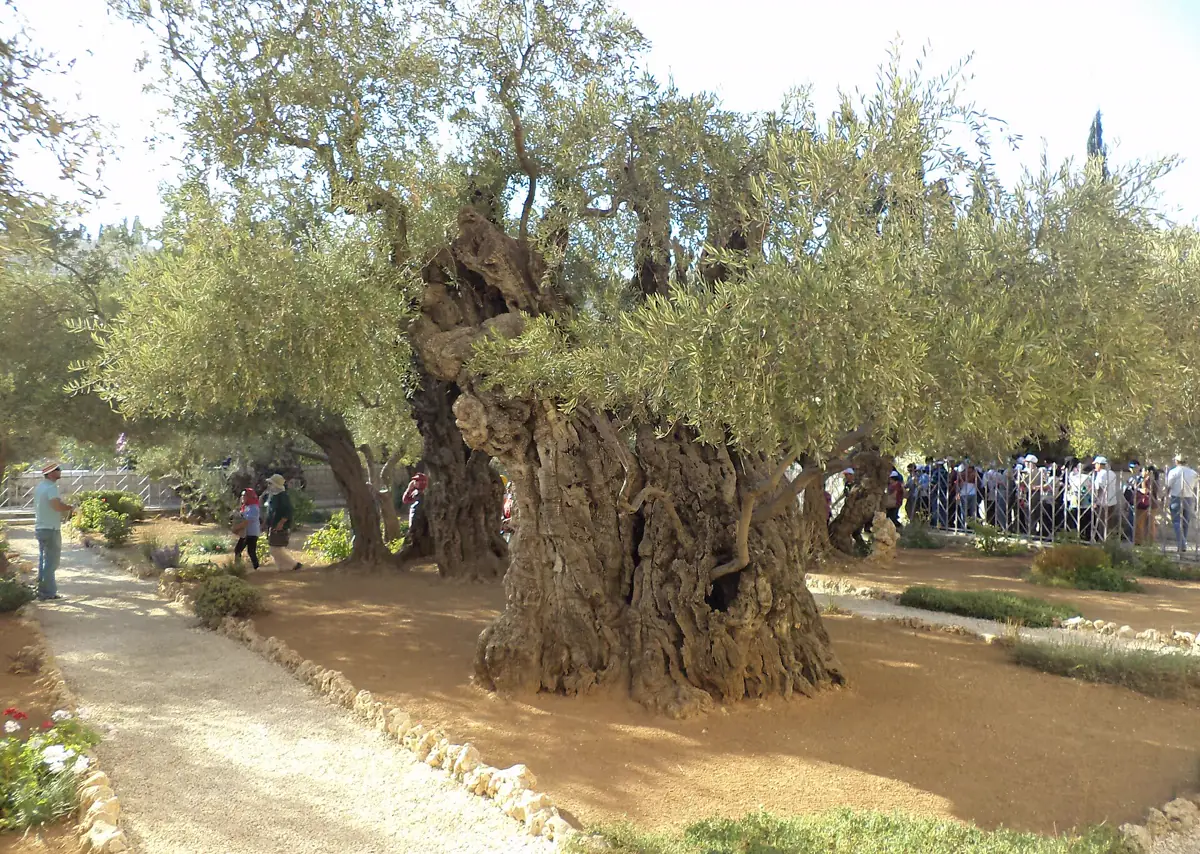
One of the oldest olive trees in the Garden of Gethsemane, rooted through centuries of continuous growth — the grove where Jesus prayed on the night of His arrest.Bogdan Kosar · CC BY-SA 4.0
"This book of the law shall not depart out of thy mouth; but thou shalt meditate therein day and night, that thou mayest observe to do according to all that is written therein: for then thou shalt make thy way prosperous, and then thou shalt have good success." (Joshua 1:8)
Moses was dead. Joshua had to lead a nation across the Jordan and into a land full of walled cities. What did God give him for the task? Not a military manual. A book, and a command to meditate on it.
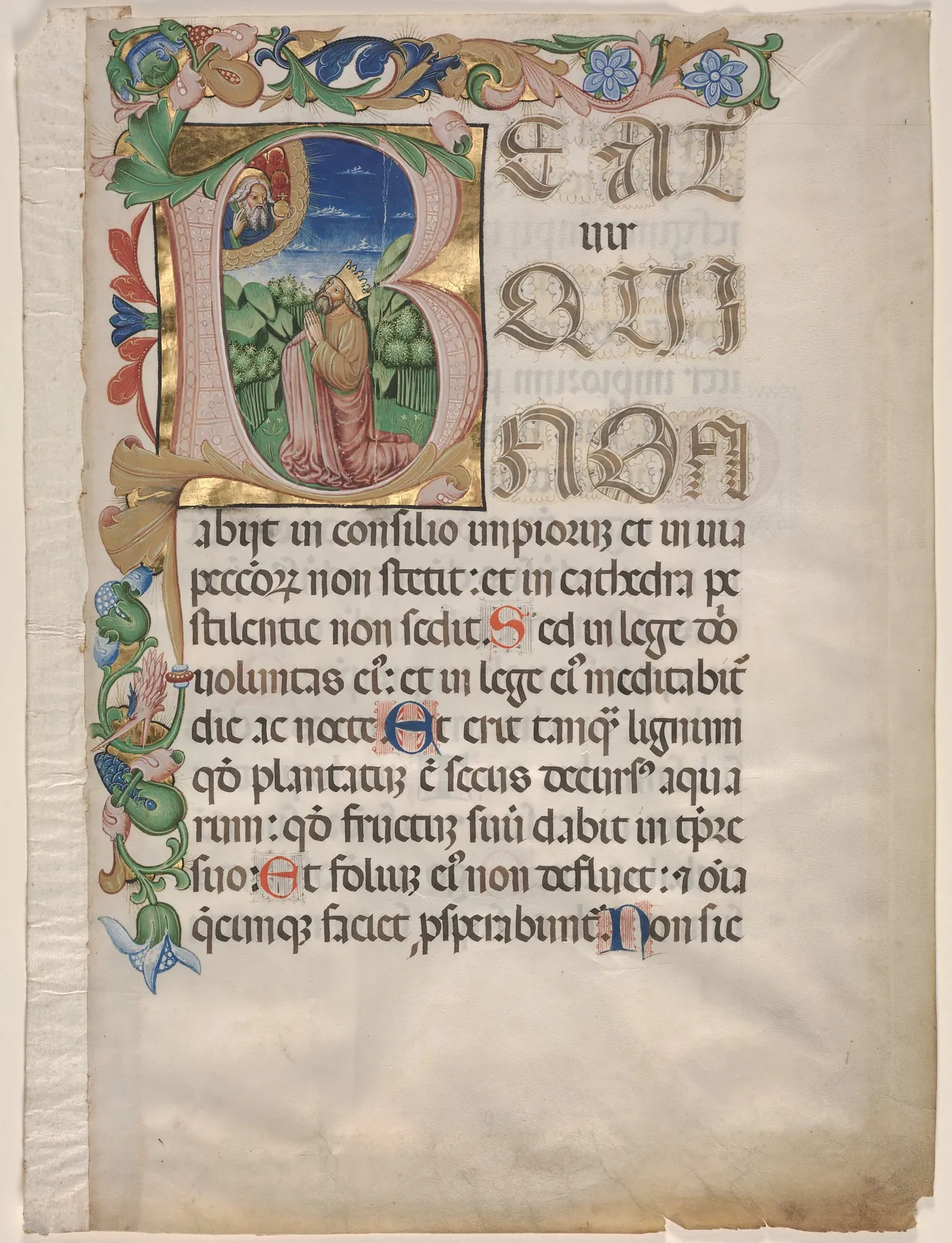
An Italian choir psalter leaf of about 1460 to 1470, King David in prayer within the initial B that opens Psalm 1, the psalm of meditation day and night.Leaf from a Choir Psalter: Initial B with King David in Prayer · c. 1460–1470 · Cleveland Museum of Art · CC0 · museum record · Galeria Regni
Notice four things.
The object is a book. "This book of the law" means the written word God had given through Moses. Meditation in Scripture is not open-ended; it has a text. Moses had already commanded the same of every king: to write a copy of the law and "read therein all the days of his life" (Deuteronomy 17:19).
It involves the mouth. "Shall not depart out of thy mouth." Joshua was to speak it, murmur it, keep it on his lips.
It is constant. "Day and night." Not every waking minute in a set exercise, but woven through the whole day, morning and evening, in rest and in work.
Its purpose is obedience. "That thou mayest observe to do according to all that is written therein." Meditation is not an end in itself. It aims at doing. The success God promises is not wealth for its own sake; it is the success of a man who does what God says. Just before, God had said the same: "Only be thou strong and very courageous, that thou mayest observe to do according to all the law, which Moses my servant commanded thee: turn not from it to the right hand or to the left, that thou mayest prosper whithersoever thou goest" (Joshua 1:7). And just after: "Be strong and of a good courage; be not afraid, neither be thou dismayed: for the LORD thy God is with thee whithersoever thou goest" (Joshua 1:9). Courage comes from the Word and from the presence of the God who gave it.
Thomas Watson, preaching on meditation in 1657, saw the obvious objection (that busy people have no time) and answered it from this verse: "Joshua might have pleaded an excuse, he was a soldier, a commander, and the care of marshaling his army lay chiefly upon him, yet this must not take him off from piety."6 If a general on the eve of war was told to meditate day and night, we are not excused.
Psalm 1 — the picture
"Blessed is the man that walketh not in the counsel of the ungodly, nor standeth in the way of sinners, nor sitteth in the seat of the scornful. But his delight is in the law of the LORD; and in his law doth he meditate day and night. And he shall be like a tree planted by the rivers of water, that bringeth forth his fruit in his season; his leaf also shall not wither; and whatsoever he doeth shall prosper." (Psalm 1:1-3)
The Book of Psalms opens with meditation. Before a single prayer or song, it shows us the man God blesses.
He is marked first by what he refuses. Walking, standing, sitting: the three verbs show a slow slide, from taking advice from the ungodly, to lingering in sinners' company, to settling down among the scornful. The blessed man does not take that road. Meditation begins with turning away from other voices.
He is marked second by what he delights in. "But his delight is in the law of the LORD." Meditation grows from delight. We think about what we love; the mind returns to it by itself. Watson begins his treatise here: "Grace breeds delight in God, and delight breeds meditation."7 If meditation feels like a chore, the deeper need may be to ask God for delight in His word.
He is marked third by what he becomes. "Like a tree planted by the rivers of water." The tree does not make the river. It is planted beside it, and its roots go down into it. That is what meditation does: it sends the roots of the soul into the water of the Word. The result is fruit "in his season" (not all at once, not on our schedule), leaves that do not wither in drought, and a life that prospers in God's sense.
Jeremiah uses the same picture of the man who trusts the Lord: "For he shall be as a tree planted by the waters, and that spreadeth out her roots by the river, and shall not see when heat cometh, but her leaf shall be green; and shall not be careful in the year of drought, neither shall cease from yielding fruit" (Jeremiah 17:8). Meditation does not stop the heat from coming. It keeps the leaf green when it does.
And he is contrasted with the chaff. "The ungodly are not so: but are like the chaff which the wind driveth away" (Psalm 1:4). Rooted or blown about: that is the choice the first psalm sets before every reader. "For the LORD knoweth the way of the righteous: but the way of the ungodly shall perish" (Psalm 1:6).
Psalm 119 — the practice
Psalm 119 is the longest chapter in the Bible: 176 verses, set in twenty-two stanzas of eight verses, one for each letter of the Hebrew alphabet. Almost every verse speaks of God's word under some name: law, testimonies, precepts, statutes, commandments, judgments, word. The words "meditate" and "meditation" occur seven times in it in the King James.
It is a whole school of meditation. Here is what it teaches.
Meditation is on the Word. Every one of the seven uses names Scripture as the object:
Meditation grows from love. "O how love I thy law! it is my meditation all the day" (Psalm 119:97). And again: "My hands also will I lift up unto thy commandments, which I have loved; and I will meditate in thy statutes" (Psalm 119:48).
Meditation steadies us under attack. "Princes also did sit and speak against me: but thy servant did meditate in thy statutes" (Psalm 119:23). And later: "Let the proud be ashamed; for they dealt perversely with me without a cause: but I will meditate in thy precepts" (Psalm 119:78). When others are talking against you, the psalmist does not rehearse their words. He rehearses God's.
Meditation gives understanding. "Thou through thy commandments hast made me wiser than mine enemies: for they are ever with me. I have more understanding than all my teachers: for thy testimonies are my meditation" (Psalm 119:98-99). This is not a boast about learning. It is the claim that a humble man who meditates on Scripture will see more truly than a clever man who does not.
Meditation keeps us from sin. "Thy word have I hid in mine heart, that I might not sin against thee" (Psalm 119:11). And earlier in the psalm: "Wherewithal shall a young man cleanse his way? by taking heed thereto according to thy word" (Psalm 119:9).
Meditation is sweet. "How sweet are thy words unto my taste! yea, sweeter than honey to my mouth!" (Psalm 119:103).
Meditation needs God's help. "Open thou mine eyes, that I may behold wondrous things out of thy law" (Psalm 119:18). The psalmist prays before he looks. "The entrance of thy words giveth light; it giveth understanding unto the simple" (Psalm 119:130).
Meditation has its hours. "Mine eyes prevent the night watches, that I might meditate in thy word" (Psalm 119:148). "Prevent" in the King James means "go before": he was awake before the night watches were called. Elsewhere David says, "When I remember thee upon my bed, and meditate on thee in the night watches" (Psalm 63:6). Isaac "went out to meditate in the field at the eventide" (Genesis 24:63). Morning, evening and the wakeful hours of night all appear.
Meditation leads to action. "I thought on my ways, and turned my feet unto thy testimonies" (Psalm 119:59). The thinking ends in turning.
"Finally, brethren, whatsoever things are true, whatsoever things are honest, whatsoever things are just, whatsoever things are pure, whatsoever things are lovely, whatsoever things are of good report; if there be any virtue, and if there be any praise, think on these things." (Philippians 4:8)
This verse is often quoted as general advice to think positive thoughts. In context it is far more than that. Read the verses before it: "Be careful for nothing; but in every thing by prayer and supplication with thanksgiving let your requests be made known unto God. And the peace of God, which passeth all understanding, shall keep your hearts and minds through Christ Jesus" (Philippians 4:6-7). And the verse after: "Those things, which ye have both learned, and received, and heard, and seen in me, do: and the God of peace shall be with you" (Philippians 4:9).
So Philippians 4:8 sits between prayer and obedience, and between two promises of peace. Paul is telling anxious believers what to do with their minds once they have handed their worries to God. Fill them. Take inventory (that is the force of logizomai) of whatever is true, honest, just, pure, lovely and of good report.
The first word sets the boundary: "true". The truest things are what God has said and done, and the measure of all the others. Jesus prayed, "thy word is truth" (John 17:17). So Philippians 4:8 does not send us away from Scripture to think about nice things in general. It sends us to Scripture first, and then to everything in God's world that agrees with it: the honest act of a neighbour, a just law, a pure love, a lovely evening, a good report of a brother's faithfulness. The believer's mind is to be a place where these things are counted, and where the lies, filth and fear of the age are not given room.
This is the range of meditation. Its centre is the written Word. But it reaches out to see all of life in that Word's light. The Puritans called this second kind "occasional meditation", and we will meet it in Part 3.
This part matters because we are not the first to ask how to obey these texts. The English Puritans of the 1600s gave more careful thought to biblical meditation than perhaps any generation of Christians before or since, and they wrote for ordinary people: farmers, weavers, servants, mothers. Two of them are our guides here, and a third man, who came after them, shows that the lesson still works.
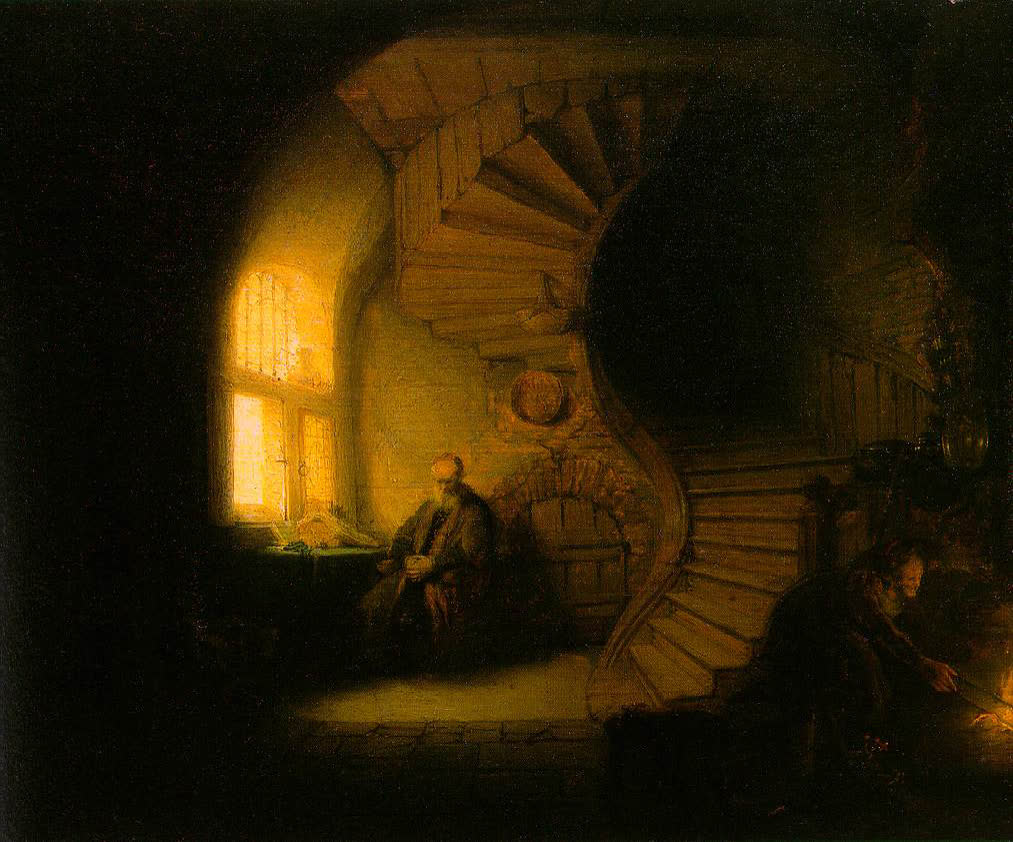
Rembrandt’s Philosopher in Meditation (1632) — the long, honest work of thinking a hard question through in the light available.Rembrandt, 1632 · Public domain
Thomas Watson: A Christian on the Mount
Thomas Watson (c. 1620–1686) began a sixteen-year ministry at St Stephen's, Walbrook, in London in 1646, and was ejected for nonconformity after the Restoration.8 In 1657 he published The Saints Delight, a treatise on Psalm 1:2 (later reprinted as The Saint's Spiritual Delight), with a second treatise annexed: A Christian on the Mount: or, A Treatise Concerning Meditation. It is short, plain and full of pictures, and it is still one of the best things ever written on the subject.
What meditation is
Watson's definition: "Meditation is the soul's retiring of itself, that by a serious and solemn thinking upon God, the heart may be raised up to heavenly affections."9 He then explained each of the three parts.
The soul's retiring of itself. Meditation begins by shutting out the world for a while. Watson's image: "If the wings of the bird are full of slime, she cannot fly. Meditation is the wing of the soul; when a Christian is beslimed with earth, he cannot fly to God upon this wing." His instruction: "lock and bolt the door against the world."10
A serious and solemn thinking upon God. Meditation is thinking, not drifting. Watson noted that the Hebrew word "signifies with intenseness to recollect and gather together the thoughts," and warned against "a few transient thoughts of religion." He compared the careless believer to a traveller who "rides quickly through a town or village" and notices nothing, and the meditating believer to an artist studying a painting, who "observes the symmetry and proportion, he minds every shadow and color."11
The raising of the heart to holy affections. Meditation is not finished when the mind understands. It aims at the heart: love, fear, joy, sorrow for sin, desire for God. Watson: "A Christian enters into meditation, as a man enters into the hospital—that he may be healed."12
What meditation is not
Watson distinguished meditation from two things it is easily confused with.
From memory: "The memory is the chest or cupboard to lock up a truth, meditation is the palate to feed on it. The memory is like the ark in which the manna was laid up, meditation is like Israel's eating of manna."13 A believer can know many verses by heart and never feed on one.
From study: "Study is a work of the brain, meditation of the heart; study sets the mind on work, meditation sets the heart on work." And: "The design of study is the finding out of a truth; the design of meditation is the spiritual improvement of a truth. The one searches for the vein of gold; the other digs out the gold."14 Study is good and necessary; meditation is what study is for.
Why it is necessary
"A Christian without meditation is like a soldier without weapons, or a workman without tools." And, of preaching and reading: "Without meditation, the truths of God will not stay with us. The heart is hard, and the memory slippery—and without meditation all is lost!" "Reading and hearing without meditation, is like weak medicine which will not work."15
He also saw it as a guard against sin. "Most sin is committed for lack of meditation," he wrote, and pointed to Joseph, who was kept from Potiphar's wife by considering the God he would be sinning against.16 And he called meditation "the bellows of the affections": "The reason our affections are so chill and cold in spiritual things, is, because we do not warm ourselves more at the fire of meditation."17
Watson's rules
Near the end of the treatise Watson gives rules. They are the best short guide to biblical meditation in English, and they are worth setting out.
1. Be serious. "When you are at the work of meditation, remember you are now to deal with GOD." 2. Read before you meditate. This rule matters most for our day. "Reading furnishes the mind with matter. Reading is the oil which feeds the lamp of meditation." And: "Be sure your meditations are grounded upon Scripture." He warned that a mind without Scripture "will be minting thoughts; and how many untruths does it mint!" His summary: "Reading without meditation—is unfruitful! Meditation without reading—is dangerous!"18 3. Do not multiply subjects. "Meditate not on too many things at once," he said, "like the bird that hops from one branch to another." "One truth driven home by meditation, will most greatly affect the heart!" 4. Join examination to meditation. After meditating on a truth, ask, "O my soul, is it thus with you—or not?" "Meditation is like a telescope by which we contemplate heavenly objects; but self-examination is like a looking glass by which we see into our own souls."19 5. Seal it with prayer. Meditation ends by turning to God in prayer. 6. Live it out. "The end of meditation is action." "Meditation is the life of piety; and practice is the life of meditation."20
When and how long
Watson admitted that callings differ and times are hard to prescribe, but gave his view plainly: "the morning is the fittest time for meditation." He called the morning "the cream of the day—let the cream be taken off, and let God have it."21
On length, he asked for "at least one half hour every day," and then gave a better rule: "meditate so long until you find your heart grow warm in this duty. If when a man is cold, you ask how long he should stand by the fire? Surely, until he be thoroughly warm, and made fit for his work."22
Set and occasional meditation
Watson distinguished two kinds. Occasional meditations are "taken up on any sudden occasion": seeing the sun rise and thinking of the Sun of Righteousness, going to bed and thinking of the grave, hearing a judge's trumpet and thinking of the last day. These are the Philippians 4:8 kind, seeing the world in the light of the Word. But he urged above all "DELIBERATE meditations, which are the chief. Set some time apart every day, that you may in a serious and solemn manner converse with God in the mount."23
Richard Baxter: heavenly contemplation
Richard Baxter (1615–1691) spent sixteen years as minister at Kidderminster, in Worcestershire. His eighteenth-century abridger, Benjamin Fawcett, records that when Baxter arrived he found "but a single instance or two of daily family prayer in a whole street," and that the town was changed under his ministry. In 1650 he published The Saints' Everlasting Rest, which, Fawcett says, he had written far from home, "without any book to consult but his Bible, and in such an ill state of health as to be in continual expectation of death for many months."24 It is a long book on heaven, and its later chapters teach what Baxter called "heavenly contemplation": meditation on the believer's eternal rest with God. Where this paper uses the word "contemplation", it is in Baxter's sense, and only in his sense.
His definition
Baxter calls the duty "The set and solemn acting of all the powers of thy soul in meditation upon thy everlasting rest."25 Each phrase is chosen with care.
Set and solemn. Like Watson, Baxter distinguished meditation that comes in passing from meditation that is planned. "As there is solemn prayer, when we set ourselves wholly to that duty; and ejaculatory prayer, when, in the midst of other business, we send up some short request to God; so also there is solemn meditation, when we apply ourselves wholly to that work; and transient meditation." He wanted both, but he wanted the set kind to be "a constant standing duty, as you do hearing, praying, and reading the Scriptures."26
All the powers of the soul. This is Baxter's great contribution. "It is the mistake of Christians to think that meditation is only the work of the understanding and memory; when every school-boy can do this, or persons that hate the things which they think on." True meditation engages the mind, then the will, then the affections. "As some labors not only stir a hand or a foot, but exercise the whole body; so doth meditation the whole soul."27
He used a homely picture from digestion: "As digestion turns food into chyle and blood for vigorous health, so meditation turns the truths received and remembered into warm affection, firm resolution, and holy conversation."28 ("Conversation" in older English means conduct, the way one lives.)
Upon thy everlasting rest. Baxter's own subject was heaven, because "as heaven hath the preeminence in perfection, it should have it also in our meditation." But he added at once, "I would not have you cast off your other meditations."29 Scripture's command to "Set your affection on things above, not on things on the earth" (Colossians 3:2) stands behind him.
Consideration, soliloquy and prayer
Baxter described how meditation actually works in three movements.
Consideration. "CONSIDERATION is the great instrument by which this heavenly work is carried on." He explained: "Consideration, as it were, opens the door between the head and the heart. The understanding having received truths, lays them up in the memory, and consideration conveys them from thence to the affections."30 Consideration means looking at a truth long and from every side, asking what it means, what it implies, what it demands.
Soliloquy. Baxter's word for preaching to yourself. "By soliloquy, or a pleading the case with thyself, thou must in thy meditation quicken thy own heart. Enter into a serious debate with it."31 The Psalms are full of this: "Why art thou cast down, O my soul?" (Psalm 42:5). David speaks to his own soul and tells it to hope in God. The believer who meditates argues with his own coldness from the Word.
Prayer. Baxter admitted that consideration by itself "is not so likely to affect the heart," just as a sermon that only explains rarely moves anyone unless it is applied and accompanied by earnest prayer for God's blessing.32 So meditation turns to prayer, asking God to make true in us what we have seen in His word.
Time, place and temper
Baxter advised that meditation be "stated", "frequent" and "seasonable". On stated times: "Stated time is a hedge to duty, and defends it against many temptations to omissions." He was realistic about the poor, whose "necessities of their families deny them this freedom"; they should "take their vacant opportunities as they fall, and especially join meditation and prayer as much as they can with the labors of their calling."33 On frequency, for those who could manage it, "once a day at least." On seasons, he named the Lord's day, times of affliction and temptation, and the approach of death.
For place, "some private retirement." "How often did Christ himself retire to some mountain, or wilderness, or other solitary place!"34 But he also left room for the believer to "observe for thyself what place best agrees with thy spirit."
A line to remember
Baxter's most quoted line on the subject is a picture of how faith and meditation work together: "Faith hath wings, and meditation is its chariot."35 Faith believes what God has said about heaven, about Christ, about the promises. Meditation carries the believing soul there in thought, and keeps it there long enough to feel the weight of it.
George Müller: food for the inner man
Two centuries after Watson and Baxter, a German-born pastor in Bristol learned the same lesson for himself. George Müller (1805–1898) is famous for the orphan houses he ran by prayer alone. But his journal for May 7, 1841, records a change in his private devotion that he believed mattered more.
For ten years his habit had been to begin the day with prayer. Often, he wrote, he spent "a quarter of an hour, or half an hour, or even an hour, on my knees, before being conscious to myself of having derived comfort", suffering "much from wandering of mind." Then he came to see "that the first great and primary business to which I ought to attend every day was, to have my soul happy in the Lord," and that the way to it was "to give myself to the reading of the word of God, and to meditation on it."36
His method was simple. "The first thing I did, after having asked in a few words the Lord's blessing upon his precious word, was, to begin to meditate on the word of God, searching as it were into every verse, to get blessing out of it." He did it "not for the sake of the public ministry of the word ... but for the sake of obtaining food for my own soul." The result: "after a very few minutes my soul has been led to confession, or to thanksgiving, or to intercession, or to supplication; so that, though I did not, as it were, give myself to prayer, but to meditation, yet it turned almost immediately more or less into prayer."37
He added that he walked in the fields before breakfast for this purpose, carrying "a New Testament of good-sized type," and found it good for body and soul; but he was careful to say that the walking "is of course not necessarily connected with this matter, and every one has to judge according to his strength and other circumstances."38
And then he gave his reason, in words every believer should read: "the first thing the child of God has to do morning by morning is, to obtain food for his inner man ... Now what is the food for the inner man? Not prayer, but the word of God; and here again, not the simple reading of the word of God, so that it only passes through our minds, just as water runs through a pipe, but considering what we read, pondering over it, and applying it to our hearts."39 He noted that prayer requires "a measure of strength or godly desire," and that the best time for it is "after the inner man has been nourished by meditation on the word of God, where we find our Father speaking to us." And he offered a comfort to the weak: "the weaker we are, the more we need meditation for the strengthening of our inner man."
Müller did not find this in a book, he said. But what he found is what Watson and Baxter had taught: read, then meditate, then pray, and let the Word lead. The method has a pedigree as long as the Psalms.
This part matters because a command without a method is easy to admire and hard to obey. What follows is not a new technique. It is the method of Psalm 119, Watson, Baxter and Müller, set out in plain steps. Use it as a scaffold; when it becomes natural, the scaffold can come down.
Before you begin
Choose a time. Morning is best for most, as Watson thought, because the mind is fresh and the day has not yet crowded in. Evening suits others. What matters is that the time is set.
Choose a place. Somewhere you will not be interrupted for fifteen to thirty minutes. Put the phone in another room.
Have a Bible open. A printed KJV, or the 1611 Reader at kylelauriano.com/library. A notebook and pen help.
Pray briefly first. Müller "asked in a few words the Lord's blessing upon his precious word." The psalmist prayed, "Open thou mine eyes, that I may behold wondrous things out of thy law" (Psalm 119:18).
The steps
1. Read
Read a passage: a psalm, a paragraph from a Gospel, part of a chapter of an epistle. Read it through at least twice, once at normal pace and once slowly, aloud if you can. Remember hagah: meditation in the Bible uses the mouth. Watson's rule stands over everything that follows: "Reading furnishes the mind with matter." Meditation without reading drifts.
2. Select
Choose one verse, or one phrase, that stood out. Watson again: "Do not multiply the subjects of meditation." One truth "driven home" does more than ten skimmed. Write it down.
3. Consider
This is Baxter's "consideration", the heart of the work. Look at the verse from every side. Questions help:
What does each word mean? (Check any unfamiliar word in Strong's.)
What does this show me about God: Father, Son and Holy Ghost?
What does it show me about Christ and His work?
What does it show me about myself?
Is there a promise to believe? A command to obey? A sin to forsake? An example to follow or avoid?
How does the rest of Scripture speak of this? (Follow one or two cross-references.)
Why did God put this here, in this book, at this point?
Write down what you see. Writing slows the mind and keeps it from wandering.
4. Apply and examine
Now turn the truth on yourself, as Watson urged: "O my soul, is it thus with you—or not?" Where does this verse meet my life today? Where am I unlike it? What would it look like to believe it this afternoon, in that conversation, at that desk?
This is where Baxter's "soliloquy" comes in: speak to your own soul from the text. If the verse says God is your shepherd, and you are anxious, say so to yourself: "Why am I acting as if no one is leading me?"
5. Pray
Turn what you have seen into prayer, as Müller found happened almost by itself. Praise God for what the verse shows about Him. Confess what it shows about you. Ask Him to make its promise true for you and its command possible. Pray it for someone else.
6. Carry
Take the verse with you. Write it on a card, or keep it on your phone's lock screen. Return to it at lunch, on the drive home, before sleep. This is how meditation becomes "day and night" without becoming an unbroken exercise. "And these words, which I command thee this day, shall be in thine heart... and shalt talk of them when thou sittest in thine house, and when thou walkest by the way, and when thou liest down, and when thou risest up" (Deuteronomy 6:6-7).
7. Do
The last step is obedience. "That thou mayest observe to do according to all that is written therein" (Joshua 1:8). James says the same: "But be ye doers of the word, and not hearers only, deceiving your own selves" (James 1:22). Watson: "The end of meditation is action."
Here is the method applied to one verse, so that you can see it rather than only read about it. (This is an illustration, not a script to copy.)
Read. Psalm 23, twice, aloud.
Select. "The LORD is my shepherd; I shall not want" (Psalm 23:1).
Consider.
The LORD. In capitals in the King James, standing for God's covenant name. Not a vague higher power; the God who made heaven and earth and bound Himself by promise to His people.
is. Present tense. Not "was, when things were better" or "will be, once I sort myself out."
my. Personal. David, a shepherd himself, says it of himself.
shepherd. A shepherd leads, feeds, guards, seeks the lost, carries the weak. Jesus took the title: the Good Shepherd who gives His life for the sheep.
I shall not want. Not "I shall have everything I wish for", but "I shall lack nothing I need." The rest of the psalm explains: green pastures, still waters, restoration, right paths, company in the valley of the shadow.
Apply and examine. Where am I acting as if I have no shepherd? Where am I trying to find my own pasture? What am I afraid of lacking: money, health, a future for my children? Do I believe that the Lord is my shepherd today, in that?
Pray. "Lord, You are my shepherd. Forgive me for worrying as if I were alone. You know what I need before I ask. Lead me today, and lead my wife and children. Help me trust You with the thing I fear."
Carry. Write "The LORD is my shepherd; I shall not want" on a card. Read it at noon. Say it when the worry comes back.
Do. Make the call you have been avoiding out of fear. Give the gift you have been holding back. Rest tonight instead of lying awake rehearsing.
Select. "Be careful for nothing; but in every thing by prayer and supplication with thanksgiving let your requests be made known unto God" (Philippians 4:6).
Consider. "Careful" in the King James means full of care, anxious. "For nothing" is absolute. "In every thing" is just as wide; nothing is too small to pray about. Prayer is general; supplication is specific asking; thanksgiving goes with both. The promise follows: God's peace "shall keep your hearts and minds", and the word "keep" pictures a guard posted at a gate. Paul wrote this from prison.
Apply. What am I anxious about right now? Have I actually asked God about it, specifically, with thanks? Or have I only worried in His general direction?
Pray. Name each worry to God, one by one, and thank Him for one thing about each.
Carry and do. Each time the worry returns today, turn it into a one-sentence prayer and a one-sentence thanks. Then fill your mind, as verse 8 says, with what is true.
Memorising as meditation
Memorising Scripture and meditating on it feed each other. To learn a verse by heart, you must repeat it and attend to every word; and once you hold it, you can meditate on it anywhere. "Thy word have I hid in mine heart" (Psalm 119:11). A simple method: one verse a week, written on a card, read aloud morning and evening, reviewed on the Lord's day. But remember Watson's warning: memory is the cupboard, meditation is the meal. Do not stop at storing the verse; feed on it.
Journaling
Many believers find a notebook helps. Write the date, the passage, the verse you chose, what you saw in it, how it applies, and a one-line prayer. Over months the notebook becomes a record of what God has taught you, and of answers to prayer. It also keeps meditation honest: if you have nothing to write, you probably skimmed.
This part matters because the question "What should I meditate on?" has a better answer than "whatever I happen to read." Scripture is the field; but within it, the great teachers pointed believers to certain truths that repay a lifetime of thought.
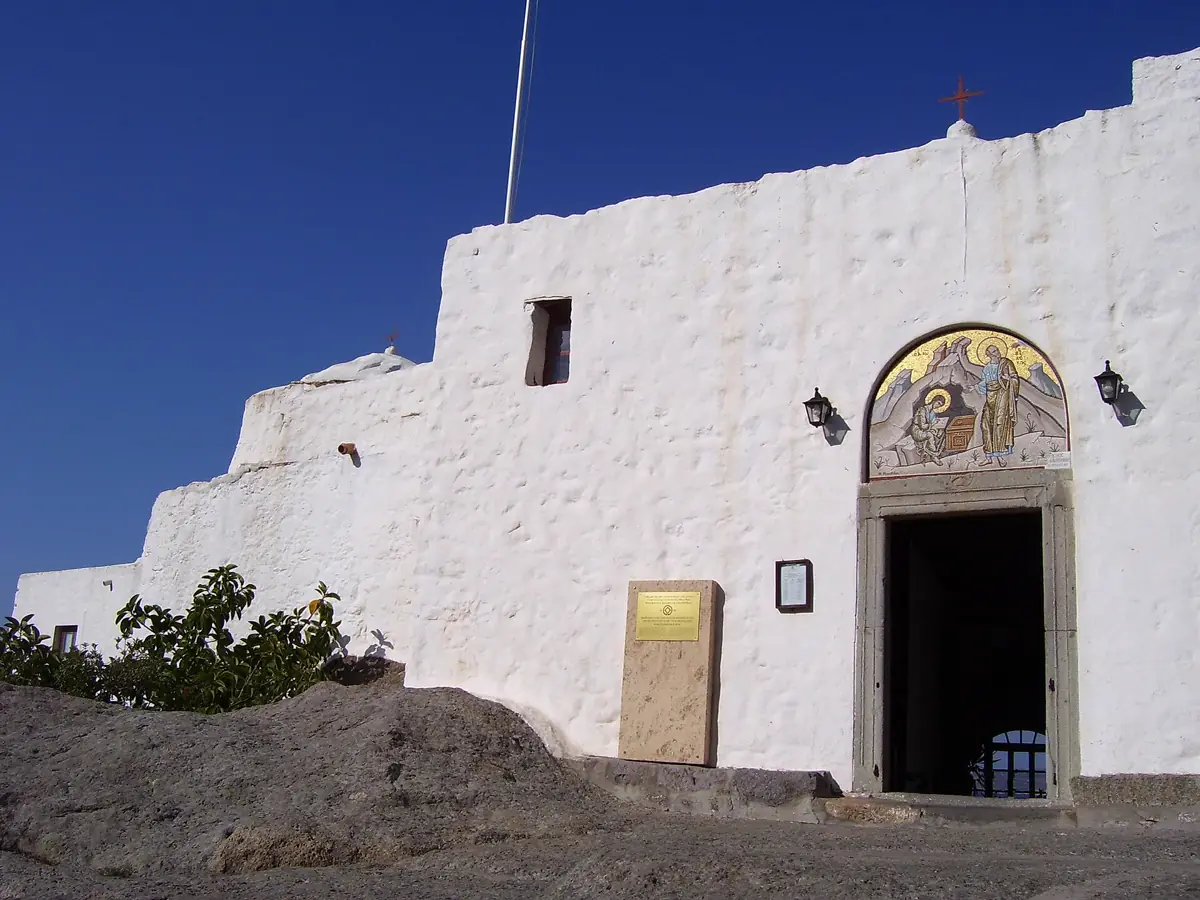
The Cave of the Apocalypse on Patmos — the traditional site where John, in exile around 95 AD, received the Revelation.Vladimir Boskovic at English Wikipedia · Public domain
Christ in all the Scriptures
The first subject is the Lord Jesus. After His resurrection, walking with two discouraged disciples to Emmaus, "beginning at Moses and all the prophets, he expounded unto them in all the scriptures the things concerning himself" (Luke 24:27). Afterwards they said, "Did not our heart burn within us, while he talked with us by the way, and while he opened to us the scriptures?" (Luke 24:32). That burning heart is what meditation aims at. Jesus told His critics, "Search the scriptures; for in them ye think ye have eternal life: and they are they which testify of me" (John 5:39).
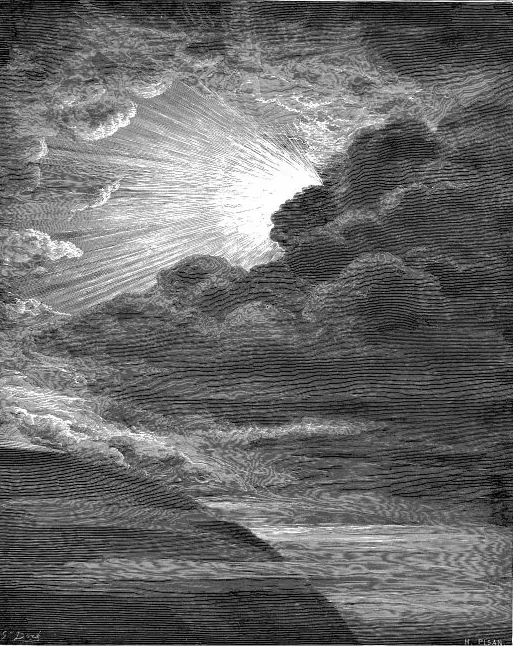
An 1866 engraving of the Creation of Light from Genesis 1, one of the works of God the Psalms call His people to meditate on.The Creation of Light · 1866 · Wikimedia Commons · Public domain · museum record · Galeria Regni
So whatever passage you meditate on, ask how it points to Christ: His person, His promises, His cross, His resurrection, His return.
Watson's subjects
Watson gave a long list of subjects for meditation, each with Scripture.40 In summary:
| Subject | What to consider | A text to start with | | --- | --- | --- | | The attributes of God | His knowledge, holiness, wisdom, power, mercy and truth | Psalm 145:5 | | The promises of God | Promises of pardon, of holiness, of reward | 2 Corinthians 1:20 | | The love of Christ | Its freeness, its cost, its constancy | Galatians 2:20 | | Sin | Its guilt, its filth, its curse | Psalm 51:3 | | The vanity of the world | How little earthly things can satisfy | Ecclesiastes 1:2 | | The excellence of grace | The worth of faith, love, humility | 2 Peter 1:5-8 | | Your own spiritual state | Am I in Christ? What evidence is there? | 2 Corinthians 13:5 | | Death | Its certainty, its nearness, its uncertainty of timing | Psalm 90:12 | | The day of judgment | That every one will give account | 2 Corinthians 5:10 | | Hell | Its loss and its pain, honestly faced | Matthew 25:46 | | Heaven | The presence of God, the end of sin and sorrow | Revelation 21:4 | | Eternity | Life and punishment without end | 2 Corinthians 4:18 | | Your experiences | God's past mercies in your own life | Psalm 103:2 |
Some of these (sin, death, judgment, hell) are not comfortable. Watson included them on purpose, and Scripture does too. A believer who never meditates on judgment will grow careless; one who never meditates on Christ's love will grow afraid. Both together keep the soul in balance. "So teach us to number our days, that we may apply our hearts unto wisdom" (Psalm 90:12).
Baxter's subject: heaven
Baxter devoted his whole treatise to meditation on the believer's rest, and he gave a reason worth pondering: "That which will make us most happy when we possess it, will make us most joyful when we meditate upon it."41 Paul did the same in affliction: "While we look not at the things which are seen, but at the things which are not seen: for the things which are seen are temporal; but the things which are not seen are eternal" (2 Corinthians 4:18).
Baxter especially commended this meditation in suffering and when facing death. "Happy art thou, poor man, if thou make this use of thy poverty! and thou that art sick, if thou so improve thy sickness!"42
The works of God
The Psalms also meditate on God's works in creation and history. "I remember the days of old; I meditate on all thy works; I muse on the work of thy hands" (Psalm 143:5). And in another psalm: "I will remember the works of the LORD: surely I will remember thy wonders of old. I will meditate also of all thy work, and talk of thy doings" (Psalm 77:11-12). This is meditation on what God has done, as Scripture records it: the creation in six days, the flood, the exodus, the cross, the empty tomb. It is also meditation on what He has done in your own life, read in the light of His word.
Your own heart
Meditation includes looking inward, but always in God's light, never as a search for something divine hidden inside ourselves. "Search me, O God, and know my heart: try me, and know my thoughts: And see if there be any wicked way in me, and lead me in the way everlasting" (Psalm 139:23-24). Jeremiah, in his Lamentations: "Let us search and try our ways, and turn again to the LORD" (Lamentations 3:40). Paul: "Examine yourselves, whether ye be in the faith" (2 Corinthians 13:5). David told his hearers to "commune with your own heart upon your bed, and be still" (Psalm 4:4), and the line before it is "Stand in awe, and sin not." That is self-examination under the fear of God, not self-absorption.
This part matters because everyone who tries to meditate runs into the same walls. The Puritans did too, and they wrote down their answers.
"I have no time"
Watson heard this objection in 1657 and did not accept it: "What! No time to meditate! What is the business of your life—but meditation?" He was not saying people should do nothing else; he spoke plainly in favour of "labor in a vocation." His point was that the soul is more important than the shop. "God never intended that the great business of piety should give way to a shop or farm."43
Practically: fifteen minutes before the house wakes is enough to begin. A verse carried through the day multiplies those minutes. Baxter's advice to the poor applies to the busy: take the "vacant opportunities as they fall," and join meditation to your work.
"It is hard"
Watson granted that it is. He even reported that the medieval scholar Gerson said he was sometimes three or four hours working his heart into a spiritual frame. But "Difficulty is the whetstone of industry," and "Though while we are first entering upon meditation it may seem hard, yet when once we are entered it is sweet and pleasant."44 "My meditation of him shall be sweet: I will be glad in the LORD" (Psalm 104:34).
A wandering mind
Everyone's mind wanders. Müller's experience is the best help here: his mind wandered most when he tried to pray with nothing in front of him, and least when the Word led. Practical steps:
Read aloud. The mouth anchors the mind (remember hagah).
Write. A pen keeps thoughts from drifting.
Keep to one verse, as Watson advised.
When the mind wanders, do not scold yourself; bring it back to the text. If the stray thought is a worry, turn it into a prayer and return.
Check your body. Meditation at the end of an exhausting day may need to be shorter, or moved.
Sleepiness
Sit up. Meditate at the time of day you are most awake. Walk, as Müller did, with a small Testament. Read aloud.
Dryness
There will be days, even seasons, when the Word seems flat and the heart cold. The psalmist knew this: his soul thirsted "in a dry and thirsty land, where no water is" (Psalm 63:1). The answer is not to stop drinking. Keep reading and meditating; ask God for delight; examine yourself for unconfessed sin or a quarrel that needs making up; get enough sleep; talk to a mature believer. Watson's rule about the fire applies: stay until the heart warms. Sometimes it will not warm today. Come back tomorrow.
Feelings are not the measure
Biblical meditation is not chasing an experience. Some mornings the heart will burn, like the disciples' on the Emmaus road. Many mornings it will simply be fed, quietly, without anything dramatic. Both are the Word doing its work. "So shall my word be that goeth forth out of my mouth: it shall not return unto me void, but it shall accomplish that which I please" (Isaiah 55:11). Judge your meditation by its fruit over months (more love, more obedience, more of Christ in your thoughts), not by how you felt this morning.
"Be still" and other misread verses
A few verses are often pulled out of context to support kinds of meditation Scripture does not teach. The best known is "Be still, and know that I am God" (Psalm 46:10). Read the psalm. It is about war: "Come, behold the works of the LORD, what desolations he hath made in the earth. He maketh wars to cease unto the end of the earth; he breaketh the bow, and cutteth the spear in sunder" (Psalm 46:8-9). The Hebrew word for "be still", raphah, means "to slacken" (Strong's H7503), and the King James elsewhere renders it with words like "cease", "let alone" and "stay".45 God is telling the warring nations, and His anxious people, to stop fighting and know who He is: "I will be exalted among the heathen, I will be exalted in the earth" (Psalm 46:10). It is a call to stop striving and trust a God who has acted, not a technique for quieting the mind.
The same is true of Elijah's "still small voice" (1 Kings 19:12). God did not teach Elijah a method of stillness. He spoke words to him (a question, a rebuke, a commission), and Elijah went and obeyed them. The point of the passage is that God's power does not always come in wind, earthquake and fire; sometimes it comes in a quiet word. But it is a word, and we have God's word written.
The test for every claim about meditation is Isaiah's: "To the law and to the testimony: if they speak not according to this word, it is because there is no light in them" (Isaiah 8:20).
Helps
A reading plan, so that your meditation ranges over the whole Bible and not only favourite chapters.
A KJV with Strong's Concordance, for the meaning of words.
A friend, to tell what you are learning. The Hebrew words show that meditation and talk go together. "Then they that feared the LORD spake often one to another: and the LORD hearkened, and heard it, and a book of remembrance was written before him for them that feared the LORD, and that thought upon his name" (Malachi 3:16).
The sermon. Meditate on Sunday's sermon text during the week. Watson complained that sermons not meditated on are "like writing in sand, or like pouring water into a sieve."46
Good old books. Watson's A Christian on the Mount and Baxter's The Saints' Everlasting Rest are both free online and worth reading whole.
God commanded Joshua to meditate on His book day and night. He pictured the man who does it as a tree by the river. He filled the longest chapter of the Bible with a man who loved His word and turned it over all day. And through Paul He told anxious believers what to fill their minds with once they had prayed.
Biblical meditation is not emptying the mind. It is filling it with what God has said, and staying with it until it reaches the heart and moves the hands. It reads first, then chooses one truth, considers it from every side, turns it on the soul, prays it back to God, carries it through the day, and does it. Watson called it the soul's retiring to think seriously upon God until the heart is raised to holy affections. Baxter called it the acting of all the powers of the soul. Müller called it food for the inner man. All three were describing the same thing the psalmist did when he said, "O how love I thy law! it is my meditation all the day" (Psalm 119:97).
The promise is sure. "And he shall be like a tree planted by the rivers of water, that bringeth forth his fruit in his season; his leaf also shall not wither; and whatsoever he doeth shall prosper" (Psalm 1:3).
A next step
Tomorrow morning, before anything else, open your Bible to Psalm 1. Read it twice, aloud. Choose one phrase. Ask the questions in Part 4. Write a few lines. Pray. Carry the phrase through the day. Do the same with Psalm 23 the next day, and then work slowly through Psalm 119, one stanza a day, for twenty-two days. By the end you will have learned to meditate the way the Bible teaches, from the Bible itself.
The companion papers in this series, Spiritual Disciplines and Spiritual Disciplines: A Checklist, place meditation among the other means of grace. Read the Bible free at kylelauriano.com/library.
An invitation
If you are not yet sure you know the God this paper speaks of, meditation is not where you start. Faith is. And faith comes by hearing the word of God. Read the Gospel of John. Ask, as you read, whether Jesus is who He says He is. He says, "If ye continue in my word, then are ye my disciples indeed; And ye shall know the truth, and the truth shall make you free" (John 8:31-32). The gospel is that Christ died for our sins, was buried, and rose again the third day, according to the scriptures. Paul preached it as "repentance toward God, and faith toward our Lord Jesus Christ" (Acts 20:21): turn from your sin to God, and trust the crucified and risen Christ. The peace you may have looked for inside yourself is found in Him.
1George Müller, The Life of Trust: Being a Narrative of the Lord's Dealings with George Müller, Written by Himself, ed. H. Lincoln Wayland (Boston: Gould and Lincoln, 1861), entry for May 7, 1841. Online: https://www.gutenberg.org/ebooks/27288.↩
2James Strong, The Exhaustive Concordance of the Bible (New York: Hunt & Eaton, 1890), Hebrew dictionary, no. 1897. Online with the KJV occurrences and counts: https://www.blueletterbible.org/lexicon/h1897/kjv/wlc/0-1/.↩
6Thomas Watson, A Christian on the Mount: or, A Treatise Concerning Meditation (London: printed by T. R. and E. M. for Ralph Smith, 1657), annexed to his The Saints Delight; part XI, "The answering of Objections". Modernised text online: https://www.preceptaustin.org/a-christian-on-the-mount-a-treatise-concerning-meditation-thomas-watson.↩
7Watson, A Christian on the Mount, part I, "The opening of the Words".↩
8"Thomas Watson," biography, Christian Classics Ethereal Library, https://ccel.org/ccel/watson; Folger Shakespeare Library catalogue, The Saints Delight (London, 1657), https://catalog.folger.edu/record/512814.↩
9Watson, A Christian on the Mount, part II, "Showing the Nature of Meditation".↩
18Watson, A Christian on the Mount, part XVIII, "Rules Concerning Meditation", rule 2.↩
19Watson, A Christian on the Mount, part XVIII, rules 3 and 4.↩
20Watson, A Christian on the Mount, part XVIII, the closing rule ("Live out your meditation").↩
21Watson, A Christian on the Mount, part XIII, "The fittest Time for Meditation".↩
22Watson, A Christian on the Mount, part XIV, "How Long Christians should Meditate".↩
23Watson, A Christian on the Mount, part XII, "Concerning Occasional Meditations".↩
24Benjamin Fawcett, "Life of the Author" and preface, in Baxter, The Saints' Everlasting Rest, abridged by Fawcett (New York: American Tract Society, n.d.). Online: https://www.ccel.org/ccel/baxter/saints_rest.html.↩
25Richard Baxter, The Saints' Everlasting Rest (1650), abridged by Benjamin Fawcett (New York: American Tract Society, n.d.), ch. 13. Online: https://www.ccel.org/ccel/baxter/saints_rest.html.↩
Seven people who say they met Jesus. What happened, in their own words.
Seven testimonies from The King Is Coming Show, one a morning — the story as they tell it, the verse the story lands on in the 1611 King James, and the page itself. Then the teaching that explains it. Free.
This is practical teaching, not proof. It's drawn from Scripture and from walking this road myself. If you're still weighing the basics — whether God is real, whether the Bible can be trusted — I'd encourage you to start with the Skeptic resources in the Research Hub before diving in here.