SCRIPTURE, THE LORD'S PRAYER, INTERCESSION, FASTING AND UNANSWERED PRAYER
A researched study of prayer from the King James Bible and the praying saints of church history — the prayers of Scripture, the Lord's Prayer phrase by phrase, intercession, fasting, spiritual warfare and the hard question of unanswered prayer.
Abstract
Prayer is the most commanded and least practised discipline of the Christian life. This study asks what Scripture actually teaches about it, and how believers across the centuries have practised it. It reads the great prayers of the Bible in their setting — Abraham over Sodom, Moses at Sinai, Hannah at Shiloh, Elijah on Carmel, Hezekiah before Sennacherib's letter, Daniel in Babylon, the Lord Jesus in Gethsemane and in John 17, the church in Acts and the prayers of Paul. It takes the Lord's Prayer phrase by phrase with the help of the Didache, Tertullian and the Westminster Shorter Catechism. It then gives full chapters to intercession, fasting, prayer in spiritual warfare (with Scripture's guardrails) and unanswered prayer, drawing on E. M. Bounds, George Müller, Charles Spurgeon, Andrew Murray, John Bunyan and John Wesley, quoted from their own works. Its conclusion is that prayer rests not on technique but on the character of the God who hears, the Son who intercedes and the Spirit who helps. It is written for believers who want to go deeper.
What’s inside
·Introduction
Part 1Part 1: What Prayer Is
Part 2Part 2: The Prayers of Scripture
Part 3Part 3: The Lord's Prayer, Phrase by Phrase
Part 4Part 4: Intercession and Spiritual Warfare
Part 5Part 5: Fasting
Part 6Part 6: Unanswered Prayer
Part 7Part 7: A Life of Prayer
·Conclusion
Research paper · 9 chapters · 36 notes · October 2026
About 63 minutes · 9 parts · the PDF has the same text
Introduction
4 min read
There is a gap in most Christian lives between what we say about prayer and what we do. We say it is essential. We often treat it as optional. We say God hears. We often pray as if He might not.
This study is written for anyone who feels that gap and wants to close it — not by guilt, but by understanding. The conviction behind it is simple: if we saw more clearly who God is, what He has promised, and how the saints of Scripture and of history actually prayed, we would pray more, and pray better.
The disciples are our starting point. "And it came to pass, that, as he was praying in a certain place, when he ceased, one of his disciples said unto him, Lord, teach us to pray, as John also taught his disciples" (Luke 11:1). They had heard Jesus preach the Sermon on the Mount and seen Him still a storm. But what made them ask to be taught was watching Him pray. Andrew Murray, whose With Christ in the School of Prayer has helped readers for well over a century, wrote that as we grow in the Christian life we "feel the need of repeating the same request."1 This paper is an attempt to sit in that school.
How this paper is built
It has seven parts. Part 1 lays the foundation: what prayer is, and how Christian prayer is shaped by the Father, the Son and the Spirit. Part 2 reads the great prayers of Scripture, from Abraham to Paul, as a school of prayer. Part 3 takes the Lord's Prayer phrase by phrase. Part 4 is on intercession — prayer for others — and on prayer in spiritual warfare, with the guardrails Scripture gives. Part 5 is on fasting. Part 6 faces unanswered prayer honestly. Part 7 draws it together into a life of prayer.
A shorter companion paper, Prayer Essentials, covers the foundations in brief. This one assumes nothing, but goes further.
The paper argues from the King James Bible first. Where the history behind a text helps, the history is given with its source. Where Christians of earlier centuries wrote about prayer — the Didache, Tertullian, Augustine, Martin Luther, John Bunyan, the Westminster divines, John Wesley, George Müller, Charles Spurgeon, Andrew Murray, E. M. Bounds — their words are quoted from their own books, with notes so you can check every one.
What this paper does not teach
Two boundaries are worth naming at the start, because much that is called "prayer" today is not what Scripture means.
First, this paper does not teach methods of emptying the mind, repeating a sacred word, or seeking a wordless "oneness" with God. Those practices — sometimes sold as "centering prayer" or borrowed from Eastern religions — have no basis in the Bible. Biblical meditation is the opposite: filling the mind with God's word and thinking hard about it. "But his delight is in the law of the LORD; and in his law doth he meditate day and night" (Psalm 1:2).
Second, it does not teach writing out imagined conversations in which we put words in God's mouth. God has spoken, and His speech is written down: "All scripture is given by inspiration of God, and is profitable for doctrine, for reproof, for correction, for instruction in righteousness" (2 Timothy 3:16). We listen to God by reading what He has said. Impressions and promptings are real, but they are tested by Scripture, never set beside it. "Prove all things; hold fast that which is good" (1 Thessalonians 5:21).
A word about me
I was raised Roman Catholic but never really connected — I went through the motions, fell asleep in the pews, and faked being sick to skip Mass. When real life hit — a lost job, a pregnant wife, constant fights — I went looking for peace anywhere I could find it. New Age, crystals, astral projection, tarot, angel numbers. None of it held. So I swung back hard to religion, said the rosary every night, and still felt nothing. Eventually I gave up and called myself an atheist. I decided to read the Bible for one reason: to disprove it, so I'd have an excuse to stop going to church for good.
It did the opposite. Genesis gripped me. In Matthew I read Jesus' own words and felt the weight of my own sin for the first time. Then one day I got on my knees and prayed: "Jesus, if you are real, show me — and I'll serve you." A warmth ran from the top of my head to the soles of my feet. Peace I'd never known, and it didn't leave. I came to faith in 2022, and my wife came to faith a month later. The full story is at kylelauriano.com/about.
I tell it because I have known both kinds of praying: saying the rosary every night and feeling nothing, and one honest sentence to a living God. This paper is about the second kind.
Every verse here is quoted from the King James Bible. You can read it free in the 1611 Reader at kylelauriano.com/library, and a KJV with Strong's Concordance will take you further than any study Bible. Where a verse on prayer or fasting stands in the 1611 but is dropped or changed in modern versions, this paper says so and points to kylelauriano.com/library/changes.
This part matters because the way we picture prayer decides how we practise it. If prayer is a duty, we will do the minimum. If it is a tool, we will use it when something breaks. If it is a child speaking to a Father who loves him and has bound Himself by promises, we will want to do it.
The vocabulary of prayer
The Bible has a large vocabulary for prayer, and the words themselves teach.
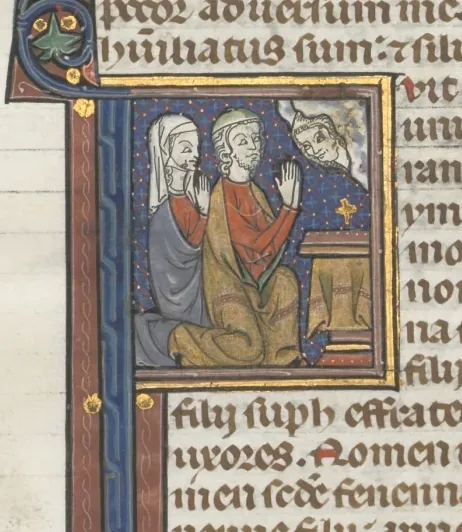
A thirteenth-century Bible initial from southern France showing Elkanah and Hannah kneeling before an altar, Hannah whose grief at Shiloh became prayer.Fol. 98r, Kings I, historiated initial F, Elkanah and Hannah kneeling before an altar with God appearing above · c. 1275–1300 · Cleveland Museum of Art · CC0 · full page · museum record · Galeria Regni
In Hebrew the common verb is palal (Strong's H6419). Strong's gives its root meaning as "to judge (officially or mentally)" and "by extension, to intercede, pray"; its noun, tephillah (H8605), is the usual word for "prayer," and Strong's notes it can also mean "a hymn."2 The book of Psalms closes its second section with the line "The prayers of David the son of Jesse are ended" (Psalm 72:20) — and the word for "prayers" there is tephillah. In Israel, prayer and song were close kin.
In Greek the usual verb is proseuchomai (G4336), "to pray to God, i.e. supplicate, worship," from euchomai (G2172), "to wish; by implication, to pray to God."3 When Paul lists the kinds of prayer the church must offer "first of all," he uses four words: "I exhort therefore, that, first of all, supplications, prayers, intercessions, and giving of thanks, be made for all men" (1 Timothy 2:1). Supplications (G1162, deesis) are petitions for a felt lack. Prayers (G4335, proseuche) is the general word. Intercessions (G1783, enteuxis) is, in Strong's words, "an interview, i.e. (specially) supplication." Giving of thanks (G2169, eucharistia) is gratitude spoken to God.4
So the Bible's picture of prayer is not narrow. It is pleading a case before a Judge, asking a Father for bread, standing before a King for someone else, and thanking a Benefactor. All of it is speech addressed to a Person who hears.
Definitions from the praying church
John Bunyan wrote his treatise on prayer in Bedford jail, where he was held for twelve years for preaching without a licence. The book is titled from 1 Corinthians 14:15, I Will Pray with the Spirit, and I Will Pray with the Understanding Also. It begins:
PRAYER is an Ordinance of God, and that to be used both in Public and Private; yea, such an Ordinance, as brings those that have the Spirit of Supplication, into great familiarity with God... By Prayer the Christian can open his heart to God as to a Friend, and obtain fresh testimony of God's Friendship to him.5
Then he gives his definition:
Prayer is a sincere, sensible, affectionate pouring out of the heart or soul to God through Christ, in the strength and assistance of the holy Spirit, for such things as God hath promised, or, according to the Word, for the good of the Church, with submission, in Faith, to the Will of God.6
Bunyan expounds each phrase in turn, and it is worth doing the same briefly:
Sincere. Prayer is not performance. Jesus' first warning about prayer was against praying "that they may be seen of men" (Matthew 6:5).
Sensible. In Bunyan's English, "sensible" means felt — aware of our need and of God's supply. Real prayer comes from a sense of want.
Affectionate. It carries desire. "As the hart panteth after the water brooks, so panteth my soul after thee, O God" (Psalm 42:1).
Pouring out. Hannah, accused of drunkenness at Shiloh, answered, "No, my lord, I am a woman of a sorrowful spirit: I have drunk neither wine nor strong drink, but have poured out my soul before the LORD" (1 Samuel 1:15).
Through Christ. We have no access in our own name.
In the strength of the Spirit. We cannot pray rightly by our own power.
For such things as God hath promised. Prayer stands on God's word.
With submission, in faith. We ask boldly and leave the answer to God.
The Westminster Shorter Catechism of 1647, written for teaching children and new believers, says it more briefly: "Prayer is an offering up of our desires unto God, for things agreeable to his will, in the name of Christ, with confession of our sins, and thankful acknowledgment of his mercies."7 Its next answer gives the rule for prayer: "The whole word of God is of use to direct us in prayer; but the special rule of direction is that form of prayer which Christ taught his disciples, commonly called the Lord's prayer."8
The Trinitarian shape of prayer
Christian prayer has a shape that comes from the nature of God. Paul compresses it into one sentence: "For through him we both have access by one Spirit unto the Father" (Ephesians 2:18).
To the Father
Jesus taught His disciples to begin, "Our Father which art in heaven" (Matthew 6:9). Israel had known God as Father of the nation, but the intimacy Jesus gave His disciples was new. Paul says the Holy Ghost Himself puts the word in our mouths: "And because ye are sons, God hath sent forth the Spirit of his Son into your hearts, crying, Abba, Father" (Galatians 4:6). Abba is Aramaic; Strong's notes it is "father as a vocative," the form used in direct address.9 Jesus used it in Gethsemane: "Abba, Father, all things are possible unto thee" (Mark 14:36).
The Shorter Catechism draws out what the opening words teach: the preface "teacheth us to draw near to God with all holy reverence and confidence, as children to a father able and ready to help us; and that we should pray with and for others."10 Reverence, because He is in heaven. Confidence, because He is our Father.
Through the Son
We come through Jesus Christ, or we do not come at all. "For there is one God, and one mediator between God and men, the man Christ Jesus" (1 Timothy 2:5). The letter to the Hebrews builds its whole call to prayer on Christ's priesthood: "Seeing then that we have a great high priest, that is passed into the heavens, Jesus the Son of God, let us hold fast our profession. For we have not an high priest which cannot be touched with the feeling of our infirmities; but was in all points tempted like as we are, yet without sin. Let us therefore come boldly unto the throne of grace, that we may obtain mercy, and find grace to help in time of need" (Hebrews 4:14-16).
To pray "in Jesus' name" is not to attach a phrase to the end of a request. It is to come on His merit and ask in line with His character and purpose. "And whatsoever ye shall ask in my name, that will I do, that the Father may be glorified in the Son" (John 14:13). A prayer that could not be offered in Christ's name — a prayer for revenge, for sinful gain, for another's harm — is not made acceptable by adding the words.
And Christ does not only open the way; He prays for us. Paul asks who could condemn the believer: "It is Christ that died, yea rather, that is risen again, who is even at the right hand of God, who also maketh intercession for us" (Romans 8:34). Hebrews says the same: "he ever liveth to make intercession for them" (Hebrews 7:25). The weakest believer's prayer goes up alongside the prayer of the Son of God.
By the Spirit
Then there is the Holy Ghost. "Likewise the Spirit also helpeth our infirmities: for we know not what we should pray for as we ought: but the Spirit itself maketh intercession for us with groanings which cannot be uttered. And he that searcheth the hearts knoweth what is the mind of the Spirit, because he maketh intercession for the saints according to the will of God" (Romans 8:26-27).
This is one of the most comforting verses in the Bible for anyone who struggles to pray. "We know not what we should pray for as we ought" — Paul includes himself. The Spirit's help is not given to the eloquent but to the weak. Bunyan, who prayed in a cell, wrote: "The best Prayers have often more groans than words; and those words that it hath, are but a lean and shallow representation of the heart, life, and spirit of that Prayer."11
Jude tells believers to keep themselves by "praying in the Holy Ghost" (Jude 1:20), and Paul to pray "always with all prayer and supplication in the Spirit" (Ephesians 6:18). Some Christians read these texts to include praying in tongues, as 1 Corinthians 14 describes; others read them as the Spirit's help in all prayer. Both agree on the main thing: Christian prayer is never a solo effort.
To God alone
Because prayer is part of worship, it goes to God alone. The Westminster Confession says worship "is to be given to God, the Father, Son, and Holy Ghost; and to him alone; not to angels, saints, or any other creature: and, since the fall, not without a Mediator; nor in the mediation of any other but of Christ alone."12 Scripture never shows a believer praying to an angel, commanding angels or asking a departed saint to pray. When John fell at an angel's feet, he was rebuked: "See thou do it not: I am thy fellowservant, and of thy brethren that have the testimony of Jesus: worship God" (Revelation 19:10).
Why pray, if God knows and God rules?
Jesus raised the obvious objection Himself: "your Father knoweth what things ye have need of, before ye ask him" (Matthew 6:8). And Scripture is clear that God rules all things. Then why pray?
Scripture's answer has three parts.
God works through means, and prayer is one of them. "Ye have not, because ye ask not" (James 4:2). The same God who decrees the harvest commands the farmer to sow. Elijah had God's own word — "Go, shew thyself unto Ahab; and I will send rain upon the earth" (1 Kings 18:1) — and he still "cast himself down upon the earth, and put his face between his knees" (1 Kings 18:42) and prayed until the cloud came. James holds him up as our example: "Elias was a man subject to like passions as we are, and he prayed earnestly that it might not rain: and it rained not on the earth by the space of three years and six months. And he prayed again, and the heaven gave rain, and the earth brought forth her fruit" (James 5:17-18).
Prayer changes the one who prays. Charles Spurgeon, preaching in 1866 on Job's longing to "order my cause before him, and fill my mouth with arguments," asked why God wants us to plead reasons. "Certainly not because God is slow to give, not because we can change the divine purpose, not because God needs to be informed of any circumstance with regard to ourselves," he answered, but because "the arguments to be used are for our own benefit, not for his." When a man searches for arguments, Spurgeon said, "it is because he attaches importance to what he is seeking."13 Prayer teaches us what we really value.
Prayer is relationship. A father wants his children to talk to him, not only to receive from him. "Trust in him at all times; ye people, pour out your heart before him: God is a refuge for us. Selah" (Psalm 62:8). The goal of prayer is not finally the gift but the Giver. "One thing have I desired of the LORD, that will I seek after; that I may dwell in the house of the LORD all the days of my life, to behold the beauty of the LORD, and to enquire in his temple" (Psalm 27:4).
This part matters because the best way to learn to pray is to listen to people who prayed well. The Bible preserves dozens of real prayers, prayed by real people in real trouble. Read together, they are a school of prayer — and almost every lesson in the rest of this paper is first learned here.
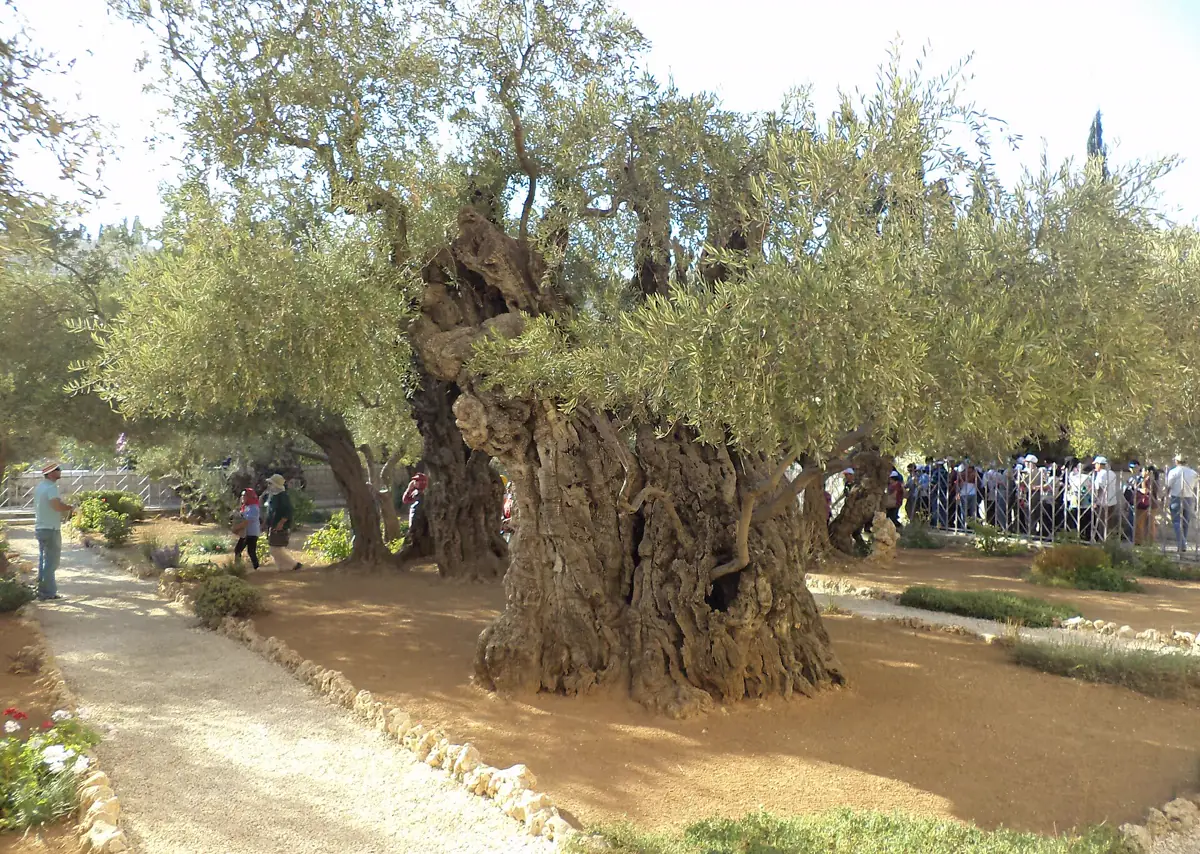
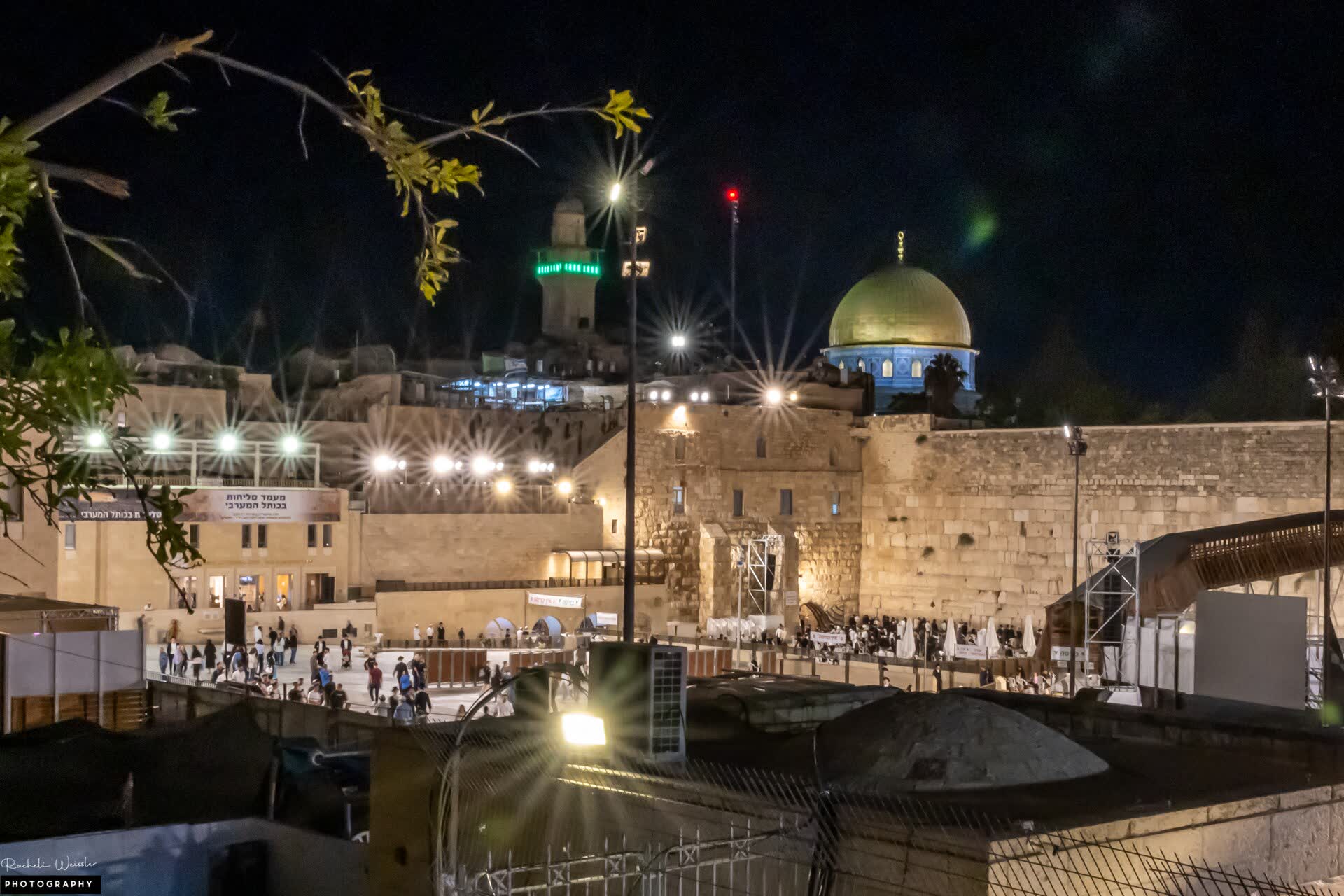
One of the oldest olive trees in the Garden of Gethsemane, rooted through centuries of continuous growth — the grove where Jesus prayed on the night of His arrest.Bogdan Kosar · CC BY-SA 4.0The Western Wall in Jerusalem — Herodian stones of the Second Temple platform where prayer has not stopped in two thousand years.רחל וייסלר · CC BY 2.5
Abraham: pleading on God's character
The first long prayer in the Bible is an intercession. When the LORD tells Abraham that He will judge Sodom, where Abraham's nephew Lot lives, Abraham does not simply ask for Lot's safety. He argues from God's own justice: "That be far from thee to do after this manner, to slay the righteous with the wicked: and that the righteous should be as the wicked, that be far from thee: Shall not the Judge of all the earth do right?" (Genesis 18:25).
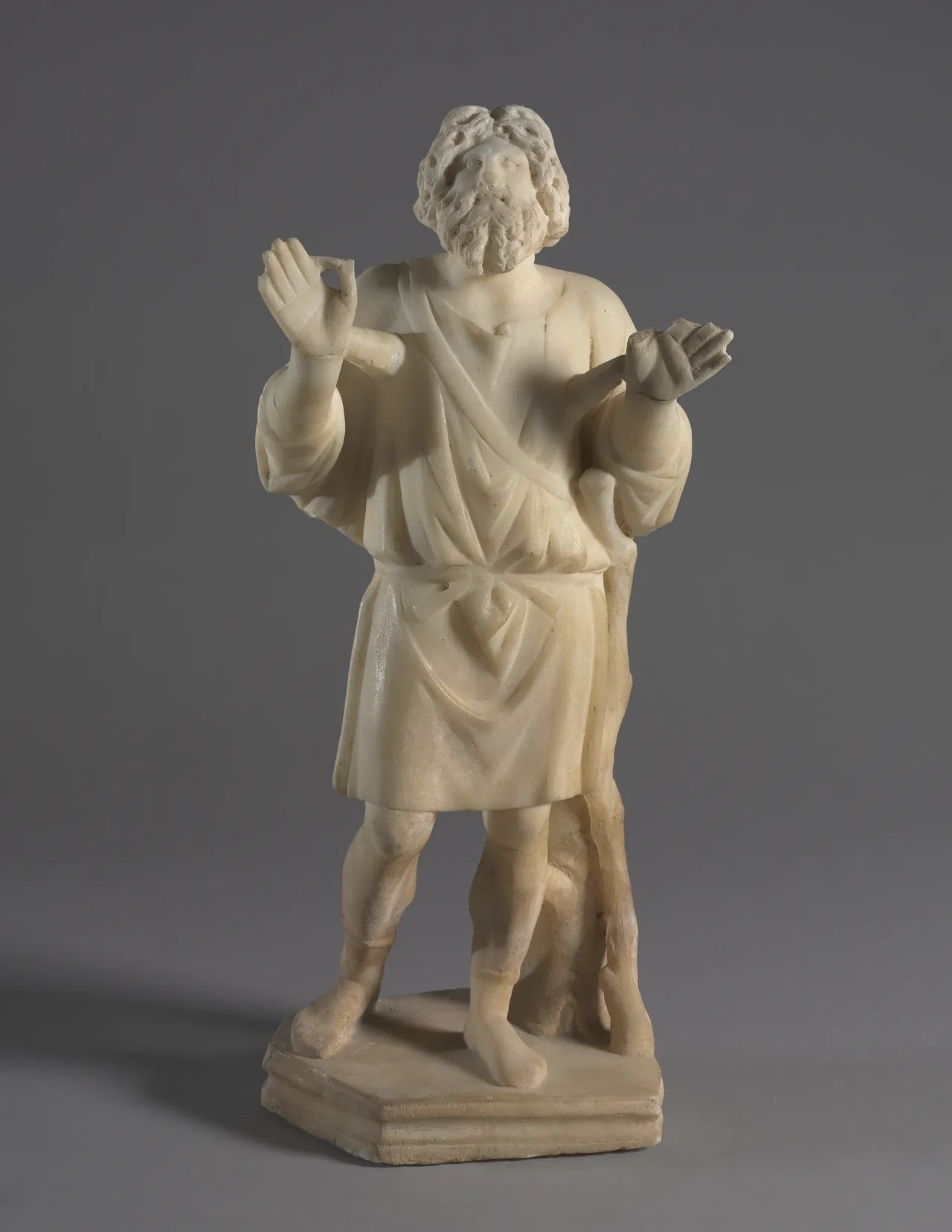
A late Roman, early Christian marble of Jonah praying, carved in Anatolia about 280 to 290, the prophet who cried to God from the depths.Jonah Praying · 280–90 CE · Cleveland Museum of Art · CC0 · museum record · Galeria Regni
He is bold, but he is not proud. "Behold now, I have taken upon me to speak unto the LORD, which am but dust and ashes" (Genesis 18:27). He bargains from fifty righteous down to ten, and each time the LORD agrees: "I will not destroy it for ten's sake" (Genesis 18:32).
Spurgeon pointed to this prayer as the first of his "arguments" — pleading God's attributes. "Abraham did so when he laid hold upon God's justice," he said; "every attribute of the Most High" can be pleaded in prayer.14 The lesson: pray from who God is. His justice, mercy, faithfulness and power are not abstract ideas; they are grounds of appeal.
Moses: standing in the gap
At Sinai, while Moses was on the mountain, Israel made the golden calf. God's anger was just. Moses prayed: "LORD, why doth thy wrath wax hot against thy people, which thou hast brought forth out of the land of Egypt with great power, and with a mighty hand?" (Exodus 32:11). He pleaded God's reputation among the nations, His promise to Abraham, Isaac and Israel, and His past mercy. Then he offered himself: "Yet now, if thou wilt forgive their sin--; and if not, blot me, I pray thee, out of thy book which thou hast written" (Exodus 32:32).
Later, at Kadesh, when the people refused to enter the land, Moses prayed again: "Pardon, I beseech thee, the iniquity of this people according unto the greatness of thy mercy, and as thou hast forgiven this people, from Egypt even until now. And the LORD said, I have pardoned according to thy word" (Numbers 14:19-20).
Moses also shows the deepest desire of prayer. Having secured the people's forgiveness, he asked for one more thing: "I beseech thee, shew me thy glory" (Exodus 33:18). Intercession had brought him close enough to want God Himself.
Hannah: pouring out the soul
Hannah's prayer at Shiloh is the prayer of a woman with a private grief — childlessness, mocked by a rival. "And she was in bitterness of soul, and prayed unto the LORD, and wept sore" (1 Samuel 1:10). She prayed silently, lips moving, and the priest Eli thought she was drunk. Her answer has become a definition of prayer: she had "poured out my soul before the LORD."
She made a vow — "if thou wilt... give unto thine handmaid a man child, then I will give him unto the LORD all the days of his life" (1 Samuel 1:11) — and she kept it. When she brought Samuel to Eli she said, "For this child I prayed; and the LORD hath given me my petition which I asked of him" (1 Samuel 1:27). Then she prayed again, and this time it was praise: "My heart rejoiceth in the LORD, mine horn is exalted in the LORD: my mouth is enlarged over mine enemies; because I rejoice in thy salvation. There is none holy as the LORD: for there is none beside thee: neither is there any rock like our God" (1 Samuel 2:1-2).
The lesson: God welcomes the prayer of private sorrow, not only the prayers of public crisis. And answered prayer should end in thanksgiving.
Elijah: the prayer that God would be known
On Mount Carmel, after the prophets of Baal had cried and cut themselves all day with no answer, Elijah prayed a prayer of about sixty words: "LORD God of Abraham, Isaac, and of Israel, let it be known this day that thou art God in Israel, and that I am thy servant, and that I have done all these things at thy word. Hear me, O LORD, hear me, that this people may know that thou art the LORD God, and that thou hast turned their heart back again" (1 Kings 18:36-37).
Notice the contrast with Baal's prophets. They called from morning until noon, leaped on the altar, and "cried aloud, and cut themselves after their manner with knives and lancets" (1 Kings 18:28). Elijah's prayer was short, plain and centred on God's glory. And then, praying for rain, he showed the other side: persistence. Seven times he sent his servant to look toward the sea; six times the servant came back with "There is nothing." The seventh time: "Behold, there ariseth a little cloud out of the sea, like a man's hand" (1 Kings 18:44). Short prayers and long persistence are not opposites.
Hezekiah: spreading the letter before the LORD
When the Assyrian king Sennacherib sent Hezekiah a letter threatening Jerusalem, Hezekiah took the letter into the temple and "spread it before the LORD." His prayer begins with who God is: "O LORD God of Israel, which dwellest between the cherubims, thou art the God, even thou alone, of all the kingdoms of the earth; thou hast made heaven and earth" (2 Kings 19:15). Then he asks for help, and gives the reason: "Now therefore, O LORD our God, I beseech thee, save thou us out of his hand, that all the kingdoms of the earth may know that thou art the LORD God, even thou only" (2 Kings 19:19).
Later, sick to the point of death, Hezekiah prayed and wept, and Isaiah brought the answer: "I have heard thy prayer, I have seen thy tears: behold, I will heal thee" (2 Kings 20:5). The lesson: bring the actual thing — the letter, the diagnosis, the bill — and lay it before God.
Nehemiah and Daniel: confession for a people
Nehemiah, hearing of Jerusalem's broken walls, "sat down and wept, and mourned certain days, and fasted, and prayed before the God of heaven" (Nehemiah 1:4). His prayer confesses not only Israel's sins but his own: "both I and my father's house have sinned" (Nehemiah 1:6). Later, standing before the Persian king with a dangerous request, he prayed in the space of a breath: "So I prayed to the God of heaven" (Nehemiah 2:4). Months of prayer had prepared him for one second of it.
Daniel, reading Jeremiah's prophecy of seventy years, turned to prayer with fasting: "And I set my face unto the Lord God, to seek by prayer and supplications, with fasting, and sackcloth, and ashes" (Daniel 9:3). His long confession ends with a cry that has given words to God's people ever since: "O Lord, hear; O Lord, forgive; O Lord, hearken and do; defer not, for thine own sake, O my God: for thy city and thy people are called by thy name" (Daniel 9:19). And he grounds it all on mercy, not merit: "for we do not present our supplications before thee for our righteousnesses, but for thy great mercies" (Daniel 9:18).
The lesson: intercession for a nation or a church begins with confession, and it includes the one who prays.
Jonah and Habakkuk: prayer from the depths
Jonah prayed from the worst place a man has ever prayed: "Then Jonah prayed unto the LORD his God out of the fish's belly, And said, I cried by reason of mine affliction unto the LORD, and he heard me; out of the belly of hell cried I, and thou heardest my voice" (Jonah 2:1-2). He was there by his own disobedience. God heard him anyway.
Habakkuk's book is a prayer argument with God. It opens with complaint — "O LORD, how long shall I cry, and thou wilt not hear!" (Habakkuk 1:2) — and ends with a song of trust that has no visible grounds at all: "Although the fig tree shall not blossom, neither shall fruit be in the vines; the labour of the olive shall fail, and the fields shall yield no meat; the flock shall be cut off from the fold, and there shall be no herd in the stalls: Yet I will rejoice in the LORD, I will joy in the God of my salvation" (Habakkuk 3:17-18). Part 6 returns to him.
The Psalms: the prayer book of Scripture
The Psalms are prayers, and they include every mood. There is praise: "Bless the LORD, O my soul: and all that is within me, bless his holy name" (Psalm 103:1). There is confession: Psalm 51. There is trust: Psalm 23. And there is lament — prayer that complains to God, honestly, about God's apparent absence: "How long wilt thou forget me, O LORD? for ever? how long wilt thou hide thy face from me?" (Psalm 13:1).
Lament is a part of biblical prayer many Christians have never been taught. The psalmists do not pretend. They bring their anger, fear and confusion to God rather than away from Him. And nearly always the lament turns, not because the circumstances change, but because the one praying remembers who God is. Psalm 13 ends: "But I have trusted in thy mercy; my heart shall rejoice in thy salvation. I will sing unto the LORD, because he hath dealt bountifully with me" (Psalm 13:5-6).
Jesus prayed the Psalms. On the cross He cried the opening words of Psalm 22: "Eli, Eli, lama sabachthani? that is to say, My God, my God, why hast thou forsaken me?" (Matthew 27:46). If the Son of God used a psalm of lament in His agony, His people may too.
The Lord Jesus at prayer
The Gospels, and Luke especially, show Jesus praying at every turning point. At His baptism, "Jesus also being baptized, and praying, the heaven was opened" (Luke 3:21). Before choosing the twelve, "he went out into a mountain to pray, and continued all night in prayer to God" (Luke 6:12). At the Transfiguration, "as he prayed, the fashion of his countenance was altered" (Luke 9:29). Busy ministry drove Him to solitude, not away from it: "And he withdrew himself into the wilderness, and prayed" (Luke 5:16). His habit was early: "And in the morning, rising up a great while before day, he went out, and departed into a solitary place, and there prayed" (Mark 1:35).
At Lazarus's tomb He prayed aloud, and the prayer shows His confidence in the Father: "Father, I thank thee that thou hast heard me. And I knew that thou hearest me always" (John 11:41-42).
The high priestly prayer
John 17 records the longest prayer of Jesus. He prays first for Himself — "Father, the hour is come; glorify thy Son, that thy Son also may glorify thee" (John 17:1) — then for His disciples, then for all who will believe. He does not ask that they be removed from the world: "I pray not that thou shouldest take them out of the world, but that thou shouldest keep them from the evil" (John 17:15). He asks that they be made holy by the truth: "Sanctify them through thy truth: thy word is truth" (John 17:17). And He prays for us: "Neither pray I for these alone, but for them also which shall believe on me through their word; That they all may be one; as thou, Father, art in me, and I in thee, that they also may be one in us: that the world may believe that thou hast sent me" (John 17:20-21).
Every Christian alive today was prayed for by name, in effect, the night before the cross.
Gethsemane
Then came the garden. "And he went a little farther, and fell on his face, and prayed, saying, O my Father, if it be possible, let this cup pass from me: nevertheless not as I will, but as thou wilt" (Matthew 26:39). He prayed it three times. The second time the words shifted: "O my Father, if this cup may not pass away from me, except I drink it, thy will be done" (Matthew 26:42). Luke records the intensity: "And being in an agony he prayed more earnestly: and his sweat was as it were great drops of blood falling down to the ground" (Luke 22:44). Luke 22:43–44 stands in the 1611 and in the Received Text; some modern versions bracket it. You can see that difference at kylelauriano.com/library/changes.
Hebrews tells us how the Father regarded that prayer: "Who in the days of his flesh, when he had offered up prayers and supplications with strong crying and tears unto him that was able to save him from death, and was heard in that he feared" (Hebrews 5:7). He was heard — and the cup did not pass. That single fact will matter in Part 6.
The church at prayer in Acts
The church was born praying. Between the ascension and Pentecost, "These all continued with one accord in prayer and supplication, with the women, and Mary the mother of Jesus, and with his brethren" (Acts 1:14). After Pentecost, prayer was one of the four marks of the church: "And they continued stedfastly in the apostles' doctrine and fellowship, and in breaking of bread, and in prayers" (Acts 2:42).
When Peter and John were threatened by the council, the church's first recorded prayer began with creation — "Lord, thou art God, which hast made heaven, and earth, and the sea, and all that in them is" (Acts 4:24) — and asked, not for safety, but for courage: "And now, Lord, behold their threatenings: and grant unto thy servants, that with all boldness they may speak thy word" (Acts 4:29). The answer came at once: "And when they had prayed, the place was shaken where they were assembled together; and they were all filled with the Holy Ghost, and they spake the word of God with boldness" (Acts 4:31).
When Herod imprisoned Peter, "prayer was made without ceasing of the church unto God for him" (Acts 12:5), and when an angel led him out, he went straight to the house where "many were gathered together praying" (Acts 12:12). Paul and Silas, beaten and in stocks at Philippi, "at midnight... prayed, and sang praises unto God: and the prisoners heard them" (Acts 16:25).
The prayers of Paul
Paul's letters contain his prayers for the churches, and they are a rebuke to most of our prayer lists. He rarely prays for circumstances. He prays for spiritual sight, strength, love and holiness.
For the Ephesians: "That the God of our Lord Jesus Christ, the Father of glory, may give unto you the spirit of wisdom and revelation in the knowledge of him: The eyes of your understanding being enlightened; that ye may know what is the hope of his calling, and what the riches of the glory of his inheritance in the saints" (Ephesians 1:17-18). And again: "That he would grant you, according to the riches of his glory, to be strengthened with might by his Spirit in the inner man; That Christ may dwell in your hearts by faith; that ye, being rooted and grounded in love, May be able to comprehend with all saints what is the breadth, and length, and depth, and height; And to know the love of Christ, which passeth knowledge, that ye might be filled with all the fulness of God" (Ephesians 3:16-19).
For the Philippians: "And this I pray, that your love may abound yet more and more in knowledge and in all judgment; That ye may approve things that are excellent; that ye may be sincere and without offence till the day of Christ" (Philippians 1:9-10).
For the Colossians: that they "might be filled with the knowledge of his will in all wisdom and spiritual understanding; That ye might walk worthy of the Lord unto all pleasing" (Colossians 1:9-10).
The lesson is simple and searching. Pray Paul's prayers for the people you love. They are already written, and they ask for what matters most.
This part matters because Jesus gave the Lord's Prayer as a pattern, not a formula to recite: "After this manner therefore pray ye" (Matthew 6:9). It shows us how to pray, but the one who prays must seek Him with his own heart: "And ye shall seek me, and find me, when ye shall search for me with all your heart" (Jeremiah 29:13). The church has prayed it for two thousand years. The Didache, a short manual of Christian teaching that is among the earliest Christian writings outside the New Testament, gives the prayer and tells believers, "Thrice in the day thus pray."15 Tertullian, writing in North Africa at the end of the second century, called it "an epitome of the whole Gospel."16 Here it is taken one phrase at a time.
The prayer comes to us in two places. In Matthew it is part of the Sermon on the Mount: "After this manner therefore pray ye: Our Father which art in heaven, Hallowed be thy name. Thy kingdom come. Thy will be done in earth, as it is in heaven. Give us this day our daily bread. And forgive us our debts, as we forgive our debtors. And lead us not into temptation, but deliver us from evil: For thine is the kingdom, and the power, and the glory, for ever. Amen" (Matthew 6:9-13). In Luke it is Jesus' answer to the disciples' request (Luke 11:2-4), in slightly different words — which shows it was given as a pattern and not only as a fixed text.
The setting: two warnings first
Before the prayer, Jesus gives two warnings. The first is against praying for an audience: "for they love to pray standing in the synagogues and in the corners of the streets, that they may be seen of men" (Matthew 6:5). The second is against praying as if God were moved by volume: "But when ye pray, use not vain repetitions, as the heathen do: for they think that they shall be heard for their much speaking" (Matthew 6:7).
The heathen of Jesus' day piled up the names and titles of their gods and repeated formulas, hoping to secure attention. Many religions still pray that way — with mantras, chants and set repetitions counted on beads.
Steve Kang told his story on The King Is Coming Show (TKIC #49): he chanted eight hours a day to reach Nirvana — and then, in his telling, woke up in hell instead. Watch it in his own words: youtube.com/watch?v=46SP1FgXfbY Steve's account of what happened to him, shared as his testimony — weigh it for yourself.
Jesus' cure for vain repetition is not a cleverer method but a truer knowledge of God: "Be not ye therefore like unto them: for your Father knoweth what things ye have need of, before ye ask him" (Matthew 6:8). That does not forbid praying the Lord's Prayer itself, often and from the heart. It forbids treating any words as a machine.
"Our Father which art in heaven"
The prayer begins with relationship before request. Our — the prayer is plural; even alone in the closet, the believer prays as one of a family. Father — God is approached as a Father who loves, not a tyrant to be appeased. "Like as a father pitieth his children, so the LORD pitieth them that fear him" (Psalm 103:13). Which art in heaven — but He is the Father in heaven: holy, sovereign, above us. Reverence and confidence belong together.
Tertullian noticed that the first words already confess faith: in calling God Father, "we at once pray to God, and commend faith, whose reward this appellation is," and he quoted John's Gospel, that to those who believed "He gave power to be called sons of God."17 The words are a pattern, not a password: no one says "Our Father" by reciting it, but by seeking Him with his own heart (Jeremiah 29:13).
"Hallowed be thy name"
The first petition is not for us at all. To hallow is to treat as holy. God's name — His revealed character — is already holy; we pray that it would be honoured as holy, in our own lives and in the world. Ezekiel heard God promise to do this Himself: "And I will sanctify my great name, which was profaned among the heathen, which ye have profaned in the midst of them; and the heathen shall know that I am the LORD, saith the Lord GOD, when I shall be sanctified in you before their eyes" (Ezekiel 36:23).
Praying this petition is a daily realignment. Before we ask for anything, we ask that God be glorified — and we submit our requests to that end. Moses pleaded God's name; Hezekiah prayed "that all the kingdoms of the earth may know." A prayer that begins with God's name will be different all the way down.
"Thy kingdom come"
God already reigns: "Thy kingdom is an everlasting kingdom, and thy dominion endureth throughout all generations" (Psalm 145:13). Yet Jesus tells us to pray for the kingdom to come. Scripture speaks of the kingdom in several ways. It is present in the hearts of those who submit to Christ: "For the kingdom of God is not meat and drink; but righteousness, and peace, and joy in the Holy Ghost" (Romans 14:17). It advances as the gospel spreads. And it will come in fullness when Christ returns: "The kingdoms of this world are become the kingdoms of our Lord, and of his Christ; and he shall reign for ever and ever" (Revelation 11:15).
To pray "Thy kingdom come" is to pray for all three: that Christ would rule more fully in me, that the gospel would reach those who have not heard, and that the King would come. It is a missionary prayer. Jesus told His disciples, "Pray ye therefore the Lord of the harvest, that he will send forth labourers into his harvest" (Matthew 9:38).
"Thy will be done in earth, as it is in heaven"
In heaven God's will is done perfectly, gladly and at once. We pray for the same on earth — beginning with ourselves. This is the petition Jesus prayed in Gethsemane, word for word: "thy will be done" (Matthew 26:42). He lived it all His life: "For I came down from heaven, not to do mine own will, but the will of him that sent me" (John 6:38).
This petition is not resignation. It is not a sigh that says "whatever happens, happens." It is an active prayer that God's revealed will — holiness, justice, mercy, the spread of the gospel — would be done, and a surrender of our own will where it differs. "I delight to do thy will, O my God: yea, thy law is within my heart" (Psalm 40:8).
"Give us this day our daily bread"
Only now does the prayer turn to our needs, and it begins with the most basic: food. God cares about bodies, rent and groceries. But notice the limits. It is bread, not luxury. It is daily, not a stockpile. It is us, not only me.
Israel learned this in the wilderness, where manna came one day at a time: "Behold, I will rain bread from heaven for you; and the people shall go out and gather a certain rate every day, that I may prove them, whether they will walk in my law, or no" (Exodus 16:4). Moses later explained the lesson: "that he might make thee know that man doth not live by bread only, but by every word that proceedeth out of the mouth of the LORD doth man live" (Deuteronomy 8:3). Proverbs puts the same balance in a prayer: "Give me neither poverty nor riches; feed me with food convenient for me" (Proverbs 30:8).
This petition is the death of prosperity teaching. Jesus did not teach His disciples to ask for wealth, and He warned against worry instead: "Take therefore no thought for the morrow: for the morrow shall take thought for the things of itself" (Matthew 6:34).
"And forgive us our debts, as we forgive our debtors"
Sin is pictured as debt — something owed to God that we cannot pay. Every believer needs to pray this daily, not because justification is lost each day, but because a child who has wronged his father needs to say so. "If we confess our sins, he is faithful and just to forgive us our sins, and to cleanse us from all unrighteousness" (1 John 1:9).
Then comes the clause that makes this the hardest petition: "as we forgive our debtors." Jesus underlined it immediately after the prayer — the only petition He comments on: "For if ye forgive men their trespasses, your heavenly Father will also forgive you: But if ye forgive not men their trespasses, neither will your Father forgive your trespasses" (Matthew 6:14-15). We do not earn God's forgiveness by forgiving others. But a heart that refuses to forgive shows it has not understood how much it has been forgiven. Peter asked whether seven times was enough; Jesus answered, "I say not unto thee, Until seven times: but, Until seventy times seven" (Matthew 18:22). Paul gives the ground: "even as Christ forgave you, so also do ye" (Colossians 3:13).
"And lead us not into temptation, but deliver us from evil"
God does not tempt anyone to sin: "Let no man say when he is tempted, I am tempted of God: for God cannot be tempted with evil, neither tempteth he any man" (James 1:13). This petition is the prayer of a soldier who knows his weakness: keep me out of the places where I fall, and when testing comes, keep me through it. Jesus gave the same instruction in Gethsemane: "Watch and pray, that ye enter not into temptation" (Matthew 26:41). And there is a promise to stand on: "God is faithful, who will not suffer you to be tempted above that ye are able; but will with the temptation also make a way to escape, that ye may be able to bear it" (1 Corinthians 10:13).
"Deliver us from evil" can be read as evil in general or "the evil one" — the Didache's translator gives both.15 Either way, it is a prayer for protection that Jesus Himself prayed for us: "keep them from the evil" (John 17:15). Paul, near the end of his life, was confident in the answer: "And the Lord shall deliver me from every evil work, and will preserve me unto his heavenly kingdom: to whom be glory for ever and ever. Amen" (2 Timothy 4:18).
"For thine is the kingdom, and the power, and the glory, for ever. Amen"
The prayer ends where it began, with God. The words echo David's great prayer at the end of his life: "Thine, O LORD, is the greatness, and the power, and the glory, and the victory, and the majesty: for all that is in the heaven and in the earth is thine; thine is the kingdom, O LORD, and thou art exalted as head above all" (1 Chronicles 29:11).
This doxology stands in the King James Bible and the Received Text. Many modern versions remove it or move it to a footnote. It is worth noting that the Didache, one of the oldest Christian writings we have, already closes the prayer with "for Yours is the power and the glory forever."15 Every place where the 1611 and the modern Critical Text part ways is listed at kylelauriano.com/library/changes.
Amen means "so be it." It is the believer's signature on everything that has gone before.
Praying the prayer
How should we use the Lord's Prayer? Three ways.
Pray it as written, slowly, meaning every word — not as a formula to recite, but seeking Him with your own heart, alone and with the church.
Pray through it as an outline, pausing at each phrase to add your own words. Under "Hallowed be thy name," praise God for specific things He has shown you of Himself. Under "Thy kingdom come," pray for missionaries, for your church, for friends who do not know Christ. Under "daily bread," bring this week's needs. Under "forgive us," confess specific sins and name the people you need to forgive.
Let it check your other prayers. If your prayers are all "give us" and never "hallowed be thy name," the pattern shows what is missing.
Martin Luther suggested something similar in 1535 in a letter to his barber, Master Peter, published as A Simple Way to Pray. He described taking a line of the Lord's Prayer (or of the Ten Commandments or the Creed) and turning it into four strands: instruction, thanksgiving, confession and petition.18 That is the right kind of meditation — the mind full of God's word, and the word turned into prayer.
This part matters because the New Testament commands prayer for others more often than any other kind of prayer, and because Scripture places that prayer on a battlefield. Both truths need to be held together — and held carefully.
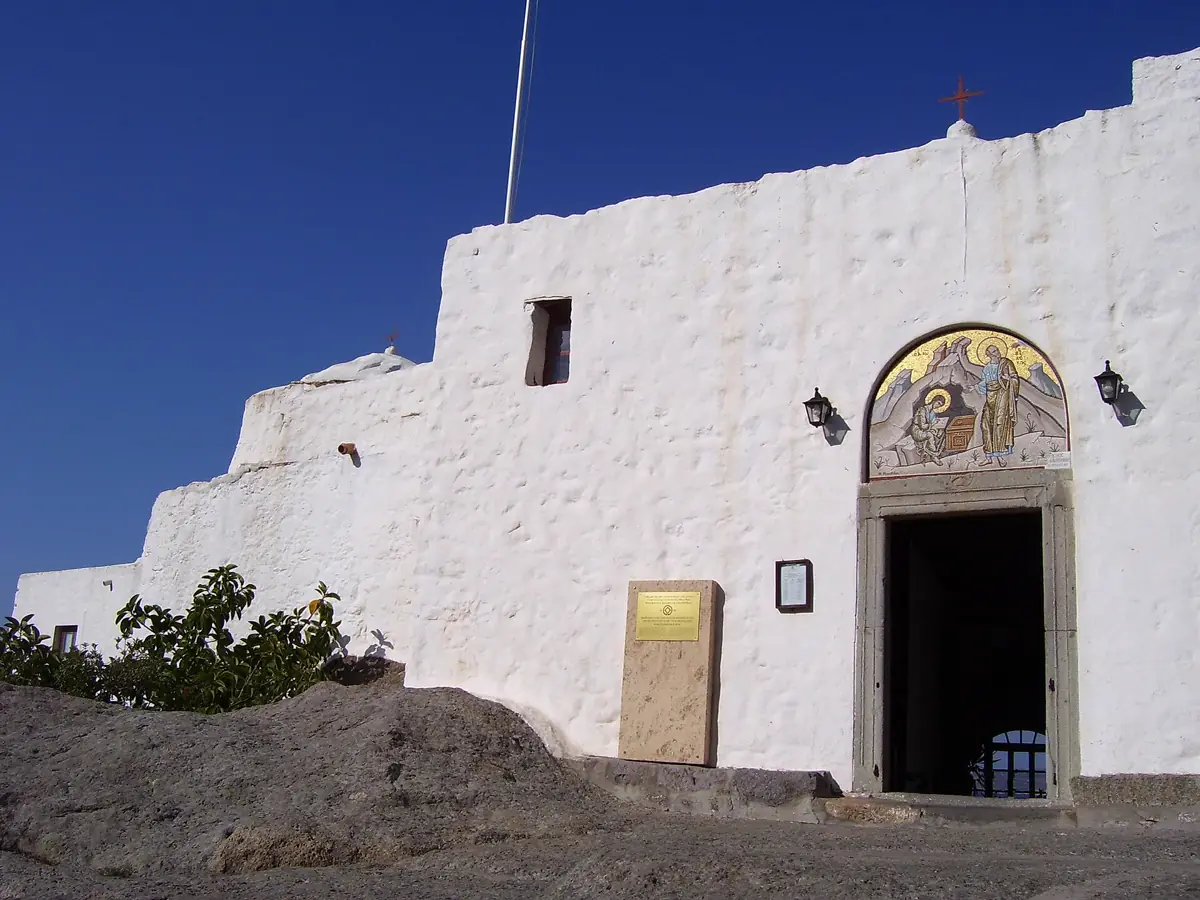
The Cave of the Apocalypse on Patmos — the traditional site where John, in exile around 95 AD, received the Revelation.Vladimir Boskovic at English Wikipedia · Public domain
The call to intercede
Paul's charge to Timothy puts intercession "first of all": "I exhort therefore, that, first of all, supplications, prayers, intercessions, and giving of thanks, be made for all men; For kings, and for all that are in authority; that we may lead a quiet and peaceable life in all godliness and honesty. For this is good and acceptable in the sight of God our Saviour; Who will have all men to be saved, and to come unto the knowledge of the truth" (1 Timothy 2:1-4).
The early church obeyed this literally. Tertullian, defending Christians to the Roman authorities in his Apology, wrote: "We meet together as an assembly and congregation, that, offering up prayer to God as with united force, we may wrestle with Him in our supplications. This violence God delights in. We pray, too, for the emperors, for their ministers and for all in authority, for the welfare of the world, for the prevalence of peace."19 These were emperors who could and did put Christians to death.
Samuel thought prayerlessness for God's people a sin: "Moreover as for me, God forbid that I should sin against the LORD in ceasing to pray for you: but I will teach you the good and the right way" (1 Samuel 12:23). Jeremiah told the exiles in Babylon to pray for the pagan city that held them: "And seek the peace of the city whither I have caused you to be carried away captives, and pray unto the LORD for it: for in the peace thereof shall ye have peace" (Jeremiah 29:7). And Jesus told His disciples to pray for those who hate them: "Love your enemies, bless them that curse you, do good to them that hate you, and pray for them which despitefully use you, and persecute you" (Matthew 5:44). He did it Himself from the cross: "Father, forgive them; for they know not what they do" (Luke 23:34). So did Stephen as the stones fell (Acts 7:60).
Standing in the gap
Ezekiel records a sentence that has haunted intercessors ever since: "And I sought for a man among them, that should make up the hedge, and stand in the gap before me for the land, that I should not destroy it: but I found none" (Ezekiel 22:30). The picture is of a broken wall and a man who stands in the breach.
Abraham stood there for Sodom; Moses for Israel at Sinai. God answered Abraham's prayer for the household of Abimelech: "So Abraham prayed unto God: and God healed Abimelech, and his wife, and his maidservants" (Genesis 20:17). And at the end of Job's long trial, the turning point came when he prayed for the friends who had wronged him: "And the LORD turned the captivity of Job, when he prayed for his friends" (Job 42:10).
The New Testament gives us a portrait of an ordinary intercessor. His name is Epaphras, and Paul mentions him only twice: "Epaphras, who is one of you, a servant of Christ, saluteth you, always labouring fervently for you in prayers, that ye may stand perfect and complete in all the will of God" (Colossians 4:12). Labouring fervently translates agonizomai (G75), which Strong's defines as "to struggle, literally (to compete for a prize), figuratively (to contend with an adversary)" — the root of our word "agonize."20 Intercession is work.
What to pray for others
Scripture gives a full list. Pray for the lost: "Brethren, my heart's desire and prayer to God for Israel is, that they might be saved" (Romans 10:1). Pray for the gospel's progress and for those who preach it, as Paul asked: "pray for us, that the word of the Lord may have free course, and be glorified" (2 Thessalonians 3:1). Pray for believers' growth, using Paul's own prayers from Part 2. Pray for the sick, as James directs the elders to do (James 5:14-15). Pray for one another's sins: "Confess your faults one to another, and pray one for another, that ye may be healed. The effectual fervent prayer of a righteous man availeth much" (James 5:16). And pray for rulers and for enemies, as above.
George Müller's prayer lists
No one in modern church history is more associated with persevering intercession than George Müller (1805–1898). A German-born pastor in Bristol, he opened homes for orphans and resolved to support them without asking any person for money — only God. He explained why in his own words: "if I, a poor man, simply by prayer and faith, obtained, without asking any individual, the means for establishing and carrying on an orphan house, there would be something which, with the Lord's blessing, might be instrumental in strengthening the faith of the children of God."21 The work grew to five orphan houses on Ashley Down; one supporter quoted by Pierson spoke of "five orphan houses running, with over two thousand orphans, and without asking any one for help."22
But Müller's intercession for people was as striking as his prayers for money. His friend Arthur T. Pierson wrote:
On his prayer list were the names of some for whom he had besought God, daily, by name, for one, two, three, four, six, ten years before the answer was given. The year just before his death, he told the writer of two parties for whose reconciliation to God he had prayed, day by day, for over sixty years, and who had not as yet to his knowledge turned unto God: and he significantly added, "I have not a doubt that I shall meet them both in heaven; for my Heavenly Father would not lay upon my heart a burden of prayer for them for over threescore years, if He had not concerning them purposes of mercy."23
Whatever became of those two men, the lesson for us is Müller's persistence. Intercession is often the work of decades.
Praying together
Intercession is not only private. Jesus attached a promise to agreement in prayer: "Again I say unto you, That if two of you shall agree on earth as touching any thing that they shall ask, it shall be done for them of my Father which is in heaven. For where two or three are gathered together in my name, there am I in the midst of them" (Matthew 18:19-20).
One of the best-documented prayer movements in modern history began with almost nobody. On September 23, 1857, Jeremiah Lanphier, a layman in New York with a business background, opened a weekday noon prayer meeting for businessmen in a third-floor room of the North Dutch Reformed Church on Fulton Street. Six people came, and they arrived late. Attendance grew week by week; a financial panic struck the city in October; by the spring of 1858, by one recent historian's account, an estimated ten thousand people were meeting for prayer across at least twenty New York churches and YMCAs, and the movement had spread to Philadelphia, Chicago and beyond.24 It was simple — prayer, a few hymns, no preaching.
If your church has a prayer meeting, go. If it does not, ask whether two or three of you could start one.
Prayer on a battlefield
Scripture is clear that the Christian life is a fight with real spiritual enemies. "For we wrestle not against flesh and blood, but against principalities, against powers, against the rulers of the darkness of this world, against spiritual wickedness in high places" (Ephesians 6:12). Paul's description of the armour of God ends with prayer — not as an extra piece of armour but as the way the whole is worn: "Praying always with all prayer and supplication in the Spirit, and watching thereunto with all perseverance and supplication for all saints" (Ephesians 6:18).
Daniel 10 lifts the curtain a little. Daniel fasted and prayed for three weeks, and when the answer came, the messenger told him: "Fear not, Daniel: for from the first day that thou didst set thine heart to understand, and to chasten thyself before thy God, thy words were heard, and I am come for thy words. But the prince of the kingdom of Persia withstood me one and twenty days" (Daniel 10:12-13). Daniel was heard on the first day. The delay was not God's indifference; there was conflict in the unseen world. Daniel did not know it; he simply kept praying. Scripture does not tell us to map those powers or address them. It tells us to pray to God.
What the New Testament gives us
The gifts of the Spirit and deliverance from evil spirits are for today. Jesus said: "And these signs shall follow them that believe; In my name shall they cast out devils; they shall speak with new tongues" (Mark 16:17). (Mark 16:9–20 stands in the 1611 and the Received Text; many modern versions bracket it. See kylelauriano.com/library/changes.) He told the seventy: "Behold, I give unto you power to tread on serpents and scorpions, and over all the power of the enemy: and nothing shall by any means hurt you" (Luke 10:19). James gives the simplest instruction: "Submit yourselves therefore to God. Resist the devil, and he will flee from you" (James 4:7).
When the disciples could not cast out a spirit from a boy, they asked why. Jesus answered: "This kind can come forth by nothing, but by prayer and fasting" (Mark 9:29). The words "and fasting" stand in the 1611 and the Received Text, as does the parallel in Matthew 17:21; many modern versions omit them. You can see both at kylelauriano.com/library/changes.
The ground of all of it is the victory Christ has already won. "And having spoiled principalities and powers, he made a shew of them openly, triumphing over them in it" (Colossians 2:15). John says why Christ came: "For this purpose the Son of God was manifested, that he might destroy the works of the devil" (1 John 3:8). Believers fight from that victory, not toward it. "Ye are of God, little children, and have overcome them: because greater is he that is in you, than he that is in the world" (1 John 4:4).
Guardrails Scripture gives
Because this area attracts excess, Scripture's own guardrails need to be stated plainly.
Our authority is Christ's name, not our formulas. The sons of Sceva tried to use "Jesus whom Paul preacheth" as a spell, and the evil spirit answered, "Jesus I know, and Paul I know; but who are ye?" (Acts 19:15). The name of Jesus is not a magic word. Neither is "the blood" a phrase to be repeated as an incantation; believers overcome "by the blood of the Lamb, and by the word of their testimony" (Revelation 12:11) — that is, by trusting what Christ's death accomplished.
We pray to God, not to spirits or angels. Nowhere does Scripture model conversations with demons, interviews to learn their names and ranks, or commands given to angels. Even Michael the archangel, "when contending with the devil... durst not bring against him a railing accusation, but said, The Lord rebuke thee" (Jude 1:9).
We bless and do not curse. There is no biblical prayer that sends curses back on enemies. "Bless them that curse you, and pray for them which despitefully use you" (Luke 6:28).
There are no guaranteed outcomes. Prayer is not a vending machine, and no one can promise a "breakthrough" on a date. God is sovereign.
A born-again believer belongs to Christ. Believers can be attacked, tempted, oppressed and harassed by the enemy, and need to resist; but one in whom the Holy Ghost dwells is not owned by another spirit.
Rejoice in the right thing. When the seventy came back thrilled that devils were subject to them, Jesus redirected them: "Notwithstanding in this rejoice not, that the spirits are subject unto you; but rather rejoice, because your names are written in heaven" (Luke 10:20).
The site's papers on spiritual warfare treat this subject at length. For prayer, the main point is that warfare prayer is ordinary prayer — to the Father, through the Son, in the Spirit — offered with the knowledge that the stakes are real.
This part matters because Jesus assumed His disciples would fast. He did not say "if ye fast" but "when ye fast" (Matthew 6:16). Yet fasting is one of the most neglected disciplines in the Western church, and one of the most misunderstood.
What fasting is
The Hebrew noun for a fast is tsom (H6685), and the Greek verb is nesteuo (G3522), which Strong's defines as "to abstain from food (religiously)."25 Biblical fasting is going without food, for a time, in order to seek God. It is joined to prayer almost everywhere it appears. It is not a diet, a hunger strike, or a way to earn God's favour.
Fasting in the Old Testament
The law commanded one fast a year, on the Day of Atonement: "in the seventh month, on the tenth day of the month, ye shall afflict your souls, and do no work at all" (Leviticus 16:29). "Afflict your souls" was understood to include going without food.
Beyond that, God's people fasted in crisis, in mourning, in repentance and in seeking guidance:
For protection and guidance. Ezra, leading exiles back to Jerusalem without a military escort, "proclaimed a fast there, at the river of Ahava, that we might afflict ourselves before our God, to seek of him a right way for us, and for our little ones, and for all our substance." And the result: "So we fasted and besought our God for this: and he was intreated of us" (Ezra 8:21-23).
Before a dangerous act. Esther, about to go uninvited before the king, sent word: "Go, gather together all the Jews that are present in Shushan, and fast ye for me, and neither eat nor drink three days, night or day: I also and my maidens will fast likewise; and so will I go in unto the king, which is not according to the law: and if I perish, I perish" (Esther 4:16).
In repentance. Through Joel, God called the nation: "Therefore also now, saith the LORD, turn ye even to me with all your heart, and with fasting, and with weeping, and with mourning: And rend your heart, and not your garments" (Joel 2:12-13).
In intercession. Nehemiah and Daniel fasted as they prayed for their people (Nehemiah 1:4; Daniel 9:3). David fasted when his enemies were sick: "I humbled my soul with fasting; and my prayer returned into mine own bosom" (Psalm 35:13).
A partial fast. Daniel, in a season of mourning, "ate no pleasant bread, neither came flesh nor wine in my mouth... till three whole weeks were fulfilled" (Daniel 10:3).
The fast God chooses
The prophets warned that fasting could become empty religion. Israel complained, "Wherefore have we fasted, say they, and thou seest not?" God's answer through Isaiah was that they fasted while oppressing their workers and quarrelling: "Behold, ye fast for strife and debate, and to smite with the fist of wickedness" (Isaiah 58:4). Then He described the fast He wanted: "Is not this the fast that I have chosen? to loose the bands of wickedness, to undo the heavy burdens, and to let the oppressed go free, and that ye break every yoke? Is it not to deal thy bread to the hungry, and that thou bring the poor that are cast out to thy house?" (Isaiah 58:6-7).
Zechariah asked the same searching question of those who had fasted for seventy years: "did ye at all fast unto me, even to me?" (Zechariah 7:5). A fast that does not change how we treat people has missed the point.
Fasting in the New Testament
Jesus fasted forty days in the wilderness before His ministry began: "And Jesus being full of the Holy Ghost returned from Jordan, and was led by the Spirit into the wilderness, Being forty days tempted of the devil. And in those days he did eat nothing" (Luke 4:1-2). That was unique, and no believer is told to copy its length.
He taught on fasting in the Sermon on the Mount, with the same warning He gave about prayer: "Moreover when ye fast, be not, as the hypocrites, of a sad countenance: for they disfigure their faces, that they may appear unto men to fast... But thou, when thou fastest, anoint thine head, and wash thy face; That thou appear not unto men to fast, but unto thy Father which is in secret" (Matthew 6:16-18).
When asked why His disciples did not fast while John's did, He answered: "Can the children of the bridechamber mourn, as long as the bridegroom is with them? but the days will come, when the bridegroom shall be taken from them, and then shall they fast" (Matthew 9:15). Those days are now.
The early church fasted when seeking direction and setting apart leaders. At Antioch, "As they ministered to the Lord, and fasted, the Holy Ghost said, Separate me Barnabas and Saul for the work whereunto I have called them. And when they had fasted and prayed, and laid their hands on them, they sent them away" (Acts 13:2-3). On their journey, Paul and Barnabas appointed elders in each church "and had prayed with fasting" (Acts 14:23). Anna, the aged widow in the temple, "served God with fastings and prayers night and day" (Luke 2:37). Paul even speaks of married couples agreeing to a time apart "that ye may give yourselves to fasting and prayer" (1 Corinthians 7:5) — another verse where "fasting" stands in the 1611 but not in many modern versions.
Fasting in the early church and after
The Didache shows that Christians kept regular weekly fasts within a few generations of the apostles, and deliberately distinguished themselves from the Pharisees: "But let not your fasts be with the hypocrites; for they fast on the second and fifth day of the week; but fast on the fourth day and the Preparation (Friday)."15 Wednesday and Friday fasts became widespread.
John Wesley, the eighteenth-century evangelist, preached a whole sermon on fasting from Matthew 6. He noted the ancient custom, citing Tertullian, of "half-fasts" on "the fourth and sixth days of the week, (Wednesday and Friday,) throughout the year; on which they took no sustenance till three in the afternoon."26 And he observed that "of all the means of grace there is scarce any concerning which men have run into greater extremes, than that of which our Lord speaks in the above-mentioned words, I mean religious fasting. How have some exalted this beyond all Scripture and reason; — and others utterly disregarded it."27
Why fast?
Scripture and the church's experience suggest several reasons.
To humble ourselves before God. Fasting is an act of the body that says "I need You more than food."
To add urgency to prayer. Esther, Ezra, Nehemiah and Daniel fasted when the need was great.
To repent. Fasting has always gone with mourning over sin (Joel 2:12).
To seek guidance. The church at Antioch fasted before sending Paul and Barnabas.
To loosen the grip of appetite. A believer who never says no to his stomach will find it harder to say no to other desires.
To share with others. Isaiah 58 links fasting with giving bread to the hungry. Wesley urged the same: "that we add alms thereto; works of mercy, after our power, both to the bodies and souls of men."28
Fasting does not twist God's arm or earn an answer. It is a way of seeking God with the whole person, body included.
Brittany Sivels told her story on The King Is Coming Show (TKIC #52): two decades in homosexuality and lust — and then, in her telling, a three-day fast that changed everything. Watch it in her own words: youtube.com/watch?v=JJ0SsSLQgEg Brittany's account of what happened to her, shared as her testimony — weigh it for yourself.
How to fast wisely
Wesley had a pastor's realism about the body. "We ought to preserve our health, as a good gift of God," he wrote. "Therefore care is to be taken, whenever we fast, to proportion the fast to our strength. For we may not offer God murder for sacrifice, or destroy our bodies to help our souls."29 That is still the right principle.
Some practical counsel:
1. Start small. Skip one meal and spend that time in prayer. Then try a day, from evening to evening or morning to evening. 2. Drink water. The biblical fasts that went without water (Esther's three days, Paul's after his conversion, Acts 9:9) were short and extraordinary. Do not go without water. 3. Talk to a doctor first if you are pregnant or nursing, diabetic, on medication, under eighteen, elderly, have a heart condition, or have any history of an eating disorder. For some believers, a partial fast — giving up certain foods, as Daniel did, or giving up a habit such as media — is the faithful choice. 4. Fill the time with God. A fast without prayer is just hunger. Use the meal times to read Scripture and pray. 5. Keep it quiet. Jesus said to wash your face. Do not advertise. 6. Break it gently, especially after more than a day. 7. Watch your heart. If you find yourself proud of fasting, or treating it as a lever on God, stop and repent. If it makes you irritable with your family, remember Isaiah 58.
This part matters because there is no harder test of prayer than praying sincerely and seeing nothing happen. Scripture does not avoid this. It is full of saints who asked "How long?" and some who were told "No." An honest study of prayer must walk through it.
When prayer is hindered
First, Scripture names things that block prayer, and we should clear them where we can. The companion paper treats them one by one; here they are in brief. Cherished sin: "If I regard iniquity in my heart, the Lord will not hear me" (Psalm 66:18). Refusing God's word: "He that turneth away his ear from hearing the law, even his prayer shall be abomination" (Proverbs 28:9). Unforgiveness (Mark 11:25). Wrong motives: "Ye ask, and receive not, because ye ask amiss, that ye may consume it upon your lusts" (James 4:3). Trouble at home, for husbands are told to honour their wives "that your prayers be not hindered" (1 Peter 3:7). And unbelief (Hebrews 11:6).
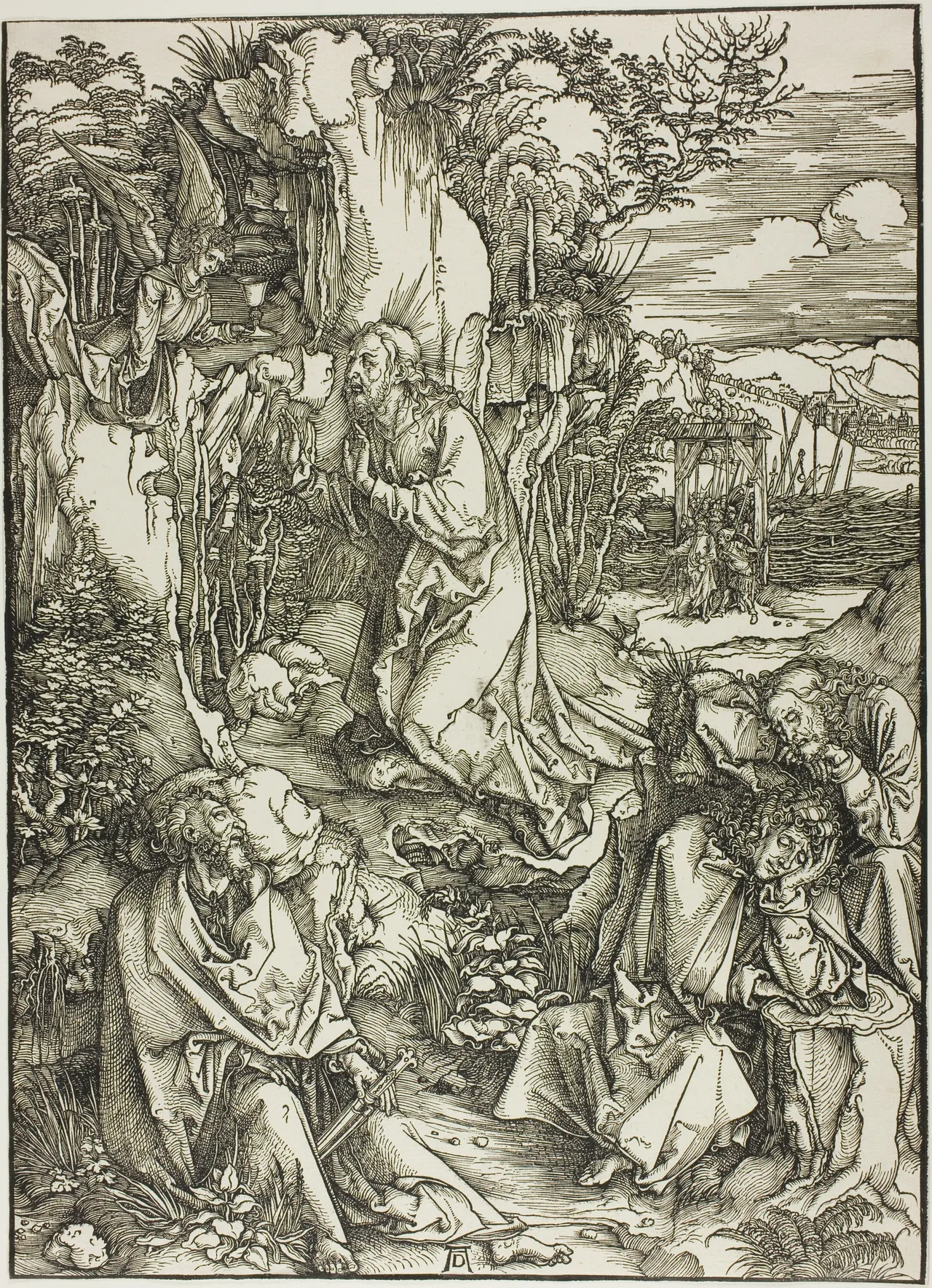
A German woodcut of about 1496 to 1497 from the Large Passion showing the Agony in the Garden, where the Son asked that the cup pass and was still heard.Agony in the Garden, from The Large Passion · c. 1496–97 · Art Institute of Chicago · CC0 · museum record · Galeria Regni
This list is not a weapon to use on yourself or anyone else whenever a prayer goes unanswered. Job's friends assumed his suffering proved hidden sin, and God rebuked them. But it is wise to ask, humbly, whether anything on it applies — and if it does, the answer is confession, not despair. Then keep praying.
When the answer is "wait"
Many answers are delayed. Daniel, as we saw, was heard on the first day and answered on the twenty-first. Elijah's servant came back six times with "There is nothing." Abraham waited twenty-five years for the son of promise.
Jesus told two parables to teach persistence. In one, a man knocks on his friend's door at midnight to borrow bread, and "though he will not rise and give him, because he is his friend, yet because of his importunity he will rise and give him as many as he needeth" (Luke 11:8). In the other, a widow keeps coming to an unjust judge until he gives in. Luke tells us why Jesus told it: "that men ought always to pray, and not to faint" (Luke 18:1). Then Jesus draws the contrast: "And shall not God avenge his own elect, which cry day and night unto him, though he bear long with them? I tell you that he will avenge them speedily. Nevertheless when the Son of man cometh, shall he find faith on the earth?" (Luke 18:7-8). The point is not that God is like the unjust judge, but that He is the opposite. If persistence moves a bad judge, how much more will a good Father answer His children?
E. M. Bounds wrote of this importunity: "Without continuance the prayer may go unanswered. Importunity is made up of the ability to hold on, to press on, to wait with unrelaxed and unrelaxable grasp, restless desire and restful patience."30
Andrew Murray asked why God would hold back what He intends to give. His answer was that God "trains them, in the school of answer delayed, to find out how their perseverance really does prevail." And he went on: "It is when the answer to prayer does not come, and the promise we are most firmly trusting appears to be of none effect, that the trial of faith, more precious than of gold, takes place."31
George Müller's counsel is the most practical of all, because he lived it for sixty years:
Should you, however, not at once obtain answers to your prayers, be not discouraged; but continue patiently, believingly, perseveringly to wait upon God: and as assuredly as that which you ask would be for your real good, and therefore for the honour of the Lord; and as assuredly as you ask it solely on the ground of the worthiness of our Lord Jesus, so assuredly you will at last obtain the blessing. I myself have had to wait upon God concerning certain matters for years, before I obtained answers to my prayers; but at last they came.32
Notice Müller's conditions: that the thing asked be truly for our good and God's honour, and that we ask on Christ's worthiness, not ours. His confidence is not in his own persistence but in God's goodness.
When the answer is "no"
Some prayers are answered with a refusal, and Scripture shows us some of the most faithful people in it hearing that answer.
David's child. After David's sin with Bathsheba, the child she bore fell sick. "David therefore besought God for the child; and David fasted, and went in, and lay all night upon the earth" (2 Samuel 12:16). The child died. David's servants were afraid to tell him, but when he understood, he rose, washed, worshipped and ate. He explained: "While the child was yet alive, I fasted and wept: for I said, Who can tell whether GOD will be gracious to me, that the child may live? But now he is dead, wherefore should I fast? can I bring him back again? I shall go to him, but he shall not return to me" (2 Samuel 12:22-23). David prayed with everything he had, accepted God's answer, and held on to hope beyond the grave.
Paul's thorn. "For this thing I besought the Lord thrice, that it might depart from me. And he said unto me, My grace is sufficient for thee: for my strength is made perfect in weakness. Most gladly therefore will I rather glory in my infirmities, that the power of Christ may rest upon me" (2 Corinthians 12:8-9). The thorn stayed. Grace came instead. Paul came to see the refusal as a gift.
The Son in Gethsemane. Most profound of all, the Lord Jesus asked that the cup pass, and it did not. Yet Hebrews says He "was heard in that he feared" (Hebrews 5:7). He was heard, and the answer was the cross — and through the cross, the salvation of everyone who believes. The Father's "no" to His Son's request was the Father's "yes" to the whole world's redemption.
These examples teach that a refused request is not proof that God is absent, angry or unloving. God's ways are higher than ours: "For as the heavens are higher than the earth, so are my ways higher than your ways, and my thoughts than your thoughts" (Isaiah 55:9). And His purposes are good for His people: "And we know that all things work together for good to them that love God, to them who are the called according to his purpose" (Romans 8:28).
When God seems silent
Then there are seasons when heaven seems shut, and nothing seems to come back at all. The psalmists knew them: "O my God, I cry in the day time, but thou hearest not; and in the night season, and am not silent" (Psalm 22:2).
Scripture's answer to those seasons is not a technique but a posture: keep praying, and pray honestly. The lament psalms give us permission to bring our complaint to God, as long as we bring it to Him. Habakkuk began "how long shall I cry, and thou wilt not hear!" and ended with a song in an empty field. Nothing outside him had changed; he had remembered who God is.
There is also a promise for the waiting: "The LORD is good unto them that wait for him, to the soul that seeketh him. It is good that a man should both hope and quietly wait for the salvation of the LORD" (Lamentations 3:25-26). And another: "And therefore will the LORD wait, that he may be gracious unto you... blessed are all they that wait for him" (Isaiah 30:18).
This part matters because all the theology of prayer is worth little if we do not pray. The praying men and women of history did not have more time than we do. They had a settled habit, and they guarded it.
Bounds on the man of prayer
E. M. Bounds (1835–1913) was a Methodist pastor from Missouri. In the Civil War he was chaplain of the Fifth Missouri Regiment; in his last seventeen years, in Washington, Georgia, he gave himself to reading, writing and praying, and for many years rose at four each morning. His Power Through Prayer opens with a sentence that every believer should read: "What the Church needs to-day is not more machinery or better, not new organizations or more and novel methods, but men whom the Holy Ghost can use—men of prayer, men mighty in prayer. The Holy Ghost does not flow through methods, but through men. He does not come on machinery, but on men. He does not anoint plans, but men—men of prayer."33
He wrote it to preachers, but it applies to every Christian. Programmes and plans are not wrong, but they are not the power. The same chapter has a line that has been quoted ever since: "Men are God's method. The Church is looking for better methods; God is looking for better men."34
Müller's morning
The most practical help I know for daily prayer comes from George Müller's journal for May 7, 1841. For ten years he had begun each morning by giving himself to prayer after dressing. Then he changed the order:
I saw more clearly than ever that the first great and primary business to which I ought to attend every day was, to have my soul happy in the Lord... Now, I saw that the most important thing I had to do was to give myself to the reading of the word of God, and to meditation on it.35
He described what happened when he began each day by meditating on the New Testament, verse by verse:
The result I have found to be almost invariably this, that after a very few minutes my soul has been led to confession, or to thanksgiving, or to intercession, or to supplication; so that, though I did not, as it were, give myself to prayer, but to meditation, yet it turned almost immediately more or less into prayer.35
This is what biblical meditation is. It is not emptying the mind but filling it with God's word, and thinking it through until it becomes prayer. "This book of the law shall not depart out of thy mouth; but thou shalt meditate therein day and night, that thou mayest observe to do according to all that is written therein" (Joshua 1:8). Müller added that he often did this walking in the fields before breakfast, New Testament in his pocket, because he found it good for body and soul.35
Spurgeon's arguments
Spurgeon's 1866 sermon on Job 23 gives another tool: plead arguments with God. Not "filling the mouth with words nor good phrases, nor pretty expressions, but filling the mouth with arguments." He listed several: plead God's attributes, as Abraham pleaded His justice; plead God's promise, as Jacob did at the Jabbok — "the promise, which has in it the attribute and something more, is even a still mightier holdfast"; plead God's great name, as Moses did; plead the sorrows of His people, as Jeremiah did; plead God's past mercies, as David did.36
This makes prayer thoughtful. Before you ask, look for the promise in Scripture that fits your need, and pray it back to God. "Thou hast said..." is one of the strongest beginnings a prayer can have.
A plan for daily prayer
Here is a plan built from the biblical pattern and the practice of the saints. It is a starting point, not a law.
A time. "My voice shalt thou hear in the morning, O LORD; in the morning will I direct my prayer unto thee, and will look up" (Psalm 5:3). Daniel prayed three times a day. Choose a time you can keep. Twenty minutes is a good start.
A place. Somewhere you can shut the door (Matthew 6:6). A chair, a car, a walk.
The word first. Read a passage — a psalm, a chapter of a Gospel or epistle. Read slowly. Ask: What does this show me about God? What sin does it expose? What does it give me to thank Him for? What does it move me to ask?
Pray the passage. Turn what you read into adoration, confession, thanksgiving and request, as Müller did.
Pray the Lord's Prayer. Slowly, adding your own words under each petition.
Intercede from a list. Divide it across the week so it stays manageable:
| Day | Pray for | |---|---| | Sunday | Your church, its pastors and its services | | Monday | Your family, by name | | Tuesday | Friends and neighbours who do not know Christ | | Wednesday | Missionaries and the spread of the gospel | | Thursday | Rulers and those in authority (1 Timothy 2:2) | | Friday | The sick, the suffering and the persecuted church | | Saturday | Your own growth, and the coming week |
Write it down. Keep a simple record: the date, the request, and later the answer. This is not a journal of imagined messages from God — it is a record of what you asked and what God did. Müller's published narratives were built from exactly this kind of record, and they became a lasting testimony to God's faithfulness. Yours will strengthen your thanksgiving.
Pray through the day. "Pray without ceasing" (1 Thessalonians 5:17). Short prayers like Nehemiah's before the king, at the start of tasks, in temptation, when a name comes to mind.
Pray with others. At home, with a friend, at the church prayer meeting. "Not forsaking the assembling of ourselves together, as the manner of some is" (Hebrews 10:25).
Fast sometimes. Perhaps one meal a week, or one day a month, given to prayer.
Listening in prayer
Many believers want prayer to be a conversation, not a monologue. It is — but we must be clear about how God speaks. He has spoken in His Son and in His written word, and that word is sufficient: "Thy word is a lamp unto my feet, and a light unto my path" (Psalm 119:105). The surest way to hear God in prayer is to pray with an open Bible.
The Holy Spirit also guides, convicts, brings Scripture to mind and gives peace. Believers rightly speak of being prompted to pray for someone or to take a step. But those impressions must always be tested by Scripture: "Beloved, believe not every spirit, but try the spirits whether they are of God" (1 John 4:1). An impression that contradicts Scripture is not from God. And we should never write our own words and label them as God's. That is how false prophecy begins.
Prayer rests on God, not on us. That is the conclusion of everything in this study.
We pray because God is a Father who invites His children to speak. We pray through Jesus Christ, the one mediator, who "ever liveth to make intercession" for us. We pray helped by the Holy Ghost, who prays in us "with groanings which cannot be uttered." We pray shaped by God's written word, which tells us who He is and what He has promised. We pray with the saints of Scripture — Abraham, Moses, Hannah, Elijah, Hezekiah, Daniel, Paul — and with the saints of history — Bunyan in his cell, Müller on Ashley Down, Lanphier's six late-comers on Fulton Street. And we keep praying, through yes and no and wait, because God is good and does not change.
If you have read this far and never yet prayed as a child to that Father, the first prayer is the one that matters most. Scripture says: "For whosoever shall call upon the name of the Lord shall be saved" (Romans 10:13). The apostles preached "repentance toward God, and faith toward our Lord Jesus Christ" (Acts 20:21). Peter told the crowd at Pentecost: "Repent, and be baptized every one of you in the name of Jesus Christ for the remission of sins, and ye shall receive the gift of the Holy Ghost" (Acts 2:38). Salvation is God's gift, "For by grace are ye saved through faith; and that not of yourselves: it is the gift of God" (Ephesians 2:8). Tell Him you have sinned. Tell Him you trust His Son, crucified and risen. Ask Him to make you His.
Mike Shreve told his story on The King Is Coming Show (TKIC #46): a kundalini and yoga guru with 300 students — until, in his telling, one prayer ended it all, and he was born again on a Tampa roadside. Watch it in his own words: youtube.com/watch?v=oqAq58bDC4k Mike's account of what happened to him, shared as his testimony — weigh it for yourself.
I came to disprove God. He met me instead — and I couldn't unsee what time it is. Whatever your story, the invitation stands: "Call unto me, and I will answer thee, and shew thee great and mighty things, which thou knowest not" (Jeremiah 33:3).
1Andrew Murray, With Christ in the School of Prayer (New York: Fleming H. Revell, n.d.), First Lesson. Online: https://www.ccel.org/ccel/murray/prayer.↩
2James Strong, The Exhaustive Concordance of the Bible (New York: Hunt & Eaton, 1890), Hebrew and Chaldee Dictionary, nos. 6419, 8605.↩
5John Bunyan, I Will Pray with the Spirit, and I Will Pray with the Understanding Also: or, A Discourse Touching Prayer, 2nd ed. (London: printed for the author, 1663), opening. Online transcription: https://distantreader.org/stacks/earlyprint/txt/A30158.txt.↩
6Bunyan, I Will Pray with the Spirit, "What Prayer Is."↩
11Bunyan, I Will Pray with the Spirit, "What it is to pray with the Spirit."↩
12The Westminster Confession of Faith (1646), 21.2. Online: https://www.opc.org/wcf.html.↩
13C. H. Spurgeon, "Order and Argument in Prayer," Sermon No. 700, preached July 15, 1866, Metropolitan Tabernacle, Newington, in The Metropolitan Tabernacle Pulpit, vol. 12. Online (modernized edition): https://answersingenesis.org/education/spurgeon-sermons/700-order-and-argument-in-prayer/.↩
15The Didache, ch. 8, trans. M. B. Riddle, in Ante-Nicene Fathers, vol. 7, ed. Alexander Roberts, James Donaldson and A. Cleveland Coxe (Buffalo: Christian Literature Publishing, 1886). Online: https://www.newadvent.org/fathers/0714.htm.↩
16Tertullian, On Prayer, ch. 1, trans. S. Thelwall, in Ante-Nicene Fathers, vol. 3 (Buffalo: Christian Literature Publishing, 1885). Online: https://www.newadvent.org/fathers/0322.htm.↩
18Martin Luther, A Simple Way to Pray (1535), in Luther's Works, vol. 43, Devotional Writings II, ed. Gustav K. Wiencke (Philadelphia: Fortress, 1968).↩
19Tertullian, Apology, ch. 39, trans. S. Thelwall, in Ante-Nicene Fathers, vol. 3 (Buffalo: Christian Literature Publishing, 1885). Online: https://www.newadvent.org/fathers/0301.htm.↩
21George Müller, "Reasons Which Led Mr. Müller to Establish an Orphan House," in Arthur T. Pierson, George Müller of Bristol, and His Witness to a Prayer-Hearing God (New York: Fleming H. Revell, 1899), appendix E. Online: https://www.gutenberg.org/ebooks/26522.↩
24Randy Petersen, "A Prayer Meeting That Went Viral," Christian History 153 (2024). Online: https://christianhistoryinstitute.org/magazine/article/ch153-viral-prayermeeting.↩
26John Wesley, Sermon 27, "Upon Our Lord's Sermon on the Mount, Discourse Seven," part I.3, in The Sermons of John Wesley (1872 ed.). Online: https://wesley.nnu.edu/john-wesley/the-sermons-of-john-wesley-1872-edition/sermon-27-upon-our-lords-sermon-on-the-mount-discourse-seven/.↩
30E. M. Bounds, Purpose in Prayer (New York: Fleming H. Revell, 1920), ch. 6. Online: https://www.gutenberg.org/ebooks/66112.↩
31Murray, With Christ in the School of Prayer, Eighth Lesson.↩
32George Müller, quoted in Pierson, George Müller of Bristol, appendix N, "The Wise Sayings of George Müller."↩
33E. M. Bounds, Power Through Prayer, 12th ed. (London: Marshall Brothers, n.d.), ch. 1. Online: https://www.gutenberg.org/ebooks/65115. On Bounds's life, see the biographical note in Bounds, Purpose in Prayer (1920).↩
35George Müller, The Life of Trust: Being a Narrative of the Lord's Dealings with George Müller, ed. H. Lincoln Wayland (Boston: Gould and Lincoln, 1861), entry for May 7, 1841. Online: https://www.gutenberg.org/ebooks/27288.↩
The Bible says something is fighting you. It names it.
Seven passages in the 1611 King James, one a day — the armour, the princes over the nations, the war in heaven — with the page, a work of art, a clip, and a real person who says they were delivered. Free.
This is practical teaching, not proof. It's drawn from Scripture and from walking this road myself. If you're still weighing the basics — whether God is real, whether the Bible can be trusted — I'd encourage you to start with the Skeptic resources in the Research Hub before diving in here.