THE CLASSICAL ARGUMENTS FOR HIS EXISTENCE, WEIGHED FAIRLY
A careful study of the cosmological, contingency, design, ontological and moral arguments, in the words of the men who made them and the men who answered them, read in the light of Scripture.
Abstract
Can a thinking person believe in God? This paper examines the five arguments for God's existence that have carried the most weight in the history of philosophy: the first-cause arguments of Thomas Aquinas and William Lane Craig's kalam argument, Leibniz's argument from contingency, the design argument from William Paley to the modern fine-tuning of physics, Anselm's ontological argument and Alvin Plantinga's modal version, and the moral argument made popular by C. S. Lewis. Each is quoted from its own sources, and each is set beside its strongest critics: David Hume, Immanuel Kant, Gaunilo, Richard Dawkins, Sam Harris and others, in their own words. Scripture comes first throughout, because the Bible itself says creation testifies to its Maker (Romans 1:20). The conclusion is that the arguments do not force faith, but together they make belief in God the most reasonable account of why anything exists, why it is ordered, and why we know right from wrong. The paper is written for honest skeptics and for believers who want to answer them well.
What’s inside
·Introduction
Part 1Part 1: Reason, Revelation and the Witness of Creation
Part 2Part 2: The First Cause: Aquinas and the Kalam Argument
Part 3Part 3: Why Anything at All? Leibniz and the Argument from Contingency
Part 4Part 4: Design: From Paley's Watch to a Finely Tuned Universe
Part 5Part 5: The Greatest Conceivable Being: The Ontological Argument
Part 6Part 6: The Moral Argument and the Argument from Reason
Part 7Part 7: Objections Fairly Heard
·Conclusion — From the God of the Philosophers to the God Who Speaks
Research paper · 9 chapters · 45 notes · October 2026
About 57 minutes · 9 parts · the PDF has the same text
Introduction
3 min read
Most people who reject God have never heard the best case for Him. They have heard a slogan, or a bad sermon, or a believer who could not answer a hard question. And many believers have never heard the best case against Him either, so the first serious objection they meet feels like an earthquake.
This paper is for both. It sets out the five arguments for God's existence that have carried the most weight across the history of philosophy, and it lets their critics speak in their own words. Nothing here asks you to switch off your mind. The Lord Himself says, “Come now, and let us reason together, saith the LORD” (Isaiah 1:18), and the first commandment includes the mind: “thou shalt love the Lord thy God with all thy heart, and with all thy soul, and with all thy mind, and with all thy strength” (Mark 12:30).
What this paper is
This is a study, not a sales pitch. Each chapter does four things. It shows where the argument touches Scripture. It quotes the philosopher who made the argument famous, from his own text. It gives the strongest objections, quoted from the men who raised them. And it says honestly how strong the argument is after the objections have been heard.
The chapters run in this order:
Part 1 asks whether Scripture welcomes arguments for God at all, and what they can and cannot do.
Part 2 examines the argument from a first cause, in Thomas Aquinas and in William Lane Craig's kalam argument.
Part 3 examines Gottfried Leibniz's argument from contingency: why is there something rather than nothing?
Part 4 examines the design argument, from William Paley's watch to the fine-tuning of the laws of physics.
Part 5 examines Anselm's ontological argument and Alvin Plantinga's modern version of it.
Part 6 examines the moral argument, and the related argument from the trustworthiness of reason.
Part 7 hears the main objections to the whole project: "Who made God?", the problem of evil, and "a god of the gaps".
The Conclusion draws the arguments together and follows them where Paul followed them in Athens: from the Creator to the risen Christ.
A word on the word "proof"
The title of this paper is Five Proofs of God. That needs a word of explanation, because "proof" means different things to different people.
In mathematics a proof is a chain of steps that no rational person can resist once he understands it. Very few things in life can be proved that way: not that your wife loves you, not that the world existed five minutes ago, not that other people have minds. When Thomas Aquinas wrote in the thirteenth century that "the existence of God can be proved in five ways",1 he meant something closer to a sound demonstration: an argument with true premises and a valid form, so that if you grant the premises, you must grant the conclusion.
That is how the word is used here. Each of these arguments is valid in form; the real question in every case is whether its premises are true, or more plausibly true than their denials. Some of them are stronger than others, and this paper will say so. Taken together, they form what is often called a cumulative case: several independent lines of evidence that point the same way, the way several witnesses who never met can confirm one story.
A word about me
My own story, in my own words, is this. Eventually I gave up and called myself an atheist. I decided to read the Bible for one reason: to disprove it, so I'd have an excuse to stop going to church for good.
It did the opposite. Genesis gripped me. In Matthew I read Jesus' own words and felt the weight of my own sin for the first time. I came to faith in 2022, and my wife came to faith a month later. The rest of the story is at kylelauriano.com/about.
I mention it because the question of God is not only intellectual. But it is intellectual too, and that is the part this paper is about.
A note on Scripture: every verse in this paper is quoted from the King James Bible. You can read it free in the 1611 Reader at kylelauriano.com/library. A KJV with Strong's Concordance is the best study tool most readers will ever need.
Part 1 — Reason, Revelation and the Witness of Creation
5 min read
This chapter matters because some Christians think arguments for God are a lack of faith, and some skeptics think faith is the refusal to argue. Scripture agrees with neither.
Creation is a witness
The Bible does not begin with an argument for God. It begins with God: “In the beginning God created the heaven and the earth” (Genesis 1:1). But it says, again and again, that the world He made bears His signature.
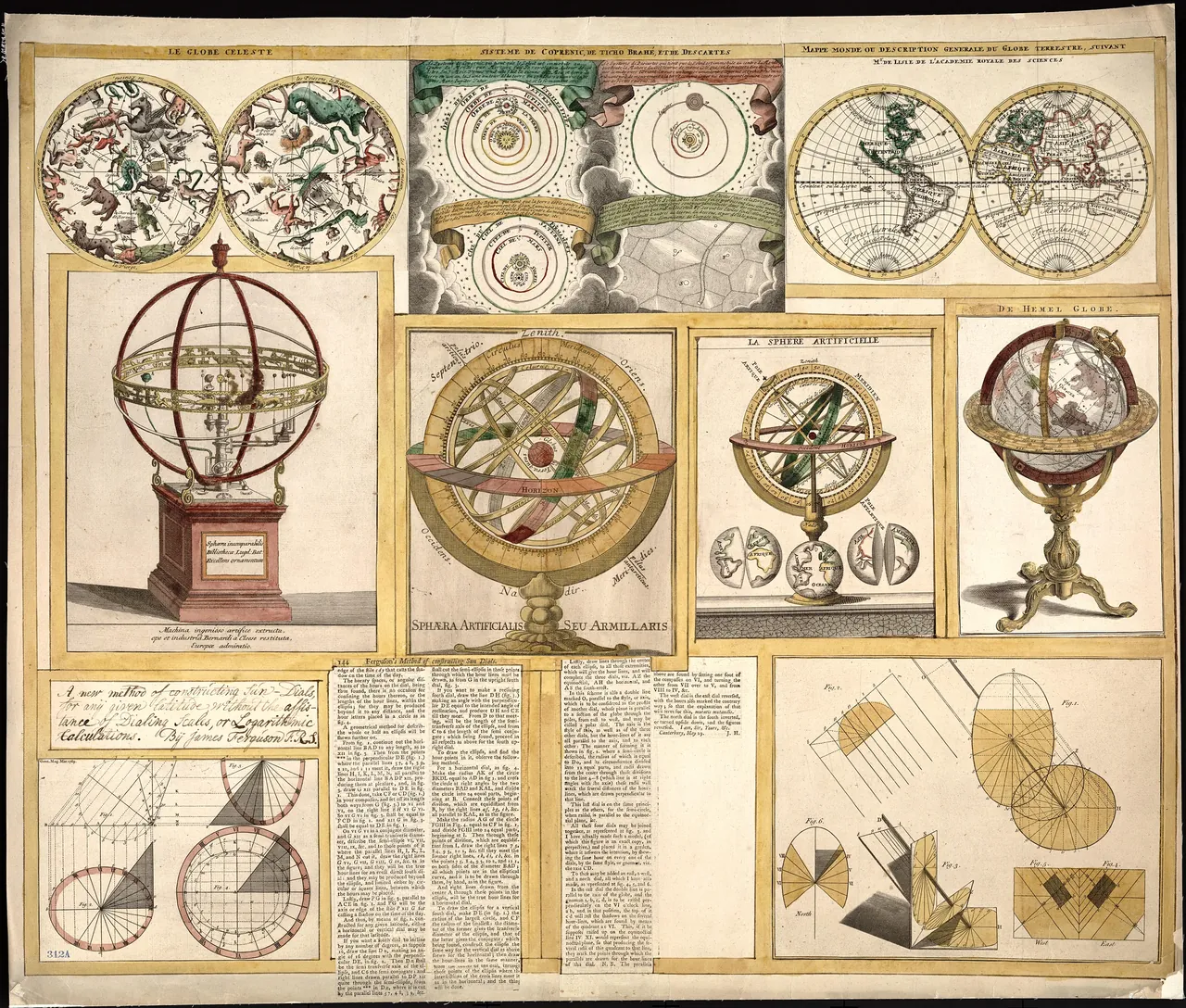
A 1769 sheet of nine images gathering astronomical instruments, celestial charts and a world map, the ordered heavens that this part sets forth as creation's witness.[Collection of nine images including astronomical instruments, celestial charts, and a world map] · 1769 · Library of Congress · Public domain · museum record · Galeria Regni
“The heavens declare the glory of God; and the firmament sheweth his handywork.” (Psalm 19:1)
“Lift up your eyes on high, and behold who hath created these things, that bringeth out their host by number: he calleth them all by names by the greatness of his might, for that he is strong in power; not one faileth.” (Isaiah 40:26)
Paul makes the point in the most important passage on this subject in the New Testament:
“Because that which may be known of God is manifest in them; for God hath shewed it unto them. For the invisible things of him from the creation of the world are clearly seen, being understood by the things that are made, even his eternal power and Godhead; so that they are without excuse:” (Romans 1:19-20)
Notice what Paul claims and what he does not. He does not say that everyone can reason his way to the Trinity or the cross from the night sky. He says that two things — God's "eternal power and Godhead" — are "clearly seen, being understood by the things that are made". The evidence is public. It is "understood", that is, grasped by the mind. And it leaves people "without excuse". The problem Paul names in the next verse is not a lack of evidence but a refusal to honour what is known: “when they knew God, they glorified him not as God, neither were thankful; but became vain in their imaginations” (Romans 1:21).
Paul reasoned
The apostles did not only announce; they argued. In Thessalonica, “Paul, as his manner was, went in unto them, and three sabbath days reasoned with them out of the scriptures” (Acts 17:2). In Lystra, speaking to pagans who had no Bible, he pointed to the world around them: “Nevertheless he left not himself without witness, in that he did good, and gave us rain from heaven, and fruitful seasons, filling our hearts with food and gladness” (Acts 14:17).
And in Athens, standing before the philosophers of the Areopagus, he made an argument that begins exactly where the arguments of this paper begin — with the Creator of all things:
“God that made the world and all things therein, seeing that he is Lord of heaven and earth, dwelleth not in temples made with hands; Neither is worshipped with men’s hands, as though he needed any thing, seeing he giveth to all life, and breath, and all things;” (Acts 17:24-25)
He even quoted their own poets: “For in him we live, and move, and have our being; as certain also of your own poets have said, For we are also his offspring” (Acts 17:28). When the governor Festus shouted that he was mad, Paul answered, “I am not mad, most noble Festus; but speak forth the words of truth and soberness” (Acts 26:25). Christianity has always claimed to be true and sober, not merely moving.
Peter tells every believer to do the same, with a particular manner: “be ready always to give an answer to every man that asketh you a reason of the hope that is in you with meekness and fear” (1 Peter 3:15). The word "answer" there is a defence; the word "reason" is an account. The command is to have one, and to give it gently.
What arguments can and cannot do
The Christian thinkers whose arguments fill this paper were clear about the limits of their work.
Thomas Aquinas, who gave the most famous arguments of all, opened his great Summa by asking why revelation was needed if reason could discover God. His answer was that "the truth about God such as reason could discover, would only be known by a few, and that after a long time, and with the admixture of many errors".2 Reason can show that God is; it cannot, on its own, show what God has done to save us. For that, God must speak.
Augustine put the relationship between faith and understanding in a sentence that has been quoted for sixteen centuries. Preaching on the Lord's words “If any man will do his will, he shall know of the doctrine” (John 7:17), he said: "For understanding is the reward of faith. Therefore do not seek to understand in order to believe, but believe that you may understand".3 Anselm of Canterbury, whose argument is the subject of Part 5, prayed the same thing before he made it: "For I do not seek to understand that I may believe, but I believe in order to understand".4
None of these men thought arguments could replace faith. They thought arguments could clear away obstacles, show that faith is not foolish, and strengthen the believer when doubts come. Scripture is clear that a person comes to God by trusting Him: “But without faith it is impossible to please him: for he that cometh to God must believe that he is, and that he is a rewarder of them that diligently seek him” (Hebrews 11:6). Notice the first thing faith believes: "that he is". The arguments of this paper speak to exactly that first step. They cannot take the second step for you — believing that He rewards those who seek Him — but they can show you that the first step is not a leap in the dark.
The heart as well as the head
One more thing must be said before we begin. Arguments are addressed to the mind, but people do not decide about God with the mind alone. Jesus said, “And this is the condemnation, that light is come into the world, and men loved darkness rather than light, because their deeds were evil” (John 3:19). There are reasons people want there to be no God, and they are not always intellectual reasons.
That cuts both ways. A believer can also want God to exist for reasons that have nothing to do with evidence. The honest course for both is the one Scripture commends in the Bereans, who “received the word with all readiness of mind, and searched the scriptures daily, whether those things were so” (Acts 17:11), and in Paul's charge: “Prove all things; hold fast that which is good” (1 Thessalonians 5:21). So let us prove these things.
Part 2 — The First Cause: Aquinas and the Kalam Argument
9 min read
This chapter matters because the oldest question anyone asks about the universe is where it came from. The first family of arguments for God starts there.
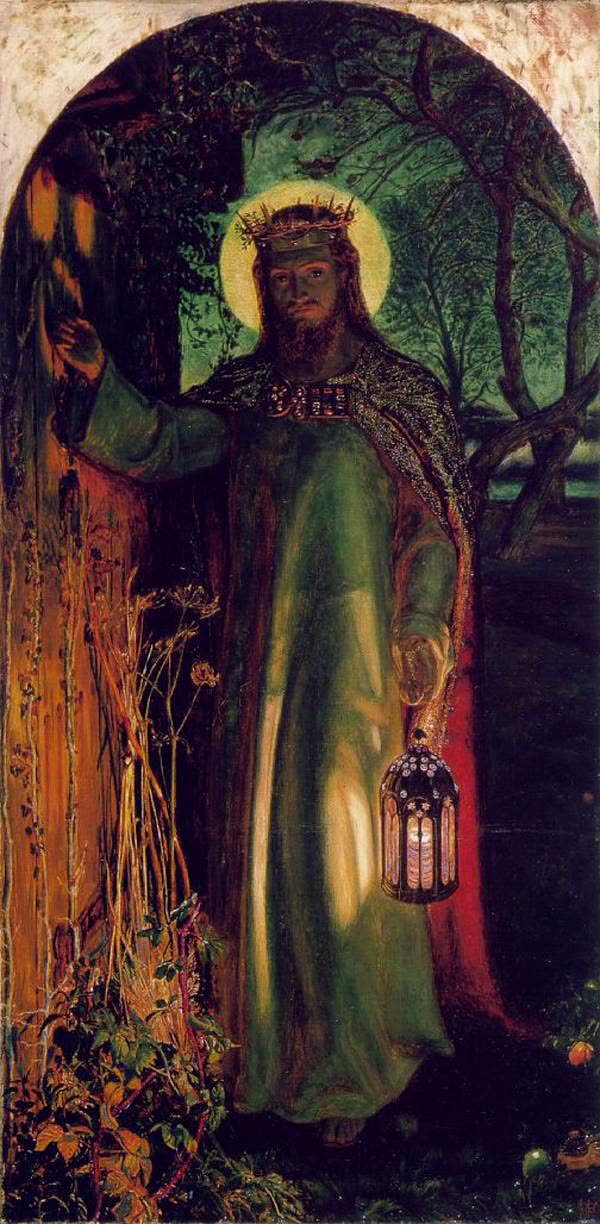
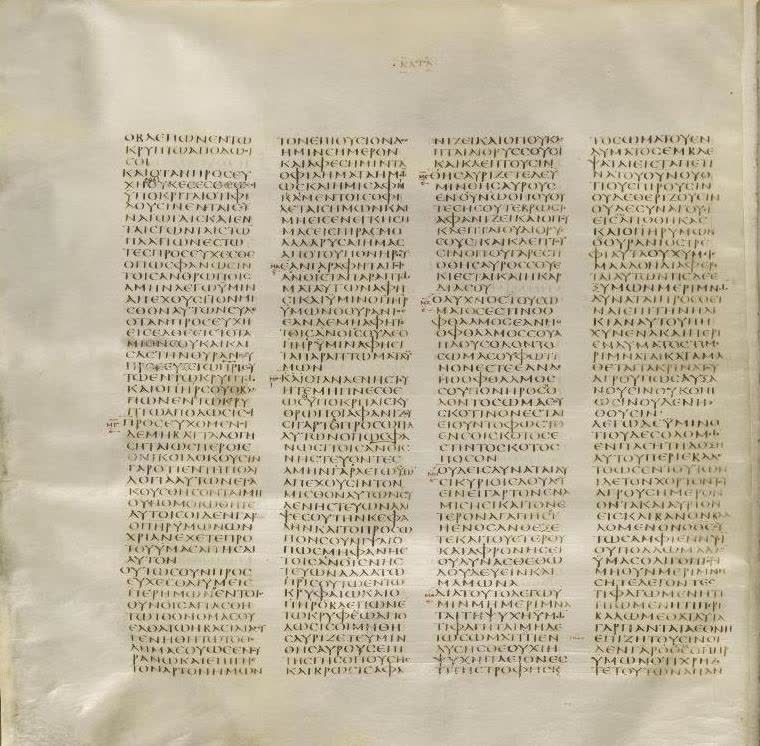
William Holman Hunt’s The Light of the World (1853) — Christ knocking at a door with no outside handle; it only opens from within.William Holman Hunt, 1853 · Public domainA page of Codex Sinaiticus (4th century AD), the oldest complete Greek New Testament — hand-copied within three centuries of the events it records.Unknown scribe, 4th century · Public domain
Aquinas's first two ways
Thomas Aquinas (about 1225–1274) gave five short arguments for God in a single article of his Summa Theologiae. The first is from motion — by which he meant any change, any passing from what something could be to what it actually is. His reasoning runs like this: whatever changes is changed by something else; that something, if it too is being changed, is changed by another; but this cannot go on to infinity, "because then there would be no first mover, and, consequently, no other mover; seeing that subsequent movers move only inasmuch as they are put in motion by the first mover; as the staff moves only because it is put in motion by the hand. Therefore it is necessary to arrive at a first mover, put in motion by no other; and this everyone understands to be God".5
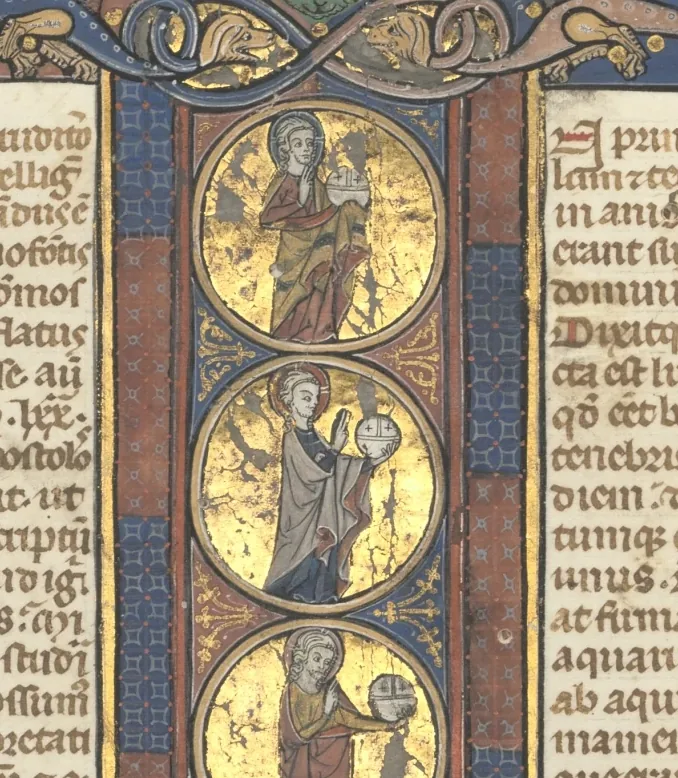
The opening page of Genesis in a thirteenth-century Bible from southern France, its tall initial picturing the Creation, the beginning on which the kalam argument turns.Fol. 1r, Genesis, with a full-length historiated initial I, showing the Creation and the Crucifixion, all on burnished gold grounds, with diapered pink and blue frames and cusped dragon and foliage extensions at top and bottom, on which are perched a vari · c. 1275–1300 · Cleveland Museum of Art · CC0 · full page · museum record · Galeria Regni
The second way runs the same pattern through causes: "There is no case known (neither is it, indeed, possible) in which a thing is found to be the efficient cause of itself; for so it would be prior to itself, which is impossible." And again the chain cannot be infinite, for "to take away the cause is to take away the effect". So "it is necessary to admit a first efficient cause, to which everyone gives the name of God".6
A common misunderstanding
These arguments are often misread, and the misreading is worth clearing up, because it is the basis of the most popular objection.
Aquinas is not mainly arguing about the distant past. He is not saying, "Your grandfather caused your father, who caused you, so there must be a first grandfather." In fact Aquinas did not think philosophy alone could prove the world had a beginning in time. He wrote: "By faith alone do we hold, and by no demonstration can it be proved, that the world did not always exist".7 He believed the beginning because Genesis teaches it, and he warned against weak arguments for it, "lest anyone, presuming to demonstrate what is of faith, should bring forward reasons that are not cogent, so as to give occasion to unbelievers to laugh".7 (Later in this chapter we will meet thinkers who disagree with him on that point.) His chains are chains of things acting now. His own example shows it: the staff moves the stone only while the hand moves the staff. Take away the hand and the whole chain stops at once. Philosophers call this a series ordered per se — a chain in which each link has its power only on loan from the one before it, at this very moment.
In a chain like that, an infinite series does not help. A thousand staffs, or an infinite number of them, each moved only because the one before moves it, never move at all unless something moves them that is not itself being moved. A train of boxcars does not run because it is very long. It runs because there is an engine.
That is what Aquinas means by a first mover. Not first in a queue, but first in power: a source of being and action that does not receive its being and action from anything else. Scripture says the same thing of Christ: “he is before all things, and by him all things consist” (Colossians 1:17), and He is “upholding all things by the word of his power” (Hebrews 1:3).
Dawkins's objection
Richard Dawkins gives Aquinas's first three ways a few paragraphs in The God Delusion, where he says they "don't prove anything, and are easily — though I hesitate to say so, given his eminence — exposed as vacuous". His main complaint is this:
All three of these arguments rely upon the idea of a regress and invoke God to terminate it. They make the entirely unwarranted assumption that God himself is immune to the regress.8
He adds that even if we grant a "terminator" to the regress, "there is absolutely no reason to endow that terminator with any of the properties normally ascribed to God".8
This deserves a fair answer, not a dismissal. The answer is that the arguments do not assume God is "immune" to their premises; they draw a distinction that the premises themselves require. The first way is not "everything has a mover". It is "whatever is being changed is changed by another". The second is not "everything has a cause". It is that nothing causes itself and that a chain of dependent causes needs something that is not dependent. The conclusion is a being that is not changed and not caused — not as a special exemption, but because that is precisely what the chain requires. To ask "what moves the unmoved mover?" is like asking what colour a number is. The question assumes what the argument denies.
Dawkins's second point, that a first cause need not have the attributes of God, is fairer. On its own, a first cause does not tell us everything. But Aquinas did not leave it there; the following questions of the Summa argue at length that such a being must be simple, perfect, good, infinite and one. Whether you accept those arguments or not, the charge that he simply "gave it a name" is not accurate. And, as this paper argues, the first-cause argument is one of several; the others add what it lacks.
The kalam argument
The second form of the first-cause argument is about the past. It was developed by medieval Islamic and Christian thinkers — the Persian theologian al-Ghazali (died 1111) is its most famous early champion — and revived in our time by the philosopher William Lane Craig, who gave it its modern name in The Kalam Cosmological Argument (1979). ("Kalam" is the Arabic word for the medieval tradition of philosophical theology.) Craig states it in three lines:
1. Whatever begins to exist has a cause of its beginning. 2. The universe began to exist. 3. Therefore, the universe has a cause of its beginning.9
The logic is valid. The question is whether the two premises are true.
Premise one: whatever begins has a cause
Almost everyone believes the first premise in daily life. If you heard a loud bang in the next room, you would not accept the explanation that nothing caused it. If a horse appeared in your living room, you would want to know how it got there. The principle that being does not come from sheer non-being is so basic that science assumes it at every step; a scientist who found an unexplained effect would look for a cause, not announce that there was none.
Some object that quantum physics shows things popping into existence uncaused. But the events physicists describe happen within a quantum vacuum — a field with structure, energy and laws. That is not nothing. It is a very rich something. Whatever the right interpretation of quantum theory, it does not show being arising from no being at all. The ancient maxim stands: out of nothing, nothing comes.
Premise two: the universe began
The second premise is supported by two kinds of argument: one from philosophy and one from physics.
The philosophical argument
The philosophical case asks whether the past could be infinite — whether an actually infinite number of past days could have gone by. Craig illustrates the difficulty with a thought experiment associated with the mathematician David Hilbert: a hotel with infinitely many rooms, all full, which can nevertheless take in infinitely many new guests by moving each guest to a room with double his number.9 In mathematics, infinite sets behave this way without contradiction. The question is whether such a thing could exist in reality — and if an actual infinite of things cannot exist, then an actual infinite of past events cannot either.
A related argument is that you cannot complete an infinite series by adding one member after another. If the past were truly beginningless, then to arrive at today the universe would have had to cross an infinite number of days, one at a time. But an infinite number of days, crossed one at a time, is never finished. Yet here we are.
Philosophers disagree about these arguments; some think the paradoxes of the infinite are only strange, not impossible. Aquinas himself, as we saw, did not think the beginning of the world could be demonstrated this way. But they are serious arguments that have been defended in major academic publications, not tricks.
The scientific evidence
The scientific case comes from cosmology. Through the twentieth century, astronomers discovered that the universe is expanding. Run that expansion backwards, and the universe was once far denser and hotter — the picture now called the Big Bang. (It was first proposed in 1927 by Georges Lemaître, a Belgian physicist who was also a Catholic priest.)
More recently, in 2003, the physicists Arvind Borde, Alan Guth and Alexander Vilenkin published a theorem showing that any universe which has, on average, been expanding throughout its history cannot be infinite in the past; its history must have a boundary.10 Vilenkin put the result bluntly in his book Many Worlds in One:
It is said that an argument is what convinces reasonable men and a proof is what it takes to convince even an unreasonable man. With the proof now in place, cosmologists can no longer hide behind the possibility of a past-eternal universe. There is no escape, they have to face the problem of a cosmic beginning.11
In fairness, three cautions must be added.
First, Vilenkin himself does not draw a theistic conclusion. In the same book he calls the view that a cosmic beginning points to God "far too simplistic", and he proposes instead that physics may one day explain the universe's origin.11
Second, the theorem has limits. It applies to universes that have been expanding on average, and it describes space-time classically, as general relativity does. Some physicists have proposed models that try to escape it; a 2024 paper by Damien Easson and Joseph Lesnefsky, for example, argues that the theorem is often read too broadly and constructs models of eternal inflation without a past boundary, though those models require unusual physics.12 Physics does not stand still, and a Christian should never rest his faith on the latest model.
Third — and this matters for how Christians use the argument — this paper makes no claim about the age of the universe or the earth. The kalam argument needs only one thing from science: that the universe had a beginning. It does not need, and this paper does not defend, any particular date for it. What the Bible teaches about creation stands on the Bible: “In the beginning God created the heaven and the earth” (Genesis 1:1), and “Through faith we understand that the worlds were framed by the word of God, so that things which are seen were not made of things which do appear” (Hebrews 11:3).
That last verse is striking in this context. The writer to the Hebrews, long before any telescope, says the visible world was not made from visible things. The kalam argument reaches, by a different road, the same place.
What kind of cause?
Suppose the argument succeeds and the universe has a cause. What can we know about it?
| If the cause is... | ...because | | --- | --- | | beyond space and time | it brought space and time into being, so it cannot be one more thing inside them | | not made of matter | it brought matter into being | | enormously powerful | it brought a universe into being | | uncaused | otherwise we have not reached the first cause, only another link | | personal | a timeless, unchanging cause that produces a first effect in time is best explained by a free choice to act |
The last line needs a word. If the cause of the universe were a set of timeless conditions that automatically produce their effect, it is hard to see why the effect would not be just as timeless as its cause. Water freezes when the temperature is below zero; if the temperature had always been below zero, the water would always have been frozen. What explains a first event from a changeless cause is a free agent who chooses to act. This is the step Craig puts most weight on, and it is the step that turns "a cause" into "a Creator".
That still is not the full God of the Bible. It is not yet the Father of our Lord Jesus Christ. But it is a long way from atheism, and it fits Scripture exactly: “Thou art worthy, O Lord, to receive glory and honour and power: for thou hast created all things, and for thy pleasure they are and were created” (Revelation 4:11).
Part 3 — Why Anything at All? Leibniz and the Argument from Contingency
5 min read
This chapter matters because even if the universe had no beginning, a deeper question would remain. It is perhaps the deepest question a human being can ask.
The question
The German philosopher Gottfried Wilhelm Leibniz (1646–1716) — co-inventor of the calculus — put it this way in 1714, in a short work called Principles of Nature and Grace:
Given that principle, the first question we can fairly ask is: Why is there something rather than nothing? After all, nothing is simpler and easier than something. Also, given that things have to exist, we must be able to give a reason why they have to exist as they are and not otherwise.13
The "principle" he refers to is what he called the principle of sufficient reason: that "nothing comes about without a sufficient reason".13 Every fact has an explanation, either in the necessity of its own nature or in something outside it.
The argument
From that question Leibniz builds an argument that can be put in plain steps:
1. Everything that exists has an explanation of its existence — either in the necessity of its own nature, or in an external cause. 2. The things we see around us — stars, atoms, people — do not exist by a necessity of their own nature. They could have failed to exist. Philosophers call them contingent. 3. The whole collection of contingent things — the universe — is therefore itself something that needs an explanation. 4. That explanation cannot be one more contingent thing, for it would belong to the very collection we are trying to explain. 5. So the explanation must lie in a being that exists by the necessity of its own nature — a necessary being.
Leibniz states his conclusion this way: the sufficient reason "must lie outside the series of contingent things, and must be found in a substance which is the cause of the entire series. It must be something that exists necessarily, carrying the reason for its existence within itself... And that ultimate reason for things is what we call 'God'".14
Notice that this argument does not depend on the universe having a beginning. Leibniz is quite willing to imagine that "any matter that is moving now does so because of a previous motion, and that in turn from a still earlier one; and we can take this back as far as we like — it won't get us anywhere, because the same question — the question Why? — will still remain".14 Even an endless chain of contingent things needs an explanation for why there is any chain at all.
Aquinas's third way makes a closely related argument: "we cannot but postulate the existence of some being having of itself its own necessity, and not receiving it from another, but rather causing in others their necessity. This all men speak of as God".15
Scripture's name for God fits this conclusion closely. When Moses asked God His name, He answered, “I AM THAT I AM” (Exodus 3:14). Everything else that exists has its being from another. God simply is. He says through Malachi, “For I am the LORD, I change not” (Malachi 3:6), and the psalmist says, “from everlasting to everlasting, thou art God” (Psalm 90:2).
Objection: the universe is just a brute fact
The most common answer to Leibniz is to deny his first premise: perhaps the universe simply exists, with no explanation at all. It is a brute fact, and that is all.
This answer has the merit of honesty. It concedes that the atheist has no explanation for why anything exists. But it has a cost. We do not accept brute facts anywhere else. If you found a glowing sphere in the woods and asked a friend how it got there, you would not be satisfied with "It just is." And it would not help to say the sphere was the size of a car, or a city, or the universe; making the thing bigger does not make its existence self-explaining. To stop asking "why?" at the one point where the question is largest looks less like reason than like a refusal to follow it.
Objection: the whole is just the parts
David Hume raised a sharper objection in his Dialogues Concerning Natural Religion, published after his death in 1779. If we explain each member of a collection, he argued, we have explained the collection:
Did I show you the particular causes of each individual in a collection of twenty particles of matter, I should think it very unreasonable, should you afterwards ask me, what was the cause of the whole twenty. This is sufficiently explained in explaining the cause of the parts.16
This is a real point, and there are cases where it is right. But it does not work for Leibniz's question. In Hume's example, each particle is explained by something outside the collection — some earlier cause. In Leibniz's question, the collection is everything contingent. If each contingent thing is explained only by another contingent thing inside the collection, we still have no explanation for why there is a collection of contingent things at all, rather than none. Leibniz's own illustration makes the point: imagine a book on geometry that has always existed, each copy made from an earlier one. You can explain each copy by the one before it, and never explain why the book exists or why it says what it says.
Objection: why not a necessary universe?
A last objection says: if something must exist necessarily, why not the universe itself? Why not matter, or energy, or the laws of physics?
The answer is that nothing we know about the universe suggests it exists by necessity. Its matter could have been arranged differently; its laws could have been different (as Part 4 shows, physicists routinely calculate what would happen if they were); every part of it is limited, changing and dependent. A necessary being, by contrast, would have to be something whose very nature is to exist, without limit or dependence. That description does not fit atoms and fields. It fits what Paul told the Athenians: “seeing he giveth to all life, and breath, and all things” (Acts 17:25), while needing nothing Himself.
How strong is it?
The argument from contingency is, in the judgment of many philosophers on both sides, among the most powerful arguments for God, because it does not depend on any particular scientific finding. Its weight rests on the principle of sufficient reason. If you hold that some things simply happen for no reason at all, the argument will not move you. But it is worth asking whether anyone actually lives as if that were true — whether a scientist, a detective or a judge could do his work for a single day if he thought that things might simply happen without explanation.
Part 4 — Design: From Paley's Watch to a Finely Tuned Universe
10 min read
This chapter matters because the design argument is the one most people feel before they can put it into words. It is also the one most often declared dead, and it is worth asking whether it is.
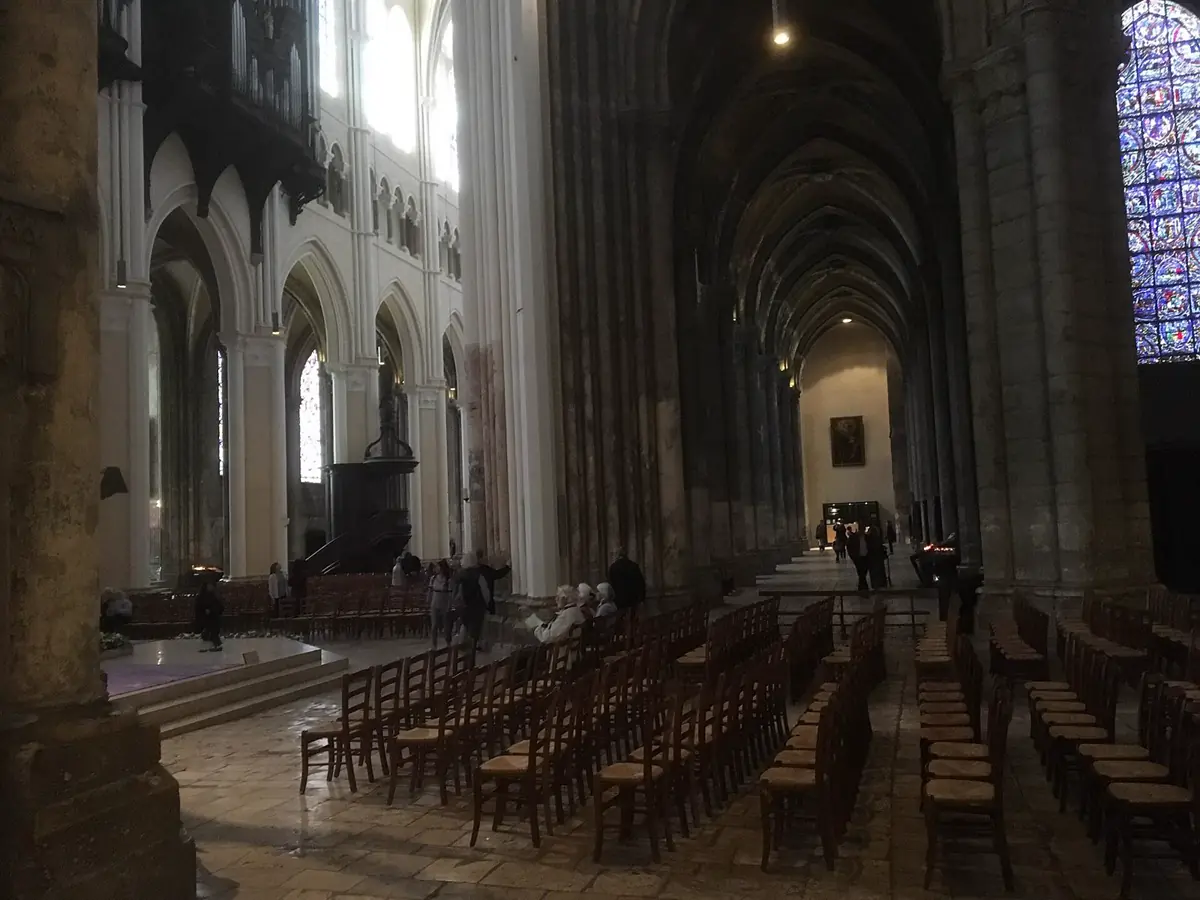
The nave of Chartres Cathedral (13th century) — built across generations by workers who knew they would never see it finished.Stephen Taber · CC BY-SA 4.0
Paley's watch
The classic statement is from William Paley, an English clergyman, in the opening paragraph of his Natural Theology (1802):
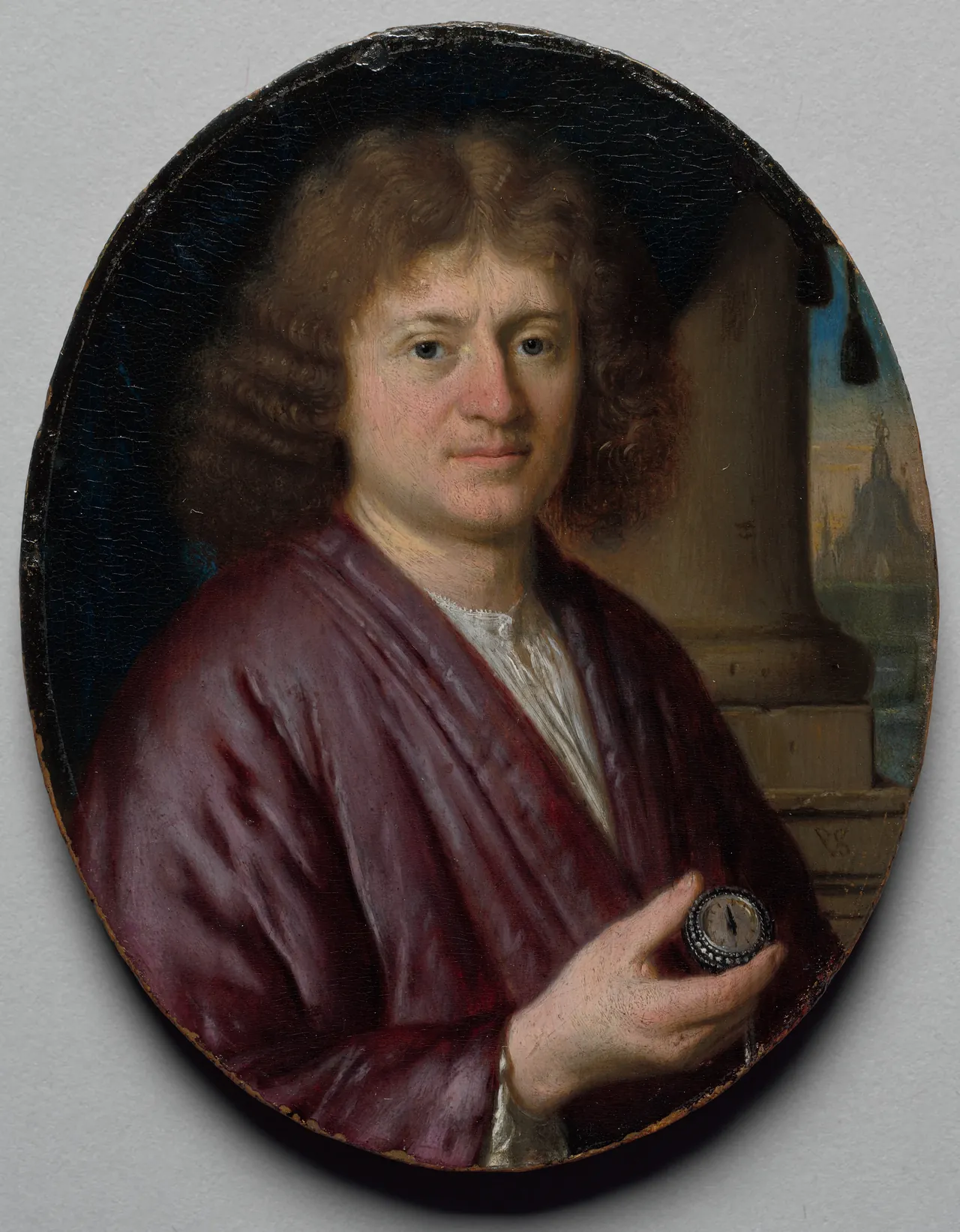
A Dutch oil portrait of about 1665 to 1670 of a man holding a watch, the kind of crafted mechanism Paley later made the emblem of design.Portrait of a Man Holding a Watch · c. 1665–70 · Cleveland Museum of Art · CC0 · museum record · Galeria Regni
In crossing a heath, suppose I pitched my foot against a stone, and were asked how the stone came to be there, I might possibly answer, that, for any thing I knew to the contrary, it had lain there forever: nor would it perhaps be very easy to shew the absurdity of this answer. But suppose I had found a watch upon the ground, and it should be inquired how the watch happened to be in that place, I should hardly think of the answer which I had before given...17
Why the difference? Because "when we come to inspect the watch, we perceive (what we could not discover in the stone) that its several parts are framed and put together for a purpose". And so, Paley says, "the inference, we think, is inevitable; that the watch must have had a maker".17
Paley went on to spend hundreds of pages on the eye, the joints, the wings of birds and the bodies of insects, arguing that living things show the same marks of purpose.
Scripture makes the same appeal in its own way. “I will praise thee; for I am fearfully and wonderfully made: marvellous are thy works; and that my soul knoweth right well” (Psalm 139:14). And God says through Isaiah that He “formed the earth and made it; he hath established it, he created it not in vain, he formed it to be inhabited” (Isaiah 45:18).
Hume's objections
Before Paley ever wrote, David Hume had raised objections to arguments like his. In the Dialogues, the skeptic Philo argues that if we reason from the world to its maker the way we reason from a house to its builder, we can conclude very little about the maker. Perhaps there were many makers. Perhaps the world, "for aught he knows, is very faulty and imperfect, compared to a superior standard; and was only the first rude essay of some infant deity, who afterwards abandoned it, ashamed of his lame performance".18
This is a fair point against a design argument that tries to prove everything at once. A design argument, on its own, shows a designer: intelligence and purpose behind the world. It does not on its own show that the designer is one, or good, or the God of Abraham. That is why design is one strand of a cumulative case and not the whole of it. But notice what Hume's objection concedes: it is an argument about what kind of designer, not about whether there is one.
Darwin, Dawkins and the "crane"
The objection most people have heard is different. It says that Charles Darwin's theory of natural selection explained the appearance of design in living things without a designer, and so Paley's argument is finished.
Richard Dawkins makes the case in The God Delusion, and it is worth hearing in his own words. He argues that "the designer hypothesis immediately raises the larger problem of who designed the designer", and that what is needed is "a 'crane', not a 'skyhook'" — a process that builds complexity gradually from simplicity. In biology, he says, natural selection is that crane. Then he adds something many readers miss:
We don't yet have an equivalent crane for physics. Some kind of multiverse theory could in principle do for physics the same explanatory work as Darwinism does for biology. This kind of explanation is superficially less satisfying than the biological version of Darwinism, because it makes heavier demands on luck ...19
This paper does not argue the biology here. I hold that Genesis is a true record: six real days of creation, a real Adam and Eve, a real Fall, and a global Flood. I make no claim about the age of the earth. The questions about living things deserve their own study. What matters for this chapter is Dawkins's own admission. Even granting everything he says about biology, there is no "crane" for physics. The design argument in its strongest modern form is not about eyes and wings at all. It is about the laws and constants of physics themselves — the stage on which any biological process would have to happen.
The fine-tuning of physics
In the second half of the twentieth century, physicists began to notice something unexpected. The basic laws of physics contain a number of quantities — the strengths of the forces, the masses of particles, the energy of empty space, the conditions at the beginning — that are not fixed by the laws themselves. They could, as far as the theory goes, have had other values. And when physicists calculated what would happen if they had, they found that in the overwhelming majority of cases, nothing like life could exist: no stable atoms, no stars that burn for billions of years, no chemistry.
This is what is meant by "fine-tuning". The astronomer Luke Barnes wrote a long review of the scientific literature on it in 2012, and he summarises the claim this way: "in the space of possible physical laws, parameters and initial conditions, the set that permits the evolution of intelligent life is very small". He notes that the fact of fine-tuning is accepted by a long list of leading physicists and cosmologists, Christian and atheist alike, including Richard Dawkins; they differ about what to conclude from it.20
Here are three examples, given with their sources and their caveats.
The energy of empty space
Quantum field theory, one of the best-tested theories in science, predicts that empty space should carry an enormous energy, which would act on the universe like the cosmological constant in Einstein's equations. Barnes writes that the theory "predicts contributions to the vacuum energy of the universe that are ~10^120 times greater than the observed total value".21 Had the actual value been anywhere near that size, the universe would have either crushed itself or blown apart too fast for any galaxy, star or planet to form. A textbook he quotes calls this "arguably the most severe theoretical problem in high-energy physics today".21 Something cancels those enormous contributions to an astonishing degree. Physicists do not know what.
The carbon in your body
The carbon and oxygen that life needs are made inside stars. In the 1950s the astronomer Fred Hoyle predicted that stars could only make carbon in abundance if the carbon nucleus had an energy level at a very particular place — and experiment then found it there. Later calculations by Heinz Oberhummer and colleagues concluded: "Even with a change of 0.4% in the strength of [nucleon-nucleon] force, carbon-based life appears to be impossible, since all the stars then would produce either almost solely carbon or oxygen, but could not produce both elements." Barnes adds, fairly, that later work by the same group suggested the degree of tuning may be somewhat less once later stages of a star's life are modelled.22
Hoyle himself was no Christian. But the discovery shook him. In 1981 he wrote:
A common sense interpretation of the facts suggests that a superintellect has monkeyed with physics, as well as with chemistry and biology, and that there are no blind forces worth speaking about in nature. The numbers one calculates from the facts seem to me so overwhelming as to put this conclusion almost beyond question.23
The order at the beginning
The mathematical physicist Roger Penrose has argued that the early universe began in an extraordinarily ordered, low-entropy state — the kind of state that makes the later growth of stars and galaxies possible — and that a state so special is, by the measure of the possible arrangements, unimaginably improbable. Penrose expresses the improbability with a number so large that it is written as ten raised to the power of ten raised to the power of 123.24 Penrose is not a theist, and his own proposed explanations are not God. But the problem he identified is real, and Barnes calls it, against those who wave it away, "the entropy problem" that homogeneous expansion cannot solve, since it "is the entropy problem".24
A note of care about numbers
Popular books sometimes pile up fine-tuning figures as if each were settled to the decimal place. Christians should not do that. Some older claims have been revised; some depend on which quantities are allowed to vary together; and Barnes himself, after defending the fact of fine-tuning in detail, says plainly: "I do not attempt to defend any conclusion based on the fine-tuning of the universe for intelligent life".20 What the scientific literature supports is the general claim — that life-permitting universes are a very small target among the possibilities physics describes — not every number in every sermon. The argument does not need more than that.
The argument
Put simply, the fine-tuning argument says:
1. The fine-tuning of the universe for life is due to physical necessity, to chance, or to design. 2. It is not plausibly due to physical necessity or to chance. 3. Therefore it is due to design.
Physical necessity would mean the constants could not have been otherwise. But nothing in current physics suggests that; the constants appear to be free, and physicists calculate the consequences of changing them all the time. If a deeper theory is found that fixes them, the question simply moves back a step: why is the deeper theory one that produces a life-permitting universe?
Chance is the main rival, and its most serious form is the multiverse.
The multiverse
If there are a vast number of universes, each with different constants, then perhaps it is no surprise that at least one is fit for life — and of course we find ourselves in that one, since we could not exist anywhere else. This is the idea Dawkins was reaching for when he wrote of a possible "crane" for physics.
Three things can be said about it fairly.
First, it is not a crazy idea; serious physicists hold versions of it, often because certain theories of the early universe seem to produce many regions with different properties. Barnes reports that some leading physicists have come to favour the multiverse precisely because they judged that every other explanation of the cosmological constant had failed.21
Second, it is not observed, and may be unobservable in principle. Other universes, if they exist, are by definition beyond our sight. That does not make the idea false, but it means the multiverse is no more "scientific" in the sense of being testable than design is.
Third, it faces problems of its own. Any mechanism that produces many universes needs laws and conditions of its own, and those may need to be fine-tuned in turn. And Penrose has raised a pointed difficulty: if our universe is just a random member of a vast ensemble, then observers like us should far more often find themselves in a much smaller, much less orderly universe than the one we see, since such universes would be vastly more common. Barnes describes this as a serious problem for most multiverse proposals.25
The believer does not need to deny that there could be other universes. God could make as many as He pleased. The question is whether a multiverse removes the need for a Maker. It does not seem to; it only enlarges the workshop.
"Who designed the designer?"
Dawkins regards his question "who designed the designer?" as the decisive answer to every design argument. A designer complex enough to design a universe, he argues, would be even more improbable than the universe, and so explains nothing.
There are two answers.
The first is that we do not need an explanation of the explanation in order to recognise that it is the best one. If archaeologists dug up arrowheads on a distant planet, they would be right to conclude that intelligent beings made them, even if they had no idea who those beings were or where they came from. Demanding an explanation of every explanation before accepting any would end all science.
The second is that the God of the classical arguments is not a complicated physical machine that needs assembling. As Parts 2 and 3 showed, the arguments point to a being that is uncaused and necessary: not one more improbable thing in the universe, but the reason there is a universe. Dawkins's argument treats God as if He were a very large and complicated creature. That is not the God of Aquinas, of Leibniz, or of the Bible, who says, “Before the mountains were brought forth, or ever thou hadst formed the earth and the world, even from everlasting to everlasting, thou art God” (Psalm 90:2).
How strong is it?
The fine-tuning argument is, in my judgment, the strongest form of the design argument, and one of the most striking pieces of evidence for God available to anyone today. It is not a gap in knowledge that God is being used to fill; it is a discovery of physics that has grown clearer, not weaker, as physics has advanced. It does not prove the God of the Bible on its own, and it must be stated with honest numbers. But when the psalmist says “The heavens declare the glory of God” (Psalm 19:1), the physics of the last century has given that sentence a depth he could not have imagined.
Part 5 — The Greatest Conceivable Being: The Ontological Argument
5 min read
This chapter matters because the ontological argument is the most puzzling argument in philosophy — and because, whatever one makes of it as a proof, it teaches us what we mean when we say "God".
Anselm's prayer
Anselm (1033–1109), an Italian monk who became Archbishop of Canterbury, wrote his argument as a prayer. He begins with the psalm: “The fool hath said in his heart, There is no God” (Psalm 14:1). How, Anselm asks, can even the fool say this?
And indeed, we believe that you are a being than which nothing greater can be conceived. Or is there no such nature, since the fool has said in his heart, there is no God? (Psalms xiv. 1). But, at any rate, this very fool, when he hears of this being of which I speak — a being than which nothing greater can be conceived — understands what he hears, and what he understands is in his understanding; although he does not understand it to exist.26
Anselm then argues that this being cannot exist in the understanding alone:
And assuredly that, than which nothing greater can be conceived, cannot exist in the understanding alone. For, suppose it exists in the understanding alone: then it can be conceived to exist in reality; which is greater.26
So to suppose that the greatest conceivable being exists only in the mind is to suppose that something greater than it can be conceived — which contradicts what we said it was. Therefore, he concludes, it exists "both in the understanding and in reality".26
In his third chapter Anselm goes further. A being that cannot even be conceived not to exist is greater than one that can. So God "cannot even be conceived not to exist; and this being you are, O Lord, our God".27
Gaunilo's island
The first critic was Anselm's contemporary Gaunilo, a monk of Marmoutier, who wrote a reply "in behalf of the fool". He asked us to imagine an island more excellent than all other lands, called the Lost Island, and to suppose someone argued that it must exist, since an existing island is more excellent than an imaginary one. "If a man should try to prove to me by such reasoning that this island truly exists," Gaunilo wrote, "either I should believe that he was jesting, or I know not which I ought to regard as the greater fool: myself, supposing that I should allow this proof; or him".28
Anselm replied — and Anselm's own reply was included with his book at his request — that his reasoning applies only to the one being than which nothing greater can be conceived, not to islands. An island, however excellent, is a limited thing; you can always conceive of one with one more palm tree. There is no "greatest possible island", because the qualities that make an island excellent have no upper limit. But the qualities that make God great — power, knowledge, goodness — do have a maximum: all power, all knowledge, perfect goodness. The parody does not carry over.
Kant: existence is not a property
The most famous objection came from the German philosopher Immanuel Kant in his Critique of Pure Reason (1781). Kant argued that the argument treats existence as one more quality that a thing can have or lack, like being red or round. But it is not:
Being is evidently not a real predicate, that is, a conception of something which is added to the conception of some other thing. It is merely the positing of a thing, or of certain determinations in it.29
When I say "God exists", Kant argues, I am not adding something to the idea of God; I am saying that the idea has something real corresponding to it. So you cannot get existence out of an idea by analysing the idea.
Many philosophers think Kant's objection decisive against Anselm's first version. Others think it misses Anselm's second chapter, which is not about existence as a property but about necessary existence — the kind of existence that cannot fail.
Plantinga's modal argument
In the twentieth century the argument was reformulated, most influentially by the American philosopher Alvin Plantinga in The Nature of Necessity (1974), using the logic of possibility and necessity. Plantinga defines a maximally great being as one that exists necessarily and is essentially all-powerful, all-knowing and morally perfect.30 The argument then runs, in simplified form:
1. It is possible that a maximally great being exists. 2. If it is possible that a maximally great being exists, then a maximally great being exists in some possible world. 3. But a maximally great being, by definition, exists necessarily — that is, in every possible world — if it exists in any. 4. So a maximally great being exists in every possible world, including the actual one.
The logic is valid in the standard system of modal logic philosophers call S5.30 Everything therefore turns on premise 1. If the idea of a maximally great being is coherent — if there is no hidden contradiction in it — then such a being exists.
The honest assessment
Here it is important to be fair. Critics reply that one can just as easily say, "It is possible that no maximally great being exists", and run the argument backwards to the conclusion that such a being is impossible. Which premise is more plausible? That is exactly what believers and unbelievers disagree about, and the argument by itself cannot settle it.
Plantinga himself knew this. The Stanford Encyclopedia of Philosophy notes that in the cases of Plantinga and of the logician Kurt Gödel "it is unclear whether we should really say that these authors claim that the arguments are proofs of the existence of God".31 Plantinga's own claim was more modest: that the argument shows belief in God is rationally acceptable — that a person who finds premise 1 plausible is not being unreasonable in accepting the conclusion.
The Encyclopedia also records a remark by the atheist Bertrand Russell, that "it is much easier to be persuaded that ontological arguments are no good than it is to say exactly what is wrong with them".31 That is why the argument has fascinated philosophers for almost a thousand years.
And the philosopher of science Michael Ruse, himself an atheist, wrote that after reading Richard Dawkins's treatment of it in The God Delusion, "for the first time in my life, I felt sorry for the ontological argument".32
What the argument teaches
Even if you are not persuaded, the ontological argument teaches something every reader of the Bible should notice. It shows that the question of God is not like the question of whether there are moons around a distant planet. God, if He exists, is not one more thing that happens to exist. He is "that than which nothing greater can be conceived" — the One whose existence cannot fail. Either such a being is impossible, or He is necessary. There is no middle ground where God merely happens to exist or not.
That is the God of Scripture, who is not one being among many but the source of all: “I am the LORD; and there is none else” (Isaiah 45:18). It is also why the psalm Anselm quotes calls atheism folly rather than merely error. To say in one's heart that there is no God is not to miss one more fact about the world. It is to deny the ground of every fact.
Part 6 — The Moral Argument and the Argument from Reason
8 min read
This chapter matters because it is the argument closest to home. You do not need a telescope or a course in logic to feel it. You need only to have been wronged, and to know that it was wrong.
Lewis's discovery
C. S. Lewis, an Oxford scholar who had been an atheist through his young adult life, explained in Mere Christianity how this argument caught him:
My argument against God was that the universe seemed so cruel and unjust. But how had I got this idea of just and unjust? A man does not call a line crooked unless he has some idea of a straight line. What was I comparing this universe with when I called it unjust?33
He saw that he could give up his idea of justice by saying it was "nothing but a private idea of my own". But "if I did that, then my argument against God collapsed too — for the argument depended on saying that the world was really unjust, not simply that it did not happen to please my fancies".33
Lewis had begun the book with two observations: "First, that human beings, all over the earth, have this curious idea that they ought to behave in a certain way, and cannot really get rid of it. Secondly, that they do not in fact behave in that way."34
Paul said the same thing about people who never had the Bible: “For when the Gentiles, which have not the law, do by nature the things contained in the law, these, having not the law, are a law unto themselves: Which shew the work of the law written in their hearts, their conscience also bearing witness” (Romans 2:14-15).
The argument
The moral argument can be put simply:
1. If God does not exist, objective moral values and duties do not exist. 2. Objective moral values and duties do exist. 3. Therefore, God exists.
"Objective" here means true whether or not anyone believes it. To say that torturing a child for fun is objectively wrong is to say it would be wrong even if everyone on earth approved of it — even if the people who did it had won every war and re-educated everyone else to think it right.
Almost everyone believes premise 2 when it matters. We do not think the abolition of slavery was merely a change of fashion, like a change in hemlines. We think it was a correction — that those who opposed slavery were right and those who defended it were wrong, even when the defenders were the majority. Moral progress only makes sense if there is a standard to progress toward. As Lewis put it, a line can only be called crooked against a straight one.
The argument's weight therefore falls on premise 1. Is there any good foundation for objective moral values and duties if there is no God?
The atheist's dilemma, stated honestly
Some of the most candid atheists have agreed that there is not. Many others disagree, and they deserve to be heard. The most widely read of them is Sam Harris, who argued in The Moral Landscape (2010) that science can tell us what is right and wrong, because "meaning, values, morality, and the good life must relate to facts about the well-being of conscious creatures".35 He asks us to picture "the worst possible misery for everyone" and says: "If you think we cannot say this would be 'bad,' then I don't know what you could mean by the word 'bad' (and I don't think you know what you mean by it either)."36
This is a serious view, and it is right about something important. Moral truths do concern the flourishing of creatures. Cruelty is wrong in part because it destroys; mercy is good in part because it heals. Scripture agrees that God's law is for our good: “He hath shewed thee, O man, what is good; and what doth the LORD require of thee, but to do justly, and to love mercy, and to walk humbly with thy God?” (Micah 6:8).
But Harris's view leaves two questions unanswered.
The first is why the well-being of conscious creatures matters — why it is not merely something we happen to care about, but something we are obliged to promote. That conscious creatures can suffer is a fact of science. That I ought not to make them suffer is a different kind of fact altogether. Harris treats the second as if it simply followed from the first. Many philosophers, including atheists, think that is the very step that needs explaining.
The second is why I am obliged to put the well-being of others ahead of my own, when they conflict. An obligation is not just a fact about what would be good; it is a claim on me. And a claim needs someone with authority to make it. On atheism, there is no one to whom we are ultimately answerable. There are only other creatures like ourselves, with their own preferences, and a universe that does not care.
Euthyphro's question
The most famous objection to the moral argument is over two thousand years old. In Plato's dialogue Euthyphro, Socrates asks a young man "whether the pious or holy is beloved by the gods because it is holy, or holy because it is beloved of the gods".37 Put in Christian terms: Is something good because God commands it, or does God command it because it is good?
If the first, it seems morality is arbitrary — God could have commanded cruelty and it would have been right. If the second, then goodness seems to be a standard above God, and we do not need God to explain it.
The classical Christian answer is that this is a false choice. The standard of goodness is neither an arbitrary command nor something outside God. It is God's own nature. God commands what is good because He is good, and He cannot command otherwise, because He cannot deny Himself. Moses says of Him, “He is the Rock, his work is perfect: for all his ways are judgment: a God of truth and without iniquity, just and right is he” (Deuteronomy 32:4). James says He is “the Father of lights, with whom is no variableness, neither shadow of turning” (James 1:17). John says simply, “God is love” (1 John 4:8).
On this view, goodness is not arbitrary, because God's nature is not arbitrary; it is necessary and unchanging. And goodness is not independent of God, because it is what God is. Our duties, in turn, are His commands to creatures made in His image, flowing from His good character. Abraham's question to God assumes exactly this: “Shall not the Judge of all the earth do right?” (Genesis 18:25). God's commands and God's goodness are not two things in competition; they are one.
Can evolution explain morality?
Another reply is that our moral sense evolved: cooperation helped our ancestors survive, so creatures with moral feelings left more descendants. Whatever one thinks of the biology, notice what this reply does and does not do. It offers an account of how we came to have moral beliefs. It does not show that those beliefs are true. In fact it tends to undercut them. If our sense that cruelty is wrong exists only because it helped our ancestors pass on their genes, then it would exist whether or not cruelty is really wrong. The account explains the belief away rather than explaining why it is right.
That leads to a related argument.
The argument from reason
Charles Darwin himself saw the problem, and not only for morality. In a letter of 3 July 1881, the year before he died, he wrote to William Graham:
But then with me the horrid doubt always arises whether the convictions of man's mind, which has been developed from the mind of the lower animals, are of any value or at all trustworthy. Would any one trust in the convictions of a monkey's mind, if there are any convictions in such a mind?38
Alvin Plantinga developed this "horrid doubt" into a formal argument, which he called the evolutionary argument against naturalism, set out in Warrant and Proper Function (1993) and later in Where the Conflict Really Lies (2011).39 Naturalism is the view that there is no God and nothing beyond nature. Plantinga's argument, in brief, is this. If our minds were produced solely by unguided processes that select for survival, not for truth, then the probability that our faculties reliably produce true beliefs is low, or at best impossible to estimate. But then anyone who believes naturalism has a reason to doubt all his beliefs — including his belief in naturalism. So naturalism, if believed, undermines itself.
This argument has been widely discussed. A whole volume of essays responding to it, Naturalism Defeated?, was edited by James Beilby in 2002, with critics arguing, among other things, that true beliefs usually help survival and so would be favoured anyway.40 Plantinga answered that what natural selection "sees" is behaviour, not the truth of the beliefs behind it, and that false beliefs can produce survival behaviour as well as true ones. The debate continues. But the argument shows something important. The Christian has a reason to trust reason: our minds were made by a God of truth, in His image (Genesis 1:27), to know Him and His world. The naturalist must hope his mind is reliable while holding a view of its origin that gives him little reason to think so.
The argument from desire
Lewis offered one more argument in Mere Christianity, more personal than the others. He observed that our natural desires correspond to real things: "A baby feels hunger: well, there is such a thing as food. A duckling wants to swim: well, there is such a thing as water." And yet there is in us a longing that nothing in this world satisfies. "If I find in myself a desire which no experience in this world can satisfy, the most probable explanation is that I was made for another world."41
This is not a proof in the strict sense, and Lewis did not present it as one. But it names something Scripture names: “He hath made every thing beautiful in his time: also he hath set the world in their heart” (Ecclesiastes 3:11). We were made for more than this.
How strong is it?
The moral argument is, for most people, the most persuasive of all, because its key premise is something they already believe and cannot stop believing. Its weakness, as an argument, is that a determined skeptic can deny premise 2 — can say that nothing is really right or wrong. But very few people can live that way, and fewer still can say it while someone is wronging them. The argument asks only that you be consistent: that you either give up the conviction that some things are truly evil, or ask what makes them so.
This chapter matters because an argument is only as good as its answers. The objections in this chapter are not about one argument but about the whole project of believing in God.
"Who made God?"
This objection has already come up twice, and it is the one heard most often, so it is worth stating the answer plainly. None of the arguments in this paper says that everything has a cause. The kalam argument says that whatever begins to exist has a cause. The argument from contingency says that whatever could have failed to exist has an explanation outside itself. Aquinas's ways say that whatever is changed or caused depends on something else.
God, as all of them conclude, is the being who did not begin, could not fail to exist, and depends on nothing. Asking who made Him is asking who made the unmade. It is not a question the arguments forgot; it is a question their conclusions answer. The atheist, for his part, must also stop somewhere — with a universe, or a multiverse, or laws, that simply exist without explanation. The question is not whether to stop, but where it is most reasonable to stop: with a universe that shows every sign of being dependent, or with a God whose nature is to be.
The problem of evil
This is the hardest objection, and the most human. If God is all-powerful and all-good, why is there so much suffering?
Christians have never pretended it is easy. Aquinas placed it first among the objections to God's existence, before giving his five ways. His answer was a quotation from Augustine: "Since God is the highest good, He would not allow any evil to exist in His works, unless His omnipotence and goodness were such as to bring good even out of evil".42
Philosophers distinguish two forms of the problem.
The logical problem says that God and evil cannot both exist — that the two claims contradict each other. The atheist philosopher J. L. Mackie defended this view in a famous 1955 article.43 Alvin Plantinga answered it in God, Freedom, and Evil (1974) with what he called the free will defence: if God has good reason to create beings who are truly free — free to love Him, which means free to refuse Him — then it may not be within even an all-powerful God's power to create such beings and guarantee that they never do wrong.44 There is no contradiction in a good God permitting evil for the sake of a greater good. Plantinga's argument is widely regarded as having answered the logical problem, and most philosophers of religion now focus on the second form.
The evidential problem says that, even if God and evil are compatible, the sheer amount of suffering — especially suffering that seems pointless — makes God's existence unlikely. The philosopher William Rowe gave this form its classic statement in 1979.45
There is no tidy answer to that, and the Christian should not pretend there is. But several things can be said.
First, we are not in a position to see every reason an infinite God might have. That is not an evasion; it is what we should expect if God exists. “For my thoughts are not your thoughts, neither are your ways my ways, saith the LORD” (Isaiah 55:8). We see a few threads of a tapestry and are asked to judge the whole design.
Second, Scripture gives us examples of evil turned to good that no one could have seen at the time. Joseph, sold by his brothers into slavery, said to them years later: “But as for you, ye thought evil against me; but God meant it unto good, to bring to pass, as it is this day, to save much people alive” (Genesis 50:20).
Third, the problem of evil assumes something the atheist has difficulty explaining: that evil is real, and not just a name for what we dislike. As Lewis found, the complaint against God borrows its force from the very moral law that points to Him.
Fourth, and most important, Christianity does not answer evil with a theory but with a person. The God of the Bible did not stay far off from suffering. He entered it, in Jesus Christ, and suffered it Himself, to defeat it. “But God commendeth his love toward us, in that, while we were yet sinners, Christ died for us” (Romans 5:8). And He promises its end: “And God shall wipe away all tears from their eyes; and there shall be no more death, neither sorrow, nor crying, neither shall there be any more pain: for the former things are passed away” (Revelation 21:4). Paul, who suffered more than most, wrote, “For I reckon that the sufferings of this present time are not worthy to be compared with the glory which shall be revealed in us” (Romans 8:18).
"A god of the gaps"
Some object that the arguments for God are only arguments from ignorance: we do not know how the universe began, or why the constants are as they are, so we say "God did it" — and as science advances, the gaps close and God shrinks.
That objection is fair against bad arguments. If someone says, "Science cannot yet explain X, so God must have done it," he is building on sand. But the arguments of this paper are not of that kind. The argument from contingency does not depend on any gap in science at all; it asks why there is anything for science to study. The moral argument is not about physics. And the fine-tuning argument is not based on what physicists do not know, but on what they have discovered: that the laws they understand very well permit life only within narrow bounds. The more physics has learned, the clearer the fine-tuning has become.
The same can be said of the beginning of the universe. Christians did not invent a cosmic beginning to plug a gap; Genesis taught it, and for centuries many scientists assumed the universe was eternal. It was evidence that changed their minds.
"Which God?"
Another objection is that even if these arguments show there is a God, they do not show which one. A first cause, a necessary being, a designer, a moral lawgiver — these could be the God of Jews, Christians or Muslims, or some philosopher's abstraction.
That is true, and the arguments were never meant to do everything. They establish what the Bible calls God's “eternal power and Godhead” (Romans 1:20) — that there is a Creator, personal, powerful, necessary and good. They rule out atheism, and they rule out every religion in which the gods are part of nature. To learn who this God is and what He has done, we must ask whether He has spoken. That is the subject of the Conclusion.
"Philosophers mostly don't believe it"
It is true that many professional philosophers are atheists, and honesty requires saying so. But the philosophy of religion has also seen a remarkable revival of theistic argument since the 1960s, led by thinkers like Plantinga, Richard Swinburne and William Lane Craig, which even critics take seriously. In the end, though, the truth of a claim is not settled by counting heads. It is settled by the arguments.
Conclusion — From the God of the Philosophers to the God Who Speaks
7 min read
This last chapter matters because a person can accept every argument in this paper and still be lost. The arguments lead to the door. They do not walk through it for you.
The cumulative case
Here are the five arguments side by side, with what each shows and where each is strongest and weakest.
| Argument | Starts from | Concludes | Strongest point | Weakest point | | --- | --- | --- | --- | --- | | First cause (Aquinas, kalam) | Change, causation, a beginning | An uncaused, powerful, personal Creator | Everyone believes things do not come from nothing | Philosophical debate over infinity; physics still developing | | Contingency (Leibniz) | Things that could have failed to exist | A necessary being, the reason for all else | Does not depend on any scientific finding | Rejected by anyone who accepts brute facts | | Design (Paley, fine-tuning) | Order and the narrow range of life-permitting physics | An intelligent designer | Rests on discoveries, not gaps | Must be stated with honest numbers; the multiverse | | Ontological (Anselm, Plantinga) | The idea of the greatest conceivable being | A necessary, maximally great being | Shows what "God" means | Turns on a disputed possibility premise | | Moral (Lewis) | Real right and wrong | A good, personal source of moral law | Its premise is almost universally believed | A skeptic can deny objective morality |
No single argument carries the whole weight. But notice how they fit together. The first-cause and contingency arguments show a necessary, powerful Creator. The design argument shows that He is intelligent and purposeful. The moral argument shows that He is good and that we are answerable to Him. The ontological argument shows that, if He is possible at all, He cannot fail to be. Each fills in what another lacks. And each is matched to a verse of Scripture that said it first.
Where Paul went next
When Paul stood on the Areopagus, he began with the Creator, as this paper has. But he did not stop there. He said:
“And the times of this ignorance God winked at; but now commandeth all men every where to repent: Because he hath appointed a day, in the which he will judge the world in righteousness by that man whom he hath ordained; whereof he hath given assurance unto all men, in that he hath raised him from the dead.” (Acts 17:30-31)
That is the step no philosophical argument can take on its own. The God whom reason shows to exist has not stayed silent. He has spoken, and the proof He offers is not a syllogism but an event in history: the resurrection of Jesus Christ. Paul says elsewhere that everything stands or falls on it: “And if Christ be not raised, your faith is vain; ye are yet in your sins” (1 Corinthians 15:17). The evidence for the resurrection is a subject for another paper; Gary Habermas and Michael Licona's The Case for the Resurrection of Jesus and Lee Strobel's The Case for Christ are good places to begin.
The response in Athens was the same as it is today: “And when they heard of the resurrection of the dead, some mocked: and others said, We will hear thee again of this matter” (Acts 17:32). And some believed.
What the arguments cannot give you
The moral argument ends in a place that is uncomfortable. If there is a moral law and a Lawgiver, then we have all broken His law. Lewis's second observation was not only that people everywhere know they ought to behave in a certain way, but "that they do not in fact behave in that way".34 Scripture says it plainly: “For all have sinned, and come short of the glory of God” (Romans 3:23), and “the wages of sin is death; but the gift of God is eternal life through Jesus Christ our Lord” (Romans 6:23).
No argument can pay that debt. Only God can, and the gospel is the news that He has. “For by grace are ye saved through faith; and that not of yourselves: it is the gift of God: Not of works, lest any man should boast” (Ephesians 2:8-9). The apostles called people to “repentance toward God, and faith toward our Lord Jesus Christ” (Acts 20:21). And on the day the church began, when the crowd asked what they should do, Peter answered: “Repent, and be baptized every one of you in the name of Jesus Christ for the remission of sins, and ye shall receive the gift of the Holy Ghost” (Acts 2:38).
A real story
Arguments are one road to God, but not the only one, and they often work alongside others. Sy Garte told his story on The King Is Coming Show (TKIC #47), under the title "Three Generations of Atheists — Until a Vision on a PA Highway". In his telling, he came from a long line of unbelief, and something on a Pennsylvania highway changed it. Hear it in his own words: youtube.com/watch?v=h-a_uZBKgDk
Sy's account of what happened to him, shared as his testimony — weigh it for yourself.
My own story did not end with an argument either. In my own words: Then one day I got on my knees and prayed: "Jesus, if you are real, show me — and I'll serve you." A warmth ran from the top of my head to the soles of my feet. Peace I'd never known, and it didn't leave. That is my testimony, and you can weigh it for yourself.
How to use these arguments
If you are a believer who wants to share these arguments, three counsels from Scripture will serve you better than any technique.
Know them well, and state them fairly. “Let your speech be alway with grace, seasoned with salt, that ye may know how ye ought to answer every man” (Colossians 4:6). Never overstate the evidence, and never caricature the other side. Quote them in their own words, as this paper has tried to do.
Be gentle. “And the servant of the Lord must not strive; but be gentle unto all men, apt to teach, patient, In meekness instructing those that oppose themselves; if God peradventure will give them repentance to the acknowledging of the truth” (2 Timothy 2:24-25). You are not trying to win an argument; you are trying to win a friend for Christ.
Point past the argument to the Person. The arguments show that God is. Only Christ shows who He is: “Jesus saith unto him, I am the way, the truth, and the life: no man cometh unto the Father, but by me” (John 14:6).
An invitation
If you are a skeptic who has read this far, thank you. I do not ask you to accept every argument here; I ask you to take them seriously, and to follow the evidence where it leads, even if it leads somewhere you did not want to go. I came to disprove God. He met me instead — and I couldn't unsee what time it is.
You can begin where I began: with the Bible itself, read honestly. The free 1611 Reader at kylelauriano.com/library is a good place to start. Read the Gospel of John. Ask, as the father in Mark's gospel did, “Lord, I believe; help thou mine unbelief” (Mark 9:24) — or, if you cannot yet say even that, ask God to show you whether He is there. The same Lord who reasoned with Israel through Isaiah still says:
“Come unto me, all ye that labour and are heavy laden, and I will give you rest.” (Matthew 11:28)
Quick reference
| Argument | In one sentence | Key text | Key verse | | --- | --- | --- | --- | | First mover / first cause | A chain of dependent changes or causes needs a first, independent source | Aquinas, Summa Theologiae I.2.3 | Colossians 1:17 | | Kalam | Whatever begins has a cause; the universe began; so it has a cause | Craig, The Kalam Cosmological Argument (1979) | Genesis 1:1; Hebrews 11:3 | | Contingency | Things that could fail to exist need a necessary being to explain them | Leibniz, Principles of Nature and Grace §§7–8 (1714) | Exodus 3:14; Acts 17:25 | | Design / fine-tuning | The narrow life-permitting range of physics is best explained by a Designer | Paley (1802); Barnes (2012) | Psalm 19:1; Isaiah 45:18 | | Ontological | If a maximally great being is possible, it exists | Anselm, Proslogium 2–3; Plantinga (1974) | Psalm 14:1 | | Moral | Real moral duties need a good, personal Lawgiver | Lewis, Mere Christianity | Romans 2:14-15 | | From reason | Unguided naturalism undercuts trust in our own minds | Plantinga (1993, 2011) | Genesis 1:27 |
1Thomas Aquinas, Summa Theologiae I, q. 2, a. 3, trans. Fathers of the English Dominican Province (1920). Online: https://www.newadvent.org/summa/1002.htm.↩
2Aquinas, Summa Theologiae I, q. 1, a. 1, https://www.newadvent.org/summa/1001.htm.↩
3Augustine, Tractates on the Gospel of John 29.6, trans. John Gibb, in Nicene and Post-Nicene Fathers, First Series, vol. 7, ed. Philip Schaff (Buffalo: Christian Literature Publishing, 1888). Online: https://www.newadvent.org/fathers/1701029.htm.↩
4Anselm, Proslogium, ch. 1, trans. Sidney Norton Deane (Chicago: Open Court, 1903), as modernized in the Internet Medieval Sourcebook, https://sourcebooks.fordham.edu/basis/anselm-proslogium.asp.↩
5Aquinas, Summa Theologiae I, q. 2, a. 3 (the first way).↩
6Aquinas, Summa Theologiae I, q. 2, a. 3 (the second way).↩
7Aquinas, Summa Theologiae I, q. 46, a. 2, https://www.newadvent.org/summa/1046.htm.↩
8Richard Dawkins, The God Delusion (Boston: Houghton Mifflin, Mariner edition, 2008), ch. 3, "Thomas Aquinas' 'Proofs'".↩
9William Lane Craig, "The Kalam Cosmological Argument" (lecture, University of Birmingham, 2015), https://www.reasonablefaith.org/writings/popular-writings/existence-nature-of-god/the-kalam-cosmological-argument. The fullest academic statement is William Lane Craig and James D. Sinclair, "The Kalam Cosmological Argument," in The Blackwell Companion to Natural Theology, ed. William Lane Craig and J. P. Moreland (Chichester: Wiley-Blackwell, 2009), 101–201.↩
10Arvind Borde, Alan H. Guth and Alexander Vilenkin, "Inflationary Spacetimes Are Incomplete in Past Directions," Physical Review Letters 90 (2003): 151301. Preprint: https://arxiv.org/abs/gr-qc/0110012.↩
11Alexander Vilenkin, Many Worlds in One: The Search for Other Universes (New York: Hill and Wang, 2006), 176–177; quoted in William Lane Craig, "Vilenkin's Cosmic Vision: A Review Essay of Many Worlds in One," Philosophia Christi 11 (2009): 231–38, https://www.reasonablefaith.org/writings/scholarly-writings/divineeternity/vilenkins-cosmic-vision-a-review-essay-of-many-worlds-in-one-the-search-for.↩
12Damien A. Easson and Joseph E. Lesnefsky, "Inflationary Resolution of the Initial Singularity" (preprint, 2024), https://arxiv.org/abs/2402.13031.↩
13G. W. Leibniz, Principles of Nature and Grace, Based on Reason (1714), §7, trans. Jonathan Bennett (Early Modern Texts, 2017), https://www.earlymoderntexts.com/assets/pdfs/leibniz1714a.pdf.↩
14Leibniz, Principles of Nature and Grace §8, trans. Bennett.↩
15Aquinas, Summa Theologiae I, q. 2, a. 3 (the third way).↩
16David Hume, Dialogues Concerning Natural Religion (1779), Part IX (Cleanthes speaking). Online: https://www.gutenberg.org/ebooks/4583.↩
17William Paley, Natural Theology; or, Evidences of the Existence and Attributes of the Deity, Collected from the Appearances of Nature (London: R. Faulder, 1802), ch. 1, "State of the Argument". Online, in the Philadelphia edition of the same year (John Morgan, 1802): https://archive.org/details/naturaltheologyo1802pale.↩
18Hume, Dialogues Concerning Natural Religion, Part V (Philo speaking).↩
19Dawkins, The God Delusion, ch. 4, summary at the close of the chapter.↩
20Luke A. Barnes, "The Fine-Tuning of the Universe for Intelligent Life," Publications of the Astronomical Society of Australia 29, no. 4 (2012): 529–64, abstract and §1. Preprint: https://arxiv.org/abs/1112.4647.↩
21Barnes, "Fine-Tuning," §4.6, on the cosmological constant, quoting C. P. Burgess and G. D. Moore, The Standard Model: A Primer (Cambridge: Cambridge University Press, 2006).↩
22Barnes, "Fine-Tuning," §4.7.2, "The Hoyle Resonance," quoting H. Oberhummer, A. Csótó and H. Schlattl, "Stellar Production Rates of Carbon and Its Abundance in the Universe," Science 289 (2000): 88–90, and noting H. Schlattl et al. (2004).↩
23Fred Hoyle, "The Universe: Past and Present Reflections," Engineering and Science (California Institute of Technology), November 1981, 12. Online: https://calteches.library.caltech.edu/527/2/Hoyle.pdf.↩
24Barnes, "Fine-Tuning," §4.3, on entropy, discussing Roger Penrose, The Emperor's New Mind (Oxford: Oxford University Press, 1989), and The Road to Reality (London: Jonathan Cape, 2004).↩
25Barnes, "Fine-Tuning," §5, on the multiverse, discussing Penrose, The Road to Reality, 763ff.↩
26Anselm, Proslogium, ch. 2, trans. Deane, Internet Medieval Sourcebook. (The Sourcebook text has "be hears", a typesetting slip, corrected here to "he hears".)↩
28Gaunilo, In Behalf of the Fool §6, trans. Deane, in the Internet Medieval Sourcebook, https://sourcebooks.fordham.edu/basis/anselm-gaunilo.asp.↩
29Immanuel Kant, Critique of Pure Reason (1781), "Transcendental Dialectic," bk. 2, ch. 3, §4, trans. J. M. D. Meiklejohn. Online: https://www.gutenberg.org/ebooks/4280.↩
30Graham Oppy, Joshua Rasmussen and Joseph Schmid, "Ontological Arguments," Stanford Encyclopedia of Philosophy (revised June 3, 2024), §8, "Modal," https://plato.stanford.edu/entries/ontological-arguments/.↩
31Oppy, Rasmussen and Schmid, "Ontological Arguments," introduction, citing Bertrand Russell, History of Western Philosophy (1946), 586.↩
32Michael Ruse, "Why I Think the New Atheists Are a Bloody Disaster," Beliefnet, "Science and the Sacred" column, August 2009, https://www.beliefnet.com/columnists/scienceandthesacred/2009/08/why-i-think-the-new-atheists-are-a-bloody-disaster.html.↩
33C. S. Lewis, Mere Christianity (San Francisco: HarperSanFrancisco, 2001), bk. 2, ch. 1, "The Rival Conceptions of God."↩
34Lewis, Mere Christianity, bk. 1, ch. 1, "The Law of Human Nature."↩
35Sam Harris, The Moral Landscape: How Science Can Determine Human Values (New York: Free Press, 2010), introduction, 6. Harris debated William Lane Craig on this question in April 2011.↩
36Harris, The Moral Landscape, ch. 1, "Moral Truth," 38–39.↩
37Plato, Euthyphro 10a, trans. Benjamin Jowett. Online: https://www.gutenberg.org/ebooks/1642.↩
38Charles Darwin to William Graham, 3 July 1881, Darwin Correspondence Project, letter no. 13230, https://www.darwinproject.ac.uk/letter/DCP-LETT-13230.xml.↩
39Alvin Plantinga, Warrant and Proper Function (New York: Oxford University Press, 1993), ch. 12; Alvin Plantinga, Where the Conflict Really Lies: Science, Religion, and Naturalism (New York: Oxford University Press, 2011). Plantinga himself holds that God could have guided biological history; this paper does not follow him there, but his argument concerns unguided naturalism and does not depend on that view.↩
40James Beilby, ed., Naturalism Defeated? Essays on Plantinga's Evolutionary Argument Against Naturalism (Ithaca: Cornell University Press, 2002).↩
41Lewis, Mere Christianity, bk. 3, ch. 10, "Hope."↩
42Aquinas, Summa Theologiae I, q. 2, a. 3, reply to objection 1, quoting Augustine, Enchiridion 11.↩
43J. L. Mackie, "Evil and Omnipotence," Mind 64 (1955): 200–212.↩
44Alvin Plantinga, God, Freedom, and Evil (Grand Rapids: Eerdmans, 1974). For a survey of the debate by an atheist philosopher, see Michael Tooley, "The Problem of Evil," Stanford Encyclopedia of Philosophy (2015), https://plato.stanford.edu/entries/evil/.↩
45William L. Rowe, "The Problem of Evil and Some Varieties of Atheism," American Philosophical Quarterly 16 (1979): 335–41.↩
The Bible makes one promise on page three. I believe its name is Jesus. Eight pages, to the empty tomb.
Eight passages in the 1611 King James, one a morning, that I believe are one story about Jesus — from the serpent’s head, through the giants, to the empty tomb. The page, a work of art, a clip, and a real person who says they met him. Free.
Some of the answers in this resource are strong — well-attested, widely accepted, and historically grounded. Others are an honest step of faith — positions I hold because of Scripture and personal experience, not because I can prove them in a lab. I've tried to be clear about which is which. Where I'm less certain, I say so.