A philosopher in meditation beside a sunlit window

Skeptic · Checklist

Rembrandt, 1632 · Public domain

Back to Research Hub

Answering Atheism

Read the paper (PDF)·or read it here ↓

A FAIR REPLY TO DAWKINS, HARRIS, HITCHENS AND DENNETT

What the New Atheists actually wrote, quoted in their own words, and how a Christian can answer them honestly, gently and from Scripture.

Abstract

Between 2004 and 2007 four best-selling books by Sam Harris, Richard Dawkins, Daniel Dennett and Christopher Hitchens launched what a Wired writer named "the New Atheism". Their claims are still repeated every day: that religion poisons everything, that faith is belief without evidence, that God is a delusion, that science has made Him unnecessary, and that morality needs no God. This paper quotes the four men from their own books, states their case at its strongest, and answers it from the King James Bible and from the historical record, including the Roman witness of Tacitus, the early church's care for the sick, the debates the New Atheists held with Christian scholars, and the atheist critics who found their arguments weak. It concludes that the New Atheism was right to demand evidence and wrong to say there is none, and that its moral passion borrowed from the Christianity it attacked. It is written for skeptics who have read these books and for Christians who want to answer them with meekness and fear.

What’s inside

  1. Introduction
  2. Part 1: What the New Atheists Actually Said
  3. Part 2: "Religion Poisons Everything": The Argument from Violence
  4. Part 3: "Faith Is Belief Without Evidence"
  5. Part 4: The God Delusion: The Hypothesis, the 747 and the Charge of Delusion
  6. Part 5: "Science Has Buried God"
  7. Part 6: Morality Without God?
  8. Part 7: After the Horsemen
  9. Conclusion — Answering with Meekness and Fear

Research paper · 9 chapters · 45 notes · October 2026

Read the paper here

About 44 minutes · 9 parts · the PDF has the same text

Introduction

4 min read

In the years after the attacks of 11 September 2001, a handful of books arrived that changed how many people talk about God. They were angry, funny, confident and very widely read. Within a few years their arguments were everywhere — in classrooms, comment threads and family arguments at Thanksgiving. Many of the people who now tell Christians that faith is irrational are repeating, whether they know it or not, what these books said.

This paper is a reply to them. It is not a reply to a caricature. The New Atheists were intelligent men, and two of them were serious scholars. They raised real questions, and some of their charges against religious people were true. A Christian answer that pretends otherwise is not worth giving.

So the rule of this paper is simple: the New Atheists will be quoted only in their own words, from their own books, with the page or chapter given. Where I cannot confirm that one of them said something, I have left it out — including several famous "quotations" that circulate online. And the answers will come first from Scripture, and then from the historical and philosophical record, with sources you can check.

What the New Atheism was

The name was coined by the journalist Gary Wolf in an article for Wired magazine in November 2006, "The Church of the Non-Believers". Wolf described a new and militant mood: "The New Atheists will not let us off the hook simply because we are not doctrinaire believers. They condemn not just belief in God but respect for belief in God. Religion is not only wrong; it's evil."1

Four writers came to be seen as its leaders, nicknamed "the Four Horsemen". In 2007 they met in Washington, D.C., for a filmed conversation about the new atheism, later published as a book in 2019.2

| Author | Book | Year | Background | | --- | --- | --- | --- | | Sam Harris | The End of Faith: Religion, Terror, and the Future of Reason | 2004 | Writer, later a neuroscientist | | Richard Dawkins | The God Delusion | 2006 | Evolutionary biologist at Oxford | | Daniel C. Dennett | Breaking the Spell: Religion as a Natural Phenomenon | 2006 | Philosopher at Tufts University | | Christopher Hitchens | God Is Not Great: How Religion Poisons Everything | 2007 | Journalist and essayist |

Hitchens died in December 2011 and Dennett in April 2024. Dawkins and Harris are still writing.

What made the movement "new" was not its arguments, most of which were old, but its tone and its target. Earlier atheists had often been content to disbelieve quietly. The New Atheists argued that belief itself was harmful, that respecting it was a mistake, and that it should be openly challenged wherever it appeared.

Why it still matters

The New Atheism as a movement has faded; Part 7 tells that story. But its claims have not. In the United States, the Pew Research Center's 2023–24 Religious Landscape Study found that 29 percent of adults now identify as atheist, agnostic or "nothing in particular", up from 16 percent in 2007, though the growth has levelled off since about 2019.3 Many of those people have never read Dawkins or Hitchens. But they have absorbed the conclusions: that faith is the opposite of thinking, that religion causes most of the world's violence, that science has answered the questions religion used to ask.

If you are one of them, this paper is for you. I am asking only that you hear the other side as fairly as the New Atheists asked to be heard.

If you are a Christian, this paper is for you too. Peter's command is not optional: “But sanctify the Lord God in your hearts: and be ready always to give an answer to every man that asketh you a reason of the hope that is in you with meekness and fear” (1 Peter 3:15). Notice the last words. The New Atheists were often scornful. We may not answer them in kind.

A word about me

I have more sympathy for the New Atheists than you might expect. My own story, in my own words: I was raised Roman Catholic but never really connected — I went through the motions, fell asleep in the pews, and faked being sick to skip Mass. Eventually I gave up and called myself an atheist. I decided to read the Bible for one reason: to disprove it, so I'd have an excuse to stop going to church for good.

It did the opposite. I came to faith in 2022, and my wife came to faith a month later. The full story is at kylelauriano.com/about.

So I know the appeal of their case. I also know what happened when I read the Bible for myself.

A note on Scripture: every verse in this paper is quoted from the King James Bible. You can read it free in the 1611 Reader at kylelauriano.com/library. Where the 1611 and modern versions part ways, kylelauriano.com/library/changes shows every place.

The shape of this paper

  • Part 1 sets out what each of the four men actually argued, and what they got right.
  • Part 2 answers the charge that religion "poisons everything" — the argument from violence.
  • Part 3 answers the charge that faith is belief without evidence, including the charge that the Gospels contradict each other.
  • Part 4 examines The God Delusion itself: the "God hypothesis", the "Ultimate Boeing 747" and the charge of delusion.
  • Part 5 answers the claim that science has made God unnecessary.
  • Part 6 asks whether morality can stand without God, and faces the New Atheists' hardest moral charge against the Bible.
  • Part 7 tells what happened to the movement and to some who left it.
  • The Conclusion summarises the answers and offers an invitation.
Part 1 — What the New Atheists Actually Said

4 min read

This chapter matters because you cannot answer an argument you have not heard. Too many Christian replies attack something no one said. Here is what the four men said, in their own words.

Sam Harris: faith as a danger

Sam Harris began writing The End of Faith in the shadow of 11 September 2001. His central claim was that faith — belief held without sufficient evidence — is not a harmless private matter but a public danger, because people act on what they believe. Richard Dawkins quotes him in The God Delusion:

The danger of religious faith is that it allows otherwise normal human beings to reap the fruits of madness and consider them holy. Because each new generation of children is taught that religious propositions need not be justified in the way that all others must, civilization is still besieged by the armies of the preposterous.4

On the hijackers of 2001, Harris wrote that "the answer is that men like bin Laden actually believe what they say they believe".5 Six years later, in The Moral Landscape, he argued that science could answer moral questions, because "meaning, values, morality, and the good life must relate to facts about the well-being of conscious creatures". Faith, he added, "if it is ever right about anything, is right by accident".6

Richard Dawkins: God as a failed hypothesis

Richard Dawkins's The God Delusion became the movement's best-known book. Dawkins treats God's existence as a scientific question, and defines what he is arguing against this way:

there exists a superhuman, supernatural intelligence who deliberately designed and created the universe and everything in it, including us.7

His conclusion, after his chapter "Why There Almost Certainly Is No God", is that "the factual premise of religion — the God Hypothesis — is untenable. God almost certainly does not exist."8 Notice the word "almost". Dawkins is careful here; on his own seven-point scale of belief, he places himself as a "de facto atheist": "I cannot know for certain but I think God is very improbable, and I live my life on the assumption that he is not there."9

He also explains his title. A dictionary, he says, defines a delusion as "a persistent false belief held in the face of strong contradictory evidence, especially as a symptom of psychiatric disorder", and "the first part captures religious faith perfectly".10

Daniel Dennett: religion as a natural phenomenon

Daniel Dennett, a philosopher of mind, wrote the most academic of the four books and the least angry. Breaking the Spell proposed to study religion scientifically, as any other human behaviour is studied. He defined religions, "tentatively", as "social systems whose participants avow belief in a supernatural agent or agents whose approval is to be sought".11 And he explained his title:

The spell that I say must be broken is the taboo against a forthright, scientific, no-holds-barred investigation of religion as one natural phenomenon among many.12

Dennett was honest enough to name the fear on the other side: that investigating religion might break "a different and much more important spell: the life-enriching enchantment of religion itself".12

Christopher Hitchens: religion poisons everything

Christopher Hitchens's God Is Not Great was the most polemical of the four, and its subtitle — How Religion Poisons Everything — became the movement's slogan. In his first chapter Hitchens set out his case in one sentence:

There still remain four irreducible objections to religious faith: that it wholly misrepresents the origins of man and the cosmos, that because of this original error it manages to combine the maximum of servility with the maximum of solipsism, that it is both the result and the cause of dangerous sexual repression, and that it is ultimately grounded on wish-thinking.13

And he coined a phrase that is now repeated as a rule of logic: "What can be asserted without evidence can also be dismissed without evidence."14

What they got right

Before answering, a Christian should concede what is true in their charges. There is a good deal.

Religious people have done terrible things in God's name. That is not an atheist invention. Jesus Himself warned of it: “Not every one that saith unto me, Lord, Lord, shall enter into the kingdom of heaven; but he that doeth the will of my Father which is in heaven” (Matthew 7:21). Paul described people who “profess that they know God; but in works they deny him” (Titus 1:16). The prophets and apostles were harder on religious hypocrisy than any atheist: “Woe unto you, scribes and Pharisees, hypocrites! for ye are like unto whited sepulchres, which indeed appear beautiful outward, but are within full of dead men’s bones, and of all uncleanness” (Matthew 23:27).

Many believers cannot give a reason for their faith. The New Atheists met a great many Christians who had never thought about why they believed, and they were right that this is a failure. Peter's command to be "ready always to give an answer" assumes we will be asked.

Claims should be tested. Hitchens's demand for evidence is not foreign to the Bible. “Prove all things; hold fast that which is good” (1 Thessalonians 5:21). The Bereans were praised for checking even an apostle against the Scriptures (Acts 17:11).

Judgment begins at home. “For the time is come that judgment must begin at the house of God” (1 Peter 4:17). A Christian who reads the New Atheists and finds nothing to repent of has not read them carefully.

Having conceded all that, we can now ask whether their central claims are true.

Part 2 — "Religion Poisons Everything": The Argument from Violence

5 min read

This chapter matters because the charge that religion causes violence is, for many people, the strongest reason to reject it — stronger than any argument about evidence.

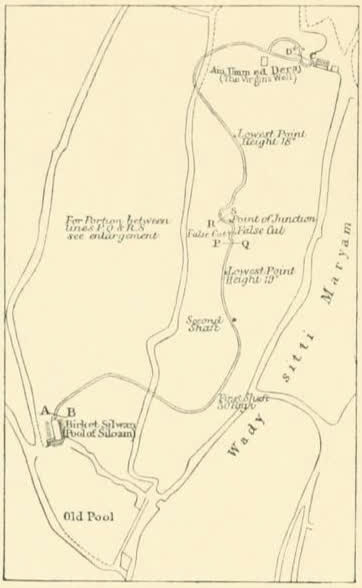
1884 survey sketch of Hezekiah’s tunnel beneath Jerusalem
The 1884 survey sketch of Hezekiah’s tunnel beneath Jerusalem — the 8th-century-BC waterworks whose Siloam Inscription confirms the account in 2 Kings 20.Charles Warren & Claude Conder, 1884 · Public domain
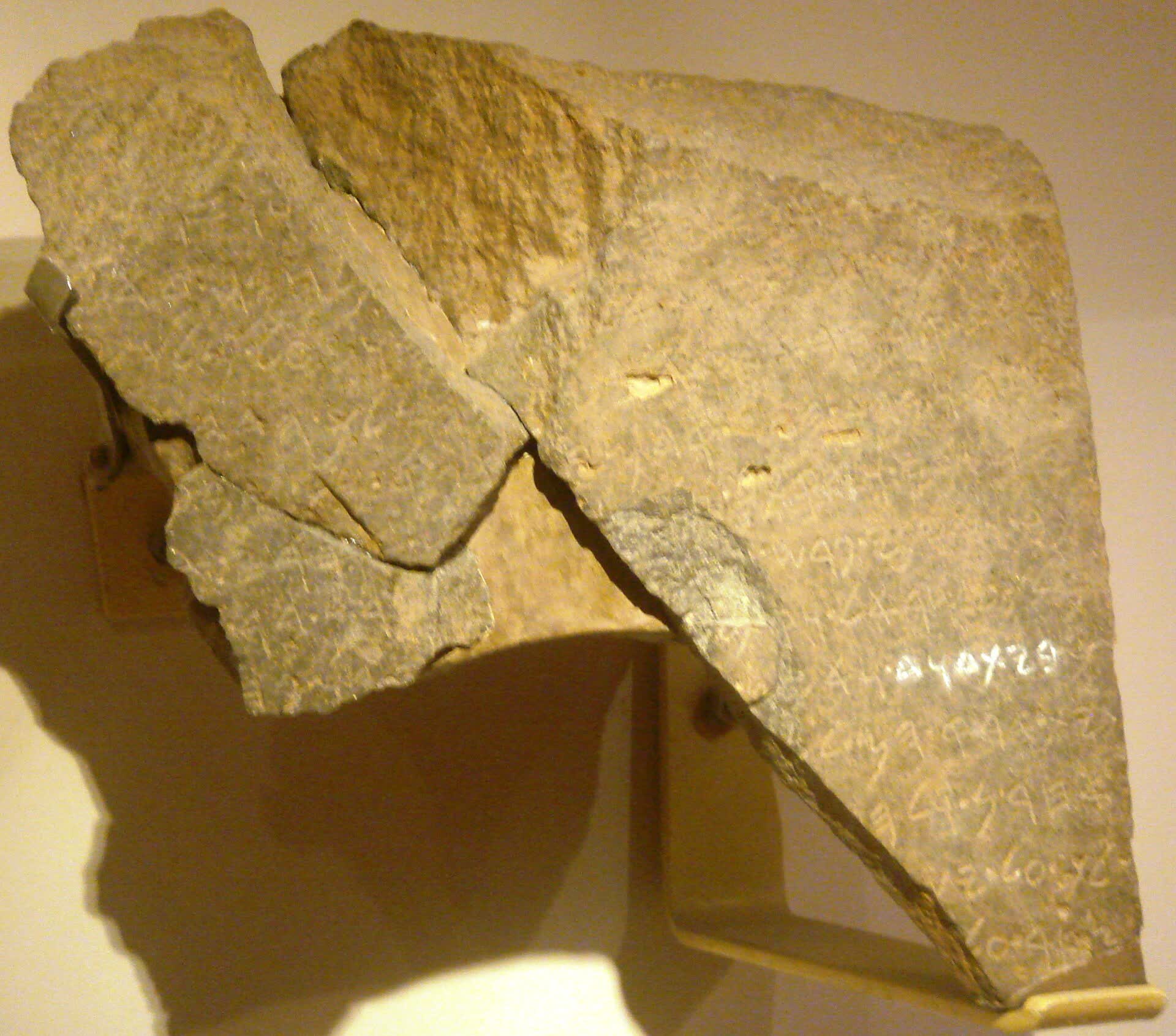
The Tel Dan Stele — basalt fragment inscribed in Aramaic
The Tel Dan Stele (9th century BC, northern Israel) — the first inscription found outside the Bible to name the “House of David.”בית השלום, Hebrew Wikipedia · Attribution

The charge

Hitchens's subtitle states it. Dawkins states it more carefully. In a section of The God Delusion titled "What about Hitler and Stalin? Weren't they atheists?", he answers the most common Christian reply:

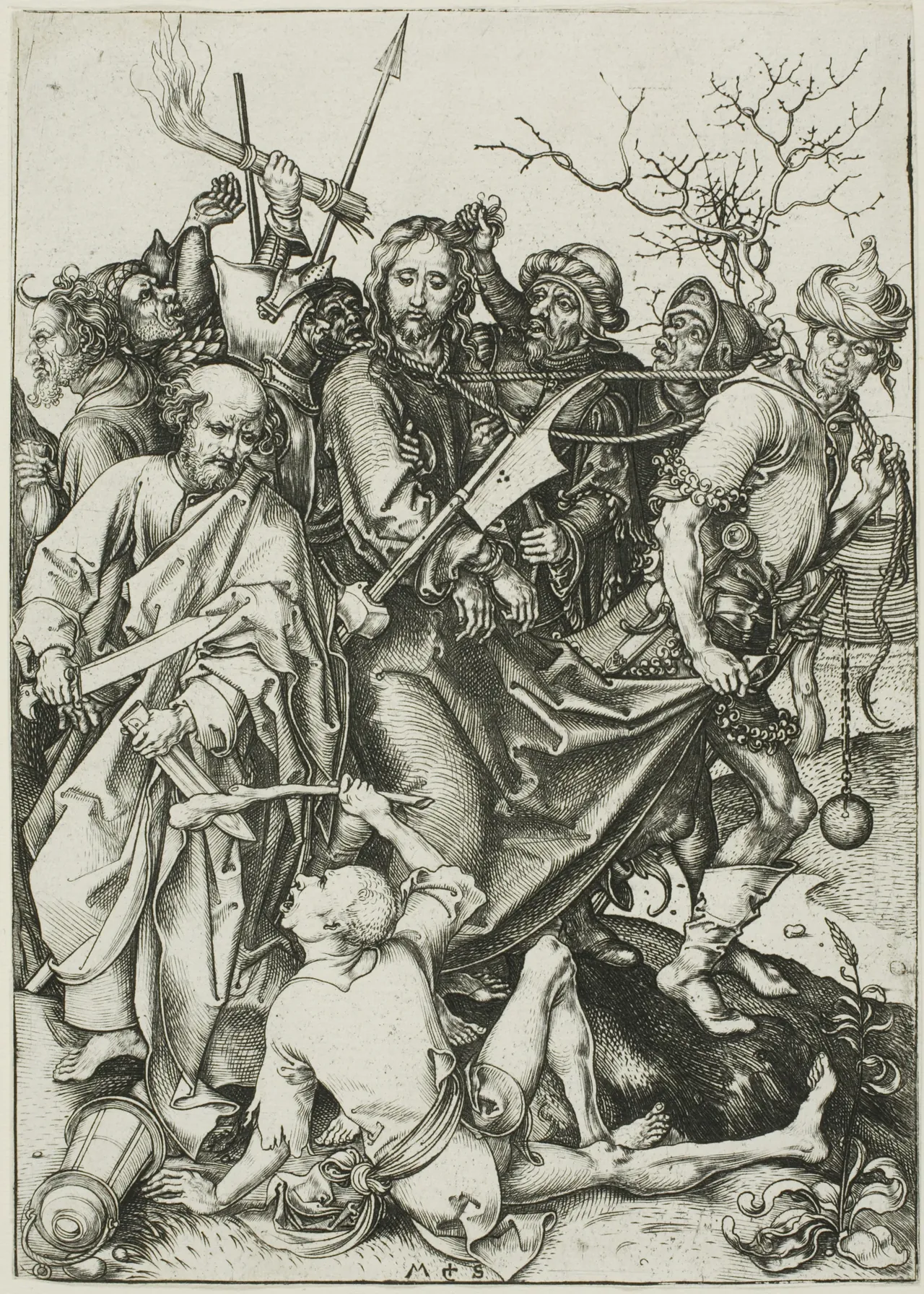
The Betrayal of Christ, from The Passion
A German engraving of about 1480 of the betrayal of Christ, Peter's sword drawn in the garden, the moment Jesus told His disciple to put it away.The Betrayal of Christ, from The Passion · c. 1480 · Art Institute of Chicago · CC0 · museum record · Galeria Regni
Stalin was probably an atheist and Hitler probably wasn't; but even if they were both atheists, the bottom line of the Stalin/Hitler debating point is very simple. Individual atheists may do evil things but they don't do evil things in the name of atheism.15

He goes on: "Religious wars really are fought in the name of religion, and they have been horribly frequent in history. I cannot think of any war that has been fought in the name of atheism."15

This is a serious argument and deserves a serious answer, not a list of body counts thrown back and forth.

The twentieth century

Start with the facts that are not in dispute. The greatest mass killings of the twentieth century were carried out by regimes that were officially atheist and actively persecuted religion. The historian Frank Dikötter, working from Chinese Communist Party archives, concluded that during Mao Zedong's Great Leap Forward alone, from 1958 to 1962, "at least 45 million people were worked, starved or beaten to death".16 The Soviet Union under Stalin and Cambodia under the Khmer Rouge added millions more. These regimes closed churches, imprisoned and killed clergy, and taught atheism as state doctrine.

Hitchens himself did not deny this. He devoted a chapter of God Is Not Great to it, calling it "the most common and frequent objection" his atheist friends heard, and conceding: "One could go further and say that secular totalitarianism has actually provided us with the summa of human evil."17

His answer was that these regimes were really religious in form — with their cults of the leader, their sacred texts and their heresy trials. Of North Korea he wrote that he left "a totalitarian state and also a religious one".18

There is something to this; totalitarian states do imitate religion. But notice what the move does. If every regime that kills is "religious" by definition, then the claim that religion poisons everything cannot be tested. It has become true by definition. And Dennett's own definition of religion — belief in "a supernatural agent or agents whose approval is to be sought"11 — does not fit the Soviet Union or Maoist China at all. They explicitly denied every supernatural agent.

"Not in the name of atheism"

What of Dawkins's point, that no one kills "in the name of atheism"?

It is partly true. Atheism, as a bare denial, gives no commands. But that is exactly the point. The question is not whether atheism commands murder; it is whether atheism gives any reason not to murder. A worldview with no God has no one above the state to whom the state must answer. The Soviet and Chinese regimes did not kill "in the name of atheism", but they killed in the name of an ideology that had removed God from the picture, and with Him any authority higher than the Party. Atheism did not pull the trigger. It removed the safety catch.

And the record shows that removing religion from a society does not remove violence from it. That is enough to answer Hitchens's subtitle. If religion poisons everything, the twentieth century should have been the least poisoned in history in the countries that abolished it. It was the opposite.

Where evil comes from

The Bible's account of violence is not that religion causes it, or that atheism causes it, but that the human heart does. Jesus said:

“For out of the heart proceed evil thoughts, murders, adulteries, fornications, thefts, false witness, blasphemies:” (Matthew 15:19)

Jeremiah said: “The heart is deceitful above all things, and desperately wicked: who can know it?” (Jeremiah 17:9). This is why both religious and irreligious societies have produced atrocities. Fallen people will use whatever is at hand — a creed, a flag, a class struggle, a race theory — to justify what they already want to do. The New Atheists were right that religion can be used this way. They were wrong to think the problem lies in religion rather than in us.

What Jesus actually taught

The more serious question is whether Christianity itself — the teaching of its founder — leads to violence. Here the record is clear.

When Peter drew a sword to defend Him, Jesus said: “Put up again thy sword into his place: for all they that take the sword shall perish with the sword” (Matthew 26:52). To Pilate He said: “My kingdom is not of this world: if my kingdom were of this world, then would my servants fight” (John 18:36). When James and John wanted to call down fire on a Samaritan village that rejected Him, “he turned, and rebuked them, and said, Ye know not what manner of spirit ye are of” (Luke 9:55). And His central command on enemies was this:

“But I say unto you, Love your enemies, bless them that curse you, do good to them that hate you, and pray for them which despitefully use you, and persecute you;” (Matthew 5:44)

When professing Christians have killed in Christ's name, they have done it against His words, not because of them. That is a serious charge against them. It is not a charge against Him. Jesus gave the test Himself: “Ye shall know them by their fruits” (Matthew 7:16).

The other side of the ledger

Hitchens said religion poisons everything. It is fair to ask what Christianity has given.

In the fourth century, Basil, bishop of Caesarea in Cappadocia, built a great complex outside his city for the sick, the poor and travellers. His friend Gregory of Nazianzus described it in Basil's funeral oration: "Go forth a little way from the city, and behold the new city, the storehouse of piety, the common treasury of the wealthy". Gregory said Basil himself "kissed the lepers".19

At almost the same time, the Roman emperor Julian — called "the Apostate" because he abandoned Christianity and tried to restore the old gods — wrote in frustration to one of his pagan high priests. He wanted the pagan temples to imitate the Christians' charity, because, he complained, "the impious Galilaeans support not only their own poor but ours as well, all men see that our people lack aid from us".20 That is the testimony of an enemy.

The historian Tom Holland, who was not writing as a believer, argued in Dominion (2019) that many of the moral assumptions the modern West takes for granted — the dignity of the weak, the equal worth of every person, the duty to the poor and the outcast — came from Christianity, and that even the secular critics of Christianity judge it by standards it gave them.21 That is a large claim, and Holland's book is long; but it is worth reading by anyone who thinks the moral world would look the same without the gospel.

None of this excuses a single crime done by Christians. But a fair ledger has two columns. And the Bible describes true religion in a way no atheist could object to: “Pure religion and undefiled before God and the Father is this, To visit the fatherless and widows in their affliction, and to keep himself unspotted from the world” (James 1:27).

Part 3 — "Faith Is Belief Without Evidence"

8 min read

This chapter matters because it is the foundation of the whole New Atheist case. If faith simply means believing without reasons, then every other argument is unnecessary; faith refutes itself. But is that what faith means?

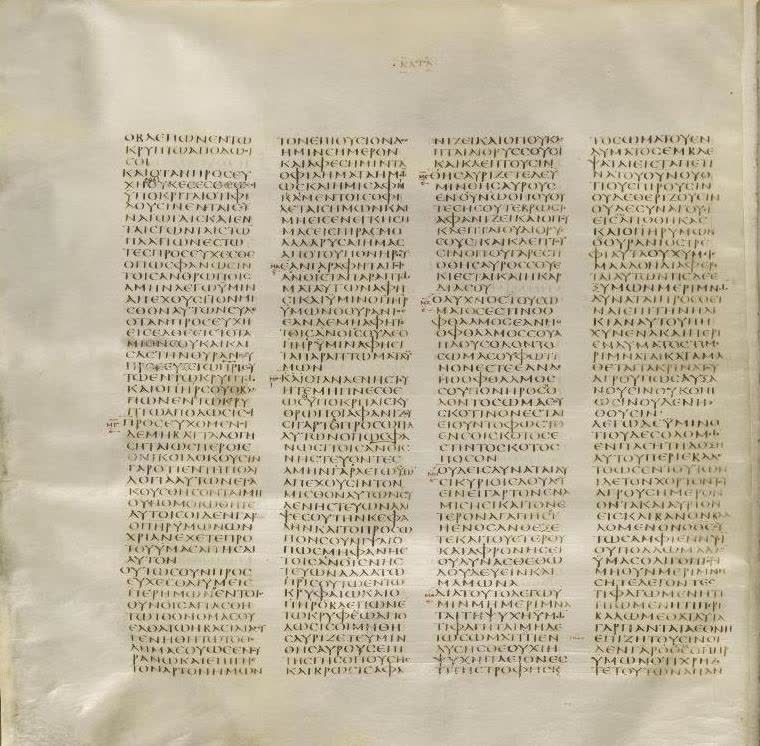
A page of Codex Sinaiticus in early Greek uncial script
A page of Codex Sinaiticus (4th century AD), the oldest complete Greek New Testament — hand-copied within three centuries of the events it records.Unknown scribe, 4th century · Public domain

The charge

Dawkins puts it strongly in The God Delusion: "Faith is an evil precisely because it requires no justification and brooks no argument."22 Harris, as we saw, says faith is right only "by accident". Hitchens says that "what can be asserted without evidence can also be dismissed without evidence".

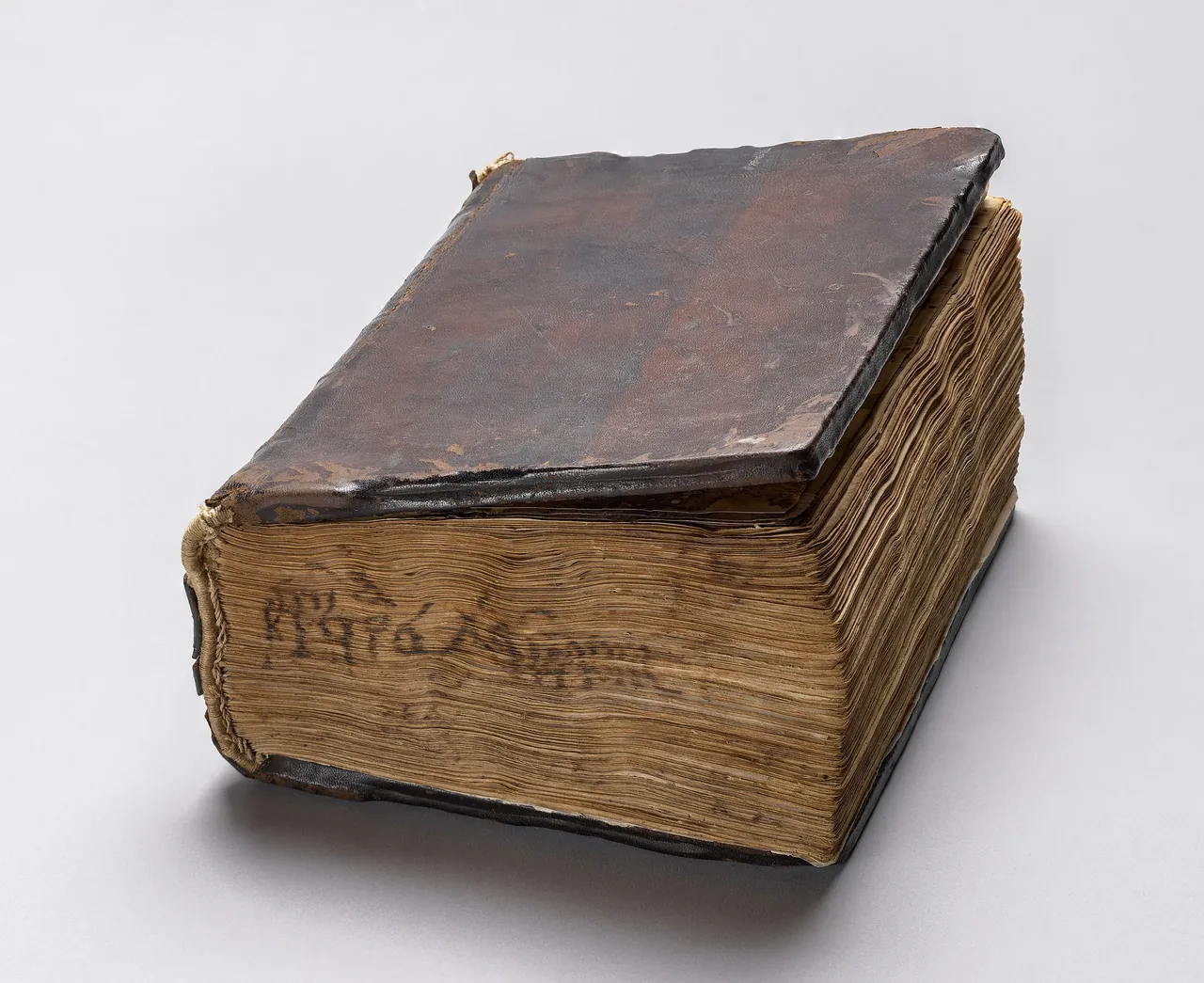
Gospel Book with Commentaries
A Byzantine Gospel book with commentaries, made in Constantinople about 1000 to 1100, in a leather binding, one of the copies through which the Gospels came down.Gospel Book with Commentaries · c. 1000–1100 · Cleveland Museum of Art · CC0 · museum record · Galeria Regni

All three assume that faith, by definition, is belief without evidence or against it. Some religious people do use the word that way. The question is whether the Bible does.

What the Bible means by faith

The Bible's own definition of faith is in Hebrews:

“Now faith is the substance of things hoped for, the evidence of things not seen.” (Hebrews 11:1)

The word translated "evidence" is the Greek elenchos, which carries the sense of proof or conviction — the thing that convinces. You can trace it in a KJV with Strong's Concordance. Faith, in this verse, is not the absence of evidence. It is the conviction of things not seen — not seen yet, or not seen by us — grounded in the trustworthiness of the one who has spoken.

That is how faith works in ordinary life. You have faith that a bridge will hold you because engineers built it and others have crossed it. You have faith in a friend because you know his character. You do not see the bridge's inner steel, or your friend's heart; but your trust is not blind. It rests on evidence.

The New Testament writers were insistent that their faith rested on evidence. John says he wrote his Gospel precisely to give it:

“And many other signs truly did Jesus in the presence of his disciples, which are not written in this book: But these are written, that ye might believe that Jesus is the Christ, the Son of God; and that believing ye might have life through his name.” (John 20:30-31)

Luke opens his Gospel like a historian, telling his reader that he has drawn on those “which from the beginning were eyewitnesses, and ministers of the word” (Luke 1:2), and has written “That thou mightest know the certainty of those things, wherein thou hast been instructed” (Luke 1:4). He opens Acts by saying that Jesus “shewed himself alive after his passion by many infallible proofs, being seen of them forty days” (Acts 1:3). Peter writes: “For we have not followed cunningly devised fables, when we made known unto you the power and coming of our Lord Jesus Christ, but were eyewitnesses of his majesty” (2 Peter 1:16). And John again: “That which was from the beginning, which we have heard, which we have seen with our eyes, which we have looked upon, and our hands have handled, of the Word of life” (1 John 1:1).

These are not the words of people who thought evidence did not matter.

Faith that holds on

C. S. Lewis, who had been an atheist himself, gave a definition of faith that both sides should hear:

Now Faith, in the sense in which I am here using the word, is the art of holding on to things your reason has once accepted, in spite of your changing moods.23

He explained: "Now that I am a Christian I do have moods in which the whole thing looks very improbable: but when I was an atheist I had moods in which Christianity looked terribly probable."23 Faith, on this account, does not replace reason. It is faithfulness to what reason has seen, when feelings waver.

"Blessed are they that have not seen"

A skeptic might point to the words of Jesus to Thomas: “Thomas, because thou hast seen me, thou hast believed: blessed are they that have not seen, and yet have believed” (John 20:29). Is that not a blessing on believing without evidence?

Read the scene. Thomas had refused to believe the testimony of the other apostles. Jesus did not scold him for wanting evidence; He gave it: “Reach hither thy finger, and behold my hands; and reach hither thy hand, and thrust it into my side: and be not faithless, but believing” (John 20:27). The blessing is on those who would believe without seeing with their own eyes — on the testimony of those who did see. That is not believing without evidence. It is believing on the evidence of witnesses, which is how we know nearly everything we know about history. And John's very next words are the ones quoted above: “these are written, that ye might believe”.

Hitchens's razor, taken seriously

Hitchens's rule — what is asserted without evidence may be dismissed without evidence — is a good rule. The Christian should accept it, and then ask: is Christianity asserted without evidence?

Christianity is not, at bottom, a set of private feelings. It is a claim about a public event: that Jesus of Nazareth was crucified under Pontius Pilate and rose from the dead on the third day. Paul put the whole faith on that claim: “And if Christ be not risen, then is our preaching vain, and your faith is also vain” (1 Corinthians 15:14). And he gave a list of witnesses, many of them still alive and available to be questioned when he wrote:

“For I delivered unto you first of all that which I also received, how that Christ died for our sins according to the scriptures; And that he was buried, and that he rose again the third day according to the scriptures: And that he was seen of Cephas, then of the twelve: After that, he was seen of above five hundred brethren at once; of whom the greater part remain unto this present, but some are fallen asleep. After that, he was seen of James; then of all the apostles. And last of all he was seen of me also, as of one born out of due time.” (1 Corinthians 15:3-8)

The crucifixion is not only a Christian claim. The Roman historian Tacitus, no friend of Christians, wrote about the fire of Rome in AD 64 and Nero's persecution of those "whom the crowd styled Christians", explaining: "Christus, the founder of the name, had undergone the death penalty in the reign of Tiberius, by sentence of the procurator Pontius Pilatus".24 Even the skeptical New Testament scholar Bart Ehrman, an agnostic, argued in Did Jesus Exist? (2012) that Jesus was a real man who was crucified.25

The resurrection itself is a larger question, and it has its own literature. Gary Habermas and Michael Licona's The Case for the Resurrection of Jesus sets out the facts about Jesus' death, burial, the empty tomb and the appearances that most historians, believing or not, accept, and argues that the resurrection is the best explanation of them.26 You may not be persuaded. But you cannot fairly say the claim is "asserted without evidence". It is asserted with evidence, and the evidence must be weighed.

"The Gospels contradict each other"

Hitchens pressed one more evidential charge: that the Gospels cannot be trusted because they disagree. He wrote that the Gospel writers "cannot agree on anything of importance", and gave an example:

They flatly contradict each other on the "Flight into Egypt," Matthew saying that Joseph was "warned in a dream" to make an immediate escape and Luke saying that all three stayed in Bethlehem until Mary's "purification according to the laws of Moses," which would make it forty days, and then went back to Nazareth via Jerusalem.27

It is worth taking this example seriously, because it shows how such charges usually work. Read the two passages.

Luke says that after the birth, “when the days of her purification according to the law of Moses were accomplished, they brought him to Jerusalem, to present him to the Lord” (Luke 2:22), and then: “when they had performed all things according to the law of the Lord, they returned into Galilee, to their own city Nazareth” (Luke 2:39).

Matthew tells a story Luke does not tell. The wise men come “into the house” and see “the young child with Mary his mother” (Matthew 2:11) — not a newborn in a manger, but a young child in a house. Herod, trying to kill him, orders the death of every child in Bethlehem “from two years old and under, according to the time which he had diligently enquired of the wise men” (Matthew 2:16). Only then does the angel tell Joseph to flee into Egypt (Matthew 2:13).

Put together, the most natural reading is that the wise men's visit came some time after the forty days of Luke's account — perhaps as much as two years — and that Luke, who does not mention the wise men at all, passes over that period and the flight to Egypt and brings the story straight to Nazareth, where Matthew also ends it (Matthew 2:23). That is not a contradiction. It is two writers, each telling part of a story, as independent witnesses do. A contradiction would be one writer saying the family went to Egypt and the other saying they never left Judea. Neither says that.

The same is true of the other differences critics most often cite. Matthew says Judas “went and hanged himself” (Matthew 27:5); Acts says “falling headlong, he burst asunder in the midst” (Acts 1:18). Both can be true of the same death. The Gospels name different women at the tomb (Matthew 28:1; Luke 24:10; John 20:1); each names those he chose to name, and all agree that Mary Magdalene was there.

Differences like these are what we expect from independent accounts. If the four Gospels agreed word for word, the critic would rightly say they had been copied from one script. Historians value testimony that agrees on the main events and differs in details, because it shows the witnesses did not collude.

As for the text itself: the King James Bible follows the Received Text. Where it and modern versions differ — at passages such as Mark 16:9–20, the account of the woman taken in adultery (John 7:53 through 8:11) and 1 John 5:7 — kylelauriano.com/library/changes sets out every difference so that you can see them for yourself.

Part 4 — *The God Delusion*: The Hypothesis, the 747 and the Charge of Delusion

5 min read

This chapter matters because Dawkins offered what he regarded as the central argument of the New Atheism — an argument meant not only to answer the case for God but to show that God almost certainly does not exist.

The Ultimate Boeing 747

The argument takes its name from an old image. Some critics of evolution had said that life arising by chance was as likely as a hurricane sweeping through a junkyard and assembling a Boeing 747. Dawkins turned the image around. Whatever designed the universe, he argued, would have to be even more complex, and therefore even more improbable, than the universe it designed:

The temptation is a false one, because the designer hypothesis immediately raises the larger problem of who designed the designer.28

God, on this view, is the "Ultimate Boeing 747": the most improbable thing of all. Dawkins calls this "the statistical demonstration that God almost certainly does not exist".28

The answer: what kind of thing is God?

The argument depends on treating God as if He were a very large, very complicated object, built out of parts, that would need assembling. But that is not what Christians, or the classical philosophers, have meant by God.

The arguments examined in this paper's companion, Five Proofs of God, conclude to a being who is uncaused, necessary and not made of parts. Such a being is not "improbable" in Dawkins's sense, because improbability belongs to things that could have been arranged otherwise — atoms that might have fallen into another pattern. God is not an arrangement of anything. He is, in Scripture's words, the One who says “I AM THAT I AM” (Exodus 3:14), who was “from everlasting to everlasting” (Psalm 90:2). The question "who designed the designer?" assumes that God is one more designed thing. The whole Christian tradition denies it.

Dawkins anticipates this answer and dismisses it as special pleading. But it is not a special exemption invented to save the argument. It is what the word "God" has always meant in serious theology. An argument against a God no one believes in is not an argument against God.

There is a second answer. We do not need to explain an explanation before we can recognise it as the best one. If you found a message carved in a cliff, you would be right to conclude that someone carved it, even if you knew nothing about who the carver was or where he came from. If every explanation had to be explained before it could be accepted, no one could ever explain anything.

Dawkins and the philosophers

The sharpest criticism of The God Delusion did not come from Christians alone. Michael Ruse, a philosopher of science and himself an atheist, wrote in 2009:

Richard Dawkins in The God Delusion would fail any introductory philosophy or religion course. Proudly he criticizes that whereof he knows nothing.29

And: "I have written elsewhere that The God Delusion makes me ashamed to be an atheist."29 Ruse's quarrel was partly tactical — he thought the New Atheists were harming the cause of science education — but his judgment of the arguments was his own.

Christian scholars answered at length. The Oxford theologian Alister McGrath, who had trained as a scientist, published The Dawkins Delusion? with Joanna Collicutt McGrath in 2007. The Oxford mathematician John Lennox debated Dawkins in public in Birmingham, Alabama, on 3 October 2007, on the arguments of The God Delusion, and later wrote Gunning for God: A Critique of the New Atheism (2011).30 William Lane Craig debated Hitchens on the existence of God at Biola University on 4 April 2009, and Harris on the foundation of morality in April 2011.31 Whatever one thinks of the outcomes, the New Atheists' arguments were heard and answered.

Is belief in God a delusion?

Dawkins's title charges that belief in God is "a persistent false belief held in the face of strong contradictory evidence". There are three problems with the charge.

First, it assumes what it needs to prove. A delusion is a false belief. Whether belief in God is false is the very question at issue. If God exists, belief in Him is not a delusion, however many people hold it for bad reasons. The charge of delusion cannot be the argument; it can only be the conclusion of an argument, and the argument is what we have been examining.

Second, it would make delusional a very large number of the most careful thinkers in history: Augustine, Anselm, Aquinas, Pascal, Newton, and in our own day philosophers like Alvin Plantinga and scientists like the ones whose work is described in Part 5. Some of them may have been wrong. But a "delusion" is not merely being wrong. It is holding a belief in the face of overwhelming contrary evidence, as a sign of disorder. That is not a credible description of them.

Third, the charge can be turned around just as easily, and it proves nothing either way. A Christian could say that atheism is a delusion produced by the desire to be free of God — and Scripture does say something like that: “because that, when they knew God, they glorified him not as God, neither were thankful; but became vain in their imaginations, and their foolish heart was darkened” (Romans 1:21). But saying it does not prove it. Explaining why someone holds a belief does not show the belief is false. Philosophers call that mistake the genetic fallacy.

Breaking the spell

That last point applies to Dennett's book as well. Breaking the Spell set out to explain religion as a natural phenomenon — how it arose, why it spreads, what needs it meets. That is a legitimate field of study, and a Christian has no reason to fear it. We believe that people are religious because they were made for God; it would not surprise us if the desire for God had natural expressions.

But an account of how a belief arose does not tell us whether it is true. A natural history of mathematics — why humans came to count, how numbers spread from culture to culture — would not show that two and two do not make four. A natural history of atheism could be written too. In every case, after the history is told, the question remains: is it true?

Dennett was right that religion should not be shielded from honest investigation. “Prove all things” (1 Thessalonians 5:21). Christians should welcome every honest question. What we cannot accept is that explaining belief is the same as explaining it away.

Part 5 — "Science Has Buried God"

4 min read

This chapter matters because many people believe, without ever having examined it, that science and Christianity are enemies, and that every advance of science is a defeat for God.

The charge

Harris states it directly in The Moral Landscape. He rejects the idea that science and religion address different questions: "The underlying claim is that while science is the best authority on the workings of the physical universe, religion is the best authority on meaning, values, morality, and the good life. I hope to persuade you that this is not only untrue, it could not possibly be true."32 Dawkins treats God as a hypothesis that science can assess and has found wanting.

Who built science?

The first thing to say is historical. Modern science did not grow up in opposition to Christian belief. It grew up largely among Christians, who expected nature to be orderly because they believed it had a rational Maker.

Isaac Newton, whose laws of motion and gravitation founded modern physics, closed the second edition of his Principia (1713) with a "General Scholium" that said:

This most beautiful System of the Sun, Planets, and Comets, could only proceed from the counsel and dominion of an intelligent and powerful being.33

The theory that the universe expanded from an early, dense state — what came to be called the Big Bang — was first proposed in 1927 by Georges Lemaître, a Belgian physicist who was also a Catholic priest.

The point is not that great scientists believed in God, so God exists; that would be a bad argument. The point is that the claim that science and faith are natural enemies is historically false. Many of the founders of science saw their work as tracing the order God had put into His world, an order Scripture names: “Thus saith the LORD; If my covenant be not with day and night, and if I have not appointed the ordinances of heaven and earth” (Jeremiah 33:25) — the verse assumes that the ordinances of heaven and earth are as fixed as God's own covenant.

What science has found

The second thing to say is that some of the most important scientific discoveries of the last century point toward God rather than away from Him. The companion paper, Five Proofs of God, examines two in detail.

A beginning. The universe, on the best evidence of modern cosmology, had a beginning. In 2003 the physicists Arvind Borde, Alan Guth and Alexander Vilenkin published a theorem showing that a universe that has on average been expanding cannot be infinitely old.34 That does not prove God, and the physicists who proved it do not draw that conclusion. But it fits the first words of the Bible — “In the beginning God created the heaven and the earth” (Genesis 1:1) — far better than it fits an eternal, self-existing universe. (This paper, like its companion, makes no claim about the age of the universe or the earth.)

Fine-tuning. The laws of physics contain quantities that, if they had been even slightly different, would have made life impossible. The astronomer Luke Barnes reviewed the scientific literature in 2012 and summarised it: "in the space of possible physical laws, parameters and initial conditions, the set that permits the evolution of intelligent life is very small".35 Dawkins himself admits in The God Delusion that there is as yet no "crane" in physics to explain this, and that the best available candidate, a multiverse, "makes heavier demands on luck".36

Science and naturalism are not the same thing

The third thing to say is philosophical. The real conflict, as Alvin Plantinga argued in Where the Conflict Really Lies (2011), is not between science and religion but between science and naturalism — the view that nature is all there is.37

Science is a method for studying the natural world. It is extraordinarily good at what it does. But it cannot, by its own methods, tell us whether there is anything beyond the natural world, any more than a metal detector can tell you whether there is wood in the ground. The claim that only what science can measure is real is not itself a scientific finding. It cannot be measured. It is a philosophical belief, and it must be argued for like any other.

Science also rests on assumptions it cannot prove: that nature is orderly, that the future will resemble the past, that our minds can grasp the world's structure, that logic and mathematics apply to physical things. A Christian has a reason to expect all of these: a rational God made an orderly world and made us in His image to understand it (Genesis 1:27). A naturalist must take them on trust.

Charles Darwin himself felt the force of this. In a letter of 1881 he wrote: "with me the horrid doubt always arises whether the convictions of man's mind, which has been developed from the mind of the lower animals, are of any value or at all trustworthy".38 If our minds are only the product of blind forces aimed at survival, why trust them on questions — like the truth of naturalism — that have nothing to do with survival? Plantinga developed that doubt into a formal argument, discussed in the companion paper.

A word on Genesis

Many New Atheist arguments assume that because Christians take Genesis seriously, they must be against science. That does not follow. I hold that Genesis is a true record: six real days of creation, a real Adam and Eve, a real Fall, and a global Flood. I make no claim about the age of the earth. That is what the text teaches, and the reader can study it there. But it does not require hostility to the honest study of nature. It requires only that we recognise the difference between what scientists observe and the philosophical assumptions some of them bring to the observations. The Christian's quarrel is not with the telescope or the microscope. It is with the claim that nothing exists beyond what they can show.

Part 6 — Morality Without God?

6 min read

This chapter matters because the New Atheists were, above all, moralists. Their books burn with moral outrage — at cruelty, at hypocrisy, at the abuse of children, at the oppression of women. The question is where that outrage gets its authority.

The Old Testament charge

Dawkins opens his second chapter with what may be the most quoted paragraph in New Atheist writing:

The God of the Old Testament is arguably the most unpleasant character in all fiction: jealous and proud of it; a petty, unjust, unforgiving control-freak; a vindictive, bloodthirsty ethnic cleanser; a misogynistic, homophobic, racist, infanticidal, genocidal, filicidal, pestilential, megalomaniacal, sado-masochistic, capriciously malevolent bully.39

Notice first what this paragraph is. It is not an argument that God does not exist; a character can be unpleasant and real. It is a moral judgment on God — and a moral judgment needs a standard. By what standard does Dawkins judge? If there is no God, there is no objective moral law, only the preferences of evolved animals. On that view, "unjust" and "malevolent" can only mean "I do not like it". But Dawkins plainly means more than that. He means that these things are really wrong. And that is the point C. S. Lewis reached as an atheist:

My argument against God was that the universe seemed so cruel and unjust. But how had I got this idea of just and unjust? A man does not call a line crooked unless he has some idea of a straight line.40

The New Atheists' moral passion is real, and in many cases admirable. But it borrows a straight line that their worldview cannot supply.

Harris's answer

Sam Harris saw this objection and tried to answer it. In The Moral Landscape he argued that morality rests on facts about "the well-being of conscious creatures", and that we can know some states of the world are bad without God. He asks us to imagine "the worst possible misery for everyone" and says: "If you think we cannot say this would be 'bad,' then I don't know what you could mean by the word 'bad'."41

That is right as far as it goes. Everyone knows the worst possible misery is bad. The question is not whether we know it, but what makes it true — and, more pointedly, why I am obliged to prevent the misery of others when it costs me something. That suffering exists is a fact of nature. That I ought to relieve it is a different kind of claim. Harris debated this very question with William Lane Craig in April 2011. The debate did not settle it, but it showed where the disagreement lies: not in whether cruelty is wrong, on which both men agreed, but in whether atheism can explain why.

The Bible's answer is that moral obligation comes from a Person who is Himself good, who made us in His image, and whose law is written on the heart: “Which shew the work of the law written in their hearts, their conscience also bearing witness” (Romans 2:15). The well-being of others matters because they bear God's image, and because the God who made them commands us: “thou shalt love thy neighbour as thyself: I am the LORD” (Leviticus 19:18).

The hardest case: the Canaanites

The New Atheists' hardest moral charge deserves a direct answer, not an evasion. In 2011 Dawkins refused to debate William Lane Craig at Oxford, and explained why in The Guardian. His reason was moral: Craig had defended the Old Testament accounts in which God commanded Israel to destroy the Canaanite cities. Dawkins quoted the command — "thou shalt save alive nothing that breatheth" — and called Craig "an apologist for genocide".42

The text is real:

“But of the cities of these people, which the LORD thy God doth give thee for an inheritance, thou shalt save alive nothing that breatheth: But thou shalt utterly destroy them; namely, the Hittites, and the Amorites, the Canaanites, and the Perizzites, the Hivites, and the Jebusites; as the LORD thy God hath commanded thee: That they teach you not to do after all their abominations, which they have done unto their gods; so should ye sin against the LORD your God.” (Deuteronomy 20:16-18)

Christians do not all explain this passage in the same way, and this paper will not pretend the difficulty is small. But several things in the text itself must be weighed before the charge is accepted.

First, the command was judgment, not ethnic hatred. God told Abraham, centuries earlier, that his descendants would wait four hundred years for the land, “for the iniquity of the Amorites is not yet full” (Genesis 15:16). The judgment was delayed for generations, and it was a judgment on practices the text calls "abominations" — practices that, elsewhere in the Law, include the burning of children in sacrifice: “for even their sons and their daughters they have burnt in the fire to their gods” (Deuteronomy 12:31).

Second, it was a command limited in time, place and purpose, given to one nation at one moment for one act of judgment. It is never repeated as a general rule, and it gives no one today any licence for violence. The same Lord says: “Have I any pleasure at all that the wicked should die? saith the Lord GOD: and not that he should return from his ways, and live?” (Ezekiel 18:23).

Third, the question presupposes that God, if He exists, has no more right over human life than we do. But if God is the Creator and Judge of all, then He has the right to end any life He gave, and every one of us will die at His appointment. The question then becomes not whether God may judge, but whether He judged justly. Abraham asked that question long before Dawkins: “Shall not the Judge of all the earth do right?” (Genesis 18:25).

Fourth, the same Bible that records these judgments records God's patience with every nation, and His ultimate answer to evil: not the destruction of sinners but the death of His own Son for them. “The Lord is not slack concerning his promise, as some men count slackness; but is longsuffering to us-ward, not willing that any should perish, but that all should come to repentance” (2 Peter 3:9).

None of this will satisfy every reader, and it should not be offered glibly. But it is worth noticing again that Dawkins's objection is a moral one, and that it assumes a standard of justice by which even God can be judged. Christians agree that there is such a standard. We say it is God's own character. The atheist must say where else it could come from.

The fruit of the gospel

The New Atheists often wrote as though the moral ideals of the modern West — equal dignity, care for the weak, the rights of women and children — were simply the product of reason, and that religion had only held them back. The historical record is more complicated. As Part 2 showed, the care of the sick and poor as a duty owed to strangers was so distinctively Christian in the Roman world that a pagan emperor complained about it. And the New Testament put into words an equality that the ancient world did not know: “There is neither Jew nor Greek, there is neither bond nor free, there is neither male nor female: for ye are all one in Christ Jesus” (Galatians 3:28).

The New Atheists' outrage at cruelty is, in large part, a Christian inheritance. That does not make Christianity true. But it should make its critics pause before they saw off the branch they are sitting on.

Part 7 — After the Horsemen

3 min read

This chapter matters because a movement's story is part of the evidence. The New Atheism promised that the end of faith was near. Two decades on, it is worth asking what happened.

The movement fades

The four men did not stop writing, but by the mid-2010s the movement had lost much of its energy, and the label was used more often by critics than by admirers. Hitchens died of cancer in December 2011, at sixty-two. Dennett died in April 2024. The religiously unaffiliated share of Americans grew through the 2010s, but Pew's latest study found that it has "plateaued in recent years after a long period of sustained growth".43

Antony Flew

Before the New Atheism there was Antony Flew, a British philosopher who for half a century was perhaps the most respected academic atheist in the English-speaking world. In 2004 Flew announced that he had come to believe in God, because, he said, he had always tried to follow the evidence where it led. In 2007 a book appeared under his name, written with Roy Abraham Varghese: There Is a God: How the World's Most Notorious Atheist Changed His Mind.

Fairness requires two cautions. Flew became a deist, not a Christian; he believed in a Creator but did not accept the Bible's account of God or an afterlife. And the journalist Mark Oppenheimer, writing in The New York Times Magazine in 2007, reported that Flew had not written the book himself and questioned how far it reflected his own thinking.44 Flew's turn proves nothing about God's existence on its own. But it does show that a lifetime of careful thought about these arguments can lead away from atheism as well as toward it.

Ayaan Hirsi Ali

Ayaan Hirsi Ali, a Somali-born writer and former Muslim, was so closely associated with the New Atheists that she was sometimes called the fifth "horseman". In November 2023 she published an essay titled "Why I am now a Christian" — a deliberate answer to Bertrand Russell's lecture "Why I Am Not a Christian".

Part of her reason, she wrote, was that she had come to believe atheism could not defend the civilisation that had produced it. But she was clear that this was not the whole of it:

I have also turned to Christianity because I ultimately found life without any spiritual solace unendurable — indeed very nearly self-destructive. Atheism failed to answer a simple question: what is the meaning and purpose of life?45

Her essay is not an argument for the truth of Christianity, and she would not claim it was. But it is a striking testimony from inside the movement: that the promise of the New Atheism — that reason without God would satisfy — did not hold for one of its most prominent voices.

A real story

Michael Ray Lewis told his story on The King Is Coming Show (TKIC #48), under the title "An Atheist Who Mocked Christians — Until One Question Undid Him". In his telling, he was an atheist who mocked believers, until a single question changed his course. Hear it in his own words: youtube.com/watch?v=Rd-RdSqeQDk

Michael's account of what happened to him, shared as his testimony — weigh it for yourself.

What the story shows

The New Atheism was right about one thing above all: that ideas matter, and that people should not believe things without good reason. It was wrong to think that Christianity has no good reasons. And it underestimated the questions that do not go away when the arguments are over: why there is anything at all, why we know right from wrong, what life is for, and what we do with our guilt. Those are the questions the gospel answers.

Conclusion — Answering with Meekness and Fear

5 min read

This last chapter matters because the way Christians answer the New Atheists says as much as what they say.

The claims and the answers

| Claim | Who said it | The short answer | | --- | --- | --- | | Religion poisons everything | Hitchens | The worst killings of the twentieth century were by regimes that abolished religion; evil comes from the heart (Matthew 15:19); Christ forbade the sword for His kingdom (Matthew 26:52) | | No one kills in the name of atheism | Dawkins | Atheism gives no commands, including none against killing; removing God removes any authority above the state | | Faith is belief without evidence | Dawkins, Harris | The Bible defines faith as conviction grounded in evidence (Hebrews 11:1) and offers eyewitness testimony (Luke 1:1-4; 1 Corinthians 15:3-8) | | What is asserted without evidence may be dismissed | Hitchens | Agreed; the resurrection is asserted with evidence, including Roman testimony to the crucifixion | | The Gospels contradict each other | Hitchens | Differences are those of independent witnesses; the Flight into Egypt fits Luke's account once Matthew 2:11 and 2:16 are read | | Who designed the designer? | Dawkins | God is not a complex, assembled thing but the uncaused, necessary ground of all things (Exodus 3:14) | | Belief in God is a delusion | Dawkins | A delusion must be false; the charge assumes the conclusion, and explaining a belief is not refuting it | | Religion is a natural phenomenon | Dennett | Studying how belief arose does not show it false; Christians welcome honest investigation (1 Thessalonians 5:21) | | Science has made God unnecessary | Harris, Dawkins | Science grew among believers; a beginning and fine-tuning point toward God; the conflict is with naturalism, not science | | Morality needs no God | Harris | We know cruelty is wrong; the question is what makes it binding, and only a good, personal Lawgiver explains obligation | | The Old Testament God is a moral monster | Dawkins | A moral charge that presupposes an objective standard; the Canaanite judgment was delayed, limited and judicial (Genesis 15:16; Ezekiel 18:23) |

How to answer

Scripture gives the Christian not only the content of an answer but its manner.

With gentleness. “And the servant of the Lord must not strive; but be gentle unto all men, apt to teach, patient, In meekness instructing those that oppose themselves; if God peradventure will give them repentance to the acknowledging of the truth” (2 Timothy 2:24-25). The New Atheists often mocked. We may not. The goal is not to win but to win a person.

With grace and salt. “Let your speech be alway with grace, seasoned with salt, that ye may know how ye ought to answer every man” (Colossians 4:6). Salt is not sugar. A gracious answer can still be sharp, and must still be true.

With both sides heard. “He that is first in his own cause seemeth just; but his neighbour cometh and searcheth him” (Proverbs 18:17). Read the New Atheists for yourself before you answer them. Quote them accurately. Never answer a version of their argument that they did not make.

With wisdom about when to answer. Proverbs gives two sayings side by side: “Answer not a fool according to his folly, lest thou also be like unto him. Answer a fool according to his folly, lest he be wise in his own conceit” (Proverbs 26:4-5). Some arguments should be answered; some mockery should be left alone. Wisdom knows the difference.

Further reading

These books, all cited in this paper, are good next steps:

  • C. S. Lewis, Mere Christianity — the classic case, by a former atheist.
  • Alister McGrath and Joanna Collicutt McGrath, The Dawkins Delusion? — a short reply to Dawkins.
  • John C. Lennox, Gunning for God: A Critique of the New Atheism.
  • Gary R. Habermas and Michael R. Licona, The Case for the Resurrection of Jesus.
  • Alvin Plantinga, Where the Conflict Really Lies — on science, religion and naturalism (demanding, but rewarding).
  • Lee Strobel, The Case for Christ — a journalist's investigation, by a former atheist.
  • Tom Holland, Dominion — a historian on how Christianity shaped the moral assumptions of the West.
  • The companion paper on this site, Five Proofs of God.

And above all, the Bible itself. The free 1611 Reader at kylelauriano.com/library has the whole King James text; a KJV with Strong's Concordance will let you trace the original words.

The question underneath

The New Atheists asked, in many forms, one question: Is there any good reason to believe? This paper has argued that there is. But the deepest question is not whether God exists. It is what you will do if He does.

The Bible's answer is that God exists, that we have all turned from Him — “For all have sinned, and come short of the glory of God” (Romans 3:23) — and that He has not left us there. “But God commendeth his love toward us, in that, while we were yet sinners, Christ died for us” (Romans 5:8). He was crucified under Pontius Pilate, as Tacitus recorded, and He rose again, as His witnesses testified. And He calls every person to turn and trust Him: “For by grace are ye saved through faith; and that not of yourselves: it is the gift of God: Not of works, lest any man should boast” (Ephesians 2:8-9). The apostles preached “repentance toward God, and faith toward our Lord Jesus Christ” (Acts 20:21), and on the first day the gospel was preached, Peter told those who asked what to do: “Repent, and be baptized every one of you in the name of Jesus Christ for the remission of sins, and ye shall receive the gift of the Holy Ghost” (Acts 2:38).

That message comes with a warning as well as a welcome. Paul told the philosophers of Athens that God “hath appointed a day, in the which he will judge the world in righteousness by that man whom he hath ordained; whereof he hath given assurance unto all men, in that he hath raised him from the dead” (Acts 17:31). The resurrection is not only the evidence for the gospel. It is the reason the question cannot be postponed forever.

An invitation

If you have read the New Atheists and found them convincing, I ask only one thing: do what they told you to do. Follow the evidence. Read the primary sources. Do not take anyone's word for it — not theirs, and not mine.

That is what I did with the Bible. In my own words: In Matthew I read Jesus' own words and felt the weight of my own sin for the first time. Then one day I got on my knees and prayed: "Jesus, if you are real, show me — and I'll serve you." A warmth ran from the top of my head to the soles of my feet. Peace I'd never known, and it didn't leave. That is my testimony; weigh it for yourself. In one line: “I came to disprove God. He met me instead — and I couldn't unsee what time it is.”

The invitation of Christ is still open, to the skeptic as much as to anyone:

“All that the Father giveth me shall come to me; and him that cometh to me I will in no wise cast out.” (John 6:37)

Notes and sources

  1. 1Gary Wolf, "The Church of the Non-Believers," Wired, November 1, 2006, https://www.wired.com/2006/11/atheism/. ↩
  2. 2Richard Dawkins, Daniel C. Dennett, Sam Harris and Christopher Hitchens, The Four Horsemen: The Conversation That Sparked an Atheist Revolution (New York: Random House, 2019); publisher's description, Penguin Random House, https://www.penguinrandomhouse.com/books/586726/the-four-horsemen-by-christopher-hitchens-richard-dawkins-sam-harris-and-daniel-dennett/9780525511953/. ↩
  3. 3Pew Research Center, "Decline of Christianity in the U.S. Has Slowed, May Have Leveled Off," February 26, 2025 (2023–24 Religious Landscape Study), https://www.pewresearch.org/religion/2025/02/26/decline-of-christianity-in-the-us-has-slowed-may-have-leveled-off/. ↩
  4. 4Sam Harris, The End of Faith: Religion, Terror, and the Future of Reason (New York: Norton, 2004). ↩
  5. 5Harris, The End of Faith. ↩
  6. 6Sam Harris, The Moral Landscape: How Science Can Determine Human Values (New York: Free Press, 2010), introduction, 6. ↩
  7. 7Richard Dawkins, The God Delusion (Boston: Houghton Mifflin, 2006; Mariner paperback edition, 2008), ch. 2, "The God Hypothesis." ↩
  8. 8Dawkins, The God Delusion, end of ch. 4. ↩
  9. 9Dawkins, The God Delusion, ch. 2, "The Poverty of Agnosticism." ↩
  10. 10Dawkins, The God Delusion, preface. ↩
  11. 11Daniel C. Dennett, Breaking the Spell: Religion as a Natural Phenomenon (New York: Viking, 2006), 9. ↩
  12. 12Dennett, Breaking the Spell, 17. ↩
  13. 13Christopher Hitchens, God Is Not Great: How Religion Poisons Everything (New York: Twelve, 2007), 4. ↩
  14. 14Hitchens, God Is Not Great, 150. ↩
  15. 15Dawkins, The God Delusion, ch. 7, "What about Hitler and Stalin? Weren't they atheists?" ↩
  16. 16Frank Dikötter, Mao's Great Famine: The History of China's Most Devastating Catastrophe, 1958–62 (London: Bloomsbury, 2010); summary at the author's site, https://www.frankdikotter.com/books/maos-great-famine/. ↩
  17. 17Hitchens, God Is Not Great, ch. 17, "An Objection Anticipated: The Last-Ditch 'Case' Against Secularism," 230. ↩
  18. 18Hitchens, God Is Not Great, ch. 17. ↩
  19. 19Gregory of Nazianzus, Oration 43 (Funeral Oration on Basil the Great), §§63–64, trans. Charles Gordon Browne and James Edward Swallow, in Nicene and Post-Nicene Fathers, Second Series, vol. 7, ed. Philip Schaff and Henry Wace (Buffalo: Christian Literature Publishing, 1894). Online: https://www.newadvent.org/fathers/310243.htm. ↩
  20. 20Julian, Letter 22, "To Arsacius, High-priest of Galatia" (362), in The Works of the Emperor Julian, vol. 3, trans. Wilmer Cave Wright, Loeb Classical Library (1923). Online: https://www.tertullian.org/fathers/julian_apostate_letters_1_trans.htm. ↩
  21. 21Tom Holland, Dominion: The Making of the Western Mind (London: Little, Brown, 2019); published in the United States as Dominion: How the Christian Revolution Remade the World (New York: Basic Books, 2019). ↩
  22. 22Dawkins, The God Delusion, ch. 8, "What's Wrong with Religion? Why Be So Hostile?" ↩
  23. 23C. S. Lewis, Mere Christianity (San Francisco: HarperSanFrancisco, 2001), bk. 3, ch. 11, "Faith." ↩
  24. 24Tacitus, Annals 15.44, trans. John Jackson, Loeb Classical Library (1937). Online: https://penelope.uchicago.edu/Thayer/E/Roman/Texts/Tacitus/Annals/15B*.html. ↩
  25. 25Bart D. Ehrman, Did Jesus Exist? The Historical Argument for Jesus of Nazareth (New York: HarperOne, 2012). ↩
  26. 26Gary R. Habermas and Michael R. Licona, The Case for the Resurrection of Jesus (Grand Rapids: Kregel, 2004). ↩
  27. 27Hitchens, God Is Not Great, ch. 8, "The 'New' Testament Exceeds the Evil of the 'Old' One," 111. ↩
  28. 28Dawkins, The God Delusion, ch. 4, "The Ultimate Boeing 747," and the summary at the end of the chapter. ↩
  29. 29Michael Ruse, "Why I Think the New Atheists Are a Bloody Disaster," Beliefnet, "Science and the Sacred" column, August 2009, https://www.beliefnet.com/columnists/scienceandthesacred/2009/08/why-i-think-the-new-atheists-are-a-bloody-disaster.html. ↩
  30. 30Alister McGrath and Joanna Collicutt McGrath, The Dawkins Delusion? Atheist Fundamentalism and the Denial of the Divine (London: SPCK, 2007); John C. Lennox, Gunning for God: A Critique of the New Atheism (Oxford: Lion, 2011). On the Lennox–Dawkins debate, filmed at the University of Alabama at Birmingham's Alys Stephens Center, see "The God Delusion Debate with Richard Dawkins," johnlennox.org, https://johnlennox.org/video/the-god-delusion-debate-with-richard-dawkins/. ↩
  31. 31Jenna Bartlo, "Top Atheist and Apologist to Debate 'Does God Exist?' at Christian University," Biola News, March 23, 2009, https://www.biola.edu/blogs/biola-news/2009/press-release-top-atheist-and-apologist-to-debate-ldquodoes-god; University of Notre Dame, College of Arts and Letters, "The God Debate II: Is the Foundation of Moral Values Natural or Supernatural?" (event, April 7, 2011), https://al.nd.edu/events/2011/04/07/the-god-debate-ii-is-the-foundation-of-moral-values-natural-or-supernatural. ↩
  32. 32Harris, The Moral Landscape, introduction, 6. ↩
  33. 33Isaac Newton, The Mathematical Principles of Natural Philosophy, Book 3, "General Scholium" (1713), trans. Andrew Motte (London, 1729). Online at The Newton Project: https://isaac-newton.org/general-scholium/. ↩
  34. 34Arvind Borde, Alan H. Guth and Alexander Vilenkin, "Inflationary Spacetimes Are Incomplete in Past Directions," Physical Review Letters 90 (2003): 151301. ↩
  35. 35Luke A. Barnes, "The Fine-Tuning of the Universe for Intelligent Life," Publications of the Astronomical Society of Australia 29, no. 4 (2012): 529–64, abstract. Preprint: https://arxiv.org/abs/1112.4647. ↩
  36. 36Dawkins, The God Delusion, ch. 4, summary at the close of the chapter. ↩
  37. 37Alvin Plantinga, Where the Conflict Really Lies: Science, Religion, and Naturalism (New York: Oxford University Press, 2011). ↩
  38. 38Charles Darwin to William Graham, 3 July 1881, Darwin Correspondence Project, letter no. 13230, https://www.darwinproject.ac.uk/letter/DCP-LETT-13230.xml. ↩
  39. 39Dawkins, The God Delusion, ch. 2, opening. ↩
  40. 40Lewis, Mere Christianity, bk. 2, ch. 1, "The Rival Conceptions of God." ↩
  41. 41Harris, The Moral Landscape, ch. 1, "Moral Truth," 38–39. ↩
  42. 42Richard Dawkins, "Why I Refuse to Debate with William Lane Craig," The Guardian, October 20, 2011, https://www.theguardian.com/commentisfree/2011/oct/20/richard-dawkins-william-lane-craig. ↩
  43. 43Pew Research Center, "Decline of Christianity in the U.S. Has Slowed, May Have Leveled Off," February 26, 2025. ↩
  44. 44Antony Flew with Roy Abraham Varghese, There Is a God: How the World's Most Notorious Atheist Changed His Mind (New York: HarperCollins, 2007); Mark Oppenheimer, "The Turning of an Atheist," The New York Times Magazine, November 4, 2007. ↩
  45. 45Ayaan Hirsi Ali, "Why I Am Now a Christian," UnHerd, November 2023, https://unherd.com/2023/11/why-i-am-now-a-christian/. ↩

Bring your questions on atheist objections to the Scripture Desk →

The Garden of Eden, Thomas Cole, 1828

Keep reading · Seven mornings by email

The Bible makes one promise on page three. I believe its name is Jesus. Eight pages, to the empty tomb.

Eight passages in the 1611 King James, one a morning, that I believe are one story about Jesus — from the serpent’s head, through the giants, to the empty tomb. The page, a work of art, a clip, and a real person who says they met him. Free.

Start the seven days

Free. One a morning. Unsubscribe with one tap.

Where I'm honest with you

Some of the answers in this resource are strong — well-attested, widely accepted, and historically grounded. Others are an honest step of faith — positions I hold because of Scripture and personal experience, not because I can prove them in a lab. I've tried to be clear about which is which. Where I'm less certain, I say so.

"But sanctify the Lord God in your hearts: and be ready always to give an answer to every man that asketh you a reason of the hope that is in you with meekness and fear." — 1 Peter 3:15 (KJV)