A study of what science is, where it came from, what it has found, and why a Christian who reads Genesis as written has nothing to fear from it.
Abstract
Is a thinking person forced to choose between science and the Bible? This paper answers from the King James Bible first and from the history of science second. It traces the "warfare" story to two nineteenth-century books and to what historians of science now say about them; it lets the founders of modern science, from Bacon, Kepler and Boyle to Faraday, Maxwell and Mendel, speak in their own words; it sets out the argument, made by Alfred North Whitehead and Peter Harrison, that science grew out of a Christian view of God, nature and the Fall. It reads Genesis as written — six days, a real Adam and Eve, a real Fall and a global Flood — and explains why theistic evolution does not fit the text, while making no claim about the age of the earth. It then weighs the findings that point beyond nature (a beginning, fine-tuning, the information in the cell, the mind) with care about what they can and cannot prove. It is written for skeptics, for students, and for believers who have been told they must pick a side.
What’s inside
·Introduction
Part 1Part 1: The War That Wasn't
Part 2Part 2: Christians Who Built Modern Science
Part 3Part 3: Why Science Grew in Christian Soil
Part 4Part 4: Reading Genesis as Written
Part 5Part 5: What Science Has Found That Points Beyond Itself
Part 6Part 6: Hard Questions, Honest Answers
Part 7Part 7: Living as a Christian Who Loves Science
·Conclusion
Research paper · 9 chapters · 52 notes · October 2026
About 46 minutes · 9 parts · the PDF has the same text
Introduction
3 min read
Many people have been told, in a classroom, in a documentary or by a friend, that science and Christianity are enemies. One deals in facts, the other in feelings. One has telescopes and laboratories, the other has an old book. You can be honest or you can be a believer, but you cannot be both.
That story is told so often that it feels like common sense. It is worth asking whether it is true.
This paper argues that it is not. The founders of modern science were, almost to a man, believers in the God of the Bible, and many of them said that their faith was the reason they did science at all. The historians who study the relationship between science and religion for a living have largely abandoned the "warfare" story. And some of the most important things science has learned in the last hundred years, about the beginning of the universe, the fine balance of its laws and the information written into every living cell, are the kind of thing a Christian would expect to find.
That does not mean every question is easy. Some are hard, and this paper says so when they are. It does mean that a Christian can open a biology textbook or look through a telescope without fear, because the One who wrote the Bible also made the world the scientist studies.
What this paper is
This is a study, not a pep talk. It argues from the King James Bible first. Where it tells the history of science, it gives the source. Where it quotes a scientist, the words are his own, checked against the text, with a note telling you where to find them. Where a scientist quoted here was not a Christian, the paper says so; their testimony is valuable precisely because they had no reason to say what they said.
Seven parts follow. Part 1 looks at the "warfare" story and where it came from. Part 2 introduces Christians who built modern science. Part 3 asks why science grew where it did. Part 4 reads the first chapters of Genesis as written. Part 5 weighs what science has found that points beyond nature. Part 6 takes up the hard questions skeptics ask. Part 7 is about living as a Christian who loves science. A bibliography follows.
Where I stand
It is fair for you to know where the writer stands before you read further.
I hold that Genesis is a true record: six real days of creation, a real Adam and Eve, a real Fall, and a global Flood. I make no claim about the age of the earth. Adam and Eve were real people, made by God, from whom every human being descends; their sin was a real event in history that brought death into the world; and the Flood in Noah's day covered the earth. I do not believe theistic evolution, the view that God created human beings through an evolutionary process from earlier animals, is a faithful reading of the text, and Part 4 explains why.
The Bible gives six days; it does not print a date, and I will not put one in its mouth. Christians who hold to six days have reached different conclusions on that question, and this paper reports their views as history without ruling between them.
A word about me
I was raised Roman Catholic but never really connected — I went through the motions, fell asleep in the pews, and faked being sick to skip Mass. When real life hit — a lost job, a pregnant wife, constant fights — I went looking for peace anywhere I could find it. New Age, crystals, astral projection, tarot, angel numbers. None of it held.
Eventually I gave up and called myself an atheist. I decided to read the Bible for one reason: to disprove it, so I'd have an excuse to stop going to church for good. It did the opposite. Genesis gripped me. I came to faith in 2022, and my wife came to faith a month later. The rest of the story is at kylelauriano.com/about.
I mention it because the first book of the Bible, the one modern people are most often told to be embarrassed by, was the one that gripped me.
A note on Scripture: every verse in this paper is quoted from the King James Bible. You can read it free in the 1611 Reader at kylelauriano.com/library. A KJV with Strong's Concordance is the best study tool most believers will ever need.
This part matters because the story you believe about the past shapes how you hear every argument in the present. If you think the church has always fought science and always lost, you will assume it is losing again. If you know what actually happened, you can weigh each question on its merits.
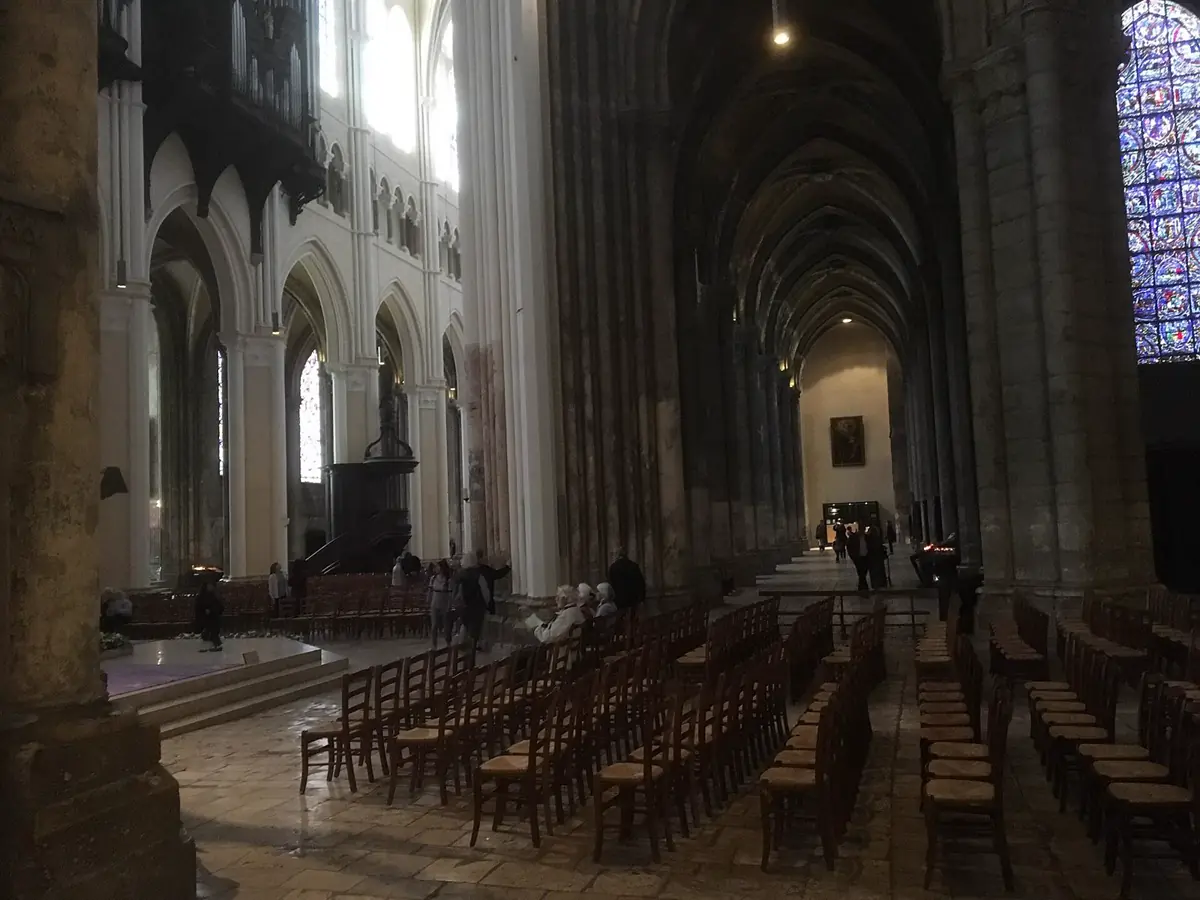
The nave of Chartres Cathedral (13th century) — built across generations by workers who knew they would never see it finished.Stephen Taber · CC BY-SA 4.0
Two books that told a story
The idea that science and religion have been at war through the whole of Western history is surprisingly recent. It was popularised by two American books of the late nineteenth century.
The first was John William Draper's History of the Conflict between Religion and Science (1874). Draper was a chemist and physician in New York, and his chief target was the Roman Catholic Church. The second was Andrew Dickson White's two-volume A History of the Warfare of Science with Theology in Christendom (1896). White was a founder of Cornell University. His book gathered every quarrel he could find between churchmen and natural philosophers across eighteen centuries and arranged them as battles in a single long war.1
Those two books shaped a century of textbooks. The phrase "warfare of science with theology" passed into common speech, and many of the stories in them are still repeated as if they were settled history.
What historians say now
Historians of science have spent the last fifty years checking those stories, and most have not survived. The British historian of science Colin Russell put the verdict plainly: "The conflict thesis, at least in its simple form, is now widely perceived as a wholly inadequate intellectual framework within which to construct a sensible and realistic historiography of Western science."2
The editor of that same volume, Gary Ferngren, notes that the more careful view has gained wide acceptance among professional historians while the old story "remains strong elsewhere, not least in the popular mind."3
In 2009 Harvard University Press published a book that took the popular myths one at a time: Galileo Goes to Jail and Other Myths about Science and Religion, edited by the historian Ronald L. Numbers. Its contributors included Christians, agnostics and atheists, and between them they dismantled stories such as the claim that Christianity caused the decline of ancient science and the claim that the medieval church taught that the earth was flat.4 The point of the book was not that Christians had always behaved well. It was that the "warfare" story is not good history.
The flat earth that nobody believed
One example shows how the myth works. Many people were taught at school that before Columbus sailed in 1492, the church taught that the world was flat, and that Columbus proved it round against the opposition of ignorant priests.
The historian Jeffrey Burton Russell showed in Inventing the Flat Earth (1991) that this is false. Educated Europeans in Columbus's day knew the earth was a sphere, and had a fair idea of its size; the argument with Columbus was about how far it was to Asia, and on that point his critics were right. Russell traced the flat-earth story to writers of the nineteenth century, among them Washington Irving, whose romantic life of Columbus first appeared in 1828, and showed how it spread with the conflict histories.5
Galileo, told straight
The case most often cited is Galileo Galilei, and it should be told honestly, because something genuinely wrong happened.
In 1616 a panel of the Roman Inquisition condemned the idea that the earth moves around the sun. In 1632 Galileo published his Dialogue Concerning the Two Chief World Systems, which argued for the sun-centred system and put the opposing view in the mouth of a character named Simplicio; it gave great offence in Rome. In 1633 the Inquisition tried him, found him "vehemently suspect of heresy," and made him recant. The sentence was commuted to house arrest, under which he lived for the rest of his life.6
Three things are worth saying. First, the churchmen who condemned Galileo were wrong, and Christians gain nothing by pretending otherwise. Second, Galileo was not an unbeliever fighting faith; he was a Catholic who believed the Bible and nature could not finally disagree, and the dispute was as much about the authority of Aristotle's physics, which the university men of his day defended, as about Scripture. Third, the popular picture of Galileo tortured and thrown into a dungeon for discovering the truth is not what the records show. He was humiliated and confined, which was bad enough.
The lesson is not that the Bible was wrong about the heavens. The Bible does not teach the Ptolemaic system. The lesson is that men can bind their own readings, and their own favourite philosophers, so tightly to the word of God that when the reading fails they think the word has failed. Christians of every age need that warning.
What is true in the story
The warfare story is bad history, but it is not built on nothing. There have been real quarrels, and there are real disagreements now, above all about origins, about whether nature is all there is, and about what a human being is. Some of those quarrels are with scientists; more are with a philosophy that often travels with science, the belief that only what science can measure is real. Part 6 takes that philosophy on directly.
What the history shows is that the quarrel is not between "science" and "faith" as such. It is between rival beliefs about what the world is. And for most of the history of modern science, the belief that the world is the ordered work of a wise Creator was not the enemy of research. It was its foundation.
This part matters because the claim that faith and science cannot mix is answered most simply by the men who mixed them. The people who laid the foundations of modern physics, chemistry, astronomy and genetics were not secular men working in spite of the church. Most of them were Christians who saw their work as a way of honouring God.
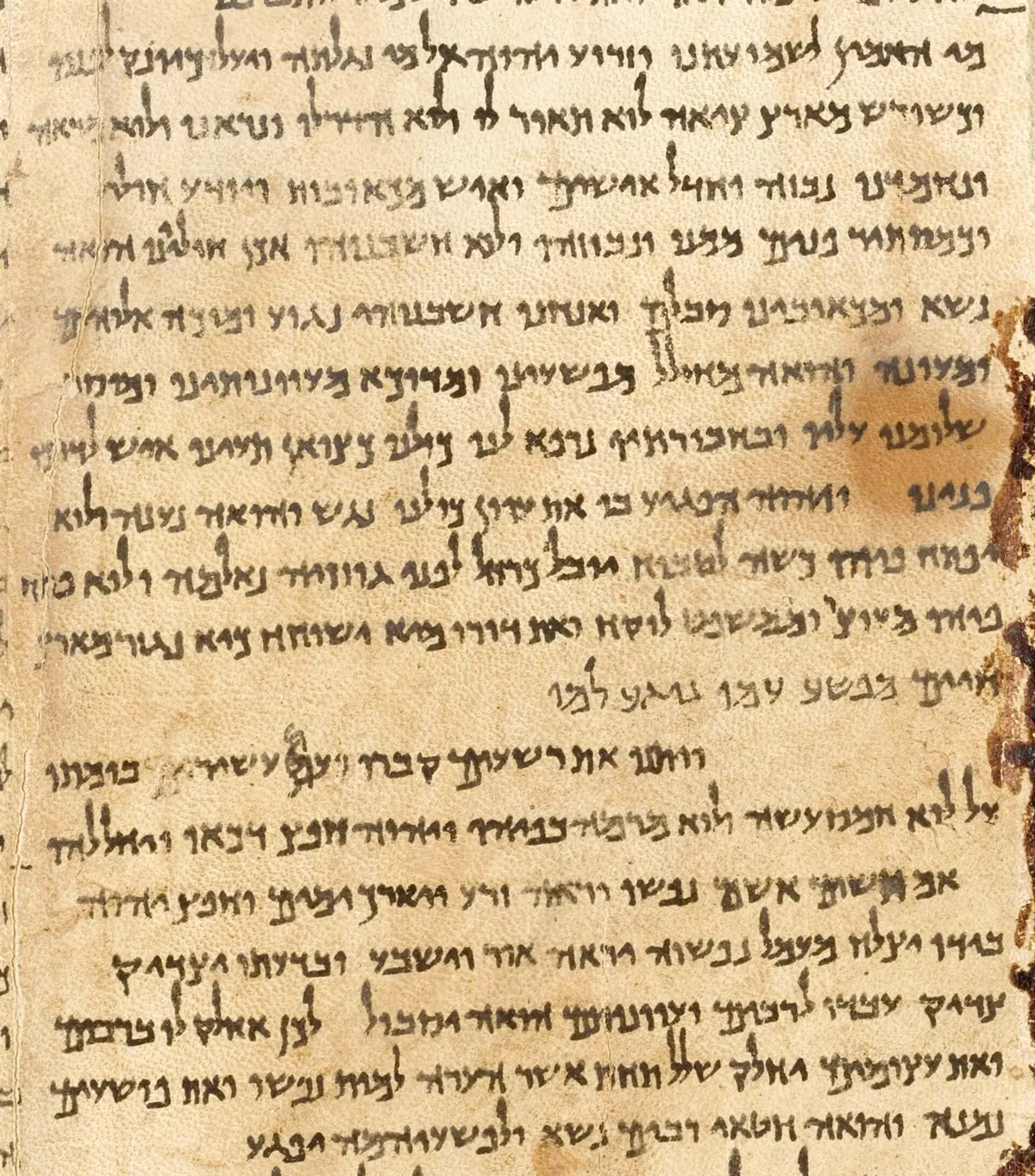
A column of the Great Isaiah Scroll (c. 125 BC) from Qumran — a complete Hebrew Isaiah a thousand years older than any copy previously known, and the text held.Photograph by Ardon Bar Hama / Google Art Project · Public domain
What follows gives each one's own words where they can be checked, and is honest where a man's beliefs differed from the faith this paper teaches.
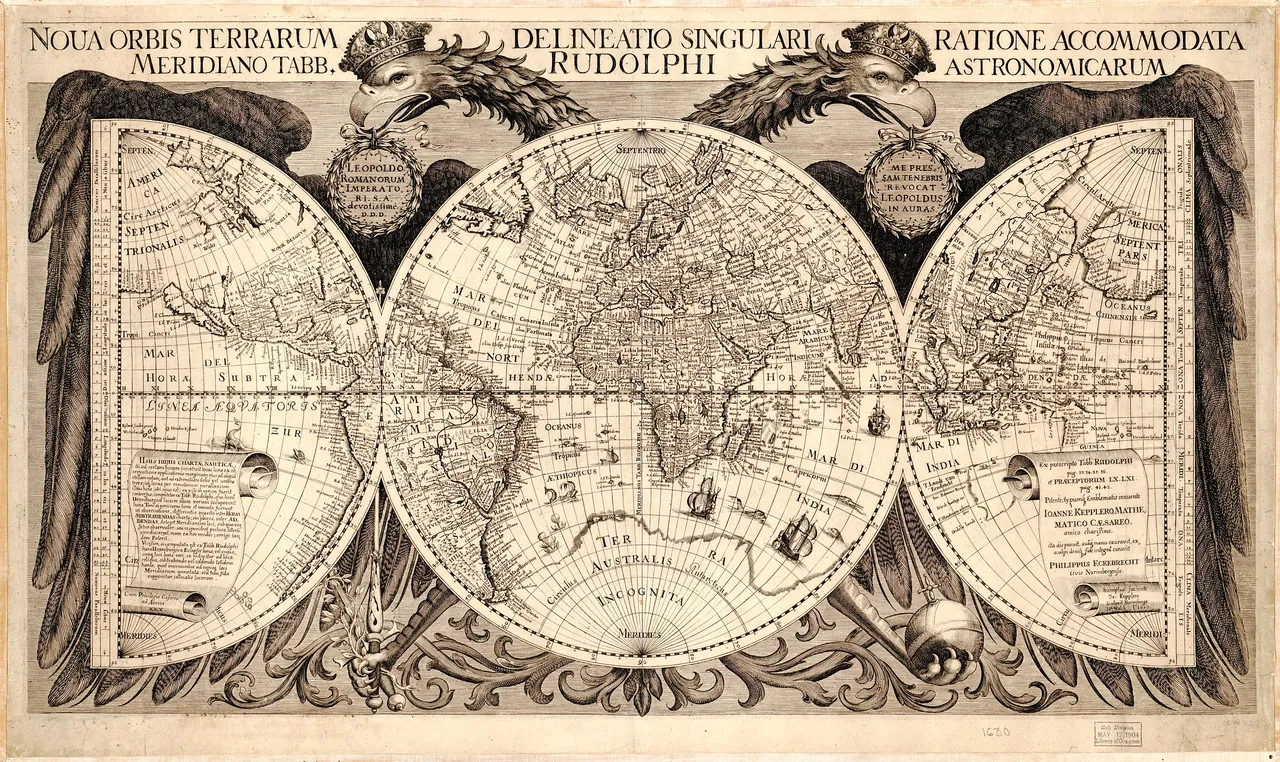
A world map of 1630 drawn to the meridian of the Rudolphine astronomical tables, made in the generation when Kepler worked out the laws of planetary motion.Noua orbis terrarum delineatio singulari ratione accommodata meridiano tabb. Rudolphi astronomicarum · 1630 · Library of Congress · Public domain · museum record · Galeria Regni
Francis Bacon and the two books
Francis Bacon (1561–1626), Lord Chancellor of England under King James I, is often called the father of the scientific method. He argued that knowledge of nature should be built by patient observation and experiment rather than by deduction from ancient authorities.
In The Advancement of Learning (1605), the same decade in which King James's translators were at work, Bacon wrote that no one should think "that a man can search too far, or be too well studied in the book of God's word, or in the book of God's works, divinity or philosophy; but rather let men endeavour an endless progress or proficience in both." He added a caution worth keeping: that men "do not unwisely mingle or confound these learnings together."7
Later in the same book he took his text from the Lord's answer to the Sadducees: “Ye do err, not knowing the scriptures, nor the power of God” (Matthew 22:29). In that saying, Bacon wrote, Christ was "laying before us two books or volumes to study, if we will be secured from error: first the Scriptures, revealing the will of God, and then the creatures expressing His power."8
Bacon also made an observation that has been quoted ever since: "a little or superficial knowledge of philosophy may incline the mind of men to atheism, but a further proceeding therein doth bring the mind back again to religion."9
Johannes Kepler
Johannes Kepler (1571–1630) discovered that the planets move in ellipses, and worked out the three laws of planetary motion that Isaac Newton would later explain by gravity. He trained at the Lutheran seminary at Tübingen to become a minister and was denied ordination over points of doctrine; he remained a committed Lutheran Christian all his life.10
Kepler saw astronomy as a kind of priestly work. In a letter of March 1598 to his patron Herwart von Hohenburg, he wrote that astronomers are priests of the highest God with respect to the book of nature, and so ought to seek His glory rather than the glory of their own cleverness.11
Robert Boyle
Robert Boyle (1627–1691), a founder of modern chemistry and one of the first fellows of the Royal Society, is remembered for Boyle's law of gases and for The Sceptical Chymist (1661), which helped turn alchemy into chemistry. He was also a devout Protestant who wrote The Christian Virtuoso (1690) to show that a man could be both an experimental scientist and a Christian. In his will he endowed the Boyle Lectures, a series of lectures to defend the Christian religion against unbelief, with the provision that disputes among Christians were not to be raised in them.12
Blaise Pascal
Blaise Pascal (1623–1662) built one of the first mechanical calculators as a teenager, helped found probability theory, and did foundational work on fluids and air pressure; the unit of pressure, the pascal, bears his name.
On the night of 23 November 1654 Pascal had an experience of God that he wrote down on a slip of paper and then sewed into the lining of his coat, where it was found after his death. It begins with the date and a single word, "FIRE." The next lines read: "GOD of Abraham, GOD of Isaac, GOD of Jacob, not of the philosophers and of the learned." A little further on: "Certitude. Certitude. Feeling. Joy. Peace." And then: "Joy, joy, joy, tears of joy."13
Pascal's point was not that philosophy is worthless; he was one of the best minds of his century. It was that the God who made the world is not an idea to be argued about but a Person to be met, the God who spoke to Moses from the bush.
Isaac Newton
Isaac Newton (1642–1727) gave the world the laws of motion, universal gravitation and much of calculus. In the General Scholium he added to the second edition of his Principia in 1713, he wrote: "This most beautiful System of the Sun, Planets, and Comets, could only proceed from the counsel and dominion of an intelligent and powerful being."14
Newton wrote more about the Bible than about physics, and he read Daniel and Revelation closely. Honesty requires one more sentence: Newton privately rejected the doctrine of the Trinity, and many scholars now describe his views as close to Arianism.15 He is a witness that the greatest scientist of his age saw the hand of God in the heavens; he is not a guide to Christian doctrine.
Michael Faraday
Michael Faraday (1791–1867), the son of a blacksmith, left school early, became an assistant at the Royal Institution in London and went on to discover electromagnetic induction, the principle behind every electric generator and transformer.
Faraday belonged all his life to the Sandemanians, a small and strict Christian church that held closely to the Bible, and served it as a deacon and twice as an elder, preaching and visiting its members.16 The historian Geoffrey Cantor, who wrote the standard study of Faraday's faith, argued that his religion and his science were not two compartments but one life.
James Clerk Maxwell
James Clerk Maxwell (1831–1879) united electricity, magnetism and light in a single set of equations, the foundation of radio, radar and much of modern physics. As a boy he could recite the whole of Psalm 119. He underwent an evangelical conversion as a young man at Cambridge, and in later life served as an elder of the Church of Scotland.17
When the Cavendish Laboratory at Cambridge was built under Maxwell as its first professor, words from Psalm 111 were carved in Latin over the great doors, according to Maxwell's wish. When the laboratory moved to new buildings in 1973, the same verse was put up in English.18 In the King James it reads:
“The works of the LORD are great, sought out of all them that have pleasure therein.” (Psalm 111:2)
That verse is as good a summary of the Christian view of science as any. The works are great; they are worth seeking out; and the people who take pleasure in them are doing something the Bible commends.
Gregor Mendel
Gregor Mendel (1822–1884), the founder of genetics, was an Augustinian friar and priest who became abbot of St Thomas's Abbey in Brno. Between 1856 and 1863 he grew and crossed thousands of pea plants in the monastery garden and worked out the rules of inheritance that bear his name. His work was ignored in his lifetime and rediscovered in 1900.19
Georges Lemaître
Georges Lemaître (1894–1966) was a Belgian Catholic priest and physicist. In 1927 he proposed that the universe is expanding, and in a short letter to Nature in 1931 he argued that, traced backward, the universe must have had a beginning in what he called a "primeval atom."20 That idea, at first resisted by leading physicists, became what is now called the Big Bang theory. Part 5 returns to it.
Others, then and now
The list could go on: the botanist John Ray, whose The Wisdom of God Manifested in the Works of the Creation (1691) shaped English natural history; the chemist and inventor George Washington Carver, born into slavery, who spoke openly of his Christian faith; and many more.
The tradition did not end in the nineteenth century. A few living or recent examples, each stated only as far as the record goes:
Raymond Damadian (1936–2022), a physician whose work on nuclear magnetic resonance led him to perform the first full-body scan of a human being in 1977, a step toward the MRI machine now in every hospital. He was an outspoken Christian and creationist. The 2003 Nobel Prize for MRI went to two other men, and Damadian publicly protested that he had been passed over; the dispute is still argued.21
James Tour, professor of chemistry at Rice University, a synthetic chemist known for work on nanotechnology, became a born-again Christian as an undergraduate. He has become one of the sharpest critics of claims that scientists understand how life began. Part 5 quotes him.22
John Lennox, emeritus professor of mathematics at the University of Oxford, has debated Richard Dawkins and Christopher Hitchens in public and written God's Undertaker: Has Science Buried God? (2007).23
Stephen Meyer, who took his doctorate in the philosophy of science at Cambridge with a dissertation on origin-of-life research, has written Signature in the Cell (2009) and Darwin's Doubt (2013), arguing that the information in living things is best explained by a designing mind.24
How many scientists believe?
It would be dishonest to leave the impression that most scientists today are Christians. They are not. In 2009 the Pew Research Center surveyed 2,533 members of the American Association for the Advancement of Science, the largest general scientific society in the United States. Thirty-three percent said they believed in God, another eighteen percent believed in a universal spirit or higher power, and forty-one percent believed in neither. Among the general public, Pew's figures were eighty-three percent and four percent. Chemists were more likely than other scientists to believe in God, and younger scientists more likely than older ones.25
Two things follow. First, a third of the members of America's largest scientific society said they believe in God; the claim that no serious scientist believes is simply false. Second, truth is not decided by a show of hands, in a laboratory or anywhere else. The question is not how many believe, but whether what they believe is true.
This part matters because it turns the usual question around. People ask whether science leaves room for God. The deeper question is why there is science at all, and why it took hold where it did.
Science needs faith before it starts
Every scientist begins with assumptions that science itself cannot prove. That nature is orderly and will behave tomorrow as it does today. That the order can be grasped by a human mind. That it is worth the effort to look, rather than merely to reason from first principles. That truth is worth knowing even when it is inconvenient.
Those are not small assumptions. Many ancient cultures did not hold them. If the world is the plaything of quarrelling gods, there is no reason to expect it to follow laws. If matter is an illusion, there is no reason to study it. If the world is divine, there is something irreverent about poking it with instruments.
The Bible teaches something different. The world is not God, so it can be studied without idolatry. It is the work of one God, faithful and wise, so it can be expected to be orderly. And human beings are made in His image, so they can expect, in a measure, to understand it.
“While the earth remaineth, seedtime and harvest, and cold and heat, and summer and winter, and day and night shall not cease.” (Genesis 8:22)
“Thus saith the LORD; If my covenant be not with day and night, and if I have not appointed the ordinances of heaven and earth;” (Jeremiah 33:25)
The New Testament goes further and says who holds it together: of Christ it says that "by him all things consist" (Colossians 1:17), and that He is "upholding all things by the word of his power" (Hebrews 1:3). The regularity the scientist depends on is, in the Bible's account, the faithfulness of a Person.
Whitehead's lecture
In 1925 the mathematician and philosopher Alfred North Whitehead gave the Lowell Lectures at Harvard, published as Science and the Modern World. Whitehead was not an orthodox Christian, which makes his argument all the more striking.
He asked where the modern scientist's confidence comes from, "the inexpugnable belief that every detailed occurrence can be correlated with its antecedents in a perfectly definite manner, exemplifying general principles. Without this belief the incredible labours of scientists would be without hope."26
His answer surprised his audience: "It must come from the medieval insistence on the rationality of God, conceived as with the personal energy of Jehovah and with the rationality of a Greek philosopher." And he concluded: "My explanation is that the faith in the possibility of science, generated antecedently to the development of modern scientific theory, is an unconscious derivative from medieval theology."27
Whitehead contrasted this with cultures in which God was thought of as "either too arbitrary or too impersonal" for such ideas to take root. A world governed by a wise and faithful Creator is a world worth investigating.
The Fall and the experiment
The Australian historian Peter Harrison added a striking piece to this picture in The Fall of Man and the Foundations of Science (2007). Harrison argues that the method of the seventeenth-century scientists was shaped by their belief in the Fall of Adam.28
The medieval thinkers, following the Greeks, had tended to trust that the human mind could reason its way to truths about nature. The Protestant thinkers of the 1600s, reading Genesis 3 seriously, were less sure. If the Fall had damaged not only the will but the mind and senses, then human reason could not be trusted on its own. It needed to be checked, slowly and repeatedly, against the world. Experiment, repeated observation, instruments that extend the senses, and communities of investigators who test one another's results were, in Harrison's account, partly a remedy for the cognitive damage of sin. Some of them, like Bacon, even spoke of science as a partial recovery of the knowledge of nature Adam had in Eden, when he named the animals.
“And out of the ground the LORD God formed every beast of the field, and every fowl of the air; and brought them unto Adam to see what he would call them: and whatsoever Adam called every living creature, that was the name thereof.” (Genesis 2:19)
That is a remarkable thing for a historian at a modern university to argue: that a literal reading of the Fall helped to produce the scientific method. It means the doctrine modern people find hardest to believe did real work in building the thing they trust most.
The mathematics that fits
There is one more puzzle. Mathematicians often work out structures for their own beauty, with no use in view, and decades later physicists find that nature runs on exactly those structures.
In 1960 the physicist Eugene Wigner, who won the Nobel Prize in 1963, wrote a famous essay called "The Unreasonable Effectiveness of Mathematics in the Natural Sciences." He did not offer a religious answer. But he closed with a sentence that has been quoted ever since: "The miracle of the appropriateness of the language of mathematics for the formulation of the laws of physics is a wonderful gift which we neither understand nor deserve."29
A gift implies a giver. The Christian has an explanation for Wigner's puzzle that the materialist does not: the mind that does the mathematics and the world that obeys it were made by the same Mind.
“It is the glory of God to conceal a thing: but the honour of kings is to search out a matter.” (Proverbs 25:2)
Searching is an honour
That proverb is worth pausing on. God does not hide things to frustrate us. He hides them, it seems, so that searching for them would be a noble work. Daniel and his friends were chosen for the king's service because they were "skilful in all wisdom, and cunning in knowledge, and understanding science" (Daniel 1:4), and the text says plainly where it came from: "God gave them knowledge and skill in all learning and wisdom" (Daniel 1:17).
The word "science" in the King James simply means knowledge. The Bible does not set knowledge against faith. "The fear of the LORD is the beginning of knowledge" (Proverbs 1:7). It is the beginning, not the end, and not the enemy.
This part matters because the sharpest disagreement between Christians and the scientific culture around them is over the first eleven chapters of the Bible. Many believers have quietly decided that those chapters are poetry or myth, so that there is nothing left to defend. This paper takes a different view, and owes the reader its reasons.
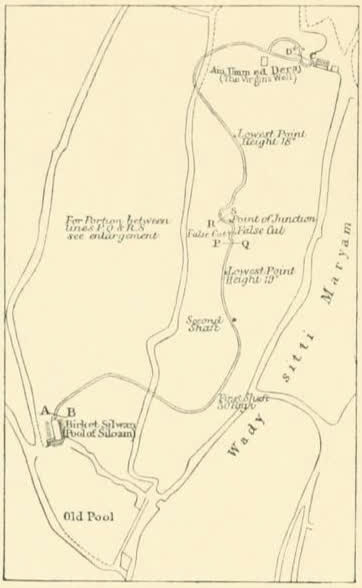
The 1884 survey sketch of Hezekiah’s tunnel beneath Jerusalem — the 8th-century-BC waterworks whose Siloam Inscription confirms the account in 2 Kings 20.Charles Warren & Claude Conder, 1884 · Public domain
What the text says
Genesis 1 describes God's work of creation in six days, each closed by the same formula.
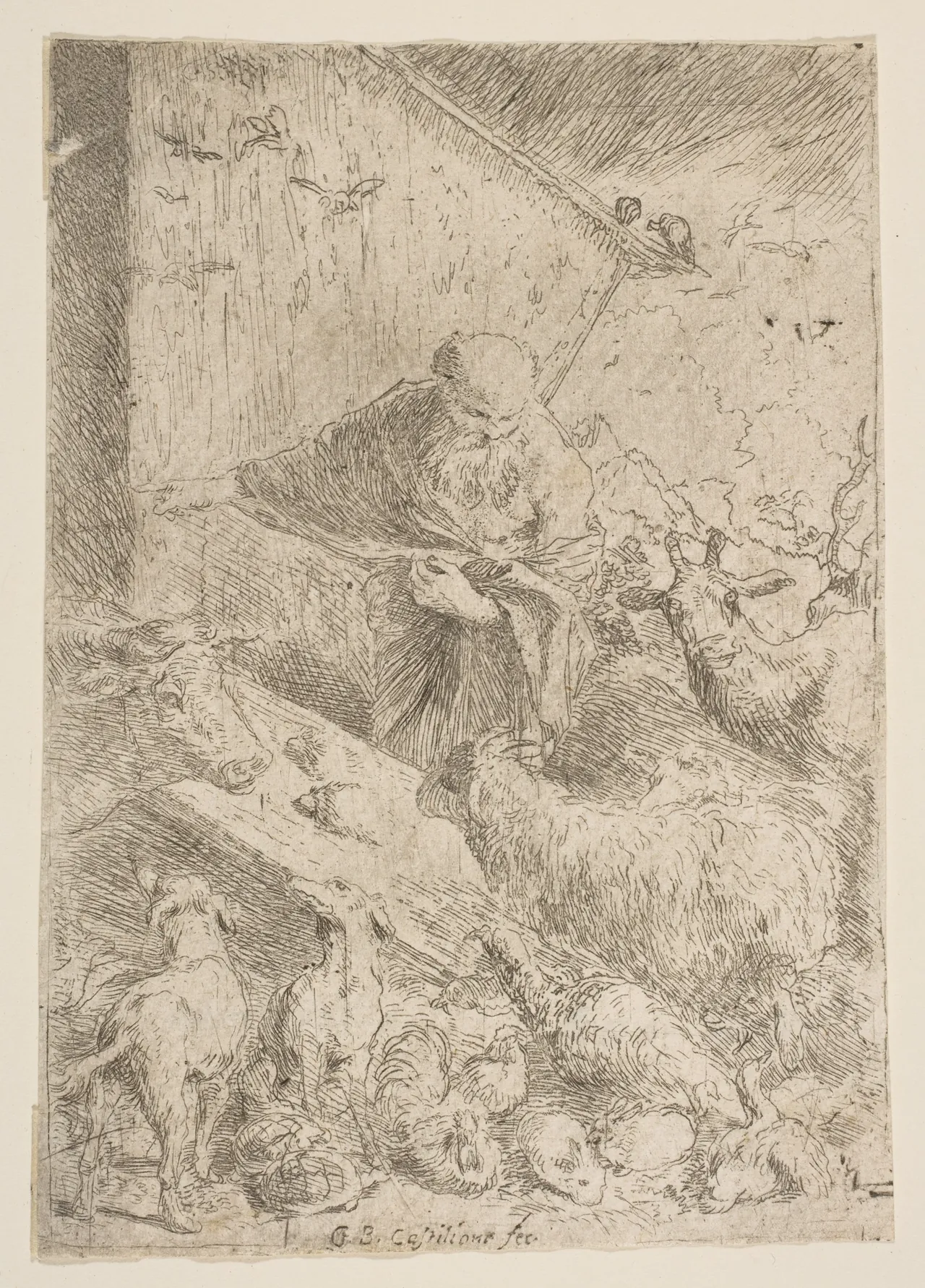
An etching of about 1630 showing Noah letting the animals into the ark, the Flood that Genesis records and this part takes up.Noah letting the animals into the ark · ca. 1630 · The Metropolitan Museum of Art · CC0 · museum record · Galeria Regni
“And God called the light Day, and the darkness he called Night. And the evening and the morning were the first day.” (Genesis 1:5)
“And God saw every thing that he had made, and, behold, it was very good. And the evening and the morning were the sixth day.” (Genesis 1:31)
“Thus the heavens and the earth were finished, and all the host of them. And on the seventh day God ended his work which he had made; and he rested on the seventh day from all his work which he had made.” (Genesis 2:1-2)
The text gives each day an evening and a morning and a number. The plainest reading is the one the readers of Moses would have taken: ordinary days. And the Bible itself reads them so. When God gave the fourth commandment at Sinai, He grounded the week of six working days and a sabbath in the week of creation:
“For in six days the LORD made heaven and earth, the sea, and all that in them is, and rested the seventh day: wherefore the LORD blessed the sabbath day, and hallowed it.” (Exodus 20:11)
If the days of Genesis 1 were vast ages or a literary frame, the commandment loses its logic. The Israelite was to work six days and rest one because God had.
Genesis also says again and again in its first chapter that living things were made to reproduce "after his kind" (Genesis 1:11, 1:24-25). The word "kind" is not the same as the modern word "species", and Christians who hold to Genesis argue about where its boundaries fall. But the text plainly teaches distinct created kinds, not one unbroken line of descent from a single first cell.
Adam and Eve were real people
Genesis presents Adam and Eve as the first man and woman, made directly by God.
“And the LORD God formed man of the dust of the ground, and breathed into his nostrils the breath of life; and man became a living soul.” (Genesis 2:7)
“And the LORD God caused a deep sleep to fall upon Adam, and he slept: and he took one of his ribs, and closed up the flesh instead thereof; And the rib, which the LORD God had taken from man, made he a woman, and brought her unto the man.” (Genesis 2:21-22)
The rest of the Bible treats them as history. Genesis 5 opens "the book of the generations of Adam" and lists his descendants by name and age. Luke traces the genealogy of Jesus back through real kings and patriarchs to "Seth, which was the son of Adam, which was the son of God" (Luke 3:38). Paul told the philosophers of Athens that God "hath made of one blood all nations of men for to dwell on all the face of the earth" (Acts 17:26). He grounded instructions for the church in the order of creation: "For Adam was first formed, then Eve" (1 Timothy 2:13).
Most weighty of all, the Lord Jesus Himself, asked about divorce, went back to the beginning:
“And he answered and said unto them, Have ye not read, that he which made them at the beginning made them male and female, And said, For this cause shall a man leave father and mother, and shall cleave to his wife: and they twain shall be one flesh?” (Matthew 19:4-5)
Mark records the saying too: "But from the beginning of the creation God made them male and female" (Mark 10:6). The Lord did not say that at the end of long ages, after countless generations of creatures had lived and died, God brought humanity on the scene. He placed man and woman at the beginning of the creation.
The Fall brought death
The heart of the matter is not the days, important as they are. It is the gospel. Paul builds his explanation of salvation on a real Adam whose real sin brought real death into the world.
“Wherefore, as by one man sin entered into the world, and death by sin; and so death passed upon all men, for that all have sinned:” (Romans 5:12)
“For since by man came death, by man came also the resurrection of the dead. For as in Adam all die, even so in Christ shall all be made alive.” (1 Corinthians 15:21-22)
“And so it is written, The first man Adam was made a living soul; the last Adam was made a quickening spirit.” (1 Corinthians 15:45)
Paul's argument runs on a parallel: one man, one act, one result, and then one Man, one act, one result. If the first Adam is a symbol, it is hard to see why the last Adam should not be one too. And Paul ties the present suffering of the whole creation to the curse that followed the Fall:
“For the creature was made subject to vanity, not willingly, but by reason of him who hath subjected the same in hope, Because the creature itself also shall be delivered from the bondage of corruption into the glorious liberty of the children of God. For we know that the whole creation groaneth and travaileth in pain together until now.” (Romans 8:20-22)
Genesis 3 says the ground itself was cursed because of Adam's sin (Genesis 3:17-19). The Bible's picture is of a very good creation spoiled by human rebellion, groaning now, and awaiting redemption.
Why theistic evolution does not fit
Some sincere Christians, among them the geneticist Francis Collins, who led the Human Genome Project, hold that God brought about life, including human life, through the process of evolution as mainstream biology describes it. Collins calls this view BioLogos and founded an organisation of that name to promote it.30 It is important to state the view fairly. Its holders believe in God, in Christ, and often in the resurrection; they believe they are taking both Scripture and science seriously.
This paper does not accept it, for reasons drawn from the text rather than from science.
It requires death long before sin. On the evolutionary account, death, disease and predation went on for countless generations before any human being existed. Paul says death entered the world by one man's sin (Romans 5:12). The two accounts cannot both be right about where death came from.
It requires that the first humans were born of earlier creatures. Genesis says Adam was formed from the dust and Eve from Adam's side (Genesis 2:7; 2:21-22). Theistic evolution must treat those statements as figures of speech, and then must explain why Luke's genealogy, Paul's sermon at Athens and the Lord's own words should be read the same way.
It weakens the gospel's logic. If Adam was not a real man whose sin brought death, Paul's comparison between Adam and Christ loses its first half. Some theistic evolutionists propose that Adam and Eve were a real couple chosen out of a larger population. That keeps the names but not the text, which says "of one blood all nations" (Acts 17:26) and that Adam was "first formed" (1 Timothy 2:13).
It reverses the order of authority. The method behind it is to take the current consensus of science as settled and then reinterpret the text to fit. Scientific consensus has changed many times; the word of God has not.
None of this is said in contempt of Christians who hold the view. It is said because the question is not which view is more respectable but which one is faithful to what God has said.
The Flood
Genesis 6–9 describes a flood sent by God in judgment on a violent world, from which Noah, his family and the animals in the ark were saved. The text describes it in universal terms:
“And, behold, I, even I, do bring a flood of waters upon the earth, to destroy all flesh, wherein is the breath of life, from under heaven; and every thing that is in the earth shall die.” (Genesis 6:17)
“And the waters prevailed exceedingly upon the earth; and all the high hills, that were under the whole heaven, were covered. Fifteen cubits upward did the waters prevail; and the mountains were covered.” (Genesis 7:19-20)
The New Testament treats the Flood as history and as a warning. The Lord Jesus compared the days before His coming to "the days of Noe," when people "did eat, they drank, they married wives, they were given in marriage, until the day that Noe entered into the ark, and the flood came, and destroyed them all" (Luke 17:26-27). Peter wrote that "the world that then was, being overflowed with water, perished" (2 Peter 3:6). Hebrews lists Noah among the heroes of faith (Hebrews 11:7).
Flood stories are found in many ancient cultures. The most famous outside the Bible was discovered in 1872, when George Smith of the British Museum read to the Society of Biblical Archaeology his translation of a Babylonian clay tablet, part of the Epic of Gilgamesh, describing a man warned by a god to build a boat and save living creatures from a great flood, who afterward sent out birds to find dry land.31 Critics took it as proof that Genesis borrowed from Babylon. Christians have long seen it the other way: that many peoples kept a distorted memory of a real event, and Genesis kept the true one. The similarity proves that the story is ancient and widespread; it cannot by itself decide which version came first.
In 1961 John C. Whitcomb and Henry M. Morris published The Genesis Flood, which argued that much of the geological record should be read as the work of the Flood rather than of slow processes over long ages. It became the founding book of the modern creationist movement.32 Christians who hold to a global Flood have built on, revised and argued over its claims ever since. This paper does not try to settle the geology. It holds to what the text says: the Flood was real and it covered the earth.
The question of age
Many readers will want to know what this means for the age of the earth. This paper deliberately makes no claim either way, and it is worth explaining why.
Genesis gives six days. It also gives genealogies with ages, and in 1650 Archbishop James Ussher of Armagh used them, with other ancient records, to calculate that creation took place in 4004 BC. His date was later printed in the margins of many English Bibles.33 Other Christians who held to the six days reasoned differently. In the early nineteenth century the Scottish preacher Thomas Chalmers, for example, taught that an unknown span of time might lie between the first verse of Genesis and the second.34 Christians who agree that the days are days have continued to disagree about the rest.
Those debates are reported here as history. What the Bible plainly teaches is what this paper defends: six days, a real Adam and Eve, a real Fall, a global Flood. Where the Bible does not print a number, this paper will not print one for it. You will find good Christians on more than one side of that question; weigh their arguments with your Bible open.
Faith that understands
The Bible does not ask us to believe the creation account because we have independently checked it. It asks us to trust the One who was there.
“Where wast thou when I laid the foundations of the earth? declare, if thou hast understanding.” (Job 38:4)
“Through faith we understand that the worlds were framed by the word of God, so that things which are seen were not made of things which do appear.” (Hebrews 11:3)
That is not a refusal to think. It is a recognition of the limits of any observer who arrived late. No scientist watched the beginning. Every account of origins, Christian or secular, reasons backward from what can be seen now under assumptions about what happened when no one was watching. The Christian's assumption is that the Creator has told us.
Part 5 — What Science Has Found That Points Beyond Itself
8 min read
This part matters because many people assume that every new discovery makes God less likely. In several of the biggest discoveries of the last century, the opposite happened. But the argument must be made carefully, and this part says what these findings can and cannot show.
A beginning
For much of the nineteenth and early twentieth centuries, many scientists assumed that the universe was eternal. An eternal universe needs no Creator; it simply is.
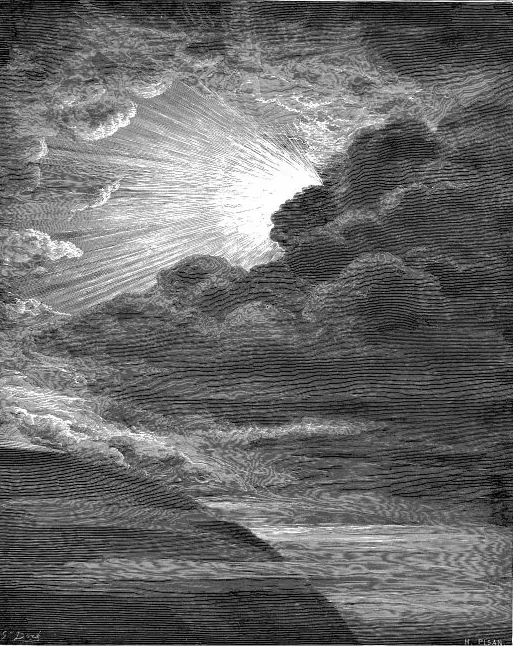
An 1866 illustration of the Creation of Light from Genesis, light breaking through cloud over the deep, a picture of the universe having a beginning.The Creation of Light · 1866 · Wikimedia Commons · Public domain · museum record · Galeria Regni
That assumption fell in the twentieth century. Lemaître proposed in 1927 that the universe is expanding, and in 1931 that it had a beginning.35 Edwin Hubble's observations of distant galaxies supported expansion. In 1964 Arno Penzias and Robert Wilson, working at Bell Laboratories in New Jersey, detected a faint microwave radiation coming from every direction in the sky, which matched a prediction of the beginning-of-the-universe model. They received the Nobel Prize in Physics in 1978 "for their discovery of cosmic microwave background radiation."36
Many physicists disliked the idea at first, precisely because a beginning sounded like creation. The astronomer Robert Jastrow, founding director of NASA's Goddard Institute for Space Studies, writing as a scientist rather than a theologian, described the moment in God and the Astronomers (1978): "For the scientist who has lived by his faith in the power of reason, the story ends like a bad dream. He has scaled the mountains of ignorance; he is about to conquer the highest peak," only to find, as Jastrow put it, a band of theologians already sitting on the summit.37
The Bible's first sentence is not a scientific paper, and the Christian should not tie it to any particular model of cosmology, which may change. But it is worth noticing that the discovery that the universe had a beginning was greeted by many scientists as an embarrassment, because it agreed with Genesis 1:1.
“In the beginning God created the heaven and the earth.” (Genesis 1:1)
A note for the careful reader: standard cosmology attaches very large ages to these events. As Part 4 explained, this paper makes no claim about age. The point here is narrower: the universe is not eternal. Something began it.
A finely balanced world
The second discovery is that the laws and constants of physics appear to be set within narrow limits that allow life to exist. If the strength of gravity, the forces that hold atoms together, or the balance of matter in the early universe were different by small amounts, there would be no stable stars, no chemistry and no life. The British Astronomer Royal Martin Rees wrote a whole book on six such numbers, Just Six Numbers (1999).38
The astronomer Fred Hoyle, who was not a Christian, worked on how stars make carbon, the element on which all life depends. He found that it requires a precise energy level in the carbon nucleus, which he predicted and which was then found. In a lecture published by the California Institute of Technology in 1981 he wrote: "A common sense interpretation of the facts suggests that a superintellect has monkeyed with physics, as well as with chemistry and biology, and that there are no blind forces worth speaking about in nature. The numbers one calculates from the facts seem to me so overwhelming as to put this conclusion almost beyond question."39
Hoyle did not become a Christian, and his "superintellect" was not the God of the Bible. That is what makes his words useful: he reached the edge of design reasoning from the numbers, not from Sunday school.
The usual answer to fine-tuning is to propose that ours is one of a vast or infinite number of universes, each with different settings, so that one like ours was bound to turn up. That may be so; no one has observed another universe, and the proposal is, by its nature, very hard to test. The Christian should notice that the alternative to a Designer has had to become enormous and invisible.
“For thus saith the LORD that created the heavens; God himself that formed the earth and made it; he hath established it, he created it not in vain, he formed it to be inhabited: I am the LORD; and there is none else.” (Isaiah 45:18)
The information in the cell
The third discovery came from biology. In 1953 Francis Crick and James Watson described the structure of DNA, and in the years that followed scientists learned that it carries a code: sequences of four chemical letters that specify how to build proteins, the machines of the cell. Every living thing runs on written instructions.
That raises the question of where the first instructions came from. Francis Crick, a lifelong unbeliever, wrote in Life Itself (1981) that an honest man, with all the knowledge then available, could only say that "the origin of life appears at the moment to be almost a miracle," because so many conditions would have to be satisfied to get it going. Crick added at once that this did not mean life could not have arisen by ordinary chemistry; only that no one knew how.40
Forty years of research later, the chemist James Tour argued that the gap has not closed. Writing for the general reader in 2016, he said that biologists suppose there are well-understood chemical pathways to the molecules of life and "have been grossly misinformed," and he put the state of the field bluntly: "Those who think scientists understand the issues of prebiotic chemistry are wholly misinformed. Nobody understands them. Maybe one day we will. But that day is far from today."41
Stephen Meyer's Signature in the Cell (2009) makes the next step of the argument: in every case where we know the cause of specified information, such as a sentence, a program or a blueprint, the cause is a mind; so the information in DNA is best explained by a mind.42 Critics reply that this is an argument from present ignorance, and that chemistry may yet find a path. The reader can weigh both. What cannot honestly be said is that science has shown how life arose from non-life without a Maker. It has not.
“I will praise thee; for I am fearfully and wonderfully made: marvellous are thy works; and that my soul knoweth right well.” (Psalm 139:14)
The sudden appearance of animals
Charles Darwin knew that his theory predicted a long, slow, branching history, and that the fossil record did not show one at its base. In the oldest rocks with abundant animal fossils, which geologists now call Cambrian and which Darwin called the lowest Silurian, many major groups of animals appear without the long series of ancestors his theory required. Darwin faced this squarely in the Origin of Species (1859): "The case at present must remain inexplicable; and may be truly urged as a valid argument against the views here entertained."43
Darwin hoped later discoveries would fill the gap. Meyer's Darwin's Doubt (2013) argues that they have not, and that the problem is now sharper, because the animals that appear carry vast new amounts of genetic information. Most biologists disagree with Meyer, and the debate continues.44 The Christian reader should take two things from it: Darwin himself admitted the difficulty, and the record shows creatures appearing as distinct kinds, which is what Genesis would lead us to expect.
The mind that does the science
The fourth puzzle is the scientist himself. If the human mind is nothing but the product of unguided processes that selected for survival, not for truth, why should we trust it to reach truth about the origin of the universe?
Darwin felt the force of this. In a letter of 3 July 1881 to William Graham, he wrote that Graham had expressed his inward conviction that the universe is not the result of chance. "But then with me the horrid doubt always arises whether the convictions of man's mind, which has been developed from the mind of the lower animals, are of any value or at all trustworthy. Would any one trust in the convictions of a monkey's mind, if there are any convictions in such a mind?"45
The biologist J. B. S. Haldane, no Christian, made the same point in 1927: "For if my mental processes are determined wholly by the motions of atoms in my brain I have no reason to suppose that my beliefs are true. They may be sound chemically, but that does not make them sound logically. And hence I have no reason for supposing my brain to be composed of atoms."46
C. S. Lewis, a former atheist, built this into an argument in Miracles (1947): reasoning that is wholly the product of non-rational causes cannot be trusted to give us truth, so if we trust our reason, as every scientist must, we already assume it is more than chemistry.47 The atheist philosopher Thomas Nagel went further in 2012, in a book whose subtitle caused a storm: Mind and Cosmos: Why the Materialist Neo-Darwinian Conception of Nature Is Almost Certainly False. Nagel did not become a believer; he argued that materialism cannot account for consciousness, reason or value.48
The Christian has a ready answer to Darwin's horrid doubt. Our minds can be trusted, within limits, because they were made by a rational God in His image to know His world. "So God created man in his own image" (Genesis 1:27).
What these arguments can and cannot do
A careful word is needed here. None of these findings proves the gospel. A beginning, fine-tuning, information and mind point to a Creator who is powerful, intelligent and purposeful. That fits what Paul says in Romans:
“For the invisible things of him from the creation of the world are clearly seen, being understood by the things that are made, even his eternal power and Godhead; so that they are without excuse:” (Romans 1:20)
But the creation does not tell you that the Creator became a man, died for sinners and rose again. That comes by His word. "So then faith cometh by hearing, and hearing by the word of God" (Romans 10:17).
Christians must also avoid what is called the "God of the gaps": pointing to whatever science has not yet explained and saying, "That is where God is." When the gap closes, God seems to shrink. John Lennox makes the point that the Christian argument is not from what we do not know but from what we do know: that information comes from minds, that beginnings have causes, that law implies a lawgiver. And he insists that God is not only the explanation of the gaps but of the whole of nature, the parts science understands as much as the parts it does not.49 The God of the Bible is not a stopgap. He is the reason there is anything to study.
“The heavens declare the glory of God; and the firmament sheweth his handywork. Day unto day uttereth speech, and night unto night sheweth knowledge. There is no speech nor language, where their voice is not heard.” (Psalm 19:1-3)
This part matters because a skeptic deserves straight answers to the objections he actually holds. Each of the following is common. Each is answered as briefly as honesty allows.
"Faith is believing without evidence."
That is not how the Bible uses the word. Biblical faith is trust in a God who has given reasons to trust Him. "Faith is the substance of things hoped for, the evidence of things not seen" (Hebrews 11:1). The apostles appealed constantly to what they had seen and heard. Luke wrote his Gospel from eyewitness sources "that thou mightest know the certainty of those things" (Luke 1:4). Paul told a Roman governor that the resurrection "was not done in a corner" (Acts 26:26). Believers are told to "be ready always to give an answer to every man that asketh you a reason of the hope that is in you with meekness and fear" (1 Peter 3:15).
Every scientist also lives by trust: in the reliability of his instruments, the honesty of his colleagues, the regularity of nature and the soundness of his own mind. The question is never whether we trust, but whether what we trust is trustworthy. C. S. Lewis, in an address to the Oxford Socratic Club, put the Christian position in a sentence now carved on his memorial in Westminster Abbey: "I believe in Christianity as I believe that the sun has risen: not only because I see it, but because by it I see everything else."50
"Science has shown that nature is all there is."
Science has shown no such thing, and cannot. It is worth separating two ideas that are often run together.
Methodological naturalism is a rule of method: when doing an experiment, look for natural causes. Christians can work by that rule in the laboratory, and Christians invented much of the laboratory. If my car will not start, I look at the battery first.
Metaphysical naturalism is a belief about reality: that natural causes are the only causes there are, and that nothing exists beyond matter and energy. That is not a finding of science. It is a philosophy, and it cannot be tested by any experiment, because every experiment can only detect what it is built to detect. A metal detector that finds no gold on a beach has not proved that there is no wood there.
Paul warns of this very danger: "Beware lest any man spoil you through philosophy and vain deceit, after the tradition of men, after the rudiments of the world, and not after Christ" (Colossians 2:8). The problem is not science. It is a philosophy dressed as science.
"Miracles break the laws of nature."
The laws of nature describe what happens when nothing outside nature acts. They do not forbid anything outside nature from acting. If I put a hundred dollars in a drawer and the next day find fifty, the laws of arithmetic have not been broken; a thief has interfered. In the same way, a miracle does not break the laws of nature; it is God acting in the world He made. Lewis argues this at length in Miracles, and it is still the clearest treatment for a general reader.51
The real question is not whether miracles are possible, but whether there is a God. If there is, miracles are possible by definition. And whether one particular miracle happened, above all the resurrection of Jesus, is a question of history and testimony, which can be investigated like any other.
"Who made God?"
The question assumes that God is the kind of thing that needs a maker. But the Christian claim is that God is not a thing in the universe; He is the eternal, uncaused Creator of it. The argument from the beginning of the universe is that whatever begins to exist has a cause. The universe began to exist; God did not. Asking who made God is like asking whom the bachelor is married to.
“Remember the former things of old: for I am God, and there is none else; I am God, and there is none like me,” (Isaiah 46:9)
"Evolution has disproved Genesis."
This is the objection most believers are least prepared for, so it deserves the longest answer.
First, the facts about scientists. In 2009, Pew found that ninety-seven percent of the AAAS scientists it surveyed said humans and other living things had evolved over time, and eighty-seven percent said this was due to natural processes such as natural selection.52 There is no point pretending otherwise. The Christian who holds to Genesis is, on this question, out of step with most professional scientists, and should say so honestly rather than claim the experts are secretly on his side.
Second, the word "evolution" covers several different claims, and it helps to separate them:
| Claim | What it means | Where it stands | |---|---|---| | Change over time | Populations vary and change from generation to generation | Observed; no Christian should deny it | | Natural selection | Some variations survive and spread better than others | Observed; beak sizes in finches, bacteria resisting antibiotics | | Common ancestry of all life | Every living thing descends from one first cell | An inference about the unobserved past; contrary to Genesis | | Unguided origin | The whole process needed no mind and no plan | A philosophical claim, not a finding of experiment |
Genesis has no quarrel with the first two. Living things were made to vary and to fill the earth, "after his kind." The quarrel is with the last two, and especially with the claim that human beings descend from animals rather than from Adam, and that death was at work long before sin. Part 4 explained why the text rules those out.
Third, the Christian should avoid two errors. One is to call every scientist who accepts evolution a liar or a fool. Most are neither; they are interpreting evidence within a framework they were trained in. The other is to treat the framework as beyond question. Darwin himself, as Part 5 showed, called the sudden appearance of animals a "valid argument" against his view. Scientific frameworks have been overturned before.
Paul warned Timothy to avoid "oppositions of science falsely so called" (1 Timothy 6:20). The word there means knowledge, and Paul was writing about false teachers in his own day, not modern biology. But the principle holds: not everything that calls itself knowledge is knowledge. Test everything. "Prove all things; hold fast that which is good" (1 Thessalonians 5:21).
"Intelligent people don't believe."
Some do and some do not. A third of the members of America's largest scientific society believe in God, by Pew's count. The founders of modern physics, chemistry and genetics did. Some of the most brilliant people alive today do. And some of the most brilliant people alive today do not.
The Bible is not surprised by that. Paul wrote that “not many wise men after the flesh, not many mighty, not many noble, are called” (1 Corinthians 1:26). He also described people who knew God and "glorified him not as God, neither were thankful; but became vain in their imaginations, and their foolish heart was darkened. Professing themselves to be wise, they became fools" (Romans 1:21-22). Intelligence is a gift. It does not by itself make a person humble enough to bow.
This part matters because the goal of this paper is not to win an argument. It is to help believers study God's world with open eyes and an open Bible, and to help skeptics see that they need not choose between their minds and their Maker.
The first commission was to study and care
The first command God gave the human race was a command to fill and manage the earth.
“And God blessed them, and God said unto them, Be fruitful, and multiply, and replenish the earth, and subdue it: and have dominion over the fish of the sea, and over the fowl of the air, and over every living thing that moveth upon the earth.” (Genesis 1:28)
“And the LORD God took the man, and put him into the garden of Eden to dress it and to keep it.” (Genesis 2:15)
Dominion is not permission to exploit; it is a steward's charge. To "dress" and "keep" a garden you must know how it works. Farming, medicine, engineering, conservation and research are all, rightly done, ways of keeping that first command.
Medicine and healing
The Bible honours the physician. Luke, who wrote a quarter of the New Testament, was "the beloved physician" (Colossians 4:14). Christians founded many of the world's hospitals. The MRI machine that scans a patient today owes something to a Christian physician in New York.
A believer who goes to the doctor is not showing a lack of faith, any more than a farmer who plants seed is doubting God's promise of harvest. God works through means. Pray for healing, and take the medicine.
For students
If you are a Christian student in a science class, a few things may help.
Study hard. Daniel did not refuse the learning of Babylon; he mastered it and stayed faithful. "God gave them knowledge and skill in all learning and wisdom" (Daniel 1:17). Be the best student in the room.
Know the difference between data and interpretation. What a fossil is, where it was found and what rock surrounds it are data. What it means about the unobserved past is interpretation. Learn both, and notice which is which.
Be honest on exams and in class. If you are asked what the textbook teaches, say what it teaches. You can explain a view without holding it. Honesty is a Christian virtue before it is a scientific one.
Read the primary sources. Darwin's Origin is free online; so are Bacon, Boyle and Newton. You will often find that the original is more careful, and more interesting, than the summary.
Keep reading your Bible. The pressure on a student's faith rarely comes from one decisive argument. It comes from slow neglect. Read Genesis, Job, the Psalms and John alongside your textbooks.
Talking with a skeptical friend
Suppose a friend says to you, "I can't believe the Bible; I believe in science." You do not need to win a debate on the spot. A few gentle questions often help more than a lecture:
What do you mean by "science"? The method of testing ideas by observation, or the belief that nothing exists beyond nature?
Did you know that the founders of modern science were mostly Christians, and many said their faith was the reason they did science?
Why do you think the universe is orderly enough to study at all?
Have you read the Gospels for yourself, as historical documents, and asked what happened at the empty tomb?
Then listen. Many people who say "science" are really saying something else: that a church hurt them, that a prayer went unanswered, or that they are afraid of what God might ask. "Be ready always to give an answer… with meekness and fear" (1 Peter 3:15), and remember that the answer is a Person, not a point.
Humility on both sides
Science at its best is humble. It knows its findings are provisional and its instruments limited. The Christian should be humble too: about what he does not understand in nature, and about his own interpretations of Scripture, while being firm about what Scripture plainly says.
“O the depth of the riches both of the wisdom and knowledge of God! how unsearchable are his judgments, and his ways past finding out!” (Romans 11:33)
“For now we see through a glass, darkly; but then face to face: now I know in part; but then shall I know even as also I am known.” (1 Corinthians 13:12)
This paper began with a story: that science and faith are enemies, and that every thinking person must choose. The story does not survive contact with history. It was popularised by two books of the late nineteenth century, and historians of science have spent fifty years taking it apart.
What took its place is richer. The men who built modern science — Bacon, Kepler, Boyle, Pascal, Newton, Faraday, Maxwell, Mendel, Lemaître — studied nature because they believed it was the ordered work of a wise God. Thinkers who were not Christians, from Whitehead to Wigner, have admitted that science rests on assumptions that are hard to explain without Him. And some of the greatest discoveries of the last century, a universe that began, laws balanced to allow life, a code at the heart of every cell, a mind able to understand it all, are what a Christian would expect.
Genesis does not need to be rescued from science by being turned into poetry. It can be read as written: six days, a real Adam and Eve, a real Fall, a global Flood. Where honest questions remain, and some do, the believer can hold them with patience, because he knows who wrote both books.
Two books, one Author, one final word
Bacon spoke of two books: Scripture, revealing the will of God, and the creatures, expressing His power. That is a good picture, with one correction. The two books are not equal. Nature is read by fallen readers with limited instruments, and its readings change. Scripture is God's own word, and it is the final authority by which every human reading, including our readings of nature, must be judged.
“By the word of the LORD were the heavens made; and all the host of them by the breath of his mouth.” (Psalm 33:6)
An invitation
If you are a skeptic, I ask only this: read the book you are rejecting. I decided to read the Bible for one reason: to disprove it, so I'd have an excuse to stop going to church for good. It did the opposite. Genesis gripped me. In Matthew I read Jesus' own words and felt the weight of my own sin for the first time. Then one day I got on my knees and prayed: "Jesus, if you are real, show me — and I'll serve you."
The God who made the heavens did not stay at a distance. "In the beginning was the Word, and the Word was with God, and the Word was God" (John 1:1), and that Word became flesh, died for sinners and rose again. He calls for repentance toward God and faith toward our Lord Jesus Christ (Acts 20:21), and He promises, "him that cometh to me I will in no wise cast out" (John 6:37).
You can begin today, free, in the 1611 Reader at kylelauriano.com/library. Start with Genesis, then read John.
“Come unto me, all ye that labour and are heavy laden, and I will give you rest. Take my yoke upon you, and learn of me; for I am meek and lowly in heart: and ye shall find rest unto your souls. For my yoke is easy, and my burden is light.” (Matthew 11:28-30)
1John William Draper, History of the Conflict between Religion and Science (New York, 1874); Andrew Dickson White, A History of the Warfare of Science with Theology in Christendom, 2 vols. (1896). On the place of both books in the "conflict thesis," see Colin A. Russell in Gary B. Ferngren, ed., Science and Religion: A Historical Introduction (Baltimore: Johns Hopkins University Press, 2002), 7.↩
2Colin A. Russell, in Ferngren, ed., Science and Religion: A Historical Introduction, 7.↩
3Gary B. Ferngren, introduction to Science and Religion: A Historical Introduction, x.↩
4Ronald L. Numbers, ed., Galileo Goes to Jail and Other Myths about Science and Religion (Cambridge, MA: Harvard University Press, 2009).↩
5Jeffrey Burton Russell, Inventing the Flat Earth: Columbus and Modern Historians (New York: Praeger, 1991).↩
6On the 1616 and 1633 proceedings and the sentence, see Maurice A. Finocchiaro, ed., The Galileo Affair: A Documentary History (Berkeley: University of California Press, 1989); and Numbers, ed., Galileo Goes to Jail.↩
7Francis Bacon, The Advancement of Learning (1605), Book 1, I.3. https://www.gutenberg.org/ebooks/5500.↩
8Bacon, The Advancement of Learning, Book 1, VI.16.↩
9Bacon, The Advancement of Learning, Book 1, I.3.↩
10On Kepler's training at the Tübinger Stift and his exclusion from the Lutheran ministry over the Formula of Concord, see Max Caspar, Kepler, trans. C. Doris Hellman (New York: Dover, 1993).↩
11Kepler to Herwart von Hohenburg, 26 March 1598, in Johannes Kepler, Gesammelte Werke, vol. 13 (Munich: C. H. Beck, 1937–), letter 91, p. 193. The paraphrase follows the translation given in the Interdisciplinary Encyclopedia of Religion and Science, https://inters.org/node/653.↩
12Robert Boyle, The Sceptical Chymist (London, 1661); Boyle, The Christian Virtuoso (London, 1690); Michael Hunter, ed., Robert Boyle Reconsidered (Cambridge: Cambridge University Press, 1994).↩
13Blaise Pascal, "The Memorial" (1654), English translation at the Christian Classics Ethereal Library, https://ccel.org/ccel/pascal/memorial/memorial.i.html.↩
14Isaac Newton, "General Scholium," in The Mathematical Principles of Natural Philosophy, trans. Andrew Motte (London, 1729). The Scholium first appeared in the second Latin edition of the Principia (1713). Text at https://isaac-newton.org/general-scholium/.↩
15Rob Iliffe, Priest of Nature: The Religious Worlds of Isaac Newton (New York: Oxford University Press, 2017).↩
16Geoffrey Cantor, Michael Faraday: Sandemanian and Scientist (London: Macmillan, 1991).↩
17Basil Mahon, The Man Who Changed Everything: The Life of James Clerk Maxwell (Chichester: Wiley, 2003); Lewis Campbell and William Garnett, The Life of James Clerk Maxwell (London: Macmillan, 1882).↩
18On the inscription, Magna opera Domini exquisita in omnes voluntates ejus, and its English copy of 1973, see the account by A. B. Pippard, former Cavendish Professor, summarised by the Faraday Institute for Science and Religion, https://faraday.cam.ac.uk/churches/church-resources/posts/172.↩
19Robin Marantz Henig, The Monk in the Garden: The Lost and Found Genius of Gregor Mendel (Boston: Houghton Mifflin, 2000).↩
20Georges Lemaître, "The Beginning of the World from the Point of View of Quantum Theory," Nature 127 (9 May 1931): 706.↩
21On Damadian's 1977 scan and the Nobel controversy, see Kenneth Chang, "Denied Nobel for M.R.I., He Wins Another Prize," New York Times, March 23, 2004.↩
22On Tour's conversion and his criticism of origin-of-life research, see James Tour, "Animadversions of a Synthetic Chemist," Inference: International Review of Science 2, no. 2 (May 2016).↩
23John C. Lennox, God's Undertaker: Has Science Buried God?, updated ed. (Oxford: Lion Hudson, 2009). Lennox debated Dawkins in Birmingham, Alabama, on 3 October 2007 ("The God Delusion Debate with Richard Dawkins," johnlennox.org, https://johnlennox.org/video/the-god-delusion-debate-with-richard-dawkins/), and later at the Oxford University Museum of Natural History ("Has Science Buried God? Richard Dawkins and John Lennox Debate," johnlennox.org, https://johnlennox.org/video/has-science-buried-god-richard-dawkins-and-john-lennox-debate/).↩
24Stephen C. Meyer, Signature in the Cell: DNA and the Evidence for Intelligent Design (New York: HarperOne, 2009); Meyer, Darwin's Doubt: The Explosive Origin of Animal Life and the Case for Intelligent Design (New York: HarperOne, 2013).↩
25Pew Research Center, "Scientists and Belief," November 5, 2009, https://www.pewresearch.org/religion/2009/11/05/scientists-and-belief/; the sample of 2,533 AAAS members is reported in Pew Research Center, "Public Praises Science; Scientists Fault Public, Media," July 9, 2009, https://www.pewresearch.org/politics/2009/07/09/public-praises-science-scientists-fault-public-media/. Pew notes that AAAS members may not represent all American scientists.↩
26Alfred North Whitehead, Science and the Modern World: Lowell Lectures, 1925 (New York: Macmillan, 1925), chap. 1, "The Origins of Modern Science." https://www.gutenberg.org/ebooks/68611.↩
27Whitehead, Science and the Modern World, chap. 1.↩
28Peter Harrison, The Fall of Man and the Foundations of Science (Cambridge: Cambridge University Press, 2007).↩
29Eugene P. Wigner, "The Unreasonable Effectiveness of Mathematics in the Natural Sciences," Communications on Pure and Applied Mathematics 13, no. 1 (1960): 1–14.↩
30Francis S. Collins, The Language of God: A Scientist Presents Evidence for Belief (New York: Free Press, 2006).↩
31George Smith read his paper "The Chaldean Account of the Deluge" to the Society of Biblical Archaeology in London on 3 December 1872. See George Smith, The Chaldean Account of Genesis (London: Sampson Low, 1876).↩
32John C. Whitcomb and Henry M. Morris, The Genesis Flood: The Biblical Record and Its Scientific Implications (Philadelphia: Presbyterian and Reformed, 1961).↩
33James Ussher, Annales veteris testamenti, a prima mundi origine deducti (London, 1650).↩
34On Chalmers and the "gap" reading, see Randy Moore and Mark D. Decker, More Than Darwin: An Encyclopedia of the People and Places of the Evolution-Creationism Controversy (Westport, CT: Greenwood Press, 2008). On the creationist movement generally, see Ronald L. Numbers, The Creationists: From Scientific Creationism to Intelligent Design, expanded ed. (Cambridge, MA: Harvard University Press, 2006).↩
35Lemaître, "The Beginning of the World from the Point of View of Quantum Theory," 706.↩
36The Nobel Prize in Physics 1978, NobelPrize.org, https://www.nobelprize.org/prizes/physics/1978/summary/.↩
37Robert Jastrow, God and the Astronomers (New York: W. W. Norton, 1978).↩
38Martin Rees, Just Six Numbers: The Deep Forces That Shape the Universe (London: Weidenfeld & Nicolson, 1999).↩
39Fred Hoyle, "The Universe: Past and Present Reflections," Engineering and Science 45, no. 2 (November 1981): 8–12, at 12. https://calteches.library.caltech.edu/527/.↩
40Francis Crick, Life Itself: Its Origin and Nature (New York: Simon & Schuster, 1981), 88.↩
43Charles Darwin, On the Origin of Species by Means of Natural Selection (London: John Murray, 1859), chap. 9, "On the Imperfection of the Geological Record." https://www.gutenberg.org/ebooks/1228.↩
45Charles Darwin to William Graham, 3 July 1881, Darwin Correspondence Project, letter no. 13230, https://www.darwinproject.ac.uk/letter/DCP-LETT-13230.xml.↩
46J. B. S. Haldane, "When I Am Dead," in Possible Worlds and Other Essays (London: Chatto & Windus, 1927), 209.↩
47C. S. Lewis, Miracles: A Preliminary Study (London: Geoffrey Bles, 1947), chap. 3.↩
48Thomas Nagel, Mind and Cosmos: Why the Materialist Neo-Darwinian Conception of Nature Is Almost Certainly False (New York: Oxford University Press, 2012).↩
The Bible makes one promise on page three. I believe its name is Jesus. Eight pages, to the empty tomb.
Eight passages in the 1611 King James, one a morning, that I believe are one story about Jesus — from the serpent’s head, through the giants, to the empty tomb. The page, a work of art, a clip, and a real person who says they met him. Free.
Some of the answers in this resource are strong — well-attested, widely accepted, and historically grounded. Others are an honest step of faith — positions I hold because of Scripture and personal experience, not because I can prove them in a lab. I've tried to be clear about which is which. Where I'm less certain, I say so.