The Great Isaiah Scroll from the caves of Qumran

Seeker · Evidence

Photo © The Israel Museum, Jerusalem / Ardon Bar Hama · Public domain

Walk the evidence — a 5-minute interactive documentary→Back to Research Hub

The Ancient Giants

Read the paper (PDF)·or read it here ↓

WHAT THE BIBLE SAYS, WHAT THE ANCIENTS SAID, WHAT WE CANNOT YET SAY

A study of the giants of Scripture, from Genesis 6 to the sons of the giant in Gath, read beside the oldest Jewish and Christian witnesses and weighed honestly against the evidence.

Abstract

The King James Bible names giants again and again, from "There were giants in the earth in those days" (Genesis 6:4) to Og's iron bedstead, the sons of Anak at Hebron and the four sons of the giant who fell in Gath. Who were they, where did they come from, and does any of it hold up? This paper reads every major giant passage in the King James Bible with Strong's Concordance, then sets beside it the earliest witnesses outside Scripture: 1 Enoch, Jubilees and the Book of Giants from Qumran, Josephus, Justin Martyr, Julius Africanus, the rabbis and Augustine. It looks at the Egyptian texts that name the Anakim, the excavations at Gath, the debate over Goliath's height, and the hoaxes that have muddied the subject. It concludes that the giants are history, as the Bible presents them; that the oldest reading of Genesis 6 takes the sons of God to be angels; and that what the ancients added about the giants is witness, not Scripture. It is written for seekers who have heard wild claims and want the text.

What’s inside

  1. Introduction
  2. Part 1: Giants Before the Flood: Genesis 6
  3. Part 2: Giants in the Land: Rephaim, Anakim, Emim, Og
  4. Part 3: Goliath and the Sons of the Giant
  5. Part 4: Giants in the Egyptian Record
  6. Part 5: The Giants in Ancient Jewish and Christian Witness
  7. Part 6: Bones, Hoaxes and Honest Limits
  8. Part 7: Why the Giants Matter
  9. Conclusion

Research paper · 9 chapters · 36 notes · October 2026

The giants the Bible names

Named peoples in named places, as the King James Bible gives them. The paper reads each passage in full. I hold these as history. This is my conviction; weigh it for yourself.

The Rephaim, Emim and Zamzummim

Genesis 14:5 · Deuteronomy 2:10–11, 20–21

Peoples counted as giants east of the Jordan, at Ashteroth Karnaim, in Moab and in Ammon, before Israel came into the land.

Og king of Bashan

Deuteronomy 3:11

The last of the remnant of giants east of the Jordan. His bedstead of iron, nine cubits by four after the cubit of a man, was kept at Rabbath of the children of Ammon.

The sons of Anak

Numbers 13:33 · Joshua 11:21–22 · Joshua 15:14

Sheshai, Ahiman and Talmai at Hebron. Joshua cut the Anakims off from Hebron, Debir and Anab; a remnant was left only in Gaza, Gath and Ashdod.

Goliath of Gath

1 Samuel 17:4

Six cubits and a span in the King James Bible: about 8 ft 8 in to 9 ft 9 in, by the cubit used. Most Greek copies, one Dead Sea scroll and Josephus read four cubits and a span; the paper keeps the 1611 reading and sets out the debate.

The sons of the giant in Gath

2 Samuel 21:15–22

Four men born to the giant in Gath, one of them with six fingers on each hand and six toes on each foot, who fell by the hand of David and his servants.

Read the paper here

About 42 minutes · 9 parts · the PDF has the same text

Introduction

3 min read

Most people meet the giants of the Bible in one story. A shepherd boy with a sling, a champion of Gath, a stone, a fall. Children hear it in Sunday school and adults use it as a figure of speech for any underdog. Very few go on to notice that Goliath is not alone. The Bible has a great deal to say about giants, and it says it plainly, in the same voice it uses for kings, wars and genealogies.

This paper is about that wider story. It matters for three reasons.

First, it matters because it is in the text. If the King James Bible is the word of God, then Genesis 6, Numbers 13, Deuteronomy 2 and 3, Joshua 11 to 15, 1 Samuel 17 and 2 Samuel 21 are as much the word of God as John 3:16. A Christian who skips them because they are strange has decided in advance what God is allowed to say.

Second, it matters because the subject has been taken over by noise. Search online for the giants of the Bible and you will find doctored photographs of skeletons, claims of museum cover-ups, and numbers no ancient source ever gave. A seeker who finds that material, and then finds out it is fake, may decide the Bible is fake too. That is a real danger, and the answer to it is not to avoid the subject. It is to handle it honestly.

Third, it matters because the giants are not the point of the story they appear in. They are opponents. Every time the Bible puts a giant on the page, it puts a promise of God beside him, and the question is always the same: will the people of God believe what God has said, or will they measure themselves against the giant? That question is as live now as it was at Kadesh.

How this paper works

The method is simple. Scripture comes first: the giant passages of the King James Bible, read slowly, with the Hebrew words behind the English traced in Strong's Concordance. Then come the oldest witnesses outside Scripture: Jewish writings from before Christ, the historian Josephus, the early Christian writers, and the rabbis. Then the evidence of ancient Egypt and of archaeology. Last, the hoaxes and the honest limits of what we can know.

Throughout, three kinds of statement are kept apart:

  • What the Bible says. This is the final authority. Where the text is plain, the paper says so plainly.
  • What the ancients said. Books like 1 Enoch and Jubilees are quoted as historical witnesses to what Jews and early Christians believed, never as Scripture.
  • What is disputed or unknown. Where good Christians have disagreed, the paper shows the views fairly. Where I hold one of them, I say so and label it.

That last point needs a word. I hold the giants of the Bible to be history: real men, of real size, who lived and died where the Bible says they did. This is my conviction; weigh it for yourself. Some of the questions around them, such as who the "sons of God" were and how giants appeared again after the Flood, are not settled by the evidence in the way the existence of Hebron is settled. Where I give my reading on those questions, I mark it the same way.

A word about me

I was raised Roman Catholic but never really connected — I went through the motions, fell asleep in the pews, and faked being sick to skip Mass. Eventually I gave up and called myself an atheist. I decided to read the Bible for one reason: to disprove it, so I'd have an excuse to stop going to church for good. It did the opposite. Genesis gripped me. I came to faith in 2022, and my wife came to faith a month later. The rest of the story is at kylelauriano.com/about.

I mention it because Genesis 6 is one of the passages a skeptic reaches for first. It sounds like mythology. I want to show you why this paper reads it as history, and why it refuses to defend it with anything false.

A note on Scripture: every verse in this paper is quoted from the King James Bible. You can read it free in the 1611 Reader at kylelauriano.com/library, where 1 Enoch and Jubilees are also kept, marked as books outside the canon. A KJV with Strong's Concordance is the best tool for following the Hebrew words in this paper.

Part 1 — Giants Before the Flood: Genesis 6

8 min read

This part matters because every other giant passage in the Bible looks back to it. Genesis 6:1–4 is four verses long, and it has generated more argument per word than almost any passage in Scripture.

The text

"And it came to pass, when men began to multiply on the face of the earth, and daughters were born unto them, That the sons of God saw the daughters of men that they were fair; and they took them wives of all which they chose." (Genesis 6:1-2)
"And the LORD said, My spirit shall not always strive with man, for that he also is flesh: yet his days shall be an hundred and twenty years." (Genesis 6:3)
"There were giants in the earth in those days; and also after that, when the sons of God came in unto the daughters of men, and they bare children to them, the same became mighty men which were of old, men of renown." (Genesis 6:4)

Then, immediately, the reason for the Flood:

"And God saw that the wickedness of man was great in the earth, and that every imagination of the thoughts of his heart was only evil continually." (Genesis 6:5)
"The earth also was corrupt before God, and the earth was filled with violence. And God looked upon the earth, and, behold, it was corrupt; for all flesh had corrupted his way upon the earth." (Genesis 6:11-12)

Notice where Moses put the giants. They are not in a book of legends or an appendix. They sit between the genealogy of Adam's line in Genesis 5 and the Flood in Genesis 7, as part of the account of why God judged the world.

The words

Three Hebrew words carry the passage.

"Giants" in Genesis 6:4 translates nephilim (Strong's H5303). Strong defines the word as "properly, a feller, i.e. a bully or tyrant", from the verb naphal (H5307), to fall.1 The King James translators rendered it "giants", as the ancient Greek translation had done. Some modern writers make much of the root and translate "fallen ones". The root is real, but the word's meaning is settled by its only other appearance, Numbers 13:33, where the nephilim are men so large that the spies felt like grasshoppers beside them. Whatever the word meant in its origin, in Scripture it describes men of great size and strength.

"Mighty men" translates gibborim (H1368), "powerful; by implication, warrior, tyrant". It is the word used of Nimrod, who "began to be a mighty one in the earth" (Genesis 10:8), and of David's mighty men.2

"Sons of God" translates bene ha-elohim. This phrase is the heart of the dispute.

Three readings of "the sons of God"

Christians and Jews have read "the sons of God" in Genesis 6 in three main ways. All three are old. All three have been held by serious men who loved the Scriptures.

The angelic reading

The oldest reading on record is that the sons of God were angels who left their place and took human wives, and that the giants were their children.

It is the reading of the Book of the Watchers, the first part of 1 Enoch, which many scholars date to the third century before Christ and which was found in Aramaic among the Dead Sea Scrolls.3 It is the reading of Jubilees, a retelling of Genesis from the second century before Christ. It is the reading of Josephus, the Jewish historian writing near the end of the first century after Christ, who says plainly: "For many Angels of God accompanied with women, and begat sons that proved unjust, and despisers of all that was good; on account of the confidence they had in their own strength."4 And it is the reading of the earliest Christian writers who comment on the passage. Justin Martyr, writing in the middle of the second century, says that "the angels transgressed this appointment, and were captivated by love of women, and begot children who are those that are called demons".5

The case for the angelic reading from Scripture itself rests on four points.

1. The phrase. Elsewhere in the Old Testament, "the sons of God" names heavenly beings. "Now there was a day when the sons of God came to present themselves before the LORD, and Satan came also among them" (Job 1:6). At the creation, "the morning stars sang together, and all the sons of God shouted for joy" (Job 38:7), before any man existed to sing. 2. The contrast. Genesis 6:2 sets "the sons of God" against "the daughters of men". If both groups were simply human, the contrast is strange. 3. The result. Ordinary marriages between two human families do not produce nephilim. The text treats the offspring as something remarkable. 4. The New Testament. Peter and Jude both speak of angels who sinned and are now held in chains, and both set that sin beside the Flood or Sodom. "For if God spared not the angels that sinned, but cast them down to hell, and delivered them into chains of darkness, to be reserved unto judgment; And spared not the old world, but saved Noah the eighth person, a preacher of righteousness, bringing in the flood upon the world of the ungodly" (2 Peter 2:4-5). Jude is sharper still: "And the angels which kept not their first estate, but left their own habitation, he hath reserved in everlasting chains under darkness unto the judgment of the great day. Even as Sodom and Gomorrha, and the cities about them in like manner, giving themselves over to fornication, and going after strange flesh, are set forth for an example, suffering the vengeance of eternal fire" (Jude 1:6-7). "In like manner" ties the sin of those angels to the sin of Sodom: fornication, and "strange flesh". And Jude, a few verses later, quotes Enoch (Jude 1:14-15), so he knew the Enoch tradition and its reading of Genesis 6.

The main objection is the Lord's word about the resurrection: "For in the resurrection they neither marry, nor are given in marriage, but are as the angels of God in heaven" (Matthew 22:30). The answer usually given is that the verse speaks of "the angels of God in heaven", angels who keep their place, while Jude speaks of angels who "left their own habitation". Scripture also shows angels appearing in bodies that eat and can be touched (Genesis 19:1-5; Hebrews 13:2). How more than that was possible the text does not say.

The Sethite reading

The second reading is that "the sons of God" were the godly line of Seth, and "the daughters of men" the women of Cain's line. On this view Genesis 6 describes the collapse of the faithful family into the ungodly world by intermarriage.

This reading appears in Christian writing by the early third century. Julius Africanus, in a surviving fragment of his Chronography, writes that "the descendants of Seth are called the sons of God on account of the righteous men and patriarchs who have sprung from him". The Greek copy he quotes read "the angels of heaven", and he notes, "In some copies I found the sons of God."6 Augustine, in The City of God (written over the 410s and 420s), weighs the question carefully and concludes that "the sons of God, who were according to the flesh the sons of Seth, sunk into this community when they forsook righteousness".7 He adds that he "could by no means believe that God's holy angels could at that time have so fallen".8 Through Augustine this reading became the common one in the Western church for many centuries.

The strength of the Sethite reading is that it fits the movement of Genesis 4 and 5, which do trace two lines, and it avoids the difficulty of angels marrying. Its weakness is that Genesis never calls Seth's line "the sons of God", that it gives no reason why Sethite fathers and Cainite mothers should produce giants, and that it was not the first reading of the passage.

Augustine himself was honest about the difficulty. In the same chapter he reports the widespread belief of his day that spirits had assaulted women, and says the belief is so commonly affirmed "that it were impudent to deny it", though he would not decide what kind of beings these were.9 He also argues that giants might have been born before the sons of God took wives at all. He was not a man who dismissed the giants. He believed in them, as Part 6 will show.

The rulers reading

The third reading is that "the sons of God" were kings or nobles, great men who took whatever women they wanted. The Aramaic paraphrase of the Torah known as Targum Onkelos renders the phrase "the sons of the rulers", literally "sons of the great ones".10 The rabbinic commentary Genesis Rabbah records that Rabbi Shimon ben Yohai, a teacher of the second century after Christ, called them "the children of judges", and that he "used to curse anyone who would call them" the children of God.11

That curse is worth noticing. A teacher does not curse a reading nobody holds. Rabbi Shimon's anger is itself evidence that the angelic reading was widespread among Jews in his day, and the rulers reading seems to have been, at least in part, a reaction against it.

Where I stand

I believe the sons of God in Genesis 6 were angels who left their first estate (Jude 6), and that the giants were real. This is my conviction; weigh it for yourself. The phrase "sons of God" means heavenly beings where the Old Testament uses it elsewhere; Peter and Jude speak of angels who left their place and sinned in a way tied to the days of Noah and to "strange flesh"; and it is the oldest reading we have, held by Jews before Christ and by Christians in the generations after the apostles. Good men, Augustine among them, have read it otherwise, and nothing in the gospel hangs on the answer.

What does not depend on the answer is the plain statement of the text: "There were giants in the earth in those days" (Genesis 6:4). On that, the King James translators and the readers of all three views agree. There were giants.

"And also after that"

Genesis 6:4 contains a phrase that shapes the rest of this study: "There were giants in the earth in those days; and also after that" (Genesis 6:4). Moses, writing after the Flood, tells his readers that giants were not only a thing of the world before it.

How did giants come again after a Flood in which "all flesh died that moved upon the earth" (Genesis 7:21), and only eight souls were saved? The Bible does not say. Some suggest the same kind of sin happened again; some that the line came through one of the wives in the ark; some that the giants after the Flood were simply very large peoples with no link to Genesis 6 at all. The text gives no mechanism, and here Moses' own rule applies: "The secret things belong unto the LORD our God: but those things which are revealed belong unto us and to our children for ever, that we may do all the words of this law" (Deuteronomy 29:29). I read "and also after that" as the giants coming back; that too is my conviction, and the text does not tell us how. What it does tell us is where they were and what happened to them. That is the subject of Parts 2 and 3.

Part 2 — Giants in the Land: Rephaim, Anakim, Emim, Og

6 min read

This part matters because it is where the giants stop being a mystery and become a map. After the Flood, the Bible names peoples, places, kings and battles. These are the passages a skeptic must explain, because they are woven into the history of Israel's conquest.

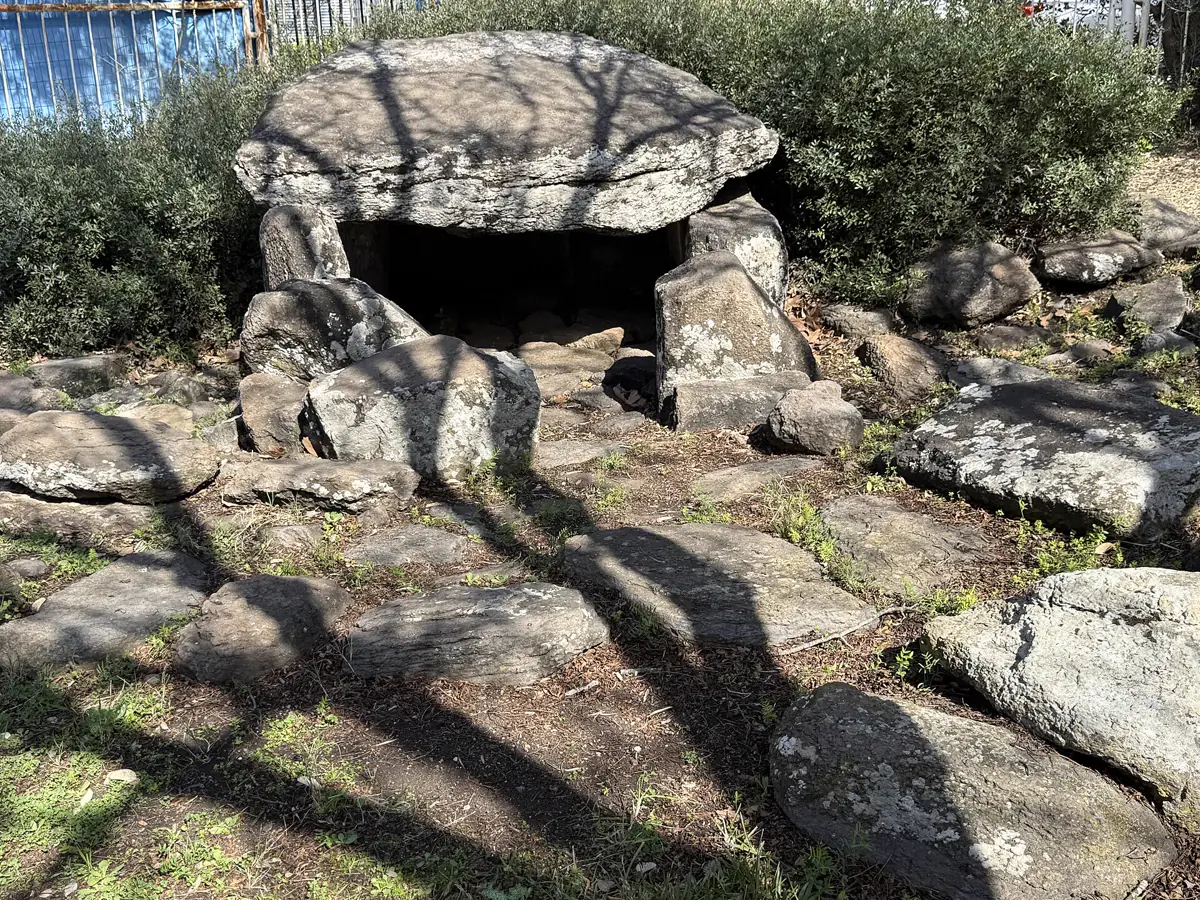
A basalt dolmen from the Golan Heights
A basalt dolmen from the Golan — megalithic tombs scattered across the land Deuteronomy calls Bashan, the country of Og, who “remained of the remnant of giants” (Deuteronomy 3:11).שלמה רודד · CC BY 2.5

The names

The King James Bible uses "giant" or "giants" for several Hebrew words. Besides nephilim there are:

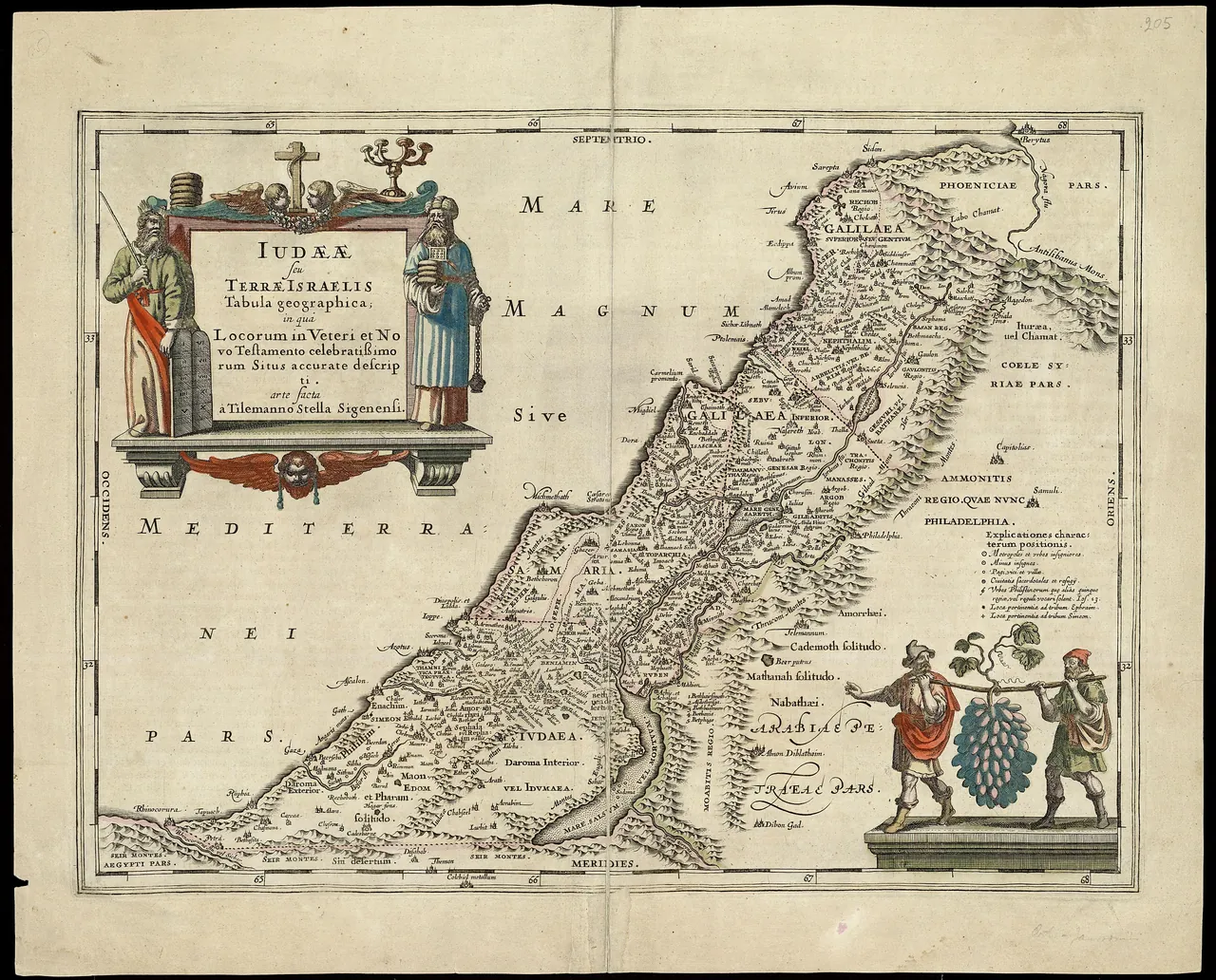
A Geographical Rendering of Judaea, or the Land of Israel, in Which the Positions of the Most Famous Places in the Old a
A 1658 map of Judaea, the Land of Israel, its corner showing two men carrying a great cluster of grapes, the land the spies searched and found held by giants.A Geographical Rendering of Judaea, or the Land of Israel, in Which the Positions of the Most Famous Places in the Old a · 1658-01-01 · Library of Congress · Public domain · museum record · Galeria Regni
  • Rephaim (H7497, rapha): Strong defines it simply as "a giant", and the King James renders it "giant", "Rapha" or "Rephaims".12 A closely related word (H7496) means the dead or the deceased; the companion paper Giants and Mountains looks at that link.
  • Anakim (H6062): "an Anakite or descendant of Anak", a people named for their ancestor Anak (H6061).
  • Emim (H368): "terrors", the Moabite name for the giants who had lived in their land.
  • Zamzummim (H2157): the Ammonite name for the giants in theirs.

In the days of Abraham

The giants appear in history before Israel exists. When four kings of the east marched west in Abraham's day, "in the fourteenth year came Chedorlaomer, and the kings that were with him, and smote the Rephaims in Ashteroth Karnaim, and the Zuzims in Ham, and the Emims in Shaveh Kiriathaim" (Genesis 14:5). The Rephaim were already a people with a homeland east of the Jordan.

The spies at Hebron

The best-known giant passage outside 1 Samuel 17 is the report of the twelve spies. Moses sent them from the wilderness of Paran to search the land of Canaan.

"And they ascended by the south, and came unto Hebron; where Ahiman, Sheshai, and Talmai, the children of Anak, were. (Now Hebron was built seven years before Zoan in Egypt.)" (Numbers 13:22)

They came back with fruit, and with fear.

"Nevertheless the people be strong that dwell in the land, and the cities are walled, and very great: and moreover we saw the children of Anak there." (Numbers 13:28)
"And they brought up an evil report of the land which they had searched unto the children of Israel, saying, The land, through which we have gone to search it, is a land that eateth up the inhabitants thereof; and all the people that we saw in it are men of a great stature. And there we saw the giants, the sons of Anak, which come of the giants: and we were in our own sight as grasshoppers, and so we were in their sight." (Numbers 13:32-33)

Some readers argue that because the report is called "an evil report", the giants must have been invented or exaggerated by frightened men. That does not follow. What made the report evil was not that it described tall men but that it concluded Israel could not take the land God had promised. Joshua and Caleb did not deny the giants. They denied that the giants mattered: "Only rebel not ye against the LORD, neither fear ye the people of the land; for they are bread for us: their defence is departed from them, and the LORD is with us: fear them not" (Numbers 14:9).

Forty years later Moses himself, speaking in his own voice to the next generation, confirmed what the spies had seen:

"Hear, O Israel: Thou art to pass over Jordan this day, to go in to possess nations greater and mightier than thyself, cities great and fenced up to heaven, A people great and tall, the children of the Anakims, whom thou knowest, and of whom thou hast heard say, Who can stand before the children of Anak!" (Deuteronomy 9:1-2)

The giants were real. This is my conviction; weigh it for yourself. The sin was unbelief.

Moses' notes on the giants

Deuteronomy contains two short passages that read like a historian's footnotes. As Moses recounts Israel's journey past Moab and Ammon, he explains who used to live there.

"The Emims dwelt therein in times past, a people great, and many, and tall, as the Anakims; Which also were accounted giants, as the Anakims; but the Moabites call them Emims." (Deuteronomy 2:10-11)
"(That also was accounted a land of giants: giants dwelt therein in old time; and the Ammonites call them Zamzummims; A people great, and many, and tall, as the Anakims; but the LORD destroyed them before them; and they succeeded them, and dwelt in their stead:" (Deuteronomy 2:20-21)

These notes are significant. They do not describe one freak of nature. They describe whole peoples, "great, and many, and tall", known to their neighbours by local names, as nations know their neighbours today. And they place the giants in history: they lived there, they were destroyed, and others lived there instead.

Og and his bedstead

The most specific measurement the Bible gives for any giant's possessions belongs to Og, king of Bashan, whom Israel defeated east of the Jordan.

"For only Og king of Bashan remained of the remnant of giants; behold, his bedstead was a bedstead of iron; is it not in Rabbath of the children of Ammon? nine cubits was the length thereof, and four cubits the breadth of it, after the cubit of a man." (Deuteronomy 3:11)

Three things stand out.

First, the bed was a known object. Moses speaks as though his hearers could go and see it: "is it not in Rabbath of the children of Ammon?" That is how a writer refers to a public monument.

Second, the measurement is careful. "After the cubit of a man" means the common cubit, the length of a man's forearm from elbow to fingertip, as opposed to the longer royal cubit used in Egypt. At about eighteen inches to the cubit, nine cubits is about thirteen and a half feet; at a common cubit of sixteen inches, which the historian Clyde Billington prefers, it is twelve feet.13 A bed is not a coffin, and a king's bed may have been built for show, so the text does not give us Og's height. It gives us the scale of a man whose bed was remembered.

Third, Og was a "remnant". By Moses' day the giant peoples east of the Jordan were already dwindling. Joshua's summary agrees: "the coast of Og king of Bashan, which was of the remnant of the giants, that dwelt at Ashtaroth and at Edrei" (Joshua 12:4).

The Amorite like the cedars

Centuries later, the prophet Amos reminded Israel of what God had done for them:

"Yet destroyed I the Amorite before them, whose height was like the height of the cedars, and he was strong as the oaks; yet I destroyed his fruit from above, and his roots from beneath." (Amos 2:9)

Amos speaks in poetry, and no one should take him to mean the Amorites were literally as tall as cedar trees. But he speaks of a memory the whole nation shared: that the peoples God drove out were huge, and that God did it anyway.

Joshua, Caleb and the three sons of Anak

The book of Joshua records the end of the Anakim in the hill country.

"And at that time came Joshua, and cut off the Anakims from the mountains, from Hebron, from Debir, from Anab, and from all the mountains of Judah, and from all the mountains of Israel: Joshua destroyed them utterly with their cities. There was none of the Anakims left in the land of the children of Israel: only in Gaza, in Gath, and in Ashdod, there remained." (Joshua 11:21-22)

Hold on to the last line. Three cities on the coastal plain kept a remnant of the Anakim: Gaza, Gath and Ashdod. All three later became cities of the Philistines. One of them was the home of Goliath.

The most moving giant passage in the Bible is not David's. It is Caleb's. He was one of the two spies who had believed God at Kadesh. Forty-five years later, at eighty-five, he came to Joshua and asked for the very place where the giants had frightened everyone else:

"Now therefore give me this mountain, whereof the LORD spake in that day; for thou heardest in that day how the Anakims were there, and that the cities were great and fenced: if so be the LORD will be with me, then I shall be able to drive them out, as the LORD said." (Joshua 14:12)

And he did: "And Caleb drove thence the three sons of Anak, Sheshai, and Ahiman, and Talmai, the children of Anak" (Joshua 15:14). They are the same three names the spies had seen at Hebron in Numbers 13:22. What frightened a nation was overcome by one old man who believed God.

Part 3 — Goliath and the Sons of the Giant

6 min read

This part matters because Goliath is the one giant everyone knows, and because his height is the one place where the wording itself has been argued over.

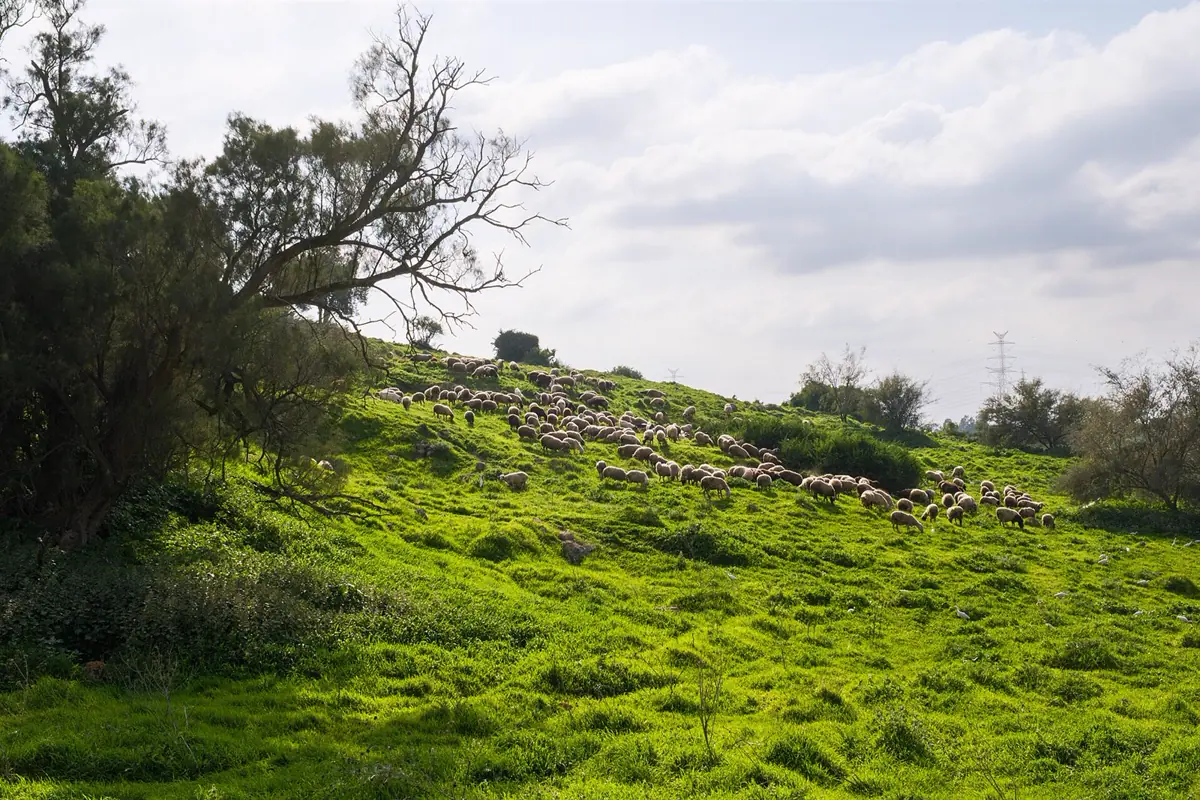
The slopes of Tel Zafit, the site of ancient Gath
Tel Zafit — ancient Gath, Goliath’s hometown — under excavation since 1996 and yielding period-correct Philistine inscriptions.מקף־עברי · CC BY-SA 4.0
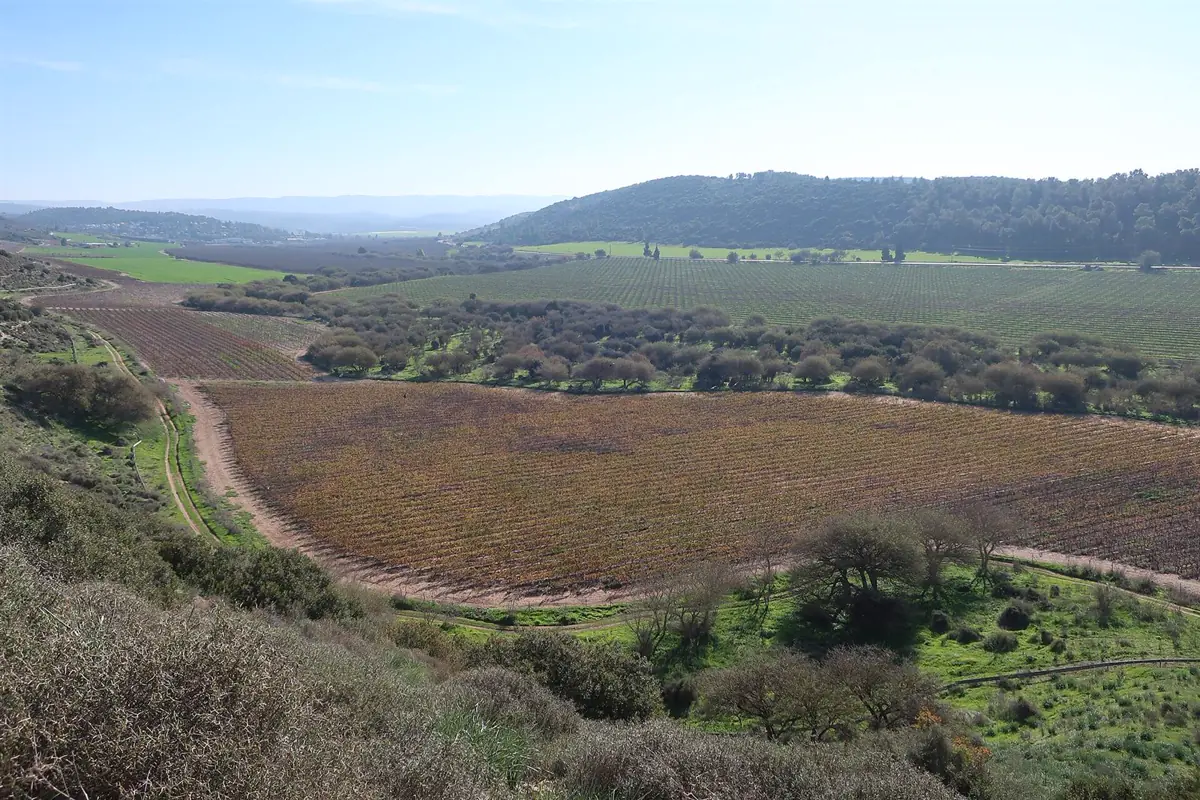
The Valley of Elah, green fields between low hills
The Valley of Elah southwest of Jerusalem — the battlefield where David met Goliath (1 Samuel 17), a real and walkable place.Davidbena · CC0

The champion of Gath

"And there went out a champion out of the camp of the Philistines, named Goliath, of Gath, whose height was six cubits and a span. And he had an helmet of brass upon his head, and he was armed with a coat of mail; and the weight of the coat was five thousand shekels of brass. And he had greaves of brass upon his legs, and a target of brass between his shoulders. And the staff of his spear was like a weaver's beam; and his spear's head weighed six hundred shekels of iron: and one bearing a shield went before him." (1 Samuel 17:4-7)

The Hebrew behind "champion" is commonly explained as "the man between", the man who stands between two armies to fight on behalf of his side. Here the Philistines offer to settle the war by single combat, and Israel has no one to send.

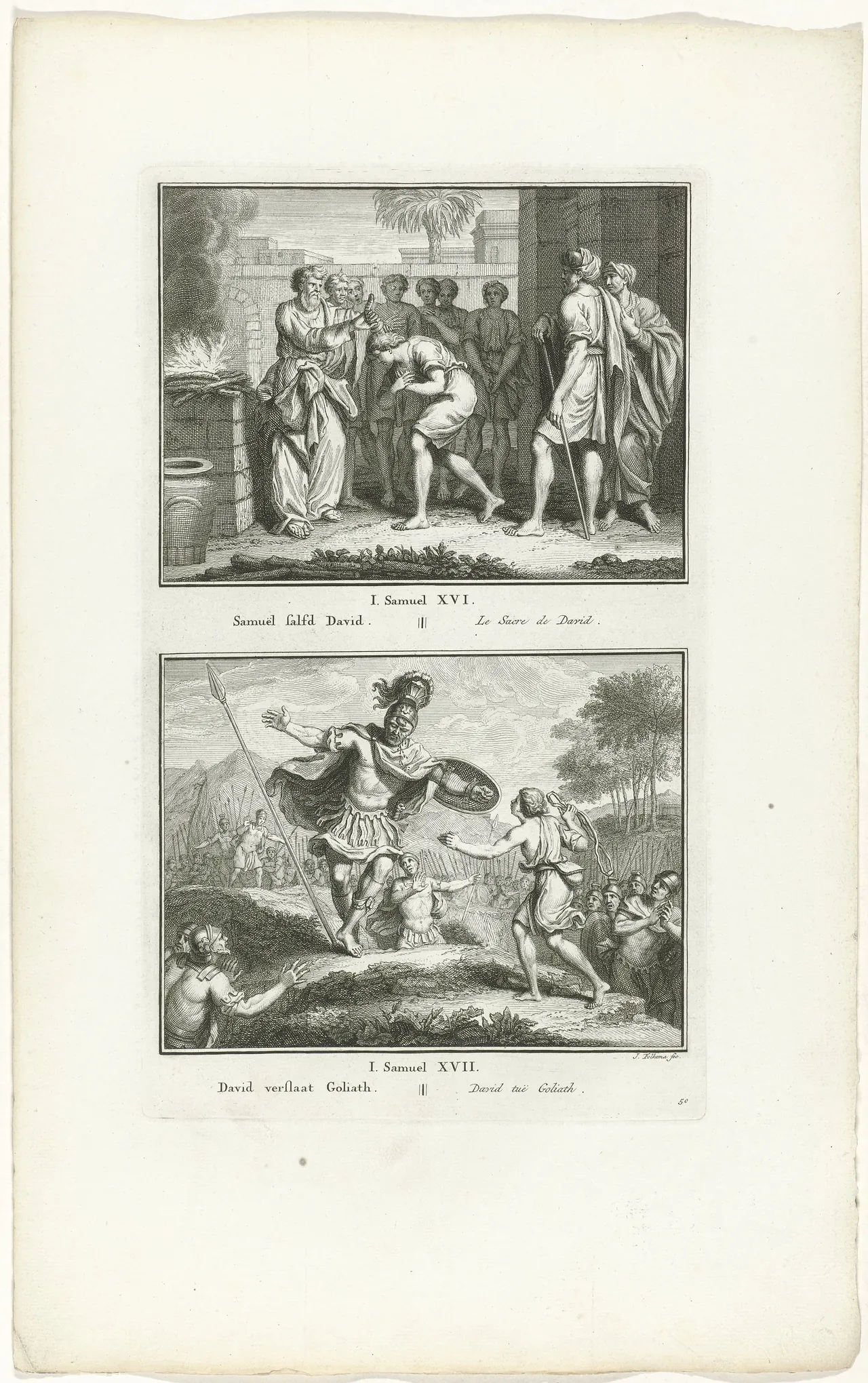
Samuel zalft David en David verslaat Goliath, RP-P-1933-15
A Dutch book illustration of 1791 pairing Samuel anointing David with David defeating Goliath, the champion of Gath whose size set the stage for David's faith.Samuel zalft David en David verslaat Goliath, RP-P-1933-15 · 1791 · Wikimedia Commons · CC0 · museum record · Galeria Regni

The figures are concrete. Six cubits and a span is six forearms plus the span of a hand, about half a cubit. At an eighteen-inch cubit, that is about nine feet nine inches; at a sixteen-inch common cubit, about eight feet eight inches. If the shekel is reckoned at about 11.4 grams, the coat of mail at five thousand shekels weighed roughly 125 pounds, and the iron spearhead at six hundred shekels about fifteen. Ancient weights varied, so these are approximations, but the picture is clear: a man of enormous size carrying a load an ordinary soldier could not have fought in.

The text stands

The King James Bible, following the Hebrew Masoretic Text, reads "six cubits and a span". That is the reading of this paper, and it stands.

There is another reading in history, and an honest paper should tell you about it. The Greek translation of the Old Testament in most of its manuscripts, one Hebrew manuscript of Samuel from the Dead Sea Scrolls (known as 4QSamuel-a), and Josephus all give Goliath's height as four cubits and a span.14 Some modern scholars have argued that this smaller figure is original and that Goliath was a tall man of about six feet nine inches, but not a giant. The fullest such argument is J. Daniel Hays's "Reconsidering the Height of Goliath", published in the Journal of the Evangelical Theological Society in December 2005.15

Two years later, in the same journal, Clyde Billington answered him. He argued that the Hebrew figure should stand; that the four-cubit reading is most likely a conversion of Hebrew common cubits into the longer Egyptian royal cubit, made by a translator who worked in Alexandria; and that the two readings, rightly understood, describe the same very tall man. His conclusion is direct: "the historical, archaeological, and biblical evidence supports the mt's reading of 6 cubits for the height of Goliath."16 Billington himself puts Goliath at a little over eight feet, because he uses a sixteen-inch cubit. The King James text does not tell us which cubit the writer used. It tells us six cubits and a span, and that is what this paper keeps.

Whichever cubit you use, a man of six cubits and a span, in a world where ordinary men stood perhaps five feet to five feet three, was a giant in every sense of the word.17

This is one of many places where ancient copies and translations differ from the text the King James translators used. You can see where the 1611 and the modern critical text part ways at kylelauriano.com/library/changes. The 1611 reading is the one this ministry holds.

The battle is the LORD's

The size of Goliath is the setting of 1 Samuel 17. The subject is the faith of David.

"Then said David to the Philistine, Thou comest to me with a sword, and with a spear, and with a shield: but I come to thee in the name of the LORD of hosts, the God of the armies of Israel, whom thou hast defied. This day will the LORD deliver thee into mine hand; and I will smite thee, and take thine head from thee; and I will give the carcases of the host of the Philistines this day unto the fowls of the air, and to the wild beasts of the earth; that all the earth may know that there is a God in Israel. And all this assembly shall know that the LORD saveth not with sword and spear: for the battle is the LORD's, and he will give you into our hands." (1 Samuel 17:45-47)

David's reasoning is the same as Caleb's at Kadesh. The question was never whether the giant was big. It was whether God had spoken. Afterwards, "David took the head of the Philistine, and brought it to Jerusalem; but he put his armour in his tent" (1 Samuel 17:54). Like Og's bedstead, the giant's remains became a witness.

The four sons of the giant

Goliath was not the last. 2 Samuel 21 records four more battles against men of his kind.

"And Ishbibenob, which was of the sons of the giant, the weight of whose spear weighed three hundred shekels of brass in weight, he being girded with a new sword, thought to have slain David. But Abishai the son of Zeruiah succoured him, and smote the Philistine, and killed him." (2 Samuel 21:16-17)
"And there was yet a battle in Gath, where was a man of great stature, that had on every hand six fingers, and on every foot six toes, four and twenty in number; and he also was born to the giant." (2 Samuel 21:20)
"These four were born to the giant in Gath, and fell by the hand of David, and by the hand of his servants." (2 Samuel 21:22)

"The giant" here is rapha (H7497), the same word as the Rephaim. The phrase "born to the giant" probably means descendants of the Rephaim rather than literal sons of one father, since Hebrew uses "sons of" for members of a family or a class.

The detail of six fingers and six toes is the kind of thing no one invents for effect. Extra fingers and toes are a known human condition. The writer records it because it was true and remarkable.

The parallel account in 1 Chronicles 20 adds a name. In 2 Samuel 21:19 the King James reads that "Elhanan the son of Jaareoregim, a Bethlehemite, slew the brother of Goliath the Gittite", and in standard editions of the King James Bible the words "the brother of" are set in italics to show they were supplied by the translators. They supplied them from 1 Chronicles 20:5, which says plainly: "And there was war again with the Philistines; and Elhanan the son of Jair slew Lahmi the brother of Goliath the Gittite, whose spear staff was like a weaver's beam" (1 Chronicles 20:5). The two passages together tell us that Goliath had a brother named Lahmi who died in a later battle. The King James translators let Scripture explain Scripture, and there is no contradiction with 1 Samuel 17.

What Gath has shown us

Gath is not a lost city. It is identified with Tell es-Safi in the lowlands of Judah, excavated by a team from Bar-Ilan University led by Aren Maeir. In 2005 the excavators announced a pottery sherd from the early Iron Age, dated to the tenth or ninth century before Christ, inscribed with two names read as ALWT and WLT. Maeir did not claim it named the Goliath of 1 Samuel. He said it showed that names of the same kind as Goliath were in use at Gath, and that the story of Goliath reflects "a clear cultural realia" of the city.18 The full scholarly publication followed in 2008.19

That is the right size of claim. The inscription does not prove Goliath. It shows that Gath was real, Philistine, and the kind of place the Bible describes. That is how archaeology usually serves the Bible: not with a skeleton and a name tag, but with a world that matches the text.

Part 4 — Giants in the Egyptian Record

2 min read

This part matters because a skeptic will say the giants exist only in Israel's own stories. They do not. Egypt, Israel's great neighbour, knew a people called by the same name, and knew some peoples of Canaan as men of unusual height.

The Execration Texts

In Egypt's Middle Kingdom, priests wrote the names of enemy rulers and peoples on clay figurines and bowls, then smashed them in a ritual curse. These are known as the Execration Texts. John A. Wilson's translation, in James Pritchard's standard collections of ancient Near Eastern texts, includes several curses on "the Ruler of Iy'anaq" and the retainers with him, listed alongside places in Canaan such as Jerusalem and Ashkelon.20 Wilson suggested, and Billington argues at length, that Iy'anaq is the people the Bible calls the Anakim.

If that identification is right, the Anakim were feared by name in Egypt centuries before the spies saw them at Hebron.

Papyrus Anastasi I

A second Egyptian text is more striking still. Papyrus Anastasi I, from the reign of Ramesses II, contains a satirical letter used to train scribes. In it the writer mocks a rival by describing the dangers of a mountain pass in Canaan:

The face of the pass is dangerous with Shasu, hidden under the bushes. Some of them are 4 or 5 cubits, nose to foot, with wild faces.21

The Shasu were semi-nomadic peoples of Canaan and the lands east of the Jordan. Allen, the translator, takes four or five cubits to mean about six feet eight inches to eight feet six inches; Billington, using a slightly longer royal cubit, makes it about six feet ten to eight feet seven.22 An Egyptian scribe, with no interest in confirming the Hebrew Bible, describes men of that size in the hills of Canaan in the thirteenth century before Christ.

The letter is a literary exercise, and its writer may be exaggerating for effect. But exaggeration needs something to exaggerate. The picture it gives fits the picture in Numbers and Deuteronomy: tall, fierce people in the hill country of Canaan, feared by their neighbours.

Part 5 — The Giants in Ancient Jewish and Christian Witness

7 min read

This part matters because many people who become interested in the giants go straight to the Book of Enoch, and some come away treating it as a lost book of the Bible. It is not. But it is a real and very old witness, and a Christian should know what it says and how to hold it.

The rule for these books

The books in this part are historical witnesses to what Jews and early Christians believed. They are quoted as such, and never as Scripture or doctrine. The Old Testament is the Hebrew Bible the Lord Jesus and the apostles received, and the King James Bible translates it. Augustine stated the church's judgement on the Enoch writings: those "which contain these fables about the giants, saying that their fathers were not men, are properly judged by prudent men to be not genuine".23 Notice what Augustine rejected: not the giants, which he believed in, but the claim that the book was Enoch's own.

1 Enoch and the Watchers

1 Enoch is a collection of several works. Its first part, the Book of the Watchers (chapters 1–36), retells Genesis 6 at length. It survives complete only in Ge'ez, the old church language of Ethiopia, and the Ethiopian Orthodox Church counts it among its sacred books. Aramaic fragments of it were found at Qumran and published by J. T. Milik in 1976, which proves the book was being copied before the time of Christ.24

The story, in R. H. Charles's translation, runs like this. In the days of Jared, two hundred angels called Watchers saw the daughters of men and desired them. Their leader, Semjaza, feared that he alone would bear the penalty, so they bound themselves by an oath:

"And they were in all two hundred; who descended in the days of Jared on the summit of Mount Hermon, and they called it Mount Hermon, because they had sworn and bound themselves by mutual imprecations upon it." (1 Enoch 6:6)

They took wives, and "taught them charms and enchantments, and the cutting of roots, and made them acquainted with plants" (1 Enoch 7:1). Their children were giants:

"And they became pregnant, and they bare great giants, whose height was three thousand ells: Who consumed all the acquisitions of men. And when men could no longer sustain them, the giants turned against them and devoured mankind." (1 Enoch 7:2-4)

A height of three thousand ells is plainly impossible, and it is one reason a careful reader should not treat this book as history in the way Deuteronomy is history.25 The Bible gives no such number for any giant. Its measurements are human in scale: a bed of nine cubits, a man of six cubits and a span.

In 1 Enoch the Watchers also teach forbidden arts. Azazel teaches men "to make swords, and knives, and shields, and breastplates", along with ornaments and the beautifying of the eyelids; others teach enchantments, astrology and the signs of heaven (1 Enoch 8:1-2). The earth cries out, and God sends his archangels. Raphael is told to bind Azazel:

"Bind Azâzêl hand and foot, and cast him into the darkness: and make an opening in the desert, which is in Dûdâêl, and cast him therein. And place upon him rough and jagged rocks, and cover him with darkness, and let him abide there for ever, and cover his face that he may not see light." (1 Enoch 10:4-5)

Gabriel is sent against the giants, to "send them one against the other that they may destroy each other in battle" (1 Enoch 10:8). Michael is told to bind Semjaza and his associates "fast for seventy generations in the valleys of the earth, till the day of their judgement and of their consummation" (1 Enoch 10:10-11).

The spirits of the giants

The part of 1 Enoch that has had the most influence is its account of what became of the giants after death:

"And now, the giants, who are produced from the spirits and flesh, shall be called evil spirits upon the earth, and on the earth shall be their dwelling. Evil spirits have proceeded from their bodies; because they are born from men, and from the holy Watchers is their beginning and primal origin; they shall be evil spirits on earth, and evil spirits shall they be called." (1 Enoch 15:8-9)

On this view, demons are the disembodied spirits of the giants, restless because they were never meant to exist, hungry for bodies they no longer have. Justin Martyr, as we saw, called the children of the angels "those that are called demons". Many later teachers have found the idea persuasive, and it does fit some things the Gospels show about unclean spirits, such as their craving for a body to inhabit.

It must be said plainly, though: the Bible does not tell us where demons come from. It tells us they are real, that they are subject to the name of Jesus, and that a believer stands over them in Christ: "Behold, I give unto you power to tread on serpents and scorpions, and over all the power of the enemy: and nothing shall by any means hurt you" (Luke 10:19). The giant-spirit account is an ancient Jewish teaching recorded in 1 Enoch, and that is how this paper reports it. It is not doctrine, and nothing in a Christian's walk depends on it.

Jude and Enoch

Jude quotes a prophecy of Enoch:

"And Enoch also, the seventh from Adam, prophesied of these, saying, Behold, the Lord cometh with ten thousands of his saints, To execute judgment upon all, and to convince all that are ungodly among them of all their ungodly deeds which they have ungodly committed, and of all their hard speeches which ungodly sinners have spoken against him." (Jude 1:14-15)

The words are very close to the opening chapter of 1 Enoch:

"And behold! He cometh with ten thousands of His holy ones To execute judgement upon all, And to destroy all the ungodly: And to convict all flesh Of all the works of their ungodliness which they have ungodly committed, And of all the hard things which ungodly sinners have spoken against Him." (1 Enoch 1:9)

That Jude quotes this prophecy, writing by the Holy Ghost, tells us the prophecy is true. It does not make 1 Enoch Scripture, any more than Paul's quotation of "certain also of your own poets" in Acts 17:28 makes those Greek poets Scripture. Jude chose one true word from a book his readers knew. What the Spirit put into Jude is Scripture; the rest of 1 Enoch remains a witness.

Jubilees

The Book of Jubilees retells Genesis and part of Exodus as a revelation given to Moses on Sinai. Fragments of it were found at Qumran too. Like 1 Enoch, it reads Genesis 6 as the sin of angels:

"the angels of God saw them on a certain year of this jubilee, that they were beautiful to look upon; and they took themselves wives of all whom they chose, and they bare unto them sons and they were giants." (Jubilees 5:1)

Jubilees adds that the Watchers were first sent to earth for good, "that they should instruct the children of men, and that they should do judgment and uprightness on the earth" (Jubilees 4:15), and that the giants destroyed each other by the sword before the Flood (Jubilees 5:9). It also tells a story found nowhere in Scripture: that after the Flood evil spirits troubled Noah's grandchildren, Noah prayed, and nine parts of the spirits were bound while a tenth was left under a chief spirit called Mastema (Jubilees 10:1-11). Some popular teachers repeat this as though it explained the present activity of demons. It is a story from Jubilees, and that is all this paper can say for it.26

The Book of Giants

Among the Dead Sea Scrolls are fragments of a separate Aramaic work about the giants themselves, now called the Book of Giants. Milik first identified it as a single work, and Loren Stuckenbruck published the standard English edition in 1997.27 The fragments tell of two giant brothers, Ohyah and Hahyah, who have troubling dreams of judgement; of a giant named Mahway sent to Enoch to learn what the dreams mean; and of Enoch's answer that judgement is certain. Strikingly, the fragments give the names of the Mesopotamian hero Gilgamesh and the monster Humbaba to figures among the giants.28 Centuries later, the Persian prophet Mani reworked the same book for his own religion.

What does that tell us? At the least, that some Jews before Christ connected the giants of Genesis with the great heroes of their neighbours' legends. Josephus noticed the same likeness when he wrote that the giants before the Flood "did what resembled the acts of those whom the Grecians call Giants".29 The nations had their own memories of mighty men of old. Genesis says the same thing in one phrase: "mighty men which were of old, men of renown" (Genesis 6:4).

Josephus on the bones at Hebron

Josephus has one more passage that belongs here. Describing Israel's capture of Hebron, he writes:

There were till then left the race of giants; who had bodies so large, and countenances so intirely different from other men, that they were surprising to the sight, and terrible to the hearing. The bones of these men are still shewn to this very day; unlike to any credible relations of other men.30

We do not know what bones Josephus or his informants had seen. They may have been human; they may, as Part 6 will suggest, have been the bones of large animals. What the passage shows is that Jews of the first century believed the Anakim were real, and believed physical remains of them had survived.

Part 6 — Bones, Hoaxes and Honest Limits

4 min read

This part matters because the giants have become a magnet for fraud, and a Christian who repeats a fraud does harm to the gospel. "Prove all things; hold fast that which is good" (1 Thessalonians 5:21).

The ancients found bones too

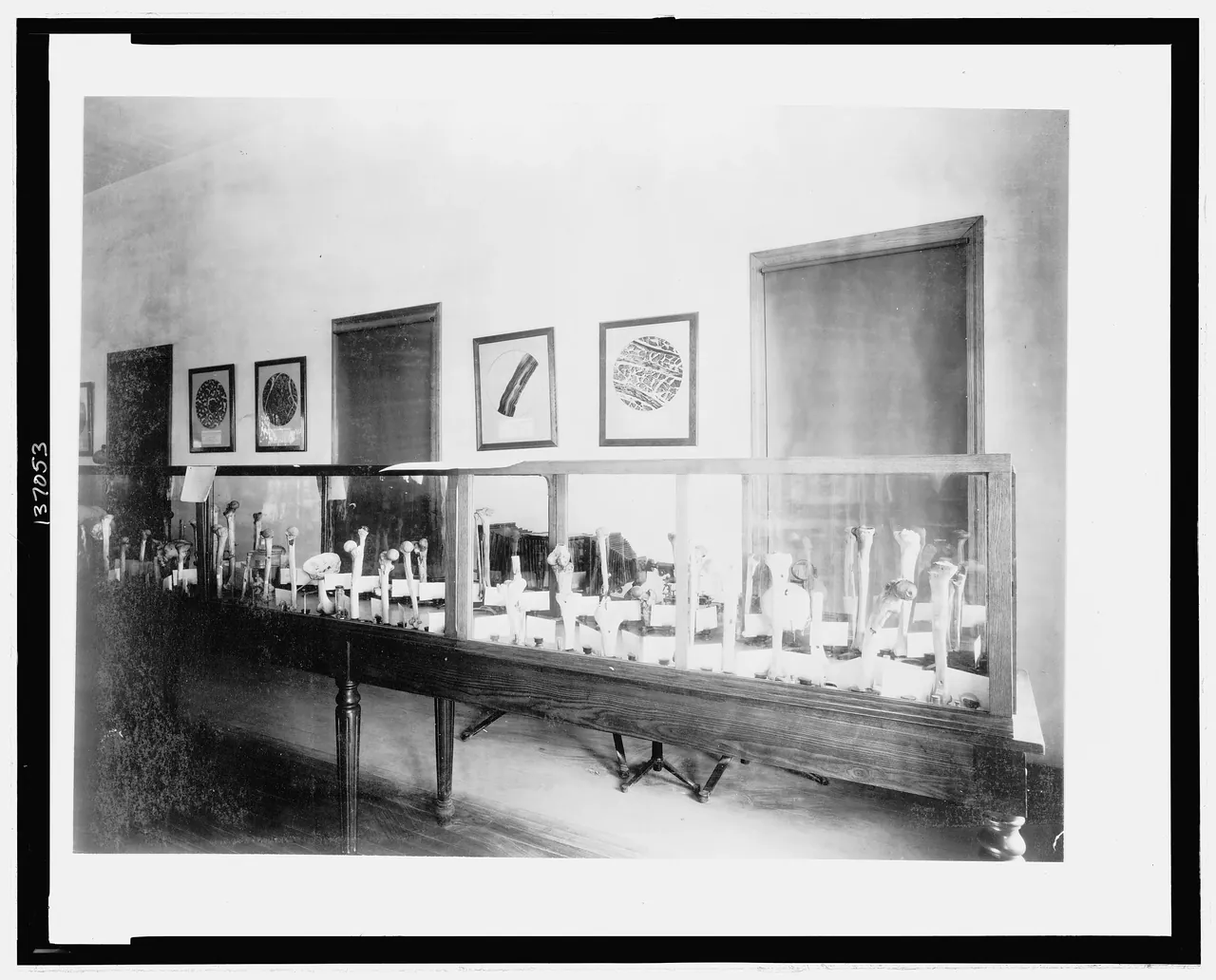
The belief that giants' bones lie in the earth is very old. The Greek historian Herodotus tells how the Spartans, seeking the bones of the hero Orestes, heard of a smith in Tegea who had been digging a well and "lighted in my digging upon a coffin of seven cubits in length", and found inside it a dead body "equal in length to the coffin".31 Augustine, who believed in the giants, gives his own testimony:

Display of human bones, probably by the U.S. Surgeon General, at the Chicago's World's Columbian Exhibition LCCN20066862
A photograph of a display of human bones, probably by the U.S. Surgeon General, at Chicago's World's Columbian Exhibition of 1893, beside this part's honest look at claimed giant remains.Display of human bones, probably by the U.S. Surgeon General, at the Chicago's World's Columbian Exhibition LCCN20066862 · 1893 · Wikimedia Commons · Public domain · museum record · Galeria Regni
I myself, along with some others, saw on the shore at Utica a man's molar tooth of such a size, that if it were cut down into teeth such as we have, a hundred, I fancy, could have been made out of it. But that, I believe, belonged to some giant.32

A tooth a hundred times the size of a human tooth did not come from a man of any height. It almost certainly came from a large animal. The historian Adrienne Mayor, in The First Fossil Hunters (2000), has shown that many Greek and Roman reports of giants' bones were real finds of the fossil bones of large animals, honestly misread.33

That should teach us humility. Augustine was one of the greatest minds of the ancient church, and he was wrong about that tooth. Being right about the Bible does not make us right about every bone.

The Cardiff Giant

On 16 October 1869, men digging a well on William Newell's farm at Cardiff, New York, uncovered a stone man of giant size. Crowds paid to see the "petrified giant". It was a hoax. George Hull, a tobacconist, had a block of gypsum carved into a man and buried on the farm. The usual account says he got the idea after arguing with a minister who took Genesis 6:4 literally. The showman P. T. Barnum had a copy made and exhibited that too. The original is still on display at the Farmers' Museum in Cooperstown, New York.34

Notice who made it. The most famous "giant" in American history was carved by a skeptic, and believers were among those who paid to see it. A Christian who wants to honour Genesis 6 should be the hardest person in the room to fool, not the easiest.

Nineteenth-century American newspapers printed many reports of giant skeletons found in mounds and fields. A report is not a find. Very few of those reports led to bones anyone can examine today.

The photographs

The giant-skeleton photographs that circulate online are, in the cases that have been traced, digital fakes. The best known shows a vast skeleton in an excavation, with tiny figures standing around it. It was made by a Canadian illustrator for a 2002 photo-manipulation contest on the website Worth1000, titled "Archaeological Anomalies 2", where it placed third. He started from an aerial photograph of a mastodon excavation and laid a human skeleton over it. By 2007 the picture was being passed around as a National Geographic discovery in India, and National Geographic News published a report explaining the hoax.35

There is no need to share these pictures, and every reason not to. If a seeker is shown a fake by a Christian and finds out, he will not stop at the photograph. He will wonder what else the Christian believes without checking.

No confirmed skeleton

Let it be said plainly: there is no confirmed skeleton of a biblical giant in any museum or laboratory. Claims that one institution or another has hidden such skeletons circulate widely, but they come without documents, catalogue numbers, photographs that survive scrutiny, or named witnesses who can be checked.

Does that disprove the Bible? No. Remains of any particular ancient people are rare finds. The Anakim were cut off in war and their cities destroyed; the Rephaim east of the Jordan were displaced by Moab and Ammon; the sons of the giant fell in battle. Ancient graves were often disturbed, reused or robbed. Absence of evidence is not evidence of absence, though it is a reason for modesty. The Bible's witness does not rest on a skeleton. It rests on the God who gave it.

How tall can a man be?

The tallest man reliably measured in modern times was Robert Wadlow of Alton, Illinois. On 27 June 1940 he measured 8 feet 11.1 inches (2.72 metres). Guinness World Records attributes his height to an overactive pituitary gland. He died on 15 July 1940, aged twenty-two, of an infection from a blister caused by a poorly fitted leg brace.36

Wadlow's height, and his suffering, show two things. First, a man of eight or nine feet is not impossible; one lived in the twentieth century. Goliath at six cubits and a span is within sight of a measured human being. Second, giant size in a modern man usually comes with disease, which is a reason to be careful about claims of giants hundreds of feet tall. Weight grows with the cube of height while the strength of bone grows only with the area of its cross-section, so a man twice as tall weighs about eight times as much on bones only four times as strong. That is why the Bible's own measurements are a quiet mark of truth. Scripture never gives a giant a height of hundreds of feet. Its giants are big men, very big men, who could be killed with a stone or a sword.

Before the Flood

Some writers argue that the world before the Flood had different air, more oxygen, or other conditions that allowed larger bodies. The Bible does record that lifespans before the Flood were far longer than after it, and that God set a limit on man's days (Genesis 6:3). It says nothing about the air, or about why the giants were large, and this paper will not fill that silence with speculation dressed as science.

Part 7 — Why the Giants Matter

3 min read

This part matters because the Bible did not record the giants to satisfy curiosity. It recorded them to teach faith.

The war of the two seeds

From the beginning, Scripture frames history as a conflict. After the Fall, God said to the serpent:

"And I will put enmity between thee and the woman, and between thy seed and her seed; it shall bruise thy head, and thou shalt bruise his heel." (Genesis 3:15)

Read in that light, Genesis 6 is an assault on the human race itself, a corruption so deep that "all flesh had corrupted his way upon the earth" (Genesis 6:12). God's answer was judgement on the world and grace to one family: "But Noah found grace in the eyes of the LORD" (Genesis 6:8). The line through which the promised Seed would come was kept safe in the ark.

Later, when the giants stood in the land God had promised to Abraham, they stood in the way of that same promise. I believe that is why the Bible bothers to name them, number them and record their end. This is my conviction; weigh it for yourself. But whether or not you see the pattern as I do, the result is the same: the giants fell, and the promise went forward to Bethlehem.

Giants and unbelief

The spies were not wrong about the giants' size. They were wrong about God. The tragedy of Numbers 13 and 14 is that a whole generation died in the wilderness, not because the giants defeated them, but because they never faced the giants at all. They measured themselves against the enemy, "and we were in our own sight as grasshoppers" (Numbers 13:33), and forgot to measure the enemy against the Lord.

Every believer faces something that looks like the sons of Anak. It may be an addiction, a fear, a family, a sickness, a sin that has beaten you for years. The lesson of Kadesh is not that the giant is small. It is that "the LORD is with us: fear them not" (Numbers 14:9).

The greater David

David went out against Goliath alone, as the champion of his people, the man between the two armies. He won the victory and his people shared it. Christians have long seen in that story a picture of a greater victory. The Son of David went out alone against an enemy no one else could face, and on the cross, "having spoiled principalities and powers, he made a shew of them openly, triumphing over them in it" (Colossians 2:15). John states the purpose of His coming in one line: "For this purpose the Son of God was manifested, that he might destroy the works of the devil" (1 John 3:8).

Whatever the giants were, the powers behind them have been defeated. "Submit yourselves therefore to God. Resist the devil, and he will flee from you" (James 4:7).

As it was in the days of Noah

The Lord Jesus Himself pointed back to the days before the Flood:

"But as the days of Noe were, so shall also the coming of the Son of man be. For as in the days that were before the flood they were eating and drinking, marrying and giving in marriage, until the day that Noe entered into the ark, And knew not until the flood came, and took them all away; so shall also the coming of the Son of man be." (Matthew 24:37-39)

Notice what Jesus emphasised. Not the giants, but the ordinariness: eating, drinking, marrying. The people of Noah's day were not destroyed because they failed to understand the nephilim. They were destroyed because they ignored the warning of "a preacher of righteousness" (2 Peter 2:5) and did not enter the ark. That is the lesson of the giants for us. The danger is not that we will know too little about the ancient world. It is that we will know a great deal and still not come in.

Conclusion

3 min read

Here is what this study has found.

The Bible presents the giants as history. They appear before the Flood and after it, as named peoples in named places: the Rephaim in Ashteroth Karnaim, the Emim in Moab, the Zamzummim in Ammon, the sons of Anak at Hebron, Og in Bashan, a remnant in Gaza, Gath and Ashdod, and finally Goliath and the four sons of the giant who fell in Gath. Moses speaks of Og's bedstead as something his hearers could go and see. I hold the giants of the Bible to be history: real men, of real size, who lived and died where the Bible says they did. This is my conviction; weigh it for yourself.

Goliath's height stands as the King James gives it: "six cubits and a span" (1 Samuel 17:4). Other ancient copies read four cubits, and that is part of the history of the text; the 1611 reading is the one this paper keeps, and kylelauriano.com/library/changes shows where the readings part ways.

The oldest reading of "the sons of God" is that they were angels. It is the reading of 1 Enoch, Jubilees, Josephus and the earliest Christian writers, and it fits Job 1:6, Job 38:7, 2 Peter 2:4 and Jude 6–7. The Sethite reading, through Augustine, and the rulers reading, in the Targum and the rabbis, are also old, and good men have held them. I believe the sons of God in Genesis 6 were angels who left their first estate (Jude 6), and that the giants were real. This is my conviction; weigh it for yourself.

The ancient books outside the Bible are witnesses, not Scripture. 1 Enoch, Jubilees and the Book of Giants show us what Jews before Christ believed about the giants. Some of what they say is impossible, such as giants three thousand ells tall; some is suggestive, such as the giant-spirit account of demons; none of it is doctrine.

Outside the Bible, the real evidence is modest but real. Egyptian Execration Texts curse the rulers of Iy'anaq; an Egyptian scribe describes Shasu of four or five cubits in the hills of Canaan; Gath has been excavated and fits the Bible's picture of a Philistine city.

Much of what circulates is false. The famous skeleton photographs are fakes; the Cardiff Giant was a carving; no confirmed skeleton of a biblical giant exists. A Christian has no need of any of it.

And finally, the giants are not the point. The point is the God who kept His promise in spite of them: who saved Noah, who gave Hebron to Caleb, who gave Goliath into the hand of a shepherd boy, and who sent the Son of David to destroy the works of the devil.

An invitation

If you have come this far as a seeker, you may have started with curiosity about giants. That is how many people first open Genesis. I decided to read the Bible for one reason: to disprove it, so I'd have an excuse to stop going to church for good. It did the opposite.

The question the giants put to the spies is the question the gospel puts to you. Will you measure your life by what you can see, or by what God has said? He has said: "For by grace are ye saved through faith; and that not of yourselves: it is the gift of God: Not of works, lest any man should boast" (Ephesians 2:8-9). The apostles preached "repentance toward God, and faith toward our Lord Jesus Christ" (Acts 20:21). And the Lord has promised: "him that cometh to me I will in no wise cast out" (John 6:37).

The days of Noah ended with a door that closed. This door is still open. Free truth, no pressure: read Genesis for yourself in the 1611 Reader at kylelauriano.com/library, and ask the God who wrote it to show you whether it is true.

Notes and sources

  1. 1James Strong, The Exhaustive Concordance of the Bible (New York: Hunt & Eaton; Cincinnati: Cranston & Curts, 1890), Hebrew and Chaldee Dictionary, H5303 nephil. The lexicon is searchable in the study tools of the 1611 Reader at kylelauriano.com/library. ↩
  2. 2Strong, Exhaustive Concordance, Hebrew dictionary, H1368 gibbowr. ↩
  3. 3J. T. Milik, ed., The Books of Enoch: Aramaic Fragments of Qumrân Cave 4 (Oxford: Clarendon Press, 1976). ↩
  4. 4Josephus, Antiquities of the Jews 1.3.1, trans. William Whiston. Online: https://penelope.uchicago.edu/josephus/ant-1.html. ↩
  5. 5Justin Martyr, Second Apology 5, in Ante-Nicene Fathers, ed. Alexander Roberts and James Donaldson, vol. 1. Online: https://www.newadvent.org/fathers/0127.htm. ↩
  6. 6Julius Africanus, Chronography, fragment 2, in Ante-Nicene Fathers, vol. 6. Online: https://www.newadvent.org/fathers/0614.htm. ↩
  7. 7Augustine, The City of God 15.23, trans. Marcus Dods, in Nicene and Post-Nicene Fathers, first series, vol. 2. Online: https://www.newadvent.org/fathers/120115.htm. ↩
  8. 8Augustine, City of God 15.23. ↩
  9. 9Augustine, City of God 15.23. ↩
  10. 10Targum Onkelos on Genesis 6:2, 6:4, in the English of the Metsudah Chumash (Metsudah Publications, 2009). Online: https://www.sefaria.org/Onkelos_Genesis.6. ↩
  11. 11Bereshit Rabbah (Genesis Rabbah) 26:5, in The Sefaria Midrash Rabbah (Sefaria, 2022). Online: https://www.sefaria.org/Bereshit_Rabbah.26.5. ↩
  12. 12Strong, Exhaustive Concordance, Hebrew dictionary, H7497 rapha, H7496 rapha, H6062 Anaqiy, H368 Eymiym, H2157 Zamzom. ↩
  13. 13Clyde E. Billington, "Goliath and the Exodus Giants: How Tall Were They?" Journal of the Evangelical Theological Society 50, no. 3 (September 2007): 489–508. Online: https://etsjets.org/wp-content/uploads/2010/06/files_JETS-PDFs_50_50-3_JETS_50-3_489-508_Billington.pdf. ↩
  14. 14Josephus, Antiquities 6.9.1, trans. Whiston: "a man of vast bulk, for he was of four cubits and a span in tallness". Online: https://penelope.uchicago.edu/josephus/ant-6.html. ↩
  15. 15J. Daniel Hays, "Reconsidering the Height of Goliath," Journal of the Evangelical Theological Society 48, no. 4 (December 2005): 701–14; his figure of six feet nine inches is at 714. Online: https://etsjets.org/wp-content/uploads/2010/06/files_JETS-PDFs_48_48-4_JETS_48-4_701-714.pdf. ↩
  16. 16Billington, "Goliath and the Exodus Giants," 508. ↩
  17. 17Billington, "Goliath and the Exodus Giants," 508, gives five feet to five feet three inches as the typical height of ancient Jewish men. ↩
  18. 18"Archaeological Discoveries: Evidence of Goliath Possibly Found at Tel es-Safi," Jewish Virtual Library, reporting a Bar-Ilan University announcement of November 2005. Online: https://www.jewishvirtuallibrary.org/jsource/Archaeology/goliathinscription.html. ↩
  19. 19Aren M. Maeir, Stefan J. Wimmer, Alexander Zukerman and Aaron Demsky, "A Late Iron Age I/Early Iron Age II Old Canaanite Inscription from Tell eṣ-Ṣâfī/Gath, Israel: Palaeography, Dating, and Historical-Cultural Significance," Bulletin of the American Schools of Oriental Research 351 (2008): 39–71, https://doi.org/10.1086/basor25609285. ↩
  20. 20Billington, "Goliath and the Exodus Giants," 500–502, quoting John A. Wilson's translations as published by James B. Pritchard (Billington names The Ancient Near East: An Anthology of Texts and Pictures, Princeton: Princeton University Press, 1958; his page references are to Pritchard's Ancient Near Eastern Texts). ↩
  21. 21Papyrus Anastasi I, "The Craft of the Scribe," trans. James P. Allen, in William W. Hallo, ed., The Context of Scripture, 3 vols. (Leiden: Brill, 2003), 3:13; quoted in Billington, "Goliath and the Exodus Giants," 505–6. ↩
  22. 22Billington, "Goliath and the Exodus Giants," 506. ↩
  23. 23Augustine, City of God 15.23. ↩
  24. 24Milik, The Books of Enoch. ↩
  25. 25R. H. Charles, trans., The Book of Enoch, in The Apocrypha and Pseudepigrapha of the Old Testament in English, ed. R. H. Charles, vol. 2 (Oxford: Clarendon Press, 1913). Charles's text of 1 Enoch is kept, marked as outside the canon, in the 1611 Reader at kylelauriano.com/library. ↩
  26. 26R. H. Charles, trans., The Book of Jubilees, in The Apocrypha and Pseudepigrapha of the Old Testament in English, vol. 2 (Oxford: Clarendon Press, 1913). Also kept in the 1611 Reader at kylelauriano.com/library. ↩
  27. 27Loren T. Stuckenbruck, The Book of Giants from Qumran: Texts, Translation, and Commentary (Tübingen: Mohr Siebeck, 1997). ↩
  28. 28Stuckenbruck, Book of Giants from Qumran, on 4Q530 (Gilgamesh) and 4Q203 (Hobabish, that is, Humbaba). The Manichaean fragments were first published by W. B. Henning, "The Book of the Giants," Bulletin of the School of Oriental and African Studies 11, no. 1 (1943): 52–74, https://doi.org/10.1017/S0041977X00071214. ↩
  29. 29Josephus, Antiquities 1.3.1. ↩
  30. 30Josephus, Antiquities 5.2.3, trans. Whiston. Online: https://penelope.uchicago.edu/josephus/ant-5.html. ↩
  31. 31Herodotus, The History of Herodotus 1.67–68, trans. G. C. Macaulay. Online: https://www.gutenberg.org/files/2707/2707-h/2707-h.htm. ↩
  32. 32Augustine, City of God 15.9. ↩
  33. 33Adrienne Mayor, The First Fossil Hunters: Paleontology in Greek and Roman Times (Princeton: Princeton University Press, 2000). ↩
  34. 34"Cardiff Giant," Roadside America, https://www.roadsideamerica.com/story/2172; "A Giant Hoax in Cardiff," Vassar College, https://pages.vassar.edu/a-giant-hoax-in-cardiff/. ↩
  35. 35James Owen, "'Skeleton of Giant' Is Internet Photo Hoax," National Geographic News, December 14, 2007. Online: https://www.nationalgeographic.com/history/article/skeleton-giant-photo-hoax. ↩
  36. 36"Robert Wadlow: Tallest Man Ever," Guinness World Records. Online: https://www.guinnessworldrecords.com/records/hall-of-fame/robert-wadlow-tallest-man-ever. ↩

Bring your questions on the giants to the Scripture Desk →

Joshua Commanding the Sun to Stand Still upon Gibeon, John Martin, 1816

Keep reading · Seven mornings by email

The Bible names the giants. Have you ever read the passages?

Seven of them, one a day, in the 1611 King James — the page, a work of art, a clip from Brian Godawa, and a real person it happened to. Free.

Start the seven days

Free. One a morning. Unsubscribe with one tap.

Where I'm honest with you

Some of what you'll read here is supported by mainstream scholarship and peer-reviewed research. Some of it is my conviction — what I believe Scripture and the evidence point to, but which the academic world does not accept. I've marked which is which. The rows marked ✗ above are conviction, not established fact. Test everything like a Berean: "These were more noble than those in Thessalonica, in that they received the word with all readiness of mind, and searched the scriptures daily, whether those things were so" (Acts 17:11, KJV).

"And there we saw the giants, the sons of Anak, which come of the giants: and we were in our own sight as grasshoppers, and so we were in their sight." — Numbers 13:33 (KJV)