TESTING A SPECULATIVE THESIS AGAINST SCRIPTURE, THE ANCIENT WITNESSES AND THE ROCKS
An honest look at the claim that the giants of old became mountains, weighed against the King James Bible, 1 Enoch, real geology and the science of seeing faces.
Abstract
A thesis circulates online that the giants of Genesis 6 were not only real but are still with us, turned to stone and lying across the earth as mountains, and that the faces and sleeping figures people see in ridges and cliffs are their remains. This paper treats that thesis fairly and tests it in four ways. It asks what the King James Bible says about where mountains came from and where the giants went; what 1 Enoch and Jubilees, the ancient books the thesis leans on, actually say about binding, burial and the giants' spirits; what geologists observe about how mountains form and how real petrifaction works; and what research on face perception shows about why we see figures in rock. It finds that the thesis is a speculation that none of these sources supports, that the giants of Scripture are nevertheless real, and that the mountains bear a better witness than the one the thesis gives them. It is written for seekers and believers who have met the idea and want to weigh it.
What’s inside
·Introduction
Part 1Part 1: The Thesis, Stated Fairly
Part 2Part 2: What Scripture Says About Mountains
Part 3Part 3: Where the Giants Went: Scripture and the Ancient Witnesses
Part 4Part 4: What the Rocks Say
Part 5Part 5: Faces in the Rock
Part 6Part 6: Weighing the Thesis, and What to Keep
·Conclusion
Research paper · 8 chapters · 15 notes · October 2026
About 34 minutes · 8 parts · the PDF has the same text
Introduction
3 min read
Some ideas spread because they are well argued. Others spread because they are beautiful and strange. The idea that giants became mountains is the second kind.
It goes like this. The giants of Genesis 6 were real. When God judged the world, their bodies were not simply lost; they were turned to stone, or buried and hardened, and they lie across the earth to this day as hills and mountains. The ancient peoples who saw sleeping figures in their ridges and faces in their cliffs were not imagining things. They were seeing the dead. Look at the right mountain from the right angle, the argument says, and you can still see the giant.
This paper takes that idea seriously enough to test it. That is a kind of respect. Ideas that are never tested are never really believed; they are only enjoyed.
Why it matters
It matters, first, because people are meeting it. It appears in videos, forums and social media posts, often beside true things: the giants of the Bible, the Book of Enoch, the global Flood. A seeker who meets the true and the speculative mixed together cannot easily tell which is which. If he later rejects the speculation, he may throw out the truth with it.
It matters, second, because Christians are told to test what they hear. "Prove all things; hold fast that which is good" (1 Thessalonians 5:21). The believers at Berea were called noble because "they received the word with all readiness of mind, and searched the scriptures daily, whether those things were so" (Acts 17:11). That standard applies to a sermon, a teacher, and a viral theory alike.
It matters, third, because Scripture warns about a particular danger: the turning of ears "unto fables" (2 Timothy 4:4). Paul told Timothy to "refuse profane and old wives' fables, and exercise thyself rather unto godliness" (1 Timothy 4:7), and Titus to give no heed to "Jewish fables" (Titus 1:14). Not every strange idea is a fable. But every Christian needs a way of telling the difference.
What this paper is and is not
This paper is a test, not a debunking for its own sake. It holds three things together.
The giants of the Bible are real. The companion paper The Ancient Giants sets out the case: the nephilim of Genesis 6, the Rephaim, the Anakim, Og and his bedstead, Goliath and the four sons of the giant. I hold the giants of the Bible to be history: real men, of real size, who lived and died where the Bible says they did. This is my conviction; weigh it for yourself.
The giants-as-mountains thesis is a speculation. It is not taught in Scripture and not supported by any source this paper could find. That does not make the people who hold it foolish or wicked. It makes the idea unproven, and this paper will say so plainly.
The real geology is presented alongside it. Mountains are made of rock, and rock can be studied. What geologists observe about how mountains rise and wear down is set out in Part 4, without taking any position on the age of the earth.
Every verse in this paper is quoted from the King James Bible. You can read it free in the 1611 Reader at kylelauriano.com/library, where 1 Enoch and Jubilees are also kept, marked as books outside the canon. A KJV with Strong's Concordance will let you follow the Hebrew words.
A word about me
I was raised Roman Catholic but never really connected — I went through the motions, fell asleep in the pews, and faked being sick to skip Mass. Eventually I gave up and called myself an atheist. I decided to read the Bible for one reason: to disprove it, so I'd have an excuse to stop going to church for good. It did the opposite. I came to faith in 2022, and my wife came to faith a month later.
I mention that because this paper is written with the skeptic in mind. A skeptic looking for reasons to dismiss the Bible could ask for nothing better than a Christian confidently telling him that a mountain is a petrified giant. He will take it as proof that believers will accept anything. The Bible does not need that kind of help, and seekers deserve better.
This part matters because it is unfair to test an idea in a weaker form than its holders give it. Before anything is weighed, the thesis should be heard in its strongest shape.
The claim in its parts
The giants-as-mountains thesis, as it is usually presented, has five parts.
1. The giants were real and very large. The nephilim of Genesis 6:4 were the children of fallen angels, and they were far larger than ordinary men. Some versions appeal to 1 Enoch's statement that their height was "three thousand ells". 2. They were judged, but not destroyed in the ordinary way. When God brought the Flood, or before it, their bodies were sealed in the earth rather than left to rot. 3. Their bodies turned to stone. Through some miraculous or catastrophic process, the bodies became rock, and over time they became, or became part of, the hills and mountains of the world. 4. The ancients knew. Peoples all over the world have legends of sleeping giants in mountains, and of giants turned to stone. These are memories of the truth. 5. You can still see them. Faces in cliffs, reclining figures in ridgelines, and other human shapes in mountains are the visible remains.
Some versions go further and claim that other landforms, such as flat-topped mesas or columns of rock, are the stumps of trees large enough to match the giants. That claim belongs to the same family and is tested by the same evidence.
Where it comes from
As far as this paper could find, the thesis has no source in published scholarship, ancient or modern. It does not appear in the church fathers, in the rabbis, in the medieval commentators, or in any geological or archaeological literature. It circulates mainly in online videos and posts, usually without footnotes. Its building blocks, however, are real things, and it is worth naming them:
the giants of the Bible, which are real;
the global Flood, which is real;
passages in 1 Enoch about angels bound under rocks and in "the valleys of the earth", which are real passages in a real ancient book;
the fact that many peoples tell legends about mountains as sleeping giants, which is true;
the experience of seeing faces and figures in rock, which almost everyone has had.
The thesis is a synthesis: it takes these pieces and fits them into a single story. The question is whether the pieces actually fit.
How it will be tested
The thesis makes claims in four areas, so it will be tested in four.
Scripture (Parts 2 and 3): Does the Bible say anything about mountains being made of giants, or about the giants' bodies being preserved?
The ancient witnesses (Part 3): Do 1 Enoch and Jubilees, which the thesis leans on, say what the thesis needs them to say?
The rocks (Part 4): Are mountains made of anything a body could become? What does real petrifaction look like?
The eye (Part 5): Why do people see giants in mountains, and what happens when we look closer?
Part 6 then weighs the results together, and asks what is worth keeping.
This part matters because the Bible is the final authority, and it says a great deal about mountains. If God has told us where the mountains came from, any other account has to answer to His.
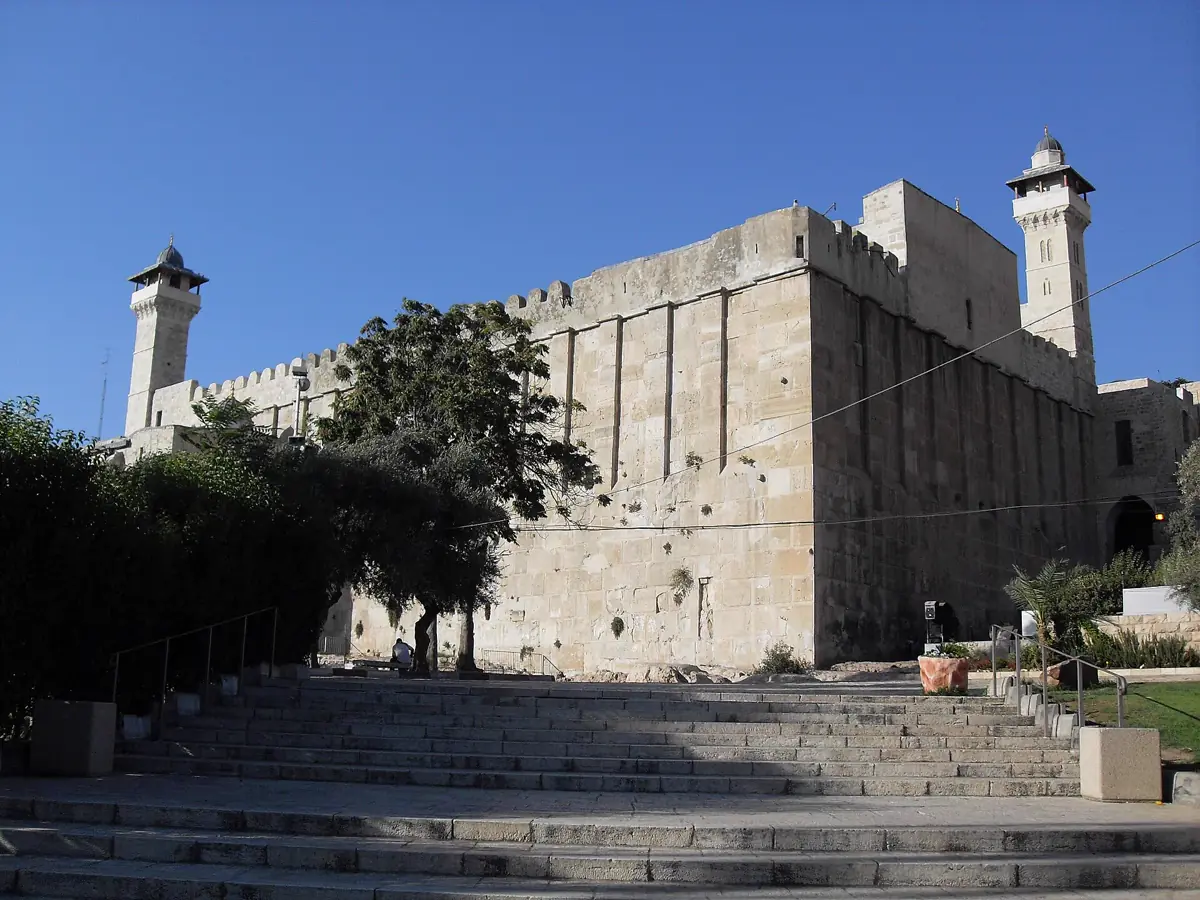
The Cave of the Patriarchs at Hebron — Abraham’s burial ground, in the hill country the Anakim held in Joshua’s day (Joshua 11:21).Djampa · CC BY-SA 4.0
God made the mountains
Scripture's first word on mountains is that they are God's work, and older than any man.
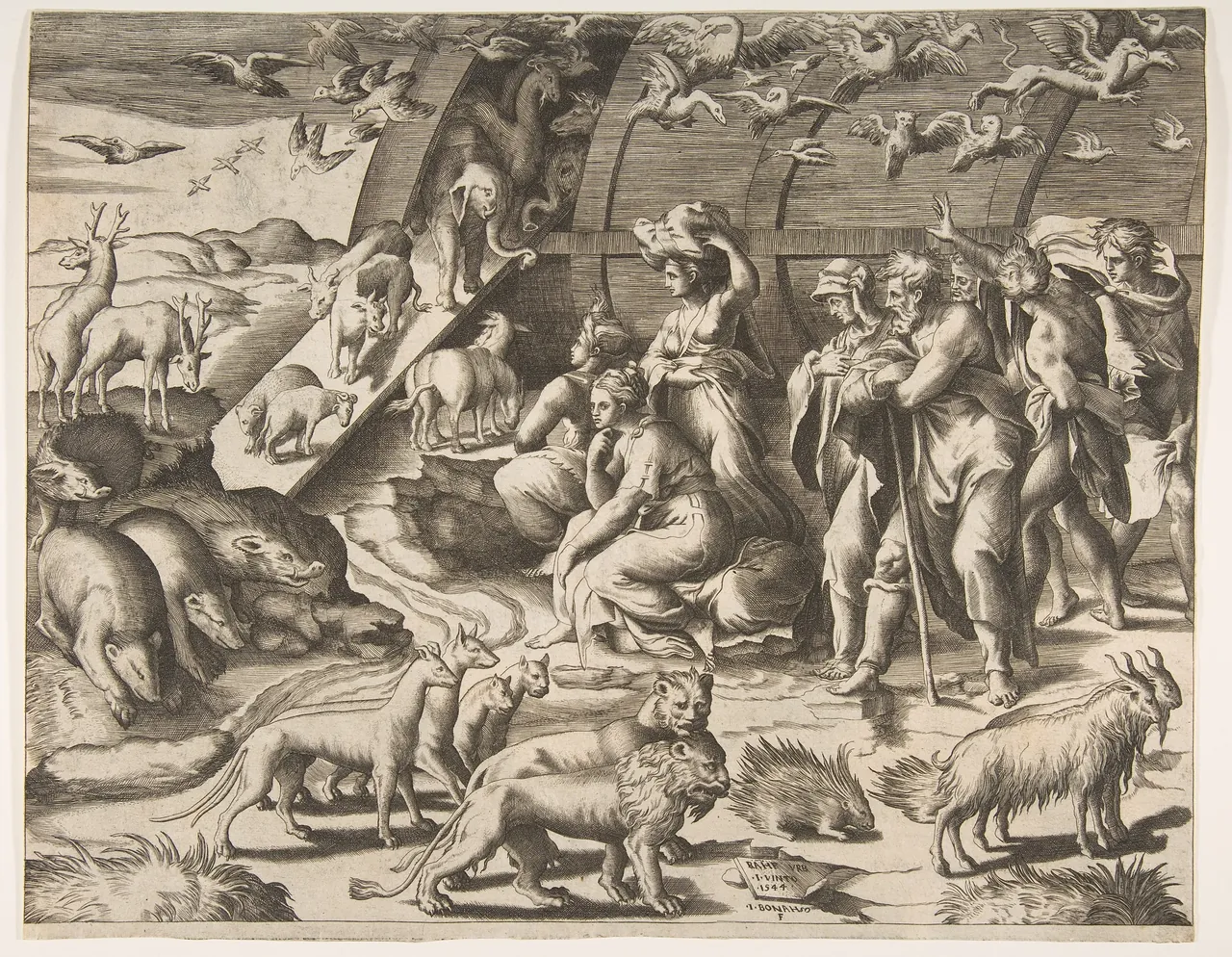
A sixteenth-century engraving of Noah leaving the Ark with his family and the animals, after the waters of the Flood went down and the mountains were seen.Noah leaving the Ark · 16th century · The Metropolitan Museum of Art · CC0 · museum record · Galeria Regni
"Before the mountains were brought forth, or ever thou hadst formed the earth and the world, even from everlasting to everlasting, thou art God." (Psalm 90:2)
Wisdom speaks in Proverbs of being with God at the beginning: "Before the mountains were settled, before the hills was I brought forth" (Proverbs 8:25). The Psalms say God "by his strength setteth fast the mountains; being girded with power" (Psalm 65:6). Isaiah asks who "weighed the mountains in scales, and the hills in a balance" (Isaiah 40:12). The answer is the LORD.
Jacob, blessing Joseph, spoke of "the utmost bound of the everlasting hills" (Genesis 49:26). The hills are a byword for what is old and lasting. They were there before the giants were born.
That point is decisive for one form of the thesis. If mountains existed from the creation week, then the mountains as a class were not made from giants who were born many generations later. Genesis 7 says plainly that there were mountains before the Flood: "And the waters prevailed exceedingly upon the earth; and all the high hills, that were under the whole heaven, were covered. Fifteen cubits upward did the waters prevail; and the mountains were covered" (Genesis 7:19-20).
The Flood and the mountains
The Flood was global and real. "The same day were all the fountains of the great deep broken up, and the windows of heaven were opened" (Genesis 7:11), and the waters covered every high hill under heaven. When they went down, the ark "rested in the seventh month, on the seventeenth day of the month, upon the mountains of Ararat", and on the first day of the tenth month "were the tops of the mountains seen" (Genesis 8:4-5).
Psalm 104 describes the waters of the deep standing above the mountains and then fleeing at God's word:
"Who laid the foundations of the earth, that it should not be removed for ever. Thou coveredst it with the deep as with a garment: the waters stood above the mountains. At thy rebuke they fled; at the voice of thy thunder they hasted away. They go up by the mountains; they go down by the valleys unto the place which thou hast founded for them. Thou hast set a bound that they may not pass over; that they turn not again to cover the earth." (Psalm 104:5-9)
The last line echoes God's covenant with Noah, "neither shall there any more be a flood to destroy the earth" (Genesis 9:11), and many readers take the psalm to describe the creation and the Flood together. Either way, the picture is of water moving over a landscape God had already made, and of God setting bounds for it. A Flood on that scale could reshape the face of the earth, and creation geologists argue that much of what we see in the rocks was laid down or carved by it. Scripture does not tell us which mountains were raised or reshaped by the Flood, or how. It certainly does not tell us any of them were made of giants.
Mountains as God's witnesses
Throughout Scripture, mountains bear witness to God, not to giants.
They are places where He meets His people. "And mount Sinai was altogether on a smoke, because the LORD descended upon it in fire: and the smoke thereof ascended as the smoke of a furnace, and the whole mount quaked greatly" (Exodus 19:18). Jesus took Peter, James and John "up into an high mountain apart, And was transfigured before them: and his face did shine as the sun, and his raiment was white as the light" (Matthew 17:1-2).
They are pictures of His strength and faithfulness. "I will lift up mine eyes unto the hills, from whence cometh my help. My help cometh from the LORD, which made heaven and earth" (Psalm 121:1-2). Notice the turn in that psalm. The hills are not the help. They point to the One who made them.
They are pictures of His kingdom. In Daniel's vision, the stone cut without hands struck the image of the world's empires, "and the stone that smote the image became a great mountain, and filled the whole earth" (Daniel 2:35). Isaiah saw that "the mountain of the LORD's house shall be established in the top of the mountains" (Isaiah 2:2). Babylon, the oppressor, is called a "destroying mountain" that God will make "a burnt mountain" (Jeremiah 51:25).
And they are pictures of what is temporary compared with Him. "For the mountains shall depart, and the hills be removed; but my kindness shall not depart from thee, neither shall the covenant of my peace be removed, saith the LORD that hath mercy on thee" (Isaiah 54:10). The psalmist says, "The hills melted like wax at the presence of the LORD, at the presence of the Lord of the whole earth" (Psalm 97:5). At the end, "every mountain and island were moved out of their places", and the kings and mighty men of the earth "said to the mountains and rocks, Fall on us, and hide us from the face of him that sitteth on the throne, and from the wrath of the Lamb" (Revelation 6:14-16).
Mount Hermon
One mountain deserves special mention, because the thesis and its sources often bring it up. Mount Hermon, the great snow-capped peak at the northern edge of Israel, rising over nine thousand feet, is the place where 1 Enoch says the Watchers descended (Part 3 looks at that passage). In Scripture, Hermon is the northern boundary of the land Israel took from the Amorite kings: "from the river of Arnon unto mount Hermon; (Which Hermon the Sidonians call Sirion; and the Amorites call it Shenir;)" (Deuteronomy 3:8-9). It was part of the kingdom of Og, the last of the Rephaim (Joshua 12:4-5).
Strong traces the name Chermon (H2768) to the root charam (H2763), "to seclude; specifically (by a ban) to devote to religious uses (especially destruction)".1 1 Enoch plays on that root when it says the Watchers named the mountain Hermon "because they had sworn and bound themselves by mutual imprecations upon it" (1 Enoch 6:6).
Yet in the Psalms, Hermon is a mountain of blessing. "As the dew of Hermon, and as the dew that descended upon the mountains of Zion: for there the LORD commanded the blessing, even life for evermore" (Psalm 133:3). Another psalm says, "The north and the south thou hast created them: Tabor and Hermon shall rejoice in thy name" (Psalm 89:12). And it was in the region at Hermon's foot, "the coasts of Caesarea Philippi", that Jesus asked His disciples, "Whom do men say that I the Son of man am?" (Matthew 16:13), and heard Peter's confession. Whatever darkness the old traditions attached to Hermon, Scripture calls it God's creation and a mountain that rejoices in His name.
The verdict of Part 2
Scripture says a great deal about mountains. It says God made them, set them fast, weighed them, covered them with the Flood and uncovered them again, met His people on them, and will one day move them out of their places. It never says that a mountain was made from a giant, or that a giant became a hill. On the first and most important test, the thesis has no support.
Part 3 — Where the Giants Went: Scripture and the Ancient Witnesses
9 min read
This part matters because the thesis depends on a claim about what happened to the giants' bodies. Scripture speaks to that question, and so do the ancient books the thesis appeals to. Neither says what the thesis needs.
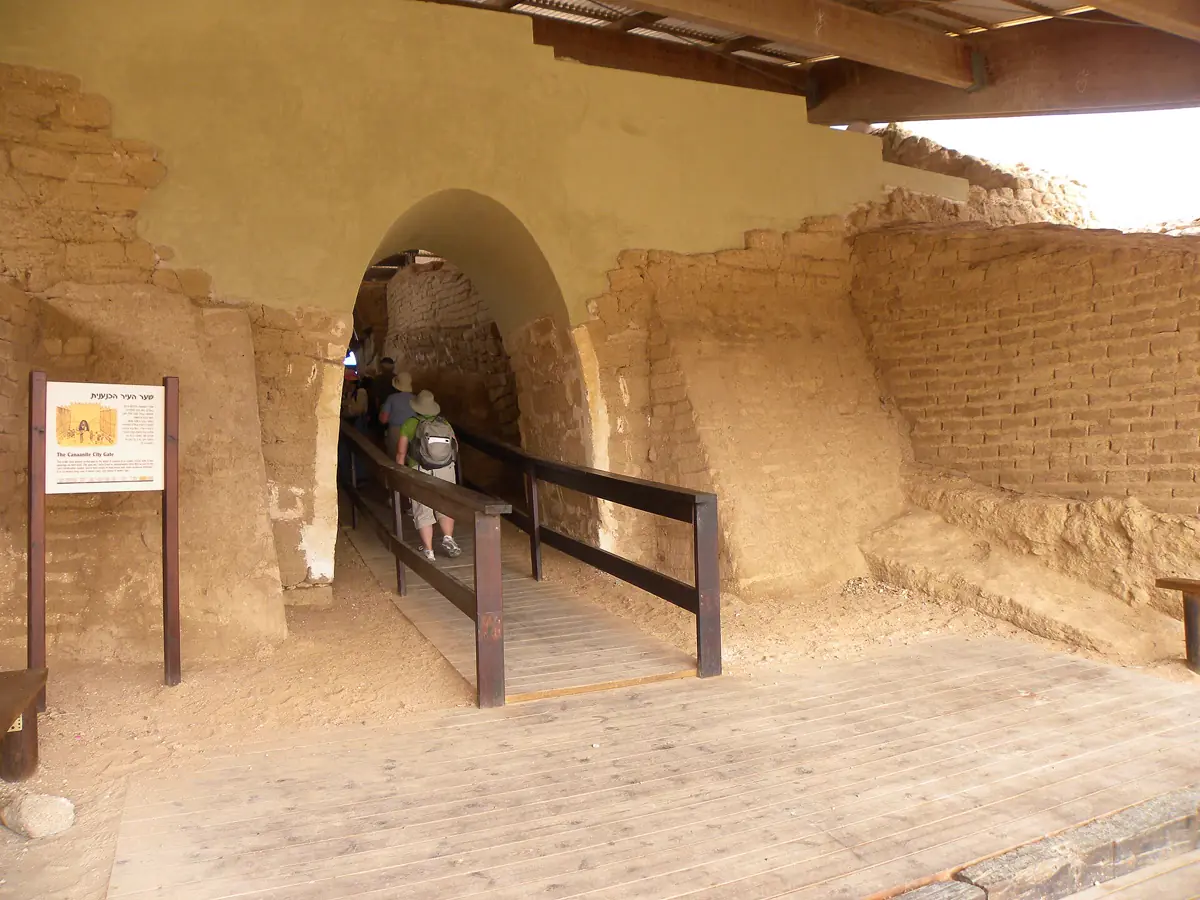
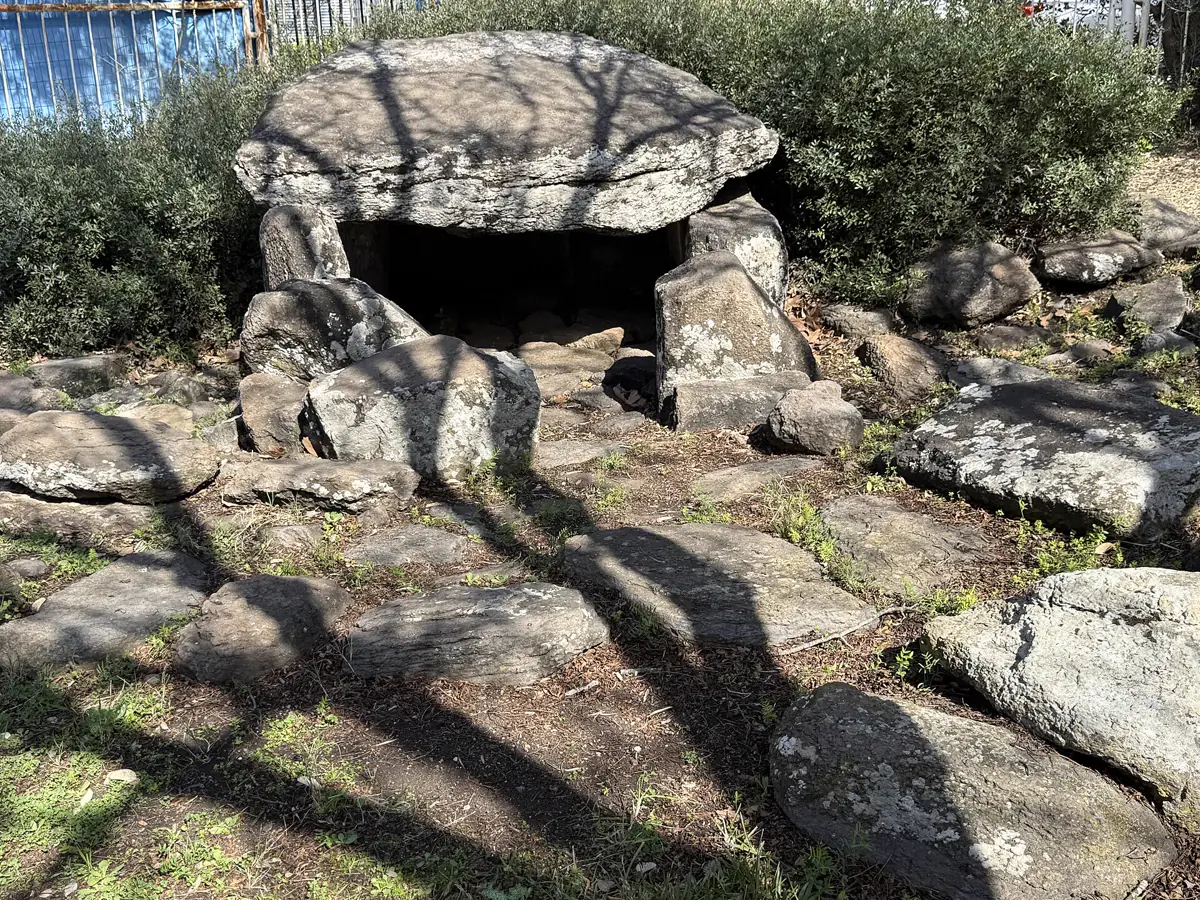
The Middle Bronze Age gate of Ashkelon — one of the Philistine cities where survivors of the Anakim remained (Joshua 11:22).Ian Scott · CC BY-SA 2.0A basalt dolmen from the Golan — megalithic tombs scattered across the land Deuteronomy calls Bashan, the country of Og, who “remained of the remnant of giants” (Deuteronomy 3:11).שלמה רודד · CC BY 2.5
The giants died
The plainest thing the Bible says about the giants after the Flood is that they died, in the ordinary ways men die.
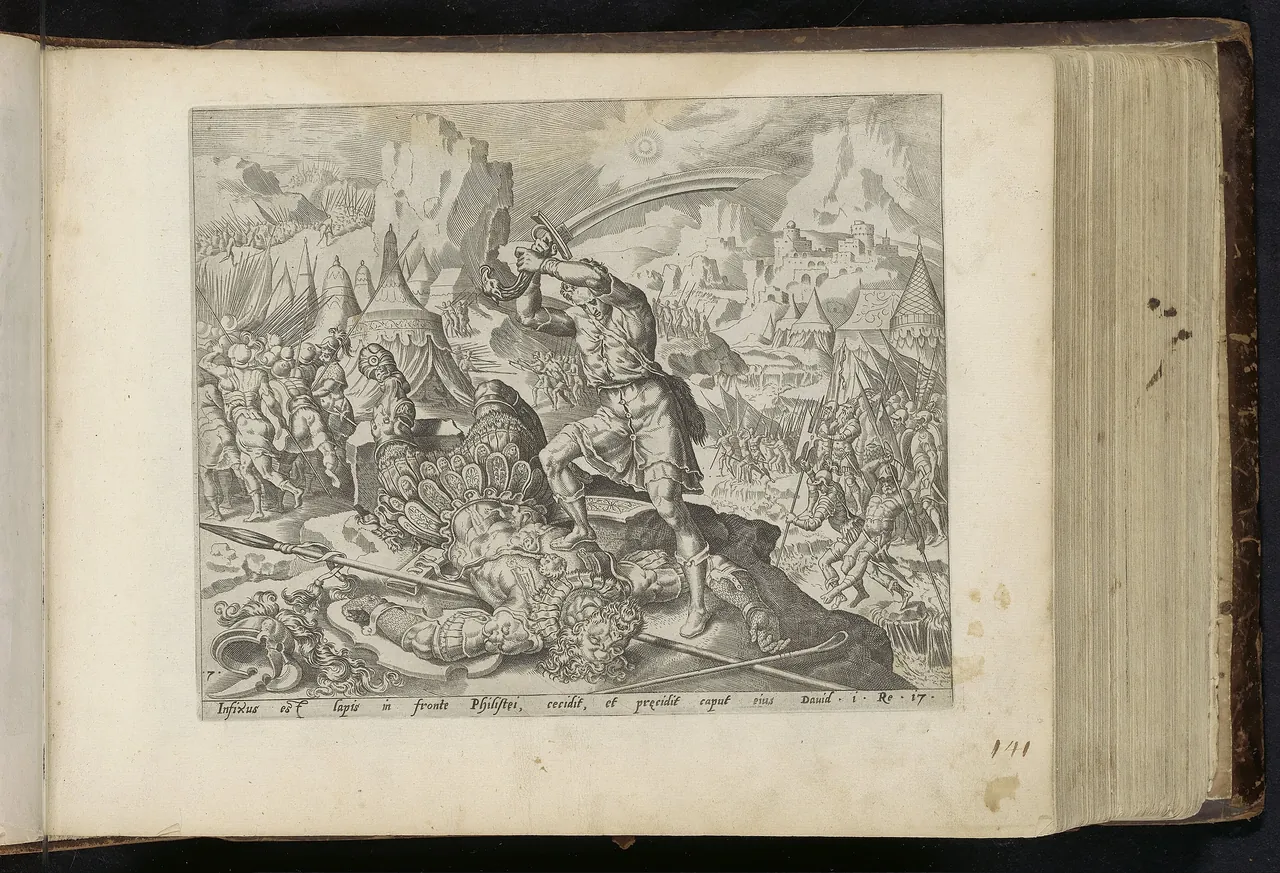
A Dutch engraving of 1554 showing David beheading Goliath, from a series on the history of David and Saul, a giant who died as other men die.David onthoofdt Goliat Van Saul, David, en Goliath (serietitel) Geschiedenis van David en Saul (serietitel) Den Grooten · 1554 · Wikimedia Commons · CC0 · museum record · Galeria Regni
The Emim and Zamzummim were "a people great, and many, and tall, as the Anakims; but the LORD destroyed them before them; and they succeeded them, and dwelt in their stead" (Deuteronomy 2:21). Joshua "cut off the Anakims from the mountains", and "destroyed them utterly with their cities" (Joshua 11:21). Og was defeated in battle. Goliath fell to a stone and a sword, and "David took the head of the Philistine, and brought it to Jerusalem" (1 Samuel 17:54). The four sons of the giant in Gath "fell by the hand of David, and by the hand of his servants" (2 Samuel 21:22).
Notice what the Bible remembers of their bodies. Og's bedstead was kept as a monument in Rabbath (Deuteronomy 3:11). Goliath's head went to Jerusalem and his armour to David's tent. These are relics a man could carry, not mountains.
The rule God gave Adam after the Fall applies to giants as well as to ordinary men: "for dust thou art, and unto dust shalt thou return" (Genesis 3:19). The Preacher says the same: "Then shall the dust return to the earth as it was: and the spirit shall return unto God who gave it" (Ecclesiastes 12:7). The body goes to dust, not to stone.
The Rephaim and the dead
The Hebrew word rephaim has a second use that is easy to miss in English. Strong lists two words spelled alike: H7497, "a giant", the Rephaim of Genesis 14 and Deuteronomy 3; and H7496, "properly, lax, i.e. (figuratively) a ghost (as dead; in plural only)", which the King James renders "dead" or "deceased".2 The second word appears in several passages about the realm of the dead:
"Dead things are formed from under the waters, and the inhabitants thereof." (Job 26:5)
"The man that wandereth out of the way of understanding shall remain in the congregation of the dead." (Proverbs 21:16)
"Hell from beneath is moved for thee to meet thee at thy coming: it stirreth up the dead for thee, even all the chief ones of the earth; it hath raised up from their thrones all the kings of the nations." (Isaiah 14:9)
"They are dead, they shall not live; they are deceased, they shall not rise: therefore hast thou visited and destroyed them, and made all their memory to perish." (Isaiah 26:14)
In each of these, "dead", "deceased" or "dead things" translates rephaim. Scholars debate how the two uses of the word are related, and whether the giant peoples were named after the shades of the dead or the other way round. What matters for this paper is where Scripture puts the rephaim when it speaks of them as dead: "under the waters", in "the congregation of the dead", in hell beneath, among those who "shall not rise". It does not put them on the surface of the earth as hills.
Job 26:5 is worth a second look, because it is the closest Scripture comes to anything the thesis might want: the rephaim "formed from under the waters". The verse sits in a passage about God's power over the deep and the realm of the dead: Job goes on: "Hell is naked before him, and destruction hath no covering" (Job 26:6). It describes the dead trembling beneath the waters before God, not giants hardening into mountains.
Isaiah 26 adds a contrast. Verse 14 says of the oppressors, the rephaim, "they shall not rise". Verse 19 says of God's people, "Thy dead men shall live, together with my dead body shall they arise. Awake and sing, ye that dwell in dust: for thy dew is as the dew of herbs, and the earth shall cast out the dead" (Isaiah 26:19). There, too, the word for "the dead" is rephaim. The hope of the righteous is resurrection from the dust, not survival as stone.
Ezekiel's mighty men
Ezekiel 32 is a lament over Egypt, describing the great nations of the past lying in the pit. Of the fallen warriors it says:
"And they shall not lie with the mighty that are fallen of the uncircumcised, which are gone down to hell with their weapons of war: and they have laid their swords under their heads, but their iniquities shall be upon their bones, though they were the terror of the mighty in the land of the living." (Ezekiel 32:27)
The "mighty" (gibborim) are the same class of men as the "mighty men which were of old" in Genesis 6:4. Some interpreters see an echo of the giants here. If there is one, it places them where the rest of Scripture does: "gone down to hell", with their bones and their iniquities, not standing on the earth as mountains.
The resurrection of the body
The Bible ends the story of every human body in the same way. "And many of them that sleep in the dust of the earth shall awake, some to everlasting life, and some to shame and everlasting contempt" (Daniel 12:2). The Lord Jesus said, "the hour is coming, in the which all that are in the graves shall hear his voice, And shall come forth" (John 5:28-29). At the last judgement "the sea gave up the dead which were in it; and death and hell delivered up the dead which were in them" (Revelation 20:13).
Graves, the sea, death and hell: those are the places Scripture names. Mountains are not among them.
What 1 Enoch says
The thesis leans heavily on 1 Enoch. It is a real and very old book, found in Aramaic among the Dead Sea Scrolls and preserved complete in Ge'ez, and the companion paper describes it. It is a historical witness to what Jews before Christ believed, and it is quoted here as that, not as Scripture.3 What it says about the giants' end is worth reading carefully, because it does not say what the thesis claims.
The rocks are on an angel, not a giant. The passage most often cited for the thesis is God's command to Raphael:
"Bind Azâzêl hand and foot, and cast him into the darkness: and make an opening in the desert, which is in Dûdâêl, and cast him therein. And place upon him rough and jagged rocks, and cover him with darkness, and let him abide there for ever, and cover his face that he may not see light." (1 Enoch 10:4-5)
Azazel in 1 Enoch is one of the Watchers, an angel, not one of the giants. The rocks are placed on him as a prison in a desert pit. Nothing is said of his body becoming the rock.
The valleys hold the Watchers, not the giants. Michael is told to bind Semjaza and his fellows:
"And when their sons have slain one another, and they have seen the destruction of their beloved ones, bind them fast for seventy generations in the valleys of the earth, till the day of their judgement and of their consummation, till the judgement that is for ever and ever is consummated." (1 Enoch 10:11)
"Them" here is the Watchers. It is the fathers who are bound "in the valleys of the earth", and they are bound after watching their sons die. The verse that follows says where they go next: "In those days they shall be led off to the abyss of fire: and to the torment and the prison in which they shall be confined for ever" (1 Enoch 10:12).
The giants kill each other. God's command concerning the giants themselves is that Gabriel should "send them one against the other that they may destroy each other in battle: for length of days shall they not have" (1 Enoch 10:8). Their end in 1 Enoch is slaughter, not preservation.
The giants' spirits leave their bodies. The most influential passage in 1 Enoch about the giants after death is this:
"And now, the giants, who are produced from the spirits and flesh, shall be called evil spirits upon the earth, and on the earth shall be their dwelling. Evil spirits have proceeded from their bodies; because they are born from men, and from the holy Watchers is their beginning and primal origin; they shall be evil spirits on earth, and evil spirits shall they be called." (1 Enoch 15:8-9)
And again, "From the days of the slaughter and destruction and death of the giants, from the souls of whose flesh the spirits, having gone forth, shall destroy without incurring judgement" (1 Enoch 16:1). In 1 Enoch's account, what survives of a giant is its spirit, which has "gone forth" from the body. The body itself is simply dead.
That is the irony at the heart of the thesis. It appeals to 1 Enoch, but 1 Enoch's own teaching runs the other way. If 1 Enoch is right, the giants are not in the mountains; their bodies perished and their spirits wander. If the giants were in the mountains as preserved bodies, 1 Enoch would be wrong. The thesis cannot have both.
As the companion paper explains, the Bible does not confirm 1 Enoch's account of the origin of evil spirits either. It is an ancient Jewish teaching, and that is how it is reported here.
Mountains in 1 Enoch
1 Enoch does have a great deal to say about mountains, which may be one reason the thesis has grown up around it. In Enoch's visionary journeys he sees seven mountains of precious stones, the middle one reaching "to heaven like the throne of God, of alabaster" (1 Enoch 18:7). Beyond them he sees a place of judgement, where there are "seven stars like great burning mountains" (1 Enoch 18:12), which an angel explains are a prison "for the stars and the host of heaven" (1 Enoch 18:13). And at the coming judgement, "the high mountains shall be shaken, And the high hills shall be made low, And shall melt like wax before the flame" (1 Enoch 1:6).
None of these is a giant turned to stone. The "burning mountains" are a simile for stars, and the stars are a picture of disobedient heavenly beings. Read as a whole, 1 Enoch's mountains are like Scripture's: things God made and will one day shake.
Jubilees
The Book of Jubilees, the other ancient book often cited, tells the same basic story. It says the angels who sinned were bound: "He bade us to bind them in the depths of the earth, and behold they are bound in the midst of them, and are (kept) separate" (Jubilees 5:6). Of their sons, the giants, it says that God "sent His sword into their midst that each should slay his neighbour, and they began to slay each other till they all fell by the sword and were destroyed from the earth" (Jubilees 5:9).4
"Destroyed from the earth" is the opposite of preserved on it.
The verdict of Part 3
Scripture says the giants died in battle, went down among the dead, and await the resurrection and judgement with all mankind. The ancient witnesses the thesis leans on say the angels were bound beneath rocks and in valleys, and the giants killed one another and perished, their spirits going out from dead bodies. Neither Scripture nor the witnesses say that giants became mountains. On the second test, the thesis again has no support, and its main ancient source counts against it.
This part matters because the thesis makes a physical claim. If mountains are petrified giants, the rock should show it. Rock can be broken, cut, polished and examined under a microscope, and geologists have done that to the mountains of the world for centuries.
A word first about time. Geologists who hold to an old earth and creation geologists who hold to a young one disagree sharply about how long the processes below have taken. This paper does not settle the age of the earth either way. The processes themselves, what mountains are made of and how they rise and wear down, can be observed and described without settling it, and that is all this part does.
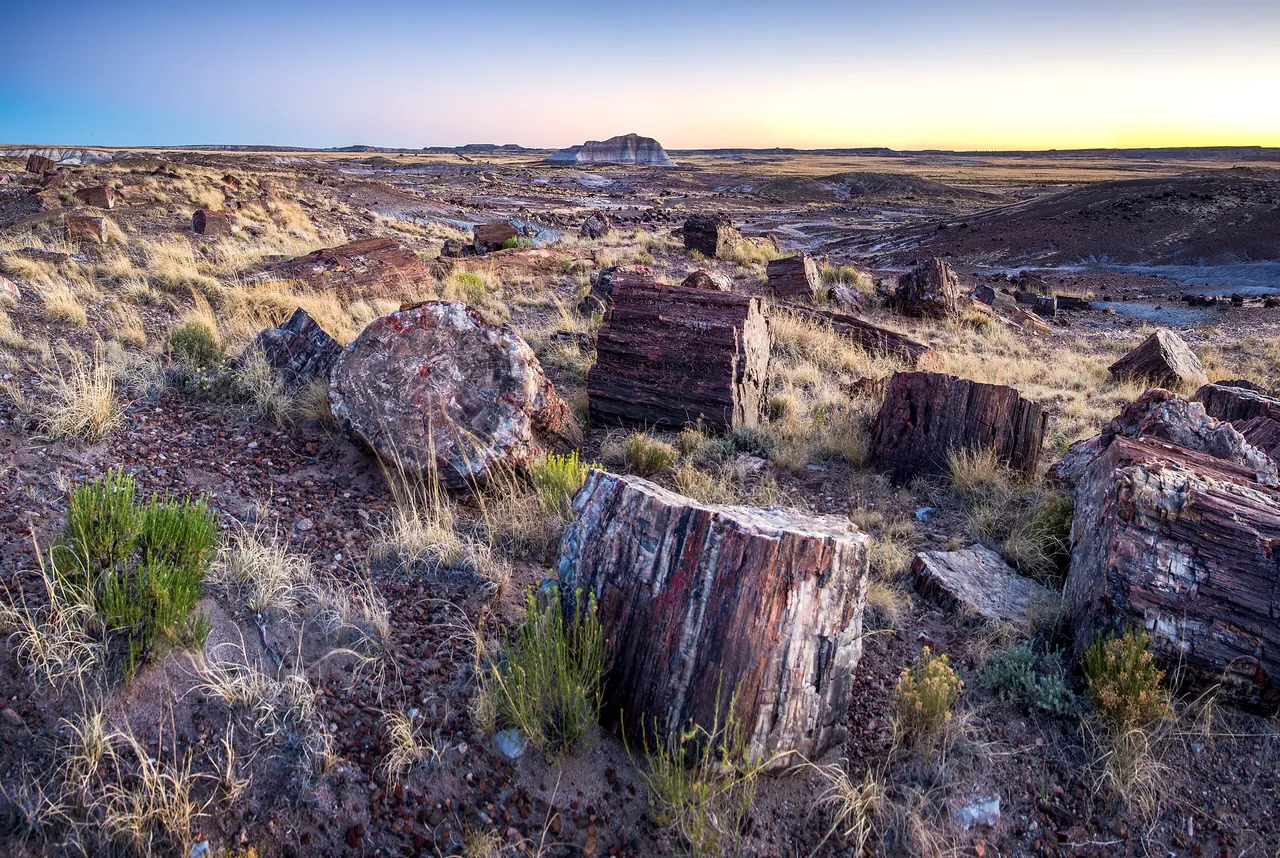
A 2014 photograph of petrified logs scattered across Petrified Forest National Park, stone that still keeps the shape of the trees it replaced.Logs everywhere, Petrified Forest · photographed 2014 · Wikimedia Commons · CC BY 2.0 · museum record · Galeria Regni
How mountains rise
Geologists group mountains by the way they form. Four kinds cover most of the mountains people point to.
Collision mountains. Where two great plates of the earth's crust push against each other, the crust buckles, folds and is thrust upward. The Himalaya is the standard example. The United States Geological Survey describes the collision of India with Asia this way: because both are continental crust that will not easily sink, "The pressure of the impinging plates could only be relieved by thrusting skyward". The survey reports that the uplift continues today at more than a centimetre a year.5
Fault-block mountains. Where the crust breaks along a fault, one side can rise while the other drops. The Teton Range in Wyoming is a classic case. The National Park Service explains that "The Teton Range uplifts one earthquake at a time along the 40-mile long Teton fault", each quake "lifting the mountain block skyward while dropping the valley floor". The core of the range is a hard banded rock called gneiss, cut through by younger granite that forms the highest peaks of the central range.6
Volcanic mountains and intrusions. Molten rock rising from below can build volcanoes on the surface, or harden underground into bodies of igneous rock that are later exposed as the softer rock around them wears away. Devils Tower in Wyoming, sometimes claimed online to be the stump of a giant tree, is of this kind. The National Park Service says "molten rock pushed up to form the Tower", and that "The Tower is full of natural cracks created by columnar jointing", the cracking into long columns that happens as such rock cools and shrinks.7 The columns that look like the ridges of bark are a cooling pattern, the same pattern seen at the Giant's Causeway in Northern Ireland and in lava flows around the world.
Erosion. Every mountain, once raised, is worn down. Rain, rivers, ice and frost cut valleys and strip slopes, and they wear soft rock faster than hard. That uneven wearing is what carves cliffs, ridges, arches and, sometimes, profiles that look like faces.
What mountains are made of
Mountains are made of rock, and rock is made of minerals: crystals of quartz, feldspar, mica, calcite and the like, in forms that can be identified under a hand lens or a microscope. Granite is a mass of interlocking crystals. Gneiss is rock whose minerals have been squeezed into bands. Limestone is mostly calcite, and sandstone mostly cemented grains of quartz.
A body is made of something very different. Bone is a living tissue with a structure all its own: a hard mineral framework laid down around networks of tiny canals and cells. Flesh is softer still. When bone or wood turns to stone in the real world, that structure does not disappear. It is copied.
How real petrifaction works
The best-known example of petrifaction is petrified wood. The National Park Service at Petrified Forest National Park in Arizona describes how it forms: logs were buried quickly and deeply in sediment, which cut off oxygen and slowed decay; then silica carried in groundwater seeped into the wood, where the minerals "crystallized within the cellular structure, replacing the organic material as it broke down over time".8 The result is stone that keeps the shape of the tree down to the level of its cells. Cut and polish a slice of petrified wood and you can see its growth rings.
The same is true of fossil bone. Bones that have been turned to stone keep the shape and internal structure of the original bone, which is how anyone can tell a fossil bone from an ordinary rock.
That gives a clear test for the thesis. If a mountain were a petrified giant, a thin slice of its rock under a microscope would show the structure of bone or tissue, the way petrified wood shows the structure of wood. That is not what geologists find. They find crystals, grains, layers and bands: the textures of rock that formed as rock. The faces and figures people see in mountains are on the outside, at the scale of hundreds or thousands of feet, while the rock inside is the same as the rock in the hills around them that look like nothing at all.
The size problem
There is a second physical difficulty. The mountains usually named as sleeping giants are miles long and thousands of feet high. Even 1 Enoch's impossible "three thousand ells" would make a giant one to two miles tall or more, depending on the length of the ell, which is still far smaller than a mountain range, and the Bible's own giants were measured in cubits: a bedstead of nine cubits, a man of six cubits and a span. The companion paper explains why a human frame could not be scaled up even to hundreds of feet. Whatever the giants of Scripture were, they were not the size of the Tetons.
The verdict of Part 4
The rocks tell a consistent story. Mountains rise by collision, faulting and volcanic activity, and are carved by erosion. They are made of minerals that formed as rock, not of replaced tissue. Real petrifaction preserves the structure of what was petrified, and no mountain shows the structure of a body. On the third test, the physical evidence counts against the thesis.
This part matters because the strongest pull of the thesis is not an argument but an experience. People look at a mountain and see a giant. That experience is real, and it has a real explanation.
Pareidolia
Psychologists call it pareidolia: seeing a meaningful pattern, most often a face, where none was made. Everyone does it. We see faces in clouds, in the fronts of cars, in electrical sockets, in the grain of a wooden door.
The human brain is built to find faces quickly. In 1997 the neuroscientist Nancy Kanwisher and her colleagues at Harvard reported a region of the brain, which they named the fusiform face area, that responds far more strongly to faces than to other objects.9 In 2014 a team of researchers from China and Canada, in a study they titled "Seeing Jesus in toast", showed volunteers images of pure visual noise but told them that half the images contained faces or letters. The volunteers reported seeing faces in pure noise 34 per cent of the time, and the face area of their brains responded when they did. The researchers concluded that "human face processing has a strong top-down component whereby sensory input with even the slightest suggestion of a face can result in the interpretation of a face".10
In other words, when we expect to see a face, we see one, even in static. Tell a man that a mountain is a sleeping giant, and he will find the head, the nose and the folded arms. That is not dishonesty. It is how God made our eyes and minds to work, so that a baby can find its mother's face. But it means that seeing a figure in a mountain is not evidence that a figure is there.
The Old Man of the Mountain
For two centuries, the most famous face in American rock was the Old Man of the Mountain on Cannon Mountain in Franconia Notch, New Hampshire. Seen from the north, a set of granite ledges formed an unmistakable profile of an old man's face. Surveyors first noted the likeness in 1805, and in 1945 New Hampshire adopted it as the state emblem.11
Then, on the night of 2–3 May 2003, it fell. Campers heard loud noises in the wet, windy night; the next morning the face was gone. Weathering and the freeze-and-thaw of water in its cracks had worked on the ledges for as long as anyone had watched them.12
The Old Man is a parable for the thesis. From one angle, at one distance, it was a face. From any other angle it was a jumble of ledges. And when it fell, what lay on the slope below was broken granite. It was rock all the way through, because it was always rock.
The Sleeping Giant of Thunder Bay
On the north shore of Lake Superior, across the bay from the city of Thunder Bay, Ontario, a long formation of cliffs and mesas on the Sibley Peninsula looks, from the city, like a giant lying on his back. The local legend told of it is that the giant is Nanabijou, "the Spirit of the Deep Sea Water", who was turned to stone after the location of a rich silver mine was given away to white men. The mine is the Silver Islet mine at the giant's feet.13
The thesis treats legends like this as memories of real giants turned to stone. But look at what the legend actually says. Nanabijou is a spirit of the water, not one of the nephilim; he was turned to stone for a reason tied to a nineteenth-century silver mine, not for the sins of the days of Noah. The story is a people's explanation of a shape they could see from their shore, told in the terms of their own religion. That is exactly what we would expect pareidolia and storytelling to produce, and it is no evidence that the giant of Genesis 6 lies on the shore of Lake Superior.
That is true of many sleeping-giant legends. They are real stories, and they deserve to be told accurately and with respect. But a legend that a mountain is a sleeping figure is evidence that people saw a figure, not evidence that one is there. Two peoples on opposite sides of the world who both see a sleeping man in a ridge are not sharing a memory. They are sharing a brain.
The Face on Mars
The clearest lesson comes from another world. On 25 July 1976 the Viking 1 orbiter, photographing the Cydonia region of Mars from about 1,873 kilometres up, captured a mesa that looked strikingly like a human face, with eyes, nose and mouth. NASA's scientists took it for a mesa with unusual shadows, and NASA's own caption for the image says that "Planetary geologists attribute the origin of the formation to purely natural processes".14 The Face nonetheless became famous, and some argued it was an artificial monument.
Later spacecraft looked again, at far higher resolution. The Mars Global Surveyor photographed the same hill in April 1998 and again on 8 April 2001, and with sharper pictures and different lighting the face disappeared into ridges, slopes and peaks. NASA concluded that the Face is "a mesa", a natural landform, and its laser-altimeter elevation maps showed the hill from every angle, "unaltered by lights and shadow", with no eyes, nose or mouth.15
The lesson is simple and it applies on earth. A face that is really there gets clearer when you look closer. A face made by light, shadow and the eye gets fainter. Every sleeping giant in the world gets fainter when you walk up to it.
The verdict of Part 5
People see giants in mountains because human beings are made to see faces, and because a story told in advance shapes what we see. The legends of sleeping giants are real stories, but they are stories about shapes, not memories of the nephilim. When the famous faces are examined, they turn out to be rock, every time. On the fourth test, the experience that gives the thesis its pull has a better explanation.
This part matters because testing an idea is not the same as sneering at it. A Christian should be able to say, kindly and clearly, why he does not believe something, and also what he does believe instead.
The four tests together
| Test | What the thesis needs | What the evidence shows | | --- | --- | --- | | Scripture | Mountains made from giants, or giants preserved as stone | Mountains made by God before the giants; giants died and went down among the dead | | Ancient witnesses | 1 Enoch and Jubilees preserving giant bodies in the earth | Angels bound under rocks and in valleys; giants killed each other; their spirits left their bodies | | The rocks | Mountains made of petrified tissue | Mountains made of minerals; real petrifaction keeps structure, and no mountain shows a body's | | The eye | Faces in mountains as remains | Faces explained by pareidolia, and they vanish on closer view |
On every test, the thesis has no support. That is the honest verdict of this paper: the giants-as-mountains thesis is a speculation that neither Scripture, nor the ancient books it leans on, nor the physical evidence supports. I do not teach it, and I would not want anyone to repeat it as fact.
Why the thesis appeals
It is still worth asking why the idea is attractive, because the reasons are mostly good ones gone astray.
A sense of wonder. The thesis takes the giants seriously and makes the world feel enchanted again. That instinct is right. "O LORD, how manifold are thy works! in wisdom hast thou made them all: the earth is full of thy riches" (Psalm 104:24). Creation is full of wonder. It does not need an invented one.
Distrust of institutions. Many who hold the thesis believe that scientists or museums have hidden the truth. Sometimes institutions have been wrong, and believers are right to be wary of claims that rule God out in advance. But distrust is not evidence. The test of a claim is still the evidence for it, and the thesis does not yet have any.
Faith in the Bible's giants. Many who hold the thesis do so because they believe Genesis 6 and Numbers 13, and they want the world to show it. That faith is sound. The problem is the bridge built from it. The Bible's giants do not need mountains to be real.
Why it matters to get this right
There are three costs to repeating a speculation as fact.
The first is to the hearer. A seeker who is told that a mountain is a petrified giant, and who then learns how mountains form, may conclude that everything else the Christian told him is equally unfounded, including the gospel.
The second is to the Christian. Scripture warns against teachers who give people what they want to hear: "after their own lusts shall they heap to themselves teachers, having itching ears; And they shall turn away their ears from the truth, and shall be turned unto fables" (2 Timothy 4:3-4). A believer who gets used to accepting what thrills him without testing it becomes easy to lead astray.
The third is to the witness of the word itself. Proverbs gives a rule every debater learns sooner or later: "He that is first in his own cause seemeth just; but his neighbour cometh and searcheth him" (Proverbs 18:17). The thesis sounds convincing until someone searches it. The Bible, by contrast, has been searched by its enemies for centuries and still stands. Tying it to a theory that cannot stand being searched does it no favours.
What to keep
Rejecting the thesis does not mean rejecting what it was built from. Several things in it are true and worth holding.
The giants were real. The Rephaim, the Anakim, the Emim, Og and Goliath are in the King James Bible as history. I hold the giants of the Bible to be history: real men, of real size, who lived and died where the Bible says they did. This is my conviction; weigh it for yourself.
The Flood was real and global. The waters covered the high hills under the whole heaven, and God set a bound that they should not cover the earth again.
The ancient witnesses are worth reading. 1 Enoch and Jubilees tell us what many Jews before Christ believed about the Watchers and the giants. Read them as witnesses, with Scripture as the judge.
Mountains do testify. Not to giants, but to God. "For the invisible things of him from the creation of the world are clearly seen, being understood by the things that are made, even his eternal power and Godhead; so that they are without excuse" (Romans 1:20). A mountain is a sermon on the strength of the One who "setteth fast the mountains" (Psalm 65:6). Stones are used as witnesses in Scripture, too, but witnesses set up by men to remember what God did: "these stones shall be for a memorial unto the children of Israel for ever" (Joshua 4:7). The memorial at the Jordan was twelve stones from the riverbed, not a petrified enemy.
Looking closely is a godly thing. "It is the glory of God to conceal a thing: but the honour of kings is to search out a matter" (Proverbs 25:2). And again, "The works of the LORD are great, sought out of all them that have pleasure therein" (Psalm 111:2). The geologist who studies how the Tetons rise and the believer who studies how Genesis reads are doing the same kind of work: searching out what God has made. Neither should be afraid of the other.
The idea that the giants became mountains is beautiful, and it is built from true pieces: the giants of the Bible, the Flood, the old books of the Watchers, the legends of sleeping giants, and the faces we all see in rock. But the pieces do not fit the way the thesis puts them together.
Scripture says God made the mountains before the giants were born, covered them in the Flood and uncovered them again, and will one day move them out of their places. It says the giants died in battle, went down among the dead, and will rise with all men to judgement. It never says a giant became a mountain.
1 Enoch and Jubilees say the angels were bound beneath rocks and in the valleys of the earth, and that the giants destroyed each other and perished, their spirits going out from their dead bodies. The books the thesis leans on teach the opposite of what it needs.
The rocks are made of minerals that formed as rock. Real petrifaction keeps the structure of what it replaces, and no mountain shows the structure of a body. Mountains rise by collision, faulting and volcanic action, and are carved by water, ice and time.
The eye sees faces because God made it to, and the famous faces in rock, from the Old Man of the Mountain to the Face on Mars, turn out to be rock when we look closer.
So the honest verdict is this: the giants-as-mountains thesis is a speculation without support, and I do not teach it. The giants of the Bible are real, and I do teach that, as my conviction; weigh it for yourself. The difference between those two sentences is the whole point of this paper.
An invitation
If you have come to this paper because the idea of giants in the mountains caught your imagination, I understand. The world is stranger and more wonderful than most people allow, and the Bible is stranger and more wonderful still. But the deepest wonder in it is not a giant. It is that the God who "weighed the mountains in scales" (Isaiah 40:12) also numbers the hairs of your head, and sent His Son to die for your sins and rise again.
The mountains will not last. "For the mountains shall depart, and the hills be removed; but my kindness shall not depart from thee, neither shall the covenant of my peace be removed, saith the LORD that hath mercy on thee" (Isaiah 54:10). That kindness is offered to you. "For by grace are ye saved through faith; and that not of yourselves: it is the gift of God: Not of works, lest any man should boast" (Ephesians 2:8-9). The way in is "repentance toward God, and faith toward our Lord Jesus Christ" (Acts 20:21), and the promise is sure: "him that cometh to me I will in no wise cast out" (John 6:37).
Lift up your eyes to the hills, then, and look past them. "My help cometh from the LORD, which made heaven and earth" (Psalm 121:2). Free truth, no pressure: open the 1611 Reader at kylelauriano.com/library, read Genesis and the Psalms for yourself, and weigh them.
1James Strong, The Exhaustive Concordance of the Bible (New York: Hunt & Eaton; Cincinnati: Cranston & Curts, 1890), Hebrew and Chaldee Dictionary, H2768 Chermown, H2763 charam. Searchable in the study tools of the 1611 Reader at kylelauriano.com/library.↩
2Strong, Exhaustive Concordance, Hebrew dictionary, H7497 and H7496 rapha.↩
3R. H. Charles, trans., The Book of Enoch, in The Apocrypha and Pseudepigrapha of the Old Testament in English, ed. R. H. Charles, vol. 2 (Oxford: Clarendon Press, 1913). Kept, marked as outside the canon, in the 1611 Reader at kylelauriano.com/library.↩
4R. H. Charles, trans., The Book of Jubilees, in The Apocrypha and Pseudepigrapha of the Old Testament in English, vol. 2 (Oxford: Clarendon Press, 1913). Also kept in the 1611 Reader at kylelauriano.com/library.↩
5U.S. Geological Survey, "The Himalayas: Two Continents Collide," in W. Jacquelyne Kious and Robert I. Tilling, This Dynamic Earth: The Story of Plate Tectonics (Washington, DC: U.S. Geological Survey, 1996). Online: https://pubs.usgs.gov/gip/dynamic/himalaya.html.↩
6National Park Service, "Geology," Grand Teton National Park. Online: https://www.nps.gov/grte/learn/nature/geology.htm.↩
7National Park Service, "Geologic Formations," Devils Tower National Monument. Online: https://www.nps.gov/deto/learn/nature/geologicformations.htm.↩
8National Park Service, "Petrified Wood," Petrified Forest National Park. Online: https://www.nps.gov/pefo/learn/nature/petrified-wood.htm.↩
9Nancy Kanwisher, Josh McDermott and Marvin M. Chun, "The Fusiform Face Area: A Module in Human Extrastriate Cortex Specialized for Face Perception," Journal of Neuroscience 17, no. 11 (1997): 4302–11. https://doi.org/10.1523/JNEUROSCI.17-11-04302.1997.↩
10Jiangang Liu, Jun Li, Lu Feng, Ling Li, Jie Tian and Kang Lee, "Seeing Jesus in Toast: Neural and Behavioral Correlates of Face Pareidolia," Cortex 53 (2014): 60–77. https://doi.org/10.1016/j.cortex.2014.01.013.↩
11Rachel Crowell, "Benchmarks: May 3, 2003: New Hampshire's Old Man of the Mountain Falls," Earth, April 10, 2018. Online: https://www.earthmagazine.org/article/benchmarks-may-3-2003-new-hampshires-old-man-mountain-falls/.↩
13"Awaken to the Wonders of the Sleeping Giant," Northern Ontario Travel. Online: https://northernontario.travel/where-am-i/awaken-wonders-sleeping-giant.↩
14NASA/JPL Photojournal, "PIA01141: Geologic 'Face on Mars' Formation." Online: https://science.nasa.gov/photojournal/geologic-face-on-mars-formation.↩
15NASA Science, "Unmasking the Face on Mars," May 24, 2001. Archived online: https://web.archive.org/web/20011217030714/http://science.nasa.gov/headlines/y2001/ast24may_1.htm.↩
Some of what you'll read here is supported by mainstream scholarship and peer-reviewed research. Some of it is my conviction — what I believe Scripture and the evidence point to, but which the academic world does not accept. I've marked which is which. The rows marked ✗ above are conviction, not established fact. Test everything like a Berean: "These were more noble than those in Thessalonica, in that they received the word with all readiness of mind, and searched the scriptures daily, whether those things were so" (Acts 17:11, KJV).
"For we wrestle not against flesh and blood, but against principalities, against powers, against the rulers of the darkness of this world, against spiritual wickedness in high places." — Ephesians 6:12 (KJV)