GENESIS 1–9, THE WATCHERS, THE GIANTS AND THE FLOOD
A study of the world before the Flood as Genesis tells it. It weighs the oldest Jewish and Christian witnesses, among them 1 Enoch and the Dead Sea Scrolls, and the flood memories of the ancient nations, and shows why it still matters.
Abstract
What was the world before the Flood like, and can we trust what Genesis says about it? This paper reads Genesis 1–9 as history: six real days of creation, a real Adam and Eve, a real Fall, long lives, the "sons of God" and the giants of Genesis 6, and a Flood that covered the whole earth. It argues first from the King James Bible, including the way Jesus, Peter, Paul and Jude read these chapters. Second, it weighs the ancient witnesses: Josephus; the church fathers who disagreed over Genesis 6; the Book of Enoch, which Jude quotes and which turned up in Aramaic among the Dead Sea Scrolls; and the flood traditions of Mesopotamia in the Sumerian King List, Atrahasis, Gilgamesh and Berossus. 1 Enoch is treated as a witness to what ancient Jews and Christians believed, never as Scripture. The paper makes no claim about the age of the earth and relies on no unverified finds. It is written for seekers and believers who want to know whether the opening of the Bible can bear their weight.
What’s inside
·Introduction
Part 1Part 1: In the Beginning
Part 2Part 2: Two Lines: Cain and Seth
Part 3Part 3: The Sons of God and the Giants
Part 4Part 4: The Witness of 1 Enoch
Part 5Part 5: The Flood
Part 6Part 6: After the Water: The Covenant with Noah
Part 7Part 7: As It Was in the Days of Noah
·Conclusion
Research paper · 9 chapters · 31 notes · October 2026
About 45 minutes · 9 parts · the PDF has the same text
Introduction
3 min read
In my own words: “I decided to read the Bible for one reason: to disprove it, so I'd have an excuse to stop going to church for good.” And then: “It did the opposite. Genesis gripped me.”
This paper is about the world before the Flood. It is a short stretch of Scripture, only nine chapters, but it holds the creation of the world, the first man and woman, the first sin, the first murder, the first city, men who lived nine hundred years, a man who walked with God and was not, the strange union of the sons of God with the daughters of men, the giants, and a Flood that destroyed the world that then was. Almost every great question about God and man is planted here.
The world before the Flood is called antediluvian, from the Latin ante, "before", and diluvium, "flood". It is a mystery in the old sense of the word: not a riddle with no answer, but a thing hidden that God has partly revealed. Some of it Scripture tells plainly. Some of it Scripture only hints at. And around those hints, ancient people wrote a great deal more, some of it true, some of it legend.
What this paper does
This paper reads Genesis 1–9 as history. It takes the six days as real days, Adam and Eve as real people, the Fall as a real event, the long lives as real lives, and the Flood as a real flood that covered the earth. It argues for that reading from the text itself, and from the way the rest of the Bible, and Jesus Himself, read these chapters.
It does not make any claim about the age of the earth, either way. Genesis gives us the ages of the patriarchs, and people have added them up in different ways for centuries, using different manuscripts and different assumptions. This paper is not going to do that sum. Its subject is what happened, not when.
Second, the paper weighs what ancient people outside the Bible said about the same events: Josephus, the Jewish historian of the first century; the early church fathers; the Book of Enoch, which the epistle of Jude quotes, and which was found in Aramaic among the Dead Sea Scrolls; and the flood stories of ancient Mesopotamia. These are treated as witnesses. They tell us what people believed, and sometimes they preserve real memories. But only Scripture is Scripture. 1 Enoch is quoted in this paper as a witness to what Jews and early Christians believed, never as the word of God.
Third, this paper is careful about evidence. You will meet many claims online about giant skeletons, hidden museum collections and petrified giants. This paper does not use any claim it could not check. Where something is a conviction rather than a proof, I say so.
How it is built
Seven parts follow. Part 1 reads the creation and the Fall. Part 2 follows the two lines of Cain and Seth, and the long lives of the patriarchs. Part 3 takes up the sons of God and the giants of Genesis 6. Part 4 introduces the Book of Enoch and shows how to read it. Part 5 is the Flood, and Part 6 the covenant God made after it. Part 7 asks what the world before the Flood means for us now.
Every verse is quoted from the King James Bible. You can read every one free in the 1611 Reader at kylelauriano.com/library, where you will also find the Book of Enoch in R. H. Charles's 1917 translation and Richard Laurence's 1821 translation, among the extra-biblical books, so that you can read it for yourself and see exactly how it differs from Genesis. A KJV with Strong's Concordance is the best tool most of us will ever need for the Hebrew words behind the English.
Everything that follows depends on how we read the first three chapters of the Bible. If they are poetry about nothing in particular, the rest of the story floats. If they are history, then the Flood, the covenant with Noah, and the promise of a Redeemer stand on solid ground. This part shows why I read them as history.
Six days
Genesis opens with a sentence that no other ancient creation story matches: “In the beginning God created the heaven and the earth” (Genesis 1:1). There is no war among the gods, no monster slain to make the sky. There is one God, and He speaks. “By the word of the LORD were the heavens made; and all the host of them by the breath of his mouth” (Psalm 33:6). And again: “For he spake, and it was done; he commanded, and it stood fast” (Psalm 33:9).
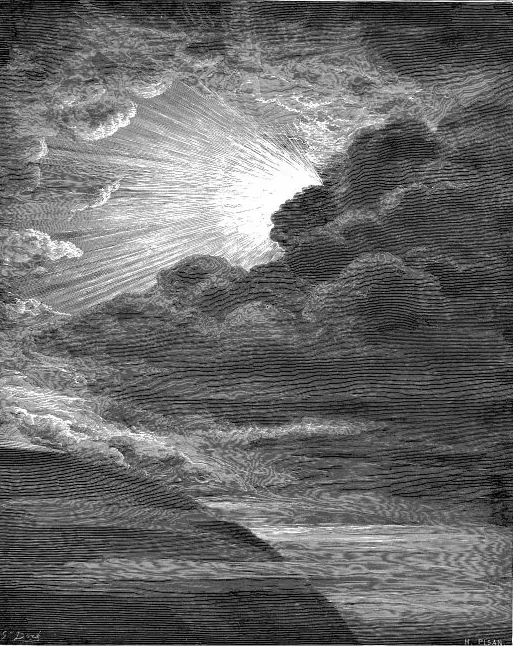
The Creation of Light, an 1866 picture of Genesis 1:1-5, showing light breaking through the dark on the first of the six days this part reads as real days.The Creation of Light · 1866 · Wikimedia Commons · Public domain · museum record · Galeria Regni
Then the text counts days. “And God called the light Day, and the darkness he called Night. And the evening and the morning were the first day” (Genesis 1:5). Each of the six days closes the same way, with evening and morning and a number, until “God saw every thing that he had made, and, behold, it was very good. And the evening and the morning were the sixth day” (Genesis 1:31). On the seventh day God rested (Genesis 2:2-3).
The Hebrew word for day is yom (Strong's H3117).1 It can mean a longer time in some places, as English "day" can ("in my grandfather's day"). But in Genesis 1 it is given a number, an evening and a morning, six times over. That is the language of ordinary days.
God Himself read it that way when He gave Israel the Sabbath. “For in six days the LORD made heaven and earth, the sea, and all that in them is, and rested the seventh day: wherefore the LORD blessed the sabbath day, and hallowed it” (Exodus 20:11). The week Israel worked and rested in was patterned on the week God worked and rested in. The commandment only makes sense if the days are days.
The creatures are made “after his kind” (Genesis 1:24-25), ten times in the chapter. And man is made last, and differently: “So God created man in his own image, in the image of God created he him; male and female created he them” (Genesis 1:27).
A real Adam and a real Eve
Genesis 2 slows down and tells how the man was made. “And the LORD God formed man of the dust of the ground, and breathed into his nostrils the breath of life; and man became a living soul” (Genesis 2:7). He is placed in a garden “eastward in Eden” (Genesis 2:8), given work and a command, and given a wife, whom he calls Eve, “because she was the mother of all living” (Genesis 3:20).
Some Christians today read Adam as a symbol for humanity in general. The rest of the Bible does not. Adam is in the genealogies. Luke traces Jesus' line back through “Enos, which was the son of Seth, which was the son of Adam, which was the son of God” (Luke 3:38). Paul builds the gospel on him: “Wherefore, as by one man sin entered into the world, and death by sin; and so death passed upon all men, for that all have sinned” (Romans 5:12). And: “For as in Adam all die, even so in Christ shall all be made alive” (1 Corinthians 15:22). Paul's argument about the order of the church rests on the order of creation: “For Adam was first formed, then Eve” (1 Timothy 2:13).
And Jesus Himself answered a question about divorce by going back to the beginning: “Have ye not read, that he which made them at the beginning made them male and female, And said, For this cause shall a man leave father and mother, and shall cleave to his wife: and they twain shall be one flesh?” (Matthew 19:4-5). Mark records it as “from the beginning of the creation God made them male and female” (Mark 10:6). Jesus put the first man and woman at the beginning of the creation, not at the end of a long process.
If Adam was not a real man, Paul's comparison between the first Adam and the last Adam collapses (1 Corinthians 15:45). The Bible does not let us keep Christ and lose Adam.
A real Fall
God gave the man one command: “Of every tree of the garden thou mayest freely eat: But of the tree of the knowledge of good and evil, thou shalt not eat of it: for in the day that thou eatest thereof thou shalt surely die” (Genesis 2:16-17). The serpent deceived the woman, the man ate with her, and everything changed.
Death came: “for dust thou art, and unto dust shalt thou return” (Genesis 3:19). The ground was cursed. The way to the tree of life was shut by “Cherubims, and a flaming sword which turned every way” (Genesis 3:24). Paul says the whole creation still feels it: “For we know that the whole creation groaneth and travaileth in pain together until now” (Romans 8:22).
But the first promise of the gospel came in the same hour. God said to the serpent: “And I will put enmity between thee and the woman, and between thy seed and her seed; it shall bruise thy head, and thou shalt bruise his heel” (Genesis 3:15). Christians since the second century have read this as the first word about Christ, the Seed of the woman who would crush the serpent.2 John says, “For this purpose the Son of God was manifested, that he might destroy the works of the devil” (1 John 3:8). Revelation names the serpent: “that old serpent, called the Devil, and Satan, which deceiveth the whole world” (Revelation 12:9).
So the antediluvian world begins with a real sin, a real curse, and a real promise. Everything that happens before the Flood plays out between those three.
Genesis 4 and 5 follow two families. One builds a city and boasts of murder. The other calls on the name of the LORD and produces a man who walked with God. Seeing the two side by side is the key to understanding why the world before the Flood went the way it did.
The first murder
The first child born into the fallen world became the first murderer. “And Cain talked with Abel his brother: and it came to pass, when they were in the field, that Cain rose up against Abel his brother, and slew him” (Genesis 4:8). Jesus treated Abel as the first martyr in history, speaking of “all the righteous blood shed upon the earth, from the blood of righteous Abel unto the blood of Zacharias son of Barachias” (Matthew 23:35). Hebrews says Abel, “being dead yet speaketh” (Hebrews 11:4).
The line of Cain
Cain “went out from the presence of the LORD” (Genesis 4:16). He built the first city and named it after his son Enoch (Genesis 4:17). His descendants were gifted. In the seventh generation from Adam, Lamech's sons founded the arts of civilisation: Jabal, “the father of such as dwell in tents, and of such as have cattle”; Jubal, “the father of all such as handle the harp and organ”; and Tubalcain, “an instructer of every artificer in brass and iron” (Genesis 4:20-22).
This matters. Genesis does not picture the first men as grunting brutes. It pictures cities, herds, music and metalwork in the generations before the Flood. Civilisation is old.
But the same Lamech is the first man in the Bible to take two wives, and the first to boast of killing:
“And Lamech said unto his wives, Adah and Zillah, Hear my voice; ye wives of Lamech, hearken unto my speech: for I have slain a man to my wounding, and a young man to my hurt. If Cain shall be avenged sevenfold, truly Lamech seventy and sevenfold.” (Genesis 4:23-24)
In seven generations, the line of Cain went from one murder hidden in a field to a song in praise of vengeance.
The line of Seth
Then Genesis turns back. “And Adam knew his wife again; and she bare a son, and called his name Seth: For God, said she, hath appointed me another seed instead of Abel, whom Cain slew” (Genesis 4:25). And with Seth's son Enos comes a sentence of great hope: “then began men to call upon the name of the LORD” (Genesis 4:26).
Genesis 5 is “the book of the generations of Adam” (Genesis 5:1), and it follows Seth's line to Noah. It has a steady rhythm: so-and-so lived, begat a son, lived on, begat sons and daughters, “and he died.” The refrain is the curse of Genesis 3 working itself out, generation after generation.
The long lives
The most striking thing about Genesis 5 is the length of those lives.
After the Flood the lifespans fall. Shem lived about six hundred years (Genesis 11:10-11); Abraham, “an hundred threescore and fifteen years” (Genesis 25:7); Joseph died “being an hundred and ten years old” (Genesis 50:26). By the time of Moses the psalm says, “The days of our years are threescore years and ten; and if by reason of strength they be fourscore years” (Psalm 90:10).
Can we believe the long lives? The question is old. Josephus, writing in the first century, faced it directly, and gave his answer: “let no one, upon comparing the lives of the ancients with our lives, and with the few years which we now live, think that what we have said of them is false.” He gave his reasons, that the first men were “beloved of God, and [lately] made by God himself”, and then he called his witnesses: Manetho of Egypt, Berosus of Babylon, Hesiod, Hecataeus and others, who “relate that the ancients lived a thousand years.”3
Josephus was right that the memory of long-lived ancestors before a great flood is not only Hebrew. The clearest example is from Mesopotamia, and we will come to it in Part 5: the Sumerian King List, which gives its kings before the flood reigns of tens of thousands of years, and then, after "the flood swept over", much shorter ones. The Sumerian numbers are wildly larger than Genesis, and there is no reason to think them accurate. But the shape is the same: long lives before the flood, shorter after. Genesis gives the sober version of a memory the nations kept in exaggerated form.
Enoch walked with God
In the middle of the refrain of death, one man breaks the pattern.
“And Enoch lived sixty and five years, and begat Methuselah: And Enoch walked with God after he begat Methuselah three hundred years, and begat sons and daughters: And all the days of Enoch were three hundred sixty and five years: And Enoch walked with God: and he was not; for God took him.” (Genesis 5:21-24)
He did not die. Hebrews explains: “By faith Enoch was translated that he should not see death; and was not found, because God had translated him: for before his translation he had this testimony, that he pleased God” (Hebrews 11:5).
Enoch is the seventh from Adam in Seth's line, as Lamech the boaster is the seventh in Cain's. The two sevenths stand as the two ends of the antediluvian world: one who walked with God, one who sang about vengeance. Jude calls him “Enoch also, the seventh from Adam” (Jude 1:14), and in Part 4 we will see why Jude mentions him at all.
Noah, the comforter
Enoch's son was Methuselah, the longest-lived man in the Bible. Methuselah's son Lamech (a different Lamech from Cain's line) named his son Noah, “saying, This same shall comfort us concerning our work and toil of our hands, because of the ground which the LORD hath cursed” (Genesis 5:29). He looked to his son for relief from the curse. He could not have known how the comfort would come.
Genesis 6 opens with four verses that have puzzled readers for more than two thousand years. They are short, and they do not explain themselves. But they come immediately before God's judgment on the world, and the rest of the Bible returns to them. This part reads them carefully and weighs the two main ways they have been understood.
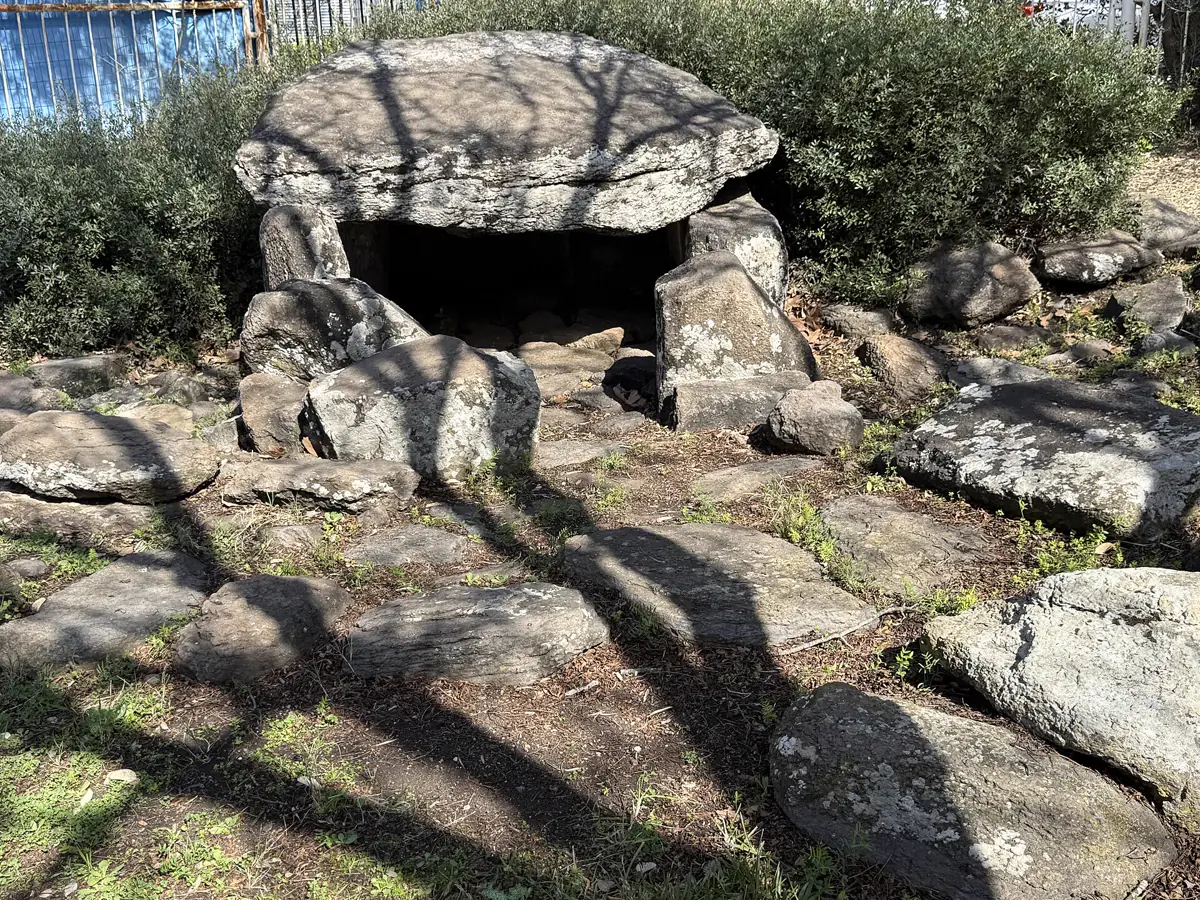
A basalt dolmen from the Golan — megalithic tombs scattered across the land Deuteronomy calls Bashan, the country of Og, who “remained of the remnant of giants” (Deuteronomy 3:11).שלמה רודד · CC BY 2.5
The text
“And it came to pass, when men began to multiply on the face of the earth, and daughters were born unto them, That the sons of God saw the daughters of men that they were fair; and they took them wives of all which they chose. And the LORD said, My spirit shall not always strive with man, for that he also is flesh: yet his days shall be an hundred and twenty years. There were giants in the earth in those days; and also after that, when the sons of God came in unto the daughters of men, and they bare children to them, the same became mighty men which were of old, men of renown.” (Genesis 6:1-4)
The words
Three phrases carry the weight.
“The sons of God” translates the Hebrew bene ha-elohim. In the rest of the Old Testament, that exact kind of phrase is used of angels. In Job, “there was a day when the sons of God came to present themselves before the LORD, and Satan came also among them” (Job 1:6). And at the creation, “the morning stars sang together, and all the sons of God shouted for joy” (Job 38:7), before any man existed.
“Giants” translates nephilim (Strong's H5303).4 The word appears again only when the spies come back from Canaan: “And there we saw the giants, the sons of Anak, which come of the giants: and we were in our own sight as grasshoppers, and so we were in their sight” (Numbers 13:33). The oldest Greek translation of Genesis, made by Jews before the time of Christ, rendered the word gigantes, giants, and the English translators followed that tradition.
“Mighty men” translates gibborim, the word used later of Nimrod, who “began to be a mighty one in the earth” (Genesis 10:8), and of David's warriors.
Then comes verse 3, the hundred and twenty years. Some have read it as a limit on the length of human life; Josephus took it that way.5 Others have read it as the time God gave the world before the Flood. Either way, it is God's response to what the sons of God did.
The two readings
There are two main ways Christians and Jews have understood the sons of God.
The angels
The oldest reading is that the sons of God were angels who left their place and took human wives, and that the giants were their offspring. That is how the Book of Enoch tells it (Part 4). It is how Josephus tells it in the first century:
“For many angels of God accompanied with women, and begat sons that proved unjust, and despisers of all that was good, on account of the confidence they had in their own strength; for the tradition is, that these men did what resembled the acts of those whom the Grecians call giants.”5
It is how Justin Martyr told it around AD 150: “But the angels transgressed this appointment, and were captivated by love of women, and begot children who are those that are called demons.”6
The sons of Seth
The second reading is that the sons of God were the godly line of Seth, and the daughters of men were from the line of Cain. Their intermarriage, on this view, mixed the faithful with the world, and the result was a godless generation. Julius Africanus, a Christian chronographer of the early third century, put it this way: “What is meant by the Spirit, in my opinion, is that the descendants of Seth are called the sons of God on account of the righteous men and patriarchs who have sprung from him.” His own Greek text read that “the angels of heaven came together with the daughters of men”, and he noted, “In some copies I found the sons of God.”7
Augustine took the same line in The City of God, and it became the common view in the Western church. He concluded “that the sons of God, who were according to the flesh the sons of Seth, sunk into this community when they forsook righteousness.” But he did not doubt the giants. “There is therefore no doubt,” he wrote, “that, according to the Hebrew and Christian canonical Scriptures, there were many giants before the deluge.”8
What the New Testament says
Two New Testament letters speak of angels who sinned in a way that seems to point back to Genesis 6.
“And the angels which kept not their first estate, but left their own habitation, he hath reserved in everlasting chains under darkness unto the judgment of the great day. Even as Sodom and Gomorrha, and the cities about them in like manner, giving themselves over to fornication, and going after strange flesh, are set forth for an example, suffering the vengeance of eternal fire.” (Jude 1:6-7)
Jude says these angels “left their own habitation”, and then says Sodom sinned “in like manner”, going “after strange flesh”. The natural reading is that the angels' sin, like Sodom's, crossed a boundary of flesh God had set.
“For if God spared not the angels that sinned, but cast them down to hell, and delivered them into chains of darkness, to be reserved unto judgment; And spared not the old world, but saved Noah the eighth person, a preacher of righteousness, bringing in the flood upon the world of the ungodly.” (2 Peter 2:4-5)
Peter puts the angels that sinned right next to the Flood, in the same breath. And Peter says in his first letter that Christ “went and preached unto the spirits in prison; Which sometime were disobedient, when once the longsuffering of God waited in the days of Noah, while the ark was a preparing” (1 Peter 3:19-20). Christians have long debated who those spirits were. But once again, the disobedient spirits are placed in the days of Noah.
The usual objection to the angel reading is Jesus' word that in the resurrection people “neither marry, nor are given in marriage, but are as the angels of God in heaven” (Matthew 22:30). But Jesus speaks of the angels “in heaven”, who keep their place. Jude speaks of angels who did not.
Where I land
The angel reading is the oldest reading we have, held by the Jewish writers before Christ, by Josephus, and by the earliest Christian writers; it fits the use of "sons of God" in Job; and it fits Jude and Peter, who connect sinning angels, strange flesh and the days of Noah. The Sethite reading came later and has godly defenders, and I respect them. But I believe the sons of God in Genesis 6 were angels who left their first estate (Jude 6), and that the giants were real.
This is my conviction; weigh it for yourself.
The giants after the Flood
Genesis 6:4 says there were giants in the earth in those days, “and also after that”. The giants appear again after the Flood. The spies saw the sons of Anak (Numbers 13:33). Moses records the Emims, “a people great, and many, and tall, as the Anakims; Which also were accounted giants” (Deuteronomy 2:10-11), and Chedorlaomer fought “the Rephaims in Ashteroth Karnaim” in Abraham's day (Genesis 14:5). Og, king of Bashan, “remained of the remnant of giants; behold, his bedstead was a bedstead of iron... nine cubits was the length thereof, and four cubits the breadth of it, after the cubit of a man” (Deuteronomy 3:11). After Joshua's conquest, “There was none of the Anakims left in the land of the children of Israel: only in Gaza, in Gath, and in Ashdod, there remained” (Joshua 11:22), and from Gath came Goliath and the four who “were born to the giant in Gath, and fell by the hand of David” (2 Samuel 21:22).
How giants existed after the Flood, when only Noah's family survived, Scripture does not say. Some have argued that the events of Genesis 6 happened again; others that the later giants were simply very large men, and the word was used for them. I do not know, and the text does not tell us. What it does tell us is that they were there. I hold the giants of the Bible to be history: real men, of real size, who lived and died where the Bible says they did. This is my conviction; weigh it for yourself.
Augustine, for what it is worth, believed it too. He wrote that he had seen with his own eyes, on the shore at Utica in North Africa, “a man's molar tooth of such a size, that if it were cut down into teeth such as we have, a hundred, I fancy, could have been made out of it.” He added, “that, I believe, belonged to some giant.”9 We cannot check that tooth, and it may have been the tooth of some large animal. I mention it only to show that belief in the giants of Scripture is not a modern fringe idea. Augustine, among the most influential theologians of the Western church, held it.
Sooner or later anyone who reads about the world before the Flood meets the Book of Enoch. It tells the story of Genesis 6 at length, with names and details Genesis does not give. It is quoted in the New Testament. And it has a following today that sometimes treats it as a lost book of the Bible. This part explains what 1 Enoch is, how we know it is ancient, what it says, and how a Christian should read it.
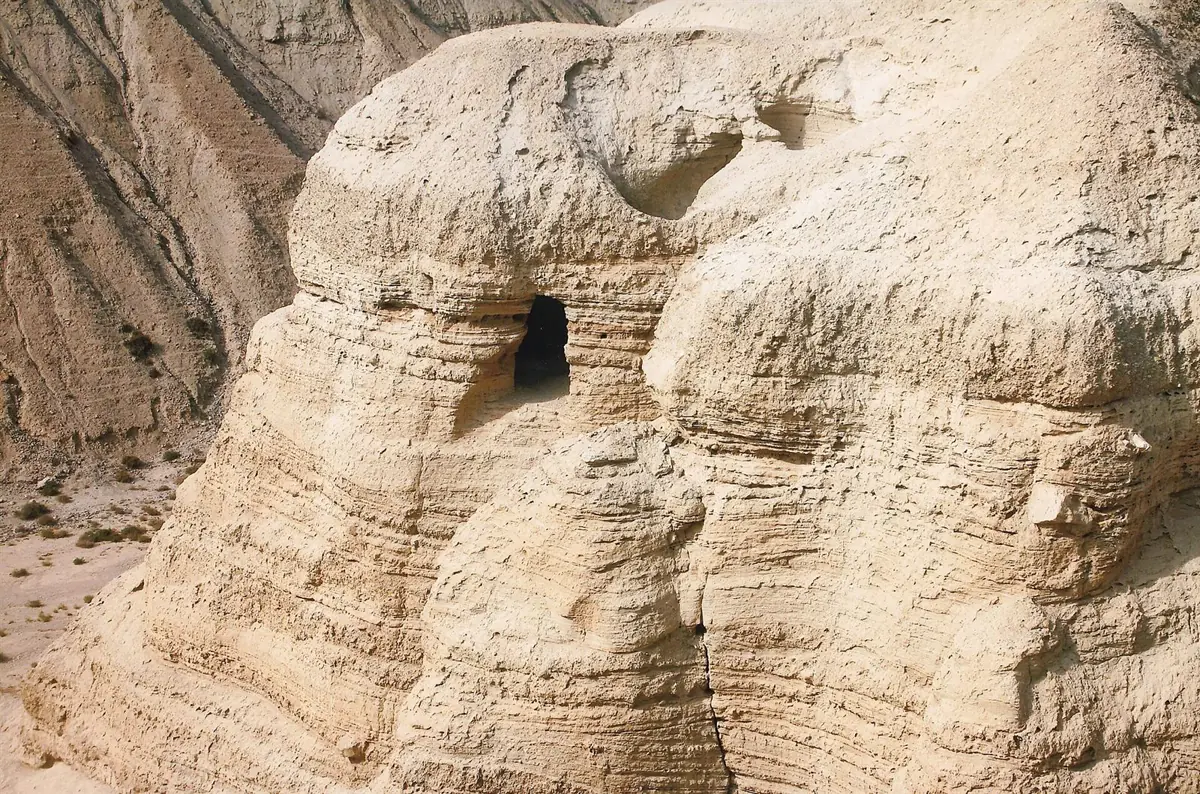
The caves at Qumran above the Dead Sea, where the Dead Sea Scrolls lay hidden and intact for two thousand years.Peter van der Sluijs · CC BY-SA 4.0
What it is
The book we call 1 Enoch is a collection of five or more Jewish writings, all presented as the visions of Enoch, the seventh from Adam. Scholars usually name them the Book of the Watchers (chapters 1–36), the Parables or Similitudes (37–71), the Astronomical Book (72–82), the Dream Visions (83–90) and the Epistle of Enoch (91–108). It was not written by Enoch. The oldest parts were written in Aramaic in the last centuries before Christ.
For more than a thousand years the full book was lost to the West. It survived complete only in Ge'ez, the old church language of Ethiopia, where the Ethiopian Orthodox Church has kept it in its Bible. The Scottish traveller James Bruce brought three Ethiopic copies back to Europe in 1773, and Richard Laurence published the first English translation from the copy in the Bodleian Library at Oxford in 1821.10 The standard English translation for most of the twentieth century was R. H. Charles's, first published in 1893, thoroughly revised in 1912, and issued in a popular edition in 1917.11 Both the Laurence and the Charles translations are in the 1611 Reader's library on this site.
The Dead Sea Scrolls
In the twentieth century, the book's age was proved by the Dead Sea Scrolls. In the caves near Qumran, among the scrolls hidden before the Romans destroyed the settlement in the first century, scholars found eleven fragmentary Aramaic manuscripts of Enoch in Cave 4. They were published by the Polish scholar J. T. Milik in The Books of Enoch (1976). By the style of their handwriting, the oldest fragments of the Book of the Watchers date to about 200–150 BC.12 No fragments of the Parables (chapters 37–71) were found at Qumran.
So the story of the Watchers is not a medieval invention. It was being copied by Jews two centuries before Jesus was born.
The story of the Watchers
“Watcher” is a biblical word. Nebuchadnezzar saw in his dream “a watcher and an holy one came down from heaven” (Daniel 4:13), and “This matter is by the decree of the watchers, and the demand by the word of the holy ones” (Daniel 4:17). In Daniel the watchers are holy angels. In 1 Enoch the name is given to angels who fell.
The Book of the Watchers retells Genesis 6 like this:
“And it came to pass when the children of men had multiplied that in those days were born unto them beautiful and comely daughters. And the angels, the children of the heaven, saw and lusted after them, and said to one another: 'Come, let us choose us wives from among the children of men and beget us children.'”13
Their leader Semjaza fears he alone will pay for the sin, so they swear an oath together. 1 Enoch says “they were in all two hundred; who descended in the days of Jared on the summit of Mount Hermon”.14 They take wives, teach them “charms and enchantments, and the cutting of roots”, and the women bear “great giants”, who consume everything men have and then turn on men themselves.15
Then comes a list of forbidden knowledge. One Watcher, Azazel, “taught men to make swords, and knives, and shields, and breastplates, and made known to them the metals of the earth and the art of working them”, along with ornaments and cosmetics; others taught enchantments, astrology, the constellations and the signs of the sun and moon. “And there arose much godlessness, and they committed fornication, and they were led astray, and became corrupt in all their ways.”16
The archangels see “much blood being shed upon the earth”, and God sends a warning to Noah: “reveal to him the end that is approaching: that the whole earth will be destroyed, and a deluge is about to come upon the whole earth.”17 The Watchers are bound “for seventy generations in the valleys of the earth, till the day of their judgement”.18
And the book explains where evil spirits come from. When the giants die, their spirits do not go to heaven or to the grave: “the giants, who are produced from the spirits and flesh, shall be called evil spirits upon the earth, and on the earth shall be their dwelling.” They “afflict, oppress, destroy, attack, do battle, and work destruction on the earth”.19
A related Qumran work, the Book of Giants, survives in fragments from several caves. It tells of the giants' dreams of their coming doom and their appeal to Enoch, and remarkably it names one of the giants Gilgamesh, after the hero of the Babylonian epic.20
Jude and Enoch
The reason Christians care about 1 Enoch at all is that the New Testament quotes it. Jude writes:
“And Enoch also, the seventh from Adam, prophesied of these, saying, Behold, the Lord cometh with ten thousands of his saints, To execute judgment upon all, and to convince all that are ungodly among them of all their ungodly deeds which they have ungodly committed, and of all their hard speeches which ungodly sinners have spoken against him.” (Jude 1:14-15)
Here is the passage from 1 Enoch's opening chapter, in Charles's translation:
“And behold! He cometh with ten thousands of His holy ones To execute judgement upon all, And to destroy all the ungodly: And to convict all flesh Of all the works of their ungodliness which they have ungodly committed, And of all the hard things which ungodly sinners have spoken against Him.”21
The two are plainly related. Jude knew this text and quoted it as a true prophecy of Enoch.
How to read it
So is 1 Enoch Scripture? No. Jude quoting a line from it does not make the whole book canon, any more than Paul quoting a Greek poet (Acts 17:28) makes the poet Scripture. Jude affirms that this prophecy of Enoch is true. He says nothing about the rest of the book.
The early church argued about it openly, and both sides are worth hearing. Tertullian, around AD 200, defended it: “I am aware that the Scripture of Enoch... is not received by some, because it is not admitted into the Jewish canon either.” He pointed out that “Enoch possesses a testimony in the Apostle Jude.”22 Augustine, two centuries later, gave the answer that the church as a whole accepted. “We cannot deny that Enoch, the seventh from Adam, left some divine writings, for this is asserted by the Apostle Jude in his canonical epistle.” But the books circulating under his name, he said, “have no place in that canon of Scripture which was preserved in the temple of the Hebrew people by the diligence of successive priests; for their antiquity brought them under suspicion, and it was impossible to ascertain whether these were his genuine writings.”23
That is the right way to read it. 1 Enoch is a historical witness. It shows us that two centuries before Christ, Jews read Genesis 6 as a story about fallen angels and real giants, and that this reading was alive in the world of Jude and Peter. In places it may preserve a true tradition, as the line Jude quotes does. In other places it plainly adds to Genesis: it gives the giants a height of "three thousand ells",15 it names angels Scripture never names, and it turns brief verses into long speeches. Where it agrees with Scripture, we already have Scripture. Where it goes beyond Scripture, we hold it loosely. And where it might contradict Scripture, Scripture wins.
“Every word of God is pure: he is a shield unto them that put their trust in him. Add thou not unto his words, lest he reprove thee, and thou be found a liar” (Proverbs 30:5-6).
Genesis and Enoch side by side
One comparison is especially interesting. 1 Enoch says the fallen Watcher Azazel taught men metalworking and the making of weapons. Genesis says it was Tubalcain, of Cain's line, who was “an instructer of every artificer in brass and iron” (Genesis 4:22). Genesis gives the credit, and the responsibility, to men. Enoch blames the angels.
That difference is typical. Genesis keeps its eye on human sin. “And God saw that the wickedness of man was great in the earth” (Genesis 6:5). Whatever the sons of God did, the Flood came because of what men had become. 1 Enoch, read alone, can make the antediluvian world sound like a story about angels in which men are mostly victims. Genesis does not let us off so easily.
The Flood is the great dividing line of Genesis 1–9, and Jesus Himself pointed to it as a picture of His own coming. This part reads the account in Genesis, shows why it describes a flood over the whole earth, and then weighs the flood memories of the ancient nations.
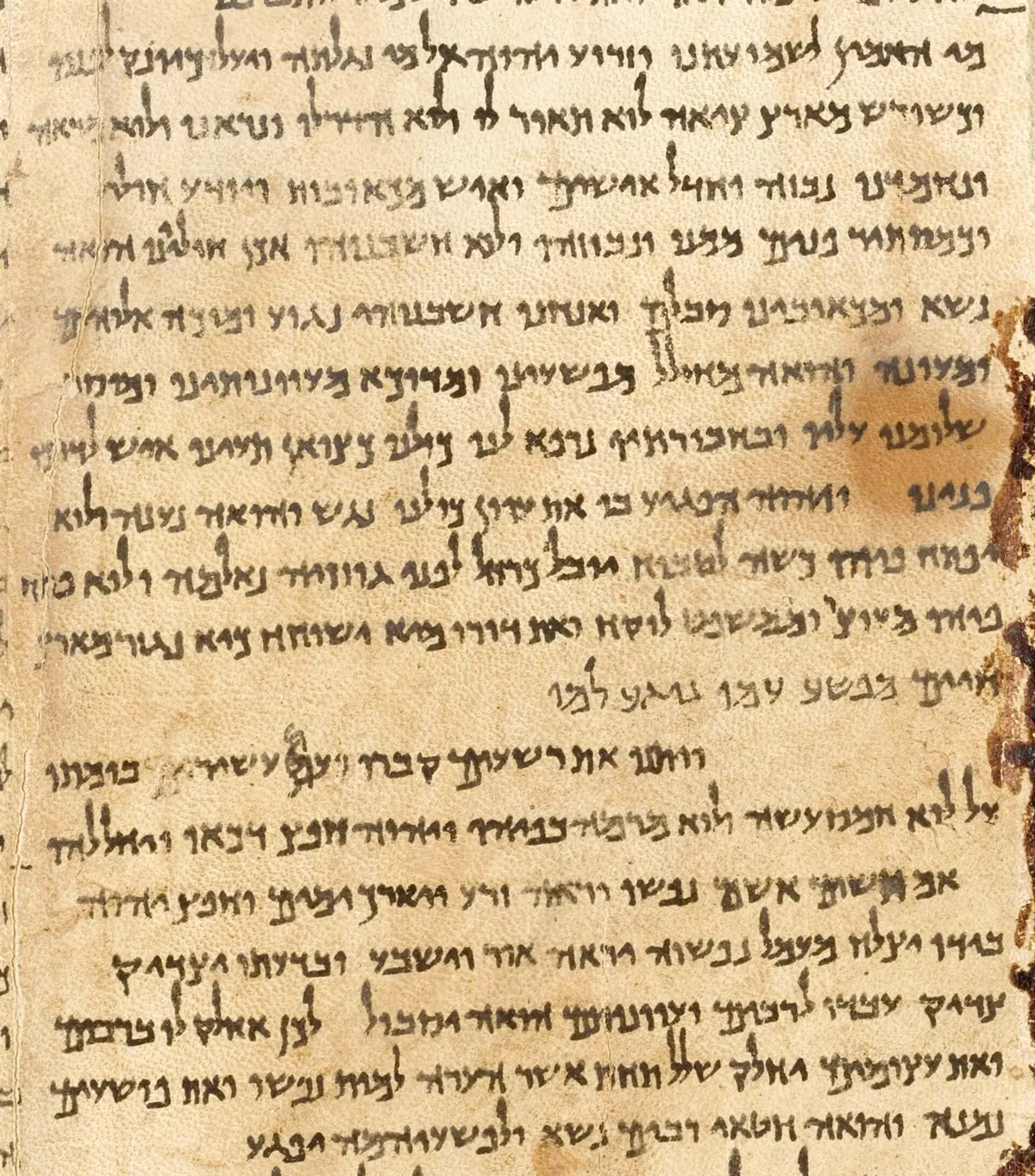
A column of the Great Isaiah Scroll (c. 125 BC) from Qumran — a complete Hebrew Isaiah a thousand years older than any copy previously known, and the text held.Photograph by Ardon Bar Hama / Google Art Project · Public domain
Why the Flood came
“And God saw that the wickedness of man was great in the earth, and that every imagination of the thoughts of his heart was only evil continually. And it repented the LORD that he had made man on the earth, and it grieved him at his heart. And the LORD said, I will destroy man whom I have created from the face of the earth; both man, and beast, and the creeping thing, and the fowls of the air; for it repenteth me that I have made them. But Noah found grace in the eyes of the LORD.” (Genesis 6:5-8)
Two words sum up the world before the Flood: corruption and violence. “The earth also was corrupt before God, and the earth was filled with violence. And God looked upon the earth, and, behold, it was corrupt; for all flesh had corrupted his way upon the earth” (Genesis 6:11-12). The song of Lamech had become the song of the world.
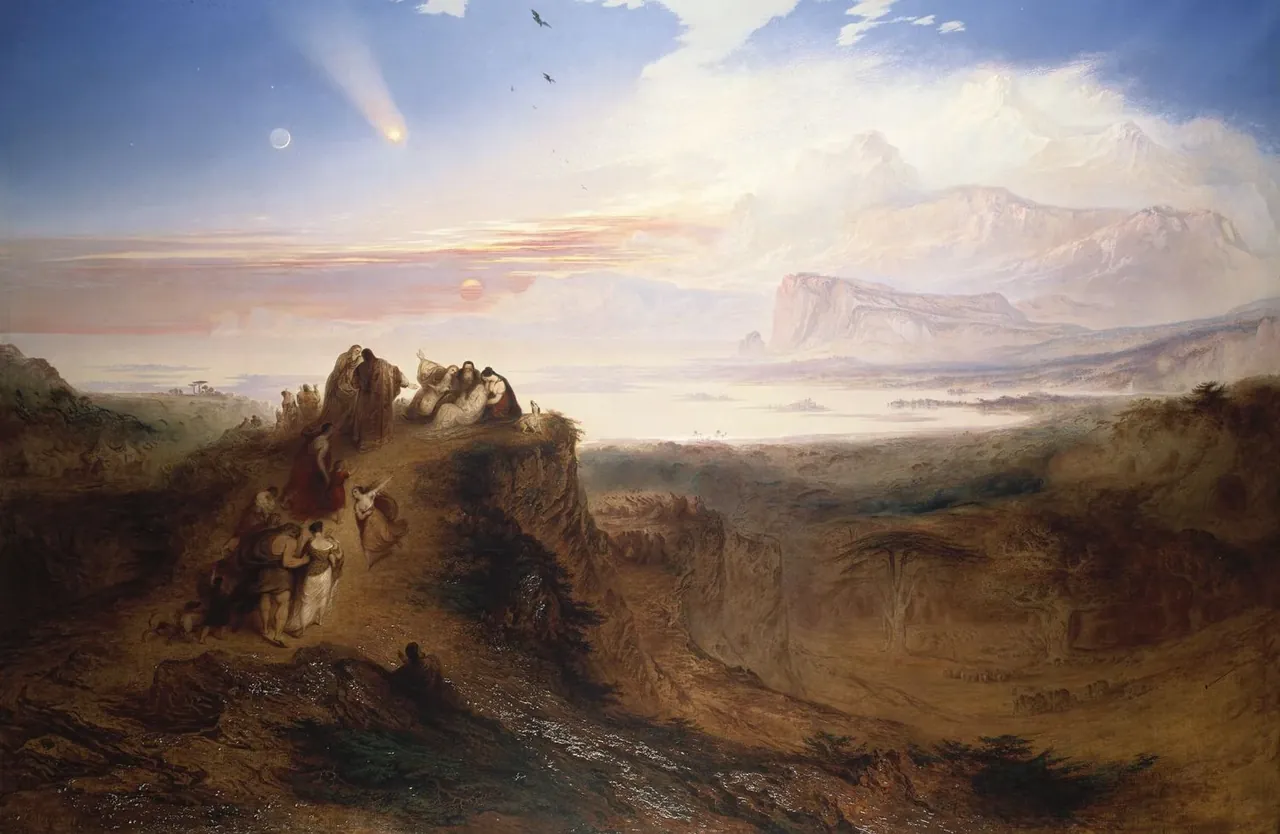
The Eve of the Deluge, painted in 1840, imagining the world on the brink of the Flood that Genesis 7 records covering the whole earth.The Eve of the Deluge · 1840 · Wikimedia Commons · Public domain · museum record · Galeria Regni
Notice that God grieved. The Flood is not the act of an angry tyrant but the judgment of a Creator whose world had been ruined, and it came after long patience. Peter says “the longsuffering of God waited in the days of Noah, while the ark was a preparing” (1 Peter 3:20), and calls Noah “a preacher of righteousness” (2 Peter 2:5). The ark itself was a sermon.
Noah
“Noah was a just man and perfect in his generations, and Noah walked with God” (Genesis 6:9). He walked with God as his great-grandfather Enoch had. And he obeyed in a thing that must have seemed absurd: “Thus did Noah; according to all that God commanded him, so did he” (Genesis 6:22). Hebrews says, “By faith Noah, being warned of God of things not seen as yet, moved with fear, prepared an ark to the saving of his house; by the which he condemned the world, and became heir of the righteousness which is by faith” (Hebrews 11:7).
But Noah was saved by grace, not by his own merit. Before Genesis says he was just, it says “Noah found grace in the eyes of the LORD” (Genesis 6:8). That is the order of the gospel.
The ark
“Make thee an ark of gopher wood; rooms shalt thou make in the ark, and shalt pitch it within and without with pitch. And this is the fashion which thou shalt make it of: The length of the ark shall be three hundred cubits, the breadth of it fifty cubits, and the height of it thirty cubits.” (Genesis 6:14-15)
A cubit was the length of a forearm, about a foot and a half. On that measure the ark was roughly 450 feet long, 75 feet wide and 45 feet high, with three decks (Genesis 6:16). It is six times as long as it is wide: a long, box-like vessel made to float and ride out the waters, not to sail anywhere. In recent years full-size and large-scale replicas have been built to the Genesis dimensions, among them the Ark Encounter in Williamstown, Kentucky, opened in 2016, and Johan Huibers's ark in the Netherlands, completed in 2012.24 Whatever one thinks of them, they show that the ark Genesis describes is a buildable thing.
God told Noah to take two of every kind of animal, and seven of the clean beasts and of the birds, “to keep seed alive upon the face of all the earth” (Genesis 7:2-3). Then Noah, his wife, his three sons and their wives went in, “and the LORD shut him in” (Genesis 7:16).
The whole earth
“In the six hundredth year of Noah’s life, in the second month, the seventeenth day of the month, the same day were all the fountains of the great deep broken up, and the windows of heaven were opened. And the rain was upon the earth forty days and forty nights.” (Genesis 7:11-12)
Was it a local flood, a great flood in Mesopotamia that seemed to its survivors to cover the world? Some Christians have thought so. I believe the text will not allow it, for five reasons.
First, the words. “And the waters prevailed exceedingly upon the earth; and all the high hills, that were under the whole heaven, were covered. Fifteen cubits upward did the waters prevail; and the mountains were covered” (Genesis 7:19-20). “All the high hills, that were under the whole heaven” is about as universal as Hebrew can say.
Second, the death toll. “And all flesh died that moved upon the earth, both of fowl, and of cattle, and of beast, and of every creeping thing that creepeth upon the earth, and every man” (Genesis 7:21). Of the whole human race, “Noah only remained alive, and they that were with him in the ark” (Genesis 7:23). Birds can fly out of a valley. They died.
Third, the ark. If the flood were local, there would be no need for an ark at all, let alone one carrying every kind of land animal and bird for more than a year. Noah could have walked to the hills.
Fourth, the promise. God promised afterwards: “neither shall all flesh be cut off any more by the waters of a flood; neither shall there any more be a flood to destroy the earth” (Genesis 9:11). Local floods, even terrible ones, have happened ever since. If the Flood was local, God's promise has been broken a thousand times. It has not, because the Flood was not a local flood. Isaiah repeats the promise: “for as I have sworn that the waters of Noah should no more go over the earth” (Isaiah 54:9).
Fifth, Jesus and Peter. Jesus said the Flood “came, and took them all away” (Matthew 24:39), and “destroyed them all” (Luke 17:27), and He made it the pattern of the final judgment that will come on the whole world. Peter wrote that “the world that then was, being overflowed with water, perished” (2 Peter 3:6), and set it beside the coming judgment by fire on “the heavens and the earth, which are now” (2 Peter 3:7). A local flood cannot be the picture of a universal judgment.
So I read the Flood as Genesis tells it: a judgment on the whole earth, from which only eight souls were saved. Christian scientists have written at length on how the geology of the earth might be read in the light of such a flood; the best-known book is John C. Whitcomb and Henry M. Morris's The Genesis Flood (1961).25 This paper does not try to settle questions of geology. Its case rests on the text, and on the Lord Jesus, who read the text this way.
The waters go down
“And God remembered Noah” (Genesis 8:1). The waters went down. “And the ark rested in the seventh month, on the seventeenth day of the month, upon the mountains of Ararat” (Genesis 8:4). Noah sent out a raven, and then a dove, which came back the second time with “an olive leaf pluckt off: so Noah knew that the waters were abated from off the earth” (Genesis 8:11). And when they came out, the first thing Noah did was build an altar and worship (Genesis 8:20).
The flood the nations remembered
If the whole human race came through Noah, we would expect the nations to remember a great flood. They did. Josephus said so in the first century: “all the writers of barbarian histories make mention of this flood, and of this ark; among whom is Berosus the Chaldean.” He quotes Berossus as saying “there is still some part of this ship in Armenia, at the mountain of the Cordyaeans.”26
We now have far older witnesses than Josephus had, written on clay in Mesopotamia.
The Sumerian King List
The Sumerian King List, known from clay tablets of the early second millennium BC, is a list of the cities and kings of Sumer. It begins: “After the kingship descended from heaven, the kingship was in Eridug. In Eridug, Alulim became king; he ruled for 28800 years.” Eight kings in five cities reign for a total of 241,200 years. Then the list says: “Then the flood swept over. After the flood had swept over, and the kingship had descended from heaven, the kingship was in Kic [Kish].”27 After the flood the reigns are still long, hundreds of years at first, and then they fall to ordinary lengths.
The Sumerian scribes did not have Genesis. But they divided their history in the same place Genesis does: before the flood and after it.
Atrahasis and Gilgamesh
The Babylonian epic of Atrahasis, whose oldest dated copy was written in the reign of King Ammi-saduqa of Babylon in the seventeenth century BC, tells of a flood sent by the gods because mankind had grown too many and too noisy, and of one man, Atrahasis, warned by a god to build a boat and save his family and the animals.28 The same story was taken into the Epic of Gilgamesh, whose eleventh tablet tells how the hero Uta-napishti built a boat at a god's command, rode out a great storm, landed on a mountain, and sent out a dove, a swallow and a raven to find dry land, before offering a sacrifice to the gods.29 When George Smith of the British Museum announced in 1872 that he had found that tablet in the library of Ashurbanipal, he caused a sensation in Victorian England.30
Berossus
Around 290–278 BC, a priest of Babylon named Berossus wrote a history of his country in Greek, the Babyloniaca, for the Seleucid king Antiochus I. It is lost, but fragments survive in later writers, especially through Eusebius. Berossus listed ten kings before the flood, and told how the last of them, Xisuthrus, was warned in a dream to build a ship and save himself, his family and the animals.31
How to weigh the parallels
What should a Christian make of these stories? Skeptics have long argued that the Hebrews borrowed the Flood from Babylon. But notice the differences.
| | Genesis | Mesopotamian accounts | |---|---|---| | Who sends the flood | The one God, grieved by man's wickedness and violence | A council of gods, annoyed by mankind's noise or numbers (Atrahasis) | | Why one man is saved | “Noah found grace in the eyes of the LORD” | One god breaks ranks and secretly warns his favourite | | The ark | A box-like vessel of reasonable proportions | In Gilgamesh, a vessel of equal length and breadth, often described as a cube | | After the flood | God makes a covenant with all flesh and promises never again | In Gilgamesh, the gods gather like flies round the sacrifice | | Lifespans | Long, then shortening, in numbers a man could live | Reigns of tens of thousands of years |
The relationship between the stories is not that of a copy and its source. It is that of a sober account and its pagan variations. If there was one real Flood, survived by one family, we should expect every branch of that family to carry the memory, and the further a branch wandered from the knowledge of the true God, the more its memory would be filled with many gods and impossible numbers. That is exactly what we find. The Mesopotamian tablets do not prove Genesis, and I do not claim they do. But they are what we would expect if Genesis is true.
The Flood is not the end of the story in Genesis. It is followed by a covenant, the first covenant God makes with all mankind. This part reads Genesis 8 and 9, because the world we live in is still the world of that covenant.
Seedtime and harvest
After Noah's sacrifice, God made a promise in His heart: “I will not again curse the ground any more for man’s sake; for the imagination of man’s heart is evil from his youth; neither will I again smite any more every thing living, as I have done. While the earth remaineth, seedtime and harvest, and cold and heat, and summer and winter, and day and night shall not cease” (Genesis 8:21-22).
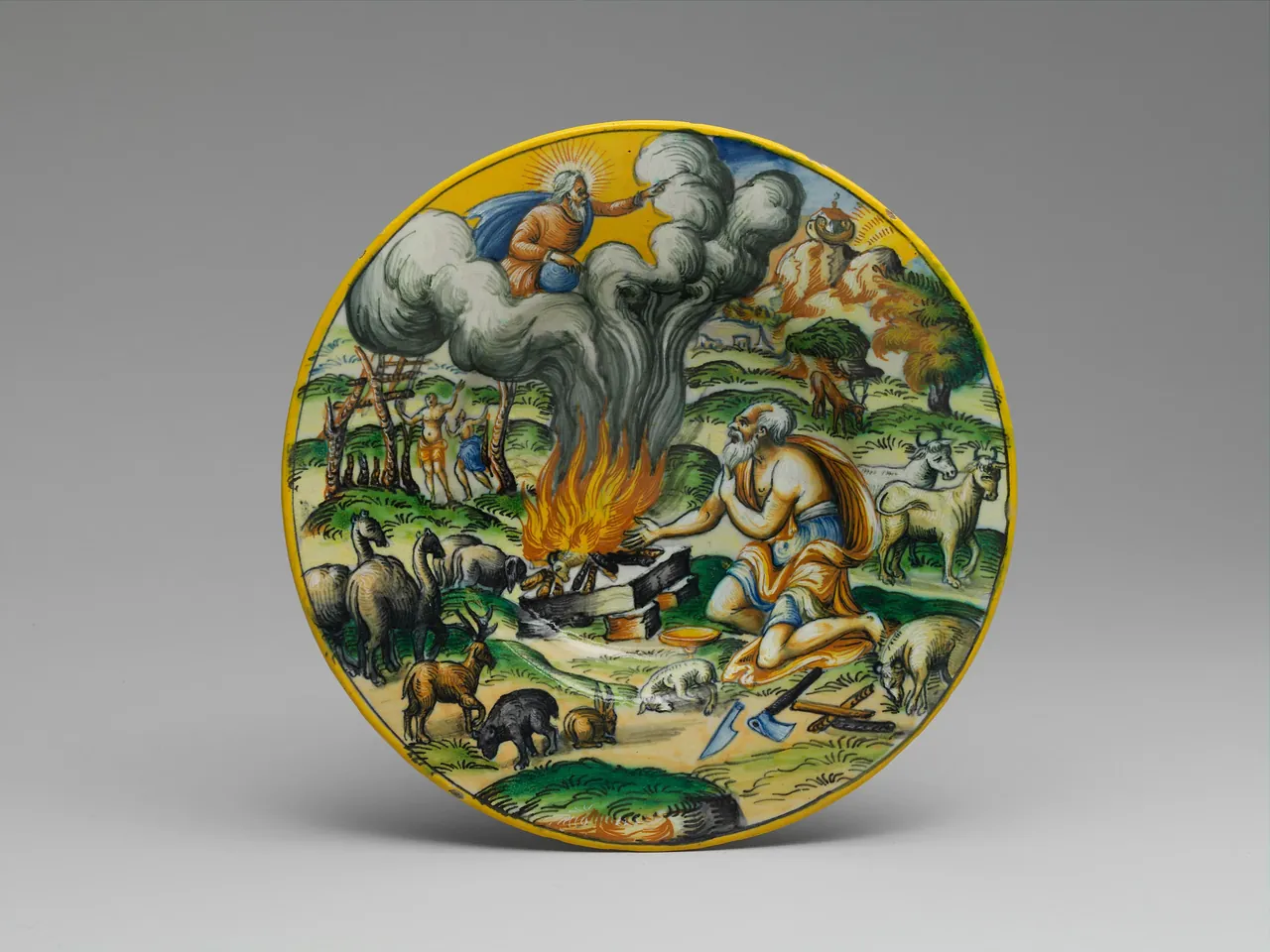
A tin-glazed faience dish of about 1580 to 1610 showing the Sacrifice of Noah, the offering after which God promised never again to curse the ground.Sacrifice of Noah · ca. 1580–1610 · The Metropolitan Museum of Art · CC0 · museum record · Galeria Regni
Notice the reason God gives. It is the same reason as before the Flood: the heart of man is evil. The Flood did not fix human nature. Noah's family carried the same fallen heart out of the ark. What changed was God's dealing with it. He would now bear with the world in patience, with a fixed order of seasons, until the time of a different judgment.
The image of God
God renewed the blessing of creation: “Be fruitful, and multiply, and replenish the earth” (Genesis 9:1). And He set the first law for all nations: “Whoso sheddeth man’s blood, by man shall his blood be shed: for in the image of God made he man” (Genesis 9:6).
That verse is the answer to the violence that filled the world before the Flood. Human life is sacred because man bears God's image. The murder of Abel and the boast of Lamech are answered here: the image of God is not to be shed.
The bow in the cloud
“And I will establish my covenant with you; neither shall all flesh be cut off any more by the waters of a flood; neither shall there any more be a flood to destroy the earth. And God said, This is the token of the covenant which I make between me and you and every living creature that is with you, for perpetual generations: I do set my bow in the cloud, and it shall be for a token of a covenant between me and the earth.” (Genesis 9:11-13)
Every rainbow you have ever seen is a sign of that promise. It is a covenant with “every living creature”, not only with believers. God binds Himself to the whole world He made.
Noah's failure
Genesis does not end the story with Noah as a hero. “And Noah began to be an husbandman, and he planted a vineyard: And he drank of the wine, and was drunken; and he was uncovered within his tent” (Genesis 9:20-21). The man who walked with God, preached righteousness and built the ark fell into drunkenness and shame within a few chapters of his deliverance.
That is the honesty of Scripture. The Bible does not make legends of its heroes. And it teaches the lesson of the whole antediluvian world: no man, however righteous, can undo the curse. Noah was a comfort, as his father hoped, but he was not the Comforter. The Seed of the woman was still to come.
“And Noah lived after the flood three hundred and fifty years. And all the days of Noah were nine hundred and fifty years: and he died” (Genesis 9:28-29). The old refrain returns.
The nations from one family
From Noah's three sons came the nations listed in Genesis 10. Paul preached the same truth to the philosophers of Athens: God “hath made of one blood all nations of men for to dwell on all the face of the earth” (Acts 17:26). Every human being alive today is a descendant of the eight souls in the ark. That is why the nations remembered the Flood. And it is why there is one gospel for all of them.
Why does any of this matter for a person living now? Because Jesus said it would. He did not treat the world before the Flood as a curiosity. He treated it as a warning about the end of our own world, and the ark as a picture of salvation. This part draws the threads together.
Jesus' warning
“But as the days of Noe were, so shall also the coming of the Son of man be. For as in the days that were before the flood they were eating and drinking, marrying and giving in marriage, until the day that Noe entered into the ark, And knew not until the flood came, and took them all away; so shall also the coming of the Son of man be.” (Matthew 24:37-39)
The striking thing in Jesus' description is how ordinary it is. He does not mention the giants. He mentions eating, drinking and weddings. The people before the Flood were not all monsters. Most of them were simply living their lives as if nothing would ever change. “And knew not until the flood came.” The great danger was not that they were wicked in some spectacular way, though many were, but that they did not believe the warning.
The scoffers
Peter saw the same danger in his own day, and in ours.
“Knowing this first, that there shall come in the last days scoffers, walking after their own lusts, And saying, Where is the promise of his coming? for since the fathers fell asleep, all things continue as they were from the beginning of the creation. For this they willingly are ignorant of, that by the word of God the heavens were of old, and the earth standing out of the water and in the water: Whereby the world that then was, being overflowed with water, perished: But the heavens and the earth, which are now, by the same word are kept in store, reserved unto fire against the day of judgment and perdition of ungodly men.” (2 Peter 3:3-7)
Peter's argument is simple. The scoffer says, "Nothing ever changes. The world goes on as it always has." Peter answers: it has not. There was a world that perished. The God who judged that world by water has promised to judge this one by fire. To deny the Flood is not a small mistake. It is, Peter says, a willing ignorance that makes people deaf to the warning of judgment to come.
That is why the history of Genesis 1–9 matters. If it is a myth, the warning has no teeth. If it is history, the warning stands.
Claims to weigh with care
Because the world before the Flood is fascinating, it attracts a great deal of speculation. You will meet claims that thousands of giant skeletons have been dug up and hidden by museums, that certain mountains are the petrified bodies of giants, that the pyramids or other monuments were built by Nephilim, or that particular sites hold the remains of the ark. Some people who make these claims are sincere. Some are selling something.
This paper has not used any of them, for one reason: I could not confirm them from sources that can be checked. That is not a judgment that nothing remains to be found. It is a refusal to build anyone's faith on what cannot be shown. The case for the world Genesis describes does not need them. It rests on the word of God, which is “given by inspiration of God, and is profitable for doctrine, for reproof, for correction, for instruction in righteousness” (2 Timothy 3:16), and on Jesus, who read it as history.
If you want to weigh one of these claims for yourself, ask simple questions. Who found it, and when? Where is it now? Has anyone outside the group making the claim examined it? Has it been published where others can check it? A true thing can bear questions. And hold even true discoveries loosely. Your faith should rest on Christ, not on a bone.
The ark and the gospel
The world before the Flood ends with a door. “And the LORD shut him in” (Genesis 7:16). Everyone inside was saved. Everyone outside was lost. There was one ark and one door.
Peter saw in that door a picture of Christ. Eight souls “were saved by water. The like figure whereunto even baptism doth also now save us (not the putting away of the filth of the flesh, but the answer of a good conscience toward God,) by the resurrection of Jesus Christ” (1 Peter 3:20-21). Jesus said, “I am the way, the truth, and the life: no man cometh unto the Father, but by me” (John 14:6).
The gospel is the answer to everything Genesis 1–9 describes. Adam's sin brought death; Christ, the last Adam, brings life (1 Corinthians 15:22). The serpent bruised the heel of the Seed; the Seed crushed the serpent's head at the cross. The world was filled with violence; Christ bore the violence of the world in His own body. The Flood came on a world that would not listen; the gospel comes to a world God loves: “For God so loved the world, that he gave his only begotten Son, that whosoever believeth in him should not perish, but have everlasting life” (John 3:16).
Salvation is by grace through faith in Him, as it was for Noah: “For by grace are ye saved through faith; and that not of yourselves: it is the gift of God: Not of works, lest any man should boast” (Ephesians 2:8-9). It calls for “repentance toward God, and faith toward our Lord Jesus Christ” (Acts 20:21). And when the crowd at Pentecost asked what to do, Peter said, “Repent, and be baptized every one of you in the name of Jesus Christ for the remission of sins, and ye shall receive the gift of the Holy Ghost” (Acts 2:38).
The curse undone
The story that began in a garden ends in a city. In the last chapter of the Bible, the tree of life that was guarded by a flaming sword in Genesis 3 stands open again, “and the leaves of the tree were for the healing of the nations. And there shall be no more curse” (Revelation 22:2-3). Lamech hoped his son would comfort them “because of the ground which the LORD hath cursed” (Genesis 5:29). The comfort he longed for is coming. It comes through Christ.
Genesis 1–9 reads as history, and the rest of the Bible reads it that way. God made the world in six days and called it very good. He made a real Adam and a real Eve, and their real sin brought death into the world, along with the first promise of a Redeemer. The world before the Flood was a world of cities, music and metalwork, of men who lived for centuries, of one who walked with God and was taken, and of a growing violence that filled the earth. The sons of God took the daughters of men, and there were giants in the earth in those days. The oldest Jewish and Christian readers, with Jude and Peter, read those sons of God as angels. I believe the sons of God in Genesis 6 were angels who left their first estate (Jude 6), and that the giants were real. This is my conviction; weigh it for yourself.
The Book of Enoch, which Jude quotes and which was found among the Dead Sea Scrolls, shows how Jews read Genesis 6 two centuries before Christ. It is a witness to that belief, not Scripture, and it is to be read with Genesis as its judge.
The Flood came on the whole earth. The text says so, the ark requires it, God's promise depends on it, and Jesus and Peter taught it. The nations remembered it in their own way, from the Sumerian King List to Gilgamesh and Berossus. And after it God made a covenant with every living creature, set His bow in the cloud, and declared that man, made in His image, is not to be murdered.
I hold that Genesis is a true record: six real days of creation, a real Adam and Eve, a real Fall, and a global Flood. I make no claim about the age of the earth. And I have used no claim I could not check.
If you are a seeker, here is my story in my own words: “I decided to read the Bible for one reason: to disprove it, so I'd have an excuse to stop going to church for good. It did the opposite. Genesis gripped me.” I came to faith in 2022, and my wife came to faith a month later. Read these nine chapters for yourself. Read them alongside the Gospels, where the Seed of the woman finally comes. And if the warning of the days of Noah is true, do not wait outside the door. The ark is open.
If you are a believer, take Genesis as God gave it. Do not be ashamed of the first pages of your Bible. The Lord Jesus was not.
1James Strong, The Exhaustive Concordance of the Bible (New York: Hunt & Eaton; Cincinnati: Cranston & Curts, 1890), Hebrew and Chaldee dictionary, entry 3117.↩
2Irenaeus, Against Heresies 5.21.1, in Ante-Nicene Fathers, vol. 1. Online: https://www.newadvent.org/fathers/0103521.htm.↩
3Josephus, Antiquities of the Jews 1.3.9, trans. William Whiston. Online: https://www.gutenberg.org/ebooks/2848.↩
6Justin Martyr, Second Apology 5, in Ante-Nicene Fathers, vol. 1. Online: https://www.newadvent.org/fathers/0127.htm.↩
7Julius Africanus, Chronography, fragment 2, in Ante-Nicene Fathers, vol. 6. Online: https://www.newadvent.org/fathers/0614.htm.↩
8Augustine, The City of God 15.23, trans. Marcus Dods, in Nicene and Post-Nicene Fathers, 1st series, vol. 2. Online: https://www.newadvent.org/fathers/120115.htm.↩
10Richard Laurence, trans., The Book of Enoch the Prophet, new ed. (London: Kegan Paul, Trench & Co., 1883), introduction, vii, quoting Bruce on the three copies he brought home in 1773; R. H. Charles, The Book of Enoch, or 1 Enoch (Oxford: Clarendon Press, 1912), introduction, §§ 8–10, on the Bodleian manuscript and Laurence's translation of 1821. Online: https://archive.org/details/bookofenochproph00laur.↩
11R. H. Charles, trans., The Book of Enoch (London: SPCK, 1917). All quotations of 1 Enoch in this paper are from Charles's translation as printed in the kylelauriano.com/library edition.↩
12J. T. Milik, ed., with Matthew Black, The Books of Enoch: Aramaic Fragments of Qumrân Cave 4 (Oxford: Clarendon Press, 1976). See also George W. E. Nickelsburg, 1 Enoch 1: A Commentary on the Book of 1 Enoch, Chapters 1–36; 81–108, Hermeneia (Minneapolis: Fortress Press, 2001).↩
20Loren T. Stuckenbruck, The Book of Giants from Qumran: Texts, Translation, and Commentary, Texte und Studien zum antiken Judentum 63 (Tübingen: Mohr Siebeck, 1997).↩
24Ark Encounter, "Press," https://arkencounter.com/press/ (opened July 7, 2016); Toby Sterling, "Noah's Ark Opens in Netherlands," Associated Press, in The Times of Israel, December 11, 2012, https://www.timesofisrael.com/noahs-ark-opens-in-netherlands/.↩
25John C. Whitcomb and Henry M. Morris, The Genesis Flood: The Biblical Record and Its Scientific Implications (Philadelphia: Presbyterian and Reformed, 1961).↩
27"The Sumerian King List," lines 1–40, trans. in The Electronic Text Corpus of Sumerian Literature (University of Oxford), text 2.1.1. Online: https://etcsl.orinst.ox.ac.uk/section2/tr211.htm.↩
28W. G. Lambert and A. R. Millard, Atra-ḫasīs: The Babylonian Story of the Flood (Oxford: Clarendon Press, 1969), which publishes the Old Babylonian copy whose colophons date it to the reign of Ammi-saduqa.↩
29Andrew George, trans., The Epic of Gilgamesh: A New Translation (London: Penguin, 1999), tablet 11.↩
30David Damrosch, The Buried Book: The Loss and Rediscovery of the Great Epic of Gilgamesh (New York: Henry Holt, 2007).↩
31Gerald P. Verbrugghe and John M. Wickersham, Berossos and Manetho, Introduced and Translated: Native Traditions in Ancient Mesopotamia and Egypt (Ann Arbor: University of Michigan Press, 1996).↩
Some of what you'll read here is supported by mainstream scholarship and peer-reviewed research. Some of it is my conviction — what I believe Scripture and the evidence point to, but which the academic world does not accept. I've marked which is which. The rows marked ✗ above are conviction, not established fact. Test everything like a Berean: "These were more noble than those in Thessalonica, in that they received the word with all readiness of mind, and searched the scriptures daily, whether those things were so" (Acts 17:11, KJV).
"There were giants in the earth in those days; and also after that, when the sons of God came in unto the daughters of men, and they bare children to them, the same became mighty men which were of old, men of renown." — Genesis 6:4 (KJV)