REVELATION 20, THE THOUSAND YEARS AND THE AGE WE ARE IN
A study of Revelation 20 read as written: Satan bound when the temple fell, a thousand years behind us, and the little season we are living in now. The case is set out from Scripture and history and labelled as my conviction.
Abstract
Revelation 20 is the only chapter in the Bible that speaks of a thousand years, a binding of Satan, and a "little season" in which he is loosed to deceive the nations again. This paper reads the chapter literally and argues for one placing of it, which is my conviction and is labelled as such throughout. Satan was bound when the temple fell in AD 70. The thousand years were a real span, the centuries of Christendom from about 500 to 1500. The little season began about 1500, and it is the age we are in. The case is made from the King James Bible first, and second from the record of history: Josephus on the fall of Jerusalem; Gregory of Tours, Bede and the Russian Primary Chronicle on the turning of the nations; Procopius, Rodulfus Glaber and Abbot Suger on the churches the reign left behind; and the record of the new deceptions since 1500, ending with today's survey data. It reports honestly how the Church has read the chapter, from Justin Martyr and Augustine to John Foxe, and where the calendar is disputed. It sets no dates. It is written for believers who want to understand the times and stand firm in them.
What’s inside
·Introduction
Part 1Part 1: Revelation 20 Read as Written
Part 2Part 2: Bound When the Temple Fell
Part 3Part 3: The Calendar Question
Part 4Part 4: The Thousand Years: Christendom, About 500 to 1500
Part 5Part 5: How the Church Has Read Revelation 20
Part 6Part 6: Loosed a Little Season: Since About 1500
Part 7Part 7: Living in the Little Season
·Conclusion
Research paper · 9 chapters · 38 notes · October 2026
A note on the calendar
I read Revelation 20 literally: Satan bound when the temple fell in AD 70, a thousand years behind us, and a little season we are living in now. I hold the 500–1500 dating for the thousand years.
Why the binding and the thousand years do not line up on the calendar: I believe the standard calendar between those points is unreliable — see Gunnar Heinsohn, who argued from archaeological stratigraphy that about 700 years of first-millennium chronology are phantom years. Historians broadly reject his chronology. No date is set. This is my conviction; weigh it for yourself.
About 40 minutes · 9 parts · the PDF has the same text
Introduction
3 min read
Most Christians have been taught to skip Revelation 20, or to file it under a system and move on. But read as it stands, the chapter tells its story plainly: an angel, a key, a chain, a dragon bound, a thousand years, souls who lived and reigned with Christ, and then a sentence that deserves far more attention than it gets.
“And cast him into the bottomless pit, and shut him up, and set a seal upon him, that he should deceive the nations no more, till the thousand years should be fulfilled: and after that he must be loosed a little season.” (Revelation 20:3)
The 1611 prints the last clause as it was first set in type: “and after that hee must be loosed a little season.” A little season. The question this paper asks is simple. If those words mean what they say, where are we standing?
What this paper argues
I read Revelation 20 literally. I believe Satan was bound when the temple fell in AD 70; that the thousand years were the medieval age, about 500 to 1500; and that the little season began about 1500 and is the age we live in now. I set no dates. This is my conviction; weigh it for yourself.
I say that plainly at the start because honesty about certainty is part of a witness. Some of what follows is the text of Scripture, which is not my opinion. Some of it is the record of history, which anyone can check. And some of it is the way I put the text and the history together, which is my reading, and which godly people have read differently. I will mark the difference as I go.
How it is built
The paper argues from the King James Bible first. Every verse is quoted from it, and you can read every one in the free 1611 Reader at kylelauriano.com/library. A KJV with Strong's Concordance is the best tool most of us will ever need for checking the Greek words behind the English.
Second, it argues from history: from the people who were there, in their own words, wherever their words survive. Josephus watched Jerusalem burn. Gregory of Tours wrote down the baptism of the Frankish king. Bede recorded the night a pagan high priest rode out to burn his own temple. The monk who compiled the Russian Primary Chronicle told how a prince dragged his idol into the river. Where I lean on a modern scholar, the note says so.
Seven parts follow. Part 1 reads Revelation 20 as written. Part 2 sets out why I believe the binding came when the temple fell. Part 3 deals honestly with the calendar between AD 70 and the medieval reign, which is the hardest part of my reading. Part 4 looks at the thousand years themselves. Part 5 reports how the Church has read the chapter over two thousand years. Part 6 looks at the little season since about 1500. Part 7 asks how a Christian lives in it.
Why it matters
This is not a puzzle for its own sake. Jesus rebuked men who could read the weather but not the times (Matthew 16:3), and Scripture honours the children of Issachar, “which were men that had understanding of the times, to know what Israel ought to do” (1 Chronicles 12:32). If the age we live in is the season in which the deceiver goes out again to the four quarters of the earth, then the flood of new spiritualities, the loss of the Christian West, and the strange confidence of unbelief are not random. They are what the text said would come. And the text also tells us how the season ends.
Everything in this paper rests on one chapter. Before any history, it is worth reading the chapter slowly, as a whole, and asking what it actually says. Systems come later. The words come first.
The text
“And I saw an angel come down from heaven, having the key of the bottomless pit and a great chain in his hand. And he laid hold on the dragon, that old serpent, which is the Devil, and Satan, and bound him a thousand years, And cast him into the bottomless pit, and shut him up, and set a seal upon him, that he should deceive the nations no more, till the thousand years should be fulfilled: and after that he must be loosed a little season.” (Revelation 20:1-3)
“And I saw thrones, and they sat upon them, and judgment was given unto them: and I saw the souls of them that were beheaded for the witness of Jesus, and for the word of God, and which had not worshipped the beast, neither his image, neither had received his mark upon their foreheads, or in their hands; and they lived and reigned with Christ a thousand years. But the rest of the dead lived not again until the thousand years were finished. This is the first resurrection. Blessed and holy is he that hath part in the first resurrection: on such the second death hath no power, but they shall be priests of God and of Christ, and shall reign with him a thousand years.” (Revelation 20:4-6)
“And when the thousand years are expired, Satan shall be loosed out of his prison, And shall go out to deceive the nations which are in the four quarters of the earth, Gog and Magog, to gather them together to battle: the number of whom is as the sand of the sea. And they went up on the breadth of the earth, and compassed the camp of the saints about, and the beloved city: and fire came down from God out of heaven, and devoured them. And the devil that deceived them was cast into the lake of fire and brimstone, where the beast and the false prophet are, and shall be tormented day and night for ever and ever.” (Revelation 20:7-10)
Five movements
Read straight through, the passage moves in five steps.
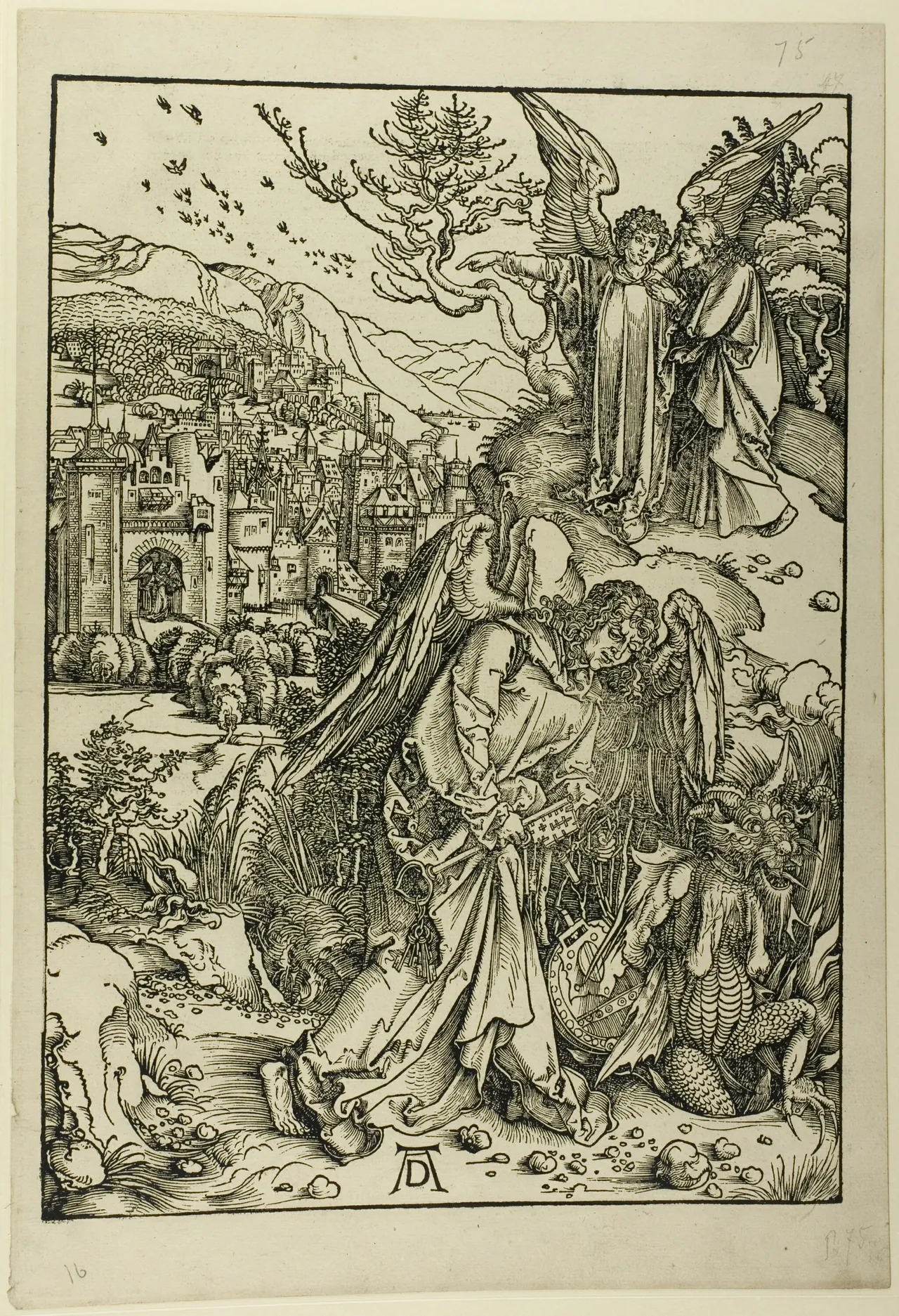
A German woodcut of about 1496 to 1498 from The Apocalypse, the angel with the key of the bottomless pit binding the dragon of Revelation 20.The Angel with the Key of the Bottomless Pit, from The Apocalypse · c. 1496–98; published 1511 · Art Institute of Chicago · CC0 · museum record · Galeria Regni
| Verses | What John sees | |---|---| | 1–3 | Satan bound and sealed in the pit, “that he should deceive the nations no more”, for a thousand years | | 4–6 | Thrones, judgment, and the souls of the martyrs, who “lived and reigned with Christ a thousand years” | | 7–8 | The thousand years expire; Satan is loosed and goes out “to deceive the nations” in the four quarters of the earth | | 9 | The nations surround “the camp of the saints” and the beloved city; fire from God devours them | | 10 | The devil is cast into the lake of fire for ever |
Then comes the great white throne and the books (Revelation 20:11-15), and then the new heaven and the new earth (Revelation 21).
What the binding restrains
The first thing to notice is that the text tells us what the binding is for. Satan is not said to be inactive, or powerless in every way. He is shut up “that he should deceive the nations no more” (Revelation 20:3). And when he is let out, the very first thing he does is the thing he was kept from doing: he “shall go out to deceive the nations” (Revelation 20:8).
That is the key that opens the whole chapter for me. The binding is a restraint on one work of the devil, the deceiving of whole peoples. Revelation has already called him the one “which deceiveth the whole world” (Revelation 12:9). For a thousand years that work is sealed up. Then, for a little season, it is loosed again.
This matters because it tells us what to look for in history. We should not expect the thousand years to be an age without sin, or without the devil's attacks on individuals, or without wicked rulers. Scripture never says that. We should expect an age in which the nations, as nations, stopped worshipping what they had worshipped, and turned to Christ. And we should expect the little season to look like the opposite: the nations going back out into deception.
The little season and the short time
The phrase “a little season” appears twice in Revelation. The souls under the altar are told “that they should rest yet for a little season, until their fellowservants also and their brethren, that should be killed as they were, should be fulfilled” (Revelation 6:11). The Greek behind both is a pair of plain words, mikros (little, small) and chronos (time), Strong's G3398 and G5550.1
A little season is short compared with what came before it, but it is not an instant. In Revelation 6 it is long enough for more martyrs to be killed. In Revelation 20 it is long enough for the deceiver to go out to all four quarters of the earth and gather nations “as the sand of the sea”. Nothing in the word fixes its length, and I will not try to.
Reading it literally
To read a passage literally is not to deny that it uses pictures. A key and a chain are pictures of real authority and real restraint; the devil is not a creature of iron. To read it literally is to take the things the pictures describe as real events with real time in them. When John says “a thousand years” six times in seven verses, I take him to mean a thousand years.
The objection is obvious: Revelation is full of symbols, so why not this number? Peter says “that one day is with the Lord as a thousand years, and a thousand years as one day” (2 Peter 3:8), and the psalmist says “a thousand years in thy sight are but as yesterday when it is past” (Psalm 90:4). Those verses tell us that God is not hurried by time. They do not turn every number in Scripture into a symbol. Revelation counts its periods with care: ten days (Revelation 2:10), five months, forty and two months, a thousand two hundred and threescore days. When it repeats a number six times, the plain sense is that the number is the point.
So a literal reading leaves us with a real binding, a real thousand years, a real loosing, and a real little season. The question is when.
What I do not press
One honest note. Verses 4–6 speak of thrones, of the souls of the beheaded who “lived and reigned with Christ a thousand years”, and of “the first resurrection”. Christians have argued over those lines for nineteen centuries. I take them as written: John saw the souls of the martyrs living and reigning with Christ through those thousand years, and he calls that the first resurrection, with a blessing on all who have part in it. I do not build a system on the details, and this paper does not need one. Its argument stands on the binding, the thousand years and the loosing, which are the parts the text explains most clearly.
If the thousand years are real years, the binding happened at a real moment. Most of the Church since Augustine has placed it at Christ's first coming. I believe the chain was laid on the dragon a generation later, when the temple fell in AD 70. This part sets out why.
The cross won the victory
Let me be clear first about what I am not saying. The decisive victory over Satan was won at the cross. Paul says of Christ that “having spoiled principalities and powers, he made a shew of them openly, triumphing over them in it” (Colossians 2:15). Hebrews says He took flesh “that through death he might destroy him that had the power of death, that is, the devil” (Hebrews 2:14). As the cross drew near, Jesus said, “Now is the judgment of this world: now shall the prince of this world be cast out” (John 12:31).
Jesus also used the very word bind during His ministry. When He was accused of casting out devils by Beelzebub, He answered:
“But if I cast out devils by the Spirit of God, then the kingdom of God is come unto you. Or else how can one enter into a strong man’s house, and spoil his goods, except he first bind the strong man? and then he will spoil his house.” (Matthew 12:28-29)
That binding is real, and it belongs to the same defeat. Every deliverance Jesus did was the strong man's house being spoiled. “I beheld Satan as lightning fall from heaven,” He told the seventy (Luke 10:18).
But Revelation 20 describes something more specific: a chain, a pit, a seal, and a restraint on deceiving the nations that lasts a thousand years and then ends. The victory of the cross does not end. So the question is not whether Christ defeated Satan at the cross. He did. The question is when the particular binding of Revelation 20 was applied.
“Shortly”
Here a single word in Romans has weighed heavily with me. Paul wrote to Rome in the 50s of the first century, a quarter of a century after the cross. And he closed his letter with a promise still in the future:
“And the God of peace shall bruise Satan under your feet shortly. The grace of our Lord Jesus Christ be with you. Amen.” (Romans 16:20)
The cross was already behind Paul. Yet he looked ahead, and not far ahead, to a day when Satan would be bruised under the church's feet. Something was still to come within that generation.
Revelation itself opens the same way. It is given “to shew unto his servants things which must shortly come to pass” (Revelation 1:1).
The generation and the house
What was coming within that generation? Jesus told His disciples plainly. After pronouncing woe on the scribes and Pharisees, He said:
“Verily I say unto you, All these things shall come upon this generation. O Jerusalem, Jerusalem, thou that killest the prophets, and stonest them which are sent unto thee, how often would I have gathered thy children together, even as a hen gathereth her chickens under her wings, and ye would not! Behold, your house is left unto you desolate.” (Matthew 23:36-38)
Then He walked out of the temple, and when His disciples pointed to its buildings, He said, “See ye not all these things? verily I say unto you, There shall not be left here one stone upon another, that shall not be thrown down” (Matthew 24:2). And in the same discourse: “Verily I say unto you, This generation shall not pass, till all these things be fulfilled” (Matthew 24:34).
Luke records the warning sign: “And when ye shall see Jerusalem compassed with armies, then know that the desolation thereof is nigh” (Luke 21:20). And the outcome: “And they shall fall by the edge of the sword, and shall be led away captive into all nations: and Jerusalem shall be trodden down of the Gentiles, until the times of the Gentiles be fulfilled” (Luke 21:24).
What Josephus saw
It happened as Jesus said, within forty years. Flavius Josephus, a Jewish priest and commander who went over to the Romans, watched the siege of Jerusalem from the Roman lines and wrote it up in The Jewish War. He dates the burning of the holy house to the very day of the year on which Babylon had burned Solomon's temple:
“But as for that house, God had, for certain, long ago doomed it to the fire; and now that fatal day was come, according to the revolution of ages; it was the tenth day of the month Lous, [Ab,] upon which it was formerly burnt by the king of Babylon.”2
And of the city afterwards, Josephus says the wall “was so thoroughly laid even with the ground by those that dug it up to the foundation, that there was left nothing to make those that came thither believe it had ever been inhabited.”3
Not one stone upon another. The words of Jesus were kept to the letter by a Roman army that had never heard them.
Why the temple's fall marks the binding
Why should the fall of the temple be the moment the dragon is chained? Here I am giving my reading of how the texts fit together, and I want to show my reasons.
First, the old order ended. Hebrews, written while the temple still stood, said the first covenant was “ready to vanish away” (Hebrews 8:13), and that “the way into the holiest of all was not yet made manifest, while as the first tabernacle was yet standing” (Hebrews 9:8). While the temple stood, the old worship stood beside the new, and the church was under constant pressure to go back to it. When the temple fell, that pressure fell with it. God Himself took the old house away.
Second, the great early persecutor of the gospel was judged. In the first generation, the fiercest opposition to the gospel came from unbelieving Jerusalem. Paul wrote that they “both killed the Lord Jesus, and their own prophets, and have persecuted us; and they please not God, and are contrary to all men: Forbidding us to speak to the Gentiles that they might be saved, to fill up their sins alway: for the wrath is come upon them to the uttermost” (1 Thessalonians 2:15-16). The risen Christ called those who opposed His church at Smyrna “the synagogue of Satan” (Revelation 2:9). The judgment Jesus foretold on that generation fell in AD 70. The opposition to the gospel going to the Gentiles lost its centre. These texts speak of the leaders of that generation who opposed the gospel, not of the Jewish people as such; the gospel itself went out “to the Jew first, and also to the Greek” (Romans 1:16).
Third, the promise of Romans 16:20 found its moment. Paul promised the bruising of Satan “shortly” to a church already living after the cross. The great event of that generation, the one Jesus had named and dated by “this generation”, was the fall of Jerusalem.
Fourth, the binding is about the nations.Revelation 20:3 says the devil was sealed so “that he should deceive the nations no more”. Before Christ, God “in times past suffered all nations to walk in their own ways” (Acts 14:16); and now “the times of this ignorance God winked at; but now commandeth all men every where to repent” (Acts 17:30). The fall of the temple closed the age in which God's dealings were centred on one nation and one house, and opened the age in which the nations themselves would be turned.
None of these four reasons proves the date by itself. Together they are why I believe the chain was laid on the dragon when the house was left desolate. This is my conviction; weigh it for yourself.
When was Revelation written?
An honest reader will ask: if John saw the binding in his vision, was the vision written before or after AD 70? Irenaeus, writing around AD 180, said that the vision “was seen no very long time since, but almost in our day, towards the end of Domitian's reign”, that is, in the 90s.4 Many scholars follow him; some argue for an earlier date.
My reading does not depend on settling it. John was told, “Write the things which thou hast seen, and the things which are, and the things which shall be hereafter” (Revelation 1:19). His visions range over what had happened, what was happening and what was to come. Revelation 12 shows the birth and ascension of the Child, the ascension already some sixty years past if Irenaeus is right. A vision written in the 90s can show a binding that took place in AD 70, just as it shows a birth that took place before AD 1.
This is the hardest part of my reading, and I will not hide it. If Satan was bound in AD 70, and the thousand years ran from about 500 to 1500, then the dates on the standard calendar do not line up. Something has to give.
Where I stand
I hold both: the binding in AD 70, and the reign in the medieval centuries. I hold the standard first-millennium calendar to be unreliable, following Gunnar Heinsohn's argument from stratigraphy. Most historians reject it, and their evidence (tree rings, radiocarbon, eclipses) is real and should be weighed. This is my conviction; weigh it for yourself.
Gunnar Heinsohn (1943–2023), a German professor at the University of Bremen, argued from archaeological stratigraphy, the order of layers in excavated sites, that about seven hundred years of first-millennium chronology are phantom years.5 Heinsohn's argument, in brief, was that the ground does not show as many centuries of building and destruction in the first millennium as the textbooks put there, and that layers and cultures the textbooks place centuries apart belong together; one of his essays asks of two Roman emperors, "Augustus and Diocletian: contemporaries, or three centuries apart?" His later essays, many of them collected by the journal Q-Mag, carry titles that state the thesis in brief: on "paper-making's mysterious 700 years of secrecy", on whether Arabs were "really ignorant of writing and coinage for 700 years", and on medieval cities "built to resemble 700-year older Roman cities".6
I will not give you arithmetic. I have seen people take a number of phantom years, add and subtract, and announce a date. That is not what I am doing, and the sums do not come out neatly anyway. The binding came when the temple fell; the reign was the age of Christendom; the little season is now.
What the historians say
Honesty requires the other side, stated fairly. Historians broadly reject Heinsohn's chronology. The dendrochronologist Mike Baillie, who built the long Irish oak tree-ring chronologies, published a rebuttal of Heinsohn's phantom-time thesis from tree rings and radiocarbon, and the same journal that printed Heinsohn printed it.7
A smaller and better-known theory, Heribert Illig's claim that about three centuries (614–911) were invented, has been answered in detail. The astronomer Dieter B. Herrmann, for one, calculated the eclipses recorded in the old sources and concluded that Illig's thesis rests on an error.8 Heinsohn's own thesis is different from Illig's, but eclipses and tree rings are the kinds of evidence any revised chronology has to answer.
So you should know that on this point I stand against the consensus of historians. This is my conviction; weigh it for yourself.
What does not depend on it
Here is the important thing. The heart of this paper does not stand or fall with Heinsohn. If you are not persuaded about the calendar, you can still weigh the shape the text describes: a binding that restrained the deception of the nations, an age in which the nations turned to Christ and built for Him, and then a season in which the deception went out again across the whole earth. Those are matters you can test against Scripture and against the record of history, and the rest of this paper does exactly that.
Part 4 — The Thousand Years: Christendom, About 500 to 1500
7 min read
If Revelation 20:3 means what it says, the thousand years should be an age in which the nations stopped being deceived as nations: an age in which peoples who had worshipped idols turned, publicly and as peoples, to Christ. This part looks at what happened in the centuries I place the reign in, through the words of the people who wrote it down.
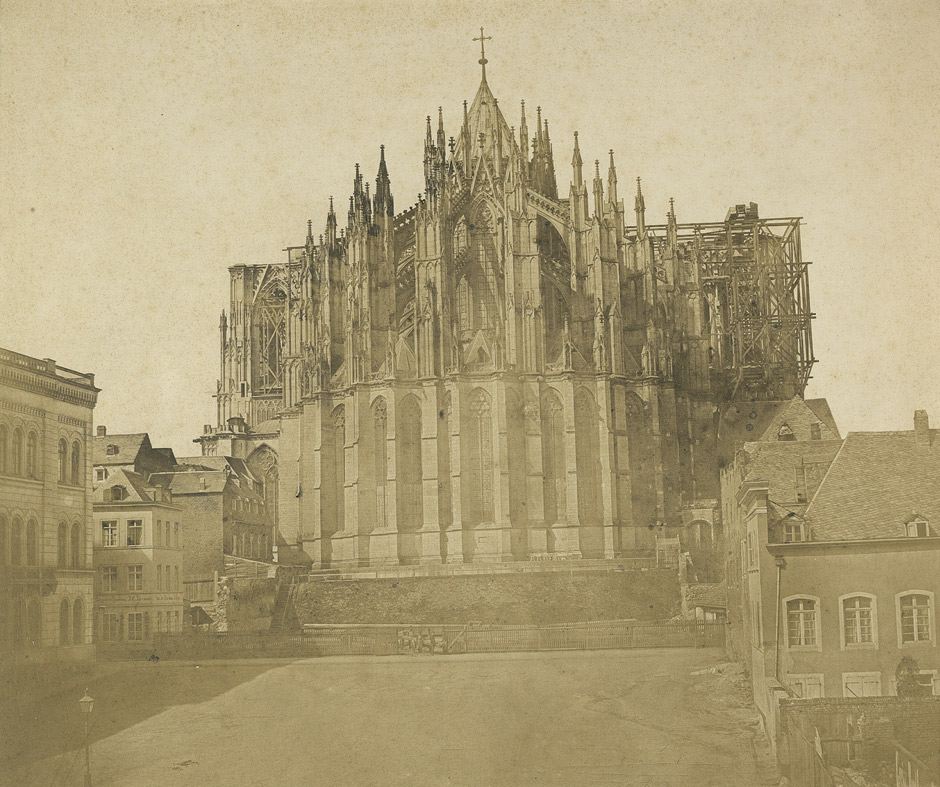
Cologne Cathedral completed in 1880 — the 632-year build finally finished, exactly to the medieval plan.Tony Hisgett · CC BY 2.0Cologne Cathedral photographed in 1855 — still unfinished, the medieval crane waiting on the tower after four centuries.Johann Franz Michiels, 1855 · Public domain
“Deceive the nations no more”
Before the gospel, the nations served what Paul calls devils. “But I say, that the things which the Gentiles sacrifice, they sacrifice to devils, and not to God” (1 Corinthians 10:20). The god of this world had “blinded the minds of them which believe not” (2 Corinthians 4:4). Paul was sent to the Gentiles “to open their eyes, and to turn them from darkness to light, and from the power of Satan unto God” (Acts 26:18). At Ephesus the turning was so deep that those “which used curious arts brought their books together, and burned them before all men” (Acts 19:19).
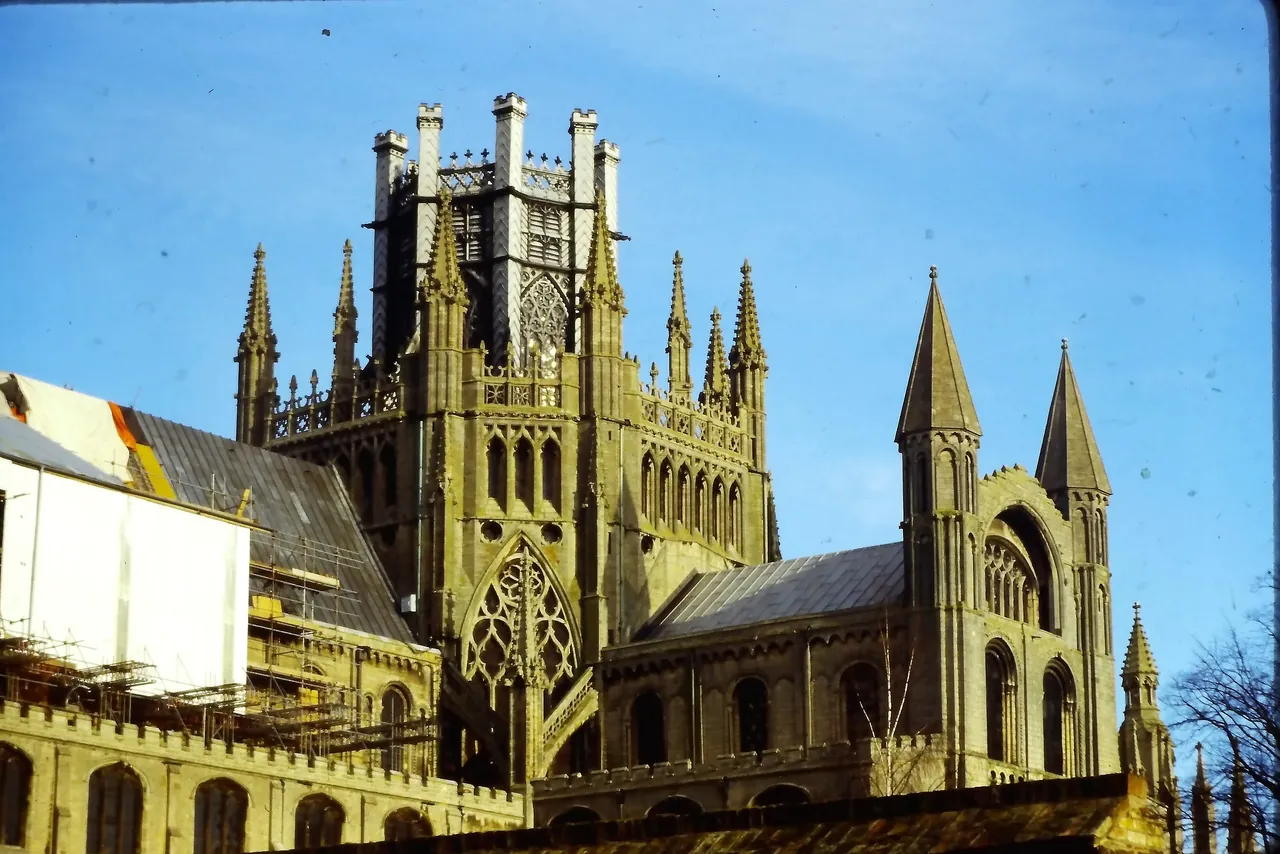
A 1988 photograph of Ely Cathedral in England, built from 1081 into the 1390s, one of the churches raised during the thousand years.Ely Cathedral · photographed 1988 · Wikimedia Commons · CC BY 4.0 · museum record · Galeria Regni
What happened at Ephesus to a few in the first century happened to whole nations in the centuries that followed. Here are four witnesses, from four corners of Europe.
The Franks: “burn what you worshipped”
Clovis, king of the Franks, was baptised at Reims around the year 500, after a long resistance and a battle in which, as Gregory of Tours tells it, he called on Christ. Gregory, bishop of Tours, wrote his History of the Franks about eighty years later. He describes the people crying out together, “O pious king, we reject our mortal gods, and we are ready to follow the immortal God whom Remi preaches.” And as the king came to the font, Bishop Remi said to him:
“Gently bend your neck, Sigamber; worship what you burned; burn what you worshipped.”9
Gregory adds that “of his army more than 3000 were baptized.”9 A nation that had served the old gods turned, and the kings of the Franks were Christian from then on.
England: the high priest burns his own temple
A century later, Pope Gregory sent a mission to the English, who had overrun Christian Britain as pagans. Bede, the monk of Jarrow, finished his Ecclesiastical History of the English People in 731. He preserved the instruction Gregory sent after the mission in 601: that the English temples, where they were well built, should “be converted from the worship of devils to the service of the true God”.10 Whatever one thinks of every detail of that policy, notice its language. Gregory, like Paul, knew what the nations had been serving.
Bede's most vivid scene comes from Northumbria in 627. King Edwin called his council to hear the preaching of Paulinus. The chief of the pagan priests, Coifi, was the first to speak, and he said “that the religion which we have hitherto professed has no virtue in it and no profit.” Another counsellor compared man's life to a sparrow flying through a lit hall in winter, in at one door and out at another: “So this life of man appears for a little while, but of what is to follow or what went before we know nothing at all.” And when Coifi heard Paulinus, he cried out:
“This long time I have perceived that what we worshipped was naught; because the more diligently I sought after truth in that worship, the less I found it.”11
Then the high priest, who by pagan law could not bear arms or ride a stallion, asked the king for both, rode out to the shrine at Goodmanham near York, threw his spear into the temple he had served, and ordered it burned with all its precincts. Bede notes that the place “is still shown, not far from York”.11 That is what it looks like when a nation stops being deceived.
The Rus: the idol dragged to the river
In the east the story repeats. The Russian Primary Chronicle, compiled at Kiev in the early twelfth century, records under the year 987 that Prince Vladimir sent envoys to examine the religions of his neighbours. Of the worship they saw in Constantinople, the envoys reported:
“We knew not whether we were in heaven or on earth. For on earth there is no such splendor or such beauty...”12
Under 988, the chronicler tells how Vladimir, returning baptised to Kiev, ordered the idols overthrown. The thunder-god Perun was bound to a horse's tail and dragged to the Dnieper, and men were appointed to beat it with sticks, “not because he thought the wood was sensitive, but to affront the demon who had deceived man in this guise.”12 Then the people of Kiev were baptised in the river.
The chronicler did not have Revelation 20:3 in front of him. But he used its idea: a demon who had deceived man, now cast down.
The shape of it
Those are three peoples among many. Between the sixth century and the end of the fifteenth, the Franks, the English, the Irish, the Germans, the Scandinavians, the Poles, the Hungarians, the Rus and others turned from their gods to Christ, and Christian communities reached as far as Persia, India and China.13 For the first time in history, an entire civilisation counted its years from the birth of Christ, swore its oaths on the Gospels, and measured its laws by His.
The law itself bore the mark. The emperors' codes, from the Theodosian Code of 438 onward, put the Christian faith into public law and forbade the old sacrifices.14 Whatever else may be said of those laws, the public worship of the old gods, practised in every city of the Roman world for a thousand years, ceased.
The churches they built
The people of those centuries built for a King they believed was reigning. The buildings still stand, and they are some of the plainest evidence we have of what the age believed.
When Justinian rebuilt the great church of Holy Wisdom in Constantinople in the 530s, the historian Procopius, who saw it new, wrote that its great dome seemed not to rest on solid masonry but to hang “suspended from Heaven”, and:
“And whenever anyone enters this church to pray, he understands at once that it is not by any human power or skill, but by the influence of God, that this work has been so finely turned. And so his mind is lifted up toward God and exalted, feeling that He cannot be far away.”15
In the eleventh century the Burgundian monk Rodulfus Glaber wrote that in the years after 1000 men rebuilt churches everywhere, even where there was no need, so that it was as if the whole world were shaking off its old age and clothing itself in “a white mantle of churches”. The phrase has become the standard way historians describe the building boom of the high Middle Ages.16
At Saint-Denis, outside Paris, Abbot Suger rebuilt his abbey church in the new style we now call Gothic, and had verses inscribed on its gilded doors to say what the light and the gold were for: they “should brighten the minds, allowing them to travel through the lights to the true light, where Christ is the true door.” And: “The dull mind rises to the truth through material things.”17
Chartres was rebuilt in about twenty-six years after the fire of 1194. At Cologne the foundation stone was laid in 1248. Work there went on for more than two and a half centuries and then stopped around 1520, for more than three hundred years; the cathedral was finished to its medieval plan only in 1880.18 I find that a striking picture. The great work begun in the reign was left standing half-built for three hundred years after the age of the cathedrals ended.
An honest word about the reign
I want to be careful here, because a reign of Christ is not the same thing as a perfect Church. The thousand years I describe were full of sin. There were wicked popes and wicked kings. Men were baptised at the edge of the sword. Crusades were preached and Jews were massacred. The machinery of the inquisitions put people to death for heresy. Historians such as R. I. Moore have written whole books on how medieval Christendom became, in his phrase, a persecuting society.19 None of that should be excused, and I do not excuse it.
But notice again what Revelation 20 claims and what it does not. It does not claim that men stopped sinning, or that the Church kept itself pure. It claims that Satan was restrained from deceiving the nations, and that the martyrs reigned with Christ. The sins of Christendom were the sins of baptised people who knew they were sinning against a law they confessed. That is a very different thing from nations that offered their children to idols and called it worship. In the thousand years, the nations knew who the true God was. Even their hypocrisy paid Him that tribute.
Why the reign is behind us
This also explains why I place the thousand years in the past and not the future. If the binding of Satan means that the nations are kept from deception, then we are not living in it now. We are watching nations that were Christian for a thousand years go back out, at speed, into every kind of spirituality and unbelief. That is not what a bound devil looks like. It is what Revelation 20:7-8 says a loosed one does. This is my conviction; weigh it for yourself.
Every reading of this chapter has a history, and mine is no exception. This part reports, as fairly as I can, what Christians have believed about Revelation 20 over two thousand years. It is history, not my position, except where I say so.
The earliest readers
The first Christian writers after the apostles who speak of the thousand years mostly expected a future earthly kingdom. Eusebius, the church historian, reports that Papias of Hierapolis, an early second-century bishop, taught “that there will be a period of some thousand years after the resurrection of the dead, and that the kingdom of Christ will be set up in material form on this very earth.” Eusebius did not agree; he thought Papias had taken “mystically in figures” what the apostles meant.20
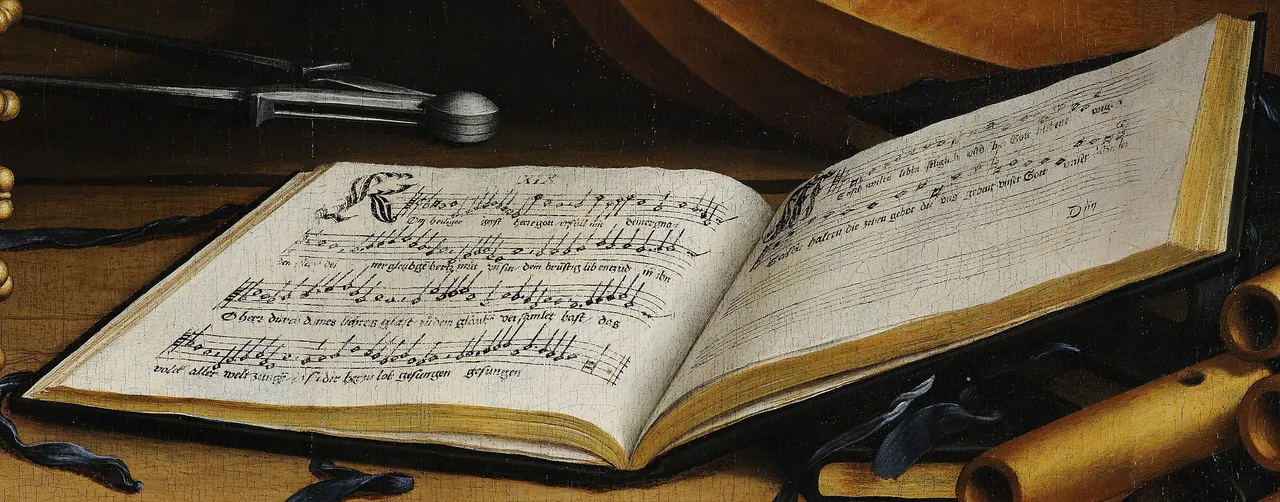
A detail from The Ambassadors of 1533 showing an open Lutheran psalm book, from the years when the Reformers kept the Augustinian reading of Revelation 20.The Ambassadors - Psalmbook · 1533 · Wikimedia Commons · Public domain · museum record · Galeria Regni
Justin Martyr, writing around 160, said in his Dialogue with Trypho: “But I and others, who are right-minded Christians on all points, are assured that there will be a resurrection of the dead, and a thousand years in Jerusalem, which will then be built, adorned, and enlarged.” He appealed to John: “there was a certain man with us, whose name was John, one of the apostles of Christ, who prophesied, by a revelation that was made to him, that those who believed in our Christ would dwell a thousand years in Jerusalem.” But Justin also admitted honestly “that many who belong to the pure and pious faith, and are true Christians, think otherwise.”21
So from the very beginning, Christians disagreed about this chapter, and said so. That should keep all of us humble.
Tyconius and Augustine
The reading that dominated the Western Church for a thousand years came from North Africa at the end of the fourth century. Tyconius, a Donatist layman, wrote a Book of Rules for interpreting Scripture and a commentary on Revelation. Augustine admired the Rules enough to summarise them in his own book on biblical interpretation, calling them seven rules “which are, as it were, keys to open the secrets of Scripture.”22
Augustine's own treatment of Revelation 20, in Book 20 of The City of God (written in the 420s), became the standard. He tells us that he once held the earlier view of a future Sabbath of a thousand years: “for I myself, too, once held this opinion.” He turned from it because of the carnal banquets some attached to it.23 He then offered two possible meanings for the thousand years: either the last part of the sixth millennium of world history, “or he used the thousand years as an equivalent for the whole duration of this world, employing the number of perfection to mark the fullness of time.”23
Augustine defined the binding carefully: “the binding of the devil is his being prevented from the exercise of his whole power to seduce men.”24 He believed that when Satan was loosed at the end, “he shall rage with the whole force of himself and his angels for three years and six months”, but he insisted that even then “there shall be a Church in this world.”24 And he concluded: “Therefore the Church even now is the kingdom of Christ, and the kingdom of heaven.”25
That is Augustine's reading, and I report it as history: it is what the medieval Church believed about the age it lived in. It is not my position. I part from it in three places. I take the thousand years as a real thousand years, not as a number for the whole age. I place the binding at the fall of the temple, not at Christ's first coming. And I believe the little season is not a final three and a half years still ahead, but the age that began about 1500.
But notice something remarkable. The Church of the medieval centuries, reading Augustine, believed that it was living in the thousand years, that Satan was bound from deceiving the nations, and that Christ was reigning. If my reading is right, they were right about their own age, even if they reckoned its length differently.
The Reformers
The Lutheran Augsburg Confession of 1530 kept the Augustinian line against the radical sects of its day. Its seventeenth article condemns those “who now scatter Jewish opinions, that, before the resurrection of the dead, the godly shall occupy the kingdom of the world, the wicked being every where suppressed.”26 The Reformers, like Augustine, rejected a coming earthly golden age before the resurrection.
John Foxe: a historian who dated the thousand years
One Reformation writer deserves special notice, because he did something close to what I am doing: he read the thousand years as a real span of past history and dated the loosing of Satan in his own recent past. John Foxe, in the fifth book of his Acts and Monuments (the work known as Foxe's Book of Martyrs), argued that the common opinion, which dated the chaining of Satan from the birth of Christ, was "deceived by ignorance of histories". He granted that the strength of Satan "in accusing and condemning us for sin, was cast down at the passion and by the passion of Christ our Saviour, and locked up not only for a thousand years, but for ever." But he held that the binding of Revelation 20 came when the persecutions of the early church ceased, and that it lasted a thousand years:
“...whenas it should please the Lord to bridle the malice and snaffle the power of the old serpent, and give rest unto his church for the term of a thousand years; which time being expired, the said serpent should be suffered loose again for a certain or a small time, Apoc. xx.”27
Foxe placed the binding around Constantine's peace in the early fourth century and the loosing around 1300. He titled the next part of his history "The Last Three Hundred Years from the Loosing Out of Satan", and he read the rise of the Reformation as the church's resistance in the little season.27 I do not follow his dates, and he reckoned by arithmetic that I deliberately avoid. But the shape of his reading is the same as mine: a literal thousand years, already past, and a little season already begun. He held it in the sixteenth century, in one of the most influential English books of the Reformation.
The modern views
In the nineteenth and twentieth centuries the debate settled into the four positions most Christians now know, each argued by its own defenders: historic premillennialism, dispensational premillennialism, postmillennialism and amillennialism. Robert G. Clouse's The Meaning of the Millennium: Four Views (1977) lets a proponent of each make his case and answer the others, and it is still a fair place to meet them.28 Dispensational premillennialism spread through the teaching of John Nelson Darby and the Scofield Reference Bible of 1909, a history traced by Ernest Sandeen and George Marsden.29
My reading does not fit neatly into any of the four, and I do not claim any of their labels. I am a Bible literalist who believes the thousand years were real and are past. If that sounds new, Foxe shows it is not entirely new. If it sounds wrong, test it against the text, as the Bereans did, “whether those things were so” (Acts 17:11). This is my conviction; weigh it for yourself.
“And when the thousand years are expired, Satan shall be loosed out of his prison, And shall go out to deceive the nations which are in the four quarters of the earth” (Revelation 20:7-8). If the thousand years ended around 1500, the centuries since should show the nations going back out into deception. This part looks at whether they do.
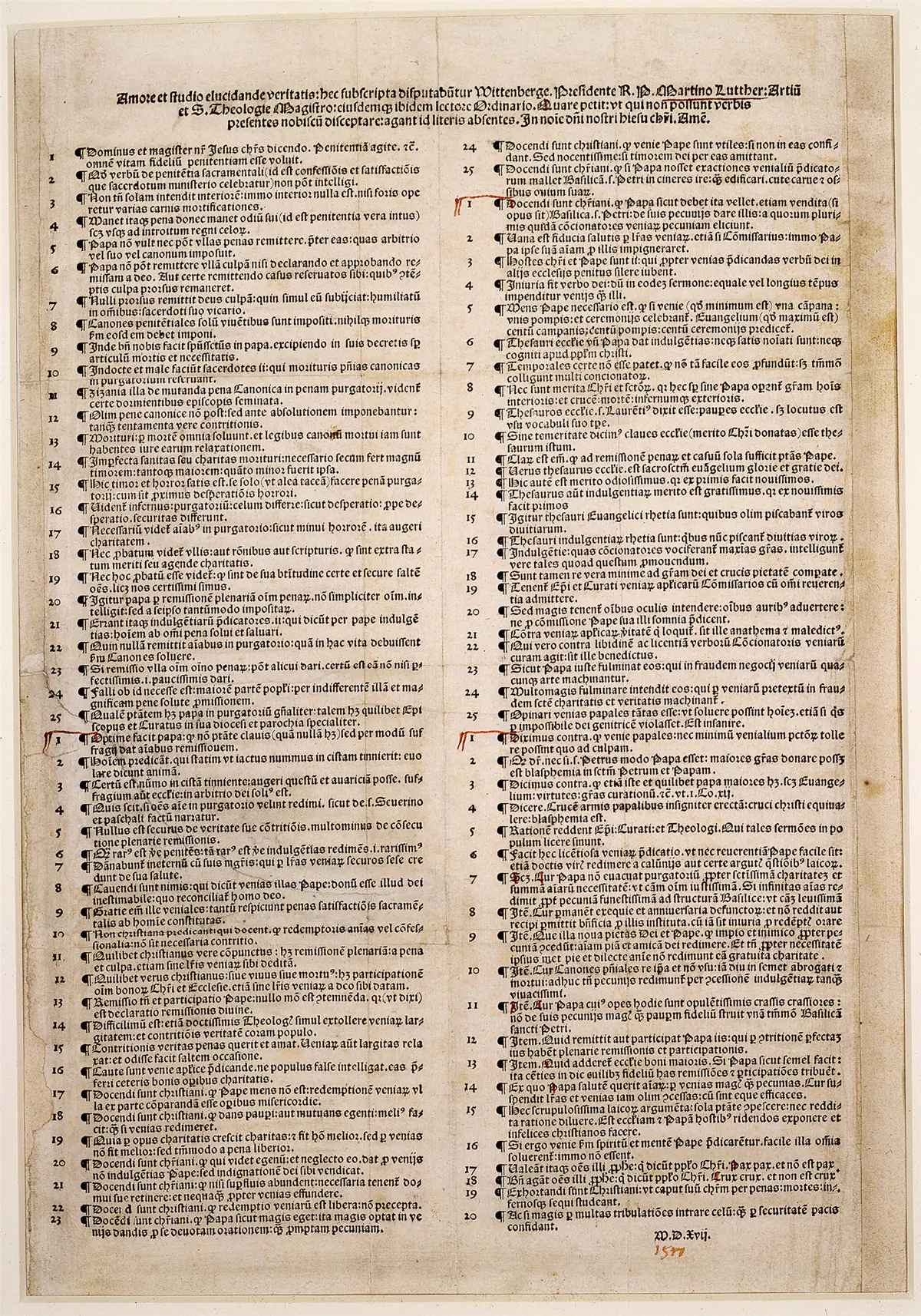
The printed Ninety-five Theses (1517) — a church-door dispute that a new medium carried across Europe in weeks.Martin Luther, 1517 · Public domain
What to look for
Revelation tells us what the deceiver's work looks like. The world beyond the church in Revelation is marked by worship of devils and idols, by murders, “sorceries”, fornication and thefts (Revelation 9:20-21), and by a city of whom it is said, “by thy sorceries were all nations deceived” (Revelation 18:23). Paul warned that “in the latter times some shall depart from the faith, giving heed to seducing spirits, and doctrines of devils” (1 Timothy 4:1), and that men “shall turn away their ears from the truth, and shall be turned unto fables” (2 Timothy 4:4). He warned of “strong delusion, that they should believe a lie” (2 Thessalonians 2:11).
Two marks stand out: the return of the old occult practices that the nations had renounced, and a turning away from the truth, by people who once had it, into unbelief and fables. Both are written across the history of the last five centuries.
The return of the old arts
The age of the Renaissance, which most textbooks treat as a rebirth of learning, was also a rebirth of the occult. In the fifteenth century the Florentine scholar Marsilio Ficino (1433–1499) translated the Corpus Hermeticum, a body of Greek writings attributed to "Hermes Trismegistus", into Latin. The historian Frances Yates showed in Giordano Bruno and the Hermetic Tradition (1964) how central magic and the Hermetic writings were to Renaissance thought.30 The arts that Coifi had renounced, and that the Ephesians had burned, came back into the learned world of Christendom dressed as ancient wisdom.
In the nineteenth century the old arts became a popular movement. In 1848 two young sisters in Hydesville, New York, Kate and Maggie Fox, claimed that spirits were knocking messages to them, and from that household spiritualism spread across America and Europe.31 In 1875 Helena Blavatsky, Henry Steel Olcott and others founded the Theosophical Society in New York, and its leaders soon turned to the religions of the East. J. Gordon Melton, the leading American scholar of new religious movements, gives the Theosophical Society its own entry in his New Age Encyclopedia as one of the main sources of the New Age movement.32
The law of Moses forbade every one of these things by name: the one “that useth divination, or an observer of times, or an enchanter, or a witch. Or a charmer, or a consulter with familiar spirits, or a wizard, or a necromancer” (Deuteronomy 18:10-11). For a thousand years, the nations of Christendom, whatever their sins, knew those things were forbidden. In the little season they became a market.
The turning away from the truth
The other mark is unbelief among people who had the truth. The centuries since 1500 have produced something the world had never seen before: whole nations, Christian for a millennium, turning from the God of the Bible not to other gods but to none.
On 10 November 1793, at the height of the French Revolution, the city officials of Paris told the National Convention that they had that day inaugurated a cult of Reason in the cathedral of Notre-Dame and enthroned a Goddess of Reason in the church, and the Convention voted that Notre-Dame be henceforth the "Temple of Reason".33 The great church raised in the reign to the honour of Christ was given to the worship of man.
In 1843 Karl Marx wrote that “the criticism of religion is the prerequisite of all criticism,” and of religion itself: “It is the opium of the people.”34 In 1882 Friedrich Nietzsche put into the mouth of his madman the sentence that became the motto of the age: “God is dead! God remains dead! And we have killed him!”35 These men did not invent unbelief. They gave words to what whole classes of the West had come to believe. Within a century, governments built on Marx's ideas were closing churches and persecuting believers.
Where we are now
The numbers in my own country tell the same story. The Pew Research Center's Religious Landscape Study, a survey of 36,908 American adults conducted from July 2023 to March 2024, found that 62% of U.S. adults identify as Christians, down from 78% in 2007, and that 29% are religiously unaffiliated, up from 16% in 2007.36 Pew notes that the decline may have slowed, and I will not overstate it. But a fall of sixteen points in less than twenty years is not a small thing.
And the old arts have not gone away; they have moved into the churches. In 2018 Pew reported that roughly six in ten American adults accept at least one of four New Age beliefs it measured: belief in psychics, that spiritual energy can be found in physical objects, in reincarnation, and in astrology. Four in ten believe in psychics; 29% believe in astrology; and six in ten Christians hold at least one of the four.37
“And shall go out to deceive the nations which are in the four quarters of the earth” (Revelation 20:8). I do not know a better description of the world in my phone.
My own story
This is my story, in my own words:
I was raised Roman Catholic but never really connected — I went through the motions, fell asleep in the pews, and faked being sick to skip Mass. College was rebellion: parties, drugs, freedom I loved and abused. When real life hit — a lost job, a pregnant wife, constant fights — I went looking for peace anywhere I could find it. New Age, crystals, astral projection, tarot, angel numbers. None of it held. So I swung back hard to religion, said the rosary every night, and still felt nothing.
Eventually I gave up and called myself an atheist. I decided to read the Bible for one reason: to disprove it, so I'd have an excuse to stop going to church for good. It did the opposite. I came to faith in 2022, and my wife came to faith a month later.
Look at that list again: New Age, crystals, astral projection, tarot, angel numbers, then atheism. In one line: “I came to disprove God. He met me instead — and I couldn't unsee what time it is.” The full story is at kylelauriano.com/about.
Others who walked out of the deception
I am not alone. Two guests on my podcast, The King Is Coming Show, told stories that fit this part of the paper closely.
Steve Kang told his story on The King Is Coming Show (TKIC #49): in his telling, he chanted eight hours a day to reach Nirvana, and woke up in hell instead. Watch it in his own words: youtube.com/watch?v=46SP1FgXfbY Steve's account of what happened to him, shared as his testimony — weigh it for yourself.
Mike Shreve told his story on The King Is Coming Show (TKIC #46): a Kundalini guru who, in his own telling, was born again on a Tampa roadside. Watch it in his own words: youtube.com/watch?v=oqAq58bDC4k Mike's account of what happened to him, shared as his testimony — weigh it for yourself.
For most of the thousand years, Eastern meditation and Kundalini yoga were scarcely known in the Christian West. In the little season they are taught in community centres and gyms.
The word in the little season
Here is the other side, and it matters just as much. The little season is not an age in which God is absent. Augustine was right that even when Satan is loosed, “there shall be a Church in this world.”24 Jesus promised, “the gates of hell shall not prevail against it” (Matthew 16:18).
In fact, God put His word into the hands of ordinary people at the very start of the little season, as if to arm them for it. Printing with movable type came to Europe in the middle of the fifteenth century. William Tyndale printed his English New Testament in 1526 and was put to death for it in 1536.38 And in 1611 the King James Bible was published, the Bible you are reading in every quotation of this paper. Revelation 20:9 shows the nations surrounding “the camp of the saints”. The saints are still there in the little season, and they have the word.
“Heaven and earth shall pass away, but my words shall not pass away” (Matthew 24:35).
If this is the season we are in, what then? The point of understanding the times is to know, like the men of Issachar, what we ought to do. Revelation 20 does not end with the deception. It ends with fire from heaven and the devil in the lake of fire. This part turns from history to the life of faith.
Do not set dates
The first rule is the one Jesus gave. “But of that day and hour knoweth no man, no, not the angels of heaven, but my Father only” (Matthew 24:36). And again: “It is not for you to know the times or the seasons, which the Father hath put in his own power” (Acts 1:7). I have refused arithmetic in this paper, and I refuse it here. A little season is a season; I do not know its length, and anyone who tells you the year is telling you more than Scripture does.
“Take ye heed, watch and pray: for ye know not when the time is” (Mark 13:33).
Test everything
The mark of the little season is deception, so the first duty in it is discernment. “Beloved, believe not every spirit, but try the spirits whether they are of God: because many false prophets are gone out into the world” (1 John 4:1). Paul says the same: “Prove all things; hold fast that which is good” (1 Thessalonians 5:21). Jesus warned that false Christs and false prophets would show signs and wonders, “insomuch that, if it were possible, they shall deceive the very elect” (Matthew 24:24).
The test is the written word. “To the law and to the testimony: if they speak not according to this word, it is because there is no light in them” (Isaiah 8:20). That includes this paper. The Bereans were commended because they “searched the scriptures daily, whether those things were so” (Acts 17:11), and they did it with an apostle. Do the same with me.
In practice that means:
Read the Bible yourself, whole books at a time, in the King James. The free 1611 Reader at kylelauriano.com/library is there for that purpose.
Get rid of what Deuteronomy 18 forbids. If you have tarot cards, crystals for "energy", astrology apps or books of spells, do what the Ephesians did (Acts 19:19).
Weigh every spiritual experience, including your own, against the text. Satan “himself is transformed into an angel of light” (2 Corinthians 11:14).
Be slow to trust teachers who sell secret knowledge, and quick to trust the plain words of Christ.
Stand in the camp of the saints
Revelation 20:9 shows the nations gathered around “the camp of the saints”. The saints are together. The little season is no time to be a solitary Christian. Hebrews says we should not forsake “the assembling of ourselves together, as the manner of some is; but exhorting one another: and so much the more, as ye see the day approaching” (Hebrews 10:25).
We are in a war, but not with people. “For we wrestle not against flesh and blood, but against principalities, against powers, against the rulers of the darkness of this world, against spiritual wickedness in high places” (Ephesians 6:12). The command is to “Put on the whole armour of God, that ye may be able to stand against the wiles of the devil” (Ephesians 6:11). And the promise is sure: “Submit yourselves therefore to God. Resist the devil, and he will flee from you” (James 4:7). Peter adds, “Be sober, be vigilant; because your adversary the devil, as a roaring lion, walketh about, seeking whom he may devour: Whom resist stedfast in the faith, knowing that the same afflictions are accomplished in your brethren that are in the world” (1 Peter 5:8-9).
A loosed devil is still a defeated devil. The cross is still behind us, and “in all these things we are more than conquerors through him that loved us” (Romans 8:37).
Preach the gospel
The little season is a season of deception, and the answer to deception is the truth. Paul's commission has not changed: “To open their eyes, and to turn them from darkness to light, and from the power of Satan unto God, that they may receive forgiveness of sins, and inheritance among them which are sanctified by faith that is in me” (Acts 26:18). The same Lord who turned the Franks and the English and the Rus can turn the people on your street.
The gospel is the same as it has always been. Christ died for our sins and rose again. Salvation is by grace through faith in Him: “For by grace are ye saved through faith; and that not of yourselves: it is the gift of God: Not of works, lest any man should boast” (Ephesians 2:8-9). Paul preached “repentance toward God, and faith toward our Lord Jesus Christ” (Acts 20:21). And on the day of Pentecost Peter said, “Repent, and be baptized every one of you in the name of Jesus Christ for the remission of sins, and ye shall receive the gift of the Holy Ghost” (Acts 2:38).
Lift up your heads
Finally, the little season is a reason for hope, not fear. It is little. It ends the way Revelation 20 says it ends: “fire came down from God out of heaven, and devoured them. And the devil that deceived them was cast into the lake of fire and brimstone” (Revelation 20:9-10). After it come the books and the throne, and then the new heaven and new earth, where “God shall wipe away all tears from their eyes; and there shall be no more death, neither sorrow, nor crying, neither shall there be any more pain: for the former things are passed away” (Revelation 21:4).
Jesus said, “And when these things begin to come to pass, then look up, and lift up your heads; for your redemption draweth nigh” (Luke 21:28). We receive “a kingdom which cannot be moved” (Hebrews 12:28). The Bible's last prayer is the right prayer for the little season: “Surely I come quickly. Amen. Even so, come, Lord Jesus” (Revelation 22:20).
Revelation 20 tells a story with real time in it: a binding that keeps Satan from deceiving the nations for a thousand years, a reign of the martyrs with Christ, and a loosing for a little season in which he goes out to deceive the nations again, before he is cast into the lake of fire.
I read Revelation 20 literally. I believe Satan was bound when the temple fell in AD 70; that the thousand years were the medieval age, about 500 to 1500; and that the little season began about 1500 and is the age we live in now. I set no dates. This is my conviction; weigh it for yourself.
The fall of the temple was the event Jesus foretold for “this generation”, which Josephus watched, and which closed the old house and opened the age of the nations. The thousand years were the centuries when the Franks burned what they had worshipped, an English high priest rode out against his own temple, a prince of the Rus dragged his idol to the river, and the nations covered Europe with a white mantle of churches. And in the little season, as I read it, the return of the occult, the turning of Christian nations to unbelief, and the flood of new spiritualities are the deceiver at his old work in the four quarters of the earth.
I have told you where I stand against the consensus. The calendar between AD 70 and the medieval reign is the hardest part of my reading. I hold the standard first-millennium calendar to be unreliable, following Gunnar Heinsohn's argument from stratigraphy. Most historians reject it, and their evidence (tree rings, radiocarbon, eclipses) is real and should be weighed. This is my conviction; weigh it for yourself. I have reported Augustine's reading, which the medieval Church lived by, as history and not as my position. And I have set no dates.
If you are not a Christian, this paper was not written to frighten you. It was written by a man whose story you read in Part 6. If the season is little, the time to settle your soul with God is now. Read the Gospels. Pray the prayer I prayed: “Jesus, if you are real, show me — and I'll serve you.”
If you are a Christian, stand firm. Read the word, keep with the saints, test every spirit, preach the gospel, and lift up your head. The little season ends with the King.
1James Strong, The Exhaustive Concordance of the Bible (New York: Hunt & Eaton; Cincinnati: Cranston & Curts, 1890), Greek dictionary, entries 3398 (mikros) and 5550 (chronos).↩
2Josephus, The Wars of the Jews 6.4.5, trans. William Whiston. Online: https://www.gutenberg.org/ebooks/2850.↩
3Josephus, Wars of the Jews 7.1.1, trans. Whiston.↩
4Irenaeus, Against Heresies 5.30.3, in Ante-Nicene Fathers, vol. 1, ed. Alexander Roberts and James Donaldson. Online: https://www.newadvent.org/fathers/0103530.htm.↩
5"Gunnar Heinsohn dies in Gdansk (Nov. 21, 1943 – Feb. 16, 2023)," Q-Mag, https://www.q-mag.org/gunnar-heinsohn-dies-in-gdansk.html, on his career at the University of Bremen; for his stratigraphic argument, his own essays in the next note.↩
6Gunnar Heinsohn, in Q-Mag: "In a Nutshell: The Revised Chronology of the First Millennium AD," https://www.q-mag.org/gunnar-heinsohn-in-a-nutshell.html; "Augustus and Diocletian: Contemporaries, or Three Centuries Apart?" https://www.q-mag.org/gunnar-heinsohn-augustus-and-diocletian-contemporaries-or-three-centuries-apart.html; "Paper-making's Mysterious 700 Years of Secrecy," https://www.q-mag.org/gunnar-heinsohn-paper-makings-mysterious-700-years-of-secrecy.html; "Bulgaria's Early Medieval Cities of Pliska and Preslav: Were They Really Built to Resemble 700-Year Older Roman Cities?" https://www.q-mag.org/bulgarias-early-medieval-cities-of-pliska-and-preslav-were-they-really-built-to-resemble-700-year-older-roman-cities.html; and "Islam and Arab Chronology: Were Arabs Really Ignorant of Writing and Coinage for 700 Years?" in "Gunnar Heinsohn's Latest," https://www.q-mag.org/gunnar-heinsohns-latest.html.↩
7Mike Baillie, "Tree-ring and Radiocarbon Rebuttal of Gunnar's Phantom Time Hypothesis," Q-Mag, https://www.q-mag.org/mike-baillie-tree-ring-and-radiocarbon-rebuttal-of-gunnars-phantom-time-hypothesis.html.↩
8Dieter B. Herrmann, "Gab es eine Phantomzeit in unserer Chronologie?" in Beiträge zur Astronomiegeschichte, vol. 2, ed. Wolfgang R. Dick and Jürgen Hamel, Acta Historica Astronomiae 5 (Thun and Frankfurt am Main: Harri Deutsch, 1999), 7–10.↩
9Gregory of Tours, History of the Franks 2.31, trans. Ernest Brehaut (New York: Columbia University Press, 1916). Online: https://sourcebooks.fordham.edu/basis/gregory-hist.asp.↩
10Bede, Ecclesiastical History of England 1.30, trans. A. M. Sellar (London: George Bell, 1907). Online: https://www.gutenberg.org/ebooks/38326.↩
11Bede, Ecclesiastical History 2.13, trans. Sellar.↩
12The Russian Primary Chronicle, entries for 987 and 988, excerpts trans. C. T. Evans from Povest vremennykh let. Online: https://novaonline.nvcc.edu/eli/evans/HIS101/Documents/Chronicle.html. The standard full English translation is The Russian Primary Chronicle: Laurentian Text, trans. and ed. Samuel Hazzard Cross and Olgerd P. Sherbowitz-Wetzor (Cambridge, MA: Mediaeval Academy of America, 1953).↩
13On the spread of the faith far beyond Europe in these centuries, see Philip Jenkins, The Lost History of Christianity: The Thousand-Year Golden Age of the Church in the Middle East, Africa, and Asia—and How It Died (New York: HarperOne, 2008).↩
14The Theodosian Code and Novels and the Sirmondian Constitutions, trans. Clyde Pharr (Princeton: Princeton University Press, 1952), book 16 (on religion).↩
15Procopius, Buildings 1.1.46 and 1.1.61, trans. H. B. Dewing, Loeb Classical Library (Cambridge, MA: Harvard University Press, 1940). Online: https://penelope.uchicago.edu/Thayer/E/Roman/Texts/Procopius/Buildings/1A*.html.↩
16Rodulfus Glaber, Historiarum libri quinque 3.4, in Rodulfi Glabri Historiarum libri quinque / Rodulfus Glaber: The Five Books of the Histories, ed. and trans. John France (Oxford: Clarendon Press, 1989).↩
17Abbot Suger, On What Was Done in His Administration, the inscription on the doors of Saint-Denis. Online: Internet Medieval Sourcebook, https://sourcebooks.fordham.edu/source/sugar.asp. See also Erwin Panofsky, ed. and trans., Abbot Suger on the Abbey Church of St.-Denis and Its Art-Treasures (Princeton: Princeton University Press, 1946).↩
18UNESCO World Heritage Centre, "Chartres Cathedral," https://whc.unesco.org/en/list/81/, and "Cologne Cathedral," https://whc.unesco.org/en/list/292/; Kölner Dombauhütte, "Geschichte der Kölner Dombauhütte," https://www.koelner-dom.de/fileadmin/media/PDF/newsroom/Geschichte_der_Koelner_Dombauhuette.pdf.↩
19R. I. Moore, The Formation of a Persecuting Society: Power and Deviance in Western Europe, 950–1250 (Oxford: Blackwell, 1987). See also Edward Peters, Inquisition (New York: Free Press, 1988).↩
20Eusebius, Church History 3.39.12, in Nicene and Post-Nicene Fathers, 2nd series, vol. 1. Online: https://www.newadvent.org/fathers/250103.htm.↩
21Justin Martyr, Dialogue with Trypho 80–81, in Ante-Nicene Fathers, vol. 1. Online: https://www.newadvent.org/fathers/01286.htm.↩
22Augustine, On Christian Doctrine 3.30.42, in Nicene and Post-Nicene Fathers, 1st series, vol. 2. Online: https://www.newadvent.org/fathers/12023.htm.↩
23Augustine, The City of God 20.7, trans. Marcus Dods, in Nicene and Post-Nicene Fathers, 1st series, vol. 2. Online: https://www.newadvent.org/fathers/120120.htm.↩
26Augsburg Confession (1530), art. 17, in Philip Schaff, The Creeds of Christendom, vol. 3 (New York: Harper, 1877). Online: https://www.ccel.org/ccel/schaff/creeds3.iii.ii.html.↩
27John Foxe, Acts and Monuments, book 5, introduction ("The Last Three Hundred Years from the Loosing Out of Satan"). Online: https://www.exclassics.com/foxe/foxe74.htm. For the history of the editions, see The Acts and Monuments Online (Digital Humanities Institute, University of Sheffield), https://www.dhi.ac.uk/foxe/.↩
28Robert G. Clouse, ed., The Meaning of the Millennium: Four Views (Downers Grove: InterVarsity Press, 1977).↩
29Ernest R. Sandeen, The Roots of Fundamentalism: British and American Millenarianism, 1800–1930 (Chicago: University of Chicago Press, 1970); George M. Marsden, Fundamentalism and American Culture (New York: Oxford University Press, 1980).↩
30Frances A. Yates, Giordano Bruno and the Hermetic Tradition (London: Routledge & Kegan Paul; Chicago: University of Chicago Press, 1964). Yates's opening chapter treats Ficino's Latin translation of the Hermetic writings.↩
31Barbara Weisberg, Talking to the Dead: Kate and Maggie Fox and the Rise of Spiritualism (San Francisco: HarperSanFrancisco, 2004).↩
32J. Gordon Melton, Jerome Clark and Aidan A. Kelly, eds., New Age Encyclopedia (Detroit: Gale Research, 1990), "Theosophical Society."↩
33Matthew Gin, "The Revolution's Sanctuary: Designing the La Réole Temple of Reason, Year II," Journal18, no. 21 (2026), https://www.journal18.org/8124, citing the Convention's proceedings of 20 Brumaire Year II. See also William Doyle, The Oxford History of the French Revolution (Oxford: Clarendon Press, 1989).↩
34Karl Marx, "A Contribution to the Critique of Hegel's Philosophy of Right: Introduction" (1843–44). Online: https://www.marxists.org/archive/marx/works/1843/critique-hpr/intro.htm.↩
35Friedrich Nietzsche, The Joyful Wisdom (Die fröhliche Wissenschaft, 1882), §125, trans. Thomas Common (London: T. N. Foulis, 1910). Online: https://www.gutenberg.org/ebooks/52881.↩
36Pew Research Center, "Decline of Christianity in the U.S. Has Slowed, May Have Leveled Off," February 26, 2025. Online: https://www.pewresearch.org/religion/2025/02/26/decline-of-christianity-in-the-us-has-slowed-may-have-leveled-off/.↩
37Pew Research Center, "'New Age' Beliefs Common among Both Religious and Nonreligious Americans," October 1, 2018. Online: https://www.pewresearch.org/short-reads/2018/10/01/new-age-beliefs-common-among-both-religious-and-nonreligious-americans/.↩
38David Daniell, William Tyndale: A Biography (New Haven: Yale University Press, 1994).↩
A thousand years, on the page. Why I believe they are already behind us.
Seven passages in the 1611 King James, one a day — Revelation 20 and the prophets who saw it — with the page, the cathedrals built for a King, and a real person who says they met him. Free.
Some of what you'll read here is supported by mainstream scholarship and peer-reviewed research. Some of it is my conviction — what I believe Scripture and the evidence point to, but which the academic world does not accept. I've marked which is which. The rows marked ✗ above are conviction, not established fact. Test everything like a Berean: "These were more noble than those in Thessalonica, in that they received the word with all readiness of mind, and searched the scriptures daily, whether those things were so" (Acts 17:11, KJV).