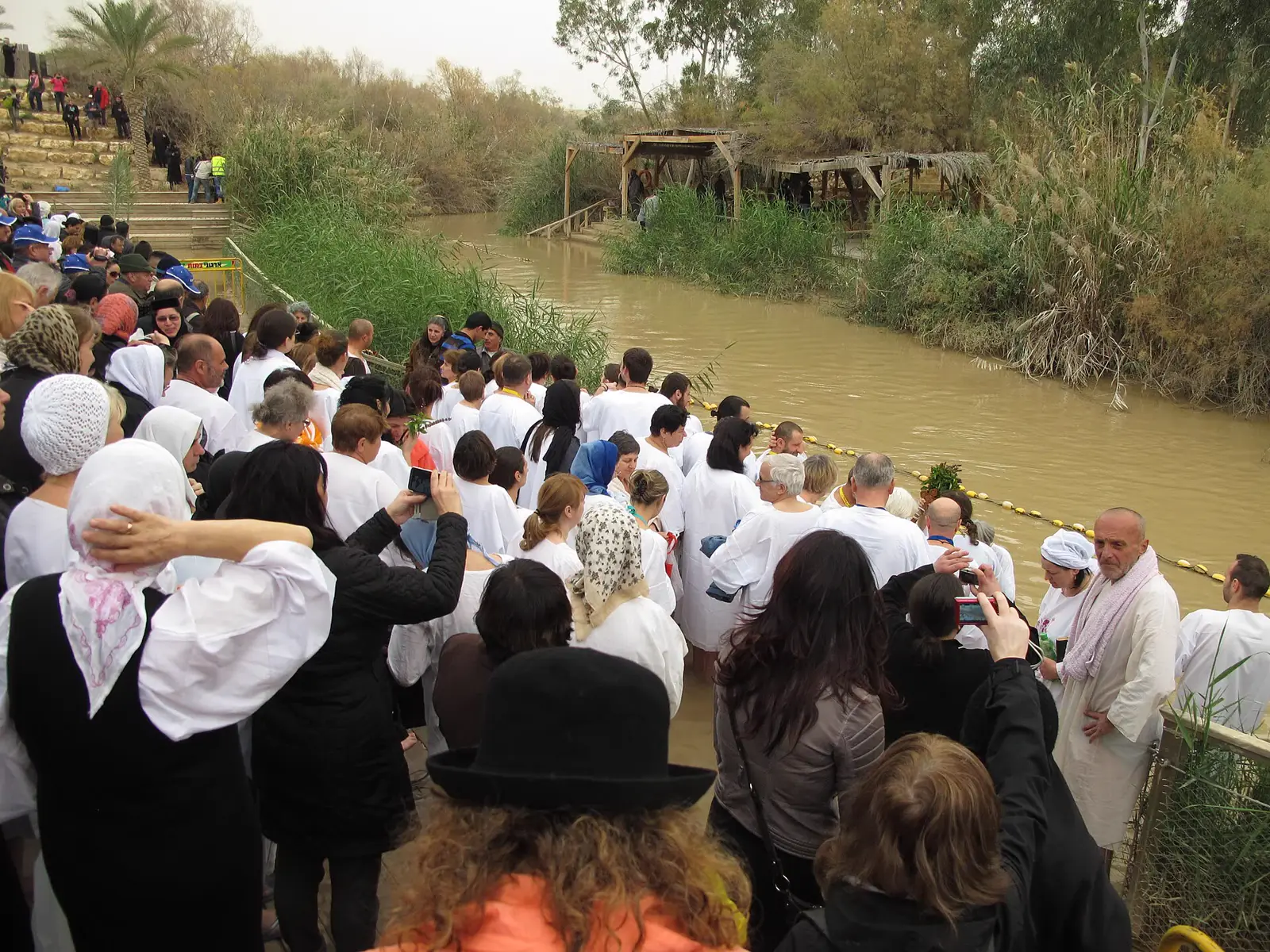
A study of Christian baptism from the King James Bible and the early church: what the word means, what the apostles did, what the first Christians wrote, where churches still differ, and how to prepare for your own.
Abstract
What is baptism, why did Jesus command it, and what does it have to do with being saved? This paper reads every major baptism text in the King James Bible as written, including Acts 2:38, Romans 6:3-4, 1 Peter 3:21 and Mark 16:16, which stands in the 1611. It sets them beside the earliest Christian witnesses outside the New Testament: the Didache, Justin Martyr, Tertullian, the Apostolic Tradition, Origen and the baptismal lectures of fourth-century Jerusalem, together with the archaeology of the oldest known baptistery at Dura-Europos and Everett Ferguson's standard history of the subject. It then reports honestly where churches have divided since: on whether baptism is the moment of forgiveness or its sign, on infants, and on immersion. The conclusion is that baptism is a command of Christ to every believer, joined in Scripture to repentance, faith and the gift of the Holy Ghost, never to be despised and never to be trusted apart from Christ. It is written for new believers preparing to be baptized and for anyone who wants to understand it.
What’s inside
·Introduction
Part 1Part 1: The Word and the World It Came From
Part 2Part 2: Baptism in the New Testament
Part 3Part 3: What Baptism Means
Part 4Part 4: Baptism and Salvation: Reading the Hard Texts Honestly
Part 5Part 5: The Early Church
Part 6Part 6: Later History and the Divisions That Remain
Part 7Part 7: Preparing for Your Baptism
·Conclusion
Research paper · 9 chapters · 28 notes · October 2026
About 46 minutes · 9 parts · the PDF has the same text
Introduction
3 min read
Baptism is the first thing Jesus told His church to do with a new disciple. It is also one of the things Christians have argued about longest. Both facts deserve to be faced honestly, and this paper tries to do that.
When Peter finished the first gospel sermon on the day of Pentecost, the crowd asked what they should do. His answer was not vague: "Repent, and be baptized every one of you in the name of Jesus Christ for the remission of sins, and ye shall receive the gift of the Holy Ghost" (Acts 2:38). That same day "they that gladly received his word were baptized: and the same day there were added unto them about three thousand souls" (Acts 2:41). From the first day, to become a Christian and to be baptized went together.
So if you have recently come to Christ and someone has told you that you should be baptized, they are right. This paper explains why, from the Scriptures and from the history of the people who first obeyed them.
What this paper is
This is a study, not a sales pitch for a denomination. It reads the baptism texts of the King James Bible in full, as they stand, without trimming the ones that are hard for one tradition or another. It gives the history behind them: the Jewish washings, John the Baptist, and what Josephus recorded about him. It quotes the earliest Christian writings outside the New Testament that describe how baptism was done, from their own pages. And it reports where churches have divided since then, and why, without pretending that the divisions do not exist.
Part 4 sets out the King James texts as they are written, all of them, and lets them speak. It also reports, as history, how the main Christian traditions have read them, so that you know what you will meet in the churches near you.
Seven parts follow. Part 1 looks at the word and the world it came from. Part 2 walks through every baptism in the New Testament. Part 3 asks what baptism means. Part 4 takes on the question of baptism and salvation. Part 5 hears the early church. Part 6 traces the later history and the divisions that remain. Part 7 is practical: how to prepare, what happens, and what comes after.
A word about me
I was raised Roman Catholic but never really connected — I went through the motions, fell asleep in the pews, and faked being sick to skip Mass. Eventually I gave up and called myself an atheist. I decided to read the Bible for one reason: to disprove it, so I'd have an excuse to stop going to church for good. It did the opposite. I came to faith in 2022, and my wife came to faith a month later. The rest of the story is at kylelauriano.com/about.
I mention it because many people reading this were, like me, raised around religion without ever knowing the Lord. Some went through rituals as children that meant very little to them. If that is you, this subject may stir up questions. That is good. Bring them to the text.
A note on Scripture: every verse in this paper is quoted from the King James Bible. You can read it free in the 1611 Reader at kylelauriano.com/library. A KJV with Strong's Concordance will let you look up the Greek word behind every "baptize" in the New Testament for yourself.
This part matters because baptism did not drop out of the sky as a strange new rite. When John the Baptist stood in the Jordan, the people who came to him already knew what it meant to wash before God. The word itself, and the world it was spoken in, tell us a good deal about what baptism is.
The Greek word
The English word "baptize" is not really a translation. It is the Greek verb baptizō brought over into English letters. The King James translators kept it, as English Bibles before them had, because by 1611 it was already the church's word for the rite.
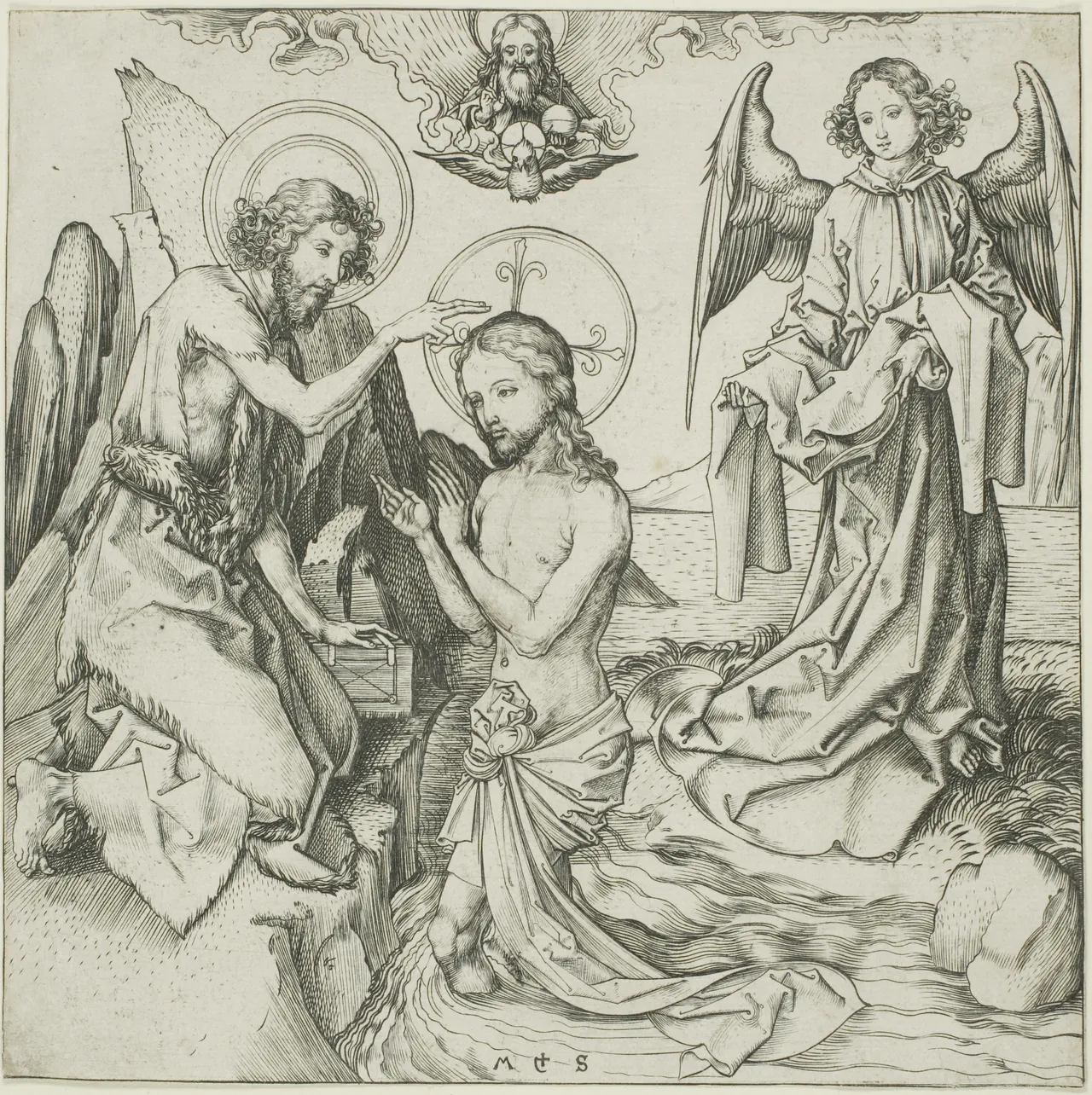
A German engraving of the Baptism of Christ from about 1480 to 1490, showing John baptizing Jesus in the Jordan, the baptism this part explains.The Baptism of Christ · 1480/90 · Art Institute of Chicago · CC0 · museum record · Galeria Regni
James Strong's concordance, which numbers every Greek word in the King James New Testament, lists baptizō as word 907 and defines it as a word meaning "to make whelmed (i.e. fully wet)", used in the New Testament of ceremonial washing and especially of Christian baptism.1 Joseph Thayer's Greek lexicon of 1889 gives its proper meaning as "to dip repeatedly, to immerge, submerge", and notes its use in ordinary Greek of ships that sank.2 Its second sense in Thayer is to cleanse by dipping, to wash.
Two things follow, and honesty requires both.
First, the basic picture in the word is going under. That is why the earliest Christian descriptions of baptism, as we will see in Part 5, describe people going down into water and coming up again.
Second, the word was also used more loosely for washing. The King James renders it "wash" twice. Mark says the Pharisees, "when they come from the market, except they wash, they eat not" (Mark 7:4), and the word there is the verb baptizō; in the same verse "the washing of cups, and pots, brasen vessels, and of tables" uses the related noun. Luke tells us a Pharisee "marvelled that he had not first washed before dinner" (Luke 11:38), and again the word is baptizō. So the lexicons give the word both senses: to dip or submerge, and to wash. Christians who immerse and Christians who pour or sprinkle both read these uses. The descriptions of baptisms in the New Testament itself are set out in Part 2 and again in Part 6, in the words of the King James text.
Washing before God in Israel
Long before John, the Law of Moses taught Israel that coming near to a holy God required cleansing. Priests washed before they served at the altar. A person who had become ceremonially unclean washed in water and was unclean until evening. The Jewish washings the Pharisees practised in Jesus' day, the ones Mark and Luke mention, were an extension of that instinct: before you come to God, or to God's table, you must be clean.
The prophets took the picture further and promised a day when God Himself would do the washing. The letter to the Hebrews draws on that language when it tells believers, "Let us draw near with a true heart in full assurance of faith, having our hearts sprinkled from an evil conscience, and our bodies washed with pure water" (Hebrews 10:22). A Jew in the first century who heard "baptism" would hear the old language of cleansing behind it.
The same letter lists "the doctrine of baptisms" among the first principles of the faith (Hebrews 6:2). The word is plural. Some take it to mean the various Jewish washings as compared with Christian baptism; others take it to mean John's baptism and Christ's, or water baptism and the baptism of the Holy Ghost. Either way, the writer assumed that a new believer would be taught the difference.
John the Baptist
John came preaching in the wilderness of Judea, and his baptism was new in one striking way. The washings of the Law were done by a person to himself, again and again. John baptized other people, once, as a sign of repentance in view of the coming of the Lord. Mark says, "John did baptize in the wilderness, and preach the baptism of repentance for the remission of sins. And there went out unto him all the land of Judaea, and they of Jerusalem, and were all baptized of him in the river of Jordan, confessing their sins" (Mark 1:4-5).
Notice where John baptized: in the Jordan, and later, the Gospel of John says, "in Aenon near to Salim, because there was much water there: and they came, and were baptized" (John 3:23).
John is one of the few New Testament figures described outside the Bible by a near-contemporary. The Jewish historian Josephus, writing in the 90s AD, says that Herod Antipas put John to death and that many Jews believed Herod's later defeat in war was God's judgment for it. He calls John "a good man" who commanded the Jews to practise virtue and righteousness "and so to come to baptism". He then explains John's view of it: the washing would be acceptable to God "not in order to the putting away [or the remission] of some sins [only], but for the purification of the body; supposing still that the soul was thoroughly purified beforehand by righteousness."3
Josephus is describing John from outside, for Roman readers, and the Gospels give John's own words. But the two agree on the main point. John's baptism was not a magic bath. It was tied to a turning of the heart, and the person who came to it was expected to repent first. John said so himself: "I indeed baptize you with water unto repentance: but he that cometh after me is mightier than I, whose shoes I am not worthy to bear: he shall baptize you with the Holy Ghost, and with fire" (Matthew 3:11).
Why Jesus was baptized
Then came the scene that has puzzled readers ever since. "Then cometh Jesus from Galilee to Jordan unto John, to be baptized of him. But John forbad him, saying, I have need to be baptized of thee, and comest thou to me? And Jesus answering said unto him, Suffer it to be so now: for thus it becometh us to fulfil all righteousness. Then he suffered him" (Matthew 3:13-15).
Jesus had no sins to confess. John knew it. So why was He baptized?
The text gives the reason in His own words: "to fulfil all righteousness". He was taking His place with the people He came to save, standing in their water, doing what God required of them. And at that moment the whole Godhead was revealed: "And Jesus, when he was baptized, went up straightway out of the water: and, lo, the heavens were opened unto him, and he saw the Spirit of God descending like a dove, and lighting upon him: And lo a voice from heaven, saying, This is my beloved Son, in whom I am well pleased" (Matthew 3:16-17).
Jesus later used the word "baptism" for His own death. "Can ye drink of the cup that I drink of? and be baptized with the baptism that I am baptized with?" (Mark 10:38). And again: "But I have a baptism to be baptized with; and how am I straitened till it be accomplished!" (Luke 12:50). He spoke of the cross as a going-under. That is the background to everything Paul will say about being "buried with him by baptism into death".
This part matters because the safest way to understand baptism is to watch the apostles do it. The New Testament does not give us a manual of baptism. It gives us a command, a series of real baptisms, and letters that explain what those baptisms meant. If we let the examples speak first, many later arguments shrink to their proper size.
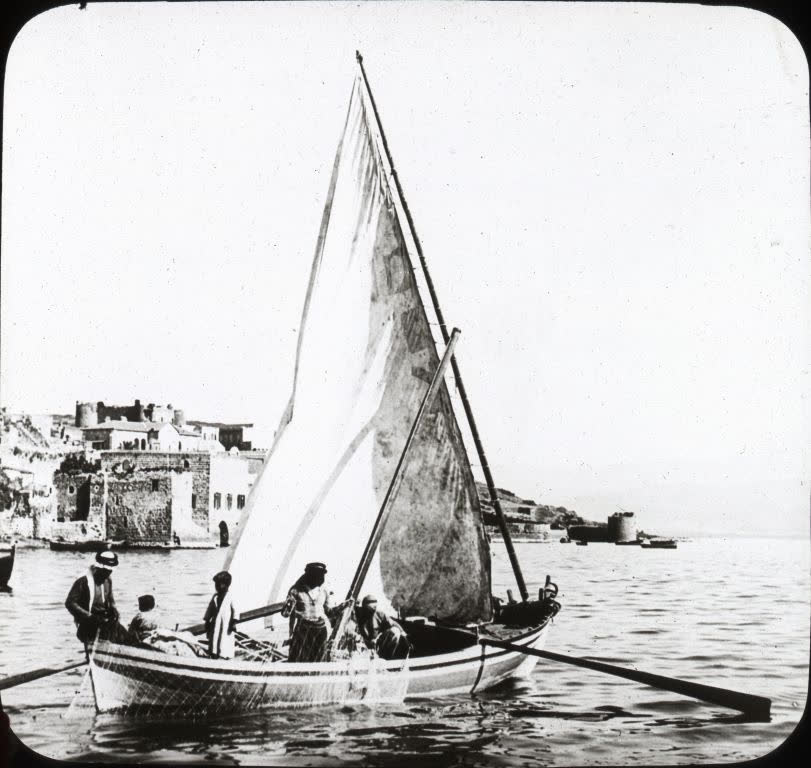
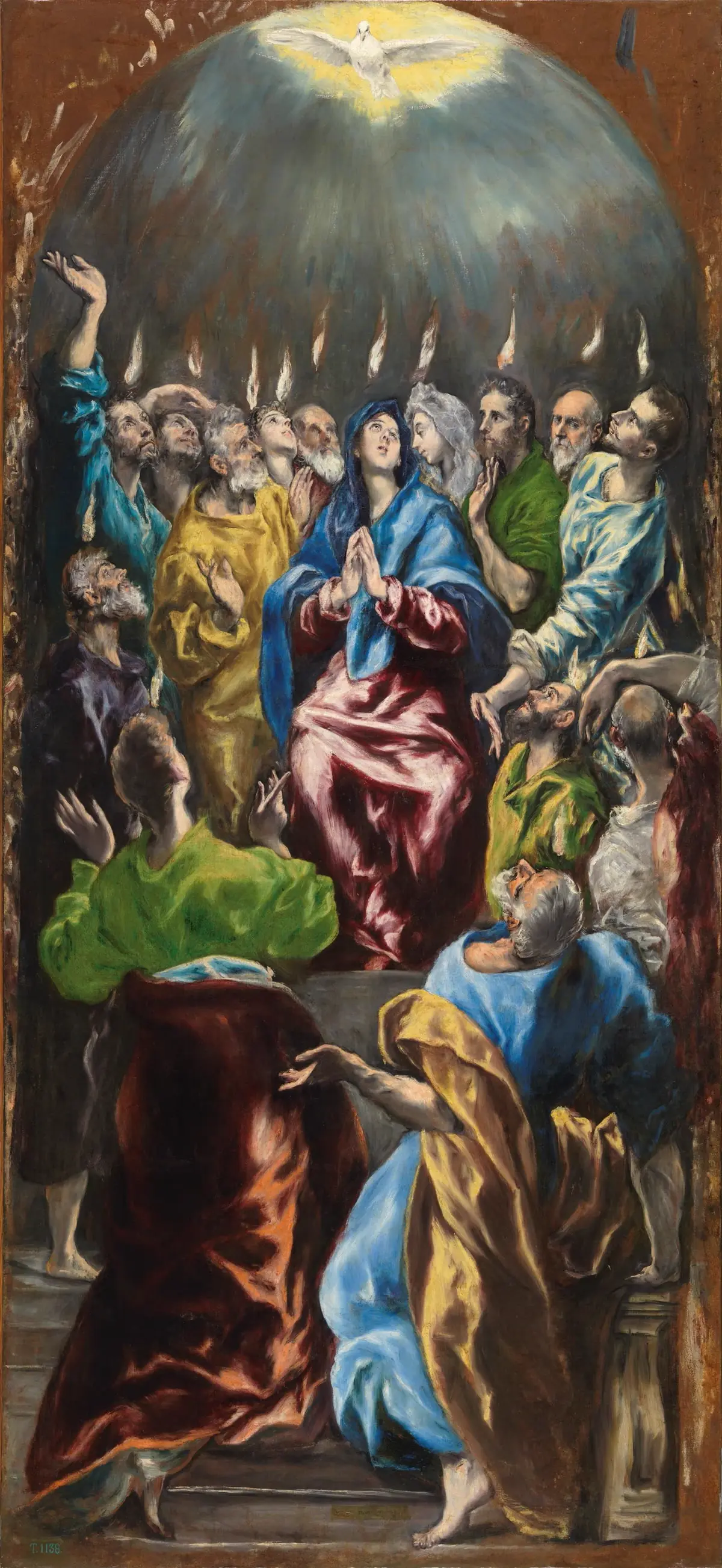
Fishing boats on the Sea of Galilee — the working world of the first disciples, called off these waters into a movement.OSU Special Collections & Archives · Public domainEl Greco’s Pentecost (c. 1600) — the descent of the Spirit that turned a locked upper room into a world movement.El Greco, c. 1600 · Public domain
The command
After His resurrection, Jesus gave His disciples their orders: "All power is given unto me in heaven and in earth. Go ye therefore, and teach all nations, baptizing them in the name of the Father, and of the Son, and of the Holy Ghost: Teaching them to observe all things whatsoever I have commanded you: and, lo, I am with you alway, even unto the end of the world. Amen" (Matthew 28:18-20).
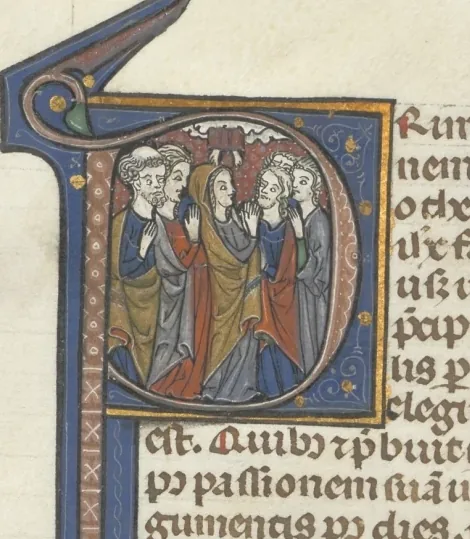
The opening of Acts in a thirteenth-century Bible from southern France, its initial showing the Ascension, the book that records the baptisms of the first believers.Fol. 463r, Acts, historiated initial P, the Ascension · c. 1275–1300 · Cleveland Museum of Art · CC0 · full page · museum record · Galeria Regni
Three things stand out. Baptism is part of making disciples, not an optional extra for keen ones. It is done "in the name of the Father, and of the Son, and of the Holy Ghost", the one name of the one God. And it is to continue "unto the end of the world". There is no generation of Christians for whom this command has expired.
Mark records the commission this way: "And he said unto them, Go ye into all the world, and preach the gospel to every creature. He that believeth and is baptized shall be saved; but he that believeth not shall be damned" (Mark 16:15-16).
A note on this passage. Mark 16:9-20 stands in the 1611 King James Bible, as it stands in the Received Text the translators used. Many modern versions set these verses apart in brackets or with a note saying that some early manuscripts end at verse 8. This paper reads Mark 16 as Scripture. You can see this place and every other place where the 1611 and the modern Critical Text part ways at kylelauriano.com/library/changes.
Read Mark 16:16 carefully. It joins believing and being baptized in the promise, and it names unbelief alone in the warning. It does not say "he that is not baptized shall be damned". Christians of every tradition have noticed that. We will weigh it in Part 4.
The baptisms of Acts
The book of Acts records the apostles carrying out the command. It is worth setting the main accounts side by side.
| Passage | Who | What came before | What is said | |---|---|---|---| | Acts 2:37-41 | About 3,000 at Pentecost | Peter's sermon; they were "pricked in their heart" | "Repent, and be baptized … for the remission of sins"; baptized the same day | | Acts 8:12-17 | Men and women of Samaria | They "believed Philip preaching" | Baptized; received the Holy Ghost later, when Peter and John laid hands on them | | Acts 8:35-39 | An Ethiopian official | Philip "preached unto him Jesus" | Asked to be baptized; "they went down both into the water" | | Acts 9:17-18; 22:16 | Saul of Tarsus | Met the risen Lord on the road; three days blind | "Arise, and be baptized, and wash away thy sins" | | Acts 10:44-48 | Cornelius and his household | Heard Peter; the Holy Ghost fell on them | Then baptized "in the name of the Lord" | | Acts 16:14-15 | Lydia and her household | "The Lord opened" her heart | Baptized, then opened her home | | Acts 16:30-34 | A jailer at Philippi and his house | "Believe on the Lord Jesus Christ" | Baptized "the same hour of the night" | | Acts 18:8 | Crispus and many Corinthians | They heard and believed | Baptized | | Acts 19:1-6 | About twelve disciples at Ephesus | Had only John's baptism | Baptized "in the name of the Lord Jesus"; then the Holy Ghost came on them |
Several patterns are plain.
Baptism followed the hearing of the gospel. In every case, someone preached Christ and the hearers responded. No one in Acts is baptized before the word is spoken to them.
Baptism came quickly. The three thousand were baptized "the same day". The Ethiopian stopped the chariot at the first water. The Philippian jailer was baptized "the same hour of the night". Saul was asked, "And now why tarriest thou?" (Acts 22:16). There is no example in the New Testament of a believer who waited months or years to be baptized.
Baptism was done in water, by someone else, in the name of Jesus. The repeated phrase "in the name of Jesus Christ" or "in the name of the Lord" does not contradict the threefold name of Matthew 28. It tells us whose authority the baptism was done under, and into whom the believer was being baptized.
The Holy Ghost was not tied to one fixed sequence. At Pentecost the promise was "Repent, and be baptized … and ye shall receive the gift of the Holy Ghost". In Samaria, believers were baptized and the Holy Ghost came later through the apostles' hands, "For as yet he was fallen upon none of them: only they were baptized in the name of the Lord Jesus" (Acts 8:16). In Caesarea, the Holy Ghost fell on Cornelius's household before they were baptized, and Peter reasoned from that: "Can any man forbid water, that these should not be baptized, which have received the Holy Ghost as well as we?" (Acts 10:47). At Ephesus, the Spirit came after baptism and the laying on of hands. God is not bound to our flowcharts. But in every case, water baptism and the gift of the Spirit belong together in the same conversion.
The baptism of the Ethiopian is the fullest picture in Acts of what happened at the water. "And as they went on their way, they came unto a certain water: and the eunuch said, See, here is water; what doth hinder me to be baptized? And Philip said, If thou believest with all thine heart, thou mayest. And he answered and said, I believe that Jesus Christ is the Son of God. And he commanded the chariot to stand still: and they went down both into the water, both Philip and the eunuch; and he baptized him. And when they were come up out of the water, the Spirit of the Lord caught away Philip, that the eunuch saw him no more: and he went on his way rejoicing" (Acts 8:36-39).
Verse 37, Philip's condition and the eunuch's confession, stands in the 1611. Many modern versions remove it to the margin. It matters here because it is the clearest statement in Acts of what was asked of someone before baptism: faith "with all thine heart", confessed with the mouth. That pattern of a confession of faith at the water is exactly what the early church went on to practise, as Part 5 will show. See kylelauriano.com/library/changes.
The households
Three times Acts mentions a household being baptized: Lydia's, the jailer's, and (by Paul's own account) "the household of Stephanas" (1 Corinthians 1:16). Christians who baptize infants have long pointed to these households as likely including children. Christians who baptize only believers point out that in the jailer's case Luke says Paul and Silas "spake unto him the word of the Lord, and to all that were in his house" (Acts 16:32), and that afterward the jailer "rejoiced, believing in God with all his house" (Acts 16:34), and that Crispus "believed on the Lord with all his house" (Acts 18:8). The texts do not name any children either way. Both sides are arguing from silence, and both know it.
What the letters say
The epistles were written to people who had already been baptized. So the apostles do not usually tell their readers to be baptized. They tell them what their baptism meant, and call them to live like it.
“Know ye not, that so many of us as were baptized into Jesus Christ were baptized into his death? Therefore we are buried with him by baptism into death: that like as Christ was raised up from the dead by the glory of the Father, even so we also should walk in newness of life. For if we have been planted together in the likeness of his death, we shall be also in the likeness of his resurrection:” (Romans 6:3-5)
“For ye are all the children of God by faith in Christ Jesus. For as many of you as have been baptized into Christ have put on Christ.” (Galatians 3:26-27)
“In whom also ye are circumcised with the circumcision made without hands, in putting off the body of the sins of the flesh by the circumcision of Christ: Buried with him in baptism, wherein also ye are risen with him through the faith of the operation of God, who hath raised him from the dead.” (Colossians 2:11-12)
“For by one Spirit are we all baptized into one body, whether we be Jews or Gentiles, whether we be bond or free; and have been all made to drink into one Spirit.” (1 Corinthians 12:13)
“There is one body, and one Spirit, even as ye are called in one hope of your calling; One Lord, one faith, one baptism, One God and Father of all, who is above all, and through all, and in you all.” (Ephesians 4:4-6)
“The like figure whereunto even baptism doth also now save us (not the putting away of the filth of the flesh, but the answer of a good conscience toward God,) by the resurrection of Jesus Christ:” (1 Peter 3:21)
“Not by works of righteousness which we have done, but according to his mercy he saved us, by the washing of regeneration, and renewing of the Holy Ghost;” (Titus 3:5)
Two more texts belong in the discussion though they do not use the word "baptism" in the same way. Jesus told Nicodemus, "Except a man be born of water and of the Spirit, he cannot enter into the kingdom of God" (John 3:5). Many Christians from the second century on have heard baptism in "water" there; others read "water" as the cleansing work of the Spirit or as natural birth. And Paul, writing to Corinth, says something no one should forget: "I thank God that I baptized none of you, but Crispus and Gaius; Lest any should say that I had baptized in mine own name. … For Christ sent me not to baptize, but to preach the gospel" (1 Corinthians 1:14-17).
That last text does not belittle baptism; Paul did baptize, and Corinth's believers had all been baptized. It does put the preaching of the gospel first. A church can lose the gospel while keeping the water. It cannot keep the gospel while despising the water Christ commanded.
This part matters because a person can go through baptism without knowing what it says. Baptism is not a bath, a club initiation or a lucky charm. It is a picture the Lord Himself designed, and every part of it preaches.
Union with Christ in His death and resurrection
Romans 6 is the centre. Paul's question is whether a Christian may go on in sin because grace abounds, and his answer is to point the Romans back to their baptism. "Know ye not, that so many of us as were baptized into Jesus Christ were baptized into his death?" (Romans 6:3).
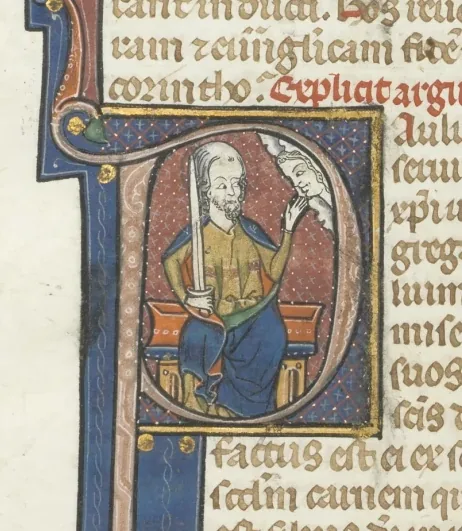
The opening of Romans in a thirteenth-century Bible from southern France, with Paul seated, the letter that ties baptism to union with Christ in Romans 6.Fol. 435v, Romans, historiated initial P, Paul seated with a sword talking to the bust of God above · c. 1275–1300 · Cleveland Museum of Art · CC0 · full page · museum record · Galeria Regni
The phrase "baptized into Jesus Christ" means more than "baptized because of Jesus". It means joined to Him, brought into Him, so that what happened to Him counts as having happened to us. He died; in Him, we died to sin's rule. He was buried; we were "buried with him by baptism into death". He was raised; we rise to "walk in newness of life". Paul concludes: "Knowing this, that our old man is crucified with him, that the body of sin might be destroyed, that henceforth we should not serve sin" (Romans 6:6).
So the apostle ties baptism to the whole story of the gospel: death, burial, resurrection. Colossians says the same thing in the same words: "Buried with him in baptism, wherein also ye are risen with him through the faith of the operation of God" (Colossians 2:12). Notice that last phrase. The rising is "through the faith of the operation of God". The power is God's. The means by which we lay hold of it is faith.
Washing
The second picture is cleansing. Ananias told Saul, "arise, and be baptized, and wash away thy sins, calling on the name of the Lord" (Acts 22:16). Titus speaks of "the washing of regeneration". Paul tells the Ephesians that Christ gave Himself for the church "That he might sanctify and cleanse it with the washing of water by the word" (Ephesians 5:26). Hebrews speaks of "our bodies washed with pure water".
Peter adds a guard rail: baptism saves "not the putting away of the filth of the flesh, but the answer of a good conscience toward God". The water does not scrub the soul the way soap scrubs skin. What baptism points to is the washing Christ's blood accomplishes, received by a conscience that has turned to God. Every Christian tradition, whatever else it teaches about baptism, agrees that the cleansing comes from Christ and not from the chemistry of water.
Putting on Christ
Galatians gives a third picture: clothing. "For as many of you as have been baptized into Christ have put on Christ" (Galatians 3:27). In the ancient world your clothes announced who you were: your rank, your household, your city. Paul says the baptized are clothed in Christ, and the next verse draws the consequence: "There is neither Jew nor Greek, there is neither bond nor free, there is neither male nor female: for ye are all one in Christ Jesus" (Galatians 3:28). The first Christians acted this picture out. As Part 5 will show, candidates in fourth-century Jerusalem took off their old garment before going into the water and were dressed in white when they came out.
Joining the body
Baptism is never a private event in the New Testament. "For by one Spirit are we all baptized into one body" (1 Corinthians 12:13). At Pentecost the baptized were "added unto them" (Acts 2:41), and the next verse tells us what that meant in practice: "And they continued stedfastly in the apostles' doctrine and fellowship, and in breaking of bread, and in prayers" (Acts 2:42). To be baptized is to be enrolled, publicly, in the people of God. That is why baptism is normally done in and by a church, and why it is followed by the Lord's Supper and a life of fellowship.
Confession before men
Finally, baptism is a public confession. Jesus said, "Whosoever therefore shall confess me before men, him will I confess also before my Father which is in heaven" (Matthew 10:32). Paul joins faith in the heart and confession with the mouth: "For with the heart man believeth unto righteousness; and with the mouth confession is made unto salvation" (Romans 10:10). In the first centuries, the confession was made at the water itself. In many places today it still is.
For a Jew in the first century, or a Muslim, Hindu or secular person in many countries today, baptism is the moment the cost becomes real. Families who will tolerate private interest in Jesus often draw the line at baptism, because baptism says out loud: I belong to Him now. That is exactly what it was designed to say.
Part 4 — Baptism and Salvation: Reading the Hard Texts Honestly
6 min read
This part matters because it is the question every new believer eventually asks: "If I died before I was baptized, would I be lost?" And it matters because Christians have given different answers for a very long time. A paper that pretends otherwise is not being honest with you.
The texts as written
Here are the texts that join baptism to salvation most closely, quoted in full.
“Repent, and be baptized every one of you in the name of Jesus Christ for the remission of sins, and ye shall receive the gift of the Holy Ghost.” (Acts 2:38)
“He that believeth and is baptized shall be saved; but he that believeth not shall be damned.” (Mark 16:16)
“And now why tarriest thou? arise, and be baptized, and wash away thy sins, calling on the name of the Lord.” (Acts 22:16)
“The like figure whereunto even baptism doth also now save us (not the putting away of the filth of the flesh, but the answer of a good conscience toward God,) by the resurrection of Jesus Christ:” (1 Peter 3:21)
“Except a man be born of water and of the Spirit, he cannot enter into the kingdom of God.” (John 3:5)
These words should not be softened. Peter did say "for the remission of sins". Ananias did say "wash away thy sins". Peter did write that baptism "doth also now save us". Any account of baptism that cannot read these sentences aloud without embarrassment has gone wrong somewhere.
And here are the texts that put faith at the centre and speak of salvation without mentioning baptism at all.
“For by grace are ye saved through faith; and that not of yourselves: it is the gift of God: Not of works, lest any man should boast.” (Ephesians 2:8-9)
“That if thou shalt confess with thy mouth the Lord Jesus, and shalt believe in thine heart that God hath raised him from the dead, thou shalt be saved.” (Romans 10:9)
“And Jesus said unto him, Verily I say unto thee, To day shalt thou be with me in paradise.” (Luke 23:43)
Add to these the household of Cornelius, who received the Holy Ghost before they were baptized (Acts 10:44-47), and Paul's words that "Christ sent me not to baptize, but to preach the gospel" (1 Corinthians 1:17).
Both sets of texts are the word of God. The task is not to choose one set and mute the other. It is to hold them together.
How the churches have read them
Broadly, there are three ways Christians have done that. Each is held by serious believers who love the Bible.
Baptism as the means through which God gives forgiveness
The Roman Catholic and Eastern Orthodox churches, and the Lutheran churches, teach that God actually gives forgiveness and new birth through baptism. The Catechism of the Catholic Church states, "The Lord himself affirms that Baptism is necessary for salvation."4 Martin Luther's Small Catechism of 1529, still taught in Lutheran churches, answers the question of what baptism gives this way: "It works forgiveness of sins, rescues from death and the devil, and gives eternal salvation to all who believe this, as the words and promises of God declare." Asked how water can do such things, it answers: "Certainly not just water, but the word of God in and with the water does these things, along with the faith which trusts this word of God in the water."5
Notice that Luther insists on faith, and that the Catholic catechism, in the paragraphs that follow, speaks of those who die for Christ before baptism or who desire it but cannot receive it. Even the traditions that bind salvation most closely to baptism do not say that God is helpless where water is lacking.
Baptism as a sign and seal of the covenant
The Reformed and Presbyterian churches teach that baptism is a sign and seal of God's covenant of grace, joined to the reality it signifies but not identical with it. The Westminster Confession of Faith, finished in 1646, says baptism is "a sign and seal of the covenant of grace". It also says, "Although it be a great sin to contemn or neglect this ordinance, yet grace and salvation are not so inseparably annexed unto it, as that no person can be regenerated, or saved, without it; or, that all that are baptized are undoubtedly regenerated."6
That sentence has two edges. It denies that the unbaptized believer is necessarily lost. And it denies that everyone who has been baptized is necessarily born again.
Baptism as an ordinance of obedience following faith
Baptist churches, and many other evangelical churches, teach that baptism is an ordinance of Christ to be received by those who have already repented and believed, as their public confession of union with Him. The Second London Baptist Confession of 1689 says, "Those who do actually profess repentance towards God, faith in, and obedience to, our Lord Jesus Christ, are the only proper subjects of this ordinance."7 On this view "for the remission of sins" in Acts 2:38 describes what baptism signifies and is tied to, the forgiveness that faith receives, rather than the moment at which God grants it.
There are other positions too. Some churches outside these three families teach that baptism is the point at which a penitent believer's sins are forgiven, while denying that it works on infants or without faith. You will meet all of these in the churches near you.
What they all agree on
It is easy to see only the disagreement. It is more useful to see how much is shared. Across these traditions, Christians who read the Bible seriously agree on the following.
1. Christ commanded baptism, for every disciple, until the end of the world (Matthew 28:19-20). 2. No one may treat it as optional. The Westminster Confession calls it "a great sin to contemn or neglect this ordinance". No Baptist, Lutheran or Catholic disagrees. 3. Baptism belongs to the beginning of the Christian life, not to some later stage of maturity (Acts 2:41; 8:36-38; 16:33). 4. The power is God's, not the water's. Peter: "not the putting away of the filth of the flesh". Luther: "Certainly not just water". Paul: "through the faith of the operation of God". 5. Faith is required. Even churches that baptize infants teach that baptism must be received in faith, and that a baptized person who never believes is not saved by the ritual. 6. Baptism without repentance is empty. "Repent, and be baptized" comes in that order. 7. There is one baptism (Ephesians 4:5). It is not repeated as a ritual for renewal.
Letting the texts speak
The church has debated this question for centuries. The course this paper takes is to say only what the texts say, and to say all of it.
The texts say that Peter told the crowd, "Repent, and be baptized every one of you in the name of Jesus Christ for the remission of sins" (Acts 2:38). They say that "they that gladly received his word were baptized" the same day (Acts 2:41). They say that Ananias told Saul to "arise, and be baptized, and wash away thy sins" (Acts 22:16), and that Peter wrote, "baptism doth also now save us" (1 Peter 3:21). The New Testament records no believer who refused baptism; in Acts, those who believed were baptized, usually that day. To say baptism is "not part of the response" is to contradict Peter.
The texts also say that Jesus told the dying thief, "To day shalt thou be with me in paradise" (Luke 23:43). They say that the Holy Ghost fell on Cornelius's household before they were baptized (Acts 10:44-47). They say, "He that believeth and is baptized shall be saved; but he that believeth not shall be damned" (Mark 16:16), and they say, "For by grace are ye saved through faith; and that not of yourselves: it is the gift of God: Not of works, lest any man should boast" (Ephesians 2:8-9).
All of these are the word of God, and none of them is to be muted to make another easier to hold. Read them together, slowly, with your Bible open. And hear the plain command they share:
If you have repented and believed the gospel, be baptized, and do not delay. "And now why tarriest thou?" (Acts 22:16). Do not trust in the water instead of Christ, for Peter says baptism saves "not the putting away of the filth of the flesh, but the answer of a good conscience toward God" (1 Peter 3:21). Do not despise the water Christ commanded. Come to it the way the three thousand did, gladly, as an obedient believer who has heard the word and wants to belong to Him openly.
This part matters because the first generations after the apostles show us how people who were close to the apostles understood baptism. Their writings are not Scripture, and where they differ from Scripture, Scripture wins. But they are honest witnesses to what churches actually did. Some of what they did will surprise you.
The Garden Tomb in Jerusalem — a rock-cut burial place of the very kind the Gospels describe, its stone bench still empty.Gary Todd · CC0
The Didache
The Didache, or "Teaching of the Twelve Apostles", is a short church manual most scholars date to the late first or early second century. It was lost for centuries and rediscovered in a manuscript published in 1883. Its seventh chapter is the oldest set of instructions for baptism outside the New Testament.
"And concerning baptism, baptize this way: Having first said all these things, baptize into the name of the Father, and of the Son, and of the Holy Spirit, in living water. But if you have not living water, baptize into other water; and if you can not in cold, in warm. But if you have not either, pour out water thrice upon the head into the name of Father and Son and Holy Spirit. But before the baptism let the baptizer fast, and the baptized, and whatever others can; but you shall order the baptized to fast one or two days before."8
Several things are worth noticing.
"Having first said all these things" refers to the first six chapters, which teach the "two ways", the way of life and the way of death: the moral teaching of Jesus, the commandments, and warnings against sin. Instruction came before baptism.
"Living water" means running water: a river or a spring. That was the preferred water, as the Jordan was for John. Other water would do. Pouring was allowed only when neither was available. That is a ranked order: the normal practice was to baptize into water, and pouring was the exception for necessity.
The baptizer, the candidate and others fasted beforehand. Baptism was treated as a solemn event for the whole church, not a casual dip.
And in chapter 9 the Didache adds: "But let no one eat or drink of your Thanksgiving (Eucharist), but they who have been baptized into the name of the Lord".9 Baptism came first; the Lord's table came after.
Justin Martyr
Justin was a philosopher who came to Christ and taught in Rome until he was executed around AD 165. In his First Apology, addressed to the emperor about AD 155, he explained to outsiders what Christians actually did. His account of baptism is the earliest description written for pagans.
"As many as are persuaded and believe that what we teach and say is true, and undertake to be able to live accordingly, are instructed to pray and to entreat God with fasting, for the remission of their sins that are past, we praying and fasting with them. Then they are brought by us where there is water, and are regenerated in the same manner in which we were ourselves regenerated."10
Justin goes on to say that they then receive "the washing with water" in the name of the Father, of Jesus Christ, and of the Holy Spirit, and he quotes Jesus' words to Nicodemus. He adds, "And this washing is called illumination, because they who learn these things are illuminated in their understandings."11
Notice the order again. First persuasion and belief. Then a commitment to live accordingly. Then prayer and fasting, with the church joining in. Then the water. Justin clearly believed something real happened in baptism; he calls it being "regenerated". He also clearly expected that only those who believed and were willing to live as Christians would be brought to it.
Tertullian
Tertullian of Carthage, writing around AD 200, wrote the first whole treatise on baptism that survives, On Baptism. He marvels that God works through something so plain: a man "is dipped in water", he says, and the rite is performed "with so great simplicity, without pomp, without any considerable novelty of preparation".12
He is also the first writer we have who mentions the baptism of little children, and he mentions it to argue against it. He counsels that, depending on each person's circumstances, disposition and age, "the delay of baptism is preferable; principally, however, in the case of little children." He asks, "Why does the innocent period of life hasten to the remission of sins?" and urges, "Let them come, then, while they are growing up".13
This passage cuts in two directions, and both should be stated. It shows that by about AD 200, at least some churches in North Africa were baptizing young children, or Tertullian would not have needed to argue the point. And it shows that a leading teacher of that church thought the practice unwise and wanted baptism to wait until children could understand and confess for themselves. Tertullian also counselled delay for unmarried adults, which few churches since have followed.
The Apostolic Tradition
A church order known as the Apostolic Tradition was long attributed to Hippolytus of Rome, who died in 235. Scholars now dispute both the author and the date; some think it preserves early Roman practice, while others think it was compiled in stages and reached its present form in the fourth century.14 Its account of baptism describes a long period of instruction for candidates, a night of preparation, and a baptism in which the candidate, standing in the water, is asked three times whether he believes, in the Father, in the Son and in the Holy Spirit, and after each confession is immersed. It instructs that children are to be baptized first, with parents or relatives answering for those who cannot speak for themselves.
Because its date is uncertain, the Apostolic Tradition cannot prove what was done in any particular decade. It is still a valuable picture of baptism as a public confession of the Trinity, made in the water, by a person who has been taught.
Origen
Origen of Alexandria, the great scholar of the third century, wrote in his commentary on Romans that the church had received from the apostles a tradition of giving baptism even to little children, because of the stain of sin with which all are born.15 That commentary survives only in a Latin translation made by Rufinus about 150 years later, who is known to have adjusted what he translated, so the exact wording is Rufinus's. Still, it is clear that by Origen's time, the first half of the 200s, infant baptism was practised in some major churches and defended as apostolic.
The baptistery at Dura-Europos
In the 1930s archaeologists working at Dura-Europos, a Roman garrison town on the Euphrates in what is now eastern Syria, uncovered a house that had been adapted for Christian use; its wall paintings came to light in 1932. One small room had been turned into a baptistery, with a font under a columned vault, large enough to hold a person, and walls painted with scenes from Scripture: the Good Shepherd above the font, with a small Adam and Eve beside it, the women coming to the tomb, Christ walking on the water, the healing of the paralytic, and the Samaritan woman at the well. The house was converted for the church around AD 240; the city was besieged by the Persians in 256, and an earthen embankment heaped against its western wall for the siege preserved the paintings, which were later moved to Yale.16 They were painted decades before Constantine recognized Christianity in 312. Even there, the room set aside for baptism was decorated with pictures of death, resurrection and rescue through water.
Jerusalem in the fourth century
By the fourth century we have detailed descriptions. A series of lectures given to the newly baptized in Jerusalem, attributed to Cyril, its bishop from about 350, reminds them of what they did on the night of their baptism. "As soon, then, as you entered, you put off your tunic; and this was an image of putting off the old man with his deeds." Then: "And each of you was asked, whether he believed in the name of the Father, and of the Son, and of the Holy Ghost, and you made that saving confession, and descended three times into the water, and ascended again".17
The candidates had acted out Galatians 3:27 and Romans 6:4 with their bodies: off with the old garment, down into the water, up again, and into new white clothes.
What the historians conclude
The most thorough study of the subject in English is Everett Ferguson's Baptism in the Early Church, a work of nearly a thousand pages published in 2009. On how baptism was done, his conclusion is that Christian writings, ordinary Greek usage and Jewish immersions together give "overwhelming support for full immersion as the normal action", with exceptions made "in cases of a lack of water and especially of sickbed baptism".18 On infants, he writes that "there is no firm evidence for infant baptism before the latter part of the second century", and he argues that the practice most likely grew out of emergency baptism of dying children, became generally accepted, and became the usual practice in the fifth and sixth centuries.19
Not every historian agrees with every part of that. Some who study the surviving fonts argue that many were too shallow for a person to be laid under the water, and that in many places water was poured over a candidate standing in the font.20 Others defend infant baptism as older than Ferguson allows, pointing to Origen. These are real scholarly debates, and you should know they exist.
What the earliest written descriptions themselves show is this. The candidate the Didache, Justin and the Jerusalem lectures describe is a person who had been taught, who confessed faith in the Father, the Son and the Holy Ghost, who had prayed and fasted with the church, and who then went into water.
Part 6 — Later History and the Divisions That Remain
5 min read
This part matters because the church you visit next Sunday stands somewhere in this history, whether it knows it or not. Knowing how the divisions arose will help you understand why a pastor answers your questions the way he does, and why sincere believers can read the same Bible and practise baptism differently.
Infant baptism becomes the norm
After the fourth century, as whole populations in the Roman world came into the church, the typical candidate changed. Augustine of Hippo, in his controversy with Pelagius in the early 400s, argued that infants needed baptism because they inherited Adam's sin, and his influence in the Western church was enormous.21 Ferguson's judgment, quoted above, is that infant baptism became the usual practice in the fifth and sixth centuries. In the West, pouring and sprinkling later came to be widely used, while the Eastern Orthodox churches immerse to this day, infants included.
The Reformation
The Reformers of the sixteenth century did not, for the most part, change who was baptized. Luther, Zwingli and Calvin all continued to baptize infants, and defended it from the covenant God made with Abraham and his children. What they changed was the understanding of how baptism relates to faith, as the statements from Luther's Small Catechism and the Westminster Confession in Part 4 show.
A group of Zwingli's own students in Zürich went further. They became convinced from Scripture that baptism belonged to those who had repented and believed. On 21 January 1525, meeting in the home of Felix Manz, George Blaurock asked Conrad Grebel to baptize him on confession of his faith, and then baptized the others present.22 Their opponents called them Anabaptists, "rebaptizers". They did not think they were baptizing anyone again; they believed their baptism as infants had not been baptism at all. The Zürich council soon made adult baptism a crime, and many of these believers were imprisoned, exiled or put to death, by Catholic and Protestant authorities alike. In 1527, the Swiss Brethren agreed on the Schleitheim articles, the first of which taught that baptism is to be given to those who have learned repentance and amendment of life and who truly believe their sins are taken away by Christ, and rejected infant baptism.23
In the next century, English Separatists who came to the same conviction formed the first Baptist churches, and by the 1640s some of them were insisting that immersion was the only proper mode. The 1689 London Baptist Confession states, "Immersion, or dipping of the person in water, is necessary to the due administration of this ordinance."24 The Westminster Confession, written by Presbyterians in the same country a generation earlier, had said the opposite: "Dipping of the person into the water is not necessary; but baptism is rightly administered by pouring, or sprinkling water upon the person."25 It also stated that "the infants of one, or both, believing parents, are to be baptized".
Those two confessions, written in the same century and the same country by men who shared most of their theology, show where the lines still fall today.
A famous baptism
Charles Spurgeon, the most widely read preacher of the nineteenth century, had been baptized as an infant by his grandfather, a Dissenter.26 He came to Christ as a fifteen-year-old on 6 January 1850, when a snowstorm drove him into a small Primitive Methodist chapel on Artillery Street in Colchester. The minister had not come that morning, "snowed up, I suppose," Spurgeon later wrote; a layman went up into the pulpit and took as his text Isaiah 45:22, "Look unto me, and be ye saved, all the ends of the earth." Spurgeon remembered the man pointing at him and saying, "Young man, you look very miserable," and calling him to look to Christ. He looked, and later wrote that he "could have risen that moment and sung with the most enthusiastic of them".27 Four months later, on 3 May 1850, he was baptized as a believer by immersion in the River Lark at Isleham.28
That is the order of his own story, as he told it: first he looked to Christ, in a chapel; then he went to the water.
Where churches differ today
So you know what to expect, here are the main questions on which churches differ, and the reasons each side gives.
| Question | One answer | Another answer | |---|---|---| | Who should be baptized? | Believers who confess faith, and also the infants of believers (Catholic, Orthodox, Lutheran, Anglican, Presbyterian, Methodist) | Only those who personally repent and believe (Baptist, Anabaptist, Pentecostal and most independent churches) | | How? | Immersion only (Baptist confessions; Orthodox churches, which immerse infants too) | Immersion, pouring or sprinkling are all valid (Westminster; Catholic; most paedobaptist churches) | | What does it do? | God gives forgiveness and new birth through it (Catholic, Orthodox, Lutheran) | It is a sign and seal of grace received by faith (Reformed), or a believer's ordinance of obedience and confession (Baptist) |
What the texts themselves say
Those are the positions. Here are the King James texts that every side reads, set out plainly, so that you can weigh them yourself.
On who was baptized:
“But when they believed Philip preaching the things concerning the kingdom of God, and the name of Jesus Christ, they were baptized, both men and women.” (Acts 8:12)
“And Philip said, If thou believest with all thine heart, thou mayest. And he answered and said, I believe that Jesus Christ is the Son of God.” (Acts 8:37)
“For the promise is unto you, and to your children, and to all that are afar off, even as many as the LORD our God shall call.” (Acts 2:39)
“And when she was baptized, and her household, she besought us, saying, If ye have judged me to be faithful to the Lord, come into my house, and abide there. And she constrained us.” (Acts 16:15)
“And he took them the same hour of the night, and washed their stripes; and was baptized, he and all his, straightway.” (Acts 16:33)
On how it was done:
“And Jesus, when he was baptized, went up straightway out of the water: and, lo, the heavens were opened unto him, and he saw the Spirit of God descending like a dove, and lighting upon him:” (Matthew 3:16)
“And John also was baptizing in Aenon near to Salim, because there was much water there: and they came, and were baptized.” (John 3:23)
“And he commanded the chariot to stand still: and they went down both into the water, both Philip and the eunuch; and he baptized him.” (Acts 8:38)
“Therefore we are buried with him by baptism into death: that like as Christ was raised up from the dead by the glory of the Father, even so we also should walk in newness of life.” (Romans 6:4)
And the texts, already quoted in Part 1, where the same Greek word is rendered "wash" (Mark 7:4; Luke 11:38).
Read them for yourself, in the 1611 Reader or a KJV with Strong's Concordance, and talk to the pastor of the church you are joining about what it practises and why.
This part matters because you are not reading about baptism as a spectator. If you have trusted Christ and have not been baptized, the question in front of you is Ananias's: "And now why tarriest thou?" What follows is practical.
Talk to a pastor
Baptism in the New Testament is done by the church, not as a private ceremony between friends. Find a Bible-believing church and tell the pastor or an elder that you have trusted Christ and want to be baptized. Most churches will want to hear your story, make sure you understand the gospel, and talk through what baptism means. Some have a short class. That is not a hurdle; it is the old pattern of the Didache and Justin, where teaching came first.
Ask what the church believes about baptism and why. A good pastor will be glad you asked and will show you from Scripture.
Questions to settle in your own heart
Before you go into the water, settle these with God, in prayer, with your Bible open.
Have I repented? Not "have I become perfect", but have I turned from my sin to God, and do I want to be done with it? "Repent, and be baptized" (Acts 2:38).
Do I believe the gospel? That Jesus Christ is the Son of God, that He died for my sins and rose again, and that He alone can save me. "If thou believest with all thine heart, thou mayest" (Acts 8:37).
Am I ready to confess Him publicly? Baptism is a confession before men. Some of the people watching may not be pleased.
Do I intend to follow Him in the fellowship of His church? The baptized at Pentecost "continued stedfastly in the apostles' doctrine and fellowship, and in breaking of bread, and in prayers" (Acts 2:42).
If you can answer yes, the New Testament's answer to "what doth hinder me to be baptized?" is: nothing.
Common hesitations
"I need to get my life together first." No one in Acts did. The jailer was baptized hours after he had drawn a sword to kill himself (Acts 16:27, 33). Baptism is for sinners who have turned to Christ, not for people who have finished growing.
"I still struggle with sin." So does every baptized Christian. Romans 6 was written to baptized believers precisely because they still needed to be told, "Let not sin therefore reign in your mortal body" (Romans 6:12).
"I'm afraid of standing up in front of people." That fear is real, and it is part of why baptism matters. You are not performing; you are confessing. Tell the pastor. Most churches will help you say only a sentence or two, or simply answer questions.
"My family will be upset." For some readers this is the hardest one, and it should not be brushed aside. Jesus warned that following Him could divide households (Matthew 10:34-36). Talk to your pastor, pray, and be gentle and honest with your family. But do not let anyone, however much you love them, keep you from obeying Christ.
"I don't feel anything." Baptism is obedience, not a feeling. Some people weep; some feel very little. Neither tells you anything about whether God has received you.
If you were baptized as a baby
Many readers were baptized as infants, as Catholics, Lutherans, Presbyterians, Methodists or Anglicans, and have since come to a living faith in Christ. Should they be baptized now?
Here the churches genuinely differ, and you should know that before anyone gives you a quick answer. Churches that baptize infants hold that your infant baptism was a true baptism, that it is not to be repeated, and that what you need now is to own, by faith, the promises signified in it. Churches that baptize only believers hold that a baptism received without repentance and faith was not the baptism the New Testament describes, and they will ask you to be baptized as a believer. Both appeal to "one baptism" (Ephesians 4:5).
Pray about it, read the texts in this paper, and talk to the pastor of the church you are joining. Whatever you decide, do not decide it by what is easiest. Decide it by what you are persuaded the word of God requires.
If you were baptized before you truly believed
Some readers were baptized as teenagers or adults, perhaps at a camp or under family pressure, and now believe they were not converted then. This is a hard and personal question. Some pastors will counsel baptism now, as a true believer's baptism; others will counsel that God has honoured the earlier act and that what is needed is repentance and faith, not more water. Talk it through with your pastor honestly. Do not let it become a source of endless anxiety; the remedy for doubt about your conversion is looking to Christ, not repeating rituals.
One guest on our show has spoken to this directly.
Criselle Mendoza told her story on The King Is Coming Show (TKIC #51): baptized at twelve in Iglesia Ni Cristo, and, in her own telling, not saved until 2025. Watch it in her own words: youtube.com/watch?v=_7vjNP6A_z8 Criselle's account of what happened to her, shared as her testimony — weigh it for yourself.
Her story, in her telling, is a reminder of something every tradition admits: a person can pass through water without passing from death to life. Baptism points to the new birth. It does not replace it.
Writing a short testimony
Many churches invite the person being baptized to say a few words, or to answer a few questions, before going into the water. If yours does, prepare. A simple shape works:
1. Before: in two or three sentences, what your life was like without Christ. Be honest but not graphic; the point is the Saviour, not the sin. 2. How: how you heard the gospel and came to trust Christ. Name what you understood: that you were a sinner, that Christ died and rose, that you turned to Him. 3. Now: why you are being baptized today. A single sentence will do: "I am being baptized because Jesus Christ is my Lord, and He commanded it."
Write it down. Read it aloud a few times. Keep it to a minute or two. Do not borrow anyone else's story, and do not dress yours up. The plain truth of what God did is enough.
What happens on the day
Practices vary, but in a church that immerses, you can expect something like this. You will change into clothes that can get wet, often a robe the church provides, with dark clothing underneath. You will step into the baptistery, pool or river with the pastor. He may ask you to confess your faith, often with a question such as, "Do you believe that Jesus Christ is the Son of God, and have you trusted Him as your Lord and Saviour?" He will then baptize you "in the name of the Father, and of the Son, and of the Holy Ghost". He will lower you back under the water, usually holding your back and your crossed hands, and bring you straight up again. It takes a few seconds.
Some practical points:
If you are afraid of water, say so beforehand. Pastors have done this many times and can reassure you.
Hold your nose or breathe out gently as you go under.
Bring a towel and dry clothes, and a bag for the wet ones.
Invite people. Family, friends, the person who first told you about Christ. A baptism is a confession; let people hear it.
If you are being baptized outdoors, the church should check the water's depth, current and temperature. Leave that to them, but it is fine to ask.
In churches that pour or sprinkle, the confession and the words are the same; only the action with the water differs.
After the water
Baptism is a beginning. The New Testament pattern is that the baptized go on into the life of the church.
The Lord's Supper. From the Didache on, the church has kept the Lord's table for the baptized. Ask your church when it observes the Supper, and come to it, examining yourself as Paul says (1 Corinthians 11:28).
Fellowship. Join the church, not just its Sunday service. Find people who will know you, pray for you and tell you the truth.
Remember your baptism. Paul's whole argument in Romans 6 is that baptized believers should remember what their baptism meant. When temptation comes, you can say what he taught the Romans to say: I was buried with Christ; I am risen with Him; sin shall not have dominion over me. That is not a magic formula. It is a believer reminding himself of the gospel.
Expect testing. Jesus Himself went from His baptism into the wilderness to be tempted. Many believers find that the weeks after baptism are hard. That is not a sign that something went wrong. It is the ordinary experience of a disciple in a fallen world. Stay close to the word, to prayer and to your church.
Baptism is simple enough that a jailer could receive it at midnight and an Ethiopian at a roadside pool. It is deep enough that Christians have studied it for two thousand years. Both are true.
From the Scriptures we have seen that Christ commanded it for every disciple until the end of the world; that the apostles baptized new believers at once, in water, in His name; that baptism pictures union with Christ in His death, burial and resurrection, the washing away of sins, the putting on of Christ and entrance into His body; and that the apostles joined it closely to repentance, faith, forgiveness and the gift of the Holy Ghost, while God showed in the thief and in Cornelius that He is not bound by water.
From the early church we have seen that those who came soon after the apostles taught candidates first, prayed and fasted with them, heard their confession of the Father, Son and Holy Ghost, and baptized them in water, pouring only where water was lacking. We have seen the first mentions of infant baptism and the first objection to it, and we have seen where the later divisions came from.
Where churches differ, this paper has told you so. Where the Scriptures speak plainly, it has tried to let them speak.
An invitation
If you have not yet trusted Christ, baptism is not your first step. Christ is. "Repent ye, and believe the gospel" (Mark 1:15). Come to Him as you are. He receives sinners.
If you have trusted Him and have not been baptized, hear the question Ananias asked Saul, and answer it this week: "And now why tarriest thou? arise, and be baptized, and wash away thy sins, calling on the name of the Lord" (Acts 22:16). Find a faithful church, talk to the pastor, and go down into the water gladly.
And if you were baptized long ago, remember it. You were buried with Christ. You are risen with Him. Walk in newness of life.
For more free study, the 1611 Reader is at kylelauriano.com/library, and the full story of how I came to faith is at kylelauriano.com/about. Free truth, no pressure.
1James Strong, The Exhaustive Concordance of the Bible (New York: Hunt & Eaton, 1890), Greek Dictionary, no. 907. Online with Thayer's entry: https://www.blueletterbible.org/lexicon/g907/kjv/tr/0-1/.↩
2Joseph Henry Thayer, A Greek-English Lexicon of the New Testament (New York: American Book Company, 1889), s.v. βαπτίζω.↩
3Josephus, Antiquities of the Jews 18.5.2 (18.116–119), trans. William Whiston (1737). Online: https://lexundria.com/j_aj/18.116-18.119/wst.↩
4Catechism of the Catholic Church, 2nd ed. (Vatican City: Libreria Editrice Vaticana, 1997), §1257. Online: https://www.vatican.va/archive/ENG0015/__P3M.HTM.↩
5Martin Luther, Small Catechism (1529), "The Sacrament of Holy Baptism," trans. Concordia Publishing House. Online: https://catechism.cph.org/en/sacrament-of-holy-baptism.html.↩
7Second London Baptist Confession of Faith (1689), ch. 29, "Of Baptism," §2. Online: https://www.the1689confession.com/1689/chapter-29.↩
8Didache 7, trans. M. B. Riddle, in Ante-Nicene Fathers, ed. Alexander Roberts, James Donaldson and A. Cleveland Coxe, vol. 7 (Buffalo: Christian Literature Publishing, 1886). Online: https://www.newadvent.org/fathers/0714.htm.↩
10Justin Martyr, First Apology 61, trans. Marcus Dods and George Reith, in Ante-Nicene Fathers, vol. 1 (Buffalo: Christian Literature Publishing, 1885). Online: https://www.newadvent.org/fathers/0126.htm.↩
12Tertullian, On Baptism 2, trans. S. Thelwall, in Ante-Nicene Fathers, vol. 3 (Buffalo: Christian Literature Publishing, 1885). Online: https://www.newadvent.org/fathers/0321.htm.↩
14Paul F. Bradshaw, Maxwell E. Johnson and L. Edward Phillips, The Apostolic Tradition: A Commentary, Hermeneia (Minneapolis: Fortress Press, 2002).↩
15Origen, Commentary on the Epistle to the Romans 5.9, in Commentary on the Epistle to the Romans, Books 1–5, trans. Thomas P. Scheck, Fathers of the Church 103 (Washington, DC: Catholic University of America Press, 2001).↩
16Yale University Art Gallery, "Christian Building," Dura-Europos: Excavating Antiquity. Online: https://duraeuropos.artgallery.yale.edu/christian-building.↩
17Cyril of Jerusalem, Catechetical Lecture 20 (Mystagogic Lecture 2), §§2, 4, trans. Edwin Hamilton Gifford, in Nicene and Post-Nicene Fathers, Second Series, vol. 7 (Buffalo: Christian Literature Publishing, 1894). Online: https://www.newadvent.org/fathers/310120.htm.↩
18Everett Ferguson, Baptism in the Early Church: History, Theology, and Liturgy in the First Five Centuries (Grand Rapids: Eerdmans, 2009), 857. Quoted in Justin Taylor, "Ferguson on Infant Baptism and Mode of Baptism," The Gospel Coalition, April 8, 2009, https://www.thegospelcoalition.org/blogs/justin-taylor/ferguson-on-infant-baptism-and-mode-of/.↩
20Robin M. Jensen, "Material and Documentary Evidence for the Practice of Early Christian Baptism," Journal of Early Christian Studies 20, no. 3 (2012): 371–405, https://doi.org/10.1353/earl.2012.0019, in an issue given to responses to Ferguson's book.↩
21Augustine, On Merit and the Forgiveness of Sins, and the Baptism of Infants (412), trans. Peter Holmes and Robert Ernest Wallis, in Nicene and Post-Nicene Fathers, First Series, vol. 5 (Buffalo: Christian Literature Publishing, 1887). Online: https://www.newadvent.org/fathers/1501.htm.↩
22Harold S. Bender, Conrad Grebel, c. 1498–1526: The Founder of the Swiss Brethren (Goshen, IN: Mennonite Historical Society, 1950).↩
23The Schleitheim Confession (1527), art. 1, in John Howard Yoder, ed. and trans., The Legacy of Michael Sattler (Scottdale, PA: Herald Press, 1973).↩
24Second London Baptist Confession (1689), ch. 29, §4.↩
25Westminster Confession of Faith, ch. 28, §§3–4.↩
26Yuta Seki, "A Seal of Consecration: Spurgeon's Account of His Own Baptism," Spurgeon Center, August 28, 2023, https://www.spurgeon.org/blog/a-seal-of-consecration-spurgeons-account-of-his-own-baptism.↩
27C. H. Spurgeon, C. H. Spurgeon's Autobiography, vol. 1 (London: Passmore & Alabaster, 1897); as quoted in Justin Taylor, "Charles Spurgeon's Conversion in a Primitive Methodist Chapel," The Gospel Coalition, January 6, 2014, https://www.thegospelcoalition.org/blogs/justin-taylor/charles-spurgeons-conversion-in-a-primitive-methodist-chapel/.↩
28Spurgeon, Autobiography, 1:145–52; Seki, "A Seal of Consecration."↩
Seven mornings for the person who just prayed: what happened, the first night, the Bible, prayer, church, the pushback, and who to tell — the page in the 1611, one person who says they walked it, and a room on the site each morning. Free.
This is practical teaching, not proof. It's drawn from Scripture and from walking this road myself. If you're still weighing the basics — whether God is real, whether the Bible can be trusted — I'd encourage you to start with the Skeptic resources in the Research Hub before diving in here.
"Therefore we are buried with him by baptism into death: that like as Christ was raised up from the dead by the glory of the Father, even so we also should walk in newness of life." — Romans 6:4 (KJV)