COUNSEL IN PERSONAL MINISTRY, EVANGELISM AND CRISIS
A study of how ordinary believers counsel in everyday ministry, how counsel opens the door to the gospel, and what to do — and whom to call — when a conversation turns into a crisis.
Abstract
Most counseling in the church does not happen in an office. It happens in kitchens, in cars, in a text message late at night, and it often happens with people who do not yet know Christ. This paper asks how a believer should counsel in personal ministry and evangelism, and what he must do when a conversation turns into a crisis. It argues from the King James Bible first — Jesus with the woman at the well and with Nicodemus, Philip with the Ethiopian, Paul with the Philippian jailer, Moses and Jethro — and second from the history of personal soul care (Richard Baxter's The Reformed Pastor) and from current, named public sources for crisis care: the 988 Suicide & Crisis Lifeline, the CDC, the federal Child Welfare Information Gateway, the National Domestic Violence Hotline, NIMH and NIAAA. It concludes that personal counsel is a natural road to the gospel, and that love in a crisis means safety first, honest referral, and obedience to the law of the land. It is written for believers who want to help, and want to help well.
What’s inside
·Introduction
Part 1Part 1: Every Believer a Counselor
Part 2Part 2: Counsel That Points to Christ
Part 3Part 3: Counseling the Unbeliever, the Religious and the New Believer
Part 4Part 4: Crisis Care: The First Hour
Part 5Part 5: Abuse: Protect, Report, Do Not Investigate
Part 6Part 6: Knowing When to Refer
Part 7Part 7: Boundaries, Confidentiality and Care for the Helper
·Conclusion
Research paper · 9 chapters · 27 notes · October 2026
About 39 minutes · 9 parts · the PDF has the same text
Introduction
2 min read
Most counseling in the church will never be called counseling. It happens when a coworker lingers after everyone else has gone home. It happens on the phone with a cousin who has just been told he has cancer. It happens in a text at one in the morning that says, "Are you awake? I can't do this anymore."
The people on the other end of those conversations are not always believers. Often they are not. They come to a Christian because they sense he has something they do not, or simply because he is the one who asked how they were really doing. What the believer says next can bring them closer to Christ — or, if he is careless, drive them further away. And sometimes what he says next can save a life.
What this paper is
This is the Witness paper on biblical counseling. Its companion, Biblical Counseling Fundamentals, sets out the foundations: the sufficiency of Scripture, the Bible's teaching on the heart, the care God shows to the hurting, and the basic work of listening and speaking the truth in love. This paper builds on those foundations and turns outward. It asks three questions.
First, how does an ordinary believer counsel in personal ministry — not as a professional, but as a friend, neighbour, parent or church member?
Second, how does counsel relate to evangelism? How did Jesus and the apostles move from a person's need to the gospel, and how can we do it honestly, without bait-and-switch?
Third, what must a believer do when a conversation becomes a crisis — when someone speaks of suicide, when a child or spouse is in danger, when a problem is beyond what a lay counselor should handle? Here the paper is practical and specific. It gives real numbers to call, the law on reporting abuse, and the signs that someone needs a doctor.
If you are in a crisis right now, stop reading. Call or text 988, the Suicide & Crisis Lifeline. If anyone is in immediate danger, call 911. Part 4 says more, and the rest of this paper will still be here.
A word about me
I was raised Roman Catholic but never really connected — I went through the motions, fell asleep in the pews, and faked being sick to skip Mass. When real life hit — a lost job, a pregnant wife, constant fights — I went looking for peace anywhere I could find it. New Age, crystals, astral projection, tarot, angel numbers. None of it held. So I swung back hard to religion, said the rosary every night, and still felt nothing.
Eventually I gave up and called myself an atheist. I decided to read the Bible for one reason: to disprove it, so I'd have an excuse to stop going to church for good. It did the opposite. I came to faith in 2022, and my wife came to faith a month later. Today we're raising three kids in a home that was transformed — and I haven't stopped telling people since. My full story is at kylelauriano.com/about.
I tell it because many of the people you will counsel are where I was. They need the truth, and they need it from someone who will not give up on them.
Every verse in this paper is from the King James Bible. You can read it free in the 1611 Reader at kylelauriano.com/library.
This part matters because many Christians believe counseling is someone else's job. If you believe that, you will hand off the very people God has put in your path. Scripture gives the work to the whole church.
William Holman Hunt’s The Light of the World (1853) — Christ knocking at a door with no outside handle; it only opens from within.William Holman Hunt, 1853 · Public domain
The ministry of the whole body
Paul wrote to ordinary believers in Rome, most of whom he had never met: "And I myself also am persuaded of you, my brethren, that ye also are full of goodness, filled with all knowledge, able also to admonish one another" (Romans 15:14). The word "admonish" is the Greek noutheteō, the same word Paul uses of his own ministry as an apostle (Colossians 1:28; Acts 20:31).1
The opening of Ecclesiastes in a thirteenth-century Bible from southern France, with Solomon teaching, the book behind this part's word that two are better than one.Fol. 247v, Ecclesiastes, historiated initial V, Solomon teaching · c. 1275–1300 · Cleveland Museum of Art · CC0 · full page · museum record · Galeria Regni
He gives the same work to the Colossians: "Let the word of Christ dwell in you richly in all wisdom; teaching and admonishing one another" (Colossians 3:16). And Hebrews makes it daily: "But exhort one another daily, while it is called To day; lest any of you be hardened through the deceitfulness of sin" (Hebrews 3:13).
None of these is addressed to pastors only. They are addressed to the church. The pastor has a special responsibility — he must "take heed... to all the flock" (Acts 20:28) — but he is not meant to carry it alone. Moses tried, and Jethro told him, "this thing is too heavy for thee; thou art not able to perform it thyself alone" (Exodus 18:18). The remedy was to raise up "able men, such as fear God, men of truth" to share the work, so that "they shall bear the burden with thee" (Exodus 18:21-22).
Baxter's door-to-door counsel
The Puritan Richard Baxter understood this. In The Reformed Pastor (1656), he described how he and his assistant met personally with every family in the parish of Kidderminster — "upwards of eight hundred families" — fifteen or sixteen a week, so that they could go through the whole parish in a year.2 He argued that such "personal conference, and examination, and instruction" had "many excellent advantages", and that personal instruction was "recommended to us by Scripture, and by the practice of the servants of Christ, and approved by the godly of all ages".3
What is striking is why Baxter did it. It was not first for the mature believers. It was for the unconverted:
"The work of conversion is the first and great thing we must drive at; after this we must labor with all our might. Alas! the misery of the unconverted is so great, that it calleth loudest to us for compassion."4
Baxter compared it to a doctor who sees one man "sick of a mortal disease, and another only pained with the toothache": he will hurry to the first.5 For Baxter, personal counsel and evangelism were not two different ministries. They were one ministry of the word, brought to one person at a time, with the gospel at its centre.
What an ordinary believer can do
An ordinary believer is not a pastor, and he is not a therapist. But he can do a great deal:
Be present. "A friend loveth at all times, and a brother is born for adversity" (Proverbs 17:17). Many hurting people need first of all someone who will not leave.
Listen. "Let every man be swift to hear, slow to speak" (James 1:19).
Pray with them, not only for them.
Open the Scriptures. You do not need a degree to read Psalm 34 with a grieving friend.
Speak the truth in love (Ephesians 4:15), including the gospel.
Help practically. "If a brother or sister be naked, and destitute of daily food, And one of you say unto them, Depart in peace, be ye warmed and filled; notwithstanding ye give them not those things which are needful to the body; what doth it profit?" (James 2:15-16).
Bring others in — the pastor, other believers, and where needed, a doctor or the authorities.
And he must know what he cannot do. Part 6 sets that out.
Two are better than one
The Preacher gives a simple reason why no one should face trouble alone:
“Two are better than one; because they have a good reward for their labour. For if they fall, the one will lift up his fellow: but woe to him that is alone when he falleth; for he hath not another to help him up.” (Ecclesiastes 4:9-10)
That is the Bible's case for community, and it fits exactly. The person who is falling needs someone close enough to lift him. The believer who counsels is often simply the one who stayed close enough to be there.
The same is true for the counselor himself. He should not counsel alone. "Where no counsel is, the people fall: but in the multitude of counsellors there is safety" (Proverbs 11:14). That verse is about wisdom shared among many advisers, and it is exactly what a wise lay counselor practises: he brings in his pastor and others, and he does not keep hard situations to himself.
This part matters because many of the people who come to a believer for help do not know Christ. The deepest help we can give them is Christ Himself. But how do we move from a person's trouble to the gospel without using the trouble as a hook? The Lord and His apostles show us.
Jesus at the well
John 4 is the longest personal conversation Jesus has in the Gospels, and it is a model of counsel that becomes evangelism.
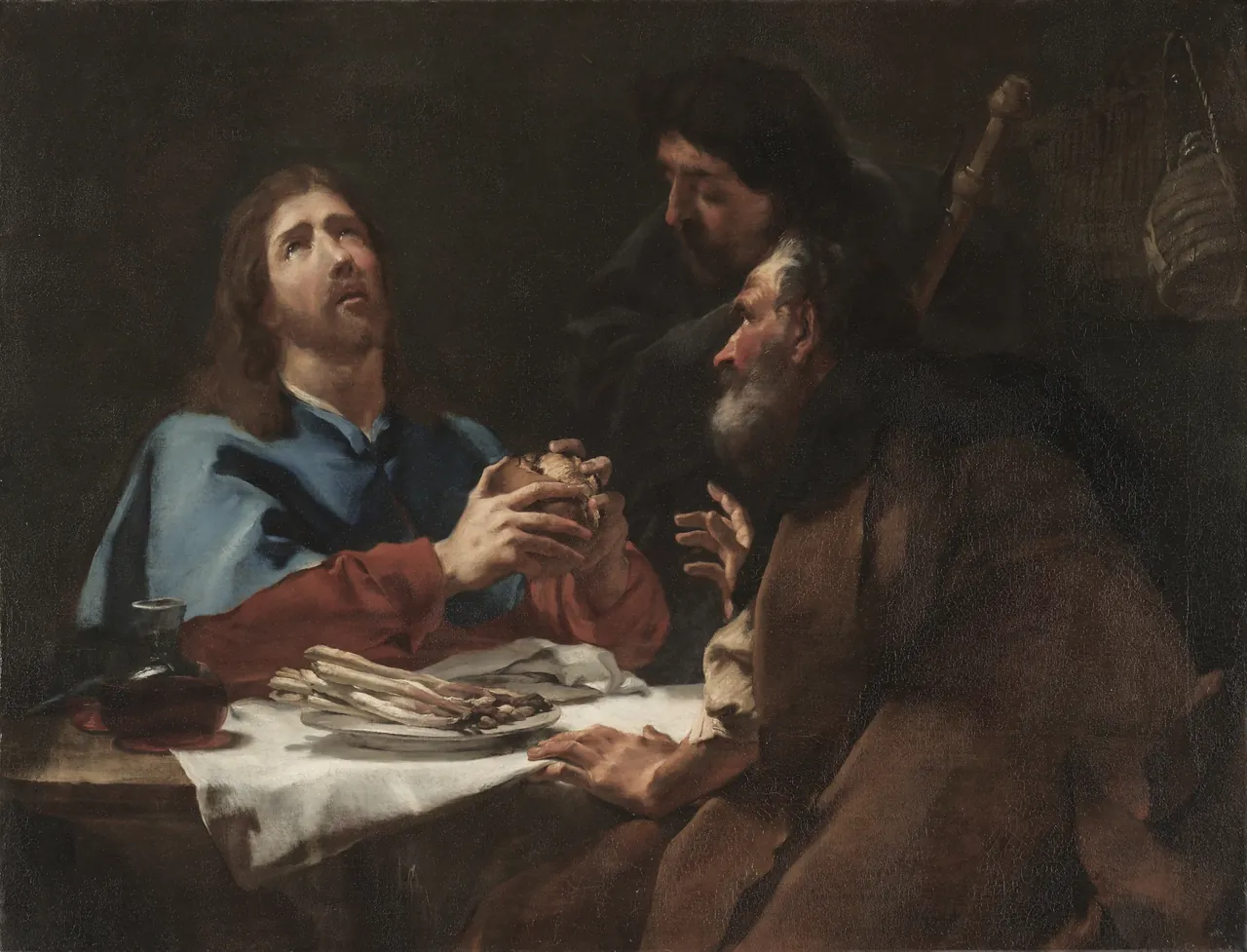
The Supper at Emmaus, an Italian oil painting of about 1720, showing the meal at the end of the road where Christ opened the Scriptures to two troubled disciples.The Supper at Emmaus · c. 1720 · Cleveland Museum of Art · CC0 · museum record · Galeria Regni
He starts where she is. "There cometh a woman of Samaria to draw water: Jesus saith unto her, Give me to drink" (John 4:7). He begins with an ordinary need — His own thirst, her bucket. He crosses barriers to do it: a Jewish man speaking to a Samaritan woman, alone, at noon.
He turns the conversation toward God. "If thou knewest the gift of God, and who it is that saith to thee, Give me to drink; thou wouldest have asked of him, and he would have given thee living water" (John 4:10). He uses her own language — water — to speak of what she really needs.
He names the truth about her life, without contempt.
“Jesus saith unto her, Go, call thy husband, and come hither. The woman answered and said, I have no husband. Jesus said unto her, Thou hast well said, I have no husband: For thou hast had five husbands; and he whom thou now hast is not thy husband: in that saidst thou truly.” (John 4:16-18)
He does not pretend her life is in order. But notice how He says it. Twice He credits her honesty: "Thou hast well said... in that saidst thou truly." He confronts the sin and honours the truth-telling in the same breath.
He reveals Himself. When she speaks of the coming Messiah, He says plainly, "I that speak unto thee am he" (John 4:26).
The result is witness. She "left her waterpot, and went her way into the city, and saith to the men, Come, see a man, which told me all things that ever I did: is not this the Christ?" (John 4:28-29). John adds: "And many of the Samaritans of that city believed on him for the saying of the woman" (John 4:39).
That is the pattern: begin with the person's real situation, listen, turn toward God, name the truth with grace, and point to Christ.
Jesus with Nicodemus
Nicodemus was the opposite of the Samaritan woman: a respected religious teacher, "a ruler of the Jews", who "came to Jesus by night" (John 3:1-2). He opened with a compliment and a careful statement of what he already knew.
Jesus went straight past it to the heart of the matter: "Verily, verily, I say unto thee, Except a man be born again, he cannot see the kingdom of God" (John 3:3). Nicodemus's problem was not lack of information. It was that he needed new life.
The conversation did not end that night with a decision. But Nicodemus appears again in John's Gospel, defending Jesus before the council (John 7:50-51), and finally at the cross, when "there came also Nicodemus, which at the first came to Jesus by night, and brought a mixture of myrrh and aloes, about an hundred pound weight" (John 19:39). Some conversations bear fruit years later. The counselor's job is to be faithful in the conversation he has.
Philip and the Ethiopian
In Acts 8, Philip found an Ethiopian official reading Isaiah in his chariot. His first move was a question: "Understandest thou what thou readest?" The man answered, "How can I, except some man should guide me?" (Acts 8:30-31).
Then "Philip opened his mouth, and began at the same scripture, and preached unto him Jesus" (Acts 8:35). He started where the man already was — in Isaiah 53 — and showed him Christ there.
“And as they went on their way, they came unto a certain water: and the eunuch said, See, here is water; what doth hinder me to be baptized? And Philip said, If thou believest with all thine heart, thou mayest. And he answered and said, I believe that Jesus Christ is the Son of God.” (Acts 8:36-37)
Verse 37 stands in the King James Bible and in the Received Text behind it; many modern versions remove it to a footnote. You can see this and every other place where the 1611 and the modern Critical Text part ways at kylelauriano.com/library/changes. Here the verse matters for counseling. In the text, Philip answers the eunuch's question with a condition, "If thou believest with all thine heart, thou mayest," and the eunuch confesses, "I believe that Jesus Christ is the Son of God," before he is baptized.
The road to Emmaus
After the resurrection, the Lord joined two grieving disciples on the road. He did not begin by announcing Himself. He began with a question: "What manner of communications are these that ye have one to another, as ye walk, and are sad?" (Luke 24:17). He let them tell Him their grief, all of it.
Then, "beginning at Moses and all the prophets, he expounded unto them in all the scriptures the things concerning himself" (Luke 24:27). Afterward they said, "Did not our heart burn within us, while he talked with us by the way, and while he opened to us the scriptures?" (Luke 24:32).
Questions, listening, the Scriptures, Christ. The same order again.
Questions that open doors
Notice how often these conversations turn on a question. "Give me to drink." "Understandest thou what thou readest?" "What manner of communications are these?" Good questions invite a person to think, and they show that you are interested in him, not only in your message.
Michael Ray Lewis told his story on The King Is Coming Show (TKIC #48): in his telling, he was an atheist who mocked Christians — until one question undid him. Watch it in his own words: youtube.com/watch?v=Rd-RdSqeQDk Michael's account of what happened to him, shared as his testimony — weigh it for yourself.
You do not need clever questions. Honest ones are enough: "What do you think happens when we die?" "Where do you go when things fall apart?" "Have you ever read what Jesus actually said?" "If God were real, would you want to know Him?" The answers will tell you where the person is, and they will often open the door to the gospel.
Be ready with an answer
Peter tells believers to "be ready always to give an answer to every man that asketh you a reason of the hope that is in you with meekness and fear" (1 Peter 3:15). Paul adds, "Walk in wisdom toward them that are without, redeeming the time. Let your speech be alway with grace, seasoned with salt, that ye may know how ye ought to answer every man" (Colossians 4:5-6).
Notice the manner: meekness, fear, grace, salt. Not arguing to win. Not pressure. And notice "every man": not one script for all, but a fitting answer for each person. Jude says the same: "And of some have compassion, making a difference: And others save with fear, pulling them out of the fire" (Jude 1:22-23).
Paul's instruction to Timothy is the clearest picture of how a believer should deal with someone who resists:
“And the servant of the Lord must not strive; but be gentle unto all men, apt to teach, patient, In meekness instructing those that oppose themselves; if God peradventure will give them repentance to the acknowledging of the truth; And that they may recover themselves out of the snare of the devil, who are taken captive by him at his will.” (2 Timothy 2:24-26)
Gentle, patient, meek — and full of hope that God will grant repentance. The counselor does not convert anyone. God does. The counselor's part is to be faithful and kind.
The gospel itself
When the door opens, the counselor must know what to say. The gospel is not "Jesus will fix your problems." It is this: "that Christ died for our sins according to the scriptures; And that he was buried, and that he rose again the third day according to the scriptures" (1 Corinthians 15:3-4).
It calls for a response. Paul preached "repentance toward God, and faith toward our Lord Jesus Christ" (Acts 20:21). Jesus said, "except ye repent, ye shall all likewise perish" (Luke 13:3). Salvation is a gift: "For by grace are ye saved through faith; and that not of yourselves: it is the gift of God: Not of works, lest any man should boast" (Ephesians 2:8-9). It is received by faith: "That if thou shalt confess with thy mouth the Lord Jesus, and shalt believe in thine heart that God hath raised him from the dead, thou shalt be saved" (Romans 10:9). And it leads to obedience, beginning with baptism. On the day of Pentecost Peter told the crowd, "Repent, and be baptized every one of you in the name of Jesus Christ for the remission of sins, and ye shall receive the gift of the Holy Ghost" (Acts 2:38).
Do not soften repentance, and do not soften hell. Jesus did not: "fear him which is able to destroy both soul and body in hell" (Matthew 10:28). But do not forget the heart of God behind the warning: "As I live, saith the Lord GOD, I have no pleasure in the death of the wicked; but that the wicked turn from his way and live: turn ye, turn ye from your evil ways; for why will ye die?" (Ezekiel 33:11).
Part 3 — Counseling the Unbeliever, the Religious and the New Believer
4 min read
This part matters because the people a believer counsels are in different places with God, and the same words will not fit them all. Gregory the Great said fourteen centuries ago that "one and the same exhortation does not suit all".6 That is especially true here.
The hurting unbeliever
When an unbeliever comes for help, three things are true at once.
He is a person in need, and you should help him whether or not he believes. The Good Samaritan did not check the wounded man's faith before he bound his wounds (Luke 10:33-35). Paul says it plainly: "As we have therefore opportunity, let us do good unto all men" (Galatians 6:10). Help with the problem in front of you — the bills, the grief, the crisis — sincerely and without conditions.
He cannot live the Christian life without Christ. Biblical counsel about forgiveness, contentment or self-control will only become a heavier law if he has no power to obey it. You can share the wisdom of Proverbs; you cannot expect the fruit of the Spirit from someone who does not have the Spirit.
So the gospel is the help he most needs. Not as a bait at the end of a "free counseling session", but honestly, as the truest thing you know about his situation. Tell him what you are doing. "Can I tell you what I think is really going on, and where I have found help?" Ask permission. Most people say yes.
Do not use counsel as a trick. If you offer someone help on the condition that he listen to a sermon, you have made the gospel a fee. Help freely; speak freely; leave the outcome to God.
The religious but unconverted
Some of the people you counsel will be religious — church members, even long-time ones — who have never been born again. Nicodemus was one. In my own story: "So I swung back hard to religion, said the rosary every night, and still felt nothing."
These are the hardest people to help, because they assume they already have what they need. The counselor should listen carefully for signs: a faith that is all duty and no joy; a view of God that is all rules and no grace; no sense of personal sin; no assurance, or a false assurance resting on a ceremony or a church membership instead of Christ.
Criselle Mendoza told her story on The King Is Coming Show (TKIC #51), under the title "Baptized at 12 in Iglesia Ni Cristo. I Wasn't Saved Until 2025." In her own telling, she was baptized at twelve in Iglesia Ni Cristo and was not saved until 2025. Watch it in her own words: youtube.com/watch?v=_7vjNP6A_z8 Criselle's account of what happened to her, shared as her testimony — weigh it for yourself.
With such a person, go gently but go deep. Ask, "If you died tonight, what would you say to God about why He should let you into heaven?" Listen to the answer. If it rests on anything other than Christ — "I was baptised", "I go to church", "I'm a good person" — open John 3 with him, and Ephesians 2:8-9.
The new believer
When someone comes to faith, counseling does not end. In many ways it begins. Jesus' commission is not only to make disciples but to teach them "to observe all things whatsoever I have commanded you" (Matthew 28:20).
A church. "Not forsaking the assembling of ourselves together, as the manner of some is; but exhorting one another" (Hebrews 10:25). Do not let a new believer depend only on you. Bring him into a local church.
The word. Help him begin reading the Bible daily. The free 1611 Reader at kylelauriano.com/library is a good start, with a reading plan.
Prayer. Teach him to pray simply and honestly.
Real assurance, and real warnings. Scripture gives both, and a new believer needs both.
On assurance, teach the texts, not a system. Jesus said of His sheep, "I give unto them eternal life; and they shall never perish, neither shall any man pluck them out of my hand" (John 10:28). John wrote his letter "that ye may know that ye have eternal life" (1 John 5:13). Paul was "persuaded" that nothing "shall be able to separate us from the love of God, which is in Christ Jesus our Lord" (Romans 8:38-39). And the same Scriptures take falling away seriously: "For it is impossible for those who were once enlightened, and have tasted of the heavenly gift... If they shall fall away, to renew them again unto repentance" (Hebrews 6:4-6). Peter therefore urges, "give diligence to make your calling and election sure: for if ye do these things, ye shall never fall" (2 Peter 1:10). A counselor should not pick a theological camp for the new believer. He should give him all these words, and point him to the Christ who said, "him that cometh to me I will in no wise cast out" (John 6:37).
This part matters because a crisis does not wait for a counselor to be ready. When someone tells you he wants to die, or that someone is hurting him, the next hour matters more than anything else in this paper. Love in a crisis looks like safety first.
Albrecht Dürer’s Praying Hands (1508) — a working study of hands folded in petition, five centuries old and still legible at a glance.Albrecht Dürer, 1508 · Public domain
The Good Samaritan's order
The parable of the Good Samaritan is a crisis-care manual in three verses. The Samaritan "had compassion on him, And went to him, and bound up his wounds, pouring in oil and wine, and set him on his own beast, and brought him to an inn, and took care of him. And on the morrow when he departed, he took out two pence, and gave them to the host, and said unto him, Take care of him" (Luke 10:33-35).
Notice the order:
1. Compassion — he did not pass by. 2. Immediate care — he dealt with the bleeding first. 3. Safety — he moved the man to a place where he could be looked after. 4. Handing on to others — he paid the innkeeper and said, "Take care of him." 5. Follow-up — "when I come again, I will repay thee."
He did not preach to the man on the road. He did not try to do everything himself. He got him safe, got him help, and came back.
A jailer with a sword
Acts 16 records a suicide that did not happen. After an earthquake opened the prison doors in Philippi, "the keeper of the prison awaking out of his sleep, and seeing the prison doors open, he drew out his sword, and would have killed himself, supposing that the prisoners had been fled" (Acts 16:27).
“But Paul cried with a loud voice, saying, Do thyself no harm: for we are all here.” (Acts 16:28)
Paul did three things a crisis counselor should do. He spoke immediately and directly: "Do thyself no harm." He addressed the false belief driving the despair: "we are all here" — the disaster the man feared had not happened. And once the man was safe, the conversation turned to the deepest need: "Sirs, what must I do to be saved? And they said, Believe on the Lord Jesus Christ, and thou shalt be saved, and thy house" (Acts 16:30-31).
Safety first. Then the gospel.
When someone speaks of suicide
This is the crisis a believer is most likely to face, and the one people fear most. Here is what to know.
The size of it
The Centers for Disease Control and Prevention reports that suicide was responsible for 48,824 deaths in the United States in 2024, and that in the same year an estimated 14.3 million adults seriously thought about suicide, 4.6 million planned an attempt, and 2.2 million attempted it.7 Some of those people sit in churches every Sunday.
The number to know: 988
The 988 Suicide & Crisis Lifeline went live nationwide on July 16, 2022.8 You can call or text 988, or chat at chat.988lifeline.org. It is free, confidential and available 24 hours a day, every day of the year, and it is for anyone — including people worried about someone else.9 Veterans can dial 988 and press 1 for the Veterans Crisis Line, or text 838255.10
If someone is in immediate danger — he has the means with him, or he has already harmed himself — call 911.
The warning signs
The 988 Lifeline lists warning signs that someone may be at risk, especially when the behaviour is new, has increased, or seems related to a painful event, loss or change. They include talking about wanting to die or to kill oneself; looking for a way to do it, such as searching online or buying a gun; talking about feeling hopeless, trapped, in unbearable pain, or a burden to others; increasing use of alcohol or drugs; acting anxious, agitated or reckless; sleeping too little or too much; withdrawing or isolating; showing rage or talking about revenge; and extreme mood swings.11
The Psalms show that believers can feel some of this. "I am forgotten as a dead man out of mind: I am like a broken vessel" (Psalm 31:12). Another psalmist cries: "Lover and friend hast thou put far from me, and mine acquaintance into darkness" (Psalm 88:18). Elijah "requested for himself that he might die" (1 Kings 19:4). Do not assume a Christian cannot be in danger.
Ask directly
Many people fear that asking about suicide will put the idea in someone's head. The evidence says otherwise. A 2014 review of the published literature in Psychological Medicine by researchers at King's College London found no study showing a statistically significant increase in suicidal thoughts among people who were asked about them, and suggested that asking may even reduce them.12
So ask, plainly: "Are you thinking about killing yourself?" Not "You're not thinking of doing anything silly, are you?" The 988 Lifeline's own guidance is to be direct and to talk "openly and matter-of-factly about suicide".13
The five steps
The 988 Lifeline teaches five action steps for helping someone in crisis: Ask. Be there. Help keep them safe. Help them connect. Follow up.14 They line up closely with the Good Samaritan's order.
1. Ask — directly, as above. 2. Be there. Stay with him. Listen. Do not argue about whether he should feel this way. Do not leave him alone if he is at risk. 3. Help keep him safe. The Lifeline says to "take action" and "remove means, like weapons or pills." Ask whether he has a plan and the means to carry it out. If he does, help get those means away from him — a family member can hold firearms or medications — and get help immediately. 4. Help him connect. Call or text 988 together, right then, with him in the room. If he has a doctor or counselor, help him call. Tell his family, with his knowledge if possible. 5. Follow up. Call the next day, and the day after. The Samaritan came back. So should you.
And one rule above all: never keep a plan secret. The Lifeline is explicit: "Never keep it a secret if a friend tells you about a plan to hurt themselves."15 If someone asks you to promise not to tell, do not promise. Say, "I care about you too much to keep that secret."
What to say about God
In the first hour, say little and stay close. Later — once he is safe and connected to help — the Scriptures have much to say. God is near: "The LORD is nigh unto them that are of a broken heart; and saveth such as be of a contrite spirit" (Psalm 34:18). He does not abandon His own: "he will not fail thee, nor forsake thee" (Deuteronomy 31:6). And like Paul to the jailer, you can say: what you fear is not the whole truth. "Do thyself no harm: for we are all here."
Do not tell someone in despair that suicide is an unforgivable sin, or that his feelings show he is not a real Christian. Neither helps, and neither is the message of Elijah's story, where the Lord's answer to a prophet who wanted to die was bread, water, sleep and a gentle word (1 Kings 19:5-8).
Other crises
Not every crisis is suicide. A believer may be called when someone has just learned of a death, been arrested, lost a job, been told a diagnosis, or found out about an affair. The same order applies:
Safety first. Is anyone in danger? If so, call 911.
Presence. Go if you can. Sit with them, as Job's friends rightly did for seven days before they spoke (Job 2:13).
Practical help. Meals, rides, childcare, phone calls. "Withhold not good from them to whom it is due, when it is in the power of thine hand to do it" (Proverbs 3:27).
Connect them with their pastor, family and any professional help they need.
Follow up, especially after the first rush of attention fades.
Part 5 — Abuse: Protect, Report, Do Not Investigate
6 min read
This part matters because churches have too often failed victims of abuse — by disbelieving them, by handling crimes "internally", or by urging them back into danger in the name of reconciliation. Scripture and the law both demand better. When abuse is disclosed, the counselor's first duty is to the safety of the vulnerable.
What Scripture says
God is the defender of the vulnerable. "Defend the poor and fatherless: do justice to the afflicted and needy. Deliver the poor and needy: rid them out of the hand of the wicked" (Psalm 82:3-4). And Proverbs: "Open thy mouth for the dumb in the cause of all such as are appointed to destruction" (Proverbs 31:8). He sees what is done in secret: "Thou hast seen it; for thou beholdest mischief and spite, to requite it with thy hand: the poor committeth himself unto thee; thou art the helper of the fatherless" (Psalm 10:14).
Jesus' warning about those who harm children is among the most severe words He spoke: "But whoso shall offend one of these little ones which believe in me, it were better for him that a millstone were hanged about his neck, and that he were drowned in the depth of the sea" (Matthew 18:6).
And God has given the civil authority a role in dealing with crime. Paul writes that the ruler "is the minister of God to thee for good. But if thou do that which is evil, be afraid; for he beareth not the sword in vain: for he is the minister of God, a revenger to execute wrath upon him that doeth evil" (Romans 13:4). Abuse of a child, assault of a spouse, exploitation of an elderly person — these are crimes, and the state is God's appointed minister to deal with them. Church discipline (Matthew 18:15-17) is not a substitute for reporting a crime to the authorities. Both may be needed; one does not replace the other.
Fleeing danger is not faithlessness
Victims are sometimes told that leaving an abusive home shows a lack of faith. Scripture says otherwise. "A prudent man foreseeth the evil, and hideth himself: but the simple pass on, and are punished" (Proverbs 22:3). David fled Saul's men through a window when his life was threatened (1 Samuel 19:11-12). When the Jews of Damascus plotted to kill Paul, "the disciples took him by night, and let him down by the wall in a basket" (Acts 9:23-25).
Get safe first. That is the word to the one in danger, and the counselor's first task is to help her do it. Paul's instruction to the married is often raised here: "Let not the wife depart from her husband: But and if she depart, let her remain unmarried, or be reconciled to her husband" (1 Corinthians 7:10-11). The text itself foresees a wife who departs, and it tells her to remain unmarried or be reconciled; it does not require anyone to stay in physical danger. Separating for safety is not divorce. "A prudent man foreseeth the evil, and hideth himself" (Proverbs 22:3). Churches differ on how the passage applies to abuse, and this paper does not settle every question about the marriage for the reader. Those questions can be addressed later, with the pastor and with time.
Husbands are commanded to "love your wives, even as Christ also loved the church, and gave himself for it" (Ephesians 5:25), and to "be not bitter against them" (Colossians 3:19). A man who uses violence or terror against his wife is not exercising headship. He is sinning against her and against God, and he may be committing a crime.
When a child is in danger
The law
Every state and U.S. territory has laws naming people who must report suspected child abuse or neglect. According to the federal Child Welfare Information Gateway, approximately 29 states and Guam specifically name clergy among those required to report, and in approximately 16 states, Puerto Rico and the Virgin Islands, any person who suspects child abuse or neglect is required to report it — language that appears to include clergy and lay church members alike.16 Some states protect certain confidential pastoral communications ("clergy-penitent privilege"), but the Gateway notes that this privilege "is not absolute," and the rules differ from state to state.17
The Gateway also points out what is true everywhere: any concerned person can make a report to child protective services when he suspects a child is being harmed.18 You do not need to be sure. You need reasonable suspicion. Investigation is the job of child protective services and the police, not of the counselor or the church.
What to do
If a child is in immediate danger, call 911.
Otherwise, report to your state's child protective services (often called CPS or the child abuse hotline) or to the police. Every state has its own reporting number; the Child Welfare Information Gateway's State Statutes Search and your state's government website list them.
Do not investigate yourself. Do not question the child repeatedly, confront the alleged abuser, or "look into it" before reporting. That can endanger the child and damage any later investigation.
Do not promise secrecy. If a child or teenager begins to tell you something, you may say, "I am glad you are telling me. I may need to get help from people whose job is to keep you safe."
Tell your pastor, and follow your church's child-protection policy — but do not let a church process delay a report the law requires.
Write down what you were told, in the person's words, with the date and time.
For advice, the Childhelp National Child Abuse Hotline can be reached by phone or text at 1-800-422-4453. It is a source of help and information, not a reporting line: Childhelp says plainly that it is "not a reporting line and is not connected to 911 or emergency services," and it lists state reporting numbers on its site.19
When a spouse or partner is being abused
The National Domestic Violence Hotline is free, confidential and open 24 hours a day: call 1-800-799-SAFE (7233), text START to 88788, or chat online at thehotline.org.20 Advocates there can help a victim make a safety plan and find local shelter and legal help.
Some cautions for the counselor:
Believe the person enough to act. You do not have to have every fact to take safety seriously.
Do not do couples counseling where one spouse is abusing the other. It can put the victim in greater danger, because what she says in the session may be punished at home.
Do not urge reconciliation before safety. Repentance in an abuser is shown over time, not in a tearful apology.
Watch for monitoring. The Hotline warns that "internet usage can be monitored and is impossible to erase completely," and suggests that someone worried about being watched call rather than browse.21 Be careful about what you text or email.
If there is immediate danger, call 911.
Sexual assault
A person who has been sexually assaulted can reach RAINN (the Rape, Abuse & Incest National Network) at 800-656-HOPE (800-656-4673), with advocates also available by online chat around the clock.22 If the assault was recent, encourage medical care; if the victim is a child, it must be reported as above.
When an older or dependent adult is being abused
Abuse, neglect and financial exploitation of older adults and adults with disabilities are handled by Adult Protective Services, which in every state receives and responds to such reports.23 The federal Eldercare Locator at 1-800-677-1116 can connect callers with local services.24 Many states require certain people to report suspected elder abuse; check your own state's law.
This part matters because a wise counselor knows the edge of his competence. Referral is not a failure of faith in Scripture. It is obedience to Scripture's own wisdom, and often it is the most loving thing a counselor can do.
The Bible honours physicians
Jesus assumed the place of doctors: "They that are whole need not a physician; but they that are sick" (Luke 5:31). Paul travelled with "Luke, the beloved physician" (Colossians 4:14) and told Timothy to "use a little wine for thy stomach's sake and thine often infirmities" (1 Timothy 5:23). Isaiah ordered a poultice for Hezekiah's boil (Isaiah 38:21). God heals in many ways, and medicine is one of them.
A leaf from a Gospel Book with Commentaries made in Constantinople around 1000 to 1100, from its section on Luke, the beloved physician who travelled with Paul.Portrait of Luke, folio 200 (recto), from a Gospel Book with Commentaries · c. 1000–1100 · Cleveland Museum of Art · CC0 · museum record · Galeria Regni
The Gospels also distinguish among the sufferings people brought to Jesus: "all sick people that were taken with divers diseases and torments, and those which were possessed with devils, and those which were lunatick, and those that had the palsy; and he healed them" (Matthew 4:24). Diseases and torments, possession by devils, the "lunatick", the palsy: they are listed side by side as different afflictions. A counselor should not collapse them into one.
Jethro's counsel to Moses applies to every helper: "this thing is too heavy for thee; thou art not able to perform it thyself alone" (Exodus 18:18). The great matters, Jethro said, should go to the one equipped to handle them (Exodus 18:22).
Body and soul together
Many problems that look purely spiritual have a physical side. The National Institute of Mental Health notes that "certain medications and medical conditions, such as viruses or thyroid disorders, can cause the same symptoms as depression," and that a provider can rule these out "by doing a physical exam, interview, and lab tests."25 A believer who is depressed should be encouraged to see a doctor as well as to seek the Lord. Doing one does not mean neglecting the other.
Similarly, alcohol and some drugs create physical dependence. The National Institute on Alcohol Abuse and Alcoholism warns that people with severe alcohol use disorder "may need medical help to avoid alcohol withdrawal if they decide to stop drinking," and that "alcohol withdrawal is a potentially life-threatening process that can occur when someone who has been drinking heavily for a prolonged period of time suddenly stops drinking."26 A counselor who urges a heavy drinker to quit cold turkey without a doctor may be putting him in danger.
When to refer
A lay counselor should bring in professional help — medical, psychiatric, legal or other — in at least these situations:
| Situation | What to do | |---|---| | Talk of suicide or self-harm, or a recent attempt | Call or text 988 together; 911 if in immediate danger | | Danger to a child | Call 911 or report to child protective services | | Violence or threats in the home | National Domestic Violence Hotline, 1-800-799-7233; 911 if in danger | | Abuse or exploitation of an older or dependent adult | Adult Protective Services; Eldercare Locator, 1-800-677-1116 | | Physical dependence on alcohol or drugs | A doctor before stopping; SAMHSA National Helpline, 1-800-662-4357 | | Sudden changes in thinking, mood or behaviour; confusion; hearing or seeing things others do not; believing things that are plainly untrue | A doctor promptly; emergency care if the person is a danger to himself or others | | Severe changes in sleep or appetite, or weight loss, lasting weeks | A doctor | | Symptoms that may be medical (a new illness, a head injury, new medication) | A doctor | | Legal trouble, custody disputes, immigration problems | A lawyer | | Anything beyond your understanding or training | Your pastor, and through him whatever help is needed |
The SAMHSA National Helpline, 1-800-662-HELP (4357), is a free, confidential referral service in English and Spanish, open 24 hours a day, 365 days a year, for people and families facing mental or substance use disorders. It does not provide counseling itself; it refers callers to local treatment and support.27
How to refer well
A good referral is not a hand-off. It is bringing another helper in while you stay involved.
Explain why. "I care about you, and I think you need more help than I can give. That's not because your faith is weak. It's because you matter."
Help him make the call. Sit with him while he calls the doctor or the hotline. Offer to drive him.
Choose carefully where you can. Where there is a choice, look for a doctor or counselor who will respect the person's faith. A Christian who is also a qualified professional is a gift. But do not delay urgent medical care while you search for the perfect fit.
Stay in his life. Keep meeting, praying and reading Scripture with him. The professional treats the illness; you and the church remain his family in Christ.
Respect boundaries. Do not ask the doctor for details the patient has not agreed to share.
Keep your pastor informed, with the person's consent.
The Good Samaritan handed the man on to the innkeeper — "Take care of him" — and then said, "when I come again, I will repay thee" (Luke 10:35). That is a good referral.
Part 7 — Boundaries, Confidentiality and Care for the Helper
4 min read
This part matters because helpers who ignore boundaries do harm — to the people they help, to themselves, and to the witness of the church. And helpers who never rest will not be able to help for long.
Rembrandt’s Christ in the Storm on the Sea of Galilee (1633), his only seascape — panic filling the boat, and one figure at rest.Rembrandt, 1633 · Public domain
Confidentiality and its limits
People will tell you things they have told no one. Guard them. "A talebearer revealeth secrets: but he that is of a faithful spirit concealeth the matter" (Proverbs 11:13). Do not repeat what you hear as a prayer request. Do not tell your friends.
But confidentiality has limits, and honesty requires you to say so before someone confides, not after. A simple sentence works: "What you tell me stays between us, with one exception: if someone is in danger — you or anyone else — I will have to get help." Then keep both halves of that promise. If someone is in danger, get help. If not, keep the secret.
Bria Isaac told her story on The King Is Coming Show (TKIC #53), under the title "I said, I'm going to take it to my grave — then I heard this voice." In her telling, she had resolved to keep something hidden for the rest of her life. Watch it in her own words: youtube.com/watch?v=Uk-02EJ6FD0 Bria's account of what happened to her, shared as her testimony — weigh it for yourself.
Secrets weigh heavily. "When I kept silence, my bones waxed old through my roaring all the day long" (Psalm 32:3). Part of a counselor's work is to be a safe place where what has been hidden can be brought into the light — and part of it is to know which secrets must be brought to others for someone's protection.
Practical boundaries
Men with men, women with women, wherever possible, especially in matters of marriage and sexuality (Titus 2:3-5). Where a man must counsel a woman, others should be nearby, and never behind a locked door.
Meet in appropriate places. A church office with others in the building, a coffee shop, a home with family present.
Be careful with messages. Texts and emails can be read by others — including, in an abusive home, by the abuser.
Do not take on more than you can carry. Better to help three people well than ten badly.
Work under authority. A lay counselor should be accountable to his pastor and church leaders.
Do not become the saviour. You are not the person's rescuer. Christ is. Point to Him, and to His church.
Care for the helper
Crisis care is draining. Even Jesus led His disciples away to rest: "Come ye yourselves apart into a desert place, and rest a while: for there were many coming and going, and they had no leisure so much as to eat" (Mark 6:31).
A counselor needs:
His own walk with God — the word, prayer and confession, not only for others but for himself.
People who counsel him. "Two are better than one" applies to the helper too (Ecclesiastes 4:9-10).
Rest. A day off. Sleep. Time with his family.
Honesty about his limits. "Thou art not able to perform it thyself alone" (Exodus 18:18).
Freedom from the outcome. You plant; another waters; God gives the increase (1 Corinthians 3:6). You cannot make anyone change, believe or live. You can be faithful.
If something you hear in a crisis stays with you — images you cannot shake, sleeplessness, dread — talk to your pastor or a doctor. Helpers need help too.
A word on spiritual warfare
The gifts of the Spirit and deliverance from evil spirits are for today, and guests on my show testify to both. Every gift is tested by the word of God and kept within the limits the word sets. Jesus said that "these signs shall follow them that believe; In my name shall they cast out devils" (Mark 16:17) — a verse from Mark 16:9-20, which stands in the 1611 though many modern versions set it apart (see kylelauriano.com/library/changes) — and the Gospels show those He set free "sitting, and clothed, and in his right mind" (Mark 5:15). A counselor may meet real spiritual oppression.
But crisis care is not the place for guesswork. Not every crisis is demonic, and treating a medical emergency, a suicidal crisis or a case of abuse as only a spiritual battle can cost a life. A born-again believer can be attacked and oppressed, but he belongs to Christ and cannot be owned by the enemy. The instruction to the believer is to "Submit yourselves therefore to God. Resist the devil, and he will flee from you" (James 4:7) — with no formulas, no conversations with spirits, and no promised outcomes. Where there is a real spiritual problem, bring in the pastor and elders. Where there is danger, call for help first.
Most of the counseling a believer will ever do happens in ordinary places, with ordinary people, many of whom do not yet know Christ. That is not a lesser kind of counseling. It is the kind Jesus did at a well, on a road, at night with a frightened religious leader. It is the kind Baxter did in eight hundred homes.
In those conversations, the believer listens before he speaks, asks honest questions, meets real needs without conditions, and — with permission and with grace — points to Christ, because Christ is the deepest help any person can receive.
And when a conversation becomes a crisis, love looks like safety first. Ask directly about suicide. Call or text 988 together. Never keep a plan secret. When a child, a spouse or an elderly person is in danger, protect them, report it, and leave the investigating to those whose job it is. Know when a problem needs a doctor, and help the person get there. Then stay in his life.
A next step
Put these numbers in your phone today: 988; 911; the National Domestic Violence Hotline, 1-800-799-7233; Childhelp, 1-800-422-4453; the SAMHSA National Helpline, 1-800-662-4357; the Eldercare Locator, 1-800-677-1116; and your state's child abuse reporting number.
Look up your own state's reporting law through the Child Welfare Information Gateway, and ask your pastor about your church's child-protection policy.
Read John 4 this week, and notice every question Jesus asks.
Think of one person in your life who is hurting. Call them. Ask how they are really doing, and listen.
Read the companion paper, Biblical Counseling Fundamentals, for the foundations beneath all of this.
An invitation
If you are the one in crisis — if you picked up this paper because you are not sure you can go on — please hear this first: call or text 988 now, or tell someone near you. You are not alone, and you are not a burden.
And hear this too. The Lord Jesus came "to seek and to save that which was lost" (Luke 19:10). He said, "him that cometh to me I will in no wise cast out" (John 6:37). In my own story, I came to disprove God. He met me instead — and I couldn't unsee what time it is. He can meet you. The free papers at kylelauriano.com will show you the way, and my own story is at kylelauriano.com/about.
1James Strong, The Exhaustive Concordance of the Bible (New York: Hunt & Eaton, 1890), Greek dictionary, entry 3560.↩
2Richard Baxter, The Reformed Pastor (1656), ed. William Brown, dedication. Online: https://www.ccel.org/ccel/b/baxter/pastor/cache/pastor.txt. Brown's edition abridges Baxter's text; quotations here are from it.↩
3Baxter, The Reformed Pastor, ed. Brown, dedication.↩
4Baxter, The Reformed Pastor, ed. Brown, on "the oversight of the flock", section 1.↩
5Baxter, The Reformed Pastor, ed. Brown, same section.↩
6Gregory the Great, The Book of Pastoral Rule 3, prologue, trans. James Barmby, in Nicene and Post-Nicene Fathers, 2nd series, vol. 12 (Buffalo: Christian Literature Publishing Co., 1895). Online: https://www.newadvent.org/fathers/36013.htm.↩
7Centers for Disease Control and Prevention, "About Suicide Prevention," https://www.cdc.gov/suicide/about/index.html (2024 data).↩
8988 Suicide & Crisis Lifeline, https://988lifeline.org/. The 988 dialing code went live nationwide on July 16, 2022, when, as Congress designated, the code began routing to the existing National Suicide Prevention Lifeline; see Centers for Medicare & Medicaid Services, "988 Suicide and Crisis Lifeline," https://cms.gov/digital-service/988.↩
12T. Dazzi, R. Gribble, S. Wessely and N. T. Fear, "Does Asking about Suicide and Related Behaviours Induce Suicidal Ideation? What Is the Evidence?" Psychological Medicine 44, no. 16 (2014): 3361–63, https://doi.org/10.1017/S0033291714001299. PubMed: https://pubmed.ncbi.nlm.nih.gov/24998511/.↩
16Child Welfare Information Gateway, Clergy as Mandatory Reporters of Child Abuse and Neglect, State Statutes Series (Washington, DC: U.S. Department of Health and Human Services, Children's Bureau, current through May 2023), 2. Online: https://www.childwelfare.gov/topics/systemwide/laws-policies/statutes/clergymandated.↩
17Child Welfare Information Gateway, Clergy as Mandatory Reporters, 2.↩
18Child Welfare Information Gateway, Clergy as Mandatory Reporters, 1.↩
19Childhelp National Child Abuse Hotline, https://www.childhelphotline.org/ (call 800-422-4453, or text 800-422-4453).↩
22U.S. Department of Justice, Office on Violence Against Women, "Sexual Assault," https://www.justice.gov/ovw/sexual-assault (listing the RAINN hotline, 800-656-HOPE / 800-656-4673).↩
23Administration for Community Living, "Supporting Adult Protective Services," https://acl.gov/programs/elder-justice/supporting-adult-protective-services.↩
24Eldercare Locator, U.S. Administration for Community Living, https://eldercare.acl.gov/ (1-800-677-1116).↩
25National Institute of Mental Health, Depression (NIH publication), https://www.nimh.nih.gov/health/publications/depression.↩
26National Institute on Alcohol Abuse and Alcoholism, "Understanding Alcohol Use Disorder," https://www.niaaa.nih.gov/publications/brochures-and-fact-sheets/understanding-alcohol-use-disorder.↩
27Substance Abuse and Mental Health Services Administration, "National Helpline," https://www.samhsa.gov/find-help/helplines/national-helpline.↩
It broke once. Seven mornings for the one who was hurt.
Seven pages in the 1611 King James for the person who believed once and was hurt — each with a work of art, one person with a before, and a room on the site built to hold you. Free.
This is practical teaching, not proof. It's drawn from Scripture and from walking this road myself. If you're still weighing the basics — whether God is real, whether the Bible can be trusted — I'd encourage you to start with the Skeptic resources in the Research Hub before diving in here.