A study of gospel movements in Scripture and history — how they grew, what marked them, how they handled structure and money, how they died, and how a faithful believer can begin where he is.
Abstract
Level 6 on the site's growth path asks the largest question: how does the gospel spread beyond one church to a whole city or region? This paper answers from the King James Bible first, tracing the movement of Acts from a hundred and twenty believers to churches across the Roman world, and the refrain "the word of God grew and multiplied." It then turns to history, using primary sources and careful arithmetic: Rodney Stark's estimate that the early church grew about 40 percent a decade, with his projected figures checked and explained; Pliny, Tertullian, Dionysius of Alexandria and the emperor Julian on what outsiders saw; the Moravians of Herrnhut; the Methodist figures recorded by Luke Tyerman; and William Carey's 1792 Enquiry. It sets out the marks these movements shared, the guardrails Scripture and the Didache put on money and leaders, and the ways movements die, including John Wesley's warning that Methodism might become "a dead sect." The conclusion is that no one launches a movement but God; believers are called to be faithful in the word, prayer, love and multiplication, and to leave the increase to Him. It is written for leaders who long to see their region reached.
What’s inside
·Introduction
Part 1Part 1: The First Movement: Acts
Part 2Part 2: How the Church Grew in the Roman World
Part 3Part 3: Later Movements: Herrnhut, the Methodists, and Carey
Part 4Part 4: Marks of a Gospel Movement
Part 5Part 5: Structure, Money and Accountability
Part 6Part 6: How Movements Die
Part 7Part 7: Beginning Where You Are
·Conclusion
Research paper · 9 chapters · 35 notes · October 2026
About 33 minutes · 9 parts · the PDF has the same text
Introduction
2 min read
This paper has a title that needs an honest word at the start. No one launches a movement of the gospel. God does.
Scripture is plain about this. "Except the LORD build the house, they labour in vain that build it" (Psalm 127:1). The prophet heard, "Not by might, nor by power, but by my spirit, saith the LORD of hosts" (Zechariah 4:6). Paul wrote, "I have planted, Apollos watered; but God gave the increase. So then neither is he that planteth any thing, neither he that watereth; but God that giveth the increase" (1 Corinthians 3:6-7). Jesus compared the kingdom to seed that a man casts into the ground, and then "should sleep, and rise night and day, and the seed should spring and grow up, he knoweth not how" (Mark 4:27).
So why a paper with this title? Because God uses people. The same Paul who said God gave the increase also said he had "planted". The farmer in Jesus' parable does not make the seed grow, but he does sow it, and "when the fruit is brought forth, immediately he putteth in the sickle" (Mark 4:29). A believer cannot make a movement happen. He can be faithful in the things God has always used when movements have happened. That is what this paper is about.
What this paper is
This is Level 6, the last step on the site's growth path. Level 4, Disciple Someone, gave a path for discipling one person. Level 5, Multiply Leaders, studied how disciples become leaders who raise up others. This paper asks what happens when that multiplication spreads through a city or a region. The companion paper Discipling Others lays the foundation for the whole series.
It has seven parts. Part 1 traces the first movement, in the book of Acts. Part 2 looks at how the church grew across the Roman world in the first three centuries, with the best numbers available and the arithmetic checked. Part 3 tells the story of three later movements: the Moravians, the Methodists, and the missionary movement William Carey helped begin. Part 4 draws out the marks these movements shared. Part 5 deals with structure, money and accountability. Part 6 shows how movements die. Part 7 sets out how a faithful believer can begin where he is.
A word about me
I came to faith in 2022, and my wife came to faith a month later. Today we're raising three kids in a home that was transformed — and I haven't stopped telling people since. I came to disprove God. He met me instead — and I couldn't unsee what time it is. Everything in this paper began, in the movements it describes, with people like that: ordinary believers who could not stop telling what the Lord had done. My story is at kylelauriano.com/about.
A note on Scripture: every verse is quoted from the King James Bible, free to read in the 1611 Reader at kylelauriano.com/library.
This part matters because the book of Acts is the one inspired record of a gospel movement. Every later movement is measured against it. Luke wrote it so that we would know not only what happened, but how.
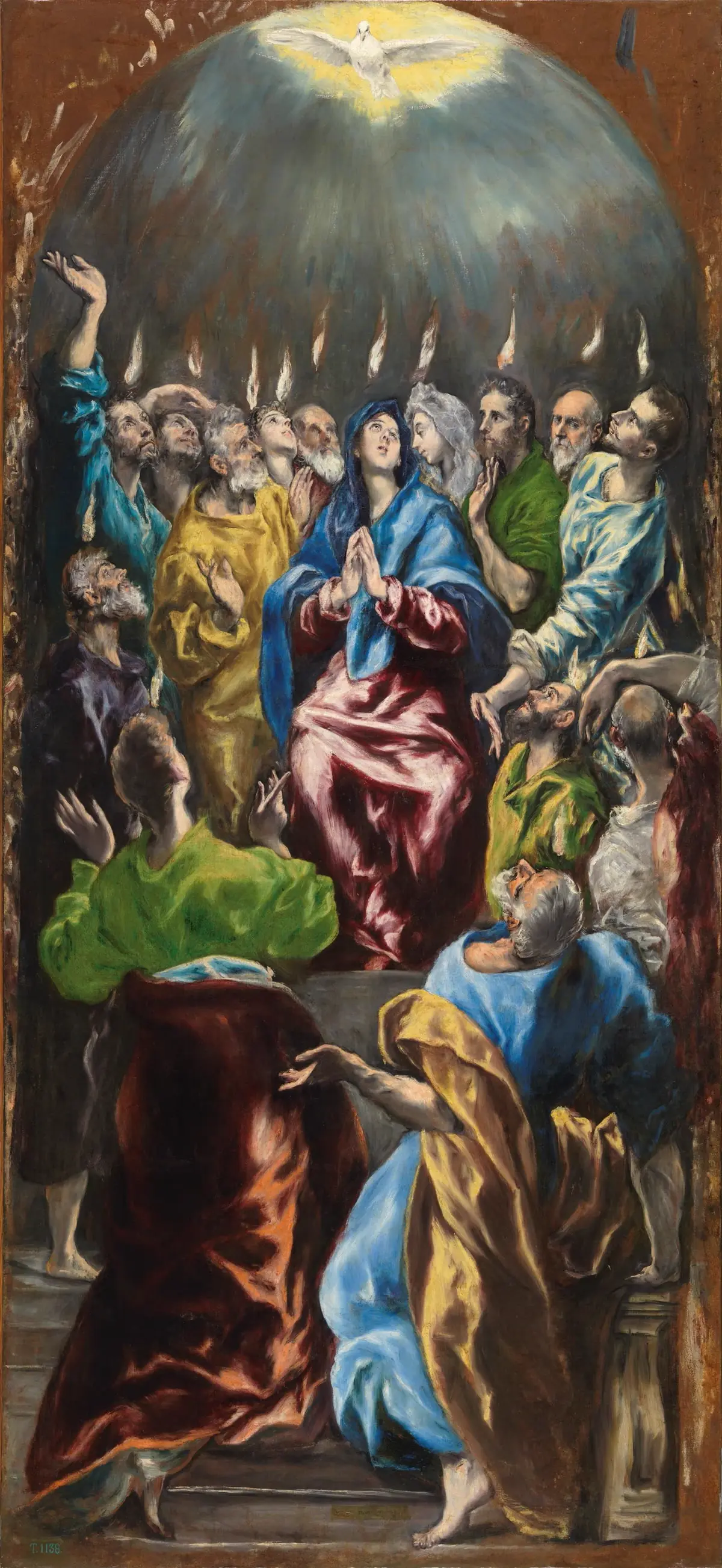
El Greco’s Pentecost (c. 1600) — the descent of the Spirit that turned a locked upper room into a world movement.El Greco, c. 1600 · Public domain
From a room to a city
Luke gives numbers at the start, and then stops counting.
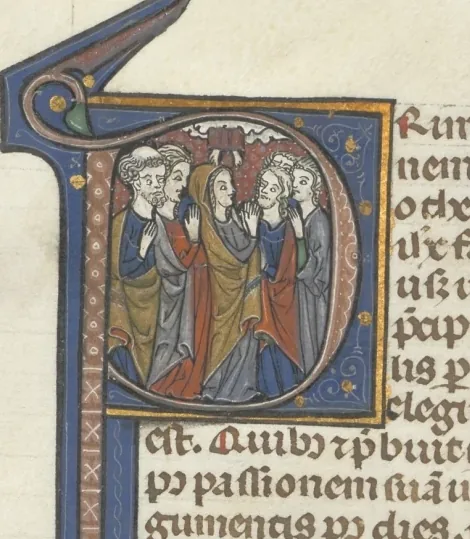
A manuscript page from southern France, about 1275 to 1300, opening the book of Acts with an initial of the Ascension, where the first movement began.Fol. 463r, Acts, historiated initial P, the Ascension · c. 1275–1300 · Cleveland Museum of Art · CC0 · full page · museum record · Galeria Regni
Before Pentecost: "the number of names together were about an hundred and twenty" (Acts 1:15).
At Pentecost: "the same day there were added unto them about three thousand souls" (Acts 2:41).
Soon after: "And the Lord added to the church daily such as should be saved" (Acts 2:47).
After the healing at the temple gate: "the number of the men was about five thousand" (Acts 4:4) — men alone, not counting women and children.
Then: "believers were the more added to the Lord, multitudes both of men and women" (Acts 5:14).
Then: "the number of the disciples multiplied in Jerusalem greatly; and a great company of the priests were obedient to the faith" (Acts 6:7).
The language moves from adding to multiplying. And from that point Luke no longer gives totals; he gives reports of the word spreading.
"The word of God grew"
Three times Luke uses the same kind of summary sentence, and each time the subject is not the church or the apostles but the word.
"And the word of God increased; and the number of the disciples multiplied in Jerusalem greatly." (Acts 6:7)
"But the word of God grew and multiplied." (Acts 12:24)
"So mightily grew the word of God and prevailed." (Acts 19:20)
That is Luke's theology of a movement in a sentence. It is the word that grows. The gospel, preached and believed and obeyed, has its own life, because "it is the power of God unto salvation to every one that believeth" (Romans 1:16). God had promised through Isaiah, "So shall my word be that goeth forth out of my mouth: it shall not return unto me void" (Isaiah 55:11).
Scattered, and preaching
The first great spread of the church came not from a strategy but from persecution. After Stephen's death, "there was a great persecution against the church which was at Jerusalem; and they were all scattered abroad throughout the regions of Judaea and Samaria, except the apostles" (Acts 8:1). Notice: except the apostles. The ones who left were ordinary believers. "Therefore they that were scattered abroad went every where preaching the word" (Acts 8:4).
Philip, one of the seven chosen to serve tables in Acts 6, "went down to the city of Samaria, and preached Christ unto them" (Acts 8:5). Others went further. "Now they which were scattered abroad upon the persecution that arose about Stephen travelled as far as Phenice, and Cyprus, and Antioch... And some of them were men of Cyprus and Cyrene, which, when they were come to Antioch, spake unto the Grecians, preaching the LORD Jesus. And the hand of the Lord was with them: and a great number believed, and turned unto the Lord" (Acts 11:19-21).
The church at Antioch — which became the base of the whole Gentile mission — was founded by believers whose names Scripture does not record. That is how movements spread.
Antioch: a sending church
Antioch shows the next stage. Barnabas was sent there, found the work growing, and fetched Saul from Tarsus to help him teach for a whole year (Acts 11:22-26). The church had a team of leaders from several backgrounds: "Barnabas, and Simeon that was called Niger, and Lucius of Cyrene, and Manaen, which had been brought up with Herod the tetrarch, and Saul" (Acts 13:1). And it gave its best away. "As they ministered to the Lord, and fasted, the Holy Ghost said, Separate me Barnabas and Saul for the work whereunto I have called them. And when they had fasted and prayed, and laid their hands on them, they sent them away" (Acts 13:2-3).
A movement is not a church that grows large. It is a church that sends.
Churches planting churches
Paul's pattern on his journeys was consistent. He preached, made disciples, appointed local elders, and moved on, returning or writing to strengthen them (Acts 14:21-23; 15:36). "And so were the churches established in the faith, and increased in number daily" (Acts 16:5).
The churches themselves became sending points. To the Thessalonians, a church only months old when he wrote, Paul said: "For from you sounded out the word of the Lord not only in Macedonia and Achaia, but also in every place your faith to God-ward is spread abroad; so that we need not to speak any thing" (1 Thessalonians 1:8). They had become "ensamples to all that believe in Macedonia and Achaia" (1 Thessalonians 1:7).
Ephesus: a region reached
The clearest picture of a regional movement in Acts is Ephesus. Paul taught in the synagogue for three months; when opposition came, "he departed from them, and separated the disciples, disputing daily in the school of one Tyrannus. And this continued by the space of two years; so that all they which dwelt in Asia heard the word of the Lord Jesus, both Jews and Greeks" (Acts 19:9-10).
Paul did not personally visit every town in the Roman province of Asia. He taught daily in one city, and from there the word travelled. An opponent, the silversmith Demetrius, confirmed it: "not alone at Ephesus, but almost throughout all Asia, this Paul hath persuaded and turned away much people" (Acts 19:26). The churches of Colossae, Laodicea and Hierapolis, and probably the other churches of Revelation 2 and 3, belong to this region. Paul later wrote to the Colossians of the gospel "Which is come unto you, as it is in all the world; and bringeth forth fruit" (Colossians 1:6). It is likely that a man named Epaphras, not Paul, first brought it there (Colossians 1:7).
"No more place in these parts"
By the time Paul wrote to the Romans, he could say something remarkable: "from Jerusalem, and round about unto Illyricum, I have fully preached the gospel of Christ" (Romans 15:19), and "now having no more place in these parts" (Romans 15:23). He had not converted everyone in those regions. He had planted churches in the key cities, raised local leaders, and left the work of reaching the rest to them. His ambition was "to preach the gospel, not where Christ was named, lest I should build upon another man's foundation" (Romans 15:20).
His enemies at Thessalonica paid the movement its best compliment: "These that have turned the world upside down are come hither also" (Acts 17:6).
Churches in houses
Where did these believers meet? Mostly in homes. Paul greets "the church that is in their house" of Priscilla and Aquila (Romans 16:5; 1 Corinthians 16:19), and also greets "Nymphas, and the church which is in his house" (Colossians 4:15). From the first days in Jerusalem the believers met "from house to house" (Acts 2:46). The movement of Acts was not built around large buildings. It was built around households.
This part matters because the story did not end with Acts. Over the next three centuries the church grew from a small sect to a large part of the population of the Roman Empire. How fast did it grow, and how? The answers correct some common exaggerations and confirm the patterns of Acts.
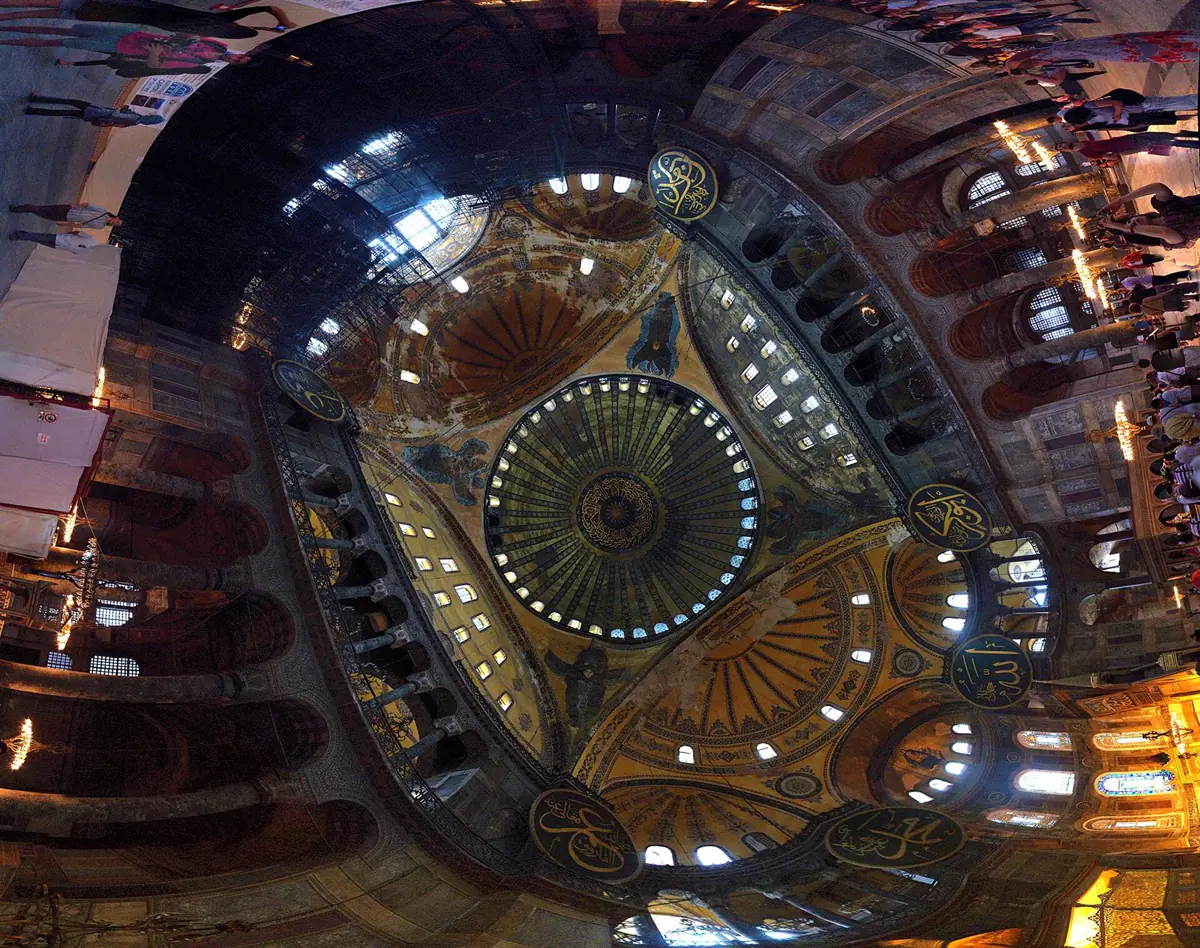
Hagia Sophia, consecrated in 537 AD — for a thousand years the largest church in the world.Ronan Reinart · CC BY-SA 3.0
The best estimate
In 1996 the American sociologist Rodney Stark published The Rise of Christianity: A Sociologist Reconsiders History. In its first chapter he asked what rate of growth would be needed to take the church from a small beginning to the size historians estimate for the year 300.
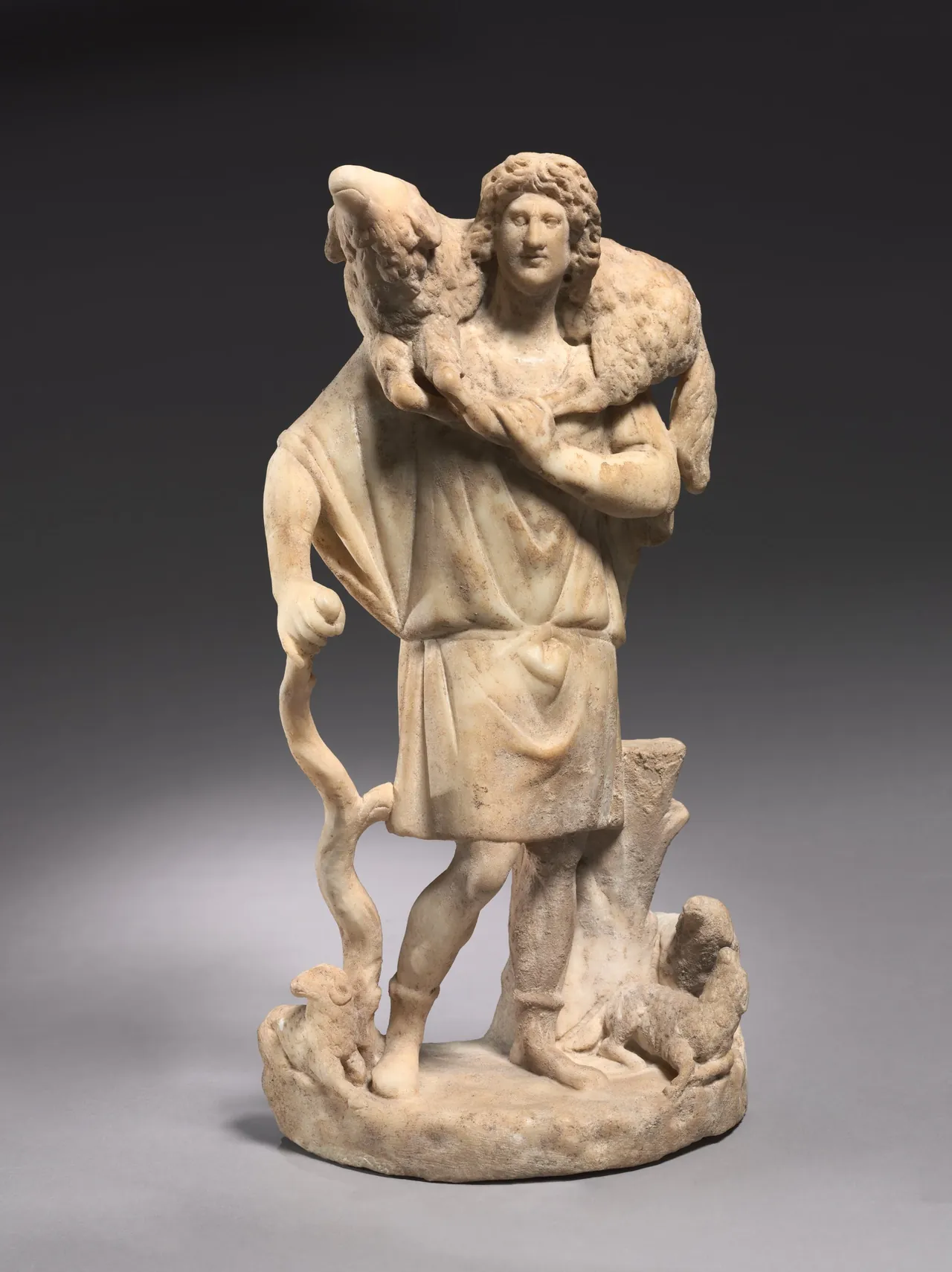
A marble Good Shepherd carved in Anatolia about 280 to 290 CE, made by Christians of the Roman world while the church was still growing under persecution.The Good Shepherd · 280–90 CE · Cleveland Museum of Art · CC0 · museum record · Galeria Regni
For a starting point, Stark wrote, "It seems wise to be conservative here, and thus I shall assume that there were 1,000 Christians in the year 40."1 For an ending point, he took the range of scholarly estimates for the year 300 — five to seven and a half million — and the most widely accepted estimate of the Empire's population at that time, sixty million.2 He then worked out the growth rate that connects them: "Given our starting number, if Christianity grew at the rate of 40 percent per decade, there would have been 7,530 Christians in the year 100, followed by 217,795 Christians in the year 200 and by 6,299,832 Christians in the year 300." A rate of 30 percent a decade would give only 917,334 by 300, far too few; 50 percent would give 37,876,752, far too many. "Hence 40 percent per decade (or 3.42 percent per year) seems the most plausible estimate."3
The figures can be checked. Growth of 40 percent per decade means multiplying by 1.4 every ten years. From AD 40 to AD 100 is six decades, so the number in 100 is 1,000 × 1.4 × 1.4 × 1.4 × 1.4 × 1.4 × 1.4 = 1,000 × 7.53 = 7,530. From 40 to 300 is twenty-six decades, and 1.4 multiplied by itself twenty-six times is about 6,300, which gives Stark's 6,299,832. The percentages follow from dividing by sixty million: 6,299,832 out of 60,000,000 is 10.5 percent. And 3.42 percent a year, compounded for ten years, comes to almost exactly 40 percent a decade.
Slow, then sudden
The most important thing the table shows is not the final number but the shape of the curve. Stark noted: "Progress must have seemed terribly slow during the first century — the projected total is only 7,530 by 100."5 Sixty years after Pentecost, on this model, the believers were still a tiny group scattered through a vast empire.
Yet the rate never changed. What changed was the size of the base. Compare the number of new believers added in two fifty-year spans, using Stark's figures:
| Period | Believers at start | Believers at end | Added in fifty years | |---|---|---|---| | 50 to 100 | 1,400 | 7,530 | 6,130 | | 250 to 300 | 1,171,356 | 6,299,832 | 5,128,476 |
The same steady rate that added about six thousand believers in the second half of the first century added more than five million in the second half of the third. Stark observed that this matches the impression of historians that something extraordinary happened in the late third century: in absolute numbers it did, even though the rate of conversion stayed the same.6
This is the same lesson as the arithmetic in Level 5, worked out in real history. Faithful multiplication looks unimpressive for a long time. Those who measure by early results will give up too soon.
What the numbers do not say
Stark's figures are a model, not a census. They rest on a starting number he chose deliberately to be conservative, an ending range taken from other scholars' estimates, and the assumption of a steady rate. Stark himself compared the 40 percent rate with the 43 percent per decade that he calculated for the Mormon church over the twentieth century, to show that such growth is possible by ordinary means.7 Historians have debated his explanations for why the church grew. But the shape of his curve is consistent with the range of earlier scholarly estimates he set it against.8 As a picture of the order of magnitude, it is the best we have.
It also corrects some exaggerations. Around the end of the second century, the North African writer Tertullian told the Roman authorities: "We are but of yesterday, and we have filled every place among you — cities, islands, fortresses, towns, market-places, the very camp, tribes, companies, palace, senate, forum — we have left nothing to you but the temples of your gods."9 On Stark's figures, Christians in AD 200 were under half of one percent of the Empire. Tertullian was writing as an advocate, and his "filled every place" is rhetoric about how widely believers were spread, not a claim that they were numerous. He was right about the spread. Believers were in every kind of place, but they were still very few.
How it grew: through relationships
How did a tiny minority grow at that steady rate for so long? Stark's answer, as a sociologist, was that it grew through personal ties. "The basis for successful conversionist movements is growth through social networks, through a structure of direct and intimate interpersonal attachments. Most new religious movements fail because they quickly become closed, or semiclosed networks." Successful ones "discover techniques for remaining open networks, able to reach out and into new adjacent social networks."10 Each new believer brought a new set of relationships with him; "as movements grow, their social surface expands proportionately."11
A Christian adds what the sociologist does not: that behind every conversion is the work of the Holy Ghost. Jesus said of Him, "And when he is come, he will reprove the world of sin, and of righteousness, and of judgment" (John 16:8). But the human pattern is exactly what Acts describes: the jailer and "all that were in his house" (Acts 16:32), the household of Lydia, the man sent home "to thy friends" (Mark 5:19). The gospel ran along the lines of family, friendship and work.
What outsiders saw
Some of the best evidence for how the movement grew comes from its opponents.
Early in the second century, Pliny the Younger, governing the province of Bithynia, wrote to the emperor Trajan that "many persons of every age, every rank, and also of both sexes are and will be endangered," and that "the contagion of this superstition has spread not only to the cities but also to the villages and farms."12 The movement had crossed every social line and reached the countryside.
Persecution did not stop it. Tertullian ended the same Apology with a line that has been quoted ever since: "The oftener we are mown down by you, the more in number we grow; the blood of Christians is seed."13
Around AD 260, during a great epidemic, Dionysius, bishop of Alexandria, described how believers stayed to nurse the sick when others fled: "The most of our brethren were unsparing in their exceeding love and brotherly kindness. They held fast to each other and visited the sick fearlessly, and ministered to them continually, serving them in Christ. And they died with them most joyfully."14 Stark devotes a chapter to arguing that this care, by keeping more of the sick alive, itself helped the church grow, and that pagans who were nursed by Christians were drawn into Christian networks.15
A century later, the emperor Julian, who tried to restore the old gods, admitted the effect in a letter to a pagan priest: "The impious Galileans support not only their poor, but ours as well, everyone can see that our people lack aid from us."16
Here, from the mouths of enemies, are the marks of the movement: it reached every kind of person, it endured suffering, and its love was visible to outsiders. "By this shall all men know that ye are my disciples, if ye have love one to another" (John 13:35).
It grew while it was careful
One more thing deserves notice. The church that grew this way was not careless about who belonged. Church orders of the period describe new believers being instructed before baptism, sometimes for a long period, and their lives examined for whether they had "lived soberly," "honoured the widows," and "visited the sick."17 The movement grew steadily while asking a great deal of its members. Growth and discipleship were not rivals.
Part 3 — Later Movements: Herrnhut, the Methodists, and Carey
4 min read
This part matters because God did not stop working after the early centuries. Three eighteenth-century movements, all well documented in their own words, show the same patterns at work in a later age.
The Moravians of Herrnhut
In the 1720s, persecuted Protestants from Moravia settled on the Saxon estate of Count Zinzendorf, at a place called Herrnhut — in Hutton's phrase, the "Watch of the Lord". They were divided and quarrelsome. On 13 August 1727, at a communion service in the parish church at Berthelsdorf, they came, in the words of their historian J. E. Hutton, to "the firm conviction that they were one in Christ." "We learned," said the Brethren, "to love." Afterwards they honoured the day "as the true spiritual birthday of the Renewed Church of the Brethren."18
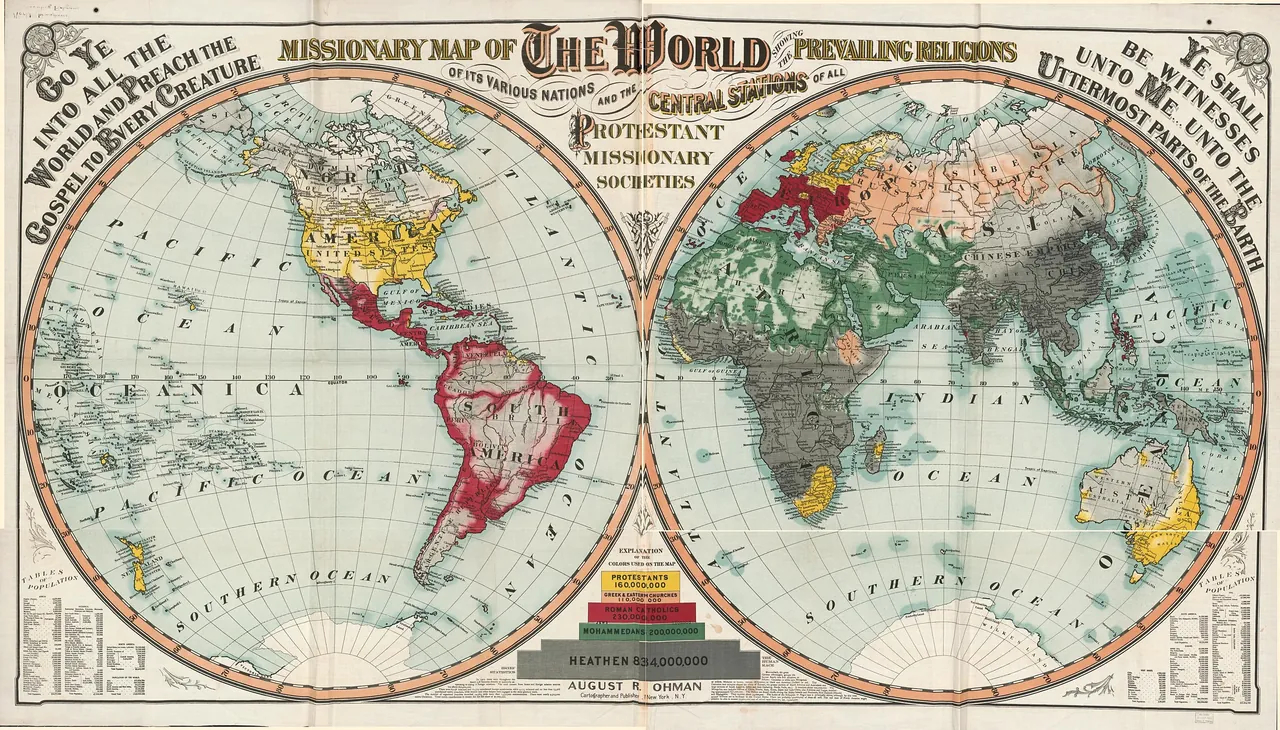
A missionary map of the world from 1902 showing the prevailing religions of the nations and the central stations of the Protestant missionary societies.Missionary map of the world showing prevailing religions of its various nations and the central stations of all Protesta · 1902 · Library of Congress · Public domain · museum record · Galeria Regni
Two weeks later, on 27 August, they began a system of "Hourly Intercession" in which brothers and sisters took turns so that prayer went on day and night. Hutton wrote, "It is said to have lasted without interruption for over a hundred years."19 The figure is his community's tradition, and he reports it as such.
Prayer was followed by sending. On 21 August 1732, two young men, the potter Leonard Dober and the carpenter David Nitschmann, set out on foot from Herrnhut for the Danish West Indian island of St. Thomas, to reach the enslaved people there. Hutton describes them as having "only about thirty shillings in their pockets" and no missionary society behind them. When a court official in Copenhagen asked how they would live, Nitschmann answered, "We shall work... as slaves among the slaves."20 In the decades that followed the Moravians sent missionaries to Greenland, North America, South Africa and elsewhere.
A small, praying, loving community gave away its young people to the hardest places. That is Antioch again.
The Methodists
The Moravians had a direct influence on John Wesley. Hutton records that Wesley first met them on his voyage to Georgia, where their calm in a storm showed him a confidence in God he knew he lacked, and that he later visited Herrnhut.21
Its genius was not Wesley's preaching, great as it was, but its structure for discipleship: societies, divided into classes of "about twelve persons" each with a lay leader who met them weekly "to inquire how their souls prosper," and smaller bands for confession and prayer.22 The companion papers describe these in detail. What matters here is what they produced.
Wesley's biographer Luke Tyerman, using the conference minutes, recorded that at the conference of 1770 there were 120 travelling preachers and 29,406 members.23 By the last conference of Wesley's life the figures had grown, in the United Kingdom, from 43,380 members in 1780 to 71,568; and in America, from 8,504 members in 1780 to 57,631 in 1790. With 5,350 members in new mission stations, the total in 1790 was 134,549.24
Those figures can be checked against each other: 71,568 + 57,631 + 5,350 = 134,549. And they show how fast the American work grew once it had its own lay leaders and travelling preachers: from 8,504 to 57,631 in ten years is nearly a sevenfold increase, while the British membership grew by about two-thirds over the same decade. The movement grew fastest where it was youngest and most mobile.
William Carey and the missionary societies
In 1792, a year after Wesley's death, an English Baptist pastor and shoemaker named William Carey published An Enquiry into the Obligations of Christians to Use Means for the Conversion of the Heathens. Its first section asked "whether the Commission given by our Lord to his Disciples be not still binding on us," and answered that it was: if the command to "teach all nations" was only for the apostles, then so was the promise that follows it: "lo, I am with you alway, even unto the end of the world" (Matthew 28:20).25
Carey's book is remarkable for its practical proposal. He compared Christians to merchants who risk everything for profit, and wrote: "Let then every one in his station consider himself as bound to act with all his might, and in every possible way for God." Then he proposed that "a company of serious Christians, ministers and private persons," form a society, with a committee "whose business it should be to procure all the information they could upon the subject, to receive contributions, to enquire into the characters, tempers, abilities and religious views of the missionaries, and also to provide them with necessaries for their undertakings."26 At a ministers' meeting at Kettering on 2 October 1792, Carey's fellow Particular Baptists resolved to form such a society, and in 1793 Carey himself went out to Bengal.27
Carey's proposal shows a movement building structure for the right reasons: to gather information, to handle money accountably, to examine the character of those sent, and to support them. Part 5 returns to this.
This part matters because, while every movement is different, the ones described above share certain marks. They are not a formula; God is free. But they are the things He has used, and they are all things a faithful believer can pursue.
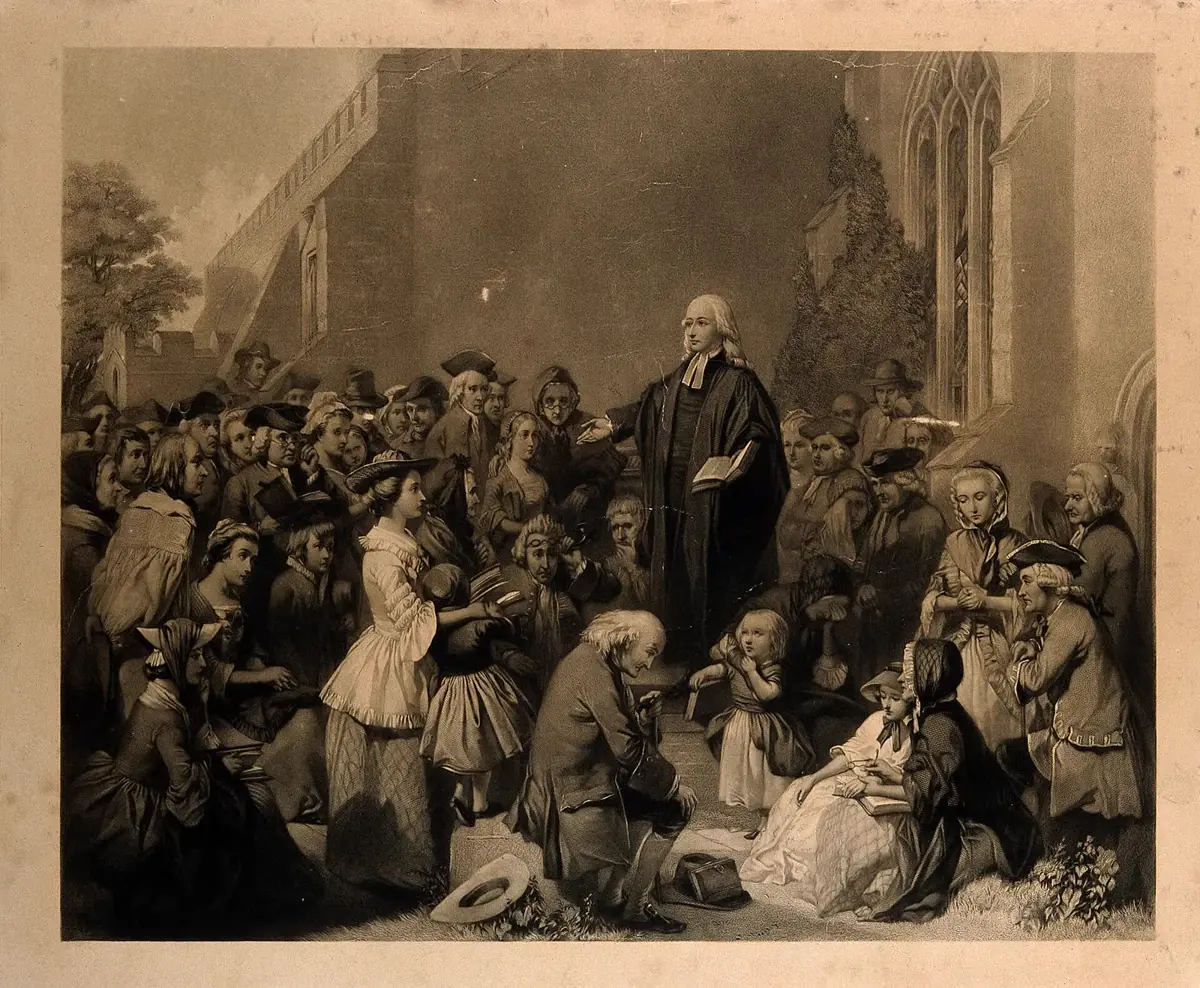
John Wesley preaching in the open air (18th-century engraving) — the message carried outside the building to wherever people already were.Wellcome Collection · CC BY 4.0
1. The word at the centre
"So mightily grew the word of God and prevailed" (Acts 19:20). In Acts, in the early church's instruction of converts, in Wesley's societies built around preaching and Scripture, the word was central. A movement that drifts from the Scriptures may grow for a while, but it is no longer the movement of Acts. The King James Bible, read, taught and obeyed, is the seed.
2. Prayer
The church of Acts was born in a prayer meeting: "These all continued with one accord in prayer and supplication" (Acts 1:14). When they were threatened, they prayed, "and when they had prayed, the place was shaken where they were assembled together; and they were all filled with the Holy Ghost, and they spake the word of God with boldness" (Acts 4:31). Antioch sent Barnabas and Saul after fasting and prayer (Acts 13:2-3). Herrnhut prayed around the clock and then sent its sons. Paul asked the churches to pray "that the word of the Lord may have free course, and be glorified" (2 Thessalonians 3:1). Jesus' own first instruction about the harvest was to pray for labourers (Matthew 9:38).
3. The power of the Spirit
"But ye shall receive power, after that the Holy Ghost is come upon you: and ye shall be witnesses unto me" (Acts 1:8). The movement of Acts was marked by the Spirit's power in preaching, in boldness, and in signs. The believers prayed, "grant unto thy servants, that with all boldness they may speak thy word, By stretching forth thine hand to heal; and that signs and wonders may be done by the name of thy holy child Jesus" (Acts 4:29-30). Paul wrote that his preaching was "in demonstration of the Spirit and of power: That your faith should not stand in the wisdom of men, but in the power of God" (1 Corinthians 2:4-5).
The gifts of the Spirit and deliverance from evil spirits are for today, and guests on my show testify to both. Every gift is tested by the word of God and kept within the limits the word sets. But the power in Acts always served the word and the name of Jesus; it was never a show and never for sale. When Simon the sorcerer offered money for it, Peter said, "Thy money perish with thee" (Acts 8:20). Signs are not guaranteed on demand, and no movement should be built on the promise of them. It should be built on the word, with expectation that God will confirm it as He chooses.
4. Every believer a witness
"Therefore they that were scattered abroad went every where preaching the word" (Acts 8:4). The founders of the church at Antioch are unnamed. Pliny found the faith in villages and on farms. Wesley's class leaders were weavers and servants. Movements spread when ordinary believers speak about Christ in ordinary places. They stall when the work is left to professionals.
5. Small companies in homes
The church of Acts met "from house to house" (Acts 2:46), and Paul greeted churches by the houses they met in. Wesley's movement held together through classes of about twelve. The large gathering has its place — the temple courts, the field preaching — but the life of a movement is in its small companies, where people are known, discipled, and cared for.
6. Local leaders, raised quickly
Paul "ordained them elders in every church" (Acts 14:23) on his first journey and left Titus to "ordain elders in every city" (Titus 1:5). Wesley's societies were led almost entirely by lay people. Movements multiply when leaders are raised up from among the new believers, trained close at hand, released early into responsibility, and overseen. Level 5 studies this in full.
7. Love that outsiders can see
Dionysius's nurses and Julian's complaint say the same thing: the love of Christians for one another, and for their neighbours, was visible. "Let your light so shine before men, that they may see your good works, and glorify your Father which is in heaven" (Matthew 5:16). God's people in exile were told to "seek the peace of the city whither I have caused you to be carried away captives, and pray unto the LORD for it" (Jeremiah 29:7). Paul adds, "As we have therefore opportunity, let us do good unto all men, especially unto them who are of the household of faith" (Galatians 6:10).
8. Suffering endured
The apostles "departed from the presence of the council, rejoicing that they were counted worthy to suffer shame for his name. And daily in the temple, and in every house, they ceased not to teach and preach Jesus Christ" (Acts 5:41-42). Persecution scattered the Jerusalem church and spread the word. Tertullian called the blood of Christians seed. Dober and Nitschmann went to work "as slaves among the slaves." Jesus said, "Except a corn of wheat fall into the ground and die, it abideth alone: but if it die, it bringeth forth much fruit" (John 12:24). No movement of the gospel has been comfortable.
9. Open, not closed
Stark's observation that movements die when they "become closed, or semiclosed networks"28 has a biblical counterpart. The Jerusalem believers at first spoke "to none but unto the Jews only" (Acts 11:19), until some men of Cyprus and Cyrene spoke to Greeks as well. A church that only ever talks to itself will not multiply, however healthy it feels. Every believer needs friendships outside the church, and every church needs doors that open outward.
This part matters because every movement that lasts more than a few years must deal with organisation and with money, and both can either serve the gospel or strangle it. Scripture and the early church give clear guardrails.
Forms serve the work
John Wesley called his classes and bands "merely prudential, not essential, not of divine institution," and said that by changing them as needed, "We prevent, so far as in us lies, their growing formal and dead."29 That is the right attitude to every structure in a movement. Elders, deacons, the gathering of the church, baptism and the Lord's Supper are given in Scripture. Almost everything else — networks, committees, schedules, buildings, curricula — is prudential. Use what serves; change what hardens. "Let all things be done decently and in order" (1 Corinthians 14:40).
A movement needs enough structure to keep leaders accountable and money honest, and no more. Carey's proposed society had a clear purpose: to gather information, to receive contributions, to examine the character of those sent, and to supply them.30 Each of those is a guardrail, not an empire.
Supporting the work
Scripture teaches both that gospel workers may be supported and that they must not be greedy. "Even so hath the Lord ordained that they which preach the gospel should live of the gospel" (1 Corinthians 9:14). And to Timothy, "Let the elders that rule well be counted worthy of double honour, especially they who labour in the word and doctrine. For the scripture saith, Thou shalt not muzzle the ox that treadeth out the corn. And, The labourer is worthy of his reward" (1 Timothy 5:17-18). Jesus Himself was supported by women "which ministered unto him of their substance" (Luke 8:3).
At the same time, Paul often chose to work with his own hands so as not to burden new churches. At Corinth he stayed with Aquila and Priscilla, "because he was of the same craft, he abode with them, and wrought: for by their occupation they were tentmakers" (Acts 18:3). He reminded the Ephesian elders, "ye yourselves know, that these hands have ministered unto my necessities, and to them that were with me" (Acts 20:34). To the Thessalonians he explained why: "Not because we have not power, but to make ourselves an ensample unto you to follow us" (2 Thessalonians 3:9).
Many movements have spread through believers who supported themselves by ordinary work. Dober and Nitschmann planned to work their way. That is not the only biblical model, but it is one, and it keeps a young movement free.
The early church's warnings
The Didache, one of the earliest Christian writings outside the New Testament, gave churches simple rules for testing travelling ministers. It is not Scripture, but it shows how seriously the first believers took this. "Let every apostle that comes to you be received as the Lord. But he shall not remain except one day; but if there be need, also the next; but if he remain three days, he is a false prophet. And when the apostle goes away, let him take nothing but bread until he lodges; but if he ask money, he is a false prophet." And: "whoever says in the Spirit, Give me money, or something else, you shall not listen to him; but if he says to you to give for others' sake who are in need, let no one judge him."31
It even coined a word for those who used the faith to live off others. A visitor who would not work, it said, "is a Christ-monger. Watch that you keep aloof from such."32
Wesley's rule for his preachers was in the same spirit: "Take no money of any one... Let there be no pretence to say, We grow rich by the Gospel."33
Honest in the sight of men
When Paul collected a large gift from the Gentile churches for the poor in Jerusalem, he arranged for representatives of the churches to travel with it. His reason: "Avoiding this, that no man should blame us in this abundance which is administered by us: Providing for honest things, not only in the sight of the Lord, but also in the sight of men" (2 Corinthians 8:20-21). That is a principle for every movement:
More than one person handles money. Never let one leader control the funds alone.
Books are open. Those who give should be able to see where it goes.
Leaders are not paid by results. No one should profit from numbers.
No pressure in giving. The Macedonians gave "of themselves" (2 Corinthians 8:3); giving is never extracted by guilt, fear or promises of reward. Prosperity teaching — the claim that giving guarantees wealth — is not the gospel.
Give to the poor. One of the Antioch church's first recorded acts was to send relief to famine-struck Judea, "every man according to his ability" (Acts 11:29).
Accountable leaders
The same principle applies to authority. In Acts, decisions affecting the whole church were made together (Acts 6:2-6; 15:6-29). Elders were plural in every church. Paul, though an apostle, went up to Jerusalem and "communicated unto them that gospel which I preach among the Gentiles" (Galatians 2:2). A movement in which one leader answers to no one is one bad decision away from disaster.
This part matters because every movement in this paper eventually declined, at least in some places. Knowing how they die is the best protection for a movement that is alive.
Wesley's warning
Near the end of his life John Wesley wrote a short piece called "Thoughts upon Methodism," printed in his Arminian Magazine for 1787. Its opening lines are among the most sobering any movement leader has written:
"I am not afraid, that the people called Methodists should ever cease to exist either in Europe or America. But I am afraid, lest they should only exist as a dead sect, having the form of religion without the power. And this undoubtedly will be the case, unless they hold fast both the doctrine, spirit, and discipline with which they first set out."34
Doctrine, spirit and discipline. Wesley named the three things a movement loses as it dies: what it believes, the life of the Holy Ghost in it, and the practices that kept it accountable. The words "having the form of religion without the power" echo his own General Rules, which defined a society as people "having the form and seeking the power of godliness."35 A movement is born seeking the power. It dies keeping only the form.
Ephesus
The saddest example is in Scripture itself. Ephesus was the city from which "all they which dwelt in Asia heard the word of the Lord Jesus" (Acts 19:10). Paul spent three years there, and warned its elders that "of your own selves shall men arise, speaking perverse things, to draw away disciples after them" (Acts 20:30).
Later, the risen Christ wrote to the same church. He praised its doctrinal vigilance: "thou hast tried them which say they are apostles, and are not, and hast found them liars" (Revelation 2:2). And then: "Nevertheless I have somewhat against thee, because thou hast left thy first love. Remember therefore from whence thou art fallen, and repent, and do the first works; or else I will come unto thee quickly, and will remove thy candlestick out of his place, except thou repent" (Revelation 2:4-5).
Ephesus kept its doctrine and lost its love. Wesley feared Methodism would keep its form and lose its power. Both are ways to die.
Five causes of death
From Scripture and history, five causes recur.
Drift from the word. "For the time will come when they will not endure sound doctrine; but after their own lusts shall they heap to themselves teachers, having itching ears" (2 Timothy 4:3). Paul warned the Galatians that even an angel preaching "any other gospel" was to be accursed (Galatians 1:8). Movements die when the gospel is softened, repentance is dropped, or Scripture is made to say what the age wants.
Loss of first love. Ephesus. Activity continues, orthodoxy is defended, but love for Christ and for people grows cold. The cure Christ gave was to "remember," "repent," and "do the first works."
Control. A movement that began in freedom can harden into a system that tells people it alone is right, controls their lives, and punishes those who leave. Jesus forbade His followers to rule like the Gentiles (Mark 10:42-43). Peter told elders not to be "lords over God's heritage" (1 Peter 5:3).
Celebrity. When a movement becomes about its leader, it rises and falls with him. "I am of Paul; and I of Apollos" (1 Corinthians 1:12) is the beginning of the end. "For we preach not ourselves, but Christ Jesus the Lord; and ourselves your servants for Jesus' sake" (2 Corinthians 4:5).
Money. "For the love of money is the root of all evil: which while some coveted after, they have erred from the faith" (1 Timothy 6:10). The Didache's "Christ-monger" is always waiting at the door of a successful movement.
The generation that knew not
Behind all of these is the danger Judges names: "there arose another generation after them, which knew not the LORD, nor yet the works which he had done for Israel" (Judges 2:10). Movements die when the first generation fails to disciple the second. That is why this paper sits at the end of a series that begins with discipling one person. There is no movement without multiplication, and no multiplication without discipleship.
Vanessa Sprenger told her story on The King Is Coming Show (TKIC #6): raised, in her telling, in a group that told her it alone was saved. Watch it in her own words: youtube.com/watch?v=3dPK9NJ8GqY Vanessa's account of what happened to her, shared as her testimony — weigh it for yourself.
Stories like Vanessa's are worth hearing in full, in her own words, by anyone who hopes to lead others.
This part matters because a paper about movements can leave a reader either discouraged ("that could never happen here") or grandiose ("I will start one"). Scripture calls us to neither. It calls us to be faithful where we are, and to trust God for what He will do.
Pray for your place
Begin by praying for the people around you by name and for the place where you live. "Pray ye therefore the Lord of the harvest, that he will send forth labourers into his harvest" (Matthew 9:38). Pray as Paul asked: "that God would open unto us a door of utterance" (Colossians 4:3). Pray for those in authority, "that we may lead a quiet and peaceable life in all godliness and honesty" (1 Timothy 2:2). Gather others to pray with you. Herrnhut prayed before it sent.
Start with your household and your network
The gospel in Acts and in Stark's analysis ran along existing relationships. Your first field is your own home, your extended family, your friends, your workplace, your street. "Go home to thy friends, and tell them how great things the Lord hath done for thee" (Mark 5:19). Write down the people in your life who do not know Christ. They are your Antioch.
Disciple a few, and teach them to do the same
Every movement in this paper was built on discipleship. Use Level 4 to disciple one or two people. Use Level 5 to raise up from them leaders who will disciple others. Watch for the third and fourth generations. That is where a movement begins — not in an event, but in a chain.
Gather small companies
Start a small company — a class of a few believers who meet weekly in a home to read the word, ask how each other's souls prosper, pray, and reach out. When it grows past a dozen or so, raise up a leader from within it and divide it, as Wesley's classes divided. Keep each one open to newcomers. Keep each one connected to a local church.
Work with the local church
A movement of the gospel is not a rival to the local church; it is the local church doing its work. Paul's churches were real congregations with elders. Wesley wanted his societies to remain within the Church of England. Whatever you begin, do it under the oversight of faithful elders, in fellowship with other Bible-believing churches, and without building "upon another man's foundation" (Romans 15:20) in a way that steals sheep from other faithful flocks.
Serve your city visibly
Seek the good of the place where you live (Jeremiah 29:7). Care for the sick, the poor, the widow, the prisoner, the child. The love Dionysius described and Julian envied was not a strategy; it was obedience. But it opened doors that preaching alone did not.
Measure honestly
If you count, count the right things. Not how many attend an event, but how many are being discipled; how many are leading who were not leading before; how many groups have been started by groups; how many generations the chain has reached. And be honest. Do not inflate numbers to impress donors or yourself. The early Methodists recorded their membership every year, and when it fell they said so.
Be patient
Stark's table is a lesson in patience. On his model, sixty years after Pentecost the church numbered about seven and a half thousand people across the Empire. Most of the believers of the first century died without seeing what their faithfulness would produce. "These all died in faith, not having received the promises, but having seen them afar off" (Hebrews 11:13). Jesus said, "One soweth, and another reapeth" (John 4:37).
The kingdom is "like to a grain of mustard seed... Which indeed is the least of all seeds: but when it is grown, it is the greatest among herbs" (Matthew 13:31-32), and "like unto leaven, which a woman took, and hid in three measures of meal, till the whole was leavened" (Matthew 13:33). Isaiah heard the Lord promise His people: "A little one shall become a thousand, and a small one a strong nation: I the LORD will hasten it in his time" (Isaiah 60:22). His time, not ours.
"And let us not be weary in well doing: for in due season we shall reap, if we faint not" (Galatians 6:9). And, "Therefore, my beloved brethren, be ye stedfast, unmoveable, always abounding in the work of the Lord, forasmuch as ye know that your labour is not in vain in the Lord" (1 Corinthians 15:58).
The movement of Acts began with a hundred and twenty people in a room, praying. It spread through persecution, through unnamed believers who would not stop speaking, through churches that met in houses and sent their best leaders away, and through a word that "grew and multiplied" (Acts 12:24). In the centuries that followed, on the best estimates we have, it grew at a steady rate that looked unimpressive for generations and then changed the Roman world. Its enemies testified to its love and its endurance. Later, in a Saxon village, in English and American towns, and in the study of a shoemaker-pastor in Leicester, God did the same kind of thing again, through prayer, discipleship, sending and sacrifice.
We have seen the marks these movements shared: the word, prayer, the power of the Spirit, every believer a witness, small companies, local leaders, visible love, suffering endured, open doors. We have seen the guardrails on structure and money, from Paul's tentmaking to the Didache's warning against the Christ-monger. And we have seen how movements die: by drifting from the word, losing their first love, turning to control, celebrity or money, and failing to disciple the next generation. Wesley's fear — "a dead sect, having the form of religion without the power" — stands over every one.
No one launches a movement but God. But God has always used ordinary, faithful people who prayed, spoke, discipled, sent and endured. That is open to every believer reading this.
A next step
Write down the name of your street, your town, or your workplace, and begin praying for it daily. Write down the names of people in your network who do not know Christ, and begin praying for them. If you have not yet discipled anyone, begin with Level 4. If you have, begin with Level 5. And ask the Lord of the harvest to do what only He can do.
An invitation
If you have read this far and you are not sure you know the Lord Jesus yourself, a movement is not what you need. You need Him. "For God so loved the world, that he gave his only begotten Son, that whosoever believeth in him should not perish, but have everlasting life" (John 3:16). Repent of your sin, put your trust in Christ who died and rose again, and you will be saved. Then find a Bible-believing church, be baptized, and ask someone to disciple you. Every movement in history began with people who did exactly that. The whole Bible is free at kylelauriano.com/library. Free truth. No pressure.
1Rodney Stark, The Rise of Christianity: A Sociologist Reconsiders History (Princeton: Princeton University Press, 1996), 5. Page references in this paper are to the 1997 HarperSanFrancisco paperback.↩
2Stark, Rise of Christianity, 5–6. Stark cites earlier estimates by Goodenough, von Hertling, Grant and MacMullen, and for the population figure Boak, Russell, MacMullen and Wilken.↩
4Stark, Rise of Christianity, 7, table 1.1, "Christian Growth Projected at 40 Percent per Decade." Percentages are of an estimated population of 60 million.↩
14Dionysius of Alexandria, quoted in Eusebius, Church History 7.22.7, trans. Arthur Cushman McGiffert, in Nicene and Post-Nicene Fathers, 2nd ser., vol. 1 (1890). Online: https://www.newadvent.org/fathers/250107.htm.↩
15Stark, Rise of Christianity, ch. 4, "Epidemics, Networks, and Conversion," 73–94.↩
16Julian, quoted in Stark, Rise of Christianity, 84.↩
17Apostolic Tradition 20.1, in The Apostolic Tradition of Hippolytus, trans. Burton Scott Easton (Cambridge: Cambridge University Press, 1934). Online: https://www.gutenberg.org/ebooks/61614. Its authorship and date are debated.↩
18J. E. Hutton, A History of the Moravian Church, 2nd ed. (1909), bk. 2, ch. 3. Online: https://www.gutenberg.org/ebooks/2099.↩
19Hutton, History of the Moravian Church, bk. 2, ch. 3.↩
20Hutton, History of the Moravian Church, bk. 2, ch. 6.↩
21Hutton, History of the Moravian Church, bk. 2, chs. 2 and 9. The movement Wesley led in England became one of the most carefully documented gospel movements in history, because its annual conference recorded membership every year.↩
22John Wesley, The Nature, Design, and General Rules of the United Societies (1743). Online: https://www.umc.org/en/content/the-general-rules-of-the-methodist-church.↩
23Luke Tyerman, The Life and Times of the Rev. John Wesley, M.A., Founder of the Methodists, vol. 3 (New York: Harper & Brothers, 1872), under the year 1770. Online: https://www.gutenberg.org/ebooks/76882.↩
24Tyerman, Life and Times, 3:under the year 1790. Tyerman's summary table gives worldwide totals of 52,334 members in 1780 and 134,549 in 1790; his 1780 total does not match his own component figures, which sum to 51,884 (43,380 + 8,504), so only the 1790 total is used here.↩
25William Carey, An Enquiry into the Obligations of Christians to Use Means for the Conversion of the Heathens (Leicester: Ann Ireland, 1792), sect. 1. Online: https://www.gutenberg.org/ebooks/11449.↩
27George Smith, The Life of William Carey, Shoemaker & Missionary, chs. 2–3, quoting the minutes of the Northampton ministers' meeting. Online: https://www.gutenberg.org/ebooks/2056.↩
29John Wesley, A Plain Account of the People Called Methodists, 2nd ed. (London: W. Strahan, 1749), II.9. Spelling modernised. Online: https://wesleyscholar.com/wp-content/uploads/2019/02/Plain-Account-People-Called-Methodists-1749.pdf.↩
31Didache 11, trans. M. B. Riddle, in Ante-Nicene Fathers, vol. 7, ed. Alexander Roberts, James Donaldson and A. Cleveland Coxe (Buffalo: Christian Literature Publishing, 1886). Online: https://www.newadvent.org/fathers/0714.htm.↩
34John Wesley, "Thoughts upon Methodism," Arminian Magazine (1787), quoted in Luke Tyerman, The Life and Times of the Rev. John Wesley, vol. 3 (New York: Harper & Brothers, 1872), under the year 1787. Online: https://www.gutenberg.org/ebooks/76882.↩
Seven people who say they met Jesus. What happened, in their own words.
Seven testimonies from The King Is Coming Show, one a morning — the story as they tell it, the verse the story lands on in the 1611 King James, and the page itself. Then the teaching that explains it. Free.
This is practical teaching, not proof. It's drawn from Scripture and from walking this road myself. If you're still weighing the basics — whether God is real, whether the Bible can be trusted — I'd encourage you to start with the Skeptic resources in the Research Hub before diving in here.