What the New Testament and church history actually show about churches that meet in homes, and how to plant one that is faithful, safe and lasting.
Abstract
The New Testament greets "the church that is in their house" more than once. What did those gatherings look like, what made them churches rather than clubs, and can believers today plant one faithfully? This paper reads the King James Bible first, gathering every house in the record from Jerusalem to Colossae, and then the earliest Christian witnesses outside it: the Didache, Pliny's letter to Trajan, Justin Martyr and Tertullian, the excavated Christian building at Dura-Europos, and later house gatherings under Spener, Bunyan, Wesley and the Chinese house churches. It concludes that meeting in a home is a sound, apostolic practice but not a doctrine; that what makes a gathering a church is the Word, prayer, the ordinances, qualified leadership, discipline and mission; and that a house church must be built on the same foundations as every other church. Practical chapters cover leaders, the gathering, order and care, money, the law, child safety and multiplication. It is written for mature believers who sense a call to gather a church in their home, and for the elders who will counsel them.
What’s inside
·Introduction
Part 1Part 1: The Church in the House: Scripture and History
Part 2Part 2: Is It a Church? What Makes a Gathering a Church
Part 3Part 3: Before You Begin: Calling, Character and Counsel
Part 4Part 4: The Gathering: Word, Prayer, Supper and Song
Part 5Part 5: Shepherding: Leaders, Order, Care and Discipline
Part 6Part 6: Money, the Law and Keeping People Safe
Part 7Part 7: Growth and Multiplication
·Conclusion
Research paper · 9 chapters · 20 notes · October 2026
"And daily in the temple, and in every house, they ceased not to teach and preach Jesus Christ." — Acts 5:42 (KJV)Read in the 1611 →
About 51 minutes · 9 parts · the PDF has the same text
Introduction
3 min read
Paul ends his letter to the Romans with a page of greetings. Most readers skim it. They should not, because tucked into that list of names is one of the plainest facts about the first Christians: "Greet Priscilla and Aquila my helpers in Christ Jesus: Who have for my life laid down their own necks: unto whom not only I give thanks, but also all the churches of the Gentiles. Likewise greet the church that is in their house" (Romans 16:3-5).
The church that is in their house. Not a building with a steeple, not a campus, not a brand. A couple who opened their door, and a company of believers who met behind it. Paul says the same of the same couple in Ephesus (1 Corinthians 16:19), and of Philemon in Colossae (Philemon 1:2), and of Nymphas in Laodicea (Colossians 4:15).
That fact has drawn believers in every century. Some came to the house because they were persecuted and had nowhere else to go. Some came because they wanted closer fellowship than a crowded sanctuary could give. Some came because they were restless with the church they had and wanted something they imagined was purer. The motives matter, and this paper will come back to them.
What this paper is
This is a study, not a sales pitch for a movement. It argues from the King James Bible first. It then sets beside Scripture what the earliest Christians outside the New Testament wrote about their gatherings, and what history records of believers who met in homes since. Every source is named and footnoted so you can check it.
It has two halves. The first half (Parts 1 and 2) asks what the evidence actually shows: where the first churches met, how the practice developed, and what makes any gathering a church at all. The second half (Parts 3 to 7) is practical: preparing to plant, ordering the gathering, shepherding the people, handling money and the law, protecting children, and multiplying. A short conclusion follows.
What it will not do
It will not tell you that a church that meets in a building is less faithful than one that meets in a living room. The New Testament does not say so. Nor will it tell you that a house church is an easy way to escape accountability. It is not. A house church is a church, with every duty a church has, and some dangers that larger churches are better shielded from.
It will not teach anything as part of worship that the New Testament does not give. The first churches gathered around the apostles' doctrine, fellowship, the breaking of bread and prayers (Acts 2:42). That is enough. A house church that adds ceremonies of its own invention has already begun to drift.
A word about me
I was raised Roman Catholic but never really connected — I went through the motions, fell asleep in the pews, and faked being sick to skip Mass. Eventually I gave up and called myself an atheist. I decided to read the Bible for one reason: to disprove it, so I'd have an excuse to stop going to church for good. It did the opposite. I came to faith in 2022, and my wife came to faith a month later. The rest of my story is at kylelauriano.com/about.
I mention it because that same man is now writing about how to plant a church. The Lord has a sense of humour. I also mention it because of another line in my story: "So I swung back hard to religion, said the rosary every night, and still felt nothing." A house church does not fix that. Only Christ does. But a small company of believers who know your name and open the Scriptures with you can be one of the ways He meets you.
A note on Scripture: every verse in this paper is quoted from the King James Bible. You can read it free in the 1611 Reader at kylelauriano.com/library, and a KJV with Strong's Concordance is the best study tool most believers will ever own.
Part 1 — The Church in the House: Scripture and History
15 min read
This part matters because the case for a house church must stand on what the text says, not on what we wish it said. Enthusiasts sometimes claim more than the evidence gives; critics sometimes claim less. So we will walk through the record city by city and then ask what it proves.
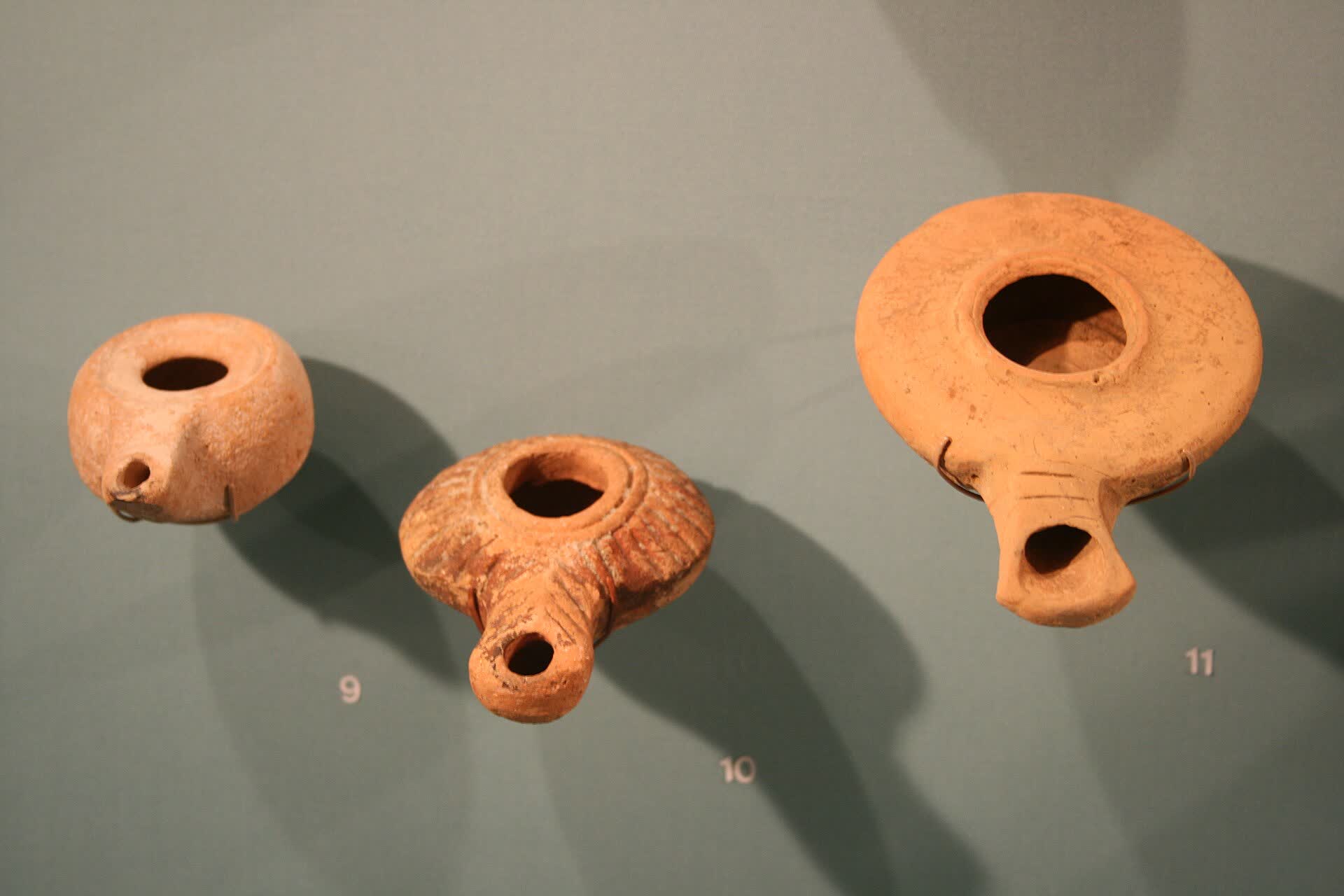
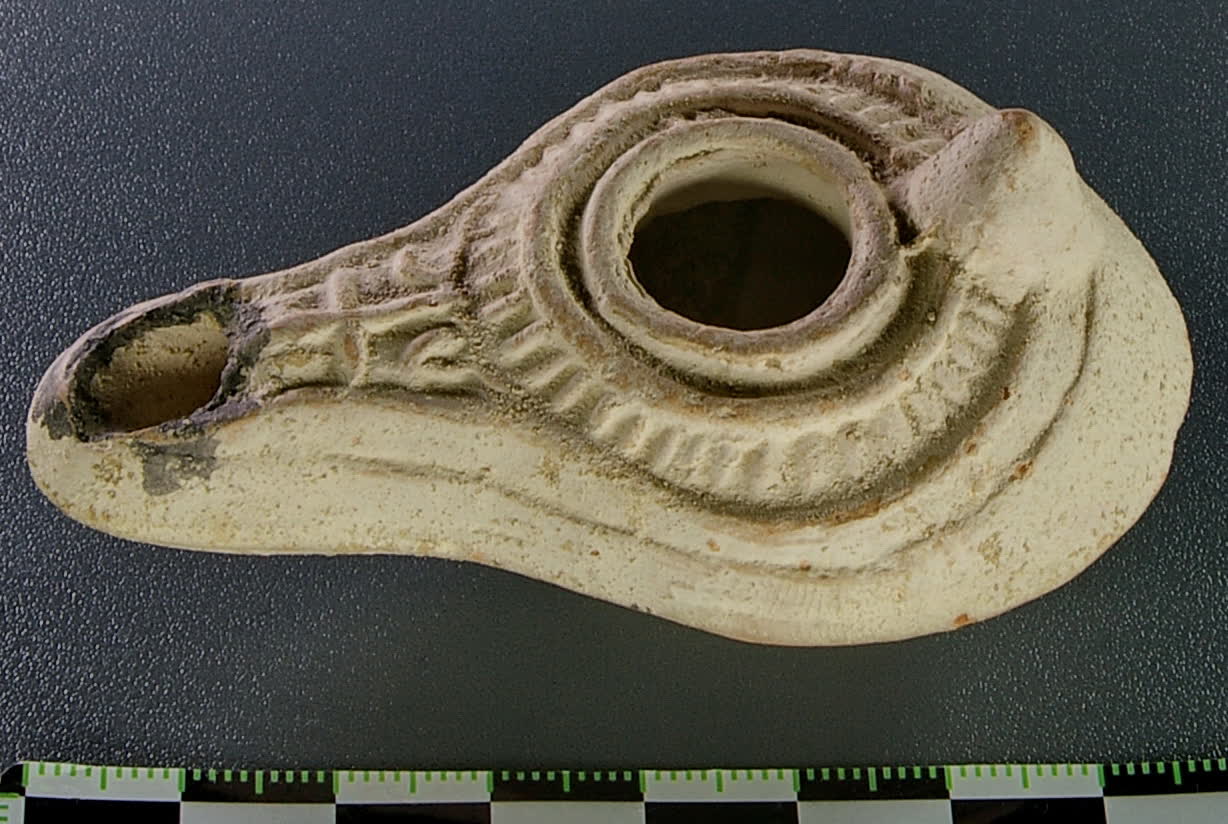
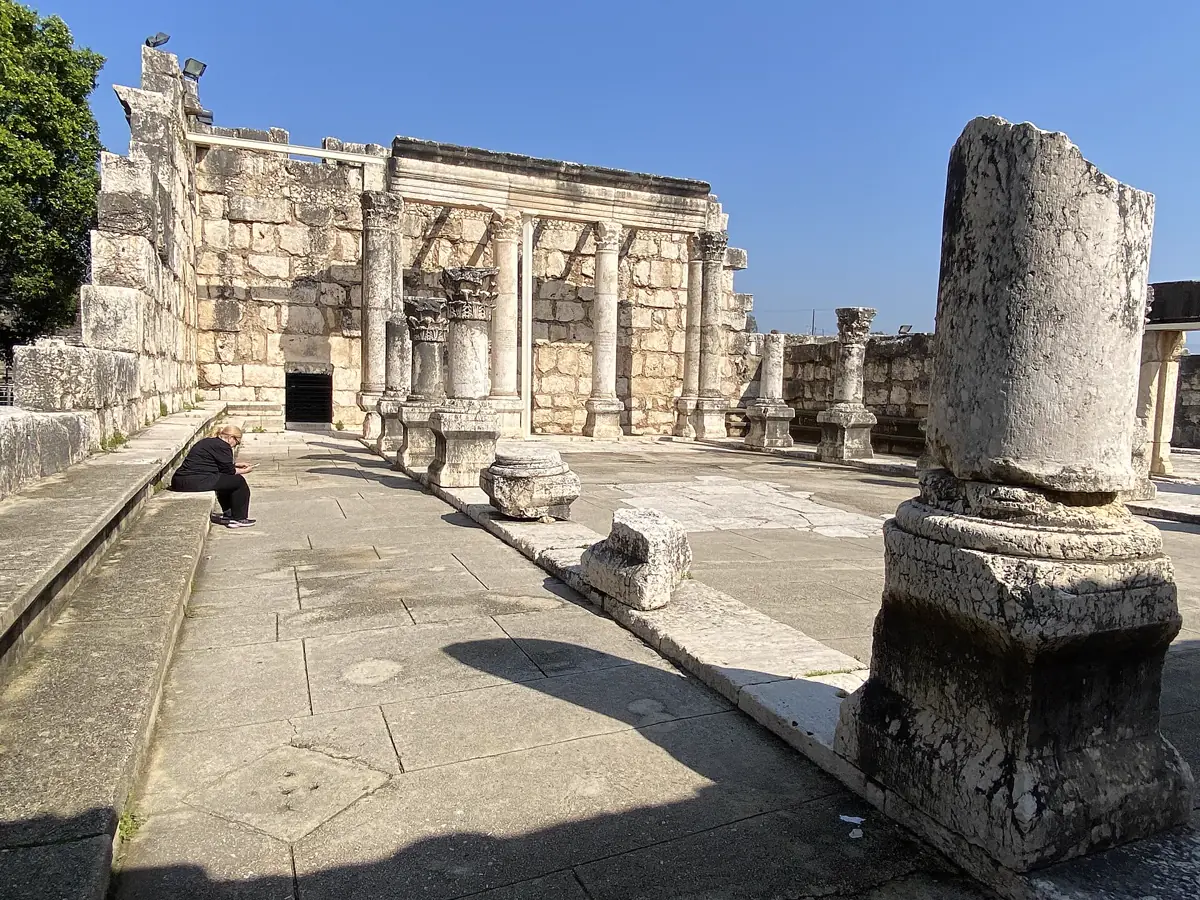
Hellenistic and Herodian clay oil lamps — the ordinary household light of the world the Gospels describe.Gary Todd · CC0A simple clay oil lamp of the Roman era — trimmed wick and ready oil, the small daily disciplines behind Jesus’ parable of the ten virgins.Johann H. Addicks · CC BY-SA 3.0The synagogue at Capernaum, standing on the black-basalt foundations of the 1st-century hall where Jesus taught.שלמה רודד · CC BY 2.5
What "church" means
The English word "church" in the King James New Testament translates the Greek ekklesia (Strong's G1577), a word used in ordinary Greek for an assembly of citizens called together. Luke uses it in exactly that ordinary sense of the crowd in the theatre at Ephesus: "the assembly was confused" (Acts 19:32).1 In its Christian use it never means a building. It means the people of God, either all of them together — "upon this rock I will build my church; and the gates of hell shall not prevail against it" (Matthew 16:18) — or the believers of one place gathered together.
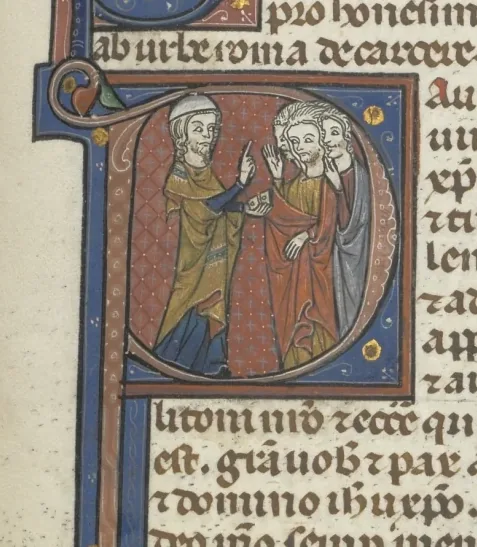
A thirteenth-century Bible page from southern France opening the letter to Philemon, its initial showing Paul addressing three men, a letter to a church that met in a house.Fol. 459r, Philemon, historiated initial P, Paul addressing three men and Hebrews, historiated initial M, Paul seated at a desk, writing · c. 1275–1300 · Cleveland Museum of Art · CC0 · full page · museum record · Galeria Regni
That is why Paul can speak in one chapter of "the church of God" as a whole and in the next of "the church that is in their house". The church in the house was not a branch office. It was the church, assembled in a particular place.
Jerusalem: the upper room and every house
The church began in a house. After the ascension the apostles "went up into an upper room", where "These all continued with one accord in prayer and supplication, with the women, and Mary the mother of Jesus, and with his brethren" (Acts 1:13-14).
After Pentecost the believers in Jerusalem used two kinds of place. "And they, continuing daily with one accord in the temple, and breaking bread from house to house, did eat their meat with gladness and singleness of heart" (Acts 2:46). The temple courts gave them room for the crowds and for public preaching; the homes gave them room for the breaking of bread. Luke repeats the pattern: "And daily in the temple, and in every house, they ceased not to teach and preach Jesus Christ" (Acts 5:42).
The houses were also where persecution found them. "As for Saul, he made havock of the church, entering into every house, and haling men and women committed them to prison" (Acts 8:3). When Peter was released from prison, he knew where to go: "he came to the house of Mary the mother of John, whose surname was Mark; where many were gathered together praying" (Acts 12:12). Notice his instruction as he left: "Go shew these things unto James, and to the brethren" (Acts 12:17). There were other believers meeting elsewhere. Jerusalem's church was one church in many houses.
Philippi: Lydia's house
In Philippi the first convert in Europe was a businesswoman. "And when she was baptized, and her household, she besought us, saying, If ye have judged me to be faithful to the Lord, come into my house, and abide there" (Acts 16:15). The jailer's household followed: "And when he had brought them into his house, he set meat before them, and rejoiced, believing in God with all his house" (Acts 16:34). When Paul and Silas were released, "they went out of the prison, and entered into the house of Lydia: and when they had seen the brethren, they comforted them, and departed" (Acts 16:40). The brethren were gathered there. Lydia's house had become the meeting place of the church in Philippi.
Corinth: Justus, Stephanas, Chloe and Gaius
In Corinth Paul preached first in the synagogue. When he was opposed, "he departed thence, and entered into a certain man's house, named Justus, one that worshipped God, whose house joined hard to the synagogue" (Acts 18:7). Paul later names other Corinthian households: "I baptized also the household of Stephanas" (1 Corinthians 1:16), and he had news "by them which are of the house of Chloe" (1 Corinthians 1:11).
Writing to Rome from Corinth, Paul passes on the greeting of "Gaius mine host, and of the whole church" (Romans 16:23). The phrase "the whole church" suggests that there were times when all the believers of Corinth met together in one house, Gaius's, as well as times when they met in smaller households. It also explains the problems of 1 Corinthians 11. Paul writes, "When ye come together therefore into one place, this is not to eat the Lord's supper" (1 Corinthians 11:20), because the wealthier members were eating their own meals first and the poor were going hungry. A house church can reproduce the class divisions of the world in its own dining room. Paul's answer is blunt: "Wherefore, my brethren, when ye come together to eat, tarry one for another" (1 Corinthians 11:33).
Ephesus: public and house to house
In Ephesus Paul used a lecture hall: when the synagogue turned hostile, "he departed from them, and separated the disciples, disputing daily in the school of one Tyrannus" (Acts 19:9). But he also reminded the Ephesian elders that he had "taught you publickly, and from house to house" (Acts 20:20). And Priscilla and Aquila, who had moved there from Corinth, again hosted a church: "Aquila and Priscilla salute you much in the Lord, with the church that is in their house" (1 Corinthians 16:19). It was this couple who took the gifted preacher Apollos aside: "they took him unto them, and expounded unto him the way of God more perfectly" (Acts 18:26). Their home was a place of correction and training as well as worship.
Rome: several households
The greetings of Romans 16 imply more than one gathering in Rome. Besides "the church that is in their house" (Romans 16:5), Paul greets "Asyncritus, Phlegon, Hermas, Patrobas, Hermes, and the brethren which are with them" and "Philologus, and Julia, Nereus, and his sister, and Olympas, and all the saints which are with them" (Romans 16:14-15). These read like groups gathered around particular people. Rome's believers, like Jerusalem's, were one church meeting in many homes. Years later, Luke ends Acts with Paul himself under house arrest, who "dwelt two whole years in his own hired house, and received all that came in unto him, Preaching the kingdom of God, and teaching those things which concern the Lord Jesus Christ, with all confidence, no man forbidding him" (Acts 28:30-31).
Colossae and Laodicea: Philemon and Nymphas
The letter to Philemon is addressed not only to a man but to a congregation: "unto Philemon our dearly beloved, and fellowlabourer, And to our beloved Apphia, and Archippus our fellowsoldier, and to the church in thy house" (Philemon 1:1-2). That matters for how we read it. Paul's request that Philemon receive his runaway slave Onesimus back "Not now as a servant, but above a servant, a brother beloved" (Philemon 1:16) was made in front of the church that met under Philemon's roof. The house church was the setting in which the gospel reordered a household.
In nearby Laodicea, Paul sends greeting to "Nymphas, and the church which is in his house" (Colossians 4:15).
What the evidence shows, and what it does not
Put together, the record is clear on several points.
Homes were normal. In every city we can see, believers met in houses, and the houses of particular believers became known as the meeting places of the church.
Homes were not the only places. The apostles also used the temple courts, synagogues while they were welcome, a rented lecture hall, and the open air. They used what was available for the work in hand.
A city's church could meet in several homes. Jerusalem, Corinth and Rome all show signs of this, and yet Paul still writes to "the church" of the city as one body.
Hosts mattered. Lydia, Priscilla and Aquila, Gaius, Philemon, Nymphas, Mary the mother of Mark: the hosts are named and honoured. Hospitality was a ministry: "Distributing to the necessity of saints; given to hospitality" (Romans 12:13).
And the record is silent on other points. The New Testament nowhere commands that churches must meet in homes, and nowhere forbids them to meet elsewhere. It gives no rule about size. It gives no order of service beyond the elements it names. So a believer may plant a house church with a clear conscience; but he may not tell another believer that a church in a building is disobedient. The location was never the point. As the Lord told the woman at the well, "the hour cometh, when ye shall neither in this mountain, nor yet at Jerusalem, worship the Father... But the hour cometh, and now is, when the true worshippers shall worship the Father in spirit and in truth" (John 4:21-23).
After the apostles
The second half of this part turns to history. It matters because the first readers of the New Testament left us their own descriptions of how they gathered, and because believers in later centuries returned to the house again and again, sometimes by choice and sometimes by force. Their experience can teach us what works and what goes wrong.
The Didache: the Lord's day and the table
The Didache, or Teaching of the Twelve Apostles, is an early Christian manual of instruction. It is not Scripture, and nothing in it binds a believer's conscience; but it is a witness to how some early Christians ordered their life together. Scholars date it variously, most often to the late first or early second century. It is short and plain:
But every Lord's day gather yourselves together, and break bread, and give thanksgiving after having confessed your transgressions, that your sacrifice may be pure. But let no one that is at variance with his fellow come together with you, until they be reconciled.
Two things stand out.2 The gathering was weekly, on the Lord's day, and it centred on the breaking of bread; and reconciliation came before worship. That second point is the Lord's own teaching (Matthew 5:23-24), and it is exactly what a small church in a home most needs. In a gathering of fifteen people, an unresolved quarrel cannot hide.
The same manual instructs the churches to "appoint for yourselves bishops and deacons worthy of the Lord, men meek, and not lovers of money", and to "reprove one another, not in anger, but in peace".3 It also gives a test for travelling teachers that every house church should remember: a visiting apostle who stays three days, or who asks for money, "is a false prophet".4
Pliny: before dawn, a hymn to Christ
Around AD 111–113, Pliny the Younger, the Roman governor of Bithynia in what is now northern Turkey, wrote to the Emperor Trajan asking how to deal with Christians. He had interrogated some who had abandoned the faith, and he reported what they said they used to do:
they were accustomed to meet on a fixed day before dawn and sing responsively a hymn to Christ as to a god, and to bind themselves by oath, not to some crime, but not to commit fraud, theft, or adultery, not falsify their trust, nor to refuse to return a trust when called upon to do so. When this was over, it was their custom to depart and to assemble again to partake of food — but ordinary and innocent food.
This is a hostile witness, which makes it valuable.5 The Christians met early, before the working day, which suggests that many of them were slaves or labourers who had no free time later. They sang to Christ "as to a god". They bound themselves to holy living. And they ate together. Pliny also says he tortured "two female slaves who were called deaconesses" and found "nothing else but depraved, excessive superstition", and that the faith had spread "not only to the cities but also to the villages and farms". These were ordinary people meeting wherever they could.
Justin Martyr: the order of a Sunday gathering
About forty years later, around the middle of the second century, Justin Martyr wrote a defence of the faith addressed to the emperor. In it he described what Christians did when they met:
And on the day called Sunday, all who live in cities or in the country gather together to one place, and the memoirs of the apostles or the writings of the prophets are read, as long as time permits; then, when the reader has ceased, the president verbally instructs, and exhorts to the imitation of these good things. Then we all rise together and pray, and, as we before said, when our prayer is ended, bread and wine and water are brought, and the president in like manner offers prayers and thanksgivings, according to his ability, and the people assent, saying Amen.
Justin goes on: those who are able give what they choose, and the collection is used to help "the orphans and widows and those who, through sickness or any other cause, are in want, and those who are in bonds and the strangers sojourning among us".6 Reading, teaching, prayer, the Lord's Supper, and giving for the needy. That is the whole of it. Nothing in Justin's account needs a building, and nothing in it is a novelty; it is Acts 2:42 a century later.
Tertullian: "the tried men of our elders preside"
Around AD 197 Tertullian of Carthage wrote his Apology. In chapter 39 he describes the Christian assembly: they pray together, read the Scriptures, exhort one another and exercise discipline. Then he adds a line that every house church leader should read twice:
The tried men of our elders preside over us, obtaining that honour not by purchase, but by established character. There is no buying and selling of any sort in the things of God.
He also says that gifts were voluntary, given monthly "if he likes", and spent not on feasts but "to support and bury poor people", to help orphans, the elderly, the shipwrecked and those imprisoned for their faith.7 Leadership by proven character, money given freely and spent on mercy: these were marks of the church long before anyone owned a church building.
Dura-Europos: a house made over for worship
One of the oldest Christian meeting places yet identified by archaeologists was found at Dura-Europos, a Roman garrison town on the Euphrates in what is now eastern Syria. A Yale and French excavation in the 1920s and 1930s uncovered a building, constructed around AD 232 and renovated for Christian worship around 234, with figural wall paintings. It stayed in use until about 254–256, when the Sasanian Persians besieged the city.8
It has long been called the classic example of a domus ecclesiae, a house adapted to become a church. Honesty requires a note here. In 2024 two researchers argued that after its renovation the building was "almost certainly not domestic in form or function", and that the label may be misleading.8 The debate is live. What is not in debate is that Christians in the third century were adapting existing buildings for worship, step by step, as they were able. The path from the living room to the purpose-built church was gradual, and it ran through a long period when the line between "house" and "church" was blurred.
After Constantine
When persecution ended in the early fourth century and the emperors began to favour the church, large public basilicas were built in the major cities. Most Christians from then on met in church buildings. That change brought real gains — room for the crowds, public visibility, stability — and real losses, as the gathering grew more distant from the household and more dependent on clergy. It did not make the earlier churches less than churches, and it did not make the later ones unfaithful merely because they had walls of their own.
Spener and the "assemblies of piety"
In the seventeenth century, a Lutheran pastor in Frankfurt, Philipp Jakob Spener, began in 1670 to host a group in his home: every Sunday and Wednesday evening some fifteen to twenty men met with him in his study, and the group soon grew to fifty and then a hundred. In 1675 he published Pia Desideria ("Pious Desires"), which proposed, among other reforms, "more extensive use of the Word of God among us", the exercise of the priesthood of all believers, and the conviction that "Christianity consists rather of practice" than of knowledge alone.9
Spener did not leave his church to do this. He urged renewal from within the state church, and his small meetings were meant to renew the congregation, not replace it. That is worth noting, because it shows a second way to use a home: not as a separate church, but as a gathering within a church. Many readers of this paper will be called to that, rather than to planting.
Bunyan and the Conventicle Acts
In England after the Restoration of 1660, meetings for worship outside the Church of England were outlawed. The Conventicle Act of 1664 made it an offence to attend a religious meeting "where there shall be five persons or more assembled together over and above those of the same Household".10 In other words, the law reached straight into the living room.
Even before that Act, John Bunyan was arrested under the older laws. In his own account, he had been asked by friends to come and teach at Samsell, near Harlington in Bedfordshire, and on 12 November 1660 a warrant was issued and the meeting was watched; he was taken as he began.11 He refused to promise to stop preaching, and he spent most of the next twelve years in Bedford jail, where he wrote much of what we still read. The house church, for Bunyan, was not a lifestyle choice. It was the price of obeying God rather than men: "We ought to obey God rather than men" (Acts 5:29).
Wesley's classes
In the eighteenth century, John Wesley organised the Methodist societies into small groups called classes. The General Rules, first published in 1743, explain it (in the form the United Methodist Church still prints them): each society "is divided into smaller companies, called classes, according to their respective places of abode. There are about twelve persons in a class, one of whom is styled the leader." The leader was to see each person "once a week at least" in order "to inquire how their souls prosper" and "to advise, reprove, comfort or exhort, as occasion may require".12
The class meeting was not a church in itself, but it was the engine of the revival's pastoral care. Its genius was simple: a small number, a named leader, a weekly meeting, and one question asked honestly — how is it with your soul? A house church that does nothing else well should do that.
China: worship at home under pressure
In the twentieth century the house church returned to the centre of the story in China. After the Communist victory of 1949 the government organised the Protestant churches under the Three-Self Patriotic Movement. The Beijing pastor Wang Mingdao refused to join its committee and was arrested in 1955. As the sociologist Fenggang Yang notes, his arrest coincided with many Christians leaving Three-Self churches to hold Sunday worship and prayer meetings in private homes, and through the hardest years of the Mao era the faith survived through worship and prayer in homes, caves, woods and fields.13
What history teaches
Four lessons stand out from this long record.
The house is where the church goes when it has to. Under Pliny, under the Conventicle Acts, under Mao, believers gathered in homes because the alternative was not to gather at all. Those of us who are free should hold that freedom humbly and pray for those who are not.
The house is where renewal often starts. Spener's study and Wesley's classes were small gatherings that strengthened the wider church. A house church need not set itself against other churches.
The pattern is always the same. Scripture read, Christ preached, prayer, the Lord's Supper, care for the needy, holy living, and leaders of proven character. From the Didache to Wesley, the elements are those of Acts 2:42.
The weaknesses are always the same, too. Division at the table (Corinth), leaders who love money (the Didache's warning), and isolation from the wider body. We will meet all three again.
Part 2 — Is It a Church? What Makes a Gathering a Church
4 min read
This part matters because the most important question about a house church is not where it meets but whether it is a church at all. A Bible study in a home is a good thing. So is a prayer meeting or a family worship time. But none of those is the same as a church, and treating them as if they were has led many sincere believers into confusion.
Luke's summary of the first church is the best place to start: "Then they that gladly received his word were baptized: and the same day there were added unto them about three thousand souls. And they continued stedfastly in the apostles' doctrine and fellowship, and in breaking of bread, and in prayers" (Acts 2:41-42).
Notice the order. First the word received, then baptism, then a life together marked by four things: the apostles' doctrine, the fellowship, the breaking of bread, and the prayers. A church is a company of baptized believers who continue steadfastly in those four. Leave one out and something essential is missing.
The Word preached and the ordinances kept
At the Reformation, Protestant churches had to answer the question "What is a true church?" under great pressure. Their answers are not Scripture, but they summarise it well. The Augsburg Confession of 1530 says: "The Church is the congregation of saints, in which the Gospel is rightly taught and the Sacraments are rightly administered."14 The Church of England's Articles say that "The visible Church of Christ is a congregation of faithful men, in the which the pure Word of God is preached, and the Sacraments be duly ministered according to Christ's ordinance".15 The Belgic Confession of 1561 adds a third mark: the true church "practices church discipline for correcting faults".16
Whatever tradition you come from, those three marks are a fair test for a house church. Is the Word of God preached faithfully and in full? Are baptism and the Lord's Supper kept as Christ gave them? Is there loving, biblical discipline when a member falls into open sin? If the answer to any of these is no, you have a fellowship, but not yet a church.
Leaders
The New Testament churches had recognised leaders. Paul and Barnabas, on their first journey, "ordained them elders in every church, and had prayed with fasting" (Acts 14:23). Paul left Titus in Crete to "set in order the things that are wanting, and ordain elders in every city, as I had appointed thee" (Titus 1:5). He wrote to the Philippians "with the bishops and deacons" (Philippians 1:1). The words "elder" and "bishop" (overseer) describe the same office (compare Titus 1:5 and 1:7).
A gathering where no one is recognised as responsible for teaching and shepherding is not more spiritual for it. It is only more vulnerable. Part 5 says more about what elders do and how they are chosen.
Members who know they belong
The New Testament assumes that a church knows who its people are. Paul can tell the Corinthians to "put away from among yourselves that wicked person" (1 Corinthians 5:13), which assumes there is an "among yourselves" to put him out of. The Lord's instruction in Matthew 18 ends with "tell it unto the church" (Matthew 18:17), which assumes there is a definite church to tell. A house church should be clear about who belongs, and what belonging means.
Mission
A church that does not reach outward is not living as the church the Lord built. "Go ye into all the world, and preach the gospel to every creature" (Mark 16:15). That verse belongs to the closing passage of Mark, which stands in the 1611; some modern versions set it apart, and you can see where they differ at kylelauriano.com/library/changes. The house churches of Acts were missionary from the start: Lydia's house became the base of the church in Philippi; Justus's house next to the synagogue became the base of the work in Corinth. A house church must ask from its first week: who in our street, our workplaces and our families has not yet heard?
Connected to the wider body
The New Testament churches were not islands. When a doctrinal crisis arose in Antioch, "they determined that Paul and Barnabas, and certain other of them, should go up to Jerusalem unto the apostles and elders about this question" (Acts 15:2), and "the apostles and elders came together for to consider of this matter" (Acts 15:6). Paul himself sought the fellowship of the Jerusalem leaders, who "gave to me and Barnabas the right hands of fellowship" (Galatians 2:9). The churches greeted each other: "The churches of Christ salute you" (Romans 16:16).
A house church that answers to no one beyond its own living room has cut itself off from the safeguard the apostles themselves used. Part 3 suggests some ways to stay connected.
A test of motives
Before going further, every would-be planter should ask honestly why he wants to do this. Some motives are good: a burden for a neighbourhood with no faithful church; a desire for deeper fellowship and discipleship; a call to reach people who would never walk into a church building; persecution or distance that makes other gatherings impossible.
Some motives are poor: anger at a former church; a wish to be the leader at last; a dislike of accountability; a hope that a small group will be easier to control. Paul's warning to the Ephesian elders applies: "Also of your own selves shall men arise, speaking perverse things, to draw away disciples after them" (Acts 20:30). If you recognise yourself in the second list, deal with that before the Lord first. A church planted in bitterness will grow bitterness.
Part 3 — Before You Begin: Calling, Character and Counsel
5 min read
This part matters because the Lord's warning about building applies here: "For which of you, intending to build a tower, sitteth not down first, and counteth the cost, whether he have sufficient to finish it?" (Luke 14:28). Many house churches begin with enthusiasm and end within a year in exhaustion or division. Most of those endings could have been foreseen.
Calling
The church at Antioch did not send out its first missionaries on a whim. "As they ministered to the Lord, and fasted, the Holy Ghost said, Separate me Barnabas and Saul for the work whereunto I have called them. And when they had fasted and prayed, and laid their hands on them, they sent them away" (Acts 13:2-3). Three things were present: an inward call, the recognition of the church, and a sending with prayer.
A believer who senses a call to plant a house church should look for the same three. Is there a settled burden that has not faded with time? Do mature believers who know you well recognise the call and the gifts? Is there a church willing to pray over you and send you, or at least to bless and counsel you? A call that only you can see is not yet a call that should gather other people's families.
Character
The qualifications Paul gives for elders are mostly about character, not talent: "A bishop then must be blameless, the husband of one wife, vigilant, sober, of good behaviour, given to hospitality, apt to teach; Not given to wine, no striker, not greedy of filthy lucre; but patient, not a brawler, not covetous; One that ruleth well his own house, having his children in subjection with all gravity; (For if a man know not how to rule his own house, how shall he take care of the church of God?) Not a novice, lest being lifted up with pride he fall into the condemnation of the devil. Moreover he must have a good report of them which are without; lest he fall into reproach and the snare of the devil" (1 Timothy 3:2-7).
In a house church the phrase "ruleth well his own house" is not a figure of speech. The church will be meeting in his house. His marriage, his children and his temper will be on display every week. If the home is not in order, the church in it will not be either.
Note also "Not a novice". A new believer, however zealous, should not lead a church. The danger Paul names is pride. A man who has been a Christian for a year and finds himself the leader of a congregation is in great danger, and so are the people he leads.
Doctrine
An elder must be "Holding fast the faithful word as he hath been taught, that he may be able by sound doctrine both to exhort and to convince the gainsayers" (Titus 1:9). Before you plant, write down what you believe. Not a long document, but a clear one: Scripture as the inspired and final authority; one God in three persons; the full deity and humanity of Christ; His atoning death and bodily resurrection; salvation by grace through faith; repentance; baptism and the Lord's Supper; the return of Christ and the judgment. Then ask an experienced pastor to read it. If you cannot write it, you are not ready to teach it.
Counsel
"Where no counsel is, the people fall: but in the multitude of counsellors there is safety" (Proverbs 11:14). The single best protection for a new house church is a relationship with an established, sound church and its elders. That might mean being sent out by your current church as a plant. It might mean an agreement that its elders will counsel you, hear concerns about you, and help in a crisis. It might mean joining with other house churches in a fellowship of mutual oversight, as Jerusalem's and Rome's house churches were one church in their cities.
Whatever shape it takes, settle it before you begin: who can correct the leader? If the answer is "no one", stop.
What churches differ on
Faithful churches differ on some questions of order, and a house church will have to decide where it stands: on the government of the church, and on the roles of men and women in the gathering. On baptism, Part 4 sets out what the King James texts themselves say; let them speak. On the roles of men and women, Scripture should be quoted plainly and not explained away. Paul wrote, "Let your women keep silence in the churches: for it is not permitted unto them to speak; but they are commanded to be under obedience, as also saith the law. And if they will learn any thing, let them ask their husbands at home: for it is a shame for women to speak in the church" (1 Corinthians 14:34-35), and "Let the woman learn in silence with all subjection. But I suffer not a woman to teach, nor to usurp authority over the man, but to be in silence" (1 Timothy 2:11-12). The same letters also honour women like Priscilla, Phebe — "a servant of the church which is at Cenchrea" (Romans 16:1) — and the aged women who are to be "teachers of good things" to the younger (Titus 2:3). Churches apply these texts in different ways. A house church must study them, decide, write its position down, and tell people before they join.
The core
Most healthy house churches begin with a small core: two or three families, or a handful of mature believers, who share the vision, agree on doctrine, and are willing to carry the work together. Choose them for faithfulness rather than enthusiasm: "Moreover it is required in stewards, that a man be found faithful" (1 Corinthians 4:2).
Before you open the door to anyone else, spend some weeks together as that core. Pray. Read a book of the Bible together. Eat together. Talk honestly about expectations: how often you will meet, where, who will teach, what you will do with children, what happens if you disagree. These conversations are dull compared to the excitement of launching. They are the foundation.
Prayer and fasting
The first elders were appointed "with fasting" (Acts 14:23), and the first missionaries were sent out after fasting and prayer (Acts 13:3). There is no formula here and no promised outcome. But a work that begins on its knees begins in the right posture: "Except the LORD build the house, they labour in vain that build it" (Psalm 127:1).
Part 4 — The Gathering: Word, Prayer, Supper and Song
8 min read
This part matters because what happens when the church gathers shapes everything else. A house church has great freedom in how it orders its meeting, and that freedom is easily wasted. Paul's two rules for the Corinthian gatherings are the frame for everything here: "Let all things be done unto edifying" (1 Corinthians 14:26) and "Let all things be done decently and in order" (1 Corinthians 14:40).
Participation and order
Paul describes a lively gathering: "How is it then, brethren? when ye come together, every one of you hath a psalm, hath a doctrine, hath a tongue, hath a revelation, hath an interpretation. Let all things be done unto edifying" (1 Corinthians 14:26). In a small church, more people can take part than in a large one. That is one of its strengths.
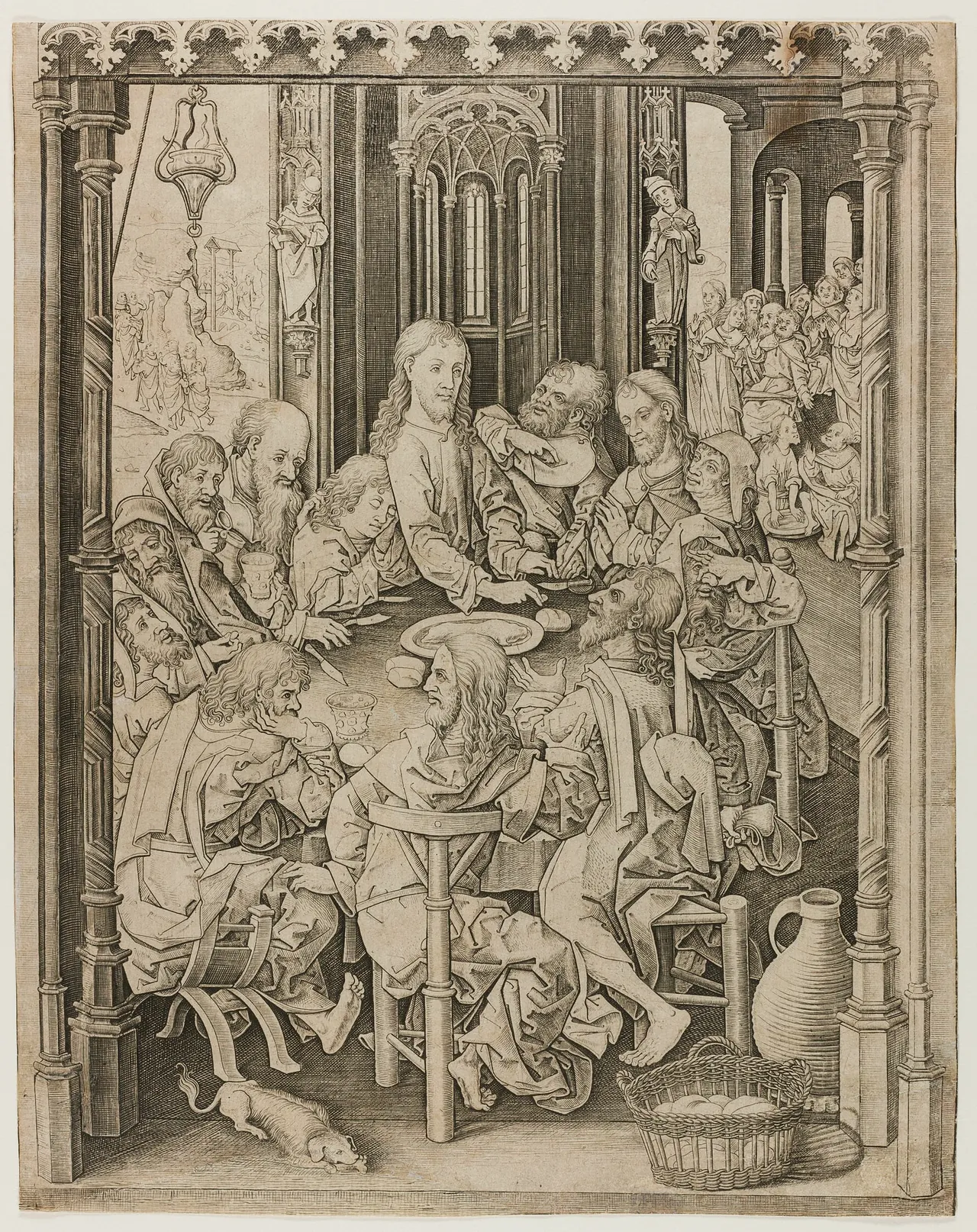
A Netherlandish engraving of about 1485 of the Last Supper, Christ at table with His disciples, the supper a house church still keeps when it gathers.The Last Supper · c. 1485 · Art Institute of Chicago · CC0 · museum record · Galeria Regni
But Paul's point in that chapter is not "anything goes". It is the opposite. Everything must build up the body, and "God is not the author of confusion, but of peace, as in all churches of the saints" (1 Corinthians 14:33). Participation must be ordered by the leaders. In practice, that means the elders know who is reading, who is teaching and who is leading in prayer, and they are ready to gently stop anything that does not edify.
The Scriptures read and taught
Paul told Timothy, "Till I come, give attendance to reading, to exhortation, to doctrine" (1 Timothy 4:13). Justin describes the same: the writings read "as long as time permits", then instruction and exhortation. A house church should read the Bible aloud, in good portions, every time it meets.
Then it should be taught. The best diet for most small churches is the steady teaching of whole books of the Bible, a passage at a time. That keeps the church from riding a leader's favourite themes, forces it to face the hard texts, and lets the Bible set the agenda. Topical studies have a place, but the backbone should be the text read in order.
Discussion is a gift of the small setting. After the teaching, people can ask questions, push back, and work out together what the passage requires of them. The Bereans are the model: "they received the word with all readiness of mind, and searched the scriptures daily, whether those things were so" (Acts 17:11). The teacher must welcome that searching, and the church must be willing to be corrected by what it finds.
Prayer
The first church "continued stedfastly... in prayers" (Acts 2:42), and when Peter was in prison "prayer was made without ceasing of the church unto God for him" (Acts 12:5). Prayer in a house church can be more personal than in a large gathering: people can name their needs, and others can pray for them by name. Give real time to it. Pray for the sick: "Is any sick among you? let him call for the elders of the church; and let them pray over him, anointing him with oil in the name of the Lord" (James 5:14). Pray for the authorities, as Tertullian's church did and as Paul commanded (1 Timothy 2:1-2). Pray for the lost by name.
The Lord's Supper
Paul delivered the Supper as he had received it: "That the Lord Jesus the same night in which he was betrayed took bread: And when he had given thanks, he brake it, and said, Take, eat: this is my body, which is broken for you: this do in remembrance of me. After the same manner also he took the cup, when he had supped, saying, This cup is the new testament in my blood: this do ye, as oft as ye drink it, in remembrance of me. For as often as ye eat this bread, and drink this cup, ye do shew the Lord's death till he come" (1 Corinthians 11:23-26).
The Supper is not a snack and not a private devotion. It is the church's shared proclamation of the Lord's death. It calls for self-examination — "let a man examine himself, and so let him eat of that bread, and drink of that cup" (1 Corinthians 11:28) — and for unity: "For we being many are one bread, and one body: for we are all partakers of that one bread" (1 Corinthians 10:17). That is why the Didache told those at odds with one another to be reconciled first.
How often, and who should lead it, are questions churches answer differently. The first believers in Troas came together "upon the first day of the week... to break bread" (Acts 20:7). Many house churches keep the Supper weekly, often with a shared meal, as the Corinthians did. Whatever you decide, keep it reverent, keep it simple, and let the elders oversee it.
Baptism
The Lord commanded, "Go ye therefore, and teach all nations, baptizing them in the name of the Father, and of the Son, and of the Holy Ghost" (Matthew 28:19). Peter preached, "Repent, and be baptized every one of you in the name of Jesus Christ for the remission of sins, and ye shall receive the gift of the Holy Ghost" (Acts 2:38). In Acts, baptism followed faith quickly, often the same day, and often at home or by the road: the jailer "was baptized, he and all his, straightway" (Acts 16:33). When the Ethiopian asked, "See, here is water; what doth hinder me to be baptized?", Philip answered, "If thou believest with all thine heart, thou mayest" (Acts 8:36-37). That verse stands in the 1611; many modern versions leave it out, and you can see where they part ways at kylelauriano.com/library/changes.
Here is what the King James texts themselves say about who was baptized and how. Set them side by side and read them slowly.
Belief and baptism together. "He that believeth and is baptized shall be saved; but he that believeth not shall be damned" (Mark 16:16). In Samaria: "But when they believed Philip preaching the things concerning the kingdom of God, and the name of Jesus Christ, they were baptized, both men and women" (Acts 8:12). In Corinth: "And many of the Corinthians hearing believed, and were baptized" (Acts 18:8).
Households. "And when she was baptized, and her household" (Acts 16:15). The jailer "was baptized, he and all his, straightway" (Acts 16:33), and Luke adds that he "rejoiced, believing in God with all his house" (Acts 16:34). "I baptized also the household of Stephanas" (1 Corinthians 1:16). In Corinth again: "And Crispus, the chief ruler of the synagogue, believed on the Lord with all his house" (Acts 18:8).
Water, going down and coming up. "And Jesus, when he was baptized, went up straightway out of the water" (Matthew 3:16). On the desert road: "And they went down both into the water, both Philip and the eunuch; and he baptized him. And when they were come up out of the water, the Spirit of the Lord caught away Philip" (Acts 8:38-39).
Buried and raised. "Therefore we are buried with him by baptism into death: that like as Christ was raised up from the dead by the glory of the Father, even so we also should walk in newness of life" (Romans 6:4). And to Colossae: "Buried with him in baptism, wherein also ye are risen with him through the faith of the operation of God, who hath raised him from the dead" (Colossians 2:12).
Without delay. "Can any man forbid water, that these should not be baptized, which have received the Holy Ghost as well as we? And he commanded them to be baptized in the name of the Lord" (Acts 10:47-48).
As history, not Scripture: the Didache, chapter 7, tells its readers to baptize "in living water", and allows other water, and even pouring water "thrice upon the head", when living water is not to be had.17 Churches since have practised baptism in more than one way. The texts above are what every church must answer to.
A house church will need to decide where and how it baptizes — a river, a pool, a bath — and who administers it. It should also make sure that baptism is a public act of the church, not a private event, and that the person baptized understands the gospel and is joining the body.
Singing
"Let the word of Christ dwell in you richly in all wisdom; teaching and admonishing one another in psalms and hymns and spiritual songs, singing with grace in your hearts to the Lord" (Colossians 3:16). Notice that singing is a form of teaching. What a church sings, it learns. Choose songs whose words are true and full. The great hymns of the church and the Psalms themselves are an inheritance; a house church with no musician can sing them unaccompanied, as believers did for most of history.
Giving and mercy
Justin and Tertullian both describe a collection taken for the needy. Paul told the Corinthians, "Upon the first day of the week let every one of you lay by him in store, as God hath prospered him" (1 Corinthians 16:2). A house church has few expenses, which frees it to give generously — to its own poor, to missionaries, to persecuted believers. Part 6 deals with handling money safely.
A sample order
There is no required order of service. But here, as an illustration only, is one shape that many small churches have found workable for a meeting of about two hours, built on the elements above:
| Part | What happens | Time | |---|---|---| | Welcome and meal | Eat together; greet newcomers; children with their parents | 30–40 min | | Singing | Two or three hymns or psalms | 10–15 min | | Scripture reading | A full passage read aloud by a member | 5–10 min | | Teaching | An elder teaches the passage | 25–35 min | | Discussion | Questions and application | 15–20 min | | Prayer | Needs shared; prayer for one another and the lost | 15–20 min | | The Lord's Supper | Self-examination, the words of institution, bread and cup | 10 min |
Adjust it to your people. A church with many small children will need a shorter teaching time. A church in a hostile setting may need to be quieter and briefer. What matters is that the Word, prayer, the Supper and fellowship are all there, and that the meeting builds up the body.
Children
"Suffer the little children to come unto me, and forbid them not: for of such is the kingdom of God" (Mark 10:14). Children are part of the household of faith, and in a house church they will be present in a way they are not in many larger churches. That is a gift. Let them hear the Scripture read and see their parents pray. Many house churches keep children with their families for most of the meeting and provide something simple for the youngest during the teaching. If you do separate them, Part 6's safeguards apply without exception.
Hospitality
The host family carries a real burden. "Use hospitality one to another without grudging" (1 Peter 4:9). Share the load. Rotate the cooking and cleaning. Do not let the host's home become the host's prison. If the church outgrows one family's capacity, that is a sign to plan for multiplication (Part 7), not to wear the host out.
Part 5 — Shepherding: Leaders, Order, Care and Discipline
5 min read
This part matters because small churches live or die by the quality of their shepherding. In a large church a poor leader can be absorbed by the structure around him. In a house church there is no structure around him. Everything depends on whether the leaders are faithful.
What elders do
Peter's charge to the elders is the job description: "Feed the flock of God which is among you, taking the oversight thereof, not by constraint, but willingly; not for filthy lucre, but of a ready mind; Neither as being lords over God's heritage, but being ensamples to the flock" (1 Peter 5:2-3).
Feed: teach the Word. Take the oversight: watch over the people's souls, "for they watch for your souls, as they that must give account" (Hebrews 13:17). Willingly, not for money, not as lords, but as examples. Paul adds that elders guard the flock from false teachers: "Take heed therefore unto yourselves, and to all the flock, over the which the Holy Ghost hath made you overseers, to feed the church of God, which he hath purchased with his own blood. For I know this, that after my departing shall grievous wolves enter in among you, not sparing the flock" (Acts 20:28-29).
More than one
The New Testament speaks of elders in the plural: "elders in every church" (Acts 14:23). There is wisdom in this beyond the text itself. A single leader has no one to check him, no one to share the burden, and no one to step in when he is sick or fails. Where possible, a house church should be led by at least two men who meet the qualifications. If at first there is only one, he should be accountable to elders of another church until others are raised up.
Raising up leaders
"And the things that thou hast heard of me among many witnesses, the same commit thou to faithful men, who shall be able to teach others also" (2 Timothy 2:2). From its first month, a house church should be training its next leaders. Give faithful men responsibility in small things — reading, leading prayer, teaching a short passage — and give them honest feedback. But do not rush: "Lay hands suddenly on no man, neither be partaker of other men's sins" (1 Timothy 5:22). Deacons too "let these also first be proved; then let them use the office of a deacon, being found blameless" (1 Timothy 3:10).
The danger of Diotrephes
John's third letter names a man every house church should fear becoming: "I wrote unto the church: but Diotrephes, who loveth to have the preeminence among them, receiveth us not. Wherefore, if I come, I will remember his deeds which he doeth, prating against us with malicious words: and not content therewith, neither doth he himself receive the brethren, and forbiddeth them that would, and casteth them out of the church" (3 John 1:9-10).
Notice what Diotrephes did. He loved to be first. He rejected outside apostolic authority. He spoke maliciously against those who might correct him. He controlled who could come in, and he threw out those who disagreed. Every one of those sins is easier in a small, isolated church. The safeguards are the ones already named: more than one elder, real accountability beyond the house, and a congregation taught to "Prove all things; hold fast that which is good" (1 Thessalonians 5:21).
Respecting leaders
The other side is also in Scripture. "And we beseech you, brethren, to know them which labour among you, and are over you in the Lord, and admonish you; And to esteem them very highly in love for their work's sake. And be at peace among yourselves" (1 Thessalonians 5:12-13). Faithful elders in a house church often work a full-time job and then shepherd a church in their evenings. They deserve honour and, where they labour in teaching, support: "Let the elders that rule well be counted worthy of double honour, especially they who labour in the word and doctrine" (1 Timothy 5:17). And they deserve protection from careless accusation: "Against an elder receive not an accusation, but before two or three witnesses" (1 Timothy 5:19).
Conflict
Conflict will come. The Lord gave a clear process: "Moreover if thy brother shall trespass against thee, go and tell him his fault between thee and him alone: if he shall hear thee, thou hast gained thy brother. But if he will not hear thee, then take with thee one or two more, that in the mouth of two or three witnesses every word may be established. And if he shall neglect to hear them, tell it unto the church: but if he neglect to hear the church, let him be unto thee as an heathen man and a publican" (Matthew 18:15-17).
Most conflicts end at the first step if the first step is taken in humility. The danger in small churches is that people skip the first step and go straight to talking with everyone else. Teach Matthew 18 early, before there is a conflict, so that everyone knows the way.
Restoring the fallen
"Brethren, if a man be overtaken in a fault, ye which are spiritual, restore such an one in the spirit of meekness; considering thyself, lest thou also be tempted" (Galatians 6:1). The aim of all church discipline is restoration. Most discipline is quiet: a word in private, an honest conversation, prayer together.
But Scripture does not shrink from the last step. Paul told the Corinthians not to keep company with "any man that is called a brother" who is living in open, unrepentant sin, and to "put away from among yourselves that wicked person" (1 Corinthians 5:11, 13). This is the hardest thing a church does, and a house church will feel it more sharply, because the person removed is someone who has sat at your table. Do it only after Matthew 18 has been followed, only with the counsel of the elders and, ideally, of your outside counsellors, and always with the door open for repentance.
Dominant personalities
Small groups are easily dominated by one talker. The leaders must gently but firmly guard the room so that others can speak. Take the person aside; thank him for his zeal; ask him to help draw others out. If he will not, the leaders must direct the discussion. "Let nothing be done through strife or vainglory; but in lowliness of mind let each esteem other better than themselves" (Philippians 2:3).
Burnout
The leaders of a house church carry the teaching, the pastoral care, the hosting and often the administration, on top of their jobs and families. The early church solved a similar problem by appointing others: "Wherefore, brethren, look ye out among you seven men of honest report, full of the Holy Ghost and wisdom, whom we may appoint over this business" (Acts 6:3). Share the work. Raise up deacons to handle practical needs. Take breaks. A leader who never rests is not showing great faith; he is showing poor stewardship.
This part matters because a house church can be wrecked by things that have nothing to do with doctrine: missing money, an angry neighbour, a lawsuit, or — worst of all — a child harmed on its watch. Paul's principle is the standard: "Providing for honest things, not only in the sight of the Lord, but also in the sight of men" (2 Corinthians 8:21). What follows is general information for readers in the United States, current as of October 2026; it is not legal or tax advice. Laws differ between states, counties, cities and countries, and they change. To find the rule where you live, call your city or county zoning or planning office, read your lease or homeowners' association rules, ask your insurer, read the IRS's own pages at irs.gov, and take advice from a qualified professional where you can.
Money
The Didache warned that a teacher who asks for money is a false prophet. Tertullian boasted that in the church "There is no buying and selling of any sort in the things of God". A house church should be able to say the same.
Practical safeguards:
Two people, always. Any money collected should be counted by two unrelated people and recorded the same day.
A separate account. Do not keep church money in a leader's personal account.
An open book. Report to the church regularly what came in and where it went.
Give it away. With few expenses, a house church can give most of what it collects to the needy, to missionaries and to the persecuted church, as the early churches did.
"For the love of money is the root of all evil: which while some coveted after, they have erred from the faith, and pierced themselves through with many sorrows" (1 Timothy 6:10).
Tax status
In the United States, the Internal Revenue Service's guide for churches states: "Churches that meet the requirements of IRC Section 501(c)(3) are automatically considered tax exempt and are not required to apply for and obtain recognition of tax-exempt status from the IRS." The same guide lists characteristics the IRS generally uses to decide whether a body is a church for tax purposes, including "regular congregations" and "regular religious services", and it states that the IRS "makes no attempt to evaluate the content of whatever doctrine a particular organization claims is religious".18
This paper gives no tax advice beyond what the IRS itself says. A house church that receives gifts, or handles significant sums, should read Publication 1828 for itself and take advice from a qualified professional. Among other things, the guide sets out the rules on political campaign activity that apply to every church.
Neighbours, zoning and the authorities
Paul wrote, "Let every soul be subject unto the higher powers" (Romans 13:1), and Peter wrote to believers under a pagan emperor, "Submit yourselves to every ordinance of man for the Lord's sake" (1 Peter 2:13). In a free country, that means being a good neighbour: keeping noise reasonable, not blocking driveways, and respecting any local rules on gatherings in homes. If your gathering grows large, find out what your city or county requires: call the zoning or planning office and ask whether regular religious meetings in a home need any permit, and check parking, occupancy and noise rules. If you rent, read your lease; if you live under a homeowners' association, read its rules. Rules vary widely from place to place, and this paper cannot tell you yours.
Scripture also shows the limit of that submission. When the authorities forbade the apostles to preach in Christ's name, they answered, "We ought to obey God rather than men" (Acts 5:29). Bunyan and Wang Mingdao went to prison on that principle. If you ever face that choice, face it with counsel and prayer, and accept the cost as they did. But do not manufacture a conflict with your neighbours and call it persecution.
"And seek the peace of the city whither I have caused you to be carried away captives, and pray unto the LORD for it: for in the peace thereof shall ye have peace" (Jeremiah 29:7).
Insurance
Ask your insurer whether your homeowner's or renter's policy covers regular gatherings in your home, and whether you need additional liability cover. This is a dull question. It is also the kind of thing a prudent man foresees: "A prudent man foreseeth the evil, and hideth himself: but the simple pass on, and are punished" (Proverbs 22:3).
Protecting children
The Lord's warning is the most severe in the Gospels: "But whoso shall offend one of these little ones which believe in me, it were better for him that a millstone were hanged about his neck, and that he were drowned in the depth of the sea" (Matthew 18:6). A house church must never be a place where a child is at risk. Small, informal, trusting settings are exactly where predators look for access. That is not a reason to fear; it is a reason for rules that apply to everyone.
Two adults, always. No adult is ever alone with a child who is not his own, in a closed room or out of sight. If children are taught separately, two approved adults are present, ideally from different families.
Know who serves. Anyone who works with children should be a known member of the church for some months first, and should pass a criminal background check before serving. Ask your insurer or your outside counsellors how to arrange one where you live.
Open doors and visible rooms. If children meet in another room, keep the door open or use a room within sight of the main gathering.
Bathrooms. Parents take their own children; set a clear rule for others.
Report, do not investigate. If anyone discloses abuse, or you have reasonable cause to suspect it, report it to the police or your state's child protective services. Do not try to handle it privately as a church matter. Every state has a law naming people who must report suspected child abuse; according to the federal Child Welfare Information Gateway (current through May 2023), about 29 states specifically name clergy, and in about 16 more any person who suspects abuse must report it.19 Learn the law where you live. In the United States the Childhelp National Child Abuse Hotline is 1-800-422-4453, available by call, text or chat 24 hours a day.20 If a child is in immediate danger, call 911.
Write these rules down, teach them to every adult, and enforce them without exception. A church that protects children well also protects the innocent from false accusation.
Privacy and safety for the vulnerable
Some who come to a house church will be fleeing danger — an abusive spouse, a hostile family, a former religious group. Be careful what you share about who attends and where you meet, especially online. Ask before posting photographs. A small church is a family, and families keep each other's confidences.
This part matters because a healthy church grows, and a house church that grows will soon outgrow the house. Planning for that from the beginning is the difference between multiplication and collapse.
The Lord gives the increase
"I have planted, Apollos watered; but God gave the increase. So then neither is he that planteth any thing, neither he that watereth; but God that giveth the increase" (1 Corinthians 3:6-7). We cannot manufacture growth. We can be faithful in the things that God uses — the Word, prayer, love and witness — and leave the increase to Him. In Jerusalem, "the Lord added to the church daily such as should be saved" (Acts 2:47). Luke is careful about who did the adding.
Health before size
Growth in numbers is not the only kind of growth, and it is not the most important. A church that is growing in the knowledge of God, in love for one another and in holiness is healthy even if it stays small for a long time. The Lord's rebuke to Ephesus is a warning to every busy church: "Nevertheless I have somewhat against thee, because thou hast left thy first love" (Revelation 2:4). And His test of a church is love: "By this shall all men know that ye are my disciples, if ye have love one to another" (John 13:35).
Witness through households
The house churches of Acts grew through households. Cornelius "had called together his kinsmen and near friends" when Peter came (Acts 10:24), and "While Peter yet spake these words, the Holy Ghost fell on all them which heard the word" (Acts 10:44). The Lord told the seventy to look for a house of peace: "And into whatsoever house ye enter, first say, Peace be to this house. And if the son of peace be there, your peace shall rest upon it" (Luke 10:5-6). The jailer's whole house heard the word that night (Acts 16:32).
A house church has a natural doorway for witness: the home itself. A neighbour who would never enter a church building may come to a meal. A family member who is suspicious of "organised religion" may sit in on a Bible reading. Encourage members to invite people to share a meal with the church, and make sure that when they come, the gospel is plainly present — not hidden for fear of offence, and not thrown at them, but there, in the reading, the teaching and the prayers. "For I am not ashamed of the gospel of Christ: for it is the power of God unto salvation to every one that believeth" (Romans 1:16).
When to multiply
Every house church has a practical limit — the size of the room, the capacity of the host, the number of people who can still know one another well. When a church approaches that limit, it has three choices: stop inviting people (which no church should choose), move to a larger venue (which changes its character), or multiply into two churches.
Multiplication works best when it is planned long in advance. Signs that a church is ready:
A second set of qualified leaders has been trained and proven.
A second host home is willing and able.
The church as a whole understands and supports the plan.
There is a clear relationship planned between the two churches afterwards.
Signs that it is not ready: the only reason is conflict; there are no proven leaders for the new group; or the original leader wants to keep control of both.
How to multiply
Talk about it from the start, so that when the time comes it feels like the fulfilment of a plan rather than a split. Pray together over the decision. Let people choose which group to join, with care that both groups have mature believers, and that families and friendships are respected. Send the new church out with prayer and the laying on of hands, as Antioch sent Barnabas and Saul (Acts 13:3). Meet together regularly afterwards — for a shared meal, a joint worship time, or a celebration — so the two remain one family.
A fellowship of house churches
Jerusalem, Corinth and Rome each had several house gatherings that were still one church. Today, house churches can do something similar by forming a fellowship: a group of house churches in one area that share elders' meetings, pray for one another, gather together from time to time, and hold each other accountable. Such a fellowship guards against isolation and Diotrephes alike. It also mirrors the way the first churches stayed connected: "Then had the churches rest throughout all Judaea and Galilee and Samaria, and were edified; and walking in the fear of the Lord, and in the comfort of the Holy Ghost, were multiplied" (Acts 9:31).
Three dangers to watch
Isolation. A house church that has no relationship with any other church will drift. Keep the connections described in Part 3.
Doctrinal drift. Small groups can slide into error without anyone noticing, especially if they follow a single teacher's enthusiasm. Return regularly to your written statement of faith. Invite outside teachers you trust. Read the whole Bible, not only the parts you like. Paul's word stands: "But though we, or an angel from heaven, preach any other gospel unto you than that which we have preached unto you, let him be accursed" (Galatians 1:8).
Pride. It is easy for a house church to begin to see itself as the only faithful church in town. That is the spirit of Diotrephes, and of every group that has told its members it alone is saved. Love the other churches in your city. Pray for them by name. Remember that the Lord who walks among the candlesticks (Revelation 2:1) sees all of them.
The church in the house is not a new idea. It is as old as the upper room. It was the ordinary setting of the apostolic churches, the refuge of persecuted believers from Pliny's Bithynia to Bunyan's Bedfordshire to Wang Mingdao's Beijing, and the seedbed of renewal in Spener's study and Wesley's classes.
But the house was never what made the church. The church was made by the Word received and believed, by baptism, by continuing steadfastly in the apostles' doctrine, the fellowship, the breaking of bread and the prayers, by leaders of proven character, by loving discipline, and by a gospel carried out the front door into the street. Those are the foundations. A house church built on them will stand. One built on frustration, novelty or the wish to be free of accountability will not, however warm the living room.
So if you sense this call, test it. Count the cost. Seek counsel. Write down what you believe. Gather a faithful core and pray. Protect the children. Keep the books open. Stay connected. Train the next leaders from the first month. And keep your eyes on the One who said, "where two or three are gathered together in my name, there am I in the midst of them" (Matthew 18:20).
A next step
If you are not ready to plant, you may be ready to host. Many churches need believers who will open their homes for a Bible study, a prayer meeting or a midweek fellowship under the oversight of their elders. That is how Spener began, and it may be how the Lord prepares you.
You will find related studies at kylelauriano.com/research, including Biblical Leadership, Raising Up Leaders and Discipling Others.
An invitation
If you have read this far and you are not yet a follower of Jesus, the most important house in this paper is not Priscilla's or Philemon's. It is the Father's house, and the door is open. The gospel is that "Christ died for our sins according to the scriptures; And that he was buried, and that he rose again the third day according to the scriptures" (1 Corinthians 15:3-4). And the promise stands: "Believe on the Lord Jesus Christ, and thou shalt be saved, and thy house" (Acts 16:31). Repent, believe, and be baptized. Then find a church, in a building or a living room, that will teach you the Word and walk with you. My story and the way to begin are at kylelauriano.com/about. Free truth, no pressure.
1James Strong, The Exhaustive Concordance of the Bible (New York: Hunt & Eaton; Cincinnati: Cranston & Curts, 1890), Greek Dictionary, no. 1577.↩
2The Didache, 14, trans. M. B. Riddle, in Ante-Nicene Fathers, vol. 7, ed. Alexander Roberts, James Donaldson and A. Cleveland Coxe (Buffalo, NY: Christian Literature Publishing Co., 1886). Online: https://www.newadvent.org/fathers/0714.htm.↩
5Pliny the Younger, Letters 10.96. English translation as given in "Pliny and Trajan on the Christians," https://faculty.georgetown.edu/jod/texts/pliny.html.↩
6Justin Martyr, First Apology, 67, trans. Marcus Dods and George Reith, in Ante-Nicene Fathers, vol. 1, ed. Alexander Roberts, James Donaldson and A. Cleveland Coxe (Buffalo, NY: Christian Literature Publishing Co., 1885). Online: https://www.newadvent.org/fathers/0126.htm.↩
7Tertullian, Apology, 39, trans. S. Thelwall, in Ante-Nicene Fathers, vol. 3 (Buffalo, NY: Christian Literature Publishing Co., 1885). Online: https://www.newadvent.org/fathers/0301.htm.↩
8"House call: New study rethinks early Christian landmark," Yale News, August 12, 2024, https://news.yale.edu/2024/08/12/house-call-new-study-rethinks-early-christian-landmark; reporting Camille Leon Angelo and Joshua Silver, "Debating the domus ecclesiae at Dura-Europos: The Christian Building in Context," Journal of Roman Archaeology 37, no. 1 (2024): 264–303, https://doi.org/10.1017/S1047759424000126.↩
9Christopher Gehrz, "Philipp Jakob Spener," Christian History, Christianity Today, April 26, 2019, https://www.christianitytoday.com/history/people/denominationalfounders/philipp-jakob-spener.html.↩
10"Charles II, 1664: An Act to prevent and suppresse seditious Conventicles," in Statutes of the Realm, vol. 5, 1625–80, ed. John Raithby (s.l., 1819), 516–520. Online: https://www.british-history.ac.uk/statutes-realm/vol5/pp516-520.↩
11John Bunyan, A Relation of the Imprisonment of Mr. John Bunyan (London: James Buckland, 1765). Online: https://johnbunyan.org/en/a-relation-of-the-imprisonment-of-mr-john-bunyan/.↩
12John Wesley, "The Nature, Design, and General Rules of the United Societies" (1743), as printed by the United Methodist Church, "The General Rules of the Methodist Church," https://www.umc.org/en/content/the-general-rules-of-the-methodist-church.↩
13Fenggang Yang, "Will Chinese House Churches Survive the Latest Government Crackdown?" Christianity Today, December 31, 2019, https://www.christianitytoday.com/2019/12/chinese-house-churches-survive-government-crackdown.↩
14The Augsburg Confession (1530), Article VII, "Of the Church," English translation as given at the Book of Concord website. Online: https://bookofconcord.org/augsburg-confession/of-the-church/.↩
15The Thirty-Nine Articles of Religion, Article XIX, "Of the Church," in The Book of Common Prayer (1662). Online: https://www.churchofengland.org/prayer-and-worship/worship-texts-and-resources/book-common-prayer/articles-religion.↩
16The Belgic Confession (1561), Article 29, "The Marks of the True Church," trans. Faith Alive Christian Resources (Grand Rapids: Christian Reformed Church in North America, 2011). Online: https://www.crcna.org/welcome/beliefs/confessions/belgic-confession.↩
18Internal Revenue Service, Tax Guide for Churches & Religious Organizations, Publication 1828 (Rev. 8-2015), 2, 33. This was still the current revision posted at irs.gov when checked in October 2026. https://www.irs.gov/pub/irs-pdf/p1828.pdf.↩
19Child Welfare Information Gateway, Clergy as Mandatory Reporters of Child Abuse and Neglect (Washington, DC: U.S. Department of Health and Human Services, Children's Bureau, 2023), 1–2, accessed October 2026, https://artifacts.childwelfare.gov/public/documents/clergy-mandated-reporters.pdf.↩
20Childhelp National Child Abuse Hotline, https://www.childhelphotline.org/; Childhelp, "Childhelp National Child Abuse Hotline," https://www.childhelp.org/hotline/. Both accessed October 2026.↩
Seven people who say they met Jesus. What happened, in their own words.
Seven testimonies from The King Is Coming Show, one a morning — the story as they tell it, the verse the story lands on in the 1611 King James, and the page itself. Then the teaching that explains it. Free.
This is practical teaching, not proof. It's drawn from Scripture and from walking this road myself. If you're still weighing the basics — whether God is real, whether the Bible can be trusted — I'd encourage you to start with the Skeptic resources in the Research Hub before diving in here.